Welcome
Maths in Year 3,4 5 and 6
Parents Information
Meeting
How we teach.
What’s different?
•
•
•
•
•
•

Interactive teaching
Emphasis on mental calculation
Different approach to written calculation
Maths through problem solving
We DO have text books!!
Maths is fun!
Our Aims
The aim is for children to do mathematics in
their heads, and if the numbers are too large,
to use pencil and paper to avoid losing track.

To do this children need to learn quick and
efficient methods, including appropriate
written and mental methods.
We want children to be
able to ask themselves
questions.

• Can I do this in my head?

• Can I do this in my head using drawings or
jottings?
• Do I need to use an expanded/compact written
method?
• Do I need a calculator?

•

Finally – is my answer sensible?
Key Skills Learnt in FS/Y1 and Y2
Children need to have a sound foundation in
Early Years and Year 1 and 2 maths to be able to
access the curriculum in Years 3,4,5 and 6
It is essential they know:
• Number bonds- two numbers that when
added together make 10, 20, 30 etc
• Times tables 2,5,10
• Adding multiples of 10 with ease
Place Value
Know the value of every digit that makes up a
number.
It’s essential to understanding all number
operations.
When the children move onto formal compact
calculations (as you are more familiar with) they
MUST have this knowledge so they can check for
sensible answers.
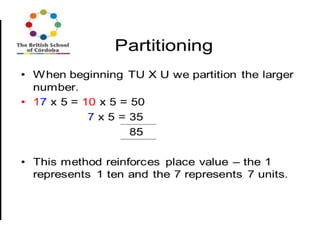
Partitioning
Once children understand place value they can
partition a number efficiently.
Partitioning of numbers is key to all the
strategies used in Primary maths.
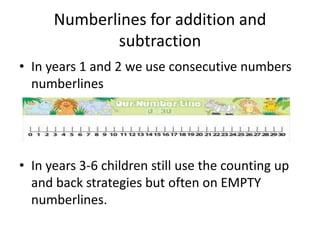
Numberlines for addition and
subtraction
• In years 1 and 2 we use consecutive numbers
numberlines

• In years 3-6 children still use the counting up
and back strategies but often on EMPTY
numberlines.
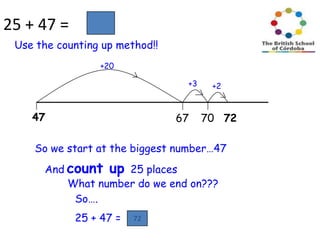
25 + 47 =
Use the counting up method!!
+20
+3

47

67

+2

70 72

So we start at the biggest number…47
And count up 25 places
What number do we end on???
So….

25 + 47 =

72
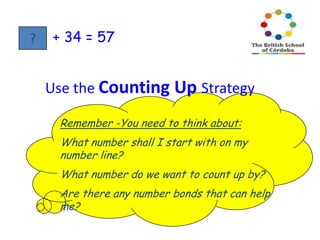
?

+ 34 = 57

Use the Counting Up Strategy
Remember -You need to think about:

What number shall I start with on my
number line?
What number do we want to count up by?

Are there any number bonds that can help
me?
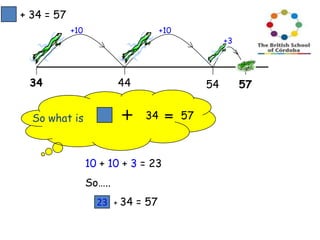
+ 34 = 57
+10

+10

34

+3

44

54
34

So what is

10 + 10 + 3 = 23

So…..
23

+

34 = 57

57

57
Children are taught to
understand subtraction as
taking away (counting back)
and finding the difference
(counting up).
Can I use the counting up strategy for
Subtraction too?
YES

Have a look at this question!
43 – 27 =

16

What number shall I start from on my number line?
What number do I want to get to?
What number shall count on by?
Can any number bond make counting on easier for me?
+10

27

10 + 3 + 3 = 16

+3

37

+3

40

43
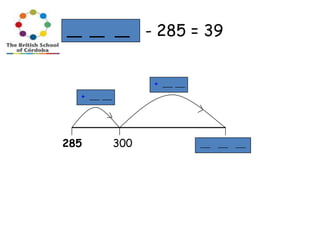
- 285 = 39
+

+

285

300
Addition and Subtraction toward an
efficient method
•Numberlines are a time
consuming method
•We need to look at more
efficient methods next
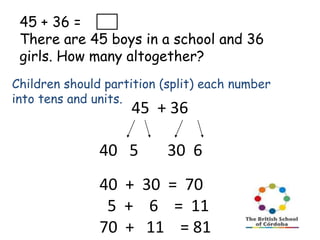
45 + 36 =
There are 45 boys in a school and 36
girls. How many altogether?
Children should partition (split) each number
into tens and units.

45 + 36

40 5

30 6

40 + 30 = 70
5 + 6 = 11
70 + 11 = 81
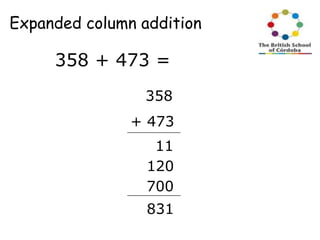
Expanded column addition

358 + 473 =
358
+ 473
11
120
700
831
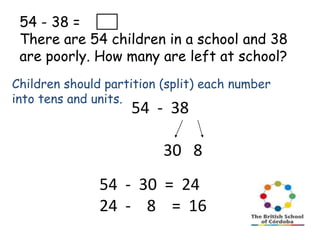
54 - 38 =
There are 54 children in a school and 38
are poorly. How many are left at school?
Children should partition (split) each number
into tens and units.

54 - 38

30 8
54 - 30 = 24
24 - 8 = 16
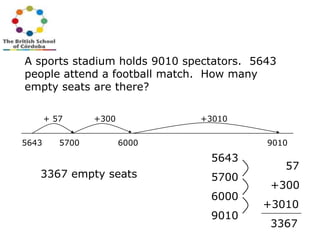
A sports stadium holds 9010 spectators. 5643
people attend a football match. How many
empty seats are there?
+ 57
5643

5700

+300

+3010
6000

9010

5643
3367 empty seats

5700

6000
9010

57
+300
+3010
3367
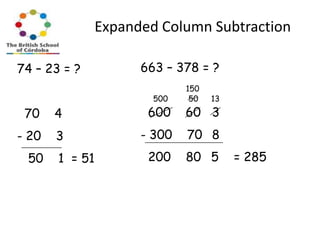
Expanded Column Subtraction
74 – 23 = ?

663 – 378 = ?
500

150
50

13

70

4

600

60 3

- 20

3

- 300

70 8

200

80 5

50

1 = 51

= 285
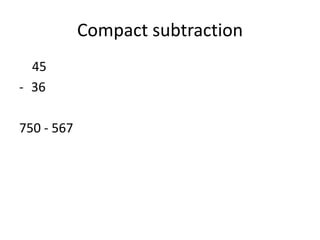
Compact subtraction
45
- 36
750 - 567
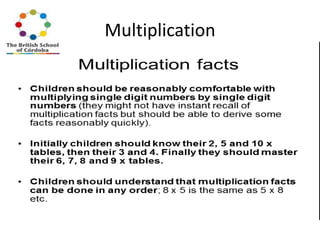
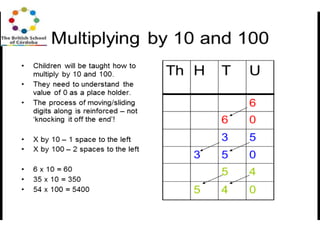
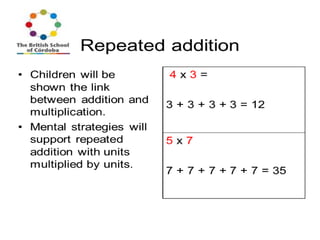
Multiplication
Division
Maths in year 3,4 5 and 6

Maths in year 3,4 5 and 6

  • 1.
    Welcome Maths in Year3,4 5 and 6 Parents Information Meeting
  • 2.
    How we teach. What’sdifferent? • • • • • • Interactive teaching Emphasis on mental calculation Different approach to written calculation Maths through problem solving We DO have text books!! Maths is fun!
  • 3.
    Our Aims The aimis for children to do mathematics in their heads, and if the numbers are too large, to use pencil and paper to avoid losing track. To do this children need to learn quick and efficient methods, including appropriate written and mental methods.
  • 4.
    We want childrento be able to ask themselves questions. • Can I do this in my head? • Can I do this in my head using drawings or jottings? • Do I need to use an expanded/compact written method? • Do I need a calculator? • Finally – is my answer sensible?
  • 5.
    Key Skills Learntin FS/Y1 and Y2 Children need to have a sound foundation in Early Years and Year 1 and 2 maths to be able to access the curriculum in Years 3,4,5 and 6 It is essential they know: • Number bonds- two numbers that when added together make 10, 20, 30 etc • Times tables 2,5,10 • Adding multiples of 10 with ease
  • 6.
    Place Value Know thevalue of every digit that makes up a number. It’s essential to understanding all number operations. When the children move onto formal compact calculations (as you are more familiar with) they MUST have this knowledge so they can check for sensible answers.
  • 7.
    Partitioning Once children understandplace value they can partition a number efficiently. Partitioning of numbers is key to all the strategies used in Primary maths.
  • 8.
    Numberlines for additionand subtraction • In years 1 and 2 we use consecutive numbers numberlines • In years 3-6 children still use the counting up and back strategies but often on EMPTY numberlines.
  • 9.
    25 + 47= Use the counting up method!! +20 +3 47 67 +2 70 72 So we start at the biggest number…47 And count up 25 places What number do we end on??? So…. 25 + 47 = 72
  • 10.
    ? + 34 =57 Use the Counting Up Strategy Remember -You need to think about: What number shall I start with on my number line? What number do we want to count up by? Are there any number bonds that can help me?
  • 11.
    + 34 =57 +10 +10 34 +3 44 54 34 So what is 10 + 10 + 3 = 23 So….. 23 + 34 = 57 57 57
  • 12.
    Children are taughtto understand subtraction as taking away (counting back) and finding the difference (counting up).
  • 13.
    Can I usethe counting up strategy for Subtraction too? YES Have a look at this question! 43 – 27 = 16 What number shall I start from on my number line? What number do I want to get to? What number shall count on by? Can any number bond make counting on easier for me? +10 27 10 + 3 + 3 = 16 +3 37 +3 40 43
  • 14.
    - 285 =39 + + 285 300
  • 15.
    Addition and Subtractiontoward an efficient method •Numberlines are a time consuming method •We need to look at more efficient methods next
  • 16.
    45 + 36= There are 45 boys in a school and 36 girls. How many altogether? Children should partition (split) each number into tens and units. 45 + 36 40 5 30 6 40 + 30 = 70 5 + 6 = 11 70 + 11 = 81
  • 17.
    Expanded column addition 358+ 473 = 358 + 473 11 120 700 831
  • 18.
    54 - 38= There are 54 children in a school and 38 are poorly. How many are left at school? Children should partition (split) each number into tens and units. 54 - 38 30 8 54 - 30 = 24 24 - 8 = 16
  • 19.
    A sports stadiumholds 9010 spectators. 5643 people attend a football match. How many empty seats are there? + 57 5643 5700 +300 +3010 6000 9010 5643 3367 empty seats 5700 6000 9010 57 +300 +3010 3367
  • 20.
    Expanded Column Subtraction 74– 23 = ? 663 – 378 = ? 500 150 50 13 70 4 600 60 3 - 20 3 - 300 70 8 200 80 5 50 1 = 51 = 285
  • 21.
  • 22.
  • 32.