Mathematics
Information
Evening
Westmere School
mathsmattersnz@gmail.com
Lucie Cheeseman
Outline
• How is Mathematics taught now?
The New Zealand Numeracy Framework
• Problem Solving Activities
• Helpful and practical ideas to support
your child’s learning in mathematics.
Numeracy Project
Goal
“to be numerate is to have the ability
and inclination to use mathematics
effectively – at home, at work and in the
community”
Published in Curriculum Update 45:
Focus of Mathematics
Teaching
• Focus on developing multiple flexible
thinking strategies
• mental and oral before written standard
vertical forms
• Make decisions about the most efficient
strategy to use on any given problem.
• Challenge children to achieve and
develop a positive attitude towards
learning mathematics.
Time to
Think!!!
Number Strategies
There are 53 people on the
bus, 29 people get off. How
many people are now on
the bus now?
Make sense of these
strategies
“I use Rounding
and Compensating
53 – 30 = 23 plus
1 = 24
I use Equal Additions and
balancing.
53 – 29 =
54 – 30 = 24
“I use the
algorithm and I
think of
53
-29
3 – 9 I can’t do so
I borrow a ten. 13
– 9 = 4.
4 tens – 2 tens = 2
tens.
It’s 24
“I use Reversibility and an
open number line!”
53 – 29 =
29 53
+20
+
2
0
30
+3+1
50
+1 +1
I use place value
“53 – 20 = 33. Minus
another 9. Split the 9 into
3 and 6.
33- 3 = 30 – 6 = 24
Multiplicative
Strategies
There are 4 packets of biscuits with
24 cookies in each pack.
How many cookies are there
altogether?
Make sense of these
Strategies.
“I used place
value
4 x 20 = 80.
And 4 x 4 = 16.
80 + 16 = 96
I used doubling and halving.
Double 4 = 8, half 24 = 12.
8 x 12 = 96
“I used the
algorithm
24
X4
4 x 4 = 16. Put
down the 6 and
carry the 1.
40 x 20 = 80 +
another ten = 90
90+6 = 96
4 x 24 =
“I use Rounding and Compensating:
I know 4 x 25 = 100.
100-(1x4) = 96.
“I used repeated
addition
and know 24 + 24 =
48.
48 + 48 = 96
Developmental
Stage
Progression
The New Zealand Number Framework
Numeracy Stages
• 0:Emergent
• 1: One to One Counting
• 2: Count from one on Materials
• 3: Count from one by Imaging
• 4: Advanced Counting
• 5: Early Additive Part-Whole
• 6: Advanced Additive Part-Whole
• 7: Advanced Multiplicative
• 8: Advanced Proportional
Counting
Strategies
Non Counting
Strategies
Stage 5: Early Part-
Whole
“I know that
If I take one off
the 6 and put it
on the 9 it =10.
10 + 5 = 15”
There are 9 counters
under there and another
6 counters under there.
How many are there
altogether?
The child uses simple
strategies to solve
addition and subtraction
problems mentally
Stage 6: Advanced
Part-Whole
I think tidy
numbers
would be
smartest.
63 – 40 = 23
23 + 1 = 24
63 people are on the
bus and 39 people get
off the bus. How many
people are left on the
bus?
The child can select from a
wide range of strategies to
solve various addition and
subtraction problems
mentally
Stage 7: Advanced
Multiplicative
Tidy Numbers
would be a smart
strategy.
6 x 30 = 180
180 – (2 x 6) = 168
There are 28 fruit trees in
each aisle of the orchard.
There are 6 aisles. How
many trees are there
altogether?
The child can select from a
wide range of strategies to
solve various multiplication
and division problems
mentally.
The NZ Numeracy
Framework
• Each Numeracy Stage highlights key
knowledge and strategy that a child should
know.
• Strong knowledge is essential for students to
broaden their strategies across a full range of
numbers.
Strategy Knowledge
Creates new knowledge through use
Provides the foundation for strategies
Knowledge and
Strategy
•Knowledge – Number Identification,
• Number Sequence and Order,
• Grouping and Place Value,
• Basic Facts
•Strategy – Addition and Subtraction,
• Multiplication and Division,
• Fraction and Proportions
How can you
help?
• Developing a child’s knowledge is the
key to their success and development in
mathematics.
• But most important is to make the
learning fun and as purposeful as
possible.
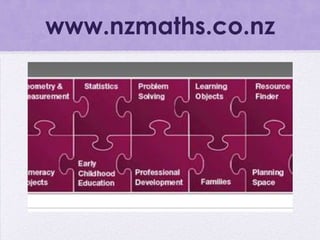
• www.nzmaths.co.nz
www.nzmaths.co.nz
Knowledge Building
•Counting
(cars, shells on beach, pegs, run around the house, how many
steps you walk, count backwards, start from different numbers)
•Numbers before and after
(Letter boxes, say a number, use a numberline, use number
cards, write a number down, ladder game, keyboard numbers,
using dice)
•Identifying numbers
(Letter boxes, number plates, speed signs, how many km to go,
number cards, combine numbers)
•Ordering numbers
(Number cards, write some numbers down)
Knowledge Building
• Knowing groups to five
• Knowing groups to ten
(Using ten frames, using fingers, quinary sticks)
• Basic addition facts to ten
(Buttons, ten frames, quinary sticks, fingers)
• Recalling Doubles
(ten frames, fingers, quinary sticks)
Quinary Sticks
Ten frames
Basic Facts
• We DO teach this explicitly.
• It does have an extremely important role in
children’s development.
• We do however ensure that the concepts
behind the Basic Facts are understood very
well first.
• There is a very clear sequence and
progression we follow when teaching Basic
Facts.

Westmere maths parent evening

  • 1.
  • 2.
    Outline • How isMathematics taught now? The New Zealand Numeracy Framework • Problem Solving Activities • Helpful and practical ideas to support your child’s learning in mathematics.
  • 3.
    Numeracy Project Goal “to benumerate is to have the ability and inclination to use mathematics effectively – at home, at work and in the community” Published in Curriculum Update 45:
  • 4.
    Focus of Mathematics Teaching •Focus on developing multiple flexible thinking strategies • mental and oral before written standard vertical forms • Make decisions about the most efficient strategy to use on any given problem. • Challenge children to achieve and develop a positive attitude towards learning mathematics.
  • 5.
  • 6.
    Number Strategies There are53 people on the bus, 29 people get off. How many people are now on the bus now?
  • 7.
    Make sense ofthese strategies “I use Rounding and Compensating 53 – 30 = 23 plus 1 = 24 I use Equal Additions and balancing. 53 – 29 = 54 – 30 = 24 “I use the algorithm and I think of 53 -29 3 – 9 I can’t do so I borrow a ten. 13 – 9 = 4. 4 tens – 2 tens = 2 tens. It’s 24 “I use Reversibility and an open number line!” 53 – 29 = 29 53 +20 + 2 0 30 +3+1 50 +1 +1 I use place value “53 – 20 = 33. Minus another 9. Split the 9 into 3 and 6. 33- 3 = 30 – 6 = 24
  • 8.
    Multiplicative Strategies There are 4packets of biscuits with 24 cookies in each pack. How many cookies are there altogether?
  • 9.
    Make sense ofthese Strategies. “I used place value 4 x 20 = 80. And 4 x 4 = 16. 80 + 16 = 96 I used doubling and halving. Double 4 = 8, half 24 = 12. 8 x 12 = 96 “I used the algorithm 24 X4 4 x 4 = 16. Put down the 6 and carry the 1. 40 x 20 = 80 + another ten = 90 90+6 = 96 4 x 24 = “I use Rounding and Compensating: I know 4 x 25 = 100. 100-(1x4) = 96. “I used repeated addition and know 24 + 24 = 48. 48 + 48 = 96
  • 10.
  • 11.
    Numeracy Stages • 0:Emergent •1: One to One Counting • 2: Count from one on Materials • 3: Count from one by Imaging • 4: Advanced Counting • 5: Early Additive Part-Whole • 6: Advanced Additive Part-Whole • 7: Advanced Multiplicative • 8: Advanced Proportional Counting Strategies Non Counting Strategies
  • 12.
    Stage 5: EarlyPart- Whole “I know that If I take one off the 6 and put it on the 9 it =10. 10 + 5 = 15” There are 9 counters under there and another 6 counters under there. How many are there altogether? The child uses simple strategies to solve addition and subtraction problems mentally
  • 13.
    Stage 6: Advanced Part-Whole Ithink tidy numbers would be smartest. 63 – 40 = 23 23 + 1 = 24 63 people are on the bus and 39 people get off the bus. How many people are left on the bus? The child can select from a wide range of strategies to solve various addition and subtraction problems mentally
  • 14.
    Stage 7: Advanced Multiplicative TidyNumbers would be a smart strategy. 6 x 30 = 180 180 – (2 x 6) = 168 There are 28 fruit trees in each aisle of the orchard. There are 6 aisles. How many trees are there altogether? The child can select from a wide range of strategies to solve various multiplication and division problems mentally.
  • 15.
    The NZ Numeracy Framework •Each Numeracy Stage highlights key knowledge and strategy that a child should know. • Strong knowledge is essential for students to broaden their strategies across a full range of numbers. Strategy Knowledge Creates new knowledge through use Provides the foundation for strategies
  • 16.
    Knowledge and Strategy •Knowledge –Number Identification, • Number Sequence and Order, • Grouping and Place Value, • Basic Facts •Strategy – Addition and Subtraction, • Multiplication and Division, • Fraction and Proportions
  • 17.
    How can you help? •Developing a child’s knowledge is the key to their success and development in mathematics. • But most important is to make the learning fun and as purposeful as possible. • www.nzmaths.co.nz
  • 18.
  • 20.
    Knowledge Building •Counting (cars, shellson beach, pegs, run around the house, how many steps you walk, count backwards, start from different numbers) •Numbers before and after (Letter boxes, say a number, use a numberline, use number cards, write a number down, ladder game, keyboard numbers, using dice) •Identifying numbers (Letter boxes, number plates, speed signs, how many km to go, number cards, combine numbers) •Ordering numbers (Number cards, write some numbers down)
  • 21.
    Knowledge Building • Knowinggroups to five • Knowing groups to ten (Using ten frames, using fingers, quinary sticks) • Basic addition facts to ten (Buttons, ten frames, quinary sticks, fingers) • Recalling Doubles (ten frames, fingers, quinary sticks) Quinary Sticks Ten frames
  • 22.
    Basic Facts • WeDO teach this explicitly. • It does have an extremely important role in children’s development. • We do however ensure that the concepts behind the Basic Facts are understood very well first. • There is a very clear sequence and progression we follow when teaching Basic Facts.