Singapore Maths
Aim of Mathematics Education:

• The aim of mathematics education, as stated by Singapore's Ministry
of Education (MOE), are to enable pupils to:
•

acquire and apply skills and knowledge relating to number, measure and space in
mathematical situations that they will meet in life

•

acquire mathematical concepts and skills necessary for a further study in
Mathematics and other disciplines

•

develop the ability to make logical deduction and induction as well as to explicate
their mathematical thinking and reasoning skills through solving of mathematical
problems

•

use mathematical language to communicate mathematical ideas and arguments
precisely, concisely and logically

•

develop positive attitudes towards Mathematics including confidence, enjoyment
and perseverance

•

appreciate the power and structure of Mathematics, including patterns and

relationships, and to enhance their intellectual curiosity
Introduction
This is a brief overview of Singapore mathematics
curriculum, its framework
and
its rationale and underlying goals
through the usage of

Number Bonds & Word Problems.
Mathematics as a Whole
•

•

•

Mathematics is the science of numbers and their
operations, interrelations, combinations,
generalizations, and abstractions and of space
configurations and their structure, measurement,
transformations, and generalizations (Merriam
Webster Dictionary http://www.merriamwebster.com/dictionary/mathematics).
The mathematics of a problem is the calculations
that are involved in it. In Singapore the solving of
mathematical word problems is a major
component both within the instructional program
as well as during formal assessments. Research
has indicated that both language and semantic
structures play a part in determining pupils’
performance in the solving of mathematical word
problems.
Reading comprehension is very important for the
students to use the required mathematical
operations to solve the problem.
Prior
• Before Singapore self-independence in 1959,
Singapore did not have a unified system of
education.
• Each type of school will teach their own type of
mathematics, using textbooks from different
countries.
• A common curriculum was developed only after selfgovernment, and increasing emphasis was given to
ensure that Singapore could develop an
industrialized economy.
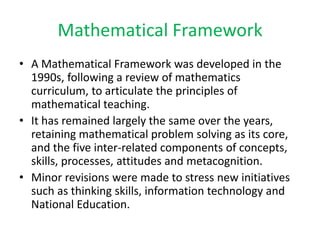
Mathematical Framework
• A Mathematical Framework was developed in the
1990s, following a review of mathematics
curriculum, to articulate the principles of
mathematical teaching.
• It has remained largely the same over the years,
retaining mathematical problem solving as its core,
and the five inter-related components of concepts,
skills, processes, attitudes and metacognition.
• Minor revisions were made to stress new initiatives
such as thinking skills, information technology and
National Education.
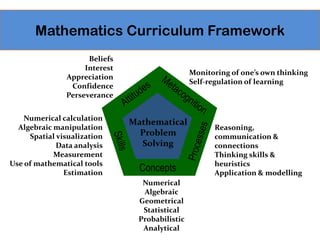
Mathematics Curriculum Framework
Beliefs
Interest
Appreciation
Confidence
Perseverance
Numerical calculation
Algebraic manipulation
Spatial visualization
Data analysis
Measurement
Use of mathematical tools
Estimation

Monitoring of one’s own thinking
Self-regulation of learning

Mathematical
Problem
Solving

Concepts
Numerical
Algebraic
Geometrical
Statistical
Probabilistic
Analytical

Reasoning,
communication &
connections
Thinking skills &
heuristics
Application & modelling
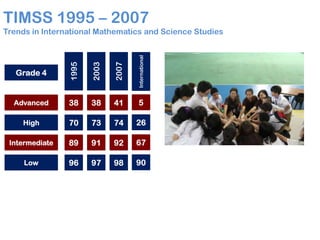
TIMSS 1995 – 2007

Grade 4

1995

2003

2007

International

Trends in International Mathematics and Science Studies

Advanced

38

38

41

5

High

70

73

74

26

Intermediate

89

91

92

67

Low

96

97

98

90
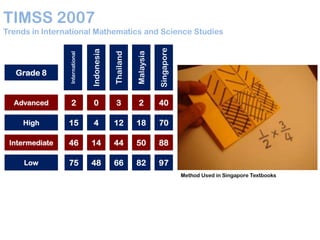
TIMSS 2007
International

Indonesia

Thailand

Malaysia

Singapore

Trends in International Mathematics and Science Studies

Advanced

2

0

3

2

40

High

15

4

12

18

70

Intermediate

46

14

44

50

88

Low

75

48

66

82

97

Grade 8

Method Used in Singapore Textbooks
Mathematics is “an excellent vehicle for
the development and improvement of a
person’s intellectual competence”.
Ministry of Education (Singapore) 2006
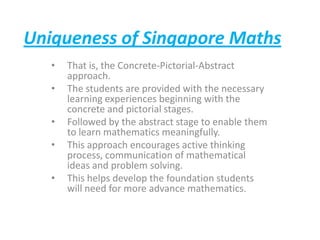
Uniqueness of Singapore Maths
•
•
•
•
•

That is, the Concrete-Pictorial-Abstract
approach.
The students are provided with the necessary
learning experiences beginning with the
concrete and pictorial stages.
Followed by the abstract stage to enable them
to learn mathematics meaningfully.
This approach encourages active thinking
process, communication of mathematical
ideas and problem solving.
This helps develop the foundation students
will need for more advance mathematics.
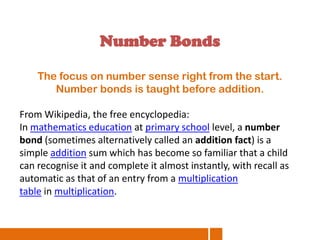
Number Bonds
The focus on number sense right from the start.
Number bonds is taught before addition.
From Wikipedia, the free encyclopedia:
In mathematics education at primary school level, a number
bond (sometimes alternatively called an addition fact) is a
simple addition sum which has become so familiar that a child
can recognise it and complete it almost instantly, with recall as
automatic as that of an entry from a multiplication
table in multiplication.
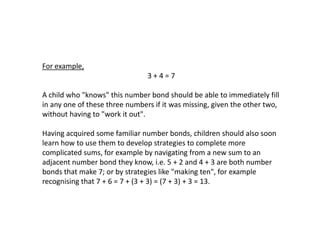
For example,

3+4=7
A child who "knows" this number bond should be able to immediately fill
in any one of these three numbers if it was missing, given the other two,
without having to "work it out".

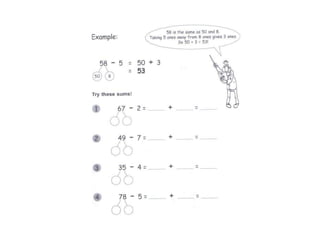
Having acquired some familiar number bonds, children should also soon
learn how to use them to develop strategies to complete more
complicated sums, for example by navigating from a new sum to an
adjacent number bond they know, i.e. 5 + 2 and 4 + 3 are both number
bonds that make 7; or by strategies like "making ten", for example
recognising that 7 + 6 = 7 + (3 + 3) = (7 + 3) + 3 = 13.
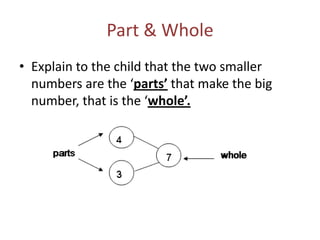
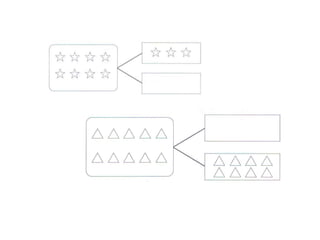
Part & Whole
• Explain to the child that the two smaller
numbers are the ‘parts’ that make the big
number, that is the ‘whole’.
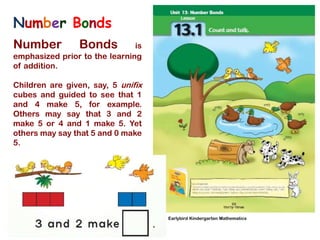
Number Bonds
Number

Bonds

is
emphasized prior to the learning
of addition.
Children are given, say, 5 unifix
cubes and guided to see that 1
and 4 make 5, for example.
Others may say that 3 and 2
make 5 or 4 and 1 make 5. Yet
others may say that 5 and 0 make
5.

Earlybird Kindergarten Mathematics
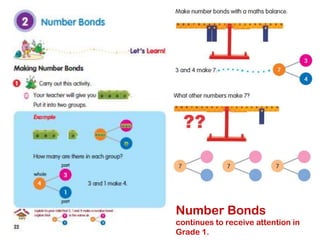
Number Bonds
continues to receive attention in
Grade 1.
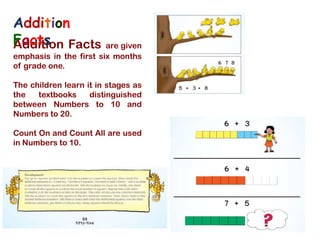
Addition
Facts Facts
Addition

are given
emphasis in the first six months
of grade one.
The children learn it in stages as
the
textbooks
distinguished
between Numbers to 10 and
Numbers to 20.
Count On and Count All are used
in Numbers to 10.
Focus on Problem Solving
(Model Drawing)
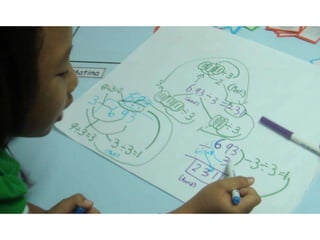
The Singapore curriculum focuses on problem solving.
So does the national test.
It is no wonder that’s schools place a lot of emphasis
on problem solving.
☻☻☻☻☻
☻☻☻☻☻
18

–

5

☻☻☻☻☻
☻☻☻

=

–
10

5

+

=

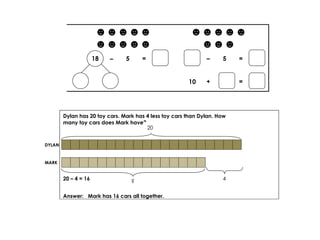
Dylan has 20 toy cars. Mark has 4 less toy cars than Dylan. How
many toy cars does Mark have?
20
DYLAN

MARK

20 – 4 = 16

?

Answer: Mark has 16 cars all together.

=

4
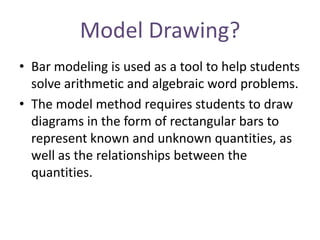
Model Drawing?
• Bar modeling is used as a tool to help students
solve arithmetic and algebraic word problems.
• The model method requires students to draw
diagrams in the form of rectangular bars to
represent known and unknown quantities, as
well as the relationships between the
quantities.
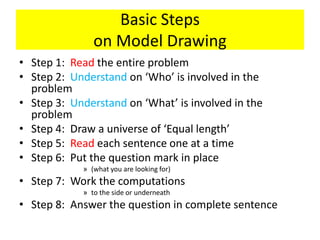
Basic Steps
on Model Drawing
• Step 1: Read the entire problem
• Step 2: Understand on ‘Who’ is involved in the
problem
• Step 3: Understand on ‘What’ is involved in the
problem
• Step 4: Draw a universe of ‘Equal length’
• Step 5: Read each sentence one at a time
• Step 6: Put the question mark in place
» (what you are looking for)

• Step 7: Work the computations
» to the side or underneath

• Step 8: Answer the question in complete sentence
Model Drawing
• http://thinkingblocks.com/
Textbooks
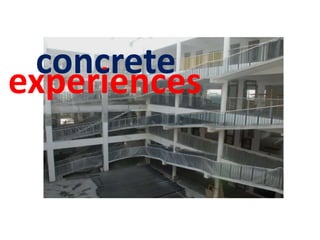
concrete
experiences
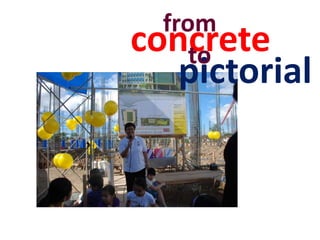
from
concrete
to

pictorial
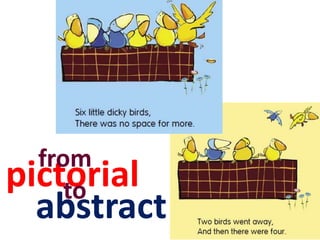
from
pictorial
to

abstract
Variations
Tasks are varied in a systematic way to ensure that

average & struggling learners
can learn well.
Spiral Approach
The spiral approach is where lessons include
mathematical variations within the same grade.
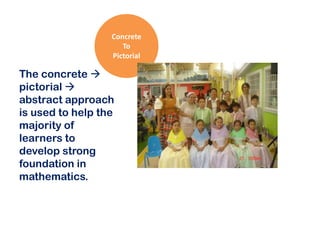
Concrete
To
Pictorial

The concrete 
pictorial 
abstract approach
is used to help the
majority of
learners to
develop strong
foundation in
mathematics.
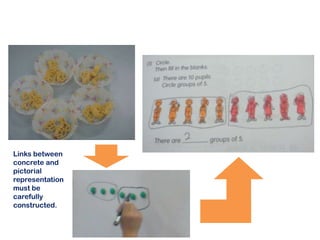
Links between
concrete and
pictorial
representation
must be
carefully
constructed.
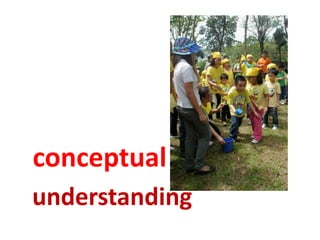
conceptual
understanding
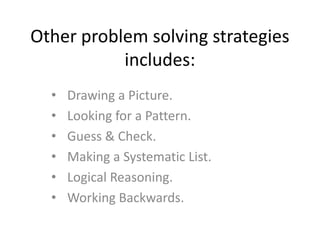
Other problem solving strategies
includes:
•
•
•
•
•
•

Drawing a Picture.
Looking for a Pattern.
Guess & Check.
Making a Systematic List.
Logical Reasoning.
Working Backwards.
Examples
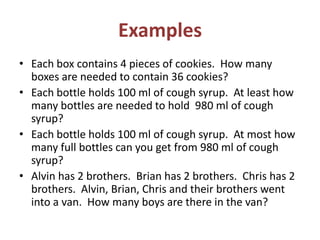
• Each box contains 4 pieces of cookies. How many
boxes are needed to contain 36 cookies?
• Each bottle holds 100 ml of cough syrup. At least how
many bottles are needed to hold 980 ml of cough
syrup?
• Each bottle holds 100 ml of cough syrup. At most how
many full bottles can you get from 980 ml of cough
syrup?
• Alvin has 2 brothers. Brian has 2 brothers. Chris has 2
brothers. Alvin, Brian, Chris and their brothers went
into a van. How many boys are there in the van?
Conclusion
• Other than the model drawing approach, pupils are also
taught different problem solving methods. They are
encouraged to try different approaches and have the
flexibility to choose the method that works best for them in
solving the problems. They are also encouraged to present
their solutions clearly so that these can be understood.
• While pupils are not required to use algebra to solve word
problems in the Primary Six Leaving Examination for
Mathematics, they are also not restricted to the use of any
one particular method. In the marking of examination itself,
all mathematically correct solutions are acceptable and
there is no loss of marks if a correct algebraic method is
used.
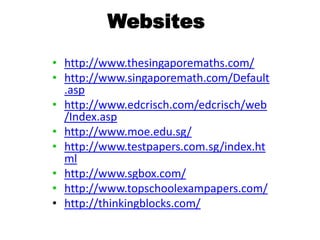
Websites
• http://www.thesingaporemaths.com/
• http://www.singaporemath.com/Default
.asp
• http://www.edcrisch.com/edcrisch/web
/Index.asp
• http://www.moe.edu.sg/
• http://www.testpapers.com.sg/index.ht
ml
• http://www.sgbox.com/
• http://www.topschoolexampapers.com/
• http://thinkingblocks.com/

3 april '13 (everyone) on Singapore Maths for ICBB / PSLE Math

  • 1.
    Singapore Maths Aim ofMathematics Education: • The aim of mathematics education, as stated by Singapore's Ministry of Education (MOE), are to enable pupils to: • acquire and apply skills and knowledge relating to number, measure and space in mathematical situations that they will meet in life • acquire mathematical concepts and skills necessary for a further study in Mathematics and other disciplines • develop the ability to make logical deduction and induction as well as to explicate their mathematical thinking and reasoning skills through solving of mathematical problems • use mathematical language to communicate mathematical ideas and arguments precisely, concisely and logically • develop positive attitudes towards Mathematics including confidence, enjoyment and perseverance • appreciate the power and structure of Mathematics, including patterns and relationships, and to enhance their intellectual curiosity
  • 2.
    Introduction This is abrief overview of Singapore mathematics curriculum, its framework and its rationale and underlying goals through the usage of Number Bonds & Word Problems.
  • 3.
    Mathematics as aWhole • • • Mathematics is the science of numbers and their operations, interrelations, combinations, generalizations, and abstractions and of space configurations and their structure, measurement, transformations, and generalizations (Merriam Webster Dictionary http://www.merriamwebster.com/dictionary/mathematics). The mathematics of a problem is the calculations that are involved in it. In Singapore the solving of mathematical word problems is a major component both within the instructional program as well as during formal assessments. Research has indicated that both language and semantic structures play a part in determining pupils’ performance in the solving of mathematical word problems. Reading comprehension is very important for the students to use the required mathematical operations to solve the problem.
  • 4.
    Prior • Before Singaporeself-independence in 1959, Singapore did not have a unified system of education. • Each type of school will teach their own type of mathematics, using textbooks from different countries. • A common curriculum was developed only after selfgovernment, and increasing emphasis was given to ensure that Singapore could develop an industrialized economy.
  • 5.
    Mathematical Framework • AMathematical Framework was developed in the 1990s, following a review of mathematics curriculum, to articulate the principles of mathematical teaching. • It has remained largely the same over the years, retaining mathematical problem solving as its core, and the five inter-related components of concepts, skills, processes, attitudes and metacognition. • Minor revisions were made to stress new initiatives such as thinking skills, information technology and National Education.
  • 6.
    Mathematics Curriculum Framework Beliefs Interest Appreciation Confidence Perseverance Numericalcalculation Algebraic manipulation Spatial visualization Data analysis Measurement Use of mathematical tools Estimation Monitoring of one’s own thinking Self-regulation of learning Mathematical Problem Solving Concepts Numerical Algebraic Geometrical Statistical Probabilistic Analytical Reasoning, communication & connections Thinking skills & heuristics Application & modelling
  • 7.
    TIMSS 1995 –2007 Grade 4 1995 2003 2007 International Trends in International Mathematics and Science Studies Advanced 38 38 41 5 High 70 73 74 26 Intermediate 89 91 92 67 Low 96 97 98 90
  • 8.
    TIMSS 2007 International Indonesia Thailand Malaysia Singapore Trends inInternational Mathematics and Science Studies Advanced 2 0 3 2 40 High 15 4 12 18 70 Intermediate 46 14 44 50 88 Low 75 48 66 82 97 Grade 8 Method Used in Singapore Textbooks
  • 9.
    Mathematics is “anexcellent vehicle for the development and improvement of a person’s intellectual competence”. Ministry of Education (Singapore) 2006
  • 10.
    Uniqueness of SingaporeMaths • • • • • That is, the Concrete-Pictorial-Abstract approach. The students are provided with the necessary learning experiences beginning with the concrete and pictorial stages. Followed by the abstract stage to enable them to learn mathematics meaningfully. This approach encourages active thinking process, communication of mathematical ideas and problem solving. This helps develop the foundation students will need for more advance mathematics.
  • 11.
    Number Bonds The focuson number sense right from the start. Number bonds is taught before addition. From Wikipedia, the free encyclopedia: In mathematics education at primary school level, a number bond (sometimes alternatively called an addition fact) is a simple addition sum which has become so familiar that a child can recognise it and complete it almost instantly, with recall as automatic as that of an entry from a multiplication table in multiplication.
  • 12.
    For example, 3+4=7 A childwho "knows" this number bond should be able to immediately fill in any one of these three numbers if it was missing, given the other two, without having to "work it out". Having acquired some familiar number bonds, children should also soon learn how to use them to develop strategies to complete more complicated sums, for example by navigating from a new sum to an adjacent number bond they know, i.e. 5 + 2 and 4 + 3 are both number bonds that make 7; or by strategies like "making ten", for example recognising that 7 + 6 = 7 + (3 + 3) = (7 + 3) + 3 = 13.
  • 13.
    Part & Whole •Explain to the child that the two smaller numbers are the ‘parts’ that make the big number, that is the ‘whole’.
  • 14.
    Number Bonds Number Bonds is emphasized priorto the learning of addition. Children are given, say, 5 unifix cubes and guided to see that 1 and 4 make 5, for example. Others may say that 3 and 2 make 5 or 4 and 1 make 5. Yet others may say that 5 and 0 make 5. Earlybird Kindergarten Mathematics
  • 15.
    Number Bonds continues toreceive attention in Grade 1.
  • 16.
    Addition Facts Facts Addition are given emphasisin the first six months of grade one. The children learn it in stages as the textbooks distinguished between Numbers to 10 and Numbers to 20. Count On and Count All are used in Numbers to 10.
  • 19.
    Focus on ProblemSolving (Model Drawing) The Singapore curriculum focuses on problem solving. So does the national test. It is no wonder that’s schools place a lot of emphasis on problem solving.
  • 20.
    ☻☻☻☻☻ ☻☻☻☻☻ 18 – 5 ☻☻☻☻☻ ☻☻☻ = – 10 5 + = Dylan has 20toy cars. Mark has 4 less toy cars than Dylan. How many toy cars does Mark have? 20 DYLAN MARK 20 – 4 = 16 ? Answer: Mark has 16 cars all together. = 4
  • 21.
    Model Drawing? • Barmodeling is used as a tool to help students solve arithmetic and algebraic word problems. • The model method requires students to draw diagrams in the form of rectangular bars to represent known and unknown quantities, as well as the relationships between the quantities.
  • 22.
    Basic Steps on ModelDrawing • Step 1: Read the entire problem • Step 2: Understand on ‘Who’ is involved in the problem • Step 3: Understand on ‘What’ is involved in the problem • Step 4: Draw a universe of ‘Equal length’ • Step 5: Read each sentence one at a time • Step 6: Put the question mark in place » (what you are looking for) • Step 7: Work the computations » to the side or underneath • Step 8: Answer the question in complete sentence
  • 23.
  • 24.
  • 25.
  • 26.
  • 27.
  • 28.
    Variations Tasks are variedin a systematic way to ensure that average & struggling learners can learn well.
  • 29.
    Spiral Approach The spiralapproach is where lessons include mathematical variations within the same grade.
  • 30.
    Concrete To Pictorial The concrete  pictorial abstract approach is used to help the majority of learners to develop strong foundation in mathematics.
  • 31.
  • 32.
  • 34.
    Other problem solvingstrategies includes: • • • • • • Drawing a Picture. Looking for a Pattern. Guess & Check. Making a Systematic List. Logical Reasoning. Working Backwards.
  • 35.
    Examples • Each boxcontains 4 pieces of cookies. How many boxes are needed to contain 36 cookies? • Each bottle holds 100 ml of cough syrup. At least how many bottles are needed to hold 980 ml of cough syrup? • Each bottle holds 100 ml of cough syrup. At most how many full bottles can you get from 980 ml of cough syrup? • Alvin has 2 brothers. Brian has 2 brothers. Chris has 2 brothers. Alvin, Brian, Chris and their brothers went into a van. How many boys are there in the van?
  • 36.
    Conclusion • Other thanthe model drawing approach, pupils are also taught different problem solving methods. They are encouraged to try different approaches and have the flexibility to choose the method that works best for them in solving the problems. They are also encouraged to present their solutions clearly so that these can be understood. • While pupils are not required to use algebra to solve word problems in the Primary Six Leaving Examination for Mathematics, they are also not restricted to the use of any one particular method. In the marking of examination itself, all mathematically correct solutions are acceptable and there is no loss of marks if a correct algebraic method is used.
  • 37.
    Websites • http://www.thesingaporemaths.com/ • http://www.singaporemath.com/Default .asp •http://www.edcrisch.com/edcrisch/web /Index.asp • http://www.moe.edu.sg/ • http://www.testpapers.com.sg/index.ht ml • http://www.sgbox.com/ • http://www.topschoolexampapers.com/ • http://thinkingblocks.com/