A Beginner’s Guide to
Number Talks
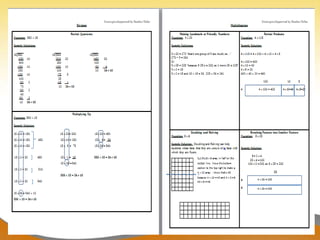
what is 45% of 63?
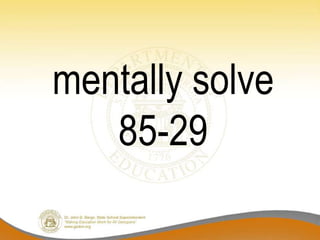
mentally solve
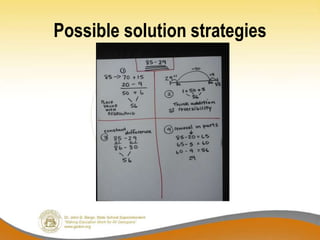
85-29
Possible solution strategies
What is Number Talks?
A Number Talk is a short, ongoing daily routine that
provides students with meaningful ongoing practice
with computation:
• keep Number Talks short, as they are not intended
to replace current curriculum or take up the majority
of the time spent on mathematics.
• spend only 5 to 15 minutes on Number Talks
• Talks are most effective when done everyday.
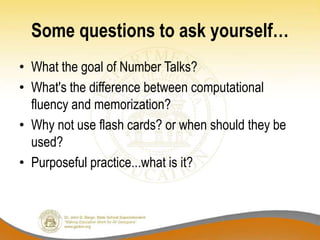
Some questions to ask yourself…
• What the goal of Number Talks?
• What's the difference between computational
fluency and memorization?
• Why not use flash cards? or when should they be
used?
• Purposeful practice...what is it?
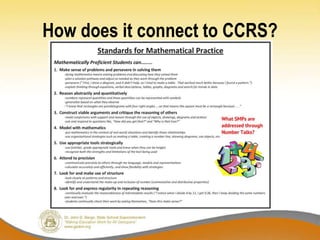
How does it connect to CCRS?
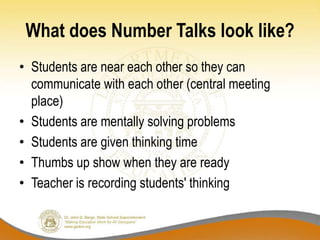
What does Number Talks look like?
• Students are near each other so they can
communicate with each other (central meeting
place)
• Students are mentally solving problems
• Students are given thinking time
• Thumbs up show when they are ready
• Teacher is recording students' thinking
Purposeful Problems
• Start with small numbers so the students can learn
to focus on the strategies instead of getting lost in
the numbers
• Use a number string (a string of problems that are
related to and scaffold each other)
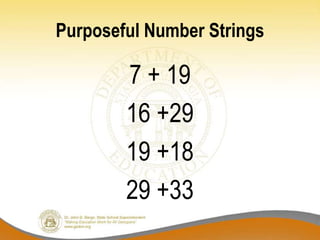
Purposeful Number Strings
7 + 19
16 +29
19 +18
29 +33
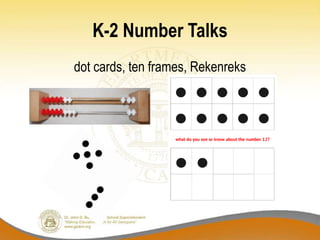
K-2 Number Talks
dot cards, ten frames, Rekenreks
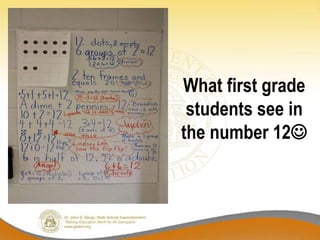
What first grade
students see in
the number 12
Number Talks in 1st Grade
• Add and subtract within 20, demonstrating fluency for
addition and subtraction within 10. Use strategies such as
counting on; making ten (e.g., 8 + 6 = 8 + 2 + 4 = 10 + 4 =
14); decomposing a number leading to a ten (e.g., 13 – 4 =
13 – 3 – 1 = 10 – 1 = 9); using the relationship between
addition and subtraction (e.g., knowing that 8 + 4 = 12, one
knows 12 – 8 = 4); and creating equivalent but easier or
known sums (e.g., adding 6 + 7 by creating the known
equivalent 6 + 6 + 1 = 12 + 1 = 13).
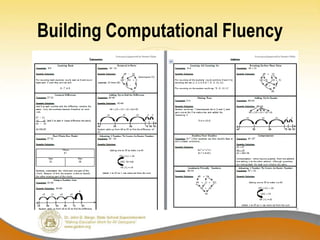
Building Computational Fluency
What could it look like in 3rd through
8th grade?
• Multiplication and division
• Decimals (same part-whole additive strategies but
extended to rational numbers…good stuff!)
• Fractions (context for learning-Fosnot)
STUDENT ACCOUNTABILITY WITH NUMBER
TALKS
• Students use finger signals to indicate most efficient
strategy.
• Keep records of problems posed and student
strategies.
• Hold small-group number talks.
• Create and post class strategy charts.
• Give students an exit problem using the discussed
strategies.
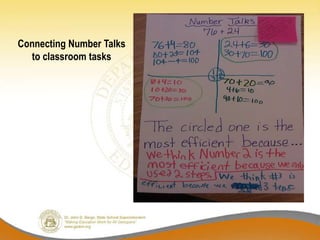
Connecting Number Talks
to classroom tasks
Starting Number Talks in your
Classroom
• Start with specific problems in mind
• Be prepared to offer a strategy from a previous
student
• It is ok to put a student's strategy on the backburner
• Limit your number talks to about 15 minutes
• Ask a question, don't tell!
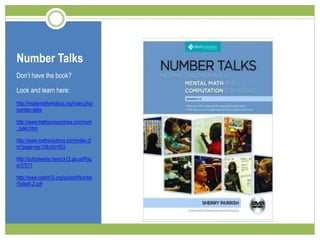
Number Talks
Don’t have the book?
Look and learn here:
http://insidemathematics.org/index.php/
number-talks
http://www.mathperspectives.com/num
_talks.html
http://www.mathsolutions.com/index.cf
m?page=wp10&crid=553
http://schoolwires.henry.k12.ga.us/Pag
e/37071
http://www.cobbk12.org/bullard/Numbe
rTalksK-2.pdf
RESOURCES
• http://insidemathematics.org/index.php/number-
talks
• http://www.mathperspectives.com/num_talks.html
• http://www.mathsolutions.com/index.cfm?page=wp1
0&crid=553
• http://schoolwires.henry.k12.ga.us/Page/37071
• http://www.cobbk12.org/bullard/NumberTalksK-2.pdf
• http://numberstrings.com/

Intro to-number-talks-powerpoint

  • 1.
    A Beginner’s Guideto Number Talks
  • 3.
  • 4.
  • 5.
  • 6.
    What is NumberTalks? A Number Talk is a short, ongoing daily routine that provides students with meaningful ongoing practice with computation: • keep Number Talks short, as they are not intended to replace current curriculum or take up the majority of the time spent on mathematics. • spend only 5 to 15 minutes on Number Talks • Talks are most effective when done everyday.
  • 7.
    Some questions toask yourself… • What the goal of Number Talks? • What's the difference between computational fluency and memorization? • Why not use flash cards? or when should they be used? • Purposeful practice...what is it?
  • 8.
    How does itconnect to CCRS?
  • 9.
    What does NumberTalks look like? • Students are near each other so they can communicate with each other (central meeting place) • Students are mentally solving problems • Students are given thinking time • Thumbs up show when they are ready • Teacher is recording students' thinking
  • 10.
    Purposeful Problems • Startwith small numbers so the students can learn to focus on the strategies instead of getting lost in the numbers • Use a number string (a string of problems that are related to and scaffold each other)
  • 11.
    Purposeful Number Strings 7+ 19 16 +29 19 +18 29 +33
  • 12.
    K-2 Number Talks dotcards, ten frames, Rekenreks
  • 13.
    What first grade studentssee in the number 12
  • 14.
    Number Talks in1st Grade • Add and subtract within 20, demonstrating fluency for addition and subtraction within 10. Use strategies such as counting on; making ten (e.g., 8 + 6 = 8 + 2 + 4 = 10 + 4 = 14); decomposing a number leading to a ten (e.g., 13 – 4 = 13 – 3 – 1 = 10 – 1 = 9); using the relationship between addition and subtraction (e.g., knowing that 8 + 4 = 12, one knows 12 – 8 = 4); and creating equivalent but easier or known sums (e.g., adding 6 + 7 by creating the known equivalent 6 + 6 + 1 = 12 + 1 = 13).
  • 15.
  • 16.
    What could itlook like in 3rd through 8th grade? • Multiplication and division • Decimals (same part-whole additive strategies but extended to rational numbers…good stuff!) • Fractions (context for learning-Fosnot)
  • 18.
    STUDENT ACCOUNTABILITY WITHNUMBER TALKS • Students use finger signals to indicate most efficient strategy. • Keep records of problems posed and student strategies. • Hold small-group number talks. • Create and post class strategy charts. • Give students an exit problem using the discussed strategies.
  • 19.
  • 20.
    Starting Number Talksin your Classroom • Start with specific problems in mind • Be prepared to offer a strategy from a previous student • It is ok to put a student's strategy on the backburner • Limit your number talks to about 15 minutes • Ask a question, don't tell!
  • 21.
    Number Talks Don’t havethe book? Look and learn here: http://insidemathematics.org/index.php/ number-talks http://www.mathperspectives.com/num _talks.html http://www.mathsolutions.com/index.cf m?page=wp10&crid=553 http://schoolwires.henry.k12.ga.us/Pag e/37071 http://www.cobbk12.org/bullard/Numbe rTalksK-2.pdf
  • 22.
    RESOURCES • http://insidemathematics.org/index.php/number- talks • http://www.mathperspectives.com/num_talks.html •http://www.mathsolutions.com/index.cfm?page=wp1 0&crid=553 • http://schoolwires.henry.k12.ga.us/Page/37071 • http://www.cobbk12.org/bullard/NumberTalksK-2.pdf • http://numberstrings.com/

Editor's Notes

  • #3 Preview and welcome -going to be really hard to talk about numbers when I can’t hear what your saying Be sure to introduce the next slide and tell them they are going to do it mentally…
  • #4 Just kidding…but the anxiety that you just felt is what your students will probably experience the first time you ask them to mentally think about numbers and then share their solution strategy
  • #5 Solve this mentally
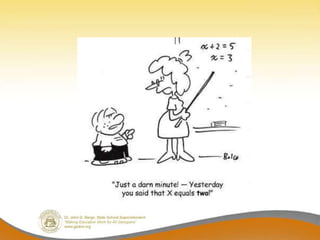
  • #7 This is what is what Number Talks is not… Push out Kid Snippet Video- www.youtube.com/watch?v=KdxEAt91D7k Discussing that we are all guilty but the good thing is that you are here and your wanting to be a more effective teacher
  • #8 Computational Fluency What happens to the students that only has memory to think mathematically. Use 8x7 as an example…if the student doesn’t know 8x7 they would revert back to skip counting but the students that has learned through strategy could say I don’t know 8x7 but I know that 8x8 is 64 and 64-8 is 56. Purposeful practice...what is it? students can only become faster and more efficient at what they already know why not use flash cards? or when should they be used? Purposeful practice...what is it?
  • #9 What SMPs are connected to Number Talks? The only one I can say is SMP#4
  • #10 Communicate: Having to talk out loud about a problem helps students clarify their own thinking Allow students to listen to other's strategies and value other's thinking Gives the teacher the opportunity to hear student's thinking Mental Math: When you are solving a problem mentally you must rely on what you know and understand about the numbers instead of memorized procedures You must be efficient when computing mentally because you can hold a lot of quantities in your head Thumps Up: This is just a signal to let you know that you have given your students enough time to think about the problem If will give you a picture of who is able to compute mentally and who is struggling It isn't as distracting as a waving hand Teacher as Recorder: Allows you to record students' thinking in the correct notation Provides a visual to look at and refer back to Allows you to keep a record of the problems posed and which students offered specific strategies
  • #12 What do you notice? Lots of 9-ness which purposely lend itself to the make a ten strategy And this really stinks because this is on tape delay…so if you’re right give yourself a Kindergarten “kiss your brain”
  • #13 We want to move our students from Perceptual Subitizers to Conceptual Subitizers Review what subitizing is for upper grades and discuss the difference between perceptual and conceptual Perceptual see 5 dots and that all they know Conceptual sees 5 dots and they can articulate and explain how they see the 5 dots (a group of 2 and a group of 3)
  • #14 Thank you Ms. Burge
  • #15 Review the standard quickly and then push out video to show how Number Talks connects to standards. Push out video…http://www.youtube.com/watch?v=eijmcqGe61o
  • #16 Undoing parent misconceptions….send this home. We pushed it out at the beginning and we’ll post it to the wiki. We need to continue to educate parents because we are educating them as well. I hate it when we spend all day exposing students to understanding numbers and then we send them home and they return back the next day to find out their parents showed them and “easier way”.
  • #20 Thanks Shelly Burch for Sharing…..discuss how Shelly uses this with her 3rd grade classroom.
  • #22 Number Talks book by Sherry Parrish, or if you don’t have the book, here are links to free resources.