Aston Rowant 
C of E Primary School. 
New Curriculum 
2014 
Maths Workshop 
Calculation Strategies
New Curriculum 2014 
• The new curriculum represents a substantial increase 
in both the amount of Maths being taught and the 
expectations of children at each age range. In 
general, much of what was traditionally taught in 
Y5/Y6 (3-digit multiplication using formal written 
methods, formal column addition and subtraction of 
4-digit numbers as well as amounts of money, time 
intervals involving 24 hour clock, two-place decimals 
...) now has to be completed and may be assessed 
by the end of Y4.
Year 6 
• By the end of Y6, the children may be 
assessed on addition/subtraction of fractions 
including mixed numbers, multiplication and 
division of fractions by integers, formal 
algorithms for multiplication and division of 
four-digit by two-digit numbers, as well as 
more advanced calculations involving 
decimals and percentages, for example using 
the fact that 3/8 is 0.375.
Calculation Strategies 
Aims 
To develop an understanding of the expanded and formal 
(traditional) methods we teach at Aston Rowant School for 
addition, subtraction, multiplication and division. 
We want pupils at Aston Rowant School: 
• To develop efficient methods of calculation with all four operations. 
• To be able to choose an appropriate method for calculation 
e.g mental, mental with jottings, expanded written, formal written, calculator. 
• To develop a mathematical understanding, a feel for the value of number 
rather than just learning a mechanical method that can be prone to error. 
To develop learners for life
4 Pillars of Calculation 
At Aston Rowant School we want the children to 
have: 
• Good understanding of Place Value 
• To use images and models 
• To use memorised number facts 
• To Double/Halve
1. Place Value 
Common errors: 
• Write 101 in figures (1001) 
• 3.4 x 10 (3.40) 
• Write one pound and 5p as a decimal (1.5) 
• 0.2 x 0.2 (0.4) 
It is so important that children at KS1 have 
sound understanding of place value to be able 
to use written calculation methods at KS2 
(examples on next slides)
Addition 
Partitioning: 
47 + 35= 
40 30 70 
7 5 12 
82
Addition 
Partitioning: 
374 + 248= 
300 70 4 
200 40 8 
500 110 12 
600 20 2 
622
Addition 
Partitioning: 
£48.56 + £23.70 = 
40.00 8.00 0.50 0.06 
20.00 3.00 0.70 0.00 
£60.00 £11.00 £1.20 £0.06 
£70.00 £2.00 £0.20 £0.06 
£72.26
Addition 
Expanded Vertical Method: 
374 + 248= 
374 
248 
12 
110 
500 
+ 
+ 
622
Addition 
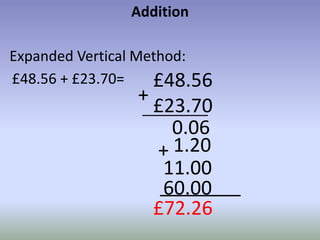
Expanded Vertical Method: 
£48.56 + £23.70= 
£48.56 
£23.70 
0.06 
1.20 
11.00 
60.00 
+ 
+ 
£72.26
Addition 
Compact Vertical Method: 
374 + 248 = 374 
248 
+ 
6 
2 
1 
2 
1
Addition 
Compact Vertical Method: 
£48.56 + £23.70= £48.56 
+ 
£23.70 
£7 .26 
2 
1 
1
Subtraction 
Partitioning: 
This method links to counting back on a number line. 
74 - 27 = 
74 - 20 = 54 
54 - 7 = 47
Subtraction 
Expanded Method – No adjustment or decomposition needed: 
563 - 241= 
500 + 60 + 3 
200 + 40 + 1 
_ 
300 + 20+ 2 = 322
Subtraction 
Expanded Method – Adjustment from the tens to the units: 
563 - 246= 
50 13 
500 + 60 + 3 
200 + 40 + 6 
_ 
300 + 10+ 7 = 317
Subtraction 
Compact Method – Adjustment from the tens to the units: 
563 + 246= 
51 
563 
-246 
317
Multiplication 
Compact Grid Method 
47 x 36 = 
X 40 7 
30 1200 210 1410 
6 240 42 282 
1692
Multiplication 
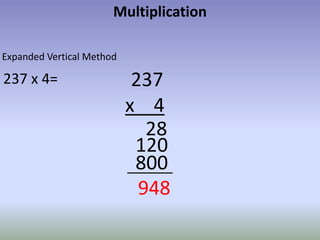
Expanded Vertical Method 
237 x 4= 237 
x 4 
28 
120 
800 
948
Multiplication 
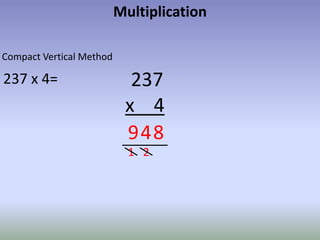
Compact Vertical Method 
237 x 4= 237 
x 4 
4 
8 
2 
9 
1
Multiplication 
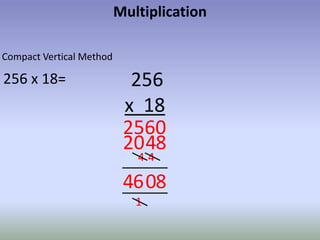
Compact Vertical Method 
256 x 18= 256 
x 18 
2560 
204 
8 
4 4 
460 
8 
1
Division 
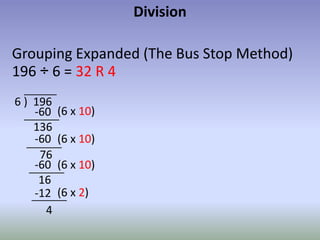
Grouping Expanded (The Bus Stop Method) 
196 ÷ 6 = 32 R 4 
6 ) 196 
(6 x 10) 
(6 x 10) 
(6 x 10) 
(6 x 2) 
-60 
136 
-60 
76 
-60 
16 
-12 
4
Division 
Grouping Efficiently (The Bus Stop Method) 
346 ÷ 8 = 43 R 2 
8 ) 346 
(8 x 40) 
(8 x 3) 
-320 
26 
-24 
2
2. Use of Images and Models 
Addition 
Pictures and Symbols: 
I buy 2 cakes and my friend buys 3 cakes. How many cakes did we 
buy altogether? 
May be recorded as: 2 + 3 = 5
Addition 
Pictures and Symbols: 
18 + 5 = 23
Addition 
Number Line: 
18 + 5 = 
+1 +1 
+1 +1 +1 
18 20 23 
19 21 22
Addition 
Number Line - Efficient Jumps: 
47 + 35 = 
+30 +3 +2 
47 77 80 82
Addition 
Number Line - Efficient Jumps: 
374 + 248 = 
+200 +40 +8 
374 574 614 622
Addition 
Number Line - Efficient Jumps: 
£48.56 + £23.70 = 
+£20 +£3 +70p 
£48.56 £68.56 £71.56 £72.26
Subtraction 
Pictures and Symbols: 
I have five cakes I eat two of them. How many do I have left? 
May be recorded as: 5 - 2 = 3 
XX
Subtraction 
Stage 1 
Pictures and Symbols: 
13 - 5 = 8
Subtraction 
Stage 2 
Number Line - Counting Back: 
13 - 5 = 
-1 -1 
-1 -1 -1 
8 10 13 
9 11 12
Subtraction 
Number Line – Counting Back Efficient Jumps: 
74 - 27 = 
-3 -4 
-20 
47 50 
54 74
Subtraction 
Number Line – Counting On Efficient Jumps: 
74 - 27 = 
+3 +40 +4 
27 30 70 74 
40 + 4 + 3 = 47
Multiplication 
Pictures and Symbols: 
There are three sweets in one bag. 
How many sweets are there in five bags?
Multiplication 
Number Line – Repeated Addition: 
5 x 3 or 3 x 5 
0 3 6 9 12 15 
0 5 10 15
Multiplication 
Arrays 
5 x 3 or 3 x 5
Multiplication 
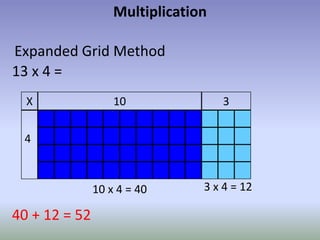
Expanded Grid Method 
13 x 4 = 
X 10 3 
4 
10 x 4 = 40 3 x 4 = 12 
40 + 12 = 52
Multiplication 
Compact Grid Method 
13 x 4 = 
X 10 3 
4 40 12 
40 + 12 = 52
Division 
Pictures and Symbols: 
How many apples in each bowl if I share 12 apples between 3 
bowls?
Division 
Number Line: 
15 ÷ 3 = 5 
0 
+3 +3 +3 +3 +3 
3 6 9 12 15 
15 
-3 -3 -3 -3 -3 
0 3 6 9 12
Division 
Number Line: Chunking. 
96 ÷ 6 = 16 
10 x 6 = 60 6 x 6 = 36 
0 60 96
Division 
Number Line: Counting Back by Chunking. 
200 ÷ 6 = 33 R 2 
3 x 6 = 18 30 x 6 = 180 
2 20 200 
0
3. Memorised Number Facts 
• Fewer children come to school knowing 
rhymes/numbers etc. 
• Memorisation is the grounds on which we 
build maths. 78+5= by year 3 children should 
not be counting on in ones but know that 2 
more is 80 plus another 3. 
• If children don’t know their number facts, 
they can’t do maths.
4. Double and Halve 
• Why is doubling and halving important? 
• It is the simplest maths function we teach. We 
do this and then it is reversed. 
• 1 million divide by 8 How would you do it? 
Halve, Halve, Halve it 
• 13 divided by 5 How? Divide by 10 and double 
it.
Thank you. 
• Please feel free to visit the classrooms. We 
have some of the resources on display for you 
to have a look at. 
• The teachers will be there to answer any 
questions.

Maths workshop calculation strategies

  • 1.
    Aston Rowant Cof E Primary School. New Curriculum 2014 Maths Workshop Calculation Strategies
  • 2.
    New Curriculum 2014 • The new curriculum represents a substantial increase in both the amount of Maths being taught and the expectations of children at each age range. In general, much of what was traditionally taught in Y5/Y6 (3-digit multiplication using formal written methods, formal column addition and subtraction of 4-digit numbers as well as amounts of money, time intervals involving 24 hour clock, two-place decimals ...) now has to be completed and may be assessed by the end of Y4.
  • 3.
    Year 6 •By the end of Y6, the children may be assessed on addition/subtraction of fractions including mixed numbers, multiplication and division of fractions by integers, formal algorithms for multiplication and division of four-digit by two-digit numbers, as well as more advanced calculations involving decimals and percentages, for example using the fact that 3/8 is 0.375.
  • 4.
    Calculation Strategies Aims To develop an understanding of the expanded and formal (traditional) methods we teach at Aston Rowant School for addition, subtraction, multiplication and division. We want pupils at Aston Rowant School: • To develop efficient methods of calculation with all four operations. • To be able to choose an appropriate method for calculation e.g mental, mental with jottings, expanded written, formal written, calculator. • To develop a mathematical understanding, a feel for the value of number rather than just learning a mechanical method that can be prone to error. To develop learners for life
  • 5.
    4 Pillars ofCalculation At Aston Rowant School we want the children to have: • Good understanding of Place Value • To use images and models • To use memorised number facts • To Double/Halve
  • 6.
    1. Place Value Common errors: • Write 101 in figures (1001) • 3.4 x 10 (3.40) • Write one pound and 5p as a decimal (1.5) • 0.2 x 0.2 (0.4) It is so important that children at KS1 have sound understanding of place value to be able to use written calculation methods at KS2 (examples on next slides)
  • 7.
    Addition Partitioning: 47+ 35= 40 30 70 7 5 12 82
  • 8.
    Addition Partitioning: 374+ 248= 300 70 4 200 40 8 500 110 12 600 20 2 622
  • 9.
    Addition Partitioning: £48.56+ £23.70 = 40.00 8.00 0.50 0.06 20.00 3.00 0.70 0.00 £60.00 £11.00 £1.20 £0.06 £70.00 £2.00 £0.20 £0.06 £72.26
  • 10.
    Addition Expanded VerticalMethod: 374 + 248= 374 248 12 110 500 + + 622
  • 11.
    Addition Expanded VerticalMethod: £48.56 + £23.70= £48.56 £23.70 0.06 1.20 11.00 60.00 + + £72.26
  • 12.
    Addition Compact VerticalMethod: 374 + 248 = 374 248 + 6 2 1 2 1
  • 13.
    Addition Compact VerticalMethod: £48.56 + £23.70= £48.56 + £23.70 £7 .26 2 1 1
  • 14.
    Subtraction Partitioning: Thismethod links to counting back on a number line. 74 - 27 = 74 - 20 = 54 54 - 7 = 47
  • 15.
    Subtraction Expanded Method– No adjustment or decomposition needed: 563 - 241= 500 + 60 + 3 200 + 40 + 1 _ 300 + 20+ 2 = 322
  • 16.
    Subtraction Expanded Method– Adjustment from the tens to the units: 563 - 246= 50 13 500 + 60 + 3 200 + 40 + 6 _ 300 + 10+ 7 = 317
  • 17.
    Subtraction Compact Method– Adjustment from the tens to the units: 563 + 246= 51 563 -246 317
  • 18.
    Multiplication Compact GridMethod 47 x 36 = X 40 7 30 1200 210 1410 6 240 42 282 1692
  • 19.
    Multiplication Expanded VerticalMethod 237 x 4= 237 x 4 28 120 800 948
  • 20.
    Multiplication Compact VerticalMethod 237 x 4= 237 x 4 4 8 2 9 1
  • 21.
    Multiplication Compact VerticalMethod 256 x 18= 256 x 18 2560 204 8 4 4 460 8 1
  • 22.
    Division Grouping Expanded(The Bus Stop Method) 196 ÷ 6 = 32 R 4 6 ) 196 (6 x 10) (6 x 10) (6 x 10) (6 x 2) -60 136 -60 76 -60 16 -12 4
  • 23.
    Division Grouping Efficiently(The Bus Stop Method) 346 ÷ 8 = 43 R 2 8 ) 346 (8 x 40) (8 x 3) -320 26 -24 2
  • 24.
    2. Use ofImages and Models Addition Pictures and Symbols: I buy 2 cakes and my friend buys 3 cakes. How many cakes did we buy altogether? May be recorded as: 2 + 3 = 5
  • 25.
    Addition Pictures andSymbols: 18 + 5 = 23
  • 26.
    Addition Number Line: 18 + 5 = +1 +1 +1 +1 +1 18 20 23 19 21 22
  • 27.
    Addition Number Line- Efficient Jumps: 47 + 35 = +30 +3 +2 47 77 80 82
  • 28.
    Addition Number Line- Efficient Jumps: 374 + 248 = +200 +40 +8 374 574 614 622
  • 29.
    Addition Number Line- Efficient Jumps: £48.56 + £23.70 = +£20 +£3 +70p £48.56 £68.56 £71.56 £72.26
  • 30.
    Subtraction Pictures andSymbols: I have five cakes I eat two of them. How many do I have left? May be recorded as: 5 - 2 = 3 XX
  • 31.
    Subtraction Stage 1 Pictures and Symbols: 13 - 5 = 8
  • 32.
    Subtraction Stage 2 Number Line - Counting Back: 13 - 5 = -1 -1 -1 -1 -1 8 10 13 9 11 12
  • 33.
    Subtraction Number Line– Counting Back Efficient Jumps: 74 - 27 = -3 -4 -20 47 50 54 74
  • 34.
    Subtraction Number Line– Counting On Efficient Jumps: 74 - 27 = +3 +40 +4 27 30 70 74 40 + 4 + 3 = 47
  • 35.
    Multiplication Pictures andSymbols: There are three sweets in one bag. How many sweets are there in five bags?
  • 36.
    Multiplication Number Line– Repeated Addition: 5 x 3 or 3 x 5 0 3 6 9 12 15 0 5 10 15
  • 37.
  • 38.
    Multiplication Expanded GridMethod 13 x 4 = X 10 3 4 10 x 4 = 40 3 x 4 = 12 40 + 12 = 52
  • 39.
    Multiplication Compact GridMethod 13 x 4 = X 10 3 4 40 12 40 + 12 = 52
  • 40.
    Division Pictures andSymbols: How many apples in each bowl if I share 12 apples between 3 bowls?
  • 41.
    Division Number Line: 15 ÷ 3 = 5 0 +3 +3 +3 +3 +3 3 6 9 12 15 15 -3 -3 -3 -3 -3 0 3 6 9 12
  • 42.
    Division Number Line:Chunking. 96 ÷ 6 = 16 10 x 6 = 60 6 x 6 = 36 0 60 96
  • 43.
    Division Number Line:Counting Back by Chunking. 200 ÷ 6 = 33 R 2 3 x 6 = 18 30 x 6 = 180 2 20 200 0
  • 44.
    3. Memorised NumberFacts • Fewer children come to school knowing rhymes/numbers etc. • Memorisation is the grounds on which we build maths. 78+5= by year 3 children should not be counting on in ones but know that 2 more is 80 plus another 3. • If children don’t know their number facts, they can’t do maths.
  • 45.
    4. Double andHalve • Why is doubling and halving important? • It is the simplest maths function we teach. We do this and then it is reversed. • 1 million divide by 8 How would you do it? Halve, Halve, Halve it • 13 divided by 5 How? Divide by 10 and double it.
  • 46.
    Thank you. •Please feel free to visit the classrooms. We have some of the resources on display for you to have a look at. • The teachers will be there to answer any questions.