Science Spectacular Course Summary and Assessment
Course Summary
You have now completed most of the activities for the course
Hopefully you should have learned:
• What the acronym STEAM means and how this links to Science.
• How Science activities encourage learning and the skills they develop.
• The meanings of key scientific terms used to conduct experiments.
• How you can actively support your child in a scientific learning experience.
Please click through the next few slides to find out about:
• Tips to help your children further develop their science skills.
• The Science curriculum at KS1 & KS2.
• Useful Science and STEAM websites and apps
• Some inspiration quotes by famous scientists.
• Take the End of Course quiz to show the learning you have achieved
Tips to Help Children Learn Science
• Explore, explore, explore! Science is everywhere, which is why a visit to the park or an afternoon in
the garden provides so many opportunities to learn. Always encourage your child to question their
surroundings, and then discuss. If there is something you’re unsure of, research and learn the answer
together. You don’t need to know all the answers—in fact, as a parent, it is beneficial when YOU ask
questions and model curiosity as well.
• Remember, science is cumulative. This means that children will build knowledge from what they
already know. Start celebrating science in your home as early as possible, discuss science-based
topics daily, and make it fun! Whether that means you head out for a special family constellation night
or bake a cake, these are everyday opportunities that allow you to discuss science.
• Always consider your child’s individual personality, interests, and social habits. This will allow
you to come up with engaging activities that make them feel excited yet comfortable. Also, be mindful
of what your child wants to do, as this will heighten their ability to learn.
• Invest in a few pieces of equipment if your child is interested in learning more. An inexpensive
microscope, for instance, could turn a trip to your local pond into an afternoon of wonder and learning.
There are so many fun toys that will also get kids involved, including ant farms, astronomy kits, and
kitchen science experiments, so have fun with science!
• Invest in your child’s willingness to learn. There are many web-based programs available that are
fun and interactive, helping them build a solid foundation in science.
The Science Curriculum in KS1 & KS2
Key Stage 1
your child will learn to use the following methods, processes and skills:
• asking simple questions (for example, 'What would happen if I didn't give a plant water?'
• observing closely, using simple equipment such as a magnifying glass
• identifying and classifying
• using their observations and ideas to suggest answers to questions
• gathering and recording data to help in answering questions
Key Stage 2
Years 3 and 4, your child will be encouraged to ask questions about scientific concepts and then carry out experiments to find out the answers. In doing this
they will:
• learn what a 'fair test' is.
• take measurements from a range of equipment.
• gather and record data.
• report their findings orally and in writing.
Years 5 and 6, children will continue to practise the above skills, but with more depth and precision. They will:
• understand what variables are and how to control them.
• take measurements from a range of equipment, understanding the need for repeated measures to increase accuracy.
• gather and record data using labels, classification keys, tables, scatter graphs, bar and line graphs.
• use test results to make further predictions to set up further comparative and fair tests.
• make conclusions on the test carried out, orally and in writing.
Taken from the School Run.
Click on the logo for more
detailed information
Useful Websites/Apps
(click on the icons below to link to the websites)
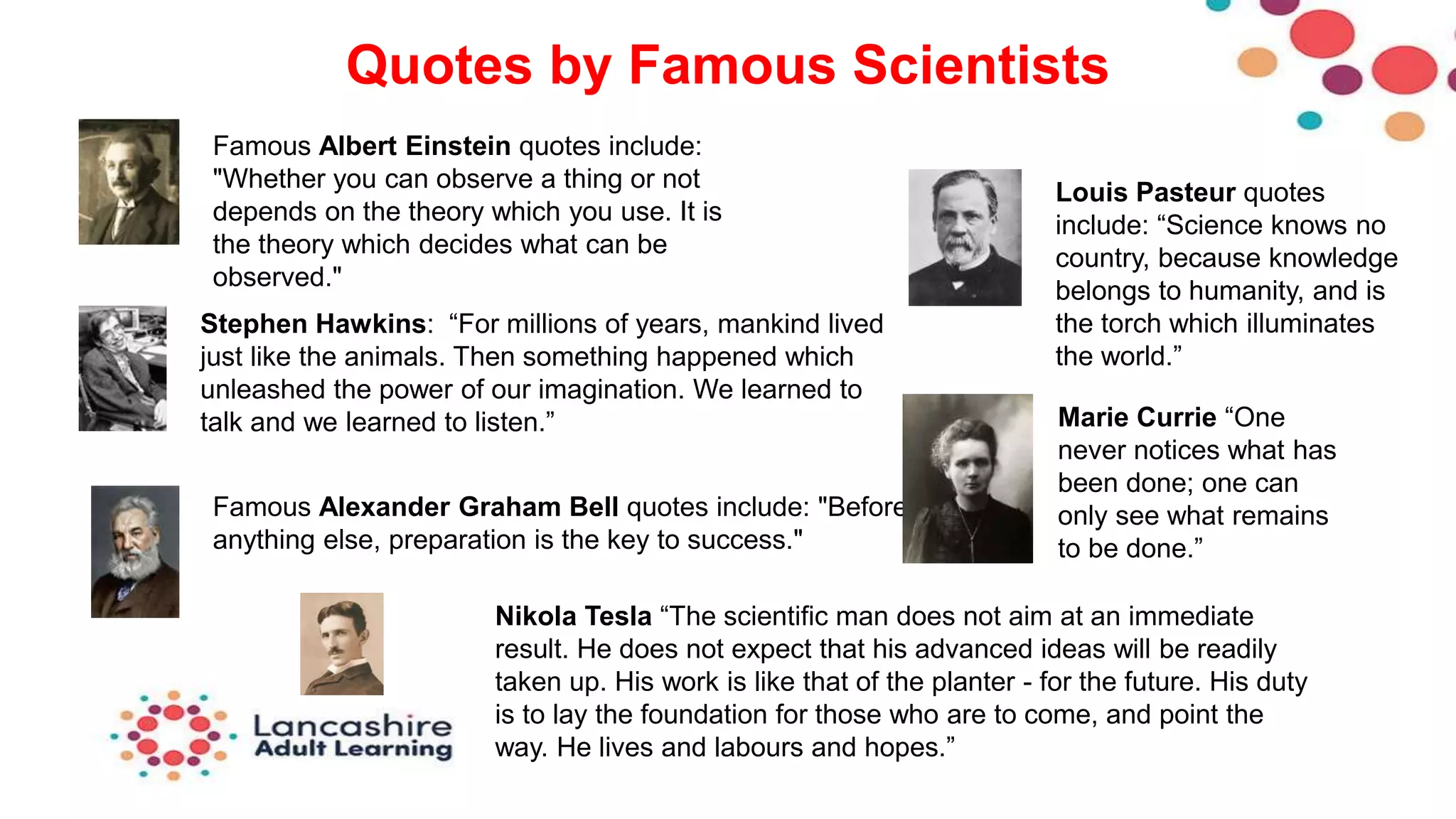
Quotes by Famous Scientists
Famous Albert Einstein quotes include:
"Whether you can observe a thing or not
depends on the theory which you use. It is
the theory which decides what can be
observed."
Stephen Hawkins: “For millions of years, mankind lived
just like the animals. Then something happened which
unleashed the power of our imagination. We learned to
talk and we learned to listen.”
Famous Alexander Graham Bell quotes include: "Before
anything else, preparation is the key to success."
Louis Pasteur quotes
include: “Science knows no
country, because knowledge
belongs to humanity, and is
the torch which illuminates
the world.”
Marie Currie “One
never notices what has
been done; one can
only see what remains
to be done.”
Nikola Tesla “The scientific man does not aim at an immediate
result. He does not expect that his advanced ideas will be readily
taken up. His work is like that of the planter - for the future. His duty
is to lay the foundation for those who are to come, and point the
way. He lives and labours and hopes.”
And finally
• Please click on the arrow to take part in the end of course quiz.
• Thank you for taking part in this course and we hope you find the information
useful in enabling you to support your child’s developing STEAM and
Science skills and confidence.
• Want to know more about the range of Family Learning courses from
Lancashire Adult Learning such as:
 Help your child with Maths at Home
 Fun with Phonics
 Lets Engineer
 Keep your child safe online
 CACHE L1 Preparing to work in Schools
Click on the arrow to
register your interest

Science spec conclusion slides 2

  • 1.
    Science Spectacular CourseSummary and Assessment
  • 2.
    Course Summary You havenow completed most of the activities for the course Hopefully you should have learned: • What the acronym STEAM means and how this links to Science. • How Science activities encourage learning and the skills they develop. • The meanings of key scientific terms used to conduct experiments. • How you can actively support your child in a scientific learning experience. Please click through the next few slides to find out about: • Tips to help your children further develop their science skills. • The Science curriculum at KS1 & KS2. • Useful Science and STEAM websites and apps • Some inspiration quotes by famous scientists. • Take the End of Course quiz to show the learning you have achieved
  • 3.
    Tips to HelpChildren Learn Science • Explore, explore, explore! Science is everywhere, which is why a visit to the park or an afternoon in the garden provides so many opportunities to learn. Always encourage your child to question their surroundings, and then discuss. If there is something you’re unsure of, research and learn the answer together. You don’t need to know all the answers—in fact, as a parent, it is beneficial when YOU ask questions and model curiosity as well. • Remember, science is cumulative. This means that children will build knowledge from what they already know. Start celebrating science in your home as early as possible, discuss science-based topics daily, and make it fun! Whether that means you head out for a special family constellation night or bake a cake, these are everyday opportunities that allow you to discuss science. • Always consider your child’s individual personality, interests, and social habits. This will allow you to come up with engaging activities that make them feel excited yet comfortable. Also, be mindful of what your child wants to do, as this will heighten their ability to learn. • Invest in a few pieces of equipment if your child is interested in learning more. An inexpensive microscope, for instance, could turn a trip to your local pond into an afternoon of wonder and learning. There are so many fun toys that will also get kids involved, including ant farms, astronomy kits, and kitchen science experiments, so have fun with science! • Invest in your child’s willingness to learn. There are many web-based programs available that are fun and interactive, helping them build a solid foundation in science.
  • 4.
    The Science Curriculumin KS1 & KS2 Key Stage 1 your child will learn to use the following methods, processes and skills: • asking simple questions (for example, 'What would happen if I didn't give a plant water?' • observing closely, using simple equipment such as a magnifying glass • identifying and classifying • using their observations and ideas to suggest answers to questions • gathering and recording data to help in answering questions Key Stage 2 Years 3 and 4, your child will be encouraged to ask questions about scientific concepts and then carry out experiments to find out the answers. In doing this they will: • learn what a 'fair test' is. • take measurements from a range of equipment. • gather and record data. • report their findings orally and in writing. Years 5 and 6, children will continue to practise the above skills, but with more depth and precision. They will: • understand what variables are and how to control them. • take measurements from a range of equipment, understanding the need for repeated measures to increase accuracy. • gather and record data using labels, classification keys, tables, scatter graphs, bar and line graphs. • use test results to make further predictions to set up further comparative and fair tests. • make conclusions on the test carried out, orally and in writing. Taken from the School Run. Click on the logo for more detailed information
  • 5.
    Useful Websites/Apps (click onthe icons below to link to the websites)
  • 6.
    Quotes by FamousScientists Famous Albert Einstein quotes include: "Whether you can observe a thing or not depends on the theory which you use. It is the theory which decides what can be observed." Stephen Hawkins: “For millions of years, mankind lived just like the animals. Then something happened which unleashed the power of our imagination. We learned to talk and we learned to listen.” Famous Alexander Graham Bell quotes include: "Before anything else, preparation is the key to success." Louis Pasteur quotes include: “Science knows no country, because knowledge belongs to humanity, and is the torch which illuminates the world.” Marie Currie “One never notices what has been done; one can only see what remains to be done.” Nikola Tesla “The scientific man does not aim at an immediate result. He does not expect that his advanced ideas will be readily taken up. His work is like that of the planter - for the future. His duty is to lay the foundation for those who are to come, and point the way. He lives and labours and hopes.”
  • 7.
    And finally • Pleaseclick on the arrow to take part in the end of course quiz. • Thank you for taking part in this course and we hope you find the information useful in enabling you to support your child’s developing STEAM and Science skills and confidence. • Want to know more about the range of Family Learning courses from Lancashire Adult Learning such as:  Help your child with Maths at Home  Fun with Phonics  Lets Engineer  Keep your child safe online  CACHE L1 Preparing to work in Schools Click on the arrow to register your interest