TYPES OF CURRENT USED IN ELECTROTHERAPY
~ABDUL AZEEM
BPT 1ST YEAR
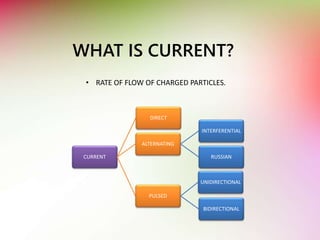
WHAT IS CURRENT?
• RATE OF FLOW OF CHARGED PARTICLES.
CURRENT
DIRECT
ALTERNATING
INTERFERENTIAL
RUSSIAN
PULSED
UNIDIRECTIONAL
BIDIRECTIONAL
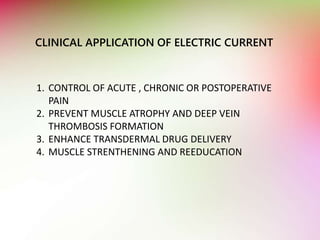
CLINICAL APPLICATION OF ELECTRIC CURRENT
1. CONTROL OF ACUTE , CHRONIC OR POSTOPERATIVE
PAIN
2. PREVENT MUSCLE ATROPHY AND DEEP VEIN
THROMBOSIS FORMATION
3. ENHANCE TRANSDERMAL DRUG DELIVERY
4. MUSCLE STRENTHENING AND REEDUCATION
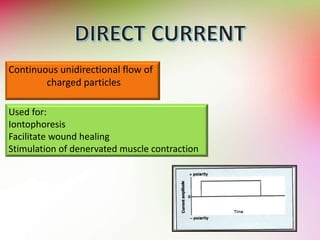
Continuous unidirectional flow of
charged particles
Used for:
Iontophoresis
Facilitate wound healing
Stimulation of denervated muscle contraction
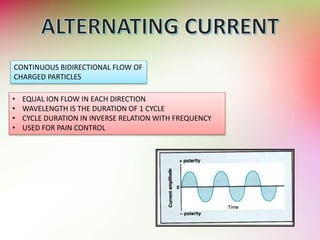
CONTINUOUS BIDIRECTIONAL FLOW OF
CHARGED PARTICLES
• EQUAL ION FLOW IN EACH DIRECTION
• WAVELENGTH IS THE DURATION OF 1 CYCLE
• CYCLE DURATION IN INVERSE RELATION WITH FREQUENCY
• USED FOR PAIN CONTROL
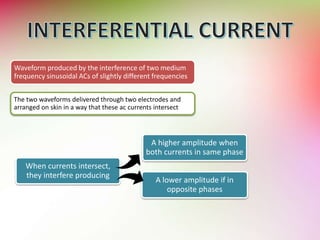
Waveform produced by the interference of two medium
frequency sinusoidal ACs of slightly different frequencies
The two waveforms delivered through two electrodes and
arranged on skin in a way that these ac currents intersect
When currents intersect,
they interfere producing
A higher amplitude when
both currents in same phase
A lower amplitude if in
opposite phases
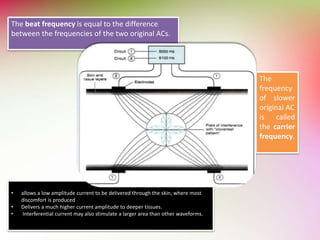
The beat frequency is equal to the difference
between the frequencies of the two original ACs.
The
frequency
of slower
original AC
is called
the carrier
frequency.
• allows a low amplitude current to be delivered through the skin, where most
discomfort is produced
• Delivers a much higher current amplitude to deeper tissues.
• Interferential current may also stimulate a larger area than other waveforms.
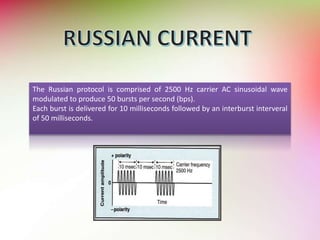
The Russian protocol is comprised of 2500 Hz carrier AC sinusoidal wave
modulated to produce 50 bursts per second (bps).
Each burst is delivered for 10 milliseconds followed by an interburst interveral
of 50 milliseconds.
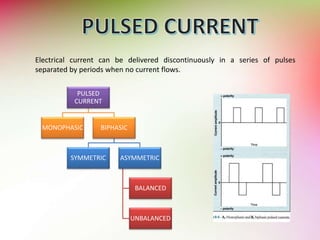
Electrical current can be delivered discontinuously in a series of pulses
separated by periods when no current flows.
PULSED
CURRENT
MONOPHASIC BIPHASIC
SYMMETRIC ASYMMETRIC
BALANCED
UNBALANCED
• Low frequency pulsed current, short duration interrupted DC.
• Pulse duration: 0.1-1 ms
• Frequency: 30-100 Hz.
• Used for stimulating innervated muscles.
 Waveform-
Biphasic, asymmetrical, unbalanced, spiked
Positive portion – Short duration, high amplitude and spiked
Negative portion – Long duration, low amplitude and curved
• Continuous direct current
• Used for iontophoresis
• For denervated muscles stimulation
• used to activate muscle directly, without activation of the peripheral nerve.
• Direct muscle stimulation requires pulse or phase durations of at least 1
milliseconds
• Purpose for electrically stimulating denervated muscle is to help minimize the
extent of atrophy while the nerve is regenerating
Types of currents in Electrotherapy.pptx

Types of currents in Electrotherapy.pptx

  • 1.
    TYPES OF CURRENTUSED IN ELECTROTHERAPY ~ABDUL AZEEM BPT 1ST YEAR
  • 2.
    WHAT IS CURRENT? •RATE OF FLOW OF CHARGED PARTICLES. CURRENT DIRECT ALTERNATING INTERFERENTIAL RUSSIAN PULSED UNIDIRECTIONAL BIDIRECTIONAL
  • 3.
    CLINICAL APPLICATION OFELECTRIC CURRENT 1. CONTROL OF ACUTE , CHRONIC OR POSTOPERATIVE PAIN 2. PREVENT MUSCLE ATROPHY AND DEEP VEIN THROMBOSIS FORMATION 3. ENHANCE TRANSDERMAL DRUG DELIVERY 4. MUSCLE STRENTHENING AND REEDUCATION
  • 4.
    Continuous unidirectional flowof charged particles Used for: Iontophoresis Facilitate wound healing Stimulation of denervated muscle contraction
  • 5.
    CONTINUOUS BIDIRECTIONAL FLOWOF CHARGED PARTICLES • EQUAL ION FLOW IN EACH DIRECTION • WAVELENGTH IS THE DURATION OF 1 CYCLE • CYCLE DURATION IN INVERSE RELATION WITH FREQUENCY • USED FOR PAIN CONTROL
  • 6.
    Waveform produced bythe interference of two medium frequency sinusoidal ACs of slightly different frequencies The two waveforms delivered through two electrodes and arranged on skin in a way that these ac currents intersect When currents intersect, they interfere producing A higher amplitude when both currents in same phase A lower amplitude if in opposite phases
  • 7.
    The beat frequencyis equal to the difference between the frequencies of the two original ACs. The frequency of slower original AC is called the carrier frequency. • allows a low amplitude current to be delivered through the skin, where most discomfort is produced • Delivers a much higher current amplitude to deeper tissues. • Interferential current may also stimulate a larger area than other waveforms.
  • 8.
    The Russian protocolis comprised of 2500 Hz carrier AC sinusoidal wave modulated to produce 50 bursts per second (bps). Each burst is delivered for 10 milliseconds followed by an interburst interveral of 50 milliseconds.
  • 9.
    Electrical current canbe delivered discontinuously in a series of pulses separated by periods when no current flows. PULSED CURRENT MONOPHASIC BIPHASIC SYMMETRIC ASYMMETRIC BALANCED UNBALANCED
  • 10.
    • Low frequencypulsed current, short duration interrupted DC. • Pulse duration: 0.1-1 ms • Frequency: 30-100 Hz. • Used for stimulating innervated muscles.  Waveform- Biphasic, asymmetrical, unbalanced, spiked Positive portion – Short duration, high amplitude and spiked Negative portion – Long duration, low amplitude and curved
  • 11.
    • Continuous directcurrent • Used for iontophoresis • For denervated muscles stimulation • used to activate muscle directly, without activation of the peripheral nerve. • Direct muscle stimulation requires pulse or phase durations of at least 1 milliseconds • Purpose for electrically stimulating denervated muscle is to help minimize the extent of atrophy while the nerve is regenerating