Airway clearance
devices
PRESENTED BY – SYED ADIL (MPT- 1)
Positive expiratory pressure
 The development of the positive expiratory pressure (PEP)
breathing came about 1980s in Denmark.
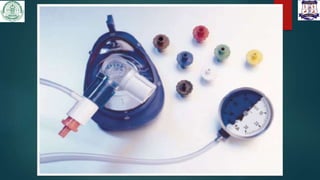
 The application of PEP consists of a mask or mouthpiece
connected to a one-way breathing valve to which expiratory
resistors are attached that create back pressure to stent the
airways opening during exhalation.
 PEP therapy involves active expiration against a fixed orifice
flow resistor or variable orifice threshold resistor capable of
developing pressure of 10-20cm H2O.
 A manometer in the circuit determines and monitors the
correct pressure generated by the patient.
 A patient uses PEP in a cycle of about 10 breaths at tidal
volume with slightly active expiration followed by
huffing or coughing o expectorate secretions(Falk and
Kelstrup, 1993).
Mechanism
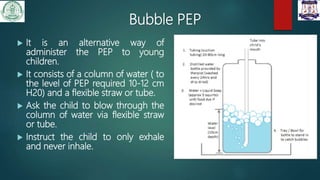
Bubble PEP
 It is an alternative way of
administer the PEP to young
children.
 It consists of a column of water ( to
the level of PEP required 10-12 cm
H20) and a flexible straw or tube.
 Ask the child to blow through the
column of water via flexible straw
or tube.
 Instruct the child to only exhale
and never inhale.
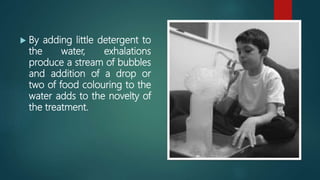
 By adding little detergent to
the water, exhalations
produce a stream of bubbles
and addition of a drop or
two of food colouring to the
water adds to the novelty of
the treatment.
Mechanism
 PEP allows more air to enter through collateral channels,
allowing reinflation of collapsed alveoli.
 Pressure is built up distal to an obstruction, promoting the
movement of secretions towards the larger airways.
 Airway stability is maintained with PEP promoting
improved ventilation and gas exchange, as well as
airway clearance.
 Supplemental oxygen can be supplied during
treatment with PEP and nebulized medication has
been shown to be effectively delivered with this
treatment as well
Indications of PEP
 Improve airway clearance
 Cystic fibrosis
 Bronchiectasis
 Improve lung function
 Acute and chronic
respiratory failure
 COPD
 Post operative atelectasis
Contraindication of PEP
 Untreated pneumothorax
 Acute haemoptysis
 Recent trauma or surgery
 Acute sinusitis
 Increased intracranial pressure
Uses of PEP
 Improve ventilation and gas exchange
 Help in airway clearance
 Prevent post operative atelectasis
 Reduce pulmonary hyperinflation
Oscillating PEP
 provides rapid fluctuation in airway as the patient exhales.
 Frequency of the vibration 10- 30Hz
 Amplitude 20 to 100 torr
 at flow of 10-25L/min.
 It provide positive expiratory pressure, oscillation of the
airway and accelerated expiratory flow rate to loose
secretion and move secretion centrally.
 Patient must be able to take deep breath (>10- 12 mL/kg) to
generate adequate pressure, oscillation and prolonged
exhalation.
 Commonly used devices:-
1. Flutter
2. R-C cornet
3. Acapella
4. Lung flute
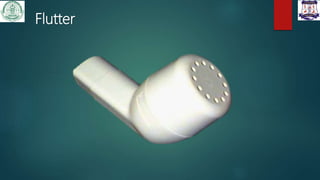
Flutter
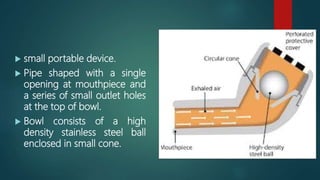
 small portable device.
 Pipe shaped with a single
opening at mouthpiece and
a series of small outlet holes
at the top of bowl.
 Bowl consists of a high
density stainless steel ball
enclosed in small cone.
 During expiration the movement of the ball along the surface
of the cone creates a positive expiratory pressure (PEP) and
an oscillatory vibration of the air within airways.
 Intermittent airflow accelerations are produced by the same
movements of the ball.
 The device is held horizontally and and tilted slightly either
downwards or upwards until a maximum oscillatory effect can
be felt.
 Sputum viscoelasticity has been shown to be reduced by the
use of flutter.
 The PEP maintained by the flutter (5-35cm H2O) prevent
dynamic airway compression and improve airway
acceleration.
 Movement of the flutter
 Upward:- increase pressure and frequency
 Downward:- lower pressure and frequency
Uses of Flutter
 Loosening mucus
 Facilitating movement of mucus up the airways
 Prevent the alveoli from collapsing
 Effective in cystic fibrosis and COPD patients
R-C cornet
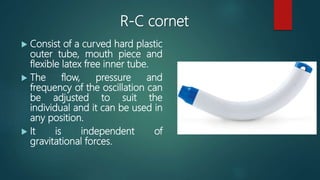
 Consist of a curved hard plastic
outer tube, mouth piece and
flexible latex free inner tube.
 The flow, pressure and
frequency of the oscillation can
be adjusted to suit the
individual and it can be used in
any position.
 It is independent of
gravitational forces.
 Exhaled gases pass through the curved plastic tube
containing a flexible latex free hose and sound damper.
 during exhalation the latex free hose strikes up and down of
the curved plastic tube, creating intermittently occluding
flow which produce oscillations and PEP.
 It can be used for 10-15 min.
Uses of R-C cornet
 Airway clearance
 COPD
 Cystic fibrosis
 Pulmonary disease
 Bronchiectasis
Acapella
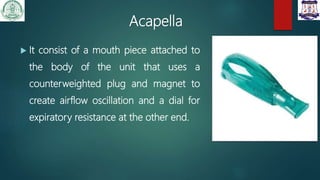
 It consist of a mouth piece attached to
the body of the unit that uses a
counterweighted plug and magnet to
create airflow oscillation and a dial for
expiratory resistance at the other end.
It comes in several models such as:
 Green:- maintain expiratory flow rate of 15L/min or more
 Blue:- expiratory flow rate is less than 15L/min
Uses of Acapella
 Cystic fibrosis
 COPD
 Bronchiectasis
 Asthma
 Mucociliary disorders
LUNG FLUTE
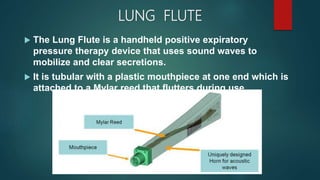
 The Lung Flute is a handheld positive expiratory
pressure therapy device that uses sound waves to
mobilize and clear secretions.
 It is tubular with a plastic mouthpiece at one end which is
attached to a Mylar reed that flutters during use.
 The Mylar reed is flared on the other end to increase the air mass
within the device. This provides acoustic impedance.
 When the device is being used, the Mylar reed will oscillate at a
frequency that matches the resonance frequency of pulmonary
secretions (16-25Hz).
 Thus, the viscosity of these secretions is reduced by mechanical
vibrations resulting from the sound waves. Additionally, these
vibrations will also facilitate the action of the mucociliary escalator
system, which will mobilize the loose and thin mucus.
Indications
• Chronic Obstructive Pulmonary Disease (COPD)
• Asthma
• Chronic Bronchitis
• Bronchiectasis
• Cystic Fibrosis
• Respiratory infections and Pneumonia
RECENT ADVANCE
Title :- Bubble-positive expiratory pressure device and
sputum clearance in bronchiectasis: A randomized
cross-over study
Published : 8 February 2020
Author : Mary Santos et.al
Journal : Physiotherapy International Research
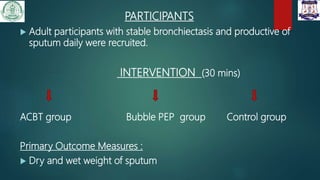
PARTICIPANTS
 Adult participants with stable bronchiectasis and productive of
sputum daily were recruited.
INTERVENTION (30 mins)
ACBT group Bubble PEP group Control group
Primary Outcome Measures :
 Dry and wet weight of sputum
CONCLUSION :
 Sputum wet weight was significantly greater with bubble-PEP
than control at all time periods, and greater than ACBT at 60-
min-post.
 Bubble-PEP could be considered an alternative sputum
clearance technique to ACBT.
References
 Jennifer A. pryor, Barbara A. Webber Physiotherapy for
respiratory and cardiac problems 2nd edition page no. 156
 Donna Frownfelter, Elizabeth Dean. Principles and practice of
cardiorespiratory physiotherapy 3rd edition page no. 328
THANK YOU

Airway clearance devices .pptx

  • 1.
  • 2.
    Positive expiratory pressure The development of the positive expiratory pressure (PEP) breathing came about 1980s in Denmark.  The application of PEP consists of a mask or mouthpiece connected to a one-way breathing valve to which expiratory resistors are attached that create back pressure to stent the airways opening during exhalation.  PEP therapy involves active expiration against a fixed orifice flow resistor or variable orifice threshold resistor capable of developing pressure of 10-20cm H2O.
  • 3.
     A manometerin the circuit determines and monitors the correct pressure generated by the patient.  A patient uses PEP in a cycle of about 10 breaths at tidal volume with slightly active expiration followed by huffing or coughing o expectorate secretions(Falk and Kelstrup, 1993).
  • 6.
  • 7.
    Bubble PEP  Itis an alternative way of administer the PEP to young children.  It consists of a column of water ( to the level of PEP required 10-12 cm H20) and a flexible straw or tube.  Ask the child to blow through the column of water via flexible straw or tube.  Instruct the child to only exhale and never inhale.
  • 8.
     By addinglittle detergent to the water, exhalations produce a stream of bubbles and addition of a drop or two of food colouring to the water adds to the novelty of the treatment.
  • 9.
    Mechanism  PEP allowsmore air to enter through collateral channels, allowing reinflation of collapsed alveoli.  Pressure is built up distal to an obstruction, promoting the movement of secretions towards the larger airways.
  • 10.
     Airway stabilityis maintained with PEP promoting improved ventilation and gas exchange, as well as airway clearance.  Supplemental oxygen can be supplied during treatment with PEP and nebulized medication has been shown to be effectively delivered with this treatment as well
  • 11.
    Indications of PEP Improve airway clearance  Cystic fibrosis  Bronchiectasis  Improve lung function  Acute and chronic respiratory failure  COPD  Post operative atelectasis
  • 12.
    Contraindication of PEP Untreated pneumothorax  Acute haemoptysis  Recent trauma or surgery  Acute sinusitis  Increased intracranial pressure
  • 13.
    Uses of PEP Improve ventilation and gas exchange  Help in airway clearance  Prevent post operative atelectasis  Reduce pulmonary hyperinflation
  • 14.
    Oscillating PEP  providesrapid fluctuation in airway as the patient exhales.  Frequency of the vibration 10- 30Hz  Amplitude 20 to 100 torr  at flow of 10-25L/min.  It provide positive expiratory pressure, oscillation of the airway and accelerated expiratory flow rate to loose secretion and move secretion centrally.
  • 16.
     Patient mustbe able to take deep breath (>10- 12 mL/kg) to generate adequate pressure, oscillation and prolonged exhalation.  Commonly used devices:- 1. Flutter 2. R-C cornet 3. Acapella 4. Lung flute
  • 17.
  • 18.
     small portabledevice.  Pipe shaped with a single opening at mouthpiece and a series of small outlet holes at the top of bowl.  Bowl consists of a high density stainless steel ball enclosed in small cone.
  • 19.
     During expirationthe movement of the ball along the surface of the cone creates a positive expiratory pressure (PEP) and an oscillatory vibration of the air within airways.  Intermittent airflow accelerations are produced by the same movements of the ball.  The device is held horizontally and and tilted slightly either downwards or upwards until a maximum oscillatory effect can be felt.  Sputum viscoelasticity has been shown to be reduced by the use of flutter.
  • 20.
     The PEPmaintained by the flutter (5-35cm H2O) prevent dynamic airway compression and improve airway acceleration.  Movement of the flutter  Upward:- increase pressure and frequency  Downward:- lower pressure and frequency
  • 21.
    Uses of Flutter Loosening mucus  Facilitating movement of mucus up the airways  Prevent the alveoli from collapsing  Effective in cystic fibrosis and COPD patients
  • 22.
    R-C cornet  Consistof a curved hard plastic outer tube, mouth piece and flexible latex free inner tube.  The flow, pressure and frequency of the oscillation can be adjusted to suit the individual and it can be used in any position.  It is independent of gravitational forces.
  • 23.
     Exhaled gasespass through the curved plastic tube containing a flexible latex free hose and sound damper.  during exhalation the latex free hose strikes up and down of the curved plastic tube, creating intermittently occluding flow which produce oscillations and PEP.  It can be used for 10-15 min.
  • 24.
    Uses of R-Ccornet  Airway clearance  COPD  Cystic fibrosis  Pulmonary disease  Bronchiectasis
  • 25.
    Acapella  It consistof a mouth piece attached to the body of the unit that uses a counterweighted plug and magnet to create airflow oscillation and a dial for expiratory resistance at the other end.
  • 26.
    It comes inseveral models such as:  Green:- maintain expiratory flow rate of 15L/min or more  Blue:- expiratory flow rate is less than 15L/min
  • 27.
    Uses of Acapella Cystic fibrosis  COPD  Bronchiectasis  Asthma  Mucociliary disorders
  • 28.
    LUNG FLUTE  TheLung Flute is a handheld positive expiratory pressure therapy device that uses sound waves to mobilize and clear secretions.  It is tubular with a plastic mouthpiece at one end which is attached to a Mylar reed that flutters during use.
  • 29.
     The Mylarreed is flared on the other end to increase the air mass within the device. This provides acoustic impedance.  When the device is being used, the Mylar reed will oscillate at a frequency that matches the resonance frequency of pulmonary secretions (16-25Hz).  Thus, the viscosity of these secretions is reduced by mechanical vibrations resulting from the sound waves. Additionally, these vibrations will also facilitate the action of the mucociliary escalator system, which will mobilize the loose and thin mucus.
  • 31.
    Indications • Chronic ObstructivePulmonary Disease (COPD) • Asthma • Chronic Bronchitis • Bronchiectasis • Cystic Fibrosis • Respiratory infections and Pneumonia
  • 32.
    RECENT ADVANCE Title :-Bubble-positive expiratory pressure device and sputum clearance in bronchiectasis: A randomized cross-over study Published : 8 February 2020 Author : Mary Santos et.al Journal : Physiotherapy International Research
  • 33.
    PARTICIPANTS  Adult participantswith stable bronchiectasis and productive of sputum daily were recruited. INTERVENTION (30 mins) ACBT group Bubble PEP group Control group Primary Outcome Measures :  Dry and wet weight of sputum
  • 34.
    CONCLUSION :  Sputumwet weight was significantly greater with bubble-PEP than control at all time periods, and greater than ACBT at 60- min-post.  Bubble-PEP could be considered an alternative sputum clearance technique to ACBT.
  • 35.
    References  Jennifer A.pryor, Barbara A. Webber Physiotherapy for respiratory and cardiac problems 2nd edition page no. 156  Donna Frownfelter, Elizabeth Dean. Principles and practice of cardiorespiratory physiotherapy 3rd edition page no. 328
  • 36.

Editor's Notes

  • #15 Peak expiratory flow rate (PEFR) is the volume of air forcefully expelled from the lungs in one quick exhalation,