HUMIDIFICATION
Dr. Rekha Marbate [PT]
Assistant Professor
CONTENT
Basic Physiology
Advance physiology
Types of Humidifiers
•BASIC PHYSIOLOGY
•Advance Physiology
INTRODUCTION
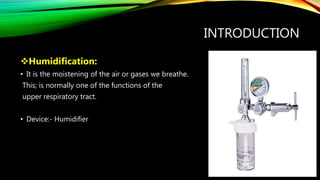
Humidification:
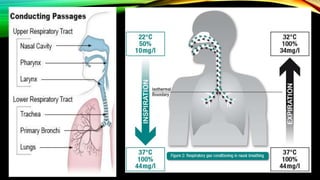
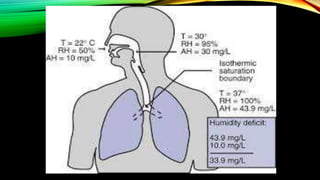
• It is the moistening of the air or gases we breathe.
This; is normally one of the functions of the
upper respiratory tract.
• Device:- Humidifier
INDICATION
1. When breathing through endotracheal or tracheostomy tubes
2. When breathing air to which gases have been added (0 2 masks)
3. When secretions are abnormally thick
WHEN BREATHING THROUGH
ENDOTRACHEAL OR TRACHEOSTOMY
TUBES
Dry air at lower than body temperature passing over secretions in the bronchial tree
extract the moisture from them causing crusts to be formed.
These crusts may partially block the trachea or main bronchus or occlude one of the
smaller airways.
 They are very difficult to remove.
Ciliary action i diminished and eventually destroyed in the absence of adequate
humidification.
Artificial humidification is therefore essential for the; maintenance of adequate
ventilation.
WHEN BREATHING AIR TO WHICH
GASES HAVE BEEN ADDED (0 2 MASKS)
• Medical gases are completely dry and will require considerably humidification
• and it may be considered advantageous to the patient! to augment the natural
humidification process.
WHEN SECRETIONS ARE
ABNORMALLY THICK
• Humidification will facilitate their removal
TYPES OF HUMIDIFIERS
Humidifiers
Suppliers
Ambient Temperature vapour supplier
Heated vapour supplier
Ambient Aerosol supplier
Heated aerosol supplier
Conservers of water Heat and Moisture exchanger or
condenser humidifier
AMBIENT TEMPERATURE VAPOUR SUPPLIER
• Gas is bubbled through room temperature water;
• if passed through a very fine sieve so that the
bubbles are very tiny then some useful
humidification can perhaps be obtained
HEATED VAPOUR SUPPLIER
• Gas is blown over a reservoir of heated sterile
water and absorbs water vapour which is then
inhaled by the patient.
• If the delivery tube is cold there is a temperature
drop as the gas passes along the tube and
condensation occurs.
• The humidifier should be positioned below the
level of the patient's airway to avoid flooding of
the airway by condensed water.
• Sealed (to prevent contamination) water traps should be included in the circuit to
allow regular emptying without interrupting ventilation.
• A heated delivery tube eliminates the problem of condensation and allows the gas
to be delivered at a desired temperature of 32-36° with a water content of 33-43
g/m3 (Hinds & Watson 1996).
•
• Humiditiers can be used for the spontaneously breathing patient or can be
incorporated into ventilator circuits including continuous positive] airway pressure
and non-invasive ventilation
AMBIENT AEROSOL SUPPLIER
• These produce a mist of liquid either by breaking up water entrained by a high
pressure gas on an anvil or
• generating the mist with a high speed spinning disc or an ultrasonic vibrating
crystal.
• Many of these devices are oxygen driven, and entrain room air (using a venturi) in
varying amounts according to the oxygen percentage (0 2%) required.
• The total gas flow varies with the entrainment, and they become rather noisy when
low 0 2 concentrations and hence high rates of air entrainment are used.
• The relative amount of vapour also falls at these high flows.
Ultrasonic
Humidifier
HEATED AEROSOL SUPPLIERS
• The water to be nebulised is heated, and in particular the
Bernouilli-type devices are often made to take a heating
element or ‘hot rod’.
• Thermal safety again is essential.
HEAT AND MOISTURE EXCHANGERS
(HMES)
• These heat and moisture exchangers
(HMEs), or condenser humidifiers, trap
expired heat and water in a mesh, and
return it to the fresh inspired gas.
• A heat and moisture exchanger or the
'Swedish nose' are lightweight disposable
devices and may be used in the intubated
patient either mechanically ventilated or
breathing spontaneously
• In the spontaneously breathing patient it is important to be aware of the slight
resistance that will increase the work of breathing.
• The humidifier acts in a similar way to the nasopharynx.
• The heat and moisture of the exhaled gas are retained either by condensation or by
absorption, and returned in the inhaled gas as it passes through the device.
• Heat and moisture exchangers are inefficient if there is a large air leak around an
uncuffed tracheostomy tube.
• do not provide adequate humidification for infants.
• If the secretions of a patient using a heat and moisture exchanger become
tenacious, a more effective form of humidification will be required
• The humidifier must be changed at least every 24 hours and immediately if it
becomes soiled with secretions.
REFERENCES
1. Cash's Textbook of Chest, Heart and Vascular Disorders for Physiotherapist
2. Physiotherapy for respiratory and cardiac problem by Jennifer A. Pryor.
This Photo by Unknown Author is licensed under CC BY

Humidification

  • 1.
    HUMIDIFICATION Dr. Rekha Marbate[PT] Assistant Professor
  • 2.
  • 3.
  • 7.
  • 9.
    INTRODUCTION Humidification: • It isthe moistening of the air or gases we breathe. This; is normally one of the functions of the upper respiratory tract. • Device:- Humidifier
  • 10.
    INDICATION 1. When breathingthrough endotracheal or tracheostomy tubes 2. When breathing air to which gases have been added (0 2 masks) 3. When secretions are abnormally thick
  • 11.
    WHEN BREATHING THROUGH ENDOTRACHEALOR TRACHEOSTOMY TUBES Dry air at lower than body temperature passing over secretions in the bronchial tree extract the moisture from them causing crusts to be formed. These crusts may partially block the trachea or main bronchus or occlude one of the smaller airways.  They are very difficult to remove. Ciliary action i diminished and eventually destroyed in the absence of adequate humidification. Artificial humidification is therefore essential for the; maintenance of adequate ventilation.
  • 12.
    WHEN BREATHING AIRTO WHICH GASES HAVE BEEN ADDED (0 2 MASKS) • Medical gases are completely dry and will require considerably humidification • and it may be considered advantageous to the patient! to augment the natural humidification process.
  • 13.
    WHEN SECRETIONS ARE ABNORMALLYTHICK • Humidification will facilitate their removal
  • 14.
    TYPES OF HUMIDIFIERS Humidifiers Suppliers AmbientTemperature vapour supplier Heated vapour supplier Ambient Aerosol supplier Heated aerosol supplier Conservers of water Heat and Moisture exchanger or condenser humidifier
  • 15.
    AMBIENT TEMPERATURE VAPOURSUPPLIER • Gas is bubbled through room temperature water; • if passed through a very fine sieve so that the bubbles are very tiny then some useful humidification can perhaps be obtained
  • 16.
    HEATED VAPOUR SUPPLIER •Gas is blown over a reservoir of heated sterile water and absorbs water vapour which is then inhaled by the patient. • If the delivery tube is cold there is a temperature drop as the gas passes along the tube and condensation occurs. • The humidifier should be positioned below the level of the patient's airway to avoid flooding of the airway by condensed water.
  • 17.
    • Sealed (toprevent contamination) water traps should be included in the circuit to allow regular emptying without interrupting ventilation. • A heated delivery tube eliminates the problem of condensation and allows the gas to be delivered at a desired temperature of 32-36° with a water content of 33-43 g/m3 (Hinds & Watson 1996). • • Humiditiers can be used for the spontaneously breathing patient or can be incorporated into ventilator circuits including continuous positive] airway pressure and non-invasive ventilation
  • 18.
    AMBIENT AEROSOL SUPPLIER •These produce a mist of liquid either by breaking up water entrained by a high pressure gas on an anvil or • generating the mist with a high speed spinning disc or an ultrasonic vibrating crystal. • Many of these devices are oxygen driven, and entrain room air (using a venturi) in varying amounts according to the oxygen percentage (0 2%) required. • The total gas flow varies with the entrainment, and they become rather noisy when low 0 2 concentrations and hence high rates of air entrainment are used. • The relative amount of vapour also falls at these high flows.
  • 19.
  • 20.
    HEATED AEROSOL SUPPLIERS •The water to be nebulised is heated, and in particular the Bernouilli-type devices are often made to take a heating element or ‘hot rod’. • Thermal safety again is essential.
  • 21.
    HEAT AND MOISTUREEXCHANGERS (HMES) • These heat and moisture exchangers (HMEs), or condenser humidifiers, trap expired heat and water in a mesh, and return it to the fresh inspired gas. • A heat and moisture exchanger or the 'Swedish nose' are lightweight disposable devices and may be used in the intubated patient either mechanically ventilated or breathing spontaneously
  • 22.
    • In thespontaneously breathing patient it is important to be aware of the slight resistance that will increase the work of breathing. • The humidifier acts in a similar way to the nasopharynx. • The heat and moisture of the exhaled gas are retained either by condensation or by absorption, and returned in the inhaled gas as it passes through the device. • Heat and moisture exchangers are inefficient if there is a large air leak around an uncuffed tracheostomy tube. • do not provide adequate humidification for infants. • If the secretions of a patient using a heat and moisture exchanger become tenacious, a more effective form of humidification will be required • The humidifier must be changed at least every 24 hours and immediately if it becomes soiled with secretions.
  • 23.
    REFERENCES 1. Cash's Textbookof Chest, Heart and Vascular Disorders for Physiotherapist 2. Physiotherapy for respiratory and cardiac problem by Jennifer A. Pryor.
  • 24.
    This Photo byUnknown Author is licensed under CC BY