HR Analytics
Presented By:
Preksha Pagare
80303170079
HR Analytics
• Workforce Analytics/ People Analytics/ Talent Analytics
• Analyzing the problem of people in an organization using data
• Identifying and quantifying the human drivers of business outcomes.
• Making better decisions using HR data
Need of HR Analytics
• To predict workforce trends, minimize risks and maximize
returns
• The costs of attrition, poor hiring, sub-optimal compensation,
keeping below par employees, bad training & learning
strategies are just too high
• Data-driven insights to make decisions in terms of
– how to recruit
– whom to hire
– how to onboard and train employees
– how they keep employees informed and engaged
through their tenure with the organization
Benefits of HR Analytics
• Benefit 1- Talent Acquisition
Companies are struggling to attract the appropriate talent and devise ways to
retain young talent. By utilizing HR analytics, companies can sift through
thousands of resumes and create a base of the most promising prospects.
• Benefit 2: Improving employee experience
Analyzing how strong the sense of belonging to the company is, as well as what
contributes to it with help of tools like HR analytics, can help improve company
culture and create a better work environment.
• Benefit 3: Stabilize retention
HR analytics has become the primary tool to assess the retention rate of
employees. It helps to identify the skill gaps and areas where teams are
struggling.
Benefits of HR Analytics(contd)
• Benefit 4: Streamlining corporate training and evaluations
By using HR analytics, trainers can get the best valuation and devise new
strategies to modify courses and make employees more productive.
• Benefit 5: Rethinking financial compensation
HR analytics can help you determine the financial model for each employee –
this is critical for large Fortune 500 companies since they have many
international branches with employees at various levels in the hierarchy.
• Benefit 6: Unified employee support
Employees need to access different intranet locations and contact different
people depending on the HR support they need or the information they are
looking for. By making use of HR analytics tools, companies can identify a
resource that accepts employee requests and returns the relevant information.
Benefits of HR Analytics(contd)
• Benefit 7: Taking greater advantage of machine learning
Machine learning and tools leverage the insights gained from HR analytics to
help interpret and act on HR data. This helps in examine
employee and applicant data and help create strong matches for roles and
teams, resulting in the recruitment of people that work well together and create
effective results.
• A recent survey by MIT and IBM highlighted the fact that companies with a high
level of HR analytics had: 8% higher sales growth, 24% higher net operating
income, and 58% higher sales per employee.
HRIS – HR Information System
• A software that provides a centralized repository of employee master data that
the human resource management (HRM) group needs for completing core
human resource (HR) processes.
• An HRIS stores, processes and manages employee data
• An HRIS can be considered a smart database of employee information: The
interaction of the data, the processes that can be performed and the reporting
capabilities make the data stored in the system more accessible and usable.
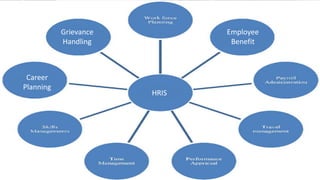
HRIS
Career
Planning
Grievance
Handling
Employee
Benefit
Benefits of HRIS
• Reduction in the cost of stored data in human resource.
• Higher speed of retrieval and processing of data.
• Reduction in duplication of efforts leading to reduction in cost.
• Availability of accurate and timely data about human resources.
• Better analysis leading to more effective decision making.
• More meaningful career planning and counselling at all levels.
• Improved quality of reports.
• Better ability to respond to environmental changes.
• More transparency in the system
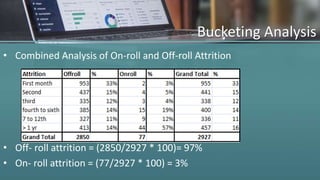
Bucketing Analysis
• Combined Analysis of On-roll and Off-roll Attrition
• Off- roll attrition = (2850/2927 * 100)= 97%
• On- roll attrition = (77/2927 * 100) = 3%
Thank
You!

Hr analytics

  • 1.
  • 2.
    HR Analytics • WorkforceAnalytics/ People Analytics/ Talent Analytics • Analyzing the problem of people in an organization using data • Identifying and quantifying the human drivers of business outcomes. • Making better decisions using HR data
  • 3.
    Need of HRAnalytics • To predict workforce trends, minimize risks and maximize returns • The costs of attrition, poor hiring, sub-optimal compensation, keeping below par employees, bad training & learning strategies are just too high • Data-driven insights to make decisions in terms of – how to recruit – whom to hire – how to onboard and train employees – how they keep employees informed and engaged through their tenure with the organization
  • 4.
    Benefits of HRAnalytics • Benefit 1- Talent Acquisition Companies are struggling to attract the appropriate talent and devise ways to retain young talent. By utilizing HR analytics, companies can sift through thousands of resumes and create a base of the most promising prospects. • Benefit 2: Improving employee experience Analyzing how strong the sense of belonging to the company is, as well as what contributes to it with help of tools like HR analytics, can help improve company culture and create a better work environment. • Benefit 3: Stabilize retention HR analytics has become the primary tool to assess the retention rate of employees. It helps to identify the skill gaps and areas where teams are struggling.
  • 5.
    Benefits of HRAnalytics(contd) • Benefit 4: Streamlining corporate training and evaluations By using HR analytics, trainers can get the best valuation and devise new strategies to modify courses and make employees more productive. • Benefit 5: Rethinking financial compensation HR analytics can help you determine the financial model for each employee – this is critical for large Fortune 500 companies since they have many international branches with employees at various levels in the hierarchy. • Benefit 6: Unified employee support Employees need to access different intranet locations and contact different people depending on the HR support they need or the information they are looking for. By making use of HR analytics tools, companies can identify a resource that accepts employee requests and returns the relevant information.
  • 6.
    Benefits of HRAnalytics(contd) • Benefit 7: Taking greater advantage of machine learning Machine learning and tools leverage the insights gained from HR analytics to help interpret and act on HR data. This helps in examine employee and applicant data and help create strong matches for roles and teams, resulting in the recruitment of people that work well together and create effective results. • A recent survey by MIT and IBM highlighted the fact that companies with a high level of HR analytics had: 8% higher sales growth, 24% higher net operating income, and 58% higher sales per employee.
  • 7.
    HRIS – HRInformation System • A software that provides a centralized repository of employee master data that the human resource management (HRM) group needs for completing core human resource (HR) processes. • An HRIS stores, processes and manages employee data • An HRIS can be considered a smart database of employee information: The interaction of the data, the processes that can be performed and the reporting capabilities make the data stored in the system more accessible and usable.
  • 8.
  • 9.
    Benefits of HRIS •Reduction in the cost of stored data in human resource. • Higher speed of retrieval and processing of data. • Reduction in duplication of efforts leading to reduction in cost. • Availability of accurate and timely data about human resources. • Better analysis leading to more effective decision making. • More meaningful career planning and counselling at all levels. • Improved quality of reports. • Better ability to respond to environmental changes. • More transparency in the system
  • 10.
    Bucketing Analysis • CombinedAnalysis of On-roll and Off-roll Attrition • Off- roll attrition = (2850/2927 * 100)= 97% • On- roll attrition = (77/2927 * 100) = 3%
  • 11.