PEOPLE, STRATEGY
&
WORKFORCE
PLANNING
PRESENTED BY:
SALONI AGARWAL
PEOPLE RESPONSIBILTIESOUTSIDE WORK
Many employees will have responsibilities outside work that are in
addition to those they normally have during a working day. If schools
are closed for example, they may have children at home where they are
working, or responsibility for elderly or vulnerable family members
some of whom may be ill.
You (As a HR) should discuss with them how you can be compassionate
in your approach to management and work, and what you can do to
accommodate these needs while maintaining business continuity. The
additional stresses people will be under will also emphasise the need for
your organisation to be clear about its well-being policy and how this is
applied during exceptional circumstances.
FLEXIBLEWORKING
Flexible working, for example core hours during part of the day when all
employees are asked to be online and available and around which some
flexibility is offered to allow people to meet their other responsibilities
with reduced pressure.
Flexible working may also help you to meet shortages through sickness,
through measures such as split shifts to ensure essential work is covered
for as much time as possible.
Working from home, even if not mandated by law, will also help limit the
spread of infection so where possible should be considered.
Technology can play a key part in your policy, with video conferencing
facilities and chat functions useful for maintaining regular contact and a
collaborative working environment.
WHAT IS STRATEGY?
Broadly speaking a strategy is the steps an organisation will take to
achieve its goal. Achieving the goal is one of the ways in which the
organisation then in turn meets its purpose.
If we take an airline as an example, their goal might be to be a
market leading company for in-flight customer service on a
particular route, and the strategy will be the different actions they
take over a period of time to enable them to achieve that goal.
The strategy might include:
Market research: What matters most to customers? Would they be
prepared to pay more for a better service? Do any competitors offer a
better service, and if so how, and for what price?
Recruiting new staff to meet specific needs and challenges: It might be
that there are skills gaps to be solved.
Buying competitor airlines: Expanding market share and growing
rapidly through acquisition could be beneficial.
Increasing marketing spend: Building awareness amongst potential
customers who may not realise what routes the airline flies, or have
incorrect perceptions of the airline.
New branding: A refresh of the organisation look isn’t a small exercise,
but can help build brand knowledge.
Understanding your organisation’s purpose
Understanding and articulating purpose can also be useful in motivating and
engaging with colleagues. It is one thing to work to pay your bills and feed your
family and that is important, but another to also be working to delight those
who use your services, or benefit your community or some other purpose in
addition to generating profit or sales. This isn’t ignoring the economic realities
or financial profit motivations that also sit behind why organisations do what
they do, however those motivations are seldom enough to drive forward a
strategy on their own.
HR will have its own strategy to support the organisation, as may other key
functions such as IT.
HR STRATEGY
To develop an HR strategy, it’s important to understand the business strategy
and how different teams within the business may vary in their approaches to
meeting it.
For example, an organisation’s aim may be to improve its customer service.
Within this, there may be a need to upgrade IT systems so that employees can
better share information, but equally there may also be a need to reduce costs.
Understanding the varying needs of different parts of your organisation is key
to creating a successful HR strategy.
key stages of forming a HR strategy
I. Define the business strategy
II. Analyse the context
III. Identify business needs
IV. Identify key HR issues
V. Develop the strategic framework
VI. Develop HR strategies
VII. Assess HR capability
I. Define the business strategy
If the purpose of HR is
broadly to support the
business to meet its
objectives and strategy, HR
must have a thorough
understanding of this
strategy. Better yet, if HR is
in a position to inform the
strategy and ensure HR
issues are understood, it can
remove the need for reactive
solutions later on.
II. Analyse the context
In order to plan
effectively, HR must
understand the world the
business operates in. To do
this, a SWOT analysis can
be used. This explores
what is and isn’t being
done well and how
changes can be managed
from a HR perspective.
III. Identify business needs
Business needs are ways
in which the business has
to change or improve to
deliver on the strategy.
HR can find out more
about business needs
through internal reports
or by talking to different
areas of the business.
IV. Identify key HR issues
It may become apparent
that there are issues
getting in the way of
addressing a business
need. If these issues
relate to people, then they
can be classed as HR
issues. This can include
things like training needs
or a lack of diversity.
V. Develop the strategic framework
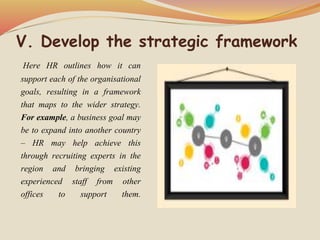
Here HR outlines how it can
support each of the organisational
goals, resulting in a framework
that maps to the wider strategy.
For example, a business goal may
be to expand into another country
– HR may help achieve this
through recruiting experts in the
region and bringing existing
experienced staff from other
offices to support them.
VI. Develop HR strategies
At this point HR should
draw up each of its
strategies, explain what
resources (financial,
people etc.) will be
needed to deliver on the
HR strategy and produce
a timetable for when they
will be able to deliver.
VII. Assess HR capability
HR will now look at whether
they themselves are
organised in the right way,
have the right skill set or
have the right processes in
place to deliver on the
strategy. It may be
appropriate to perform
another SWOT analysis to
drill down into some of the
detail of what’s required.
Workforceplanning andits need
The need for organisations to have the right people, with the right
skills, in the right roles, at the right time, at the right cost is as true
today as it’s ever been.
Many industries currently face skills gaps, which has led to more
competition for ‘talented’ employees. HR has a key role in helping
organisations meet these challenges that doesn’t just help them
thrive, but in some cases survive.
Workforce planning can be the most effective way for HR to
strategically add value. Plus, it doesn’t need to be complicated,
that’ll often depend on the size of an organisation and how long it’s
been around.
Business strategy
Workforce planning needs to align the demand for people with what the
business wants to achieve. So, understanding the direction of the business is
essential.
Understanding the business and its environment:
This sets the context for your plan and considers ‘Where are we now?’ and
‘Where do we want to be in 2, 5, or in 10 years time?’
 Look at your internal factors: these are areas of strength or weakness
relating to how the organisation operates. Examples of this include typical
business metrics such as productivity, efficiency and revenues, plus related
areas such as capability, culture and leadership strength.
 Look at your external factors: these are areas outside of the organisation that
may have an impact on the business.
Identifying gaps:
This results in a list of actions. Some actions will be fairly simple –
for example, you may plan to recruit people to fill upcoming
vacancies, or plan to develop learning initiatives to address skill
gaps. Another action area could involve re-designing roles due to
organisational change.
Internal labour market: this is the labour market that exists inside
of the organisation, so the people within and organisation and their
skills and capabilities.
External labour market: this is the labour market that exists
outside of the organisation, so people that can be recruited in the
future.
Workforce planning& employee life-cycle
 The employee life-cycle is an overview of each of the different
stages of an employee’s journey through the organisation. It
includes attraction, recruitment, on-boarding, development and
retention, and separation.
 Workforce planning touches on each of these stages, so can
often act as a link between each of the different activities.
I. Attraction: It is about how likely people are to apply for roles within the
organisation. It is the time it takes to fill positions. It can also be affected by
whether or not people are likely to have heard of the organisation (brand
awareness) and how they might perceive it.
II. Recruitment: Recruitment is about getting people to apply for jobs, and
then filtering them in a way that will result in the right person getting the
job. For example, it’s not uncommon these days for candidates to be
interviewed remotely via video conferencing, at least for the first part of the
process.
III. On-boarding: This is about giving new employees a feel of the organisation,
so they’re able to make a smooth transition into their new role. Often
there’s a gap between making an offer of employment, having it be accepted
by the candidate and then the start date. However, it’s sometimes possible to
send new starters information about the organisation before their official
start date, which can speed up the process.
IV. Development and retention: This is about developing the skills of
employees, and trying to get them to stay with the organisation. For
example when employment is high, or there’s lots of competition for certain
skills. Evidence suggests this challenge can exist both in times of economic
growth and decline.
Collecting data on staff turnover (how often and why people leave the
organisation) is a good way to identify some of the factors causing people to
leave. Plans can then be put in place to address these issues. For
example through promotions, and/or the extent to which job vacancies are
filled by recruiting from outside.
V. Separation: Workforce planning will also help you to plan for exits such as
redundancies, dismissals and retirement. These are all subject to local
employment legislation so it is advisable to check you do not act in a way
that breaches a person’s employment rights. In the UK for example there
are 5 ‘fair’ reasons for dismissal of which redundancy is one.
People, Strategy & Workforce Planning

People, Strategy & Workforce Planning

  • 1.
  • 2.
    PEOPLE RESPONSIBILTIESOUTSIDE WORK Manyemployees will have responsibilities outside work that are in addition to those they normally have during a working day. If schools are closed for example, they may have children at home where they are working, or responsibility for elderly or vulnerable family members some of whom may be ill. You (As a HR) should discuss with them how you can be compassionate in your approach to management and work, and what you can do to accommodate these needs while maintaining business continuity. The additional stresses people will be under will also emphasise the need for your organisation to be clear about its well-being policy and how this is applied during exceptional circumstances.
  • 3.
    FLEXIBLEWORKING Flexible working, forexample core hours during part of the day when all employees are asked to be online and available and around which some flexibility is offered to allow people to meet their other responsibilities with reduced pressure. Flexible working may also help you to meet shortages through sickness, through measures such as split shifts to ensure essential work is covered for as much time as possible. Working from home, even if not mandated by law, will also help limit the spread of infection so where possible should be considered. Technology can play a key part in your policy, with video conferencing facilities and chat functions useful for maintaining regular contact and a collaborative working environment.
  • 4.
    WHAT IS STRATEGY? Broadlyspeaking a strategy is the steps an organisation will take to achieve its goal. Achieving the goal is one of the ways in which the organisation then in turn meets its purpose. If we take an airline as an example, their goal might be to be a market leading company for in-flight customer service on a particular route, and the strategy will be the different actions they take over a period of time to enable them to achieve that goal.
  • 5.
    The strategy mightinclude: Market research: What matters most to customers? Would they be prepared to pay more for a better service? Do any competitors offer a better service, and if so how, and for what price? Recruiting new staff to meet specific needs and challenges: It might be that there are skills gaps to be solved. Buying competitor airlines: Expanding market share and growing rapidly through acquisition could be beneficial. Increasing marketing spend: Building awareness amongst potential customers who may not realise what routes the airline flies, or have incorrect perceptions of the airline. New branding: A refresh of the organisation look isn’t a small exercise, but can help build brand knowledge.
  • 6.
    Understanding your organisation’spurpose Understanding and articulating purpose can also be useful in motivating and engaging with colleagues. It is one thing to work to pay your bills and feed your family and that is important, but another to also be working to delight those who use your services, or benefit your community or some other purpose in addition to generating profit or sales. This isn’t ignoring the economic realities or financial profit motivations that also sit behind why organisations do what they do, however those motivations are seldom enough to drive forward a strategy on their own. HR will have its own strategy to support the organisation, as may other key functions such as IT.
  • 7.
    HR STRATEGY To developan HR strategy, it’s important to understand the business strategy and how different teams within the business may vary in their approaches to meeting it. For example, an organisation’s aim may be to improve its customer service. Within this, there may be a need to upgrade IT systems so that employees can better share information, but equally there may also be a need to reduce costs. Understanding the varying needs of different parts of your organisation is key to creating a successful HR strategy.
  • 8.
    key stages offorming a HR strategy I. Define the business strategy II. Analyse the context III. Identify business needs IV. Identify key HR issues V. Develop the strategic framework VI. Develop HR strategies VII. Assess HR capability
  • 9.
    I. Define thebusiness strategy If the purpose of HR is broadly to support the business to meet its objectives and strategy, HR must have a thorough understanding of this strategy. Better yet, if HR is in a position to inform the strategy and ensure HR issues are understood, it can remove the need for reactive solutions later on.
  • 10.
    II. Analyse thecontext In order to plan effectively, HR must understand the world the business operates in. To do this, a SWOT analysis can be used. This explores what is and isn’t being done well and how changes can be managed from a HR perspective.
  • 11.
    III. Identify businessneeds Business needs are ways in which the business has to change or improve to deliver on the strategy. HR can find out more about business needs through internal reports or by talking to different areas of the business.
  • 12.
    IV. Identify keyHR issues It may become apparent that there are issues getting in the way of addressing a business need. If these issues relate to people, then they can be classed as HR issues. This can include things like training needs or a lack of diversity.
  • 13.
    V. Develop thestrategic framework Here HR outlines how it can support each of the organisational goals, resulting in a framework that maps to the wider strategy. For example, a business goal may be to expand into another country – HR may help achieve this through recruiting experts in the region and bringing existing experienced staff from other offices to support them.
  • 14.
    VI. Develop HRstrategies At this point HR should draw up each of its strategies, explain what resources (financial, people etc.) will be needed to deliver on the HR strategy and produce a timetable for when they will be able to deliver.
  • 15.
    VII. Assess HRcapability HR will now look at whether they themselves are organised in the right way, have the right skill set or have the right processes in place to deliver on the strategy. It may be appropriate to perform another SWOT analysis to drill down into some of the detail of what’s required.
  • 16.
    Workforceplanning andits need Theneed for organisations to have the right people, with the right skills, in the right roles, at the right time, at the right cost is as true today as it’s ever been. Many industries currently face skills gaps, which has led to more competition for ‘talented’ employees. HR has a key role in helping organisations meet these challenges that doesn’t just help them thrive, but in some cases survive. Workforce planning can be the most effective way for HR to strategically add value. Plus, it doesn’t need to be complicated, that’ll often depend on the size of an organisation and how long it’s been around.
  • 17.
    Business strategy Workforce planningneeds to align the demand for people with what the business wants to achieve. So, understanding the direction of the business is essential. Understanding the business and its environment: This sets the context for your plan and considers ‘Where are we now?’ and ‘Where do we want to be in 2, 5, or in 10 years time?’  Look at your internal factors: these are areas of strength or weakness relating to how the organisation operates. Examples of this include typical business metrics such as productivity, efficiency and revenues, plus related areas such as capability, culture and leadership strength.  Look at your external factors: these are areas outside of the organisation that may have an impact on the business.
  • 18.
    Identifying gaps: This resultsin a list of actions. Some actions will be fairly simple – for example, you may plan to recruit people to fill upcoming vacancies, or plan to develop learning initiatives to address skill gaps. Another action area could involve re-designing roles due to organisational change. Internal labour market: this is the labour market that exists inside of the organisation, so the people within and organisation and their skills and capabilities. External labour market: this is the labour market that exists outside of the organisation, so people that can be recruited in the future.
  • 19.
    Workforce planning& employeelife-cycle  The employee life-cycle is an overview of each of the different stages of an employee’s journey through the organisation. It includes attraction, recruitment, on-boarding, development and retention, and separation.  Workforce planning touches on each of these stages, so can often act as a link between each of the different activities.
  • 20.
    I. Attraction: Itis about how likely people are to apply for roles within the organisation. It is the time it takes to fill positions. It can also be affected by whether or not people are likely to have heard of the organisation (brand awareness) and how they might perceive it. II. Recruitment: Recruitment is about getting people to apply for jobs, and then filtering them in a way that will result in the right person getting the job. For example, it’s not uncommon these days for candidates to be interviewed remotely via video conferencing, at least for the first part of the process. III. On-boarding: This is about giving new employees a feel of the organisation, so they’re able to make a smooth transition into their new role. Often there’s a gap between making an offer of employment, having it be accepted by the candidate and then the start date. However, it’s sometimes possible to send new starters information about the organisation before their official start date, which can speed up the process.
  • 21.
    IV. Development andretention: This is about developing the skills of employees, and trying to get them to stay with the organisation. For example when employment is high, or there’s lots of competition for certain skills. Evidence suggests this challenge can exist both in times of economic growth and decline. Collecting data on staff turnover (how often and why people leave the organisation) is a good way to identify some of the factors causing people to leave. Plans can then be put in place to address these issues. For example through promotions, and/or the extent to which job vacancies are filled by recruiting from outside. V. Separation: Workforce planning will also help you to plan for exits such as redundancies, dismissals and retirement. These are all subject to local employment legislation so it is advisable to check you do not act in a way that breaches a person’s employment rights. In the UK for example there are 5 ‘fair’ reasons for dismissal of which redundancy is one.