Human Resource Planning
                Fatemeh Hashemi
Human Resource Planning – Out Line


I. What is it?
II. Why is it important?
III. How is it done?
                                     2
I- What is it?


According to Geisler, “Manpower planning is the process including
   forecasting, developing and controlling by which a firm ensures that it has
• The right number of people,
• The right kind of people,
• At the right places,
• At the right time,
doing work for which they are economically most useful”.

                                                                                 3
I- What is it?


Human resource planning is the process of anticipating and carrying
out the movement of people into, within, and out of the organization.
Human resources planning is done to achieve the optimum use of
human resources and to have the correct number and types of
employees needed to meet organizational goals.


                                                                    4
II. Why is it important?


A. often long lag times to fill positions.
B. often influences both turnover(Number of employees hired to replace those
  who left or were fired during a 12 month period.) and productivity(The amount of output per unit
   of input (labor , equipment, and capital).


• C. the “demographic imperative” (Characteristics of population
  Class, age, sex, orientation ability )demands more such planning.

                                                                                                     5
III. How do you do it?
A. General Comments:
       1.       It is a process of comparing human
                resource supply with human resource
                demand.
       2.       It works best when it is tied to:
            a. the organization’s strategic planning process
            b. all available forecasts (technological , economic, market, etc)

       3. When there are variances, action plans must
          be formulated.
            a. for surpluses, will organization use layoffs, retirement incentives,
            reduced hours, or something else?
            b. for shortages, will organization use overtime, temporary workers,
            or recruit new permanent workers?
                                                                                      6
III. How do you do it?
B. Methods Used for Human Resource Planning:
       1. Approaches to forecasting:
          a. Qualitative:
              i. Expert opinions
              ii. Delphi technique
              iii. “Bottom-up” approach
          b. Quantitative (mathematical modeling):
             i. Regression analysis / Trend analysis
             ii. Markov analysis

       2. Supply Analysis
          a. Skills inventories
               i. Card systems
               ii. Human Resource Information Systems (HRIS)
          b. Replacement charts / Succession plans


                                                               7
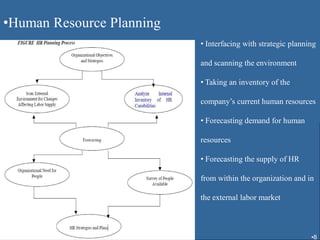
•Human Resource Planning
                           • Interfacing with strategic planning
Process                    and scanning the environment

                           • Taking an inventory of the

                           company’s current human resources

                           • Forecasting demand for human

                           resources

                           • Forecasting the supply of HR

                           from within the organization and in

                           the external labor market


                                                              •8
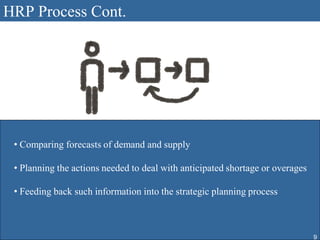
HRP Process Cont.


 • Comparing forecasts of demand and supply

 • Planning the actions needed to deal with anticipated shortage or overages

 • Feeding back such information into the strategic planning process


                                                                               9
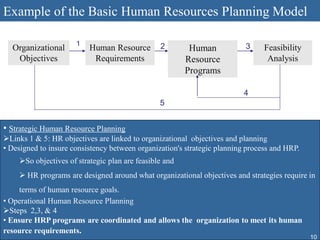
Example of the Basic Human Resources Planning Model

                      1                         2                         3
  Organizational          Human Resource                 Human                  Feasibility
   Objectives              Requirements                 Resource                 Analysis
                                                        Programs

                                                                         4
                                                5


• Strategic Human Resource Planning
Links 1 & 5: HR objectives are linked to organizational objectives and planning
• Designed to insure consistency between organization's strategic planning process and HRP.
    So objectives of strategic plan are feasible and
     HR programs are designed around what organizational objectives and strategies require in
     terms of human resource goals.
• Operational Human Resource Planning
Steps 2,3, & 4
• Ensure HRP programs are coordinated and allows the organization to meet its human
resource requirements.
                                                                                              10
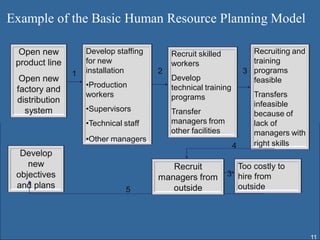
Example of the Basic Human Resource Planning Model

  Open new          Develop staffing       Recruit skilled            Recruiting and
 H
 product line       for new
                    installation       2
                                           workers                    training
                                                                    3 programs
                1
  Open new                                 Develop                    feasible
                    •Production            technical training
 factory and
                    workers                programs                   Transfers
 distribution                                                         infeasible
   system           •Supervisors           Transfer                   because of
                    •Technical staff       managers from              lack of
                                           other facilities           managers with
                    •Other managers
                                                                4     right skills
  Develop
    new                                   Recruit               Too costly to
 objectives                            managers from          3 hire from
 and plans                      5         outside               outside


                                                                                       11
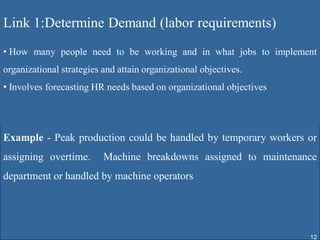
Link 1:Determine Demand (labor requirements)
• How many people need to be working and in what jobs to implement
organizational strategies and attain organizational objectives.
• Involves forecasting HR needs based on organizational objectives


Example - Peak production could be handled by temporary workers or
assigning overtime.       Machine breakdowns assigned to maintenance
department or handled by machine operators


                                                                     12
Link 2:Determine HR Supply (availability)
• Choose HRM programs (supply)


• Involves forecasting or predicting effect of various HR programs on
employee flowing into, through and out various job classifications.


• First determine how well existing programs are doing then forecast what
additional programs or combination of programs will do
• Need to know capabilities of various programs and program combinations


                                                                        13
Determine Feasibility Links 3 & 4

  • Capable of being done
      – Requires knowledge of programs, how programs fit together and
        external environmental constraints (e.g., labor force, labor unions,
        technology created skill shortages) and internal environmental
        constraints (skill shortages within the organization, financial
        resources, managerial attitudes, culture)

  •   Do the benefits outweigh the costs
      – Difficulty in quantifying costs and benefits


                                                                               14
Revise Organizational Objectives and Strategies Link 5


    “If no feasible HR program can be
   devised, the organization must revise
              strategic plans.”


                                                         15
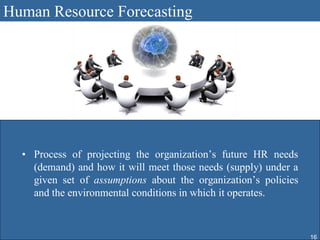
Human Resource Forecasting


  • Process of projecting the organization’s future HR needs
    (demand) and how it will meet those needs (supply) under a
    given set of assumptions about the organization’s policies
    and the environmental conditions in which it operates.


                                                                 16
Reasons for demand forecasting:

 1. Quantify the jobs necessary for producing goods.
 2. Assess appropriate staffing levels in different parts
    organization to avoid unnecessary costs.
 3. Prevent shortage of people when they are needed
    most.
 4. Monitor compliance with legal requirements.


                                                            17
Potential benefits


   •   Upper management better aware.
   •   Personnel cost is controlled.
   •   Less time to locate talent.
   •   Affirmative Action Plan implemented
   •   Time to develop employees
                                             18
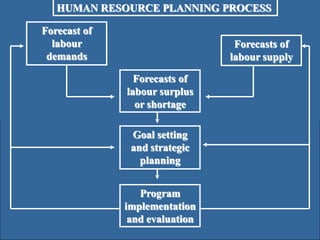
HUMAN RESOURCE PLANNING PROCESS

Forecast of
  labour                         Forecasts of
 demands                        labour supply

                Forecasts of
              labour surplus
                or shortage

               Goal setting
               and strategic
                 planning


                 Program
              implementation
               and evaluation
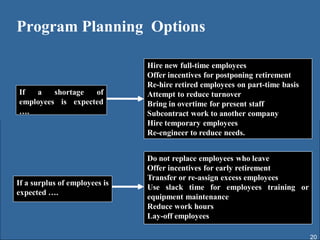
Program Planning Options

                               Hire new full-time employees
                               Offer incentives for postponing retirement
                               Re-hire retired employees on part-time basis
If  a    shortage  of          Attempt to reduce turnover
employees is expected          Bring in overtime for present staff
….                             Subcontract work to another company
                               Hire temporary employees
                               Re-engineer to reduce needs.


                               Do not replace employees who leave
                               Offer incentives for early retirement
                               Transfer or re-assign excess employees
If a surplus of employees is
                               Use slack time for employees training or
expected ….
                               equipment maintenance
                               Reduce work hours
                               Lay-off employees

                                                                              20
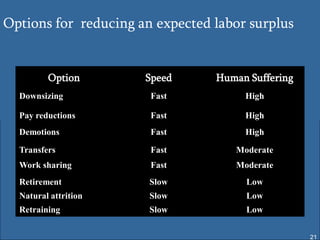
Options for reducing an expected labor surplus


         Option       Speed      Human Suffering
  Downsizing           Fast           High

  Pay reductions       Fast           High
  Demotions            Fast           High

  Transfers            Fast         Moderate
  Work sharing         Fast         Moderate
  Retirement           Slow           Low
  Natural attrition    Slow           Low
  Retraining           Slow           Low


                                                   21
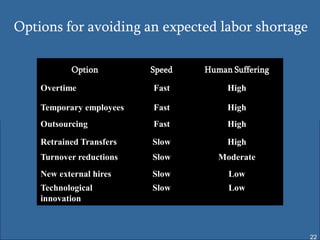
Options for avoiding an expected labor shortage

           Option         Speed   Human Suffering

    Overtime              Fast         High

    Temporary employees   Fast         High
    Outsourcing           Fast         High

    Retrained Transfers   Slow         High
    Turnover reductions   Slow       Moderate
    New external hires    Slow         Low
    Technological         Slow         Low
    innovation


                                                    22
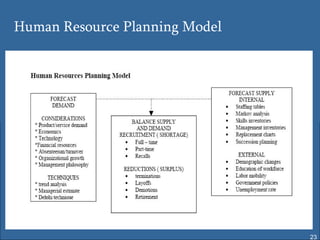
Human Resource Planning Model


                                23

Human resource planning

  • 1.
    Human Resource Planning Fatemeh Hashemi
  • 2.
    Human Resource Planning– Out Line I. What is it? II. Why is it important? III. How is it done? 2
  • 3.
    I- What isit? According to Geisler, “Manpower planning is the process including forecasting, developing and controlling by which a firm ensures that it has • The right number of people, • The right kind of people, • At the right places, • At the right time, doing work for which they are economically most useful”. 3
  • 4.
    I- What isit? Human resource planning is the process of anticipating and carrying out the movement of people into, within, and out of the organization. Human resources planning is done to achieve the optimum use of human resources and to have the correct number and types of employees needed to meet organizational goals. 4
  • 5.
    II. Why isit important? A. often long lag times to fill positions. B. often influences both turnover(Number of employees hired to replace those who left or were fired during a 12 month period.) and productivity(The amount of output per unit of input (labor , equipment, and capital). • C. the “demographic imperative” (Characteristics of population Class, age, sex, orientation ability )demands more such planning. 5
  • 6.
    III. How doyou do it? A. General Comments: 1. It is a process of comparing human resource supply with human resource demand. 2. It works best when it is tied to: a. the organization’s strategic planning process b. all available forecasts (technological , economic, market, etc) 3. When there are variances, action plans must be formulated. a. for surpluses, will organization use layoffs, retirement incentives, reduced hours, or something else? b. for shortages, will organization use overtime, temporary workers, or recruit new permanent workers? 6
  • 7.
    III. How doyou do it? B. Methods Used for Human Resource Planning: 1. Approaches to forecasting: a. Qualitative: i. Expert opinions ii. Delphi technique iii. “Bottom-up” approach b. Quantitative (mathematical modeling): i. Regression analysis / Trend analysis ii. Markov analysis 2. Supply Analysis a. Skills inventories i. Card systems ii. Human Resource Information Systems (HRIS) b. Replacement charts / Succession plans 7
  • 8.
    •Human Resource Planning • Interfacing with strategic planning Process and scanning the environment • Taking an inventory of the company’s current human resources • Forecasting demand for human resources • Forecasting the supply of HR from within the organization and in the external labor market •8
  • 9.
    HRP Process Cont. • Comparing forecasts of demand and supply • Planning the actions needed to deal with anticipated shortage or overages • Feeding back such information into the strategic planning process 9
  • 10.
    Example of theBasic Human Resources Planning Model 1 2 3 Organizational Human Resource Human Feasibility Objectives Requirements Resource Analysis Programs 4 5 • Strategic Human Resource Planning Links 1 & 5: HR objectives are linked to organizational objectives and planning • Designed to insure consistency between organization's strategic planning process and HRP. So objectives of strategic plan are feasible and  HR programs are designed around what organizational objectives and strategies require in terms of human resource goals. • Operational Human Resource Planning Steps 2,3, & 4 • Ensure HRP programs are coordinated and allows the organization to meet its human resource requirements. 10
  • 11.
    Example of theBasic Human Resource Planning Model Open new Develop staffing Recruit skilled Recruiting and H product line for new installation 2 workers training 3 programs 1 Open new Develop feasible •Production technical training factory and workers programs Transfers distribution infeasible system •Supervisors Transfer because of •Technical staff managers from lack of other facilities managers with •Other managers 4 right skills Develop new Recruit Too costly to objectives managers from 3 hire from and plans 5 outside outside 11
  • 12.
    Link 1:Determine Demand(labor requirements) • How many people need to be working and in what jobs to implement organizational strategies and attain organizational objectives. • Involves forecasting HR needs based on organizational objectives Example - Peak production could be handled by temporary workers or assigning overtime. Machine breakdowns assigned to maintenance department or handled by machine operators 12
  • 13.
    Link 2:Determine HRSupply (availability) • Choose HRM programs (supply) • Involves forecasting or predicting effect of various HR programs on employee flowing into, through and out various job classifications. • First determine how well existing programs are doing then forecast what additional programs or combination of programs will do • Need to know capabilities of various programs and program combinations 13
  • 14.
    Determine Feasibility Links3 & 4 • Capable of being done – Requires knowledge of programs, how programs fit together and external environmental constraints (e.g., labor force, labor unions, technology created skill shortages) and internal environmental constraints (skill shortages within the organization, financial resources, managerial attitudes, culture) • Do the benefits outweigh the costs – Difficulty in quantifying costs and benefits 14
  • 15.
    Revise Organizational Objectivesand Strategies Link 5 “If no feasible HR program can be devised, the organization must revise strategic plans.” 15
  • 16.
    Human Resource Forecasting • Process of projecting the organization’s future HR needs (demand) and how it will meet those needs (supply) under a given set of assumptions about the organization’s policies and the environmental conditions in which it operates. 16
  • 17.
    Reasons for demandforecasting: 1. Quantify the jobs necessary for producing goods. 2. Assess appropriate staffing levels in different parts organization to avoid unnecessary costs. 3. Prevent shortage of people when they are needed most. 4. Monitor compliance with legal requirements. 17
  • 18.
    Potential benefits • Upper management better aware. • Personnel cost is controlled. • Less time to locate talent. • Affirmative Action Plan implemented • Time to develop employees 18
  • 19.
    HUMAN RESOURCE PLANNINGPROCESS Forecast of labour Forecasts of demands labour supply Forecasts of labour surplus or shortage Goal setting and strategic planning Program implementation and evaluation
  • 20.
    Program Planning Options Hire new full-time employees Offer incentives for postponing retirement Re-hire retired employees on part-time basis If a shortage of Attempt to reduce turnover employees is expected Bring in overtime for present staff …. Subcontract work to another company Hire temporary employees Re-engineer to reduce needs. Do not replace employees who leave Offer incentives for early retirement Transfer or re-assign excess employees If a surplus of employees is Use slack time for employees training or expected …. equipment maintenance Reduce work hours Lay-off employees 20
  • 21.
    Options for reducingan expected labor surplus Option Speed Human Suffering Downsizing Fast High Pay reductions Fast High Demotions Fast High Transfers Fast Moderate Work sharing Fast Moderate Retirement Slow Low Natural attrition Slow Low Retraining Slow Low 21
  • 22.
    Options for avoidingan expected labor shortage Option Speed Human Suffering Overtime Fast High Temporary employees Fast High Outsourcing Fast High Retrained Transfers Slow High Turnover reductions Slow Moderate New external hires Slow Low Technological Slow Low innovation 22
  • 23.