Conducting
Performance Management
             Fatemeh Hashemi
How performance management is
 strategically important to firms
   Performance management is a formal, structured process used to
      measure,evaluate, and influence employees’ job-related attitudes,
      behaviours, and performance results.
   Performance management serves many purposes in organizations:


   1-Enhancing Motivation and Productivity:
   An employee’s motivation to perform well is determined by how
      responds to three key questions:
   • The expectancy question(‘If I make an effort, will I be able to
      perform as intended?’)
   • The instrumentality question(‘What consequences, if any, will
      follow from my decision to perform?’)
   • The valence question(‘How much do I value the consequences
      associated with the intended behavour?’)
How performance management is
   strategically important to firms
2-Supporting Strategic Goals

Defining goals and their measures is an important part of the perfomance management
process.When goals have a direct and obvious link to strategic goals and to the firm’s
success factors, two benefits occur:
• Employees better understand their organization’s strategic focus and how their jobs fit
with it.
• The goals direct employee behaviours toward activites that are consistent and
supportive of the organization’s strategy.

3-Strategic Planning, Alignment and Change
Performance measures provide valuable information for use in strategic planning and
organizational change.
• Detecting Problems :for example; declining sales performance may point to a
deficiency in training.
• Evaluating Change: Employee performance measures should be a key component of
a plan for evaluating the success of a change initiative.
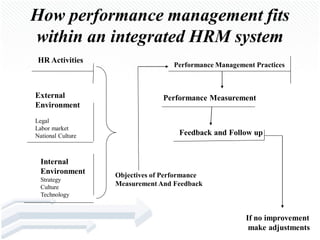
How performance management fits
within an integrated HRM system
 HR Activities
                                   Performance Management Practices


External                        Performance Measurement
Environment
Legal
Labor market
National Culture                     Feedback and Follow up


  Internal
  Environment      Objectives of Performance
  Strategy
  Culture
                   Measurement And Feedback
  Technology


                                                       If no improvement
                                                        make adjustments
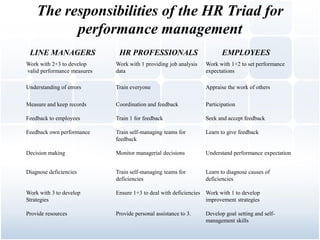
The responsibilities of the HR Triad for
          performance management
 LINE MANAGERS                HR PROFESSIONALS                           EMPLOYEES
Work with 2+3 to develop     Work with 1 providing job analysis   Work with 1+2 to set performance
valid performance measures   data                                 expectations

Understanding of errors      Train everyone                       Appraise the work of others

Measure and keep records     Coordination and feedback            Participation

Feedback to employees        Train 1 for feedback                 Seek and accept feedback

Feedback own performance     Train self-managing teams for        Learn to give feedback
                             feedback

Decision making              Monitor managerial decisions         Understand performance expectation


Diagnose deficiencies        Train self-managing teams for        Learn to diagnose causes of
                             deficiencies                         deficiencies

Work with 3 to develop       Ensure 1+3 to deal with deficiencies Work with 1 to develop
Strategies                                                        improvement strategies

Provide resources            Provide personal assistance to 3.    Develop goal setting and self-
                                                                  management skills
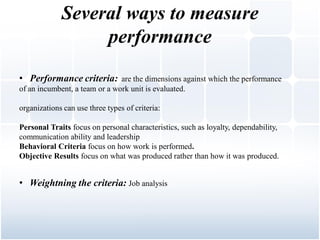
Several ways to measure
                  performance
• Performance criteria: are the dimensions against which the performance
of an incumbent, a team or a work unit is evaluated.

organizations can use three types of criteria:

Personal Traits focus on personal characteristics, such as loyalty, dependability,
communication ability and leadership
Behavioral Criteria focus on how work is performed.
Objective Results focus on what was produced rather than how it was produced.


• Weightning the criteria: Job analysis
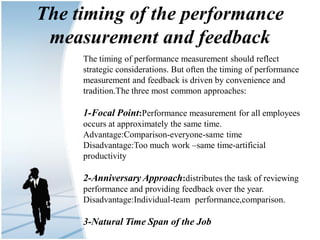
The timing of the performance
 measurement and feedback
     The timing of performance measurement should reflect
     strategic considerations. But often the timing of performance
     measurement and feedback is driven by convenience and
     tradition.The three most common approaches:

     1-Focal Point:Performance measurement for all employees
     occurs at approximately the same time.
     Advantage:Comparison-everyone-same time
     Disadvantage:Too much work –same time-artificial
     productivity

     2-Anniversary Approach:distributes the task of reviewing
     performance and providing feedback over the year.
     Disadvantage:Individual-team performance,comparison.

     3-Natural Time Span of the Job
The participants in performance
  measurement and feedback
          To compensate for the disadvantages of gathering data
           from any single source, most large organizations involve
           multiple participants when measuring performance and
           providing feedback.
      •   Supervisors
      •   Self-Appraisal
      •   Peers
      •   Subordinates
      •   Customers
      •   360 – Degree Appraisals
Appraisal formats
Involves evaluating performance based on the judgemets and
opinions of subordinates, peers, supervisors, other managers
and even the employees themselves.

Norm-Referenced
1.Straight Ranking
2.Forced Distribution.
Absolute Standards Formats
1.Graphic Rating Scales
2.Behaviourally Anchored Rating Scales
3.Behavioural Observation Scales
Result-Based Formats.
1.Direct Index Approach
2.Management by Objectives
The rating process
 Common Performance Rating Errors
 Halo and Horn :sex,age,race
 Leniency: high rated
 Strictness: low rated
 Central Tendency: ‘play –it- safe’ average rating
 Primacy:Initial information to categorize
 Recency:Recent results
 Contrast Effects:Comparison of different levels.
 Improving Rater Accuracy
 Rating Scale Format:
 •A single job activity
 •Rate separately
 •Do not use term ‘average’
 Provide Memory Aids
 Provide Rater Training
 Reward Accurate and Timely Appraisals
 Use Multiple Raters
Providing feedback

The feedback makes employees aware of any problems and should adress the
importance of change when applicable. Many managers feel uncomfortable
providing feedback to employees.
Different perspective,egos,defence,discussions...
Timing:Immediate feedback is most useful.Continous,from several sources and
as much info as reciever can use.
Preparation:Before the actual interview decision has to be taken is it one way or
interactive
Content of the Discussion:The most useful feedback sessions focus on
solving problems and planning for the future.Problem solving involves diagnosing
the causes of performance.
Diagnosis:The objective of diagnosis is to understand the factors that affect an
employee’s performance.Training in problem solving and in giving and receiving
feedback should be provided.
Removing Roadblocks: Action plan: Supervisor should adress lack of
resources,feedback,Subordinate should adress behavorial changes,career
development activities...
Two current issues related to
       performance management
• Automated Performance Management
  Technology can automate the process by tracking goals,scoring and approving
  appraisals and processing the data for use in determining compensation, training
  ,planning and recruiting.Customer satisfaction,managers ratings etc..the technology
  allows organizations to convert a great deal of data into usable
  information.Efficiency,time saving,accuracy.


• Monitoring Through Technology
  Handscanners-attendancy,GPS devices –location,softwares-emails,internet activities
  It concerns privacy.Must find a balance between benefits and privacy.How ?
  Communication and training.

Conducting performance management

  • 1.
  • 2.
    How performance managementis strategically important to firms Performance management is a formal, structured process used to measure,evaluate, and influence employees’ job-related attitudes, behaviours, and performance results. Performance management serves many purposes in organizations: 1-Enhancing Motivation and Productivity: An employee’s motivation to perform well is determined by how responds to three key questions: • The expectancy question(‘If I make an effort, will I be able to perform as intended?’) • The instrumentality question(‘What consequences, if any, will follow from my decision to perform?’) • The valence question(‘How much do I value the consequences associated with the intended behavour?’)
  • 3.
    How performance managementis strategically important to firms 2-Supporting Strategic Goals Defining goals and their measures is an important part of the perfomance management process.When goals have a direct and obvious link to strategic goals and to the firm’s success factors, two benefits occur: • Employees better understand their organization’s strategic focus and how their jobs fit with it. • The goals direct employee behaviours toward activites that are consistent and supportive of the organization’s strategy. 3-Strategic Planning, Alignment and Change Performance measures provide valuable information for use in strategic planning and organizational change. • Detecting Problems :for example; declining sales performance may point to a deficiency in training. • Evaluating Change: Employee performance measures should be a key component of a plan for evaluating the success of a change initiative.
  • 4.
    How performance managementfits within an integrated HRM system HR Activities Performance Management Practices External Performance Measurement Environment Legal Labor market National Culture Feedback and Follow up Internal Environment Objectives of Performance Strategy Culture Measurement And Feedback Technology If no improvement make adjustments
  • 5.
    The responsibilities ofthe HR Triad for performance management LINE MANAGERS HR PROFESSIONALS EMPLOYEES Work with 2+3 to develop Work with 1 providing job analysis Work with 1+2 to set performance valid performance measures data expectations Understanding of errors Train everyone Appraise the work of others Measure and keep records Coordination and feedback Participation Feedback to employees Train 1 for feedback Seek and accept feedback Feedback own performance Train self-managing teams for Learn to give feedback feedback Decision making Monitor managerial decisions Understand performance expectation Diagnose deficiencies Train self-managing teams for Learn to diagnose causes of deficiencies deficiencies Work with 3 to develop Ensure 1+3 to deal with deficiencies Work with 1 to develop Strategies improvement strategies Provide resources Provide personal assistance to 3. Develop goal setting and self- management skills
  • 6.
    Several ways tomeasure performance • Performance criteria: are the dimensions against which the performance of an incumbent, a team or a work unit is evaluated. organizations can use three types of criteria: Personal Traits focus on personal characteristics, such as loyalty, dependability, communication ability and leadership Behavioral Criteria focus on how work is performed. Objective Results focus on what was produced rather than how it was produced. • Weightning the criteria: Job analysis
  • 7.
    The timing ofthe performance measurement and feedback The timing of performance measurement should reflect strategic considerations. But often the timing of performance measurement and feedback is driven by convenience and tradition.The three most common approaches: 1-Focal Point:Performance measurement for all employees occurs at approximately the same time. Advantage:Comparison-everyone-same time Disadvantage:Too much work –same time-artificial productivity 2-Anniversary Approach:distributes the task of reviewing performance and providing feedback over the year. Disadvantage:Individual-team performance,comparison. 3-Natural Time Span of the Job
  • 8.
    The participants inperformance measurement and feedback To compensate for the disadvantages of gathering data from any single source, most large organizations involve multiple participants when measuring performance and providing feedback. • Supervisors • Self-Appraisal • Peers • Subordinates • Customers • 360 – Degree Appraisals
  • 9.
    Appraisal formats Involves evaluatingperformance based on the judgemets and opinions of subordinates, peers, supervisors, other managers and even the employees themselves. Norm-Referenced 1.Straight Ranking 2.Forced Distribution. Absolute Standards Formats 1.Graphic Rating Scales 2.Behaviourally Anchored Rating Scales 3.Behavioural Observation Scales Result-Based Formats. 1.Direct Index Approach 2.Management by Objectives
  • 10.
    The rating process Common Performance Rating Errors Halo and Horn :sex,age,race Leniency: high rated Strictness: low rated Central Tendency: ‘play –it- safe’ average rating Primacy:Initial information to categorize Recency:Recent results Contrast Effects:Comparison of different levels. Improving Rater Accuracy Rating Scale Format: •A single job activity •Rate separately •Do not use term ‘average’ Provide Memory Aids Provide Rater Training Reward Accurate and Timely Appraisals Use Multiple Raters
  • 11.
    Providing feedback The feedbackmakes employees aware of any problems and should adress the importance of change when applicable. Many managers feel uncomfortable providing feedback to employees. Different perspective,egos,defence,discussions... Timing:Immediate feedback is most useful.Continous,from several sources and as much info as reciever can use. Preparation:Before the actual interview decision has to be taken is it one way or interactive Content of the Discussion:The most useful feedback sessions focus on solving problems and planning for the future.Problem solving involves diagnosing the causes of performance. Diagnosis:The objective of diagnosis is to understand the factors that affect an employee’s performance.Training in problem solving and in giving and receiving feedback should be provided. Removing Roadblocks: Action plan: Supervisor should adress lack of resources,feedback,Subordinate should adress behavorial changes,career development activities...
  • 12.
    Two current issuesrelated to performance management • Automated Performance Management Technology can automate the process by tracking goals,scoring and approving appraisals and processing the data for use in determining compensation, training ,planning and recruiting.Customer satisfaction,managers ratings etc..the technology allows organizations to convert a great deal of data into usable information.Efficiency,time saving,accuracy. • Monitoring Through Technology Handscanners-attendancy,GPS devices –location,softwares-emails,internet activities It concerns privacy.Must find a balance between benefits and privacy.How ? Communication and training.