Emerging Trends In HRM
HR policies and Procedures They are Internal guide lines – must be employee friendly, simple, fair, healthy, and maintaining uniformity keeping in mind  organizational objectives, individuals expectations, market demands.   More democratic rather being individual’s  decision that  makes employees secured, satisfied, and motivated.  Factors determine good / bad HR policies;  1. Pay,  2. Promotion, 3. Reward,  4. Appraisal system,  5. Benefits,  6. Dev. opportunity,  7. Timely benefits  8. Fair treatment,  9. Empl. Recognition, etc. Updating of these - a must - to match  changing needs.
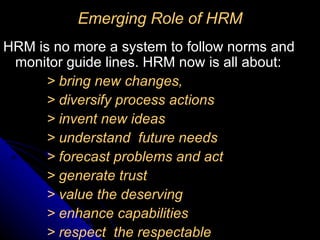
Emerging Role of HRM HRM is no more a system to follow norms and monitor guide lines. HRM now is all about: > bring new changes, > diversify process actions > invent new ideas > understand  future needs > forecast problems and act > generate trust > value the deserving > enhance capabilities > respect  the respectable
Human Resource;  back bone of business development.  Need to  proactive/innovative to match business  knowledge , services. HR is measured  against cost and value of people. It is very much accounted for in terms of profit and loss.  HR  accounting is considered as the right way to  measure and control techniques in HRM based on HR input (placement, training etc) vs. profit (skill enhancement, quick result, fast problem resolve to avoid time waste etc)
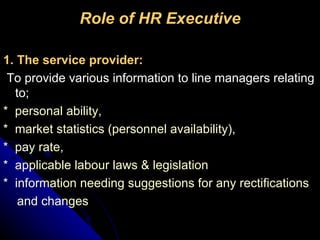
Role of HR Executive 1. The service provider: To provide various information to line managers relating to; *  personal ability, *  market statistics (personnel availability), *  pay rate,  *  applicable labour laws & legislation  *  information needing suggestions for any rectifications  and changes
2. The executive: HR executive, to execute various jobs pertaining to HRM ( recruitment, labor law, compensation etc ) 3. The facilitator: a. Support line management on training and dev. process under organizational planning,  b. Support while performance appraisal conducted, c.  Provide information on prescribed tools to other managers on above issues to enable them to execute systems
4. The Consultant: Advise other managers in the areas of motivation, grievance handling, resolving discrepancies in pay / benefits, personal / psychological issues, etc.  Note :  Line managers face problems on such issues while supervising people and seek advise for smooth resolve.  5. The auditor: Executive to perform auditor’s role ensuring  management members performing their respective roles concerned with the effective use of HR.
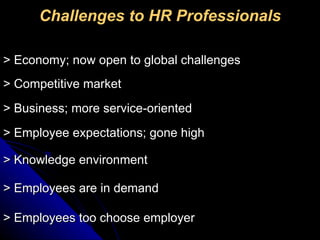
Challenges to HR Professionals > Economy; now open to global challenges > Competitive market > Business; more service-oriented > Employee expectations; gone high > Knowledge environment > Employees are in demand > Employees too choose employer
1. Worker Productivity: * High competitive market * World class quality * Flexible manufacturing cycle * Companies reinventing themselves * Revamping of culture & structure by companies * Hierarchical ladder;  made shorter * Communication barriers; dismantled * Self-managed teams have replaced supervisors (controlled  to assurance)  Note: Manger can no longer ignore people issues so as HR managers neglect their attention as  facilitators.
2. Quality Improvement: * Continuous strive to improve product & services. * Excellence is recognized * Top to bottom (all); committed to commitment & Qc. * Proactive steps is must at top and to trickle down to  employees levels  The factors; support quality improvement: a. Education & Training  b. Team work c. Total system approach  d. Employee involvement e. Mgmt involvement  f. Customer driven standard g. Long term prospective  h. Allocation of resources
3. Changing Attitudes of Workforce: * Job security;  no more a priority, people look for opportunities & changes. * Job market;  has gone global, better and better opportunities are on hand, distance - no more a constraint. * Culture of working with people belong to same race, gender, level of education has changed.  * More female employment, flexible wok hours to support family needs, work from home concept
* Discriminations on religion, caste, creed, gender, have changed . (equal opportunity to deserving)  * More employment in one family, parents (both) do jobs, elders at home accept this as growing need. (professional and social needs) * Companies; becoming more family friendly.  * Mgmt.; extends care on personal / house hold tasks,  employees’ time/energy waste being saved form non- productive issues. (bank settlement, electricity bill, school admission, house search, vacation schedule, ticketing, etc)
4. Impact of Government: * Government policies and programs have major effect. * Change in Indian Economy. * Globalization, divestment, liberalization. * Various labor laws/acts, formulated and amended over the years resulted in structured direction and support to the organizations and work force.  5. Quality of Work Life: Employee’s expectation  from work to meets professional need. * Sense of satisfaction  * Sense of achievement * Self esteem  * Employee’s participation  * Reducing anxiety  * Making work rewarding
6. Technology and Training: * Technological changes; made decision making faster. * Computer * Wireless and cellular technology * Advance devises  Note: Organizations; adapting them for faster/ accuracy in result. Employees;  started believing them as more reliable / dependable.
Strategic HRM * This is the management of available  resources to achieve short term and long term goals. * Optimum utilization of HR to achieve set goals. * Strategic HR planning involves designing HR goals to match organizational goals. * Acquiring, developing, retaining, and motivating human resources. * Training HR to  match desired expectation. * HR policies are made with a view to support organization’s culture, based on its product and ongoing challenges.  -------------------------------------
Manager’s characteristics.   > Be genuinely interested in employee & his work > Lend support & guidance whenever required > Bring clarity in job responsibilities & tasks > Identify employees’ strength & allow growth > Identify weaknesses & suggest remedies > Take personal interest in employees’ problems > Listen to them & accept genuine ideas > reward employees for their contribution > Believe them & their abilities > Be frank & deal openly to gain employees’ trust.

HR Emerging Trends

  • 1.
  • 2.
    HR policies andProcedures They are Internal guide lines – must be employee friendly, simple, fair, healthy, and maintaining uniformity keeping in mind organizational objectives, individuals expectations, market demands. More democratic rather being individual’s decision that makes employees secured, satisfied, and motivated. Factors determine good / bad HR policies; 1. Pay, 2. Promotion, 3. Reward, 4. Appraisal system, 5. Benefits, 6. Dev. opportunity, 7. Timely benefits 8. Fair treatment, 9. Empl. Recognition, etc. Updating of these - a must - to match changing needs.
  • 3.
    Emerging Role ofHRM HRM is no more a system to follow norms and monitor guide lines. HRM now is all about: > bring new changes, > diversify process actions > invent new ideas > understand future needs > forecast problems and act > generate trust > value the deserving > enhance capabilities > respect the respectable
  • 4.
    Human Resource; back bone of business development. Need to proactive/innovative to match business knowledge , services. HR is measured against cost and value of people. It is very much accounted for in terms of profit and loss. HR accounting is considered as the right way to measure and control techniques in HRM based on HR input (placement, training etc) vs. profit (skill enhancement, quick result, fast problem resolve to avoid time waste etc)
  • 5.
    Role of HRExecutive 1. The service provider: To provide various information to line managers relating to; * personal ability, * market statistics (personnel availability), * pay rate, * applicable labour laws & legislation * information needing suggestions for any rectifications and changes
  • 6.
    2. The executive:HR executive, to execute various jobs pertaining to HRM ( recruitment, labor law, compensation etc ) 3. The facilitator: a. Support line management on training and dev. process under organizational planning, b. Support while performance appraisal conducted, c. Provide information on prescribed tools to other managers on above issues to enable them to execute systems
  • 7.
    4. The Consultant:Advise other managers in the areas of motivation, grievance handling, resolving discrepancies in pay / benefits, personal / psychological issues, etc. Note : Line managers face problems on such issues while supervising people and seek advise for smooth resolve. 5. The auditor: Executive to perform auditor’s role ensuring management members performing their respective roles concerned with the effective use of HR.
  • 8.
    Challenges to HRProfessionals > Economy; now open to global challenges > Competitive market > Business; more service-oriented > Employee expectations; gone high > Knowledge environment > Employees are in demand > Employees too choose employer
  • 9.
    1. Worker Productivity:* High competitive market * World class quality * Flexible manufacturing cycle * Companies reinventing themselves * Revamping of culture & structure by companies * Hierarchical ladder; made shorter * Communication barriers; dismantled * Self-managed teams have replaced supervisors (controlled to assurance) Note: Manger can no longer ignore people issues so as HR managers neglect their attention as facilitators.
  • 10.
    2. Quality Improvement:* Continuous strive to improve product & services. * Excellence is recognized * Top to bottom (all); committed to commitment & Qc. * Proactive steps is must at top and to trickle down to employees levels The factors; support quality improvement: a. Education & Training b. Team work c. Total system approach d. Employee involvement e. Mgmt involvement f. Customer driven standard g. Long term prospective h. Allocation of resources
  • 11.
    3. Changing Attitudesof Workforce: * Job security; no more a priority, people look for opportunities & changes. * Job market; has gone global, better and better opportunities are on hand, distance - no more a constraint. * Culture of working with people belong to same race, gender, level of education has changed. * More female employment, flexible wok hours to support family needs, work from home concept
  • 12.
    * Discriminations onreligion, caste, creed, gender, have changed . (equal opportunity to deserving) * More employment in one family, parents (both) do jobs, elders at home accept this as growing need. (professional and social needs) * Companies; becoming more family friendly. * Mgmt.; extends care on personal / house hold tasks, employees’ time/energy waste being saved form non- productive issues. (bank settlement, electricity bill, school admission, house search, vacation schedule, ticketing, etc)
  • 13.
    4. Impact ofGovernment: * Government policies and programs have major effect. * Change in Indian Economy. * Globalization, divestment, liberalization. * Various labor laws/acts, formulated and amended over the years resulted in structured direction and support to the organizations and work force. 5. Quality of Work Life: Employee’s expectation from work to meets professional need. * Sense of satisfaction * Sense of achievement * Self esteem * Employee’s participation * Reducing anxiety * Making work rewarding
  • 14.
    6. Technology andTraining: * Technological changes; made decision making faster. * Computer * Wireless and cellular technology * Advance devises Note: Organizations; adapting them for faster/ accuracy in result. Employees; started believing them as more reliable / dependable.
  • 15.
    Strategic HRM *This is the management of available resources to achieve short term and long term goals. * Optimum utilization of HR to achieve set goals. * Strategic HR planning involves designing HR goals to match organizational goals. * Acquiring, developing, retaining, and motivating human resources. * Training HR to match desired expectation. * HR policies are made with a view to support organization’s culture, based on its product and ongoing challenges. -------------------------------------
  • 16.
    Manager’s characteristics. > Be genuinely interested in employee & his work > Lend support & guidance whenever required > Bring clarity in job responsibilities & tasks > Identify employees’ strength & allow growth > Identify weaknesses & suggest remedies > Take personal interest in employees’ problems > Listen to them & accept genuine ideas > reward employees for their contribution > Believe them & their abilities > Be frank & deal openly to gain employees’ trust.