HRMG100 – WEEK 10 [WEEK 10 IN TEXTBOOK] STRATEGIC  HUMAN  RESOURCE  MANAGEMENT
HUMAN RESOURCE MANAGEMENT the person, department or section of an organisation  which deals with people it involves the process of  co-ordinating all aspects of what needs to happen to and for people in an organisation  – recruitment, training, monitoring and appraisal it also involves  policy development, systems, processes and procedures , planning and development
ONE TYPE DOES NOT FIT ALL Human Resource Management departments or sections vary from one organisation to another, depending upon : size of an organisation the type of organisation the age of an organisation staff stability or high staff turnover
HRM  SUPPORTS THE  WHOLE ORGANISATION The aim of a Human Resource Management section is  to support the strategic direction of an organisation In other words the HRM Department should  plan  for and  recruit  staff to: Enable the organisation to function well  now Enable the organisation to function well  in the future
SOME HRM OBJECTIVES Like other departments – Accounting, Research & Development etc –  HRM must assist the organization in achieving its objectives: Organizational effectiveness  – employee selection, job satisfaction, productivity, low wastage, motivation, change, recognition, performance evaluation, rewards etc. Profit  – cost containment in the staffing area (downsizing etc) Customer Service Ethical behaviour  – social responsibility
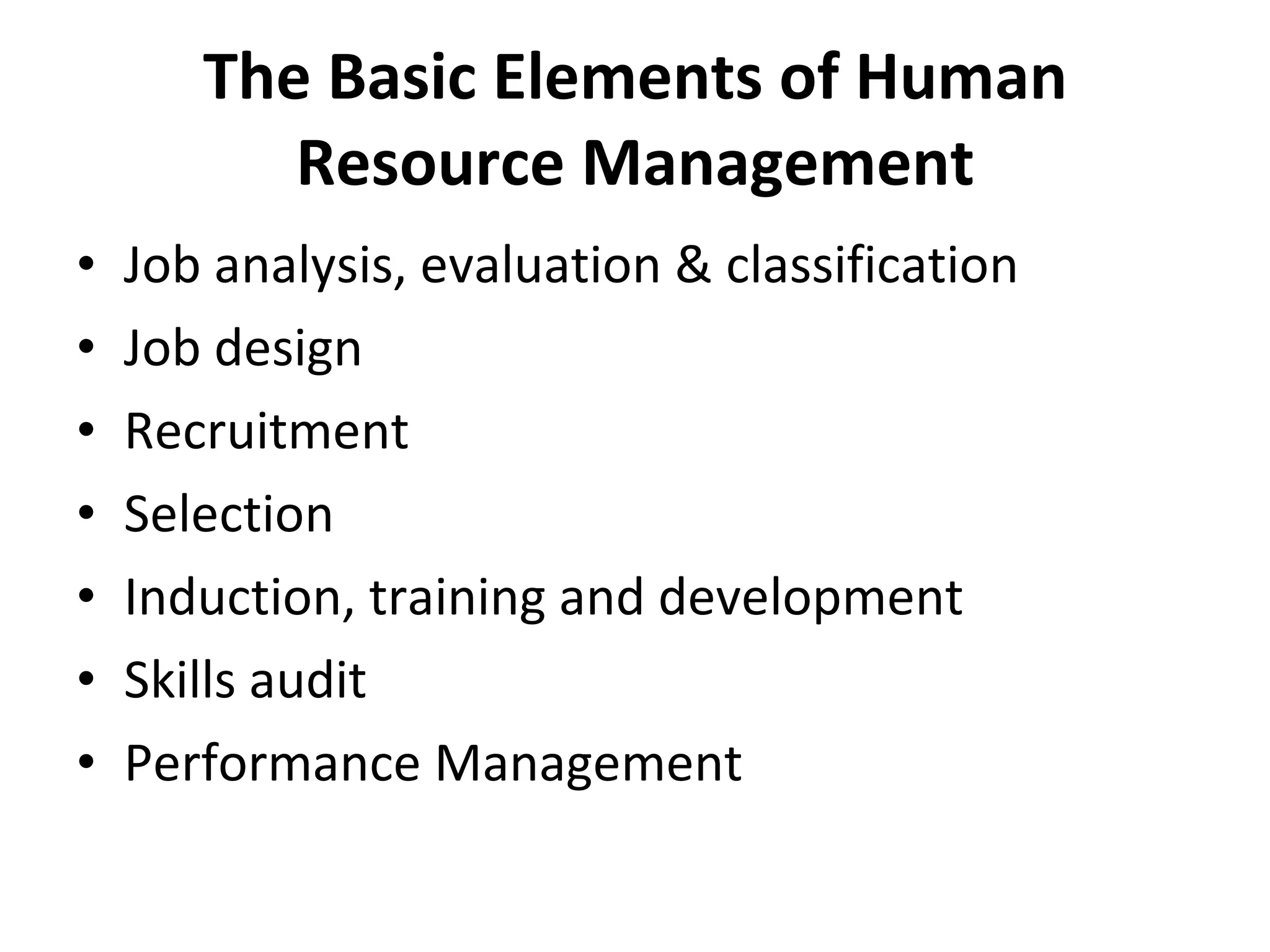
The Basic Elements of Human Resource Management Job analysis, evaluation & classification Job design  Recruitment Selection Induction, training and development Skills audit Performance Management
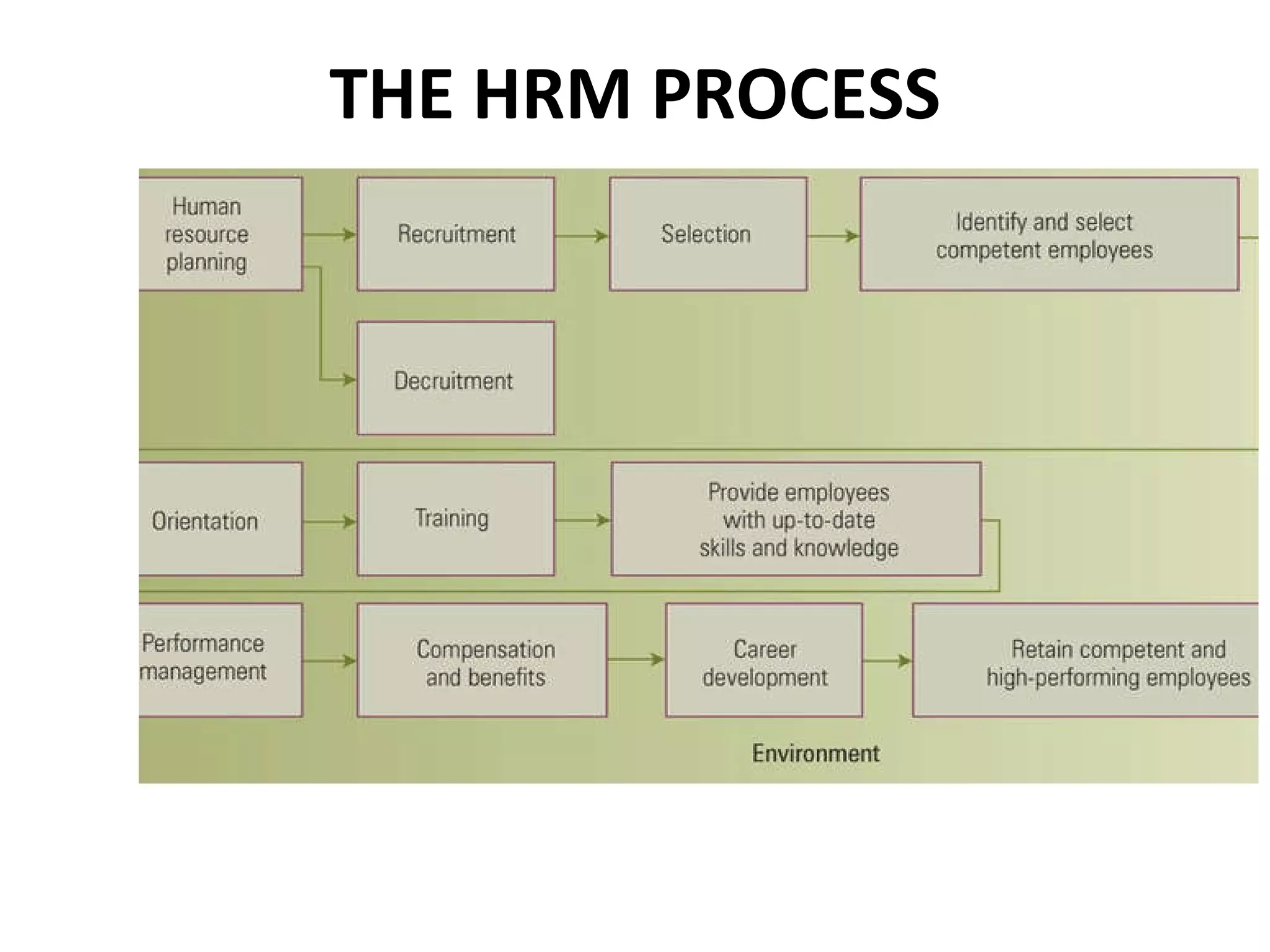
THE HRM PROCESS
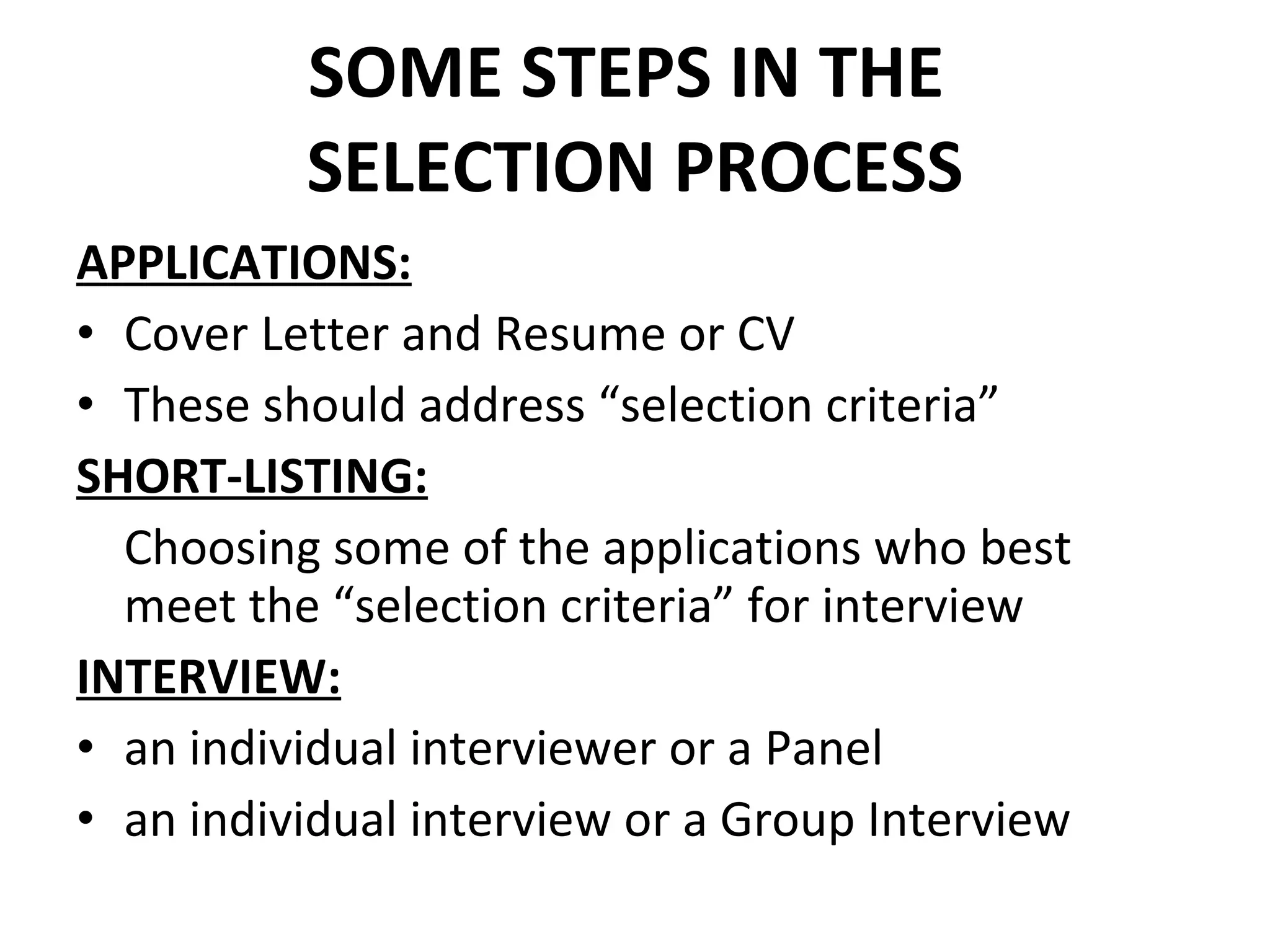
SOME STEPS IN THE  SELECTION PROCESS APPLICATIONS: Cover Letter and Resume or CV These should address “selection criteria” SHORT-LISTING: Choosing some of the applications who best meet the “selection criteria” for interview INTERVIEW: an individual interviewer or a Panel an individual interview or a Group Interview
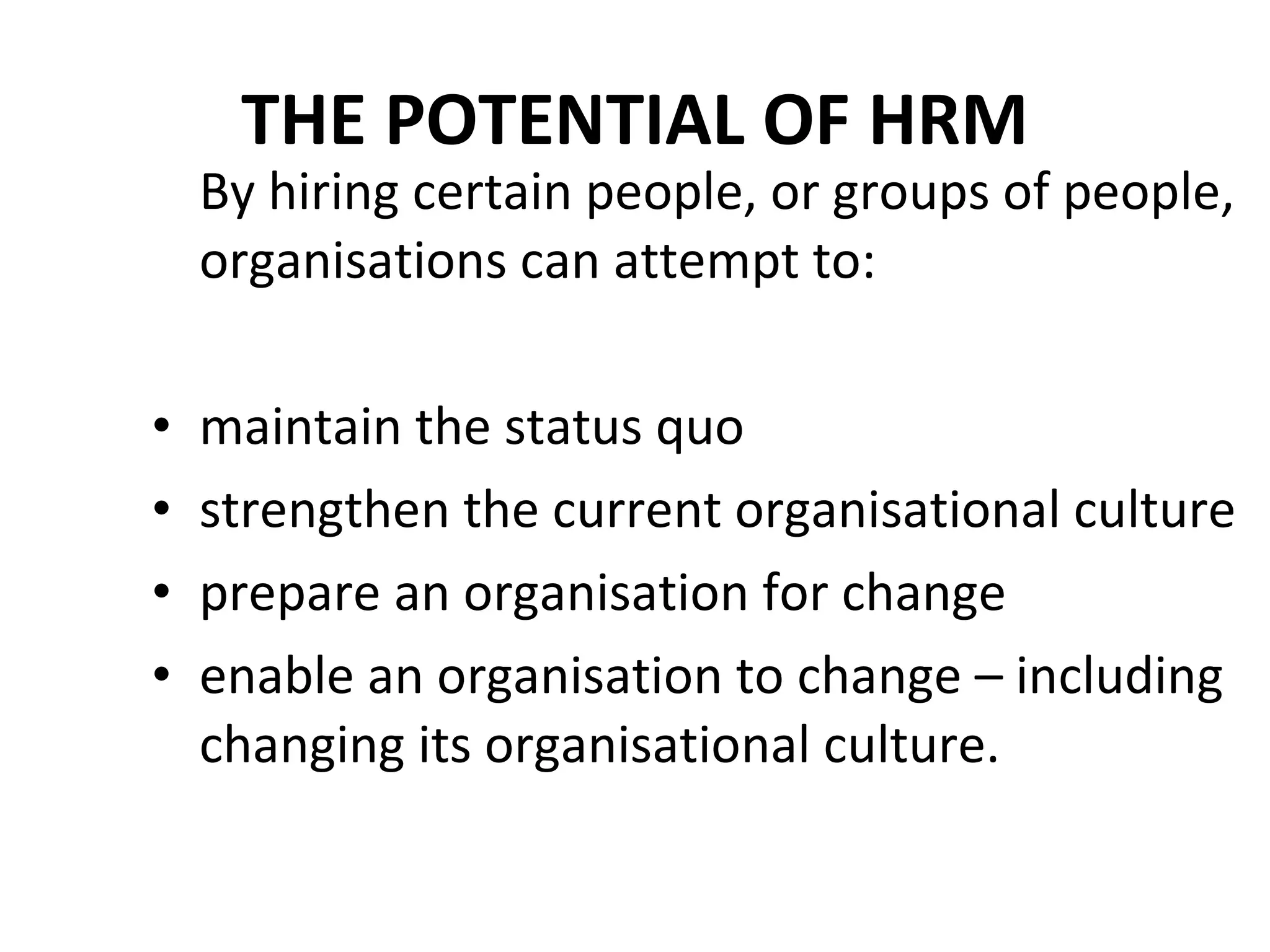
THE POTENTIAL OF HRM By hiring certain people, or groups of people, organisations can attempt to: maintain the status quo  strengthen the current organisational culture prepare an organisation for change enable an organisation to change – including changing its organisational culture.
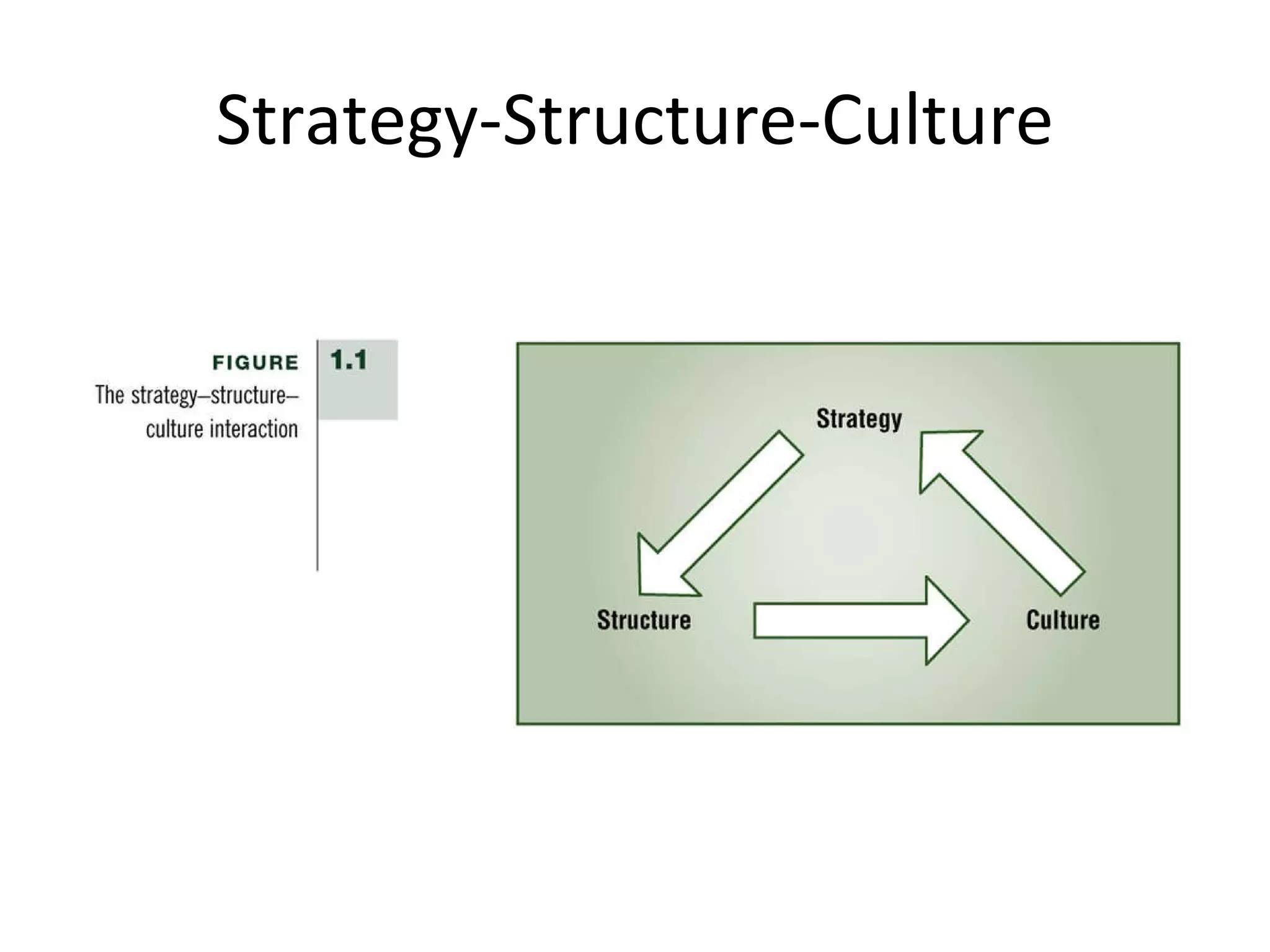
Strategy-Structure-Culture
Strategy-Structure-Culture HRM exists as part of a larger system To be effective HRM must be familiar and congruent to the other parts in the system The strategy-structure-culture interaction suggests that changes in one may require changes in another as the three are interconnected
STRATEGIC  HUMAN RESOURCE MANAGEMENT To be strategic is to: - plan - design - scheme - manoeuvre - plot - develop a game-plan
To be strategic is to  -  be tactical achieve an advantage have a long term plan for success  outwit your enemies (your competitors) Strategic Human Resource Management (SHRM) aims to ensure that you are at least one step ahead of your competitors The organisation aims to have a competitive advantage
SHRM by considering the future goals of an organisation  Strategic Human Resource Management should ensure that an organisation  has the staff it needs in the  future to be able to achieve those goals: staff re-training and/or development recruitment decruitment
Strategic HRM Definition of SHRM:  The process of HRM which is driven by  planning ,  foresight  and  analytical decision making SHRM involves: Setting standards and policies and developing a culture that aligns with the organisation’s environment and objectives Identifying and implementing activities and policies to enact the chosen strategy and to manage the employment relationship
SHRM &  ORGANISATIONAL PERFORMANCE SHRM  is important to an organisation’s  survival  and  sustainability SHRM  should lead to  improved organisational performance  - short term - medium term - long term
Competitive Advantage  – The Resource Based View An organisation can have a competitive advantage  (an advantage over competitors) by having : human skills knowledge learning mechanisms systems and processes behaviours that are superior to its competitors
The Resource Based View Pfeffer & Vaiga 1999 Effective staff management and effective HRM practices should deliver: increased productivity and less waste greater collaborative problem solving better skills in use of equipment improved customer satisfaction fewer accidents less staff turnover and absenteeism increased staff loyalty
The Resource Based View (The negatives) It assumes that the organisation is always in control and seems to overlook that there are many external environmental factors beyond the firm’s control which can affect its performance: minimum wage  rates (for the sector) EEO requirements trade union activity Economic conditions The Resource Based view tends to reduce people to assets.
SHRM is intangible Intangible   = it can’t be measured in financial terms: An organisation can obtain non-financial advantage from: - skills developed - location - knowledge and intellectual property - relationships and networks - efficient and effective systems and processes
THE BALANCED SCORECARD Kaplan and Norton (1996) developed the  Balanced Scorecard  as a simple way of measuring organisational performance: it is one way of assessing intangible and intellectual assets it translates an organisation’s vision, mission, value and strategy into a comprehensive set of performance measures this serves as the framework for a strategic management system
THE BALANCED SCORECARD The four areas addressed in the  Balanced Scorecard  are: The customers’ perspective The innovation & learning perspective The internal perspective – what do the workers excel at? The shareholders’ perspective – financial returns on funds investd!
MODELS OF SHRM (1) JACKSON AND SCHULER (1995): A variety of  macro-level environmental characteristics  influence the adoption of HRM practices, policies and philosophies EG. laws & regulations, culture, politics, markets, industry dynamics Information interpretation depends on the organisation’s  technology ,  structure ,  size , l ife cycle stage  and  strategy
MODELS OF SHRM (2) KOCHAN AND BAROCCI (1985): Causal links between environmental changes,  HRM policies and practices and the needs/goals  of stakeholders The need to recognise HRM policies and practices that respond to environmental changes both inside and outside the organisation Accurate and comprehensive understanding of the organisation’s history is necessary
MODELS OF SHRM (3) KLATT, MURDICK AND SCHUSTER (1978): A systems approach aimed at planning and development HR implications should be considered when developing organisational objectives: Type of employees required How employee behaviours impact on  organisational objectives What systems are required regarding  behaviour and accountability
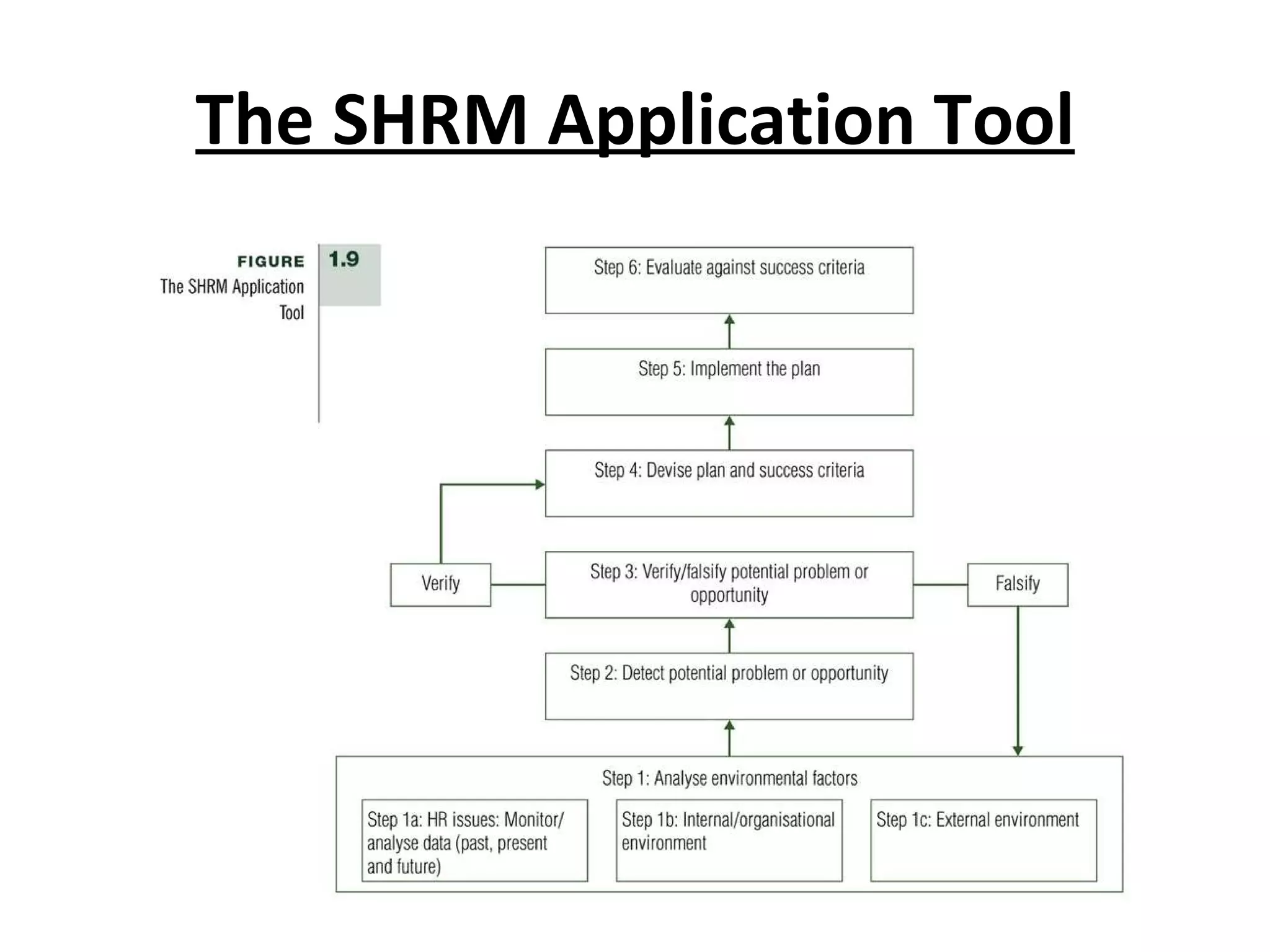
The SHRM Application Tool The SHRM Application Tool provides a framework for analysing the organisation, its environment and issues as a whole It presents six steps in a decision-making process of SHRM To be effective, this tool needs to be continuous, with ongoing monitoring, constant responses and regular evaluation
The SHRM Application Tool
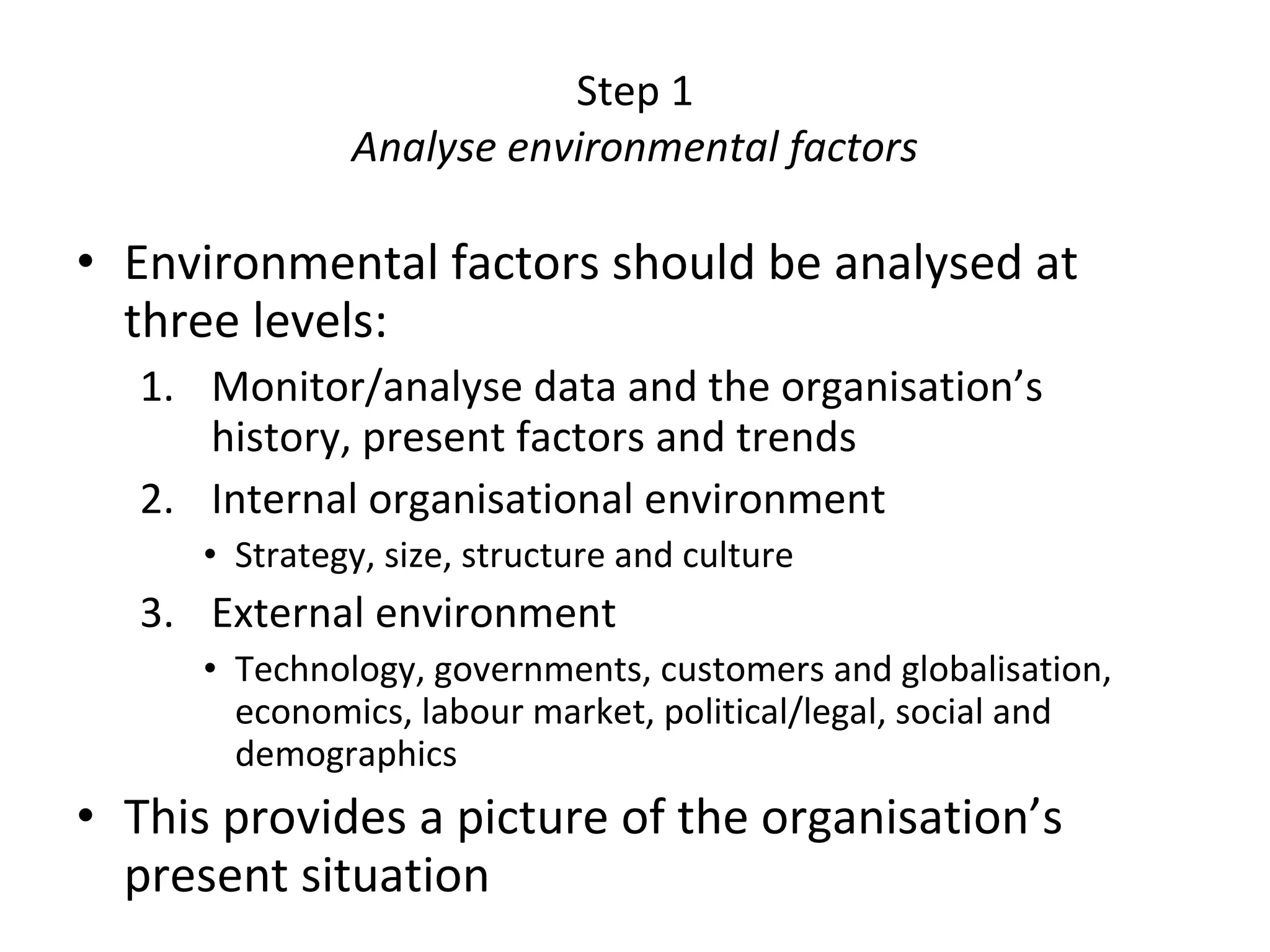
Step 1 Analyse environmental factors Environmental factors should be analysed at three levels: Monitor/analyse data and the organisation’s history, present factors and trends Internal organisational environment Strategy, size, structure and culture External environment Technology, governments, customers and globalisation, economics, labour market, political/legal, social and demographics This provides a picture of the organisation’s present situation
Step 2 Detect potential problem or opportunity Need to identify strengths, weaknesses, opportunities and threats Gap analysis At what level do these issues occur? Individual, group or organisational Assess potential impact and prioritise Porter’s five forces  (see slide 35) SWOT analysis
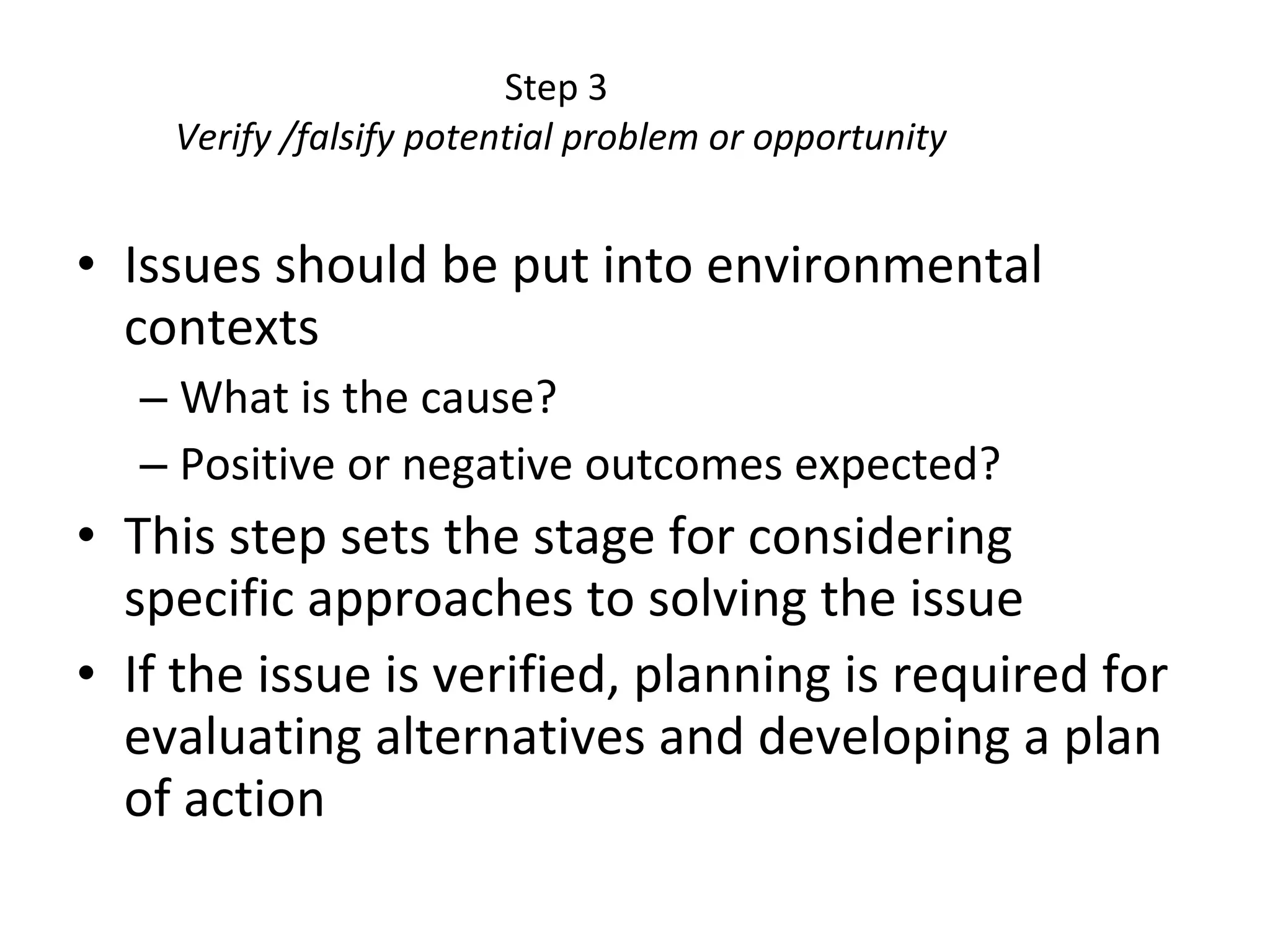
Step 3  Verify /falsify potential problem or opportunity Issues should be put into environmental contexts What is the cause? Positive or negative outcomes expected? This step sets the stage for considering specific approaches to solving the issue If the issue is verified, planning is required for evaluating alternatives and developing a plan of action
Step 4 Devise plan and success criteria   Identify alternatives Identify all conceivable courses of action which will address the issue(s) in Step 3 Brainstorming and mind mapping Evaluate alternatives Be realistic: does the alternative address the issue? Suitability, feasibility, acceptability
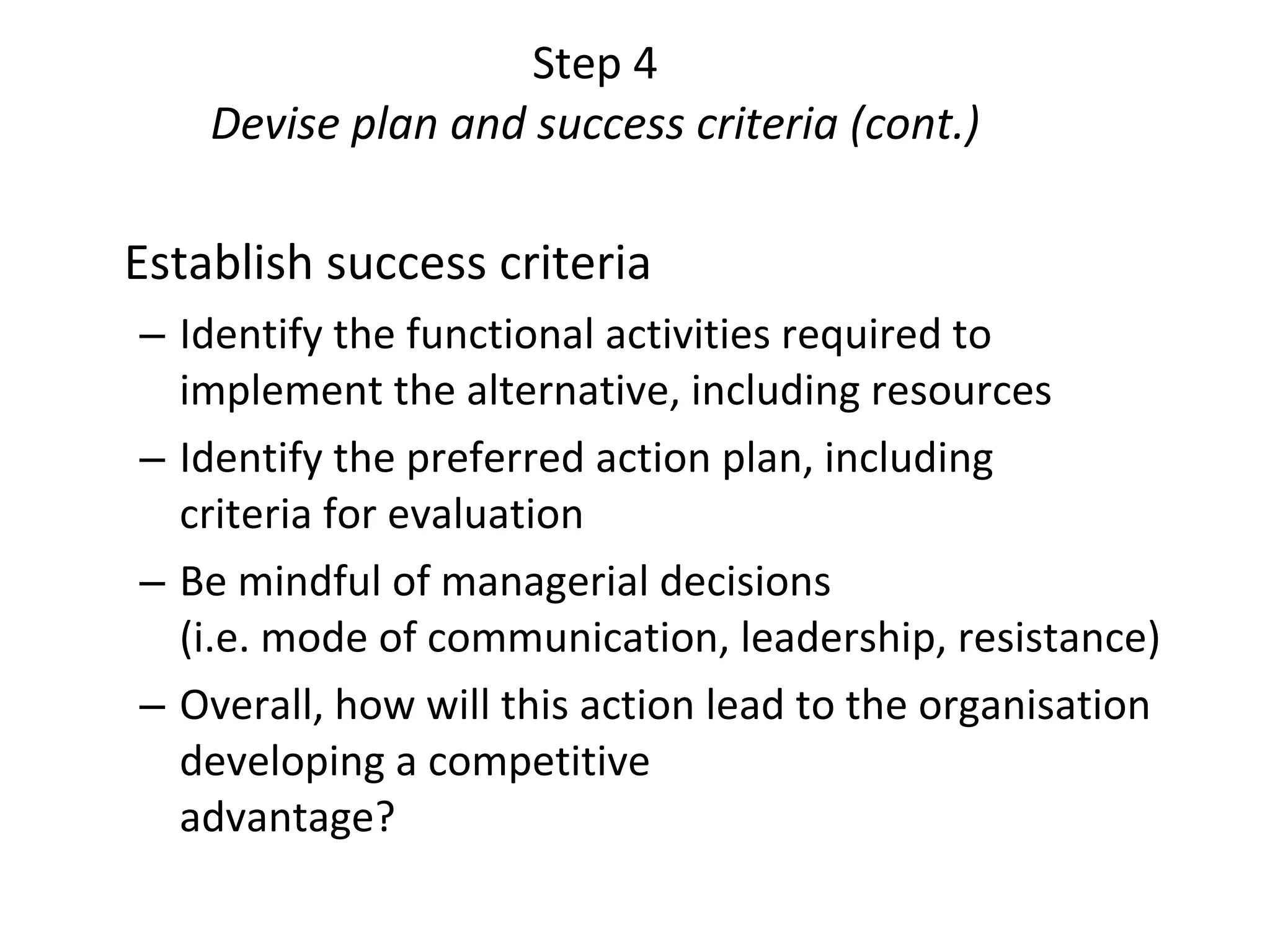
Step 4 Devise plan and success criteria (cont.) Establish success criteria Identify the functional activities required to implement the alternative, including resources Identify the preferred action plan, including  criteria for evaluation Be mindful of managerial decisions  (i.e. mode of communication, leadership, resistance) Overall, how will this action lead to the organisation developing a competitive  advantage?
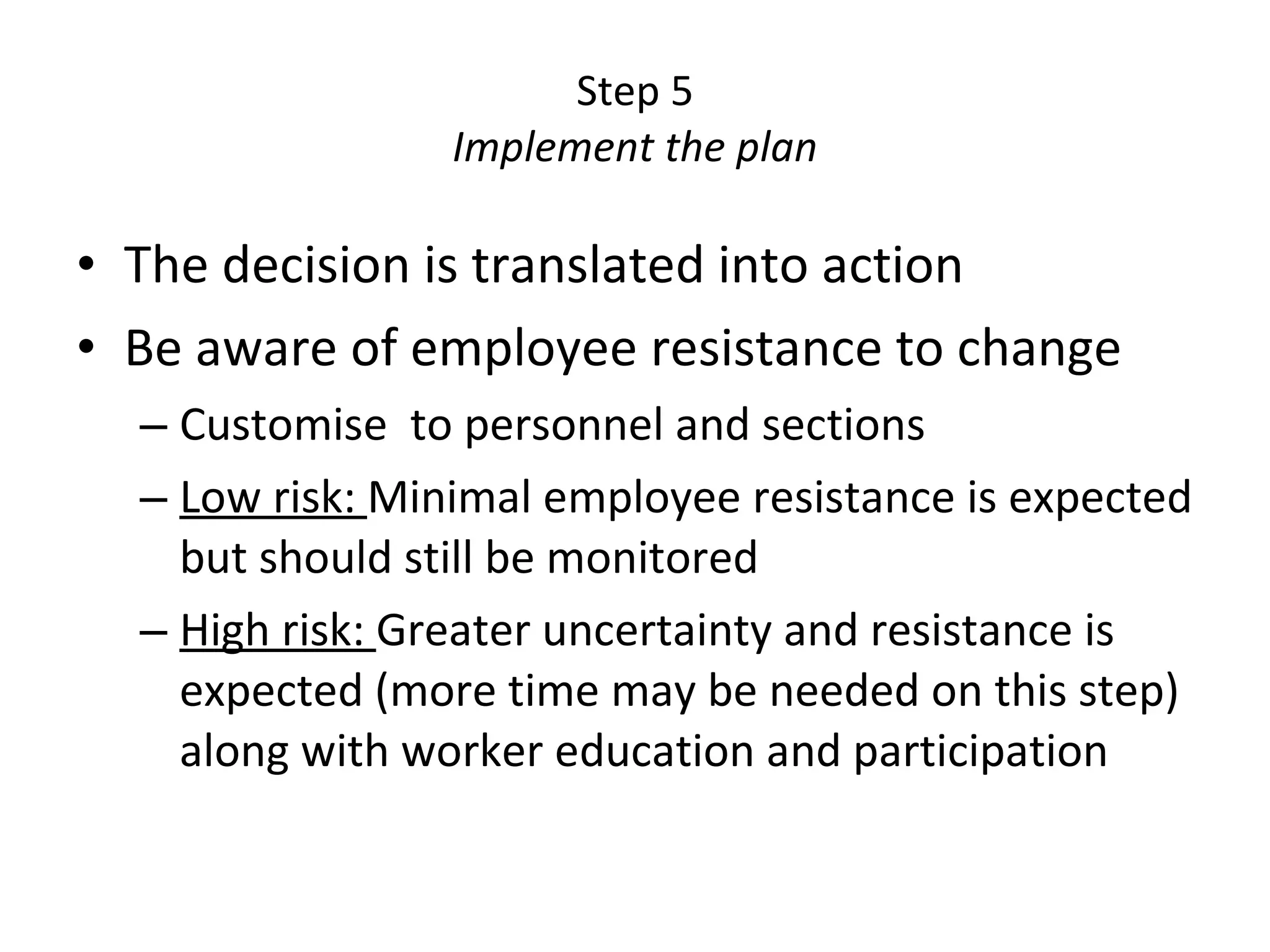
Step 5 Implement the plan The decision is translated into action Be aware of employee resistance to change Customise  to personnel and sections Low risk:  Minimal employee resistance is expected but should still be monitored High risk:  Greater uncertainty and resistance is expected (more time may be needed on this step) along with worker education and participation
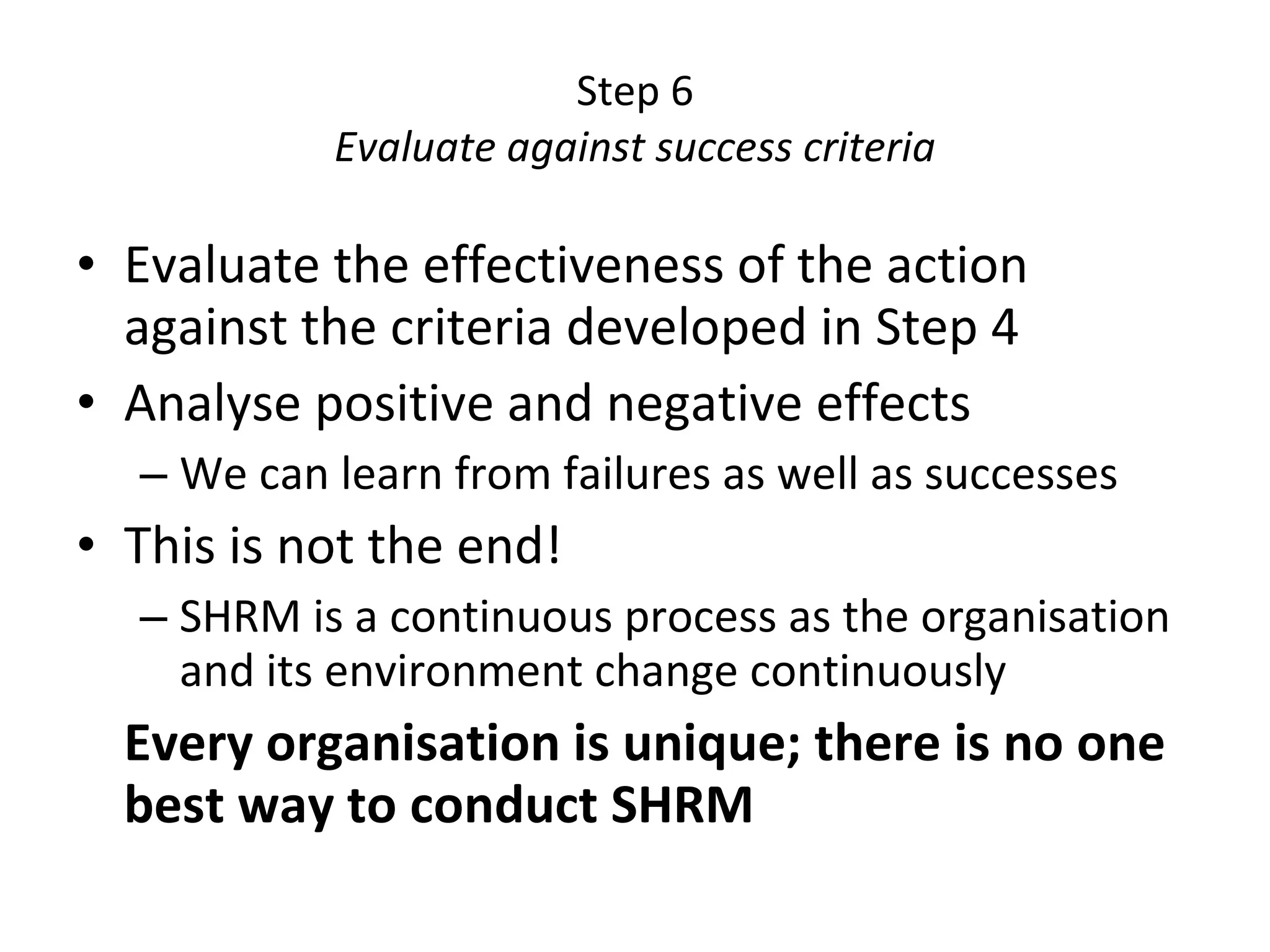
Step 6 Evaluate against success criteria Evaluate the effectiveness of the action against the criteria developed in Step 4 Analyse positive and negative effects We can learn from failures as well as successes This is not the end! SHRM is a continuous process as the organisation and its environment change continuously Every organisation is unique; there is no one best way to conduct SHRM
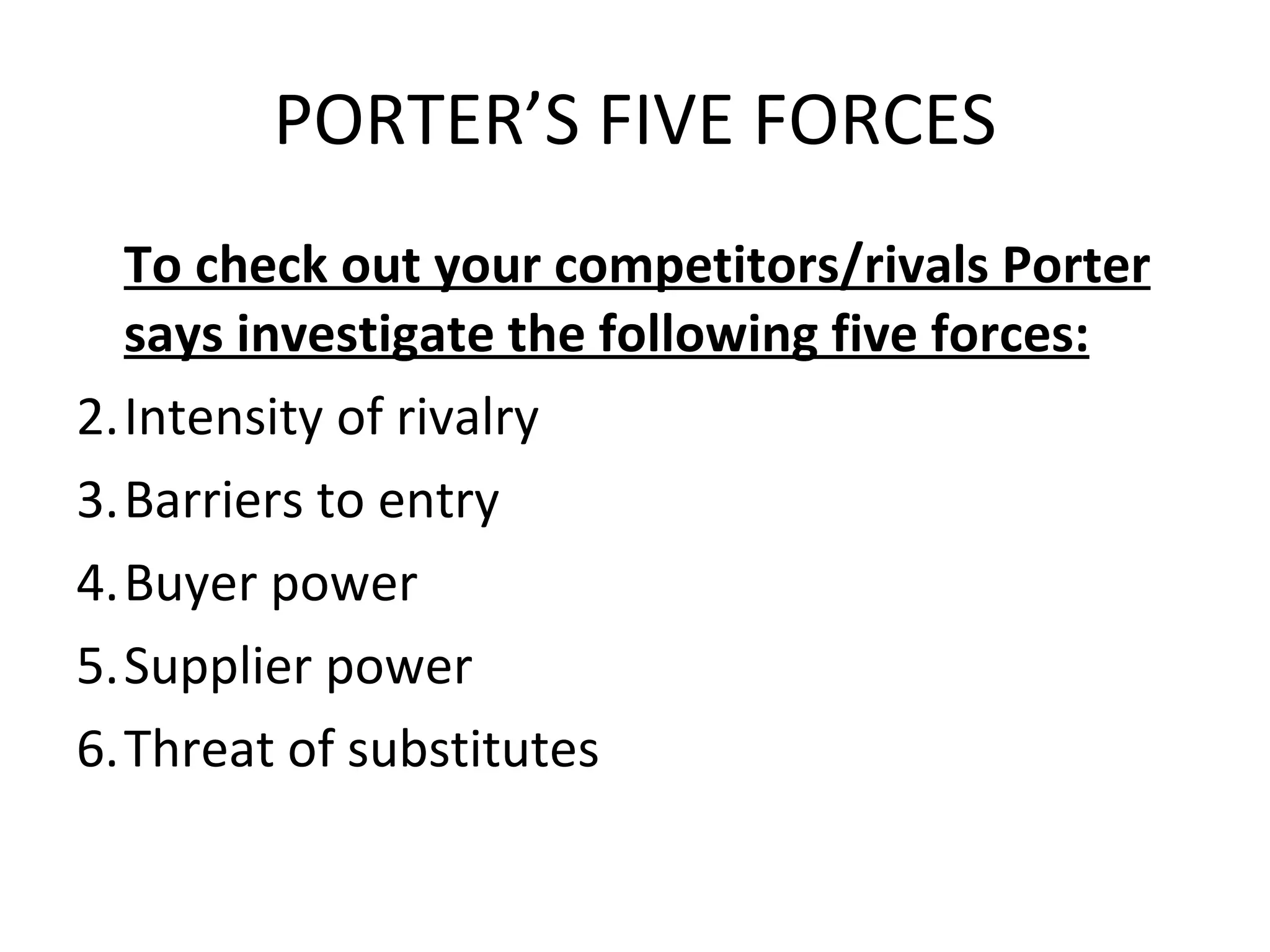
PORTER’S FIVE FORCES To check out your competitors/rivals Porter says investigate the following five forces: Intensity of rivalry Barriers to entry Buyer power Supplier power Threat of substitutes
THE AIMS OF SHRM Strategic Human Resource Management aims to align the functions and processes of HRM with the strategic aims and objectives and competitive advantage of an organisation. The availability and skills, knowledge, experience and superiority of staff  is as important as finance, technology, location  and innovation. SHRM AIMS TO LINK IT ALL TOGETHER.

Hrmg100 week 10

  • 1.
    HRMG100 – WEEK10 [WEEK 10 IN TEXTBOOK] STRATEGIC HUMAN RESOURCE MANAGEMENT
  • 2.
    HUMAN RESOURCE MANAGEMENTthe person, department or section of an organisation which deals with people it involves the process of co-ordinating all aspects of what needs to happen to and for people in an organisation – recruitment, training, monitoring and appraisal it also involves policy development, systems, processes and procedures , planning and development
  • 3.
    ONE TYPE DOESNOT FIT ALL Human Resource Management departments or sections vary from one organisation to another, depending upon : size of an organisation the type of organisation the age of an organisation staff stability or high staff turnover
  • 4.
    HRM SUPPORTSTHE WHOLE ORGANISATION The aim of a Human Resource Management section is to support the strategic direction of an organisation In other words the HRM Department should plan for and recruit staff to: Enable the organisation to function well now Enable the organisation to function well in the future
  • 5.
    SOME HRM OBJECTIVESLike other departments – Accounting, Research & Development etc – HRM must assist the organization in achieving its objectives: Organizational effectiveness – employee selection, job satisfaction, productivity, low wastage, motivation, change, recognition, performance evaluation, rewards etc. Profit – cost containment in the staffing area (downsizing etc) Customer Service Ethical behaviour – social responsibility
  • 6.
    The Basic Elementsof Human Resource Management Job analysis, evaluation & classification Job design Recruitment Selection Induction, training and development Skills audit Performance Management
  • 7.
  • 8.
    SOME STEPS INTHE SELECTION PROCESS APPLICATIONS: Cover Letter and Resume or CV These should address “selection criteria” SHORT-LISTING: Choosing some of the applications who best meet the “selection criteria” for interview INTERVIEW: an individual interviewer or a Panel an individual interview or a Group Interview
  • 9.
    THE POTENTIAL OFHRM By hiring certain people, or groups of people, organisations can attempt to: maintain the status quo strengthen the current organisational culture prepare an organisation for change enable an organisation to change – including changing its organisational culture.
  • 10.
  • 11.
    Strategy-Structure-Culture HRM existsas part of a larger system To be effective HRM must be familiar and congruent to the other parts in the system The strategy-structure-culture interaction suggests that changes in one may require changes in another as the three are interconnected
  • 12.
    STRATEGIC HUMANRESOURCE MANAGEMENT To be strategic is to: - plan - design - scheme - manoeuvre - plot - develop a game-plan
  • 13.
    To be strategicis to - be tactical achieve an advantage have a long term plan for success outwit your enemies (your competitors) Strategic Human Resource Management (SHRM) aims to ensure that you are at least one step ahead of your competitors The organisation aims to have a competitive advantage
  • 14.
    SHRM by consideringthe future goals of an organisation Strategic Human Resource Management should ensure that an organisation has the staff it needs in the future to be able to achieve those goals: staff re-training and/or development recruitment decruitment
  • 15.
    Strategic HRM Definitionof SHRM: The process of HRM which is driven by planning , foresight and analytical decision making SHRM involves: Setting standards and policies and developing a culture that aligns with the organisation’s environment and objectives Identifying and implementing activities and policies to enact the chosen strategy and to manage the employment relationship
  • 16.
    SHRM & ORGANISATIONAL PERFORMANCE SHRM is important to an organisation’s survival and sustainability SHRM should lead to improved organisational performance - short term - medium term - long term
  • 17.
    Competitive Advantage – The Resource Based View An organisation can have a competitive advantage (an advantage over competitors) by having : human skills knowledge learning mechanisms systems and processes behaviours that are superior to its competitors
  • 18.
    The Resource BasedView Pfeffer & Vaiga 1999 Effective staff management and effective HRM practices should deliver: increased productivity and less waste greater collaborative problem solving better skills in use of equipment improved customer satisfaction fewer accidents less staff turnover and absenteeism increased staff loyalty
  • 19.
    The Resource BasedView (The negatives) It assumes that the organisation is always in control and seems to overlook that there are many external environmental factors beyond the firm’s control which can affect its performance: minimum wage rates (for the sector) EEO requirements trade union activity Economic conditions The Resource Based view tends to reduce people to assets.
  • 20.
    SHRM is intangibleIntangible = it can’t be measured in financial terms: An organisation can obtain non-financial advantage from: - skills developed - location - knowledge and intellectual property - relationships and networks - efficient and effective systems and processes
  • 21.
    THE BALANCED SCORECARDKaplan and Norton (1996) developed the Balanced Scorecard as a simple way of measuring organisational performance: it is one way of assessing intangible and intellectual assets it translates an organisation’s vision, mission, value and strategy into a comprehensive set of performance measures this serves as the framework for a strategic management system
  • 22.
    THE BALANCED SCORECARDThe four areas addressed in the Balanced Scorecard are: The customers’ perspective The innovation & learning perspective The internal perspective – what do the workers excel at? The shareholders’ perspective – financial returns on funds investd!
  • 23.
    MODELS OF SHRM(1) JACKSON AND SCHULER (1995): A variety of macro-level environmental characteristics influence the adoption of HRM practices, policies and philosophies EG. laws & regulations, culture, politics, markets, industry dynamics Information interpretation depends on the organisation’s technology , structure , size , l ife cycle stage and strategy
  • 24.
    MODELS OF SHRM(2) KOCHAN AND BAROCCI (1985): Causal links between environmental changes, HRM policies and practices and the needs/goals of stakeholders The need to recognise HRM policies and practices that respond to environmental changes both inside and outside the organisation Accurate and comprehensive understanding of the organisation’s history is necessary
  • 25.
    MODELS OF SHRM(3) KLATT, MURDICK AND SCHUSTER (1978): A systems approach aimed at planning and development HR implications should be considered when developing organisational objectives: Type of employees required How employee behaviours impact on organisational objectives What systems are required regarding behaviour and accountability
  • 26.
    The SHRM ApplicationTool The SHRM Application Tool provides a framework for analysing the organisation, its environment and issues as a whole It presents six steps in a decision-making process of SHRM To be effective, this tool needs to be continuous, with ongoing monitoring, constant responses and regular evaluation
  • 27.
  • 28.
    Step 1 Analyseenvironmental factors Environmental factors should be analysed at three levels: Monitor/analyse data and the organisation’s history, present factors and trends Internal organisational environment Strategy, size, structure and culture External environment Technology, governments, customers and globalisation, economics, labour market, political/legal, social and demographics This provides a picture of the organisation’s present situation
  • 29.
    Step 2 Detectpotential problem or opportunity Need to identify strengths, weaknesses, opportunities and threats Gap analysis At what level do these issues occur? Individual, group or organisational Assess potential impact and prioritise Porter’s five forces (see slide 35) SWOT analysis
  • 30.
    Step 3 Verify /falsify potential problem or opportunity Issues should be put into environmental contexts What is the cause? Positive or negative outcomes expected? This step sets the stage for considering specific approaches to solving the issue If the issue is verified, planning is required for evaluating alternatives and developing a plan of action
  • 31.
    Step 4 Deviseplan and success criteria Identify alternatives Identify all conceivable courses of action which will address the issue(s) in Step 3 Brainstorming and mind mapping Evaluate alternatives Be realistic: does the alternative address the issue? Suitability, feasibility, acceptability
  • 32.
    Step 4 Deviseplan and success criteria (cont.) Establish success criteria Identify the functional activities required to implement the alternative, including resources Identify the preferred action plan, including criteria for evaluation Be mindful of managerial decisions (i.e. mode of communication, leadership, resistance) Overall, how will this action lead to the organisation developing a competitive advantage?
  • 33.
    Step 5 Implementthe plan The decision is translated into action Be aware of employee resistance to change Customise to personnel and sections Low risk: Minimal employee resistance is expected but should still be monitored High risk: Greater uncertainty and resistance is expected (more time may be needed on this step) along with worker education and participation
  • 34.
    Step 6 Evaluateagainst success criteria Evaluate the effectiveness of the action against the criteria developed in Step 4 Analyse positive and negative effects We can learn from failures as well as successes This is not the end! SHRM is a continuous process as the organisation and its environment change continuously Every organisation is unique; there is no one best way to conduct SHRM
  • 35.
    PORTER’S FIVE FORCESTo check out your competitors/rivals Porter says investigate the following five forces: Intensity of rivalry Barriers to entry Buyer power Supplier power Threat of substitutes
  • 36.
    THE AIMS OFSHRM Strategic Human Resource Management aims to align the functions and processes of HRM with the strategic aims and objectives and competitive advantage of an organisation. The availability and skills, knowledge, experience and superiority of staff is as important as finance, technology, location and innovation. SHRM AIMS TO LINK IT ALL TOGETHER.

Editor's Notes

  • #8 Figure 12.1 from page 414 of the text Certain HRM activities are necessary to ensure the organisation has qualified people to perform the work that needs to be done. Three main activities: One. Recruit Two: adapt, and train Three: sustain