TOTAL REWARDS AND
COMPENSATION
Overview
• Total Rewards
• Nature Of Total rewards
• Models of total rewards
• Example
• Components Of total rewards
• Compensation
• Types of compensation
• Building Compensation Plan
• Compensation design issue
• Legal Constrain of pay system
• Establishing pay structure
• Example
• Summary
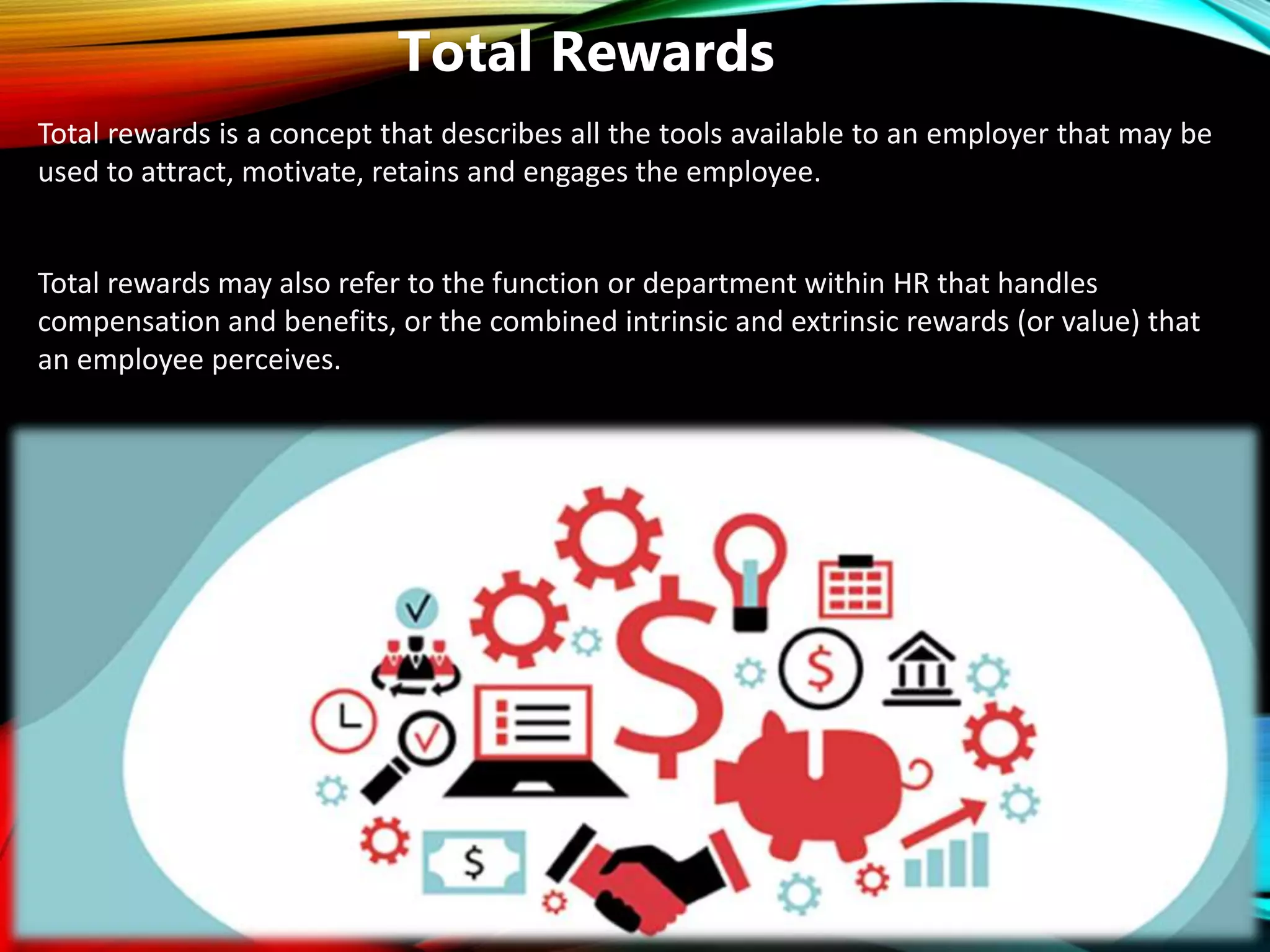
Total rewards is a concept that describes all the tools available to an employer that may be
used to attract, motivate, retains and engages the employee.
Total rewards may also refer to the function or department within HR that handles
compensation and benefits, or the combined intrinsic and extrinsic rewards (or value) that
an employee perceives.
Total Rewards
• Legal compliance
with all appropriate
laws and regulations
• Cost-effectiveness
for the organization
• Internal, external,
and individual equity
for employees
• Performance
enhancement for the
organization
• Performance
recognition and talent
management for
employees
• Enhanced
recruitment,
involvement, and
retention of employees
Nature Of Total Rewards
Models Of Total Rewards
1. External Influence: Industry and geographic area in
which the organization competes for talent.
2. Internal Influence: Business strategy, organizational
culture and human resource strategy that drive
total reward decisions.
3. Total Reward strategy: Six elements of total rewards
that define an organization’s program.
4. The Result: The Right people in the right job
at the right time.
Example
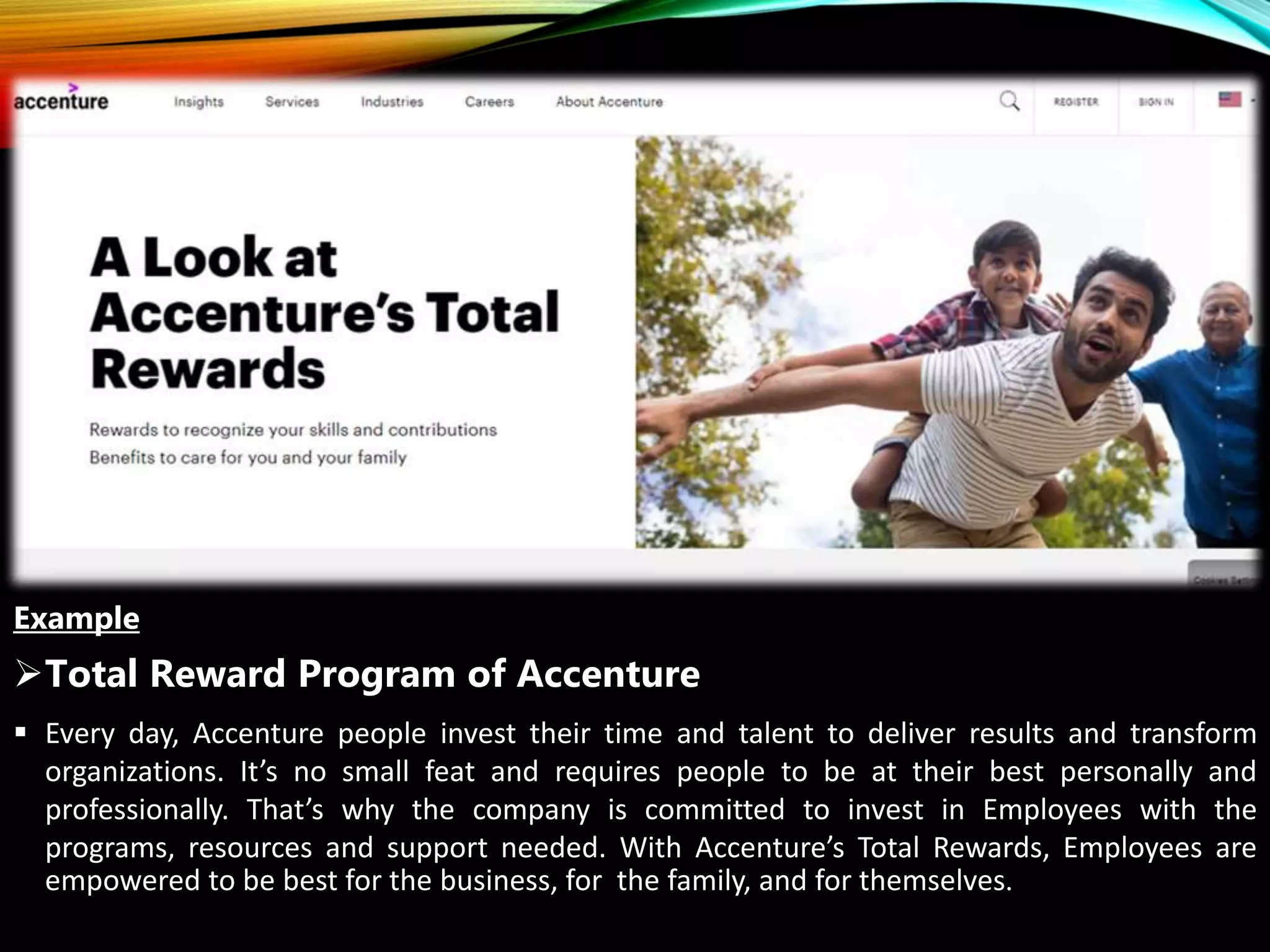
Total Reward Program of Accenture
 Every day, Accenture people invest their time and talent to deliver results and transform
organizations. It’s no small feat and requires people to be at their best personally and
professionally. That’s why the company is committed to invest in Employees with the
programs, resources and support needed. With Accenture’s Total Rewards, Employees are
empowered to be best for the business, for the family, and for themselves.
Rewards to recognize Employee skills and contributions
• The Accenture's mix of financial rewards recognize the unique skills, impact and career
progression. The Employees personal blend of base pay, bonus and equity is tailored to the
market where you work and live. As the Employers advance in your career, they have greater
opportunities to be rewarded.
Components Of Total Rewards
Compensation
Compensation is a systematic approach to providing monetary values to Employees in Exchange
of work performed.
Compensation Management:
Compensation system or designed keeping in mind the strategic goal and business
objectives.
Pay for performance:
Determining the use of pay that varies with some measure of individual or organizational
performance , such as merit , incentive and variable pay.
• Base pay
• Variable pay
Types Of Compensation
1. Direct Compensation:
Direct compensation refers to monitory benefits offered and provided to employees in return of
servicers they provide to the organization.
• Basic Salary
• House Rent Allowance
• Conveyance
• Leave Travel Allowance
• Medical reimbursement
• Special Allowances
• Bonus
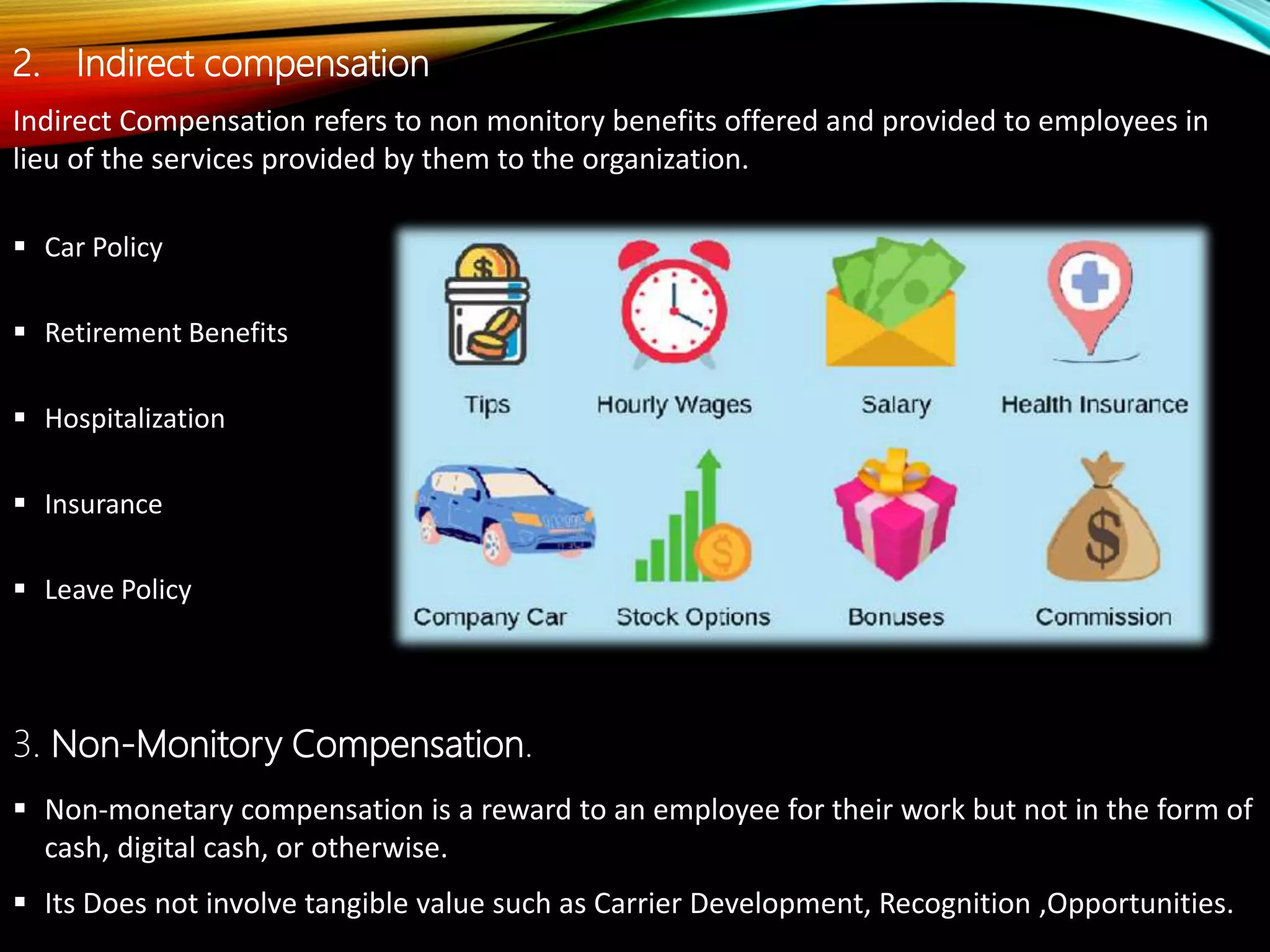
2. Indirect compensation
Indirect Compensation refers to non monitory benefits offered and provided to employees in
lieu of the services provided by them to the organization.
 Car Policy
 Retirement Benefits
 Hospitalization
 Insurance
 Leave Policy
3. Non-Monitory Compensation.
 Non-monetary compensation is a reward to an employee for their work but not in the form of
cash, digital cash, or otherwise.
 Its Does not involve tangible value such as Carrier Development, Recognition ,Opportunities.
Building Of Compensation Plan:
Internal alignment: Makes pay comparisons among jobs or skill levels inside single
organization.
Job Analysis: Job analysis is the systematic process of collecting information that
identifies similarities and differences in work.
JOB EVALUATION: Job evaluation is the systematic process of determination the
relative worth of jobs . The outcome of job evaluation is the development of an internal
structure or hierarchical ranking of jobs
• III. Pay Policy
• Pay policy is the process of determining whether the
organization wants to lead , lag or meet the market in
compensation.
• Lead – Lead the market by paying rates higher than the
relative marketplace.
• Match - Match the market by paying rates comparable
to the relative marketplace.
• Lag- Lag the market by paying rates lower than those of
the relative marketplace.
External Competitiveness:
Pay Comparisons with competitors' other organization that hire people with same of similar
knowledge , skills and abilities.
1. Market Analysis :Is the process of analyzing compensation data gathered from
other employers in a survey of the relevant labor market.
I. Select Data
II. Age Data
III. Weight Data
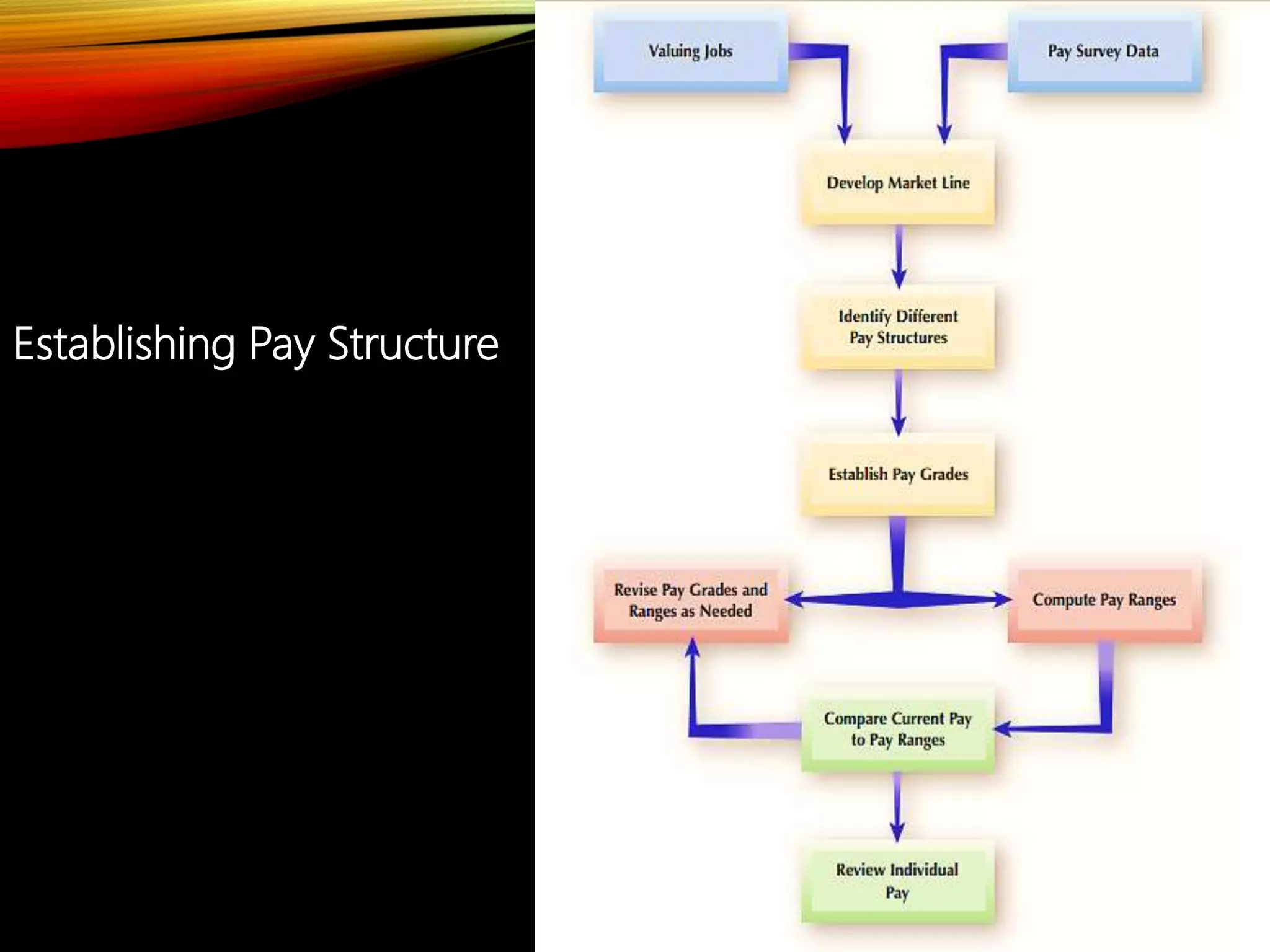
2. Base pay structure- A base pay structure is developed through job Evolution is
merged with the external market pay rates in a simple regression to develop a market pay line
from which pay grades and ranges are developed.
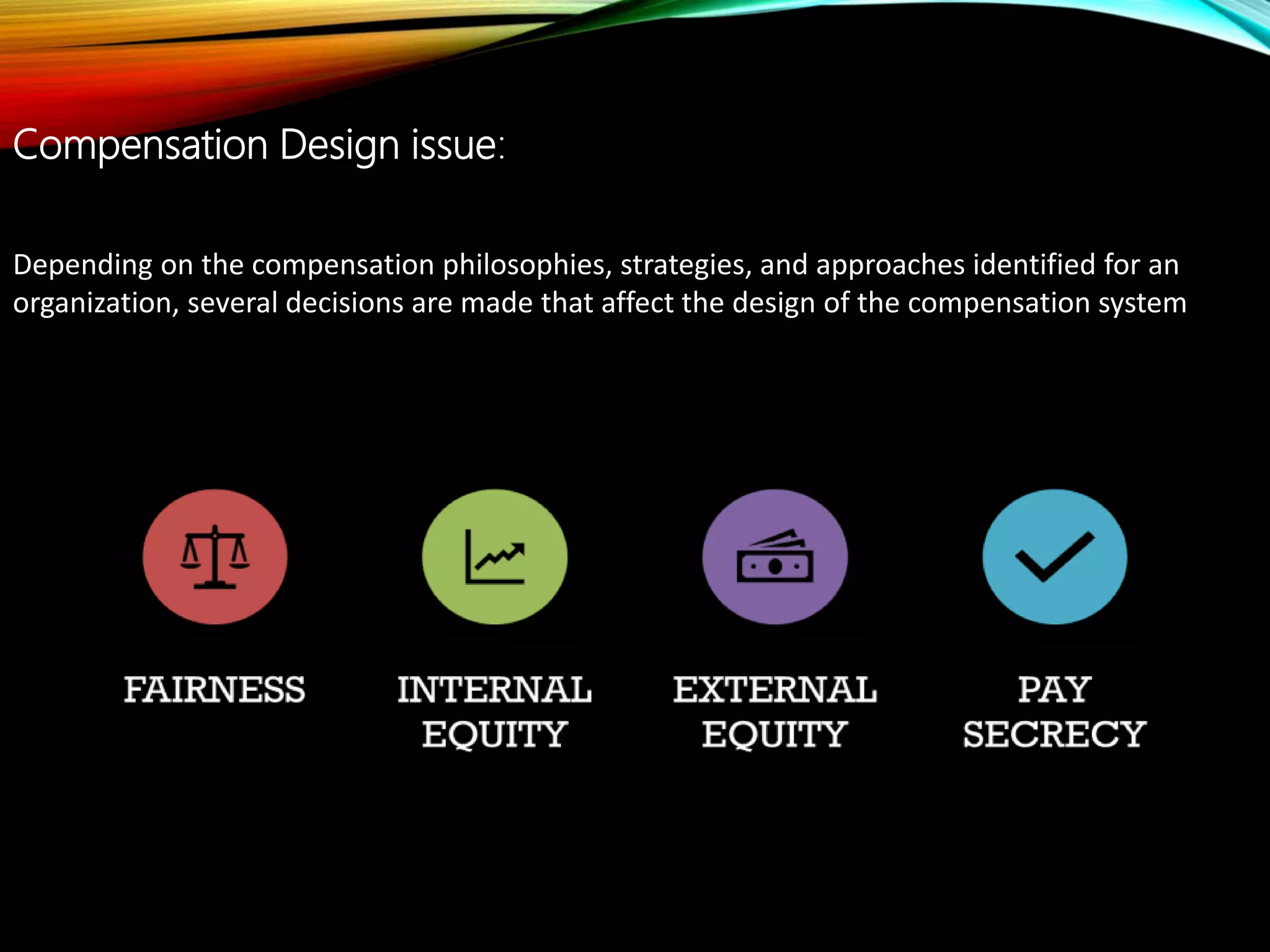
Compensation Design issue:
Depending on the compensation philosophies, strategies, and approaches identified for an
organization, several decisions are made that affect the design of the compensation system
Legal constraints on pay system
Fair Labor Standards Act (FLSA): The major federal law affecting compensation is the Fair Labor
Standards Act (FLSA), which was originally passed in 1938. Compliance with FLSA provisions is
enforced by the Wage and Hour Division of the U.S. Department of Labor. To meet FLSA
requirements, employers must keep accurate time records and maintain those records for 3
years. Penalties for wage and hour violations often include awards of up to 2 years of back pay
for affected current and former employees.
 Minimum Wage Per Month :
1. Afghanistan : 67 $
2. India: 70 $
3. Poland:657 $
4. China: 175 $
5. Germany 1,723 $
 Child Labor /Union Rights
 Exempt and Nonexempt Statues
Exempt: Employees doesn’t receive overtime, They are paid for the job they do ,
Not for the hours they work.
Nonexempt: Employees must be paid for all hours worked and depending on the position
and the business of the employer they may be entitled by overtime
Establishing Pay Structure
Traditional Bases of Pay
 Seniority Pay
 Longevity Pay
Pros
 Guarantee Promotions
 Job Security
 Avoid the perception of favoritism
Cons
 Not Rewarding Performance
 Slow Growth
 Motivation Limited
Modern Bases of Pay
 Merit Pay
 Knowledge & Skills Based Pay
Pros
 Attract and retain High Performers
 Higher Motivation
 Promote creativity and quality
Cons
• Difficult to Evaluate Performance
Objectively
• Focus on individual performances
Example
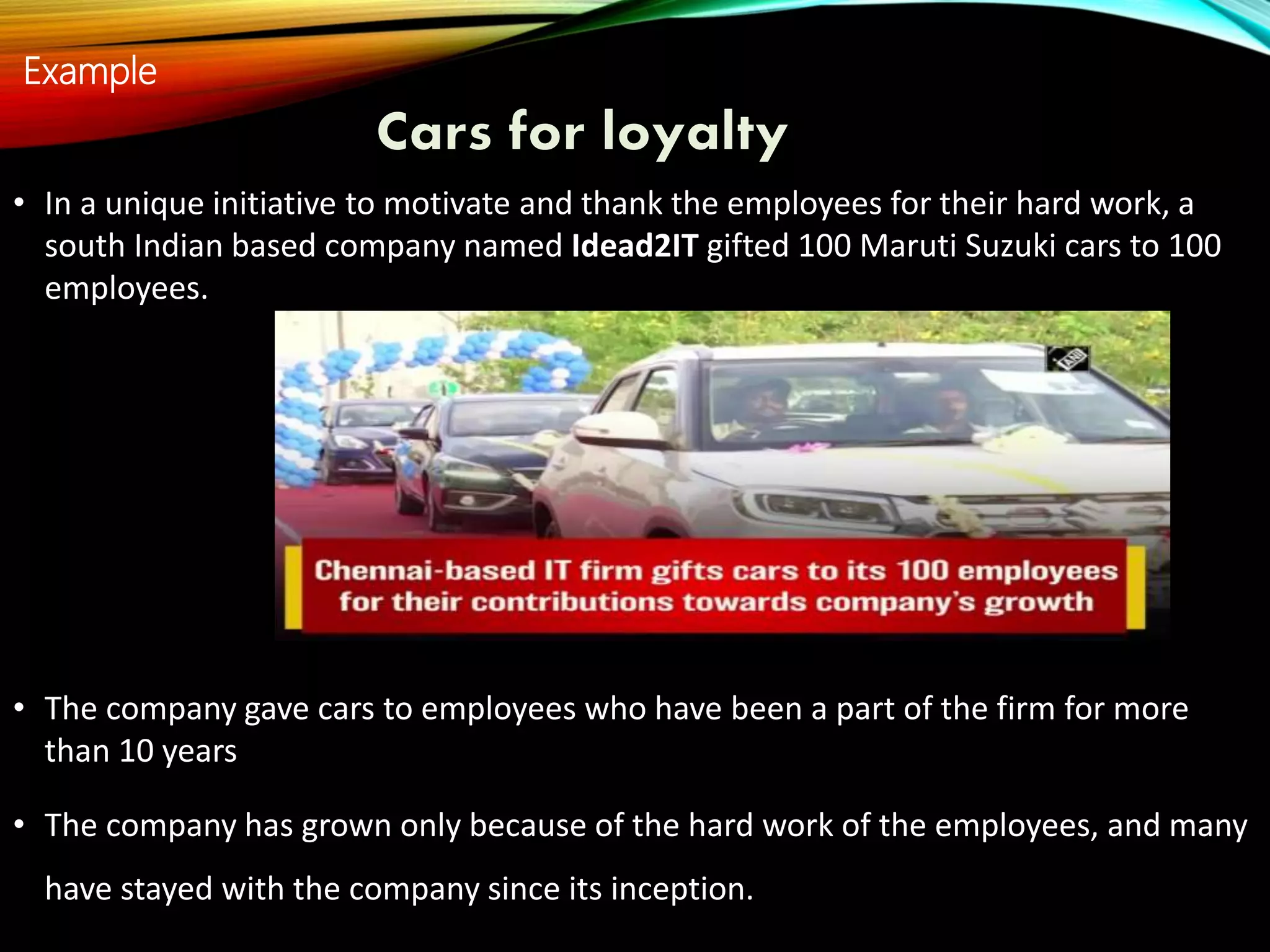
• In a unique initiative to motivate and thank the employees for their hard work, a
south Indian based company named Idead2IT gifted 100 Maruti Suzuki cars to 100
employees.
• The company gave cars to employees who have been a part of the firm for more
than 10 years
• The company has grown only because of the hard work of the employees, and many
have stayed with the company since its inception.
• Their Have strength of 500 employees their concept is to return
the wealth they have received, to the employees," said Hari
Subramanian, Marketing Head, Ideas2IT.
• The founder told the new portal that some seven years ago the
company had promised that it will share its wealth when it
reaches its goals, He added that gifting the cars was merely the
first step and that the company plans to roll out more such
incentives in future.
Example-2
• IT firm in Chennai gifted five BMW 6 Series cars worth Rs 1
crore each to its senior management. The software-as-a-service
(SaaS) firm Kissflow Inc made headlines after it gifted the BMWs
to its executives.
 Ideas2IT and Kissflow Inc have boosted the morale of their
employees with their benevolent acts of kindness.
SUMMARY
• The concept of total rewards has become a crucial part of HR management, and includes
compensation, benefits, and performance and talent management.
• Compensation provided by an organization can come directly through base pay and variable
pay and indirectly through benefits.
• A continuum of compensation philosophies exists, ranging from an entitlement philosophy to
a performance philosophy.
• HR metrics can and should be used to measure the effectiveness of compensation
• For compensation expenditures to be administered effectively, compensation responsibilities
of both HR specialists and managers must be performed well.
• When designing and administering compensation programs, internal and external equity,
organizational justice, and pay openness all must be considered.
• Decisions about compensation must always consider market competitiveness and position-ing,
use of competency-based pay, and team rewards.
Total rewards and compensation.pptx

Total rewards and compensation.pptx

  • 1.
  • 2.
    Overview • Total Rewards •Nature Of Total rewards • Models of total rewards • Example • Components Of total rewards • Compensation • Types of compensation • Building Compensation Plan • Compensation design issue • Legal Constrain of pay system • Establishing pay structure • Example • Summary
  • 3.
    Total rewards isa concept that describes all the tools available to an employer that may be used to attract, motivate, retains and engages the employee. Total rewards may also refer to the function or department within HR that handles compensation and benefits, or the combined intrinsic and extrinsic rewards (or value) that an employee perceives. Total Rewards
  • 4.
    • Legal compliance withall appropriate laws and regulations • Cost-effectiveness for the organization • Internal, external, and individual equity for employees • Performance enhancement for the organization • Performance recognition and talent management for employees • Enhanced recruitment, involvement, and retention of employees Nature Of Total Rewards
  • 5.
    Models Of TotalRewards 1. External Influence: Industry and geographic area in which the organization competes for talent. 2. Internal Influence: Business strategy, organizational culture and human resource strategy that drive total reward decisions. 3. Total Reward strategy: Six elements of total rewards that define an organization’s program. 4. The Result: The Right people in the right job at the right time.
  • 6.
    Example Total Reward Programof Accenture  Every day, Accenture people invest their time and talent to deliver results and transform organizations. It’s no small feat and requires people to be at their best personally and professionally. That’s why the company is committed to invest in Employees with the programs, resources and support needed. With Accenture’s Total Rewards, Employees are empowered to be best for the business, for the family, and for themselves.
  • 7.
    Rewards to recognizeEmployee skills and contributions • The Accenture's mix of financial rewards recognize the unique skills, impact and career progression. The Employees personal blend of base pay, bonus and equity is tailored to the market where you work and live. As the Employers advance in your career, they have greater opportunities to be rewarded.
  • 8.
  • 9.
    Compensation Compensation is asystematic approach to providing monetary values to Employees in Exchange of work performed. Compensation Management: Compensation system or designed keeping in mind the strategic goal and business objectives. Pay for performance: Determining the use of pay that varies with some measure of individual or organizational performance , such as merit , incentive and variable pay. • Base pay • Variable pay
  • 10.
    Types Of Compensation 1.Direct Compensation: Direct compensation refers to monitory benefits offered and provided to employees in return of servicers they provide to the organization. • Basic Salary • House Rent Allowance • Conveyance • Leave Travel Allowance • Medical reimbursement • Special Allowances • Bonus
  • 11.
    2. Indirect compensation IndirectCompensation refers to non monitory benefits offered and provided to employees in lieu of the services provided by them to the organization.  Car Policy  Retirement Benefits  Hospitalization  Insurance  Leave Policy 3. Non-Monitory Compensation.  Non-monetary compensation is a reward to an employee for their work but not in the form of cash, digital cash, or otherwise.  Its Does not involve tangible value such as Carrier Development, Recognition ,Opportunities.
  • 12.
    Building Of CompensationPlan: Internal alignment: Makes pay comparisons among jobs or skill levels inside single organization. Job Analysis: Job analysis is the systematic process of collecting information that identifies similarities and differences in work. JOB EVALUATION: Job evaluation is the systematic process of determination the relative worth of jobs . The outcome of job evaluation is the development of an internal structure or hierarchical ranking of jobs
  • 13.
    • III. PayPolicy • Pay policy is the process of determining whether the organization wants to lead , lag or meet the market in compensation. • Lead – Lead the market by paying rates higher than the relative marketplace. • Match - Match the market by paying rates comparable to the relative marketplace. • Lag- Lag the market by paying rates lower than those of the relative marketplace.
  • 14.
    External Competitiveness: Pay Comparisonswith competitors' other organization that hire people with same of similar knowledge , skills and abilities. 1. Market Analysis :Is the process of analyzing compensation data gathered from other employers in a survey of the relevant labor market. I. Select Data II. Age Data III. Weight Data 2. Base pay structure- A base pay structure is developed through job Evolution is merged with the external market pay rates in a simple regression to develop a market pay line from which pay grades and ranges are developed.
  • 15.
    Compensation Design issue: Dependingon the compensation philosophies, strategies, and approaches identified for an organization, several decisions are made that affect the design of the compensation system
  • 16.
    Legal constraints onpay system Fair Labor Standards Act (FLSA): The major federal law affecting compensation is the Fair Labor Standards Act (FLSA), which was originally passed in 1938. Compliance with FLSA provisions is enforced by the Wage and Hour Division of the U.S. Department of Labor. To meet FLSA requirements, employers must keep accurate time records and maintain those records for 3 years. Penalties for wage and hour violations often include awards of up to 2 years of back pay for affected current and former employees.  Minimum Wage Per Month : 1. Afghanistan : 67 $ 2. India: 70 $ 3. Poland:657 $ 4. China: 175 $ 5. Germany 1,723 $  Child Labor /Union Rights  Exempt and Nonexempt Statues Exempt: Employees doesn’t receive overtime, They are paid for the job they do , Not for the hours they work. Nonexempt: Employees must be paid for all hours worked and depending on the position and the business of the employer they may be entitled by overtime
  • 17.
  • 18.
    Traditional Bases ofPay  Seniority Pay  Longevity Pay Pros  Guarantee Promotions  Job Security  Avoid the perception of favoritism Cons  Not Rewarding Performance  Slow Growth  Motivation Limited Modern Bases of Pay  Merit Pay  Knowledge & Skills Based Pay Pros  Attract and retain High Performers  Higher Motivation  Promote creativity and quality Cons • Difficult to Evaluate Performance Objectively • Focus on individual performances
  • 19.
    Example • In aunique initiative to motivate and thank the employees for their hard work, a south Indian based company named Idead2IT gifted 100 Maruti Suzuki cars to 100 employees. • The company gave cars to employees who have been a part of the firm for more than 10 years • The company has grown only because of the hard work of the employees, and many have stayed with the company since its inception.
  • 20.
    • Their Havestrength of 500 employees their concept is to return the wealth they have received, to the employees," said Hari Subramanian, Marketing Head, Ideas2IT. • The founder told the new portal that some seven years ago the company had promised that it will share its wealth when it reaches its goals, He added that gifting the cars was merely the first step and that the company plans to roll out more such incentives in future. Example-2 • IT firm in Chennai gifted five BMW 6 Series cars worth Rs 1 crore each to its senior management. The software-as-a-service (SaaS) firm Kissflow Inc made headlines after it gifted the BMWs to its executives.  Ideas2IT and Kissflow Inc have boosted the morale of their employees with their benevolent acts of kindness.
  • 21.
    SUMMARY • The conceptof total rewards has become a crucial part of HR management, and includes compensation, benefits, and performance and talent management. • Compensation provided by an organization can come directly through base pay and variable pay and indirectly through benefits. • A continuum of compensation philosophies exists, ranging from an entitlement philosophy to a performance philosophy. • HR metrics can and should be used to measure the effectiveness of compensation • For compensation expenditures to be administered effectively, compensation responsibilities of both HR specialists and managers must be performed well. • When designing and administering compensation programs, internal and external equity, organizational justice, and pay openness all must be considered. • Decisions about compensation must always consider market competitiveness and position-ing, use of competency-based pay, and team rewards.

Editor's Notes