Aroosa shazadi
Mbaf13m047
Presented to:
Sir Hamza Aziz Noori
Project Human resource
management
 Is the processes that organize, manage, and lead
the project team.
 The project team is comprised of the people with
assigned roles and responsibilities for completing
the project.
Overview of the chapter
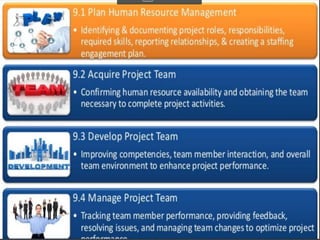
Plan Human Resource
Management
is the process of identifying and
documenting project roles,
responsibilities, required skills,
reporting relationships, and creating a
staffing management plan.
Key benefits of this process
 establishes project roles and
responsibilities,
 project organization charts,
 and the staffing management plan
including the timetable for staff
acquisition and release.
Project Management Plan
 provides guidance on how project human
resources should be defined, staffed,
managed, and eventually released.
 The information used for the development of
the human resource management plan
includes
 The project life cycle and the processes that
will be applied to each phase,
 How work will be executed to accomplish the
project objectives,
 A change management plan that documents
how changes will be monitored and controlled
 Needs and methods of communication
among stakeholders.
Activity Resource Requirements
 identify the types and quantities of
resources required for each activity in
a work package.
 Aggregated to determine
estimated resources for each work
package
each work period.
Enterprise Environmental
Factors
 enterprise environmental factors that
can influence the Plan Human
Resource management process
Organizational culture and structure,
Existing human resources,
Geographical dispersion of team
members,
Personnel administration policies, and
Marketplace conditions.
Organizational Process Assets
 are the plans, processes, policies,
procedures, and knowledge bases
specific to and used by the performing
organization.
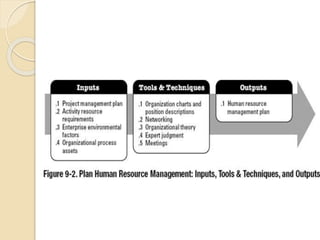
Tools &
Techniques
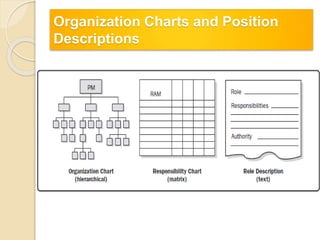
Organization Charts and Position
Descriptions
Networking
 formal and informal interaction with
others in an organization, industry, or
professional environment.
Expert Judgment
 required skills;
 standardized role descriptions
 Number of resources needed
 reporting relationships
 guidelines on lead time required for
staffing
 Identify risks associated with staff
acquisition, retention, and release
plans
Organizational Theory
 provides information regarding the
way in which people, teams, and
organizational units behave.
Outputs
Human Resource Management Plan
 Roles and responsibilities
 Role.
 Authority.
 Responsibility.
 Competency
 Project organization charts.
 Staffing management plan.
Acquire Project Team
The process of conforming human
resource availability and obtaining the
team necessary to complete project
activities.
Inputs
Human Resource Management
Plan
Provides guidance on how project
human resources should be identified,
staffed, managed, and eventually
released.
Enterprise Environmental
Factors
 Existing information on human
resources
 Personal administration policies
 Organizational structure
 Colocation or multiple locations
Organization process assets
 Organization standard policies,
processes, and procedures.
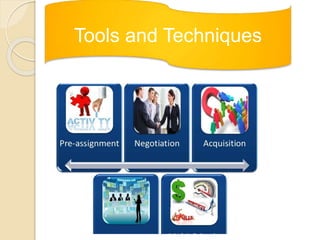
Tools and Techniques
 Specific people being identified.
 According to the project proposal
 Depend on expertise defined in project
charter.
Pre-assignment
Negotiation:
Staff assignment are negotiated on
many projects.
 Functional manager
 Other project management team
 External organizations, vendors,
suppliers, contractors etc.
Acquisition :
Performing organization is unable to
provide human resource.
 Acquire services from outside
providers where expertise is not
available internally.
 Contract employees, consultants,
outsourcing to other organizations.
Virtual teams:
 Groups possessing shared goals and
fulfilling responsibilities with little or no
face-to-face contact.
 Enabled by electronic communication
technologies.
Individuals geographically dispersed
Differences in shifts and work hours
 Minimizes travel expenses .
Multi-Criteria Decision Analysis:
Selection criteria are often used as
apart of acquiring the project team.
Some examples of selection criteria
that can be used to score team
members are given below:
 Availability
 Cost
 Knowledge
 Ability
 Experience
Outputs
Project Staff Assignments:
 Staffs project by assigning specific
individuals to project roles and
responsibilities.
 Documentation often include:
Project team directory
Specific names inserted into revised
organization charts and schedules
Resource Calendars:
 Documents time periods each member
can work on project
 Creating a reliable scheduling of each
person availability, scheduling conflicts,
time zone, work hours, and commitment
to other projects
 Enable to building out the final human
resource budgets
Project Management Plan Updates:
 Elements of project management
plan that may be updated
 Human resource plan updated
 Continuing updates should reflect
promotions, retirements,
performance issues and changing
workloads
Develop project team
The process of improving competencies
,team member interaction, and overall
team environment to enhance project
performance
Inputs
1) Human resource management plan
2) Project staff assignments
3) Resource calendars
Tools and techniques
1) Interpersonal skills
2) Training
3) Team –building activities
4) Ground rules
5) Colocation
6) Recognition and rewards
7) Personal assessment tools
Out put
 Team performance assessments
 Enterprise environmental factors
updates.
Manage project team
 Tracking of team performance
 Providing feedback
 Resolving issues
 Resource allocation
Benefits of manage project team
 Influencing team Behavior
 Conflict management
 Performance appraises
Manage project team: Inputs
 HR plan
 Requirement of job
Manage project team: tool and
techniques
 Observations
 Communication
Manage project team: output
 Project team
For managing a project team
skills are required
 Communication
 Conflict management
 Negotiation
 Leadership
 Interpersonal skill
 Project manager assign task, provide
recognition to high performance.
Factor influencing team
decisions
 change request
 PM plan update
 Project documentation
 External factor
 Organizational process assets
project human resource managment

project human resource managment

  • 2.
  • 4.
    Project Human resource management Is the processes that organize, manage, and lead the project team.  The project team is comprised of the people with assigned roles and responsibilities for completing the project.
  • 5.
  • 6.
    Plan Human Resource Management isthe process of identifying and documenting project roles, responsibilities, required skills, reporting relationships, and creating a staffing management plan.
  • 7.
    Key benefits ofthis process  establishes project roles and responsibilities,  project organization charts,  and the staffing management plan including the timetable for staff acquisition and release.
  • 9.
    Project Management Plan provides guidance on how project human resources should be defined, staffed, managed, and eventually released.  The information used for the development of the human resource management plan includes  The project life cycle and the processes that will be applied to each phase,  How work will be executed to accomplish the project objectives,  A change management plan that documents how changes will be monitored and controlled  Needs and methods of communication among stakeholders.
  • 10.
    Activity Resource Requirements identify the types and quantities of resources required for each activity in a work package.  Aggregated to determine estimated resources for each work package each work period.
  • 11.
    Enterprise Environmental Factors  enterpriseenvironmental factors that can influence the Plan Human Resource management process Organizational culture and structure, Existing human resources, Geographical dispersion of team members, Personnel administration policies, and Marketplace conditions.
  • 12.
    Organizational Process Assets are the plans, processes, policies, procedures, and knowledge bases specific to and used by the performing organization.
  • 13.
  • 14.
    Organization Charts andPosition Descriptions
  • 15.
    Networking  formal andinformal interaction with others in an organization, industry, or professional environment.
  • 16.
    Expert Judgment  requiredskills;  standardized role descriptions  Number of resources needed  reporting relationships  guidelines on lead time required for staffing  Identify risks associated with staff acquisition, retention, and release plans
  • 17.
    Organizational Theory  providesinformation regarding the way in which people, teams, and organizational units behave.
  • 18.
  • 19.
    Human Resource ManagementPlan  Roles and responsibilities  Role.  Authority.  Responsibility.  Competency  Project organization charts.  Staffing management plan.
  • 20.
    Acquire Project Team Theprocess of conforming human resource availability and obtaining the team necessary to complete project activities.
  • 21.
  • 22.
    Human Resource Management Plan Providesguidance on how project human resources should be identified, staffed, managed, and eventually released.
  • 23.
    Enterprise Environmental Factors  Existinginformation on human resources  Personal administration policies  Organizational structure  Colocation or multiple locations
  • 24.
    Organization process assets Organization standard policies, processes, and procedures.
  • 25.
  • 26.
     Specific peoplebeing identified.  According to the project proposal  Depend on expertise defined in project charter. Pre-assignment
  • 27.
    Negotiation: Staff assignment arenegotiated on many projects.  Functional manager  Other project management team  External organizations, vendors, suppliers, contractors etc.
  • 28.
    Acquisition : Performing organizationis unable to provide human resource.  Acquire services from outside providers where expertise is not available internally.  Contract employees, consultants, outsourcing to other organizations.
  • 29.
    Virtual teams:  Groupspossessing shared goals and fulfilling responsibilities with little or no face-to-face contact.  Enabled by electronic communication technologies. Individuals geographically dispersed Differences in shifts and work hours  Minimizes travel expenses .
  • 30.
    Multi-Criteria Decision Analysis: Selectioncriteria are often used as apart of acquiring the project team. Some examples of selection criteria that can be used to score team members are given below:  Availability  Cost  Knowledge  Ability  Experience
  • 31.
  • 32.
    Project Staff Assignments: Staffs project by assigning specific individuals to project roles and responsibilities.  Documentation often include: Project team directory Specific names inserted into revised organization charts and schedules
  • 33.
    Resource Calendars:  Documentstime periods each member can work on project  Creating a reliable scheduling of each person availability, scheduling conflicts, time zone, work hours, and commitment to other projects  Enable to building out the final human resource budgets
  • 34.
    Project Management PlanUpdates:  Elements of project management plan that may be updated  Human resource plan updated  Continuing updates should reflect promotions, retirements, performance issues and changing workloads
  • 35.
    Develop project team Theprocess of improving competencies ,team member interaction, and overall team environment to enhance project performance
  • 36.
    Inputs 1) Human resourcemanagement plan 2) Project staff assignments 3) Resource calendars
  • 37.
    Tools and techniques 1)Interpersonal skills 2) Training 3) Team –building activities 4) Ground rules 5) Colocation 6) Recognition and rewards 7) Personal assessment tools
  • 38.
    Out put  Teamperformance assessments  Enterprise environmental factors updates.
  • 39.
    Manage project team Tracking of team performance  Providing feedback  Resolving issues  Resource allocation
  • 40.
    Benefits of manageproject team  Influencing team Behavior  Conflict management  Performance appraises
  • 41.
    Manage project team:Inputs  HR plan  Requirement of job
  • 42.
    Manage project team:tool and techniques  Observations  Communication
  • 43.
    Manage project team:output  Project team
  • 44.
    For managing aproject team skills are required  Communication  Conflict management  Negotiation  Leadership  Interpersonal skill  Project manager assign task, provide recognition to high performance.
  • 45.
    Factor influencing team decisions change request  PM plan update  Project documentation  External factor  Organizational process assets