Adaptation-101
M. FEISAL RAHMAN
19 DECEMBER 2020
Session Plan
 What is adaptation and the process for
implementing adaptation?
 What are the different types of adaptation
 How is adaptation different from conventional
development?
2
Two Policy Response to Climate Change
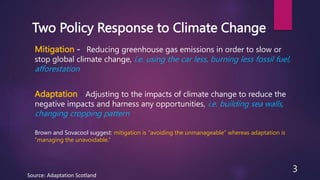
Mitigation - Reducing greenhouse gas emissions in order to slow or
stop global climate change, i.e. using the car less, burning less fossil fuel,
afforestation
Adaptation - Adjusting to the impacts of climate change to reduce the
negative impacts and harness any opportunities, i.e. building sea walls,
changing cropping pattern
Source: Adaptation Scotland
3
Brown and Sovacool suggest: mitigation is “avoiding the unmanageable” whereas adaptation is
“managing the unavoidable.”
Why is Adaptation Important?
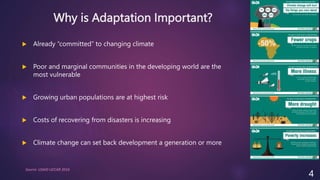
 Already “committed” to changing climate
 Poor and marginal communities in the developing world are the
most vulnerable
 Growing urban populations are at highest risk
 Costs of recovering from disasters is increasing
 Climate change can set back development a generation or more
Source: USAID UCCAR 2016
4
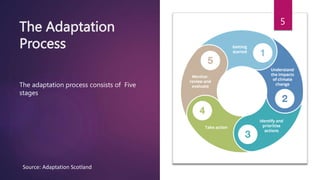
The Adaptation
Process
The adaptation process consists of Five
stages
Source: Adaptation Scotland
5
Getting started
This stage of the process includes:
 Finding out about the impacts of climate change
 Understanding why the impacts of climate change matter
 Raising awareness and agreeing next steps
1
Source: Adaptation Scotland
6
Understand the impacts of climate change
This stage of the process includes:
 Learning about past climate trends and future projections
 Understanding how your place, assets, services or priorities have been
affected by severe weather events in the past
 Considering how your place, assets, services or priorities might be
affected as our climate continues to change
2
Source: Adaptation Scotland
7
Identify and prioritise actions
This stage of the process includes:
 Establishing a vision for a climate ready future
 Identifying the most significant climate risks
 Identifying existing adaptation options
 Examining what further action is needed
3
Source: Adaptation Scotland 8
Take action
This stage of the process includes:
 Partnership working and leadership
 Collating and presenting your adaptation actions
 Building adaptive capacity
 Implementing on the ground actions
 Telling others
4
Source: Adaptation Scotland
9
Monitor, review and evaluate
This stage of the process includes:
 Monitoring and reporting progress
 Reviewing regularly
 Reflecting on what has worked and why
 Evaluating the outcomes
5
Source: Adaptation Scotland 10
Types of Adaptation
 Spontaneous/ autonomous/ reactive adaptations
o to cope with gradual changes in climate system
o either unconscious or automatic reactions to climatic perturbation
o or conscious responses to variations in climate that are part of the routine functioning of a
system, or responses requiring a behavioural change
 Anticipatory/ Planned/ proactive
o strategically anticipates and strives to avoid the effects of future undesired changes
Ahmed et al. 1999
Biagini, B., Bierbaum, R., Stults, M., Dobardzic, S., & McNeeley, S. M. (2014). A typology of adaptation actions: A global look at climate adaptation actions
financed through the Global Environment Facility. Global Environmental Change, 25, 97-108. (check for multiple other typology of adaptation)
11
Anticipatory Adaptation
1. Bear losses- basically doing nothing and accepting ‘suffering’ to climate change
2. Share losses- provide subsidies to people living in vulnerable areas, or to increase taxes for those living in protected areas. Also
crop loss insurance or homestead insurance etc.
3. Modify the threat- switching to alternative cropping patterns, improving early warning systems, or erecting breakwaters in an
island to safeguard tourism.
4. Prevent the effect- building embankments to prevent flooding, or constructing flood control infrastructure.
5. Change use- switching from rice to growing shrimp or aquaculture in areas suffering saltwater intrusion.
6. Change location- for example, relocating people or activities away from harm, such as the establishment of flood evacuation
centers, provision of boats for refugees, or providing climate migrants with new housing and land.
7. Restoration- restoring ecosystems or other infrastructure to their original conditions following climate-related damage.
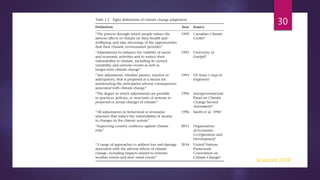
Sovacool 2018; Ahmed et al. 1999
12
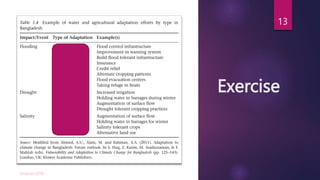
Exercise
Sovacool 2018
13
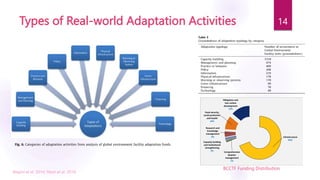
Types of Real-world Adaptation Activities
Biagini et al. 2014; Nasir et al. 2018
Infrastructure
69%
Comprehensive
disaster
management
1%
Capacity building
and institutional
strengthening
2%
Research and
knowledge
management
4%
Food security,
social protection
and health
10%
Mitigation and
low-carbon
development
14%
BCCTF Funding Distribution
14
Is it Adaptation or Development?
Adaptation
“Adjustment in natural or human systems in response to actual or expected climatic stimuli or their effects,
which moderates harm or exploits beneficial opportunities.”(IPCC 2007). Adaptation is a process, not an
outcome.
Development
The pursuit or attainment of well-being in all its dimensions, including economic sufficiency, social equity,
personal security, good health, opportunity, and personal freedom.
“The question has bedevilled the adaptation policy community for well over a decade”
(Hammill and Mcgray 2018)
15
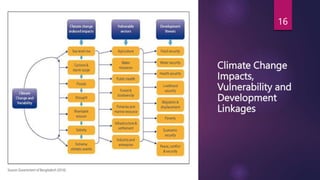
Climate Change
Impacts,
Vulnerability and
Development
Linkages
16
(McGray et al. 2007)
17
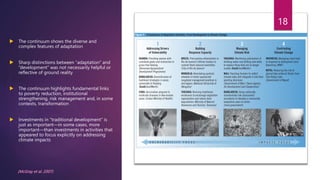
 The continuum shows the diverse and
complex features of adaptation
 Sharp distinctions between “adaptation” and
“development” was not necessarily helpful or
reflective of ground reality
 The continuum highlights fundamental links
to poverty reduction, institutional
strengthening, risk management and, in some
contexts, transformation
 Investments in “traditional development” is
just as important—in some cases, more
important—than investments in activities that
appeared to focus explicitly on addressing
climate impacts
18
(McGray et al. 2007)
Adaptation vs Development
McGray et al. (2007) concluded:
“Rarely do adaptation efforts entail activities not found in the development toolbox.
The uniquely adaptive elements of most efforts are those involved in defining problems,
selecting strategies, and setting priorities – not in implementing solutions”
19
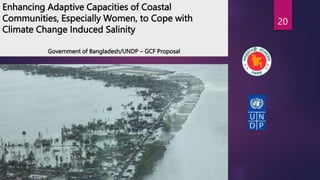
Enhancing Adaptive Capacities of Coastal
Communities, Especially Women, to Cope with
Climate Change Induced Salinity
Government of Bangladesh/UNDP – GCF Proposal
20
Bangladesh Case Study
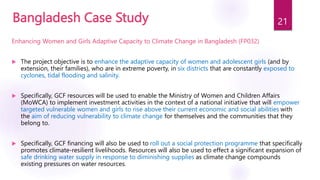
Enhancing Women and Girls Adaptive Capacity to Climate Change in Bangladesh (FP032)
 The project objective is to enhance the adaptive capacity of women and adolescent girls (and by
extension, their families), who are in extreme poverty, in six districts that are constantly exposed to
cyclones, tidal flooding and salinity.
 Specifically, GCF resources will be used to enable the Ministry of Women and Children Affairs
(MoWCA) to implement investment activities in the context of a national initiative that will empower
targeted vulnerable women and girls to rise above their current economic and social abilities with
the aim of reducing vulnerability to climate change for themselves and the communities that they
belong to.
 Specifically, GCF financing will also be used to roll out a social protection programme that specifically
promotes climate-resilient livelihoods. Resources will also be used to effect a significant expansion of
safe drinking water supply in response to diminishing supplies as climate change compounds
existing pressures on water resources.
21
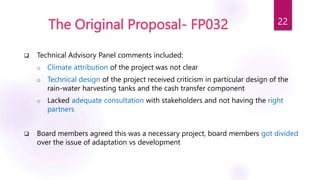
The Original Proposal- FP032
 Technical Advisory Panel comments included:
o Climate attribution of the project was not clear
o Technical design of the project received criticism in particular design of the
rain-water harvesting tanks and the cash transfer component
o Lacked adequate consultation with stakeholders and not having the right
partners
 Board members agreed this was a necessary project, board members got divided
over the issue of adaptation vs development
22
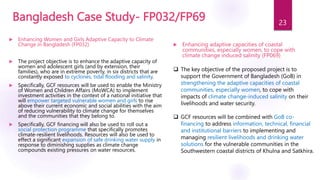
Bangladesh Case Study- FP032/FP69
 Enhancing adaptive capacities of coastal
communities, especially women, to cope with
climate change induced salinity (FP069)
 The key objective of the proposed project is to
support the Government of Bangladesh (GoB) in
strengthening the adaptive capacities of coastal
communities, especially women, to cope with
impacts of climate change-induced salinity on their
livelihoods and water security.
 GCF resources will be combined with GoB co-
financing to address information, technical, financial
and institutional barriers to implementing and
managing resilient livelihoods and drinking water
solutions for the vulnerable communities in the
Southwestern coastal districts of Khulna and Satkhira.
 Enhancing Women and Girls Adaptive Capacity to Climate
Change in Bangladesh (FP032)
 The project objective is to enhance the adaptive capacity of
women and adolescent girls (and by extension, their
families), who are in extreme poverty, in six districts that are
constantly exposed to cyclones, tidal flooding and salinity.
 Specifically, GCF resources will be used to enable the Ministry
of Women and Children Affairs (MoWCA) to implement
investment activities in the context of a national initiative that
will empower targeted vulnerable women and girls to rise
above their current economic and social abilities with the aim
of reducing vulnerability to climate change for themselves
and the communities that they belong to.
 Specifically, GCF financing will also be used to roll out a
social protection programme that specifically promotes
climate-resilient livelihoods. Resources will also be used to
effect a significant expansion of safe drinking water supply in
response to diminishing supplies as climate change
compounds existing pressures on water resources.
23
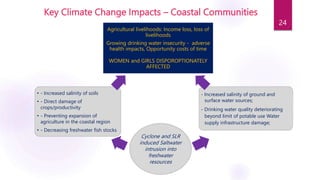
Cyclone and SLR
induced Saltwater
intrusion into
freshwater
resources
• - Increased salinity of soils
• - Direct damage of
crops/productivity
• - Preventing expansion of
agriculture in the coastal region
• - Decreasing freshwater fish stocks
- Increased salinity of ground and
surface water sources;
- Drinking water quality deteriorating
beyond limit of potable use Water
supply infrastructure damage;
Key Climate Change Impacts – Coastal Communities
Agricultural livelihoods: Income loss, loss of
livelihoods
Growing drinking water insecurity - adverse
health impacts, Opportunity costs of time
WOMEN and GIRLS DISPOROPTIONATELY
AFFECTED
24
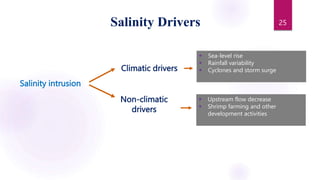
Salinity Drivers
Salinity intrusion
 Sea-level rise
 Rainfall variability
 Cyclones and storm surge
Climatic drivers
Non-climatic
drivers
 Upstream flow decrease
 Shrimp farming and other
development activities
25
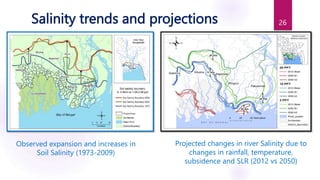
Salinity trends and projections
2
6
Projected changes in river Salinity due to
changes in rainfall, temperature,
subsidence and SLR (2012 vs 2050)
Observed expansion and increases in
Soil Salinity (1973-2009)
26
 This case study reflects the confusion and debate around issue “adaptation
vs development” are far from being resolved especially since 2007 several
climate funds have become operational and more resources are available!!!
 “The relationship between the activity and the context—the adaptation logic
or justification—must be clearly articulated by those seeking funding and
other forms of support”
Hammill and McGray (2018)
27
So, the authors looked back on the continuum and
tried to capture lessons since 2007
 “Adaptation or development” is not an either-or choice
 Understanding the climate risk context is the crux of adaptation
 We need to keep the full spectrum of adaptation options on the table
 Adaptation often requires simultaneous work at multiple points on the continuum
 Long-term success means abandoning the “adaptation vs development” function of the
continuum
Hammill and Mcgray (2018) argued:
“Fully integrating adaptation into development is among the most transformational
processes we could wish for in the climate change space”
Hammill and McGray (2018)
28
Thank you
29
30
Sovacool 2018

Adaptation 101-A.pptx

  • 1.
  • 2.
    Session Plan  Whatis adaptation and the process for implementing adaptation?  What are the different types of adaptation  How is adaptation different from conventional development? 2
  • 3.
    Two Policy Responseto Climate Change Mitigation - Reducing greenhouse gas emissions in order to slow or stop global climate change, i.e. using the car less, burning less fossil fuel, afforestation Adaptation - Adjusting to the impacts of climate change to reduce the negative impacts and harness any opportunities, i.e. building sea walls, changing cropping pattern Source: Adaptation Scotland 3 Brown and Sovacool suggest: mitigation is “avoiding the unmanageable” whereas adaptation is “managing the unavoidable.”
  • 4.
    Why is AdaptationImportant?  Already “committed” to changing climate  Poor and marginal communities in the developing world are the most vulnerable  Growing urban populations are at highest risk  Costs of recovering from disasters is increasing  Climate change can set back development a generation or more Source: USAID UCCAR 2016 4
  • 5.
    The Adaptation Process The adaptationprocess consists of Five stages Source: Adaptation Scotland 5
  • 6.
    Getting started This stageof the process includes:  Finding out about the impacts of climate change  Understanding why the impacts of climate change matter  Raising awareness and agreeing next steps 1 Source: Adaptation Scotland 6
  • 7.
    Understand the impactsof climate change This stage of the process includes:  Learning about past climate trends and future projections  Understanding how your place, assets, services or priorities have been affected by severe weather events in the past  Considering how your place, assets, services or priorities might be affected as our climate continues to change 2 Source: Adaptation Scotland 7
  • 8.
    Identify and prioritiseactions This stage of the process includes:  Establishing a vision for a climate ready future  Identifying the most significant climate risks  Identifying existing adaptation options  Examining what further action is needed 3 Source: Adaptation Scotland 8
  • 9.
    Take action This stageof the process includes:  Partnership working and leadership  Collating and presenting your adaptation actions  Building adaptive capacity  Implementing on the ground actions  Telling others 4 Source: Adaptation Scotland 9
  • 10.
    Monitor, review andevaluate This stage of the process includes:  Monitoring and reporting progress  Reviewing regularly  Reflecting on what has worked and why  Evaluating the outcomes 5 Source: Adaptation Scotland 10
  • 11.
    Types of Adaptation Spontaneous/ autonomous/ reactive adaptations o to cope with gradual changes in climate system o either unconscious or automatic reactions to climatic perturbation o or conscious responses to variations in climate that are part of the routine functioning of a system, or responses requiring a behavioural change  Anticipatory/ Planned/ proactive o strategically anticipates and strives to avoid the effects of future undesired changes Ahmed et al. 1999 Biagini, B., Bierbaum, R., Stults, M., Dobardzic, S., & McNeeley, S. M. (2014). A typology of adaptation actions: A global look at climate adaptation actions financed through the Global Environment Facility. Global Environmental Change, 25, 97-108. (check for multiple other typology of adaptation) 11
  • 12.
    Anticipatory Adaptation 1. Bearlosses- basically doing nothing and accepting ‘suffering’ to climate change 2. Share losses- provide subsidies to people living in vulnerable areas, or to increase taxes for those living in protected areas. Also crop loss insurance or homestead insurance etc. 3. Modify the threat- switching to alternative cropping patterns, improving early warning systems, or erecting breakwaters in an island to safeguard tourism. 4. Prevent the effect- building embankments to prevent flooding, or constructing flood control infrastructure. 5. Change use- switching from rice to growing shrimp or aquaculture in areas suffering saltwater intrusion. 6. Change location- for example, relocating people or activities away from harm, such as the establishment of flood evacuation centers, provision of boats for refugees, or providing climate migrants with new housing and land. 7. Restoration- restoring ecosystems or other infrastructure to their original conditions following climate-related damage. Sovacool 2018; Ahmed et al. 1999 12
  • 13.
  • 14.
    Types of Real-worldAdaptation Activities Biagini et al. 2014; Nasir et al. 2018 Infrastructure 69% Comprehensive disaster management 1% Capacity building and institutional strengthening 2% Research and knowledge management 4% Food security, social protection and health 10% Mitigation and low-carbon development 14% BCCTF Funding Distribution 14
  • 15.
    Is it Adaptationor Development? Adaptation “Adjustment in natural or human systems in response to actual or expected climatic stimuli or their effects, which moderates harm or exploits beneficial opportunities.”(IPCC 2007). Adaptation is a process, not an outcome. Development The pursuit or attainment of well-being in all its dimensions, including economic sufficiency, social equity, personal security, good health, opportunity, and personal freedom. “The question has bedevilled the adaptation policy community for well over a decade” (Hammill and Mcgray 2018) 15
  • 16.
  • 17.
  • 18.
     The continuumshows the diverse and complex features of adaptation  Sharp distinctions between “adaptation” and “development” was not necessarily helpful or reflective of ground reality  The continuum highlights fundamental links to poverty reduction, institutional strengthening, risk management and, in some contexts, transformation  Investments in “traditional development” is just as important—in some cases, more important—than investments in activities that appeared to focus explicitly on addressing climate impacts 18 (McGray et al. 2007)
  • 19.
    Adaptation vs Development McGrayet al. (2007) concluded: “Rarely do adaptation efforts entail activities not found in the development toolbox. The uniquely adaptive elements of most efforts are those involved in defining problems, selecting strategies, and setting priorities – not in implementing solutions” 19
  • 20.
    Enhancing Adaptive Capacitiesof Coastal Communities, Especially Women, to Cope with Climate Change Induced Salinity Government of Bangladesh/UNDP – GCF Proposal 20
  • 21.
    Bangladesh Case Study EnhancingWomen and Girls Adaptive Capacity to Climate Change in Bangladesh (FP032)  The project objective is to enhance the adaptive capacity of women and adolescent girls (and by extension, their families), who are in extreme poverty, in six districts that are constantly exposed to cyclones, tidal flooding and salinity.  Specifically, GCF resources will be used to enable the Ministry of Women and Children Affairs (MoWCA) to implement investment activities in the context of a national initiative that will empower targeted vulnerable women and girls to rise above their current economic and social abilities with the aim of reducing vulnerability to climate change for themselves and the communities that they belong to.  Specifically, GCF financing will also be used to roll out a social protection programme that specifically promotes climate-resilient livelihoods. Resources will also be used to effect a significant expansion of safe drinking water supply in response to diminishing supplies as climate change compounds existing pressures on water resources. 21
  • 22.
    The Original Proposal-FP032  Technical Advisory Panel comments included: o Climate attribution of the project was not clear o Technical design of the project received criticism in particular design of the rain-water harvesting tanks and the cash transfer component o Lacked adequate consultation with stakeholders and not having the right partners  Board members agreed this was a necessary project, board members got divided over the issue of adaptation vs development 22
  • 23.
    Bangladesh Case Study-FP032/FP69  Enhancing adaptive capacities of coastal communities, especially women, to cope with climate change induced salinity (FP069)  The key objective of the proposed project is to support the Government of Bangladesh (GoB) in strengthening the adaptive capacities of coastal communities, especially women, to cope with impacts of climate change-induced salinity on their livelihoods and water security.  GCF resources will be combined with GoB co- financing to address information, technical, financial and institutional barriers to implementing and managing resilient livelihoods and drinking water solutions for the vulnerable communities in the Southwestern coastal districts of Khulna and Satkhira.  Enhancing Women and Girls Adaptive Capacity to Climate Change in Bangladesh (FP032)  The project objective is to enhance the adaptive capacity of women and adolescent girls (and by extension, their families), who are in extreme poverty, in six districts that are constantly exposed to cyclones, tidal flooding and salinity.  Specifically, GCF resources will be used to enable the Ministry of Women and Children Affairs (MoWCA) to implement investment activities in the context of a national initiative that will empower targeted vulnerable women and girls to rise above their current economic and social abilities with the aim of reducing vulnerability to climate change for themselves and the communities that they belong to.  Specifically, GCF financing will also be used to roll out a social protection programme that specifically promotes climate-resilient livelihoods. Resources will also be used to effect a significant expansion of safe drinking water supply in response to diminishing supplies as climate change compounds existing pressures on water resources. 23
  • 24.
    Cyclone and SLR inducedSaltwater intrusion into freshwater resources • - Increased salinity of soils • - Direct damage of crops/productivity • - Preventing expansion of agriculture in the coastal region • - Decreasing freshwater fish stocks - Increased salinity of ground and surface water sources; - Drinking water quality deteriorating beyond limit of potable use Water supply infrastructure damage; Key Climate Change Impacts – Coastal Communities Agricultural livelihoods: Income loss, loss of livelihoods Growing drinking water insecurity - adverse health impacts, Opportunity costs of time WOMEN and GIRLS DISPOROPTIONATELY AFFECTED 24
  • 25.
    Salinity Drivers Salinity intrusion Sea-level rise  Rainfall variability  Cyclones and storm surge Climatic drivers Non-climatic drivers  Upstream flow decrease  Shrimp farming and other development activities 25
  • 26.
    Salinity trends andprojections 2 6 Projected changes in river Salinity due to changes in rainfall, temperature, subsidence and SLR (2012 vs 2050) Observed expansion and increases in Soil Salinity (1973-2009) 26
  • 27.
     This casestudy reflects the confusion and debate around issue “adaptation vs development” are far from being resolved especially since 2007 several climate funds have become operational and more resources are available!!!  “The relationship between the activity and the context—the adaptation logic or justification—must be clearly articulated by those seeking funding and other forms of support” Hammill and McGray (2018) 27
  • 28.
    So, the authorslooked back on the continuum and tried to capture lessons since 2007  “Adaptation or development” is not an either-or choice  Understanding the climate risk context is the crux of adaptation  We need to keep the full spectrum of adaptation options on the table  Adaptation often requires simultaneous work at multiple points on the continuum  Long-term success means abandoning the “adaptation vs development” function of the continuum Hammill and Mcgray (2018) argued: “Fully integrating adaptation into development is among the most transformational processes we could wish for in the climate change space” Hammill and McGray (2018) 28
  • 29.
  • 30.

Editor's Notes

  • #5 Already committed to changing climate. Climatologists often use the term “committed climate change” to refer to changes in our climate that have already occurred or will occur even if aggressive mitigation proves successful in limiting future greenhouse gas emissions. Committed climate change is a result of greenhouse gases that have already been added to the atmosphere. In other words, committed climate change means that the climate will continue to change because a) we have already changed the composition of the atmosphere such that the thermal characteristics are different than the pre-industrial era and so the climate will respond to these changes, and b) some greenhouse gasses have long “residence times” in the atmosphere, which means that they will continue to produce a warming effect into the future. Growing urban populations are at highest risk. Adaptation considers not only physical aspects of climate change, but also socio-economic processes and conditions that shape the impacts of a changing climate. Demographic characteristics are a key influence on climate change impacts. The global urban population is expected to double from 3.7 billion to over 7 billion in next two decades (by 2030), most of it in urban slums of cities in the developing world, particularly in South Asia and Sub-Saharan Africa. (Ref: Systems of Cities report, World Bank, p.1 (foreword), 2009 and WB 2013 reference above.) Urban poor in the developing world are the most vulnerable. Various studies, practically all, mention poorer urban residents as the key group to build resilience strategies and programs around. They comprise a large proportion of the “vulnerable populations” that are cited by many World Bank and UNDP studies (among others) as key to address in taking a “pro-poor” approach to building resilience and sustaining social and economic progress/development. Costs of recovering from disasters is increasing. The costs of climate-induced “disasters” is climbing rapidly, and is expected to accelerate even more in the next 10-20 years as more and more climate change impacts take their toll on human life, assets, and livelihoods as well as on ecological systems providing enormous and multiple types of benefits to society that are not incorporated into national accounting systems of gross national product (GNP) or gross domestic product (GDP). Cities are particularly “vulnerable” to CC impacts because many of the world’s largest cities are located in low-lying coastal areas or along major rivers, and other vulnerable sites (mainly due to their historic trading and political advantages provided by the location on major river or ocean commercial routes). Despite this vulnerability, most cities are not prepared for or equipped to deal with CC impacts. Since they have not yet incorporated climate change adaptation and resilience (CCA) measures into their annual planning & budgeting processes nor incorporated them into their longer-term capital improvements budgets for public facilities and infrastructure, they are ill-prepared for and not resilient to coming CC impacts. As we will see in a moment, costs for climate change related disasters are increasing. Can set back development a generation or more. Lastly, climate change threatens much of the progress made over the past few decades in terms of improving the human condition around the world. Climate change is a fundamental threat to development, and if we don’t confront climate change we will not be able to end poverty. Climate change and global warming will have impacts on agriculture, water resources, ecosystems, and human health, and these impacts will be far worse if we do not take action to adapt. In the words of US Secretary of State John Kerry: “On a range of crosscutting issues from global hunger to global health, changing global temperatures and weather patterns will inject a new element of chaos into the already-fragile existences of the world’s poorest people. Among the predictions are more famine and drought, expanding epidemics, more natural disasters, more resource scarcity and significant human displacement.” Note that John Kerry made this statement in an editorial article in 2010 when he was still a US Senator. The source for the quotation is http://www.huffingtonpost.com/john-kerry/climate- change-development_b_733060.html. The material on this slide addresses learning objective 1.2.A. The graphic featured in this slide is from the Overseas Development Institute and was sourced from http://visual.ly/impact-climate-change-development-efforts. The graphic references an ODI website, www.odi.org/zero-proverty, which provides a great deal of information on the nexus of climate change and development.
  • #13 “Ahmed, Alam, and Rahman categorized adaptation measures into at least seven strategies.27 The first is to “bear losses,” which amounts to basically doing nothing. John Holden in the US called this the “suffering” response to climate change.28 A second is to “share losses,” to provide subsidies to people living in vulnerable areas, or to increase taxes for those living in protected areas. Other efforts falling under this option include offering crop loss insurance or homestead insurance, or providing relief or credit for rehabilitation. A third is to “modify the threat,” switching to alternative cropping patterns, improving early warning systems, or erecting breakwaters in an island to safeguard tourism. A fourth is to “prevent the effect,” such as building embank- ments to prevent flooding, or constructing flood control infrastruc- ture. A fifth is to “change use,” such as switching from rice to growing shrimp or aquaculture in areas suffering saltwater intrusion. A sixth is to “change location,” for example, relocating people or activities away from harm, such as the establishment of flood evacuation centers, provision of boats for refugees, or providing climate migrants with new housing and land. A final is “restoration,” restoring ecosystems or other infra- structure to their original conditions following climate-related damage.”
  • #16 - Failure to clarify the relationship between adaptation and development runs the risk that funding mechanisms will create redundancies or leave gaps in the landscape of activities that receive support. - However, efforts to draw a distinct line between adaptation and development can prove counterproductive. - A broader, more nuanced definition of “adaptation” is needed to accommodate its complex relationship with development.
  • #25 - Impact pathways through saltwater intrusion into freshwater resources used for Agricultural livelihoods and drinking water Salinity, therefore, impacts: freshwater-dependent agricultural (crop/fisheries) livelihoods through loss of productivity or the livelihoods and communities’ availability and quality of drinking water Given women’s role in livelihood and water security and the socio-economic marginalization, they are disproportionately impacted Project promote synergistic co-benefits of livelihood and drinking water security for the communities affected by climate change induced salinity on their freshwater resources