Malignant Melanoma
By : Dr. Amit Kumar Choudhary
INTRODUCTION
• Malignant transformation of the melanocyte, the cell
responsible for the production of the pigment melanin.
• Precursor melanocytes arise in the neural crest and, as the fetus
develops, migrate to multiple areas in the body including the
skin, meninges, mucous membranes, upper esophagus, and
eyes.
91.2% cutaneous
5.3% ocular
1.3% mucosal
2.2% unknown primary site
cutaneous melanoma
 a carcinogen-induced cancer with
a high mutational load,
 dependenton a particular
oncogenic signaling pathway, the
mitogen-activated protein kinase
(MAPK) pathway
 BRAF (50%) or NRAS (20%)
mutations
Mucosal or uveal melanoma
• BRAF mutations (5% to 20%)
• KIT mutations (5% to 10%)
• Uveal melanomas have mutations
in the alpha subunits of G-
protein–coupled receptors GNAQ
and GNA11
MOLECULAR BIOLOGY OF
MELANOMA
• Melanomahas significantly have more sequence variations per
megabase of DNA.
• For example, melanomas have 15 times more mutations per
megabase of DNA than colorectal cancer and 4 times more
than lung cancer.
• mutations are cytosine to thymine (C>T) substitutions,
typical of UV radiation– induced thymine dimmers
• Mutations in BRAF, NRAS, and cKit.
Driver Mutations in Melanoma
• Dependent upon driver oncogenic mutations in the MAPK
pathway,with additional genetic alterations in other pathways
leading to
 uncontrolled cell growth and
 avoidance of apoptosis
• activating mutations in the receptor tyrosine kinase KIT (2% to
3%), the G-protein neuroblastoma RAS viral oncogene
homolog (NRAS) (15% to 20%), and the serine-threonine
kinase BRAF (40% to 50%).
• Uveal melanomas have a driver mutations in GNAQ and
GNA11, which are the alpha subunits of G-protein–coupled
receptors
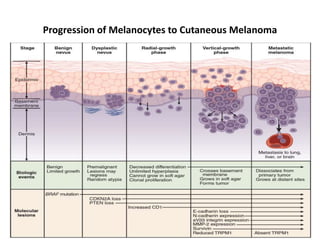
Progression of Melanocytes to Cutaneous Melanoma
EPIDEMIOLOGY
• Malignant melanoma is the sixth most common cancer in
US cancer diagnosis.
• This amounts to 4% of new cancer diagnoses and 1.5% of
cancer deaths.
• Currently, 1 in 49 men and women will be diagnosed with
melanoma of the skin during their lifetime. Its incidence is
second only to breast cancer for women from birth to age 39
years.
• Overall 5-year survival rates for melanoma
- 82% in the late 1970s (1975 to 1977) to
- 91% in the more recent era (2002 to 2006).
• Highest per capita incidence of melanoma worldwide is in
Australia
• In nonwhite populations, there is a much higher proportion of
melanomas in acral (subungual, palmar, plantar) and mucosal
locations.
• Ocular and nonacral cutaneous melanomas are 50- to 200-fold
more likely in white populations.
• Gender ratio at diagnosis- 2:1 -male :female, but it depends
on the age group.
ANATOMIC DISTRIBUTION
• Most common sites in males are on the back and in the head
and neck regions.
• Women, the most common sites are in the lower extremities,
commonly below the knee.
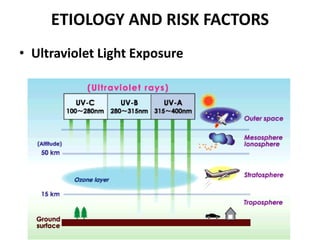
ETIOLOGY AND RISK FACTORS
• Ultraviolet Light Exposure
• UV light exposure as a major etiologic factor in the
development of melanoma.
 UVC radiation is generally absorbed by the ozone layer.
 UVB radiation (290 to 320 nm) is associated with sunburn
and induction of tanning by melanin pigment production and
has etiologic role in melanoma.
 UVA radiation (320 to 400 nm),associated with chronic sun
damage changes.
Physical Traits
 Blond or red hair,
 Green or blue eyes,
 Presence of multiple (>100) melanocytic nevi, and five or
more atypical nevi.
 A prior diagnosis of melanoma is associated with an eight-fold
increased risk of developing a secondary melanoma.
Familial Predisposition
• 5% of melanomas occur in high-risk families
• Autosomal dominant inheritance with incomplete penetrance.
• The most frequent and highest penetrance melanoma susceptibility
gene is a germline mutation in CDKN2A, a tumor suppressor gene.
• germline mutation in cyclin-dependent kinase 4
• Other common risk factors include
 dysplastic nevus syndrome,
 xeroderma pigmentosum,
 a family history of melanoma even without the known genetic traits
 Li-Fraumeni syndrome,
 germline mutations in p53
DIAGNOSIS OF PRIMARY
MELANOMA
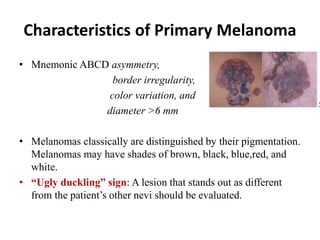
Characteristics of Primary Melanoma
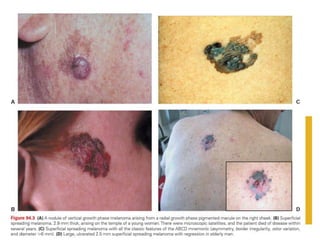
• Mnemonic ABCD asymmetry,
border irregularity,
color variation, and
diameter >6 mm
• Melanomas classically are distinguished by their pigmentation.
Melanomas may have shades of brown, black, blue,red, and
white.
• “Ugly duckling” sign: A lesion that stands out as different
from the patient’s other nevi should be evaluated.
• Symptoms of bleeding, itching,
pain, and ulceration - hallmarks
of a late diagnosis
Biopsy
• Full-thickness biopsy of the
entire lesion, with a narrow
(1 to 2 mm) margin of
grossly normal skin.
• This allows assessment of the
architecture of the lesion,
• which is critical for
differentiation of melanoma
from Spitz nevus,
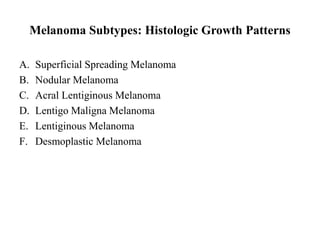
Melanoma Subtypes: Histologic Growth Patterns
A. Superficial Spreading Melanoma
B. Nodular Melanoma
C. Acral Lentiginous Melanoma
D. Lentigo Maligna Melanoma
E. Lentiginous Melanoma
F. Desmoplastic Melanoma
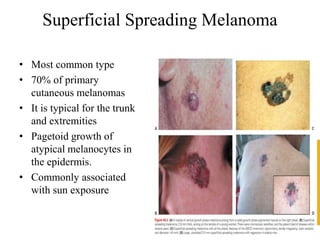
Superficial Spreading Melanoma
• Most common type
• 70% of primary
cutaneous melanomas
• It is typical for the trunk
and extremities
• Pagetoid growth of
atypical melanocytes in
the epidermis.
• Commonly associated
with sun exposure
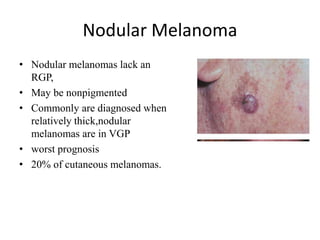
Nodular Melanoma
• Nodular melanomas lack an
RGP,
• May be nonpigmented
• Commonly are diagnosed when
relatively thick,nodular
melanomas are in VGP
• worst prognosis
• 20% of cutaneous melanomas.
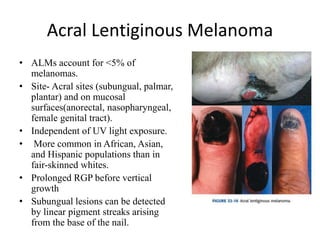
Acral Lentiginous Melanoma
• ALMs account for <5% of
melanomas.
• Site- Acral sites (subungual, palmar,
plantar) and on mucosal
surfaces(anorectal, nasopharyngeal,
female genital tract).
• Independent of UV light exposure.
• More common in African, Asian,
and Hispanic populations than in
fair-skinned whites.
• Prolonged RGP before vertical
growth
• Subungual lesions can be detected
by linear pigment streaks arising
from the base of the nail.
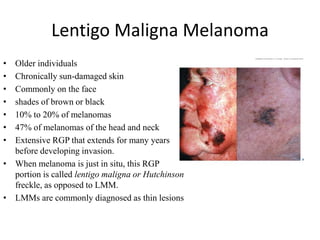
Lentigo Maligna Melanoma
• Older individuals
• Chronically sun-damaged skin
• Commonly on the face
• shades of brown or black
• 10% to 20% of melanomas
• 47% of melanomas of the head and neck
• Extensive RGP that extends for many years
before developing invasion.
• When melanoma is just in situ, this RGP
portion is called lentigo maligna or Hutchinson
freckle, as opposed to LMM.
• LMMs are commonly diagnosed as thin lesions
Lentiginous Melanoma
• Its features include diameter ≥1 cm,
• elongated and irregular rete ridges
• confluent melanocytic nests and single cells over a broad area
of the dermal/epidermal junction,
• focal pagetoid spread,
• cytologic atypia, and possible focal dermal fibrosis.
Desmoplastic Melanoma
• Uncommon form of melanoma,
• Histologically manifest by dermal melanocytes in a dense
stromal response.
• Usually nonpigmented and usually have lost the melanin
production pathway.
• They usually stain negative for MART-1/MelanA, gp100, and
tyrosinase, stain for S100.
• Most commonly in the head and neck
Prognostic Factors for Primary
Melanomas
• The best predictor of metastatic risk is the depth of invasion,
measured with an ocular micrometer, from the granular layer
of the skin to the base of the primary lesion.
• Other prognostic factor include age, angiolymphatic
invasion,mitotic rate, gender, and body site.
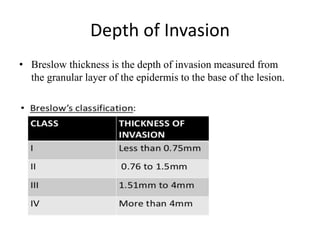
Depth of Invasion
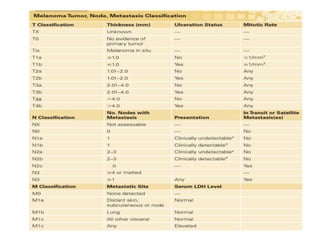
• Breslow thickness is the depth of invasion measured from
the granular layer of the epidermis to the base of the lesion.
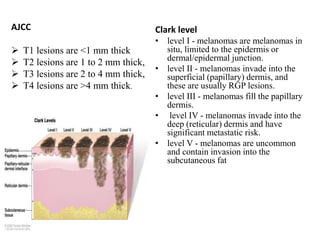
AJCC
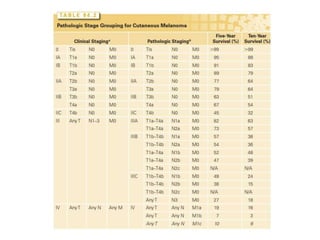
 T1 lesions are <1 mm thick
 T2 lesions are 1 to 2 mm thick,
 T3 lesions are 2 to 4 mm thick,
 T4 lesions are >4 mm thick.
Clark level
• level I - melanomas are melanomas in
situ, limited to the epidermis or
dermal/epidermal junction.
• level II - melanomas invade into the
superficial (papillary) dermis, and
these are usually RGP lesions.
• level III - melanomas fill the papillary
dermis.
• level IV - melanomas invade into the
deep (reticular) dermis and have
significant metastatic risk.
• level V - melanomas are uncommon
and contain invasion into the
subcutaneous fat
Ulceration
• Important negative prognostic feature
• T1a, T2a, T3a, and T4a melanomas are nonulcerated, and T1b,
T2b, T3b, and T4b melanomas are ulcerated.
Patient Gender and Skin Location
• Incidence of melanoma men women
• But in adolescents and young adults it is more common in
women.
• Prognosis is better for women than men.
• Extremities is better than that for patients with truncal or head-
and-neck melanomas
• There is a greater risk of lymph node metastasis in young
patients at the time of SNBx,especially for patients younger
than age 35 years, but the melanoma-associated mortality risk
increases with age for all thickness ranges.
Growth Pattern
• Overall, nodular melanomas have the worst prognosis,
associated with their diagnosis at a thicker stage.
• Lesser risk is associated with ALM, superficial spreading
melanoma, and LMM, in that order, all associated with
decreasing average Breslow thickness.
• The VGP component appears to be the component of
melanoma that determines metastatic risk
Mitotic Rate
• Identified as a negative prognostic feature, especially with six
or more mitoses per square millimeter.
• Other Prognostic Factors
 Angiolymphatic invasion
 microscopic satellites
MANAGEMENT OFA NEWLY DIAGNOSED
CUTANEOUS MELANOMA (STAGE I–II)
• Complete history and physical examination
• Biopsy should be done for any suspicious lesions and with a very
low threshold for biopsy.
NCCN Clinical Practice Guidelines in Oncology (NCCN GuidelinesR)
 melanoma in situ, No staging radiographs or blood work
 low-risk thin melanomas (stage IA) recommend imaging “only to
evaluate specific signs or symptoms.”
 Clinical stage I–II, no other imaging is recommended.
 Stage III melanoma chest radiograph (CXR),
computed tomography (CT) scans, or
positron emission tomography (PET)/CT scans,
magnetic resonance imaging (MRI) of the brain,
Wide Local Excision
SURGICAL STAGING OF REGIONAL
NODES
• Melanoma may metastasize by lymphatic or hematogenous
routes.
• Usually, lymphatic dissemination presents earlier than
hematogenous dissemination.
• The finding of lymphatic metastases is associated with a
higher risk of systemic disease
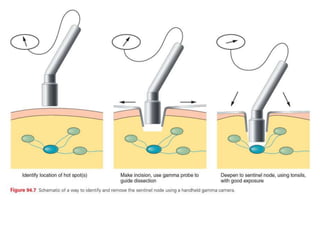
Intraoperative lymphatic mapping and sentinel lymph node
biopsy
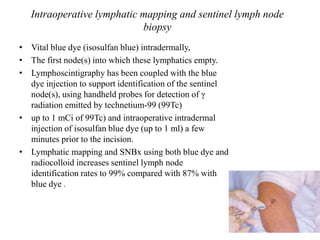
• Vital blue dye (isosulfan blue) intradermally,
• The first node(s) into which these lymphatics empty.
• Lymphoscintigraphy has been coupled with the blue
dye injection to support identification of the sentinel
node(s), using handheld probes for detection of γ
radiation emitted by technetium-99 (99Tc)
• up to 1 mCi of 99Tc) and intraoperative intradermal
injection of isosulfan blue dye (up to 1 ml) a few
minutes prior to the incision.
• Lymphatic mapping and SNBx using both blue dye and
radiocolloid increases sentinel lymph node
identification rates to 99% compared with 87% with
blue dye .
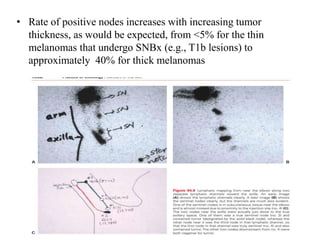
• Rate of positive nodes increases with increasing tumor
thickness, as would be expected, from <5% for the thin
melanomas that undergo SNBx (e.g., T1b lesions) to
approximately 40% for thick melanomas
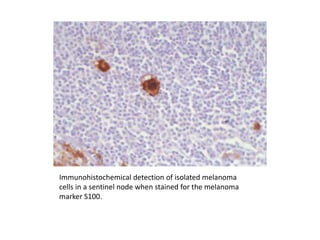
Immunohistochemical detection of isolated melanoma
cells in a sentinel node when stained for the melanoma
marker S100.
MANAGEMENT
Clinically Localized Melanoma
Melanoma In Situ (Clinical TISN0M0, Stage 0)
• Confined to the epidermis and epidermal/dermal junction
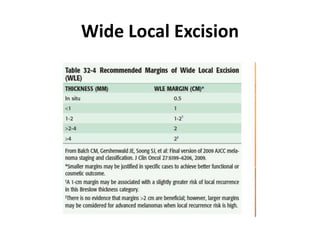
• Wide excision-Definitive management involves re-excision
with a margin of 5 mm.
• if cosmetically acceptable, obtain a margin of as much as 1
cm, especially if the original biopsy was incomplete.
• SNBx is not indicated.
• No adjuvant therapy is needed if the margins are widely clear.
• Clinical Follow-Up After Surgical Treatment- annual basis
Thin Primary Melanoma (Clinical T1A)
• Melanoma <0.76 mm thick.
• approximately a 5% risk of subsequent metastasis.
• AJCC- Melanomas are those <1 mm thick, with less than one
mitosis per square millimeter, and without ulceration.
• stage IA melanomas have a 5-year survival rate of 94%.
• Wide excision with a 1-cm margin (including skin and all
underlying subcutaneous tissue, to the deep muscle fascia)
• Annual follow-up for many years is recommended rather than
frequent follow-up in the first few years.
Clinical T2A, T2B Melanomas
• Melanomas 1 to 2 mm thick, with or without ulceration.
• Wide excision with a 1- to 2-cm margin and SNBx.
• SNBx
 Positive, then subsequent management should follow
recommendations given later for stage IIIA melanoma (T2a
with positive SNBx involving one to three nodes) or stage IIIB
melanoma (T2b with positive SNBx involving one to three
nodes).
 Negative, then the patient is considered to have been
pathologically staged as T2aN0M0 (stage IB) or T2bN0M0
(stage IIA), and no additional surgical management is required
and no adjuvant systemic therapy is indicated.
T3A Melanomas (Clinical Stage IIA)
• Melanomas 2 to 4 mm thick, without ulceration, and in the
absence of metastases, these are clinical stage IIA lesions.
• Definitive management includes wide excision with a 2-cm
margin and SNBx .
• SNBx
Negative, then no additional surgical or systemic therapy is
indicated .
Positive, then management for stage IIIA melanoma should be
followed.
Clinical T3B Melanomas (Clinical
Stage IIB)
• Melanomas 2 to 4 mm thick with ulceration represent T3b
lesions and thus are clinical stage IIB melanomas.
• Management is wide excision with a 2-cm margin and an
SNBx.
• SNBx
Negative, the summary stage is IIB (T3bN0M0).
patients, no additional surgical therapy is needed.
HDI and pegylated-interferon therapies
Thick Melanomas (T4A, T4B, Greater than
4 mm Thick)
• Metastasis and mortality in the range of 50% over 5 to 10
years.
• Ulceration increases this risk
• T4a melanomas are clinical stage IIB,
T4b melanomas are clinical stage IIC.
• Definitive management includes wide excision with at least a
2-cm margin plus SNBx
• SNBx
Positive- CLND
Negative- adjuvant interferon
SPECIAL CONSIDERATIONS
Primary Melanomas of the Head and Neck
• Large- diameter lentigo maligna on the face that is not
amenable to surgical resection because of cosmetic results
or comorbid patient conditions
 superficial or Grenz X-rays with local control rates
reported above 90%.
 imiquimod ointment
• Desmoplastic melanoma,
 Adequate margins.If that is not possible,
 postoperative adjuvant radiation should be considered
with 2- to 3-cm margins around the resected lesion.
REGIONALLY METASTATIC MELANOMA
(STAGE III)
Regional metastases are defined as follows:
■ Local recurrence is best defined as recurrence of melanoma in
the scar from the original excision or at the edge of the skin
graft
■ Satellites metastases recurrences that are separate from the scar
but within 2 to 5 cm of it are considered satellite metastases
■ Regional recurrences beyond 5 cm of the scar but proximal to
regional nodes are considered in-transit metastases
■ Regional node metastases are typically in a draining nodal
basin that is near the lesion.
Management of Local Recurrence
• Local recurrence is common after a primary lesion is
inadequately excised.
• very poor prognosis.
• Local recurrences were associated with 9% to 11% overall 5-
year survival rate, as compared with 86% for those without
local recurrence.
• Management- re-resection of entire scar down to the level of
fascia, Excision with a 1- to 2-cm margin.
Management of Satellite and
In-Transit Metastases
• Negative prognostic feature, with clinical
outcomes similar to those observed for
patients with palpable nodal metastases.
• Excision with SNBx.
• Radiation therapy
• Intralesional therapy with
o interferon-α,
o interleukin(IL)-2,
o bacillus Calmette-Guerin (BCG),
o oncolytic
o replication competent virus injections and
o dyes like Rose Bengal
o diphencyprone,
o imiquimod,
Systemic treatments
anti–cytotoxic T-lymphocyte
antigen (CTLA4),
anti–programmed death 1
PD-1
anti-PD-L1 antibodies,
BRAF and other targeted
inhibitors
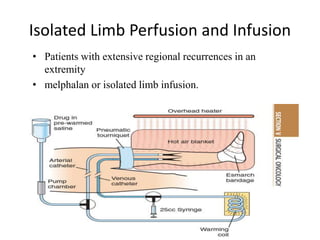
Isolated Limb Perfusion and Infusion
• Patients with extensive regional recurrences in an
extremity
• melphalan or isolated limb infusion.
ADJUVANT SYSTEMIC THERAPY
(STAGES IIB, IIC, and III)
• Adjuvant Interferon Therapy
(1) HDI-α for 1 month followed by 1 year of intermediate dosing,
(2) interferon-α at an intermediate dose administered for 1 or 2 years,
(3) interferon-α at a low dose administered for 1 or 3 years, or
(4) pegylated interferon administered for a target period of 5 years
• High-Dose Interferon-𝛂2B
 Induction phase intravenous infusion, 20 million U/m2, for 5
consecutive days every 7 days for 4 weeks .
 Maintenance phase For the subsequent 48 weeks, 10 million U/m2
were administered by subcutaneous injection on alternate days for
a total of three doses every 7 days
• Pegylated Interferon-𝛂
Biochemotherapy
• Biochemotherapy consisting of
 Dacarbazine 800 mg/m2 on day 1,
 cisplatin 20 mg/m2 on days 1 to 4;
 Vinblastine 1.2 mg/m2 on days 1 to 4;
 IL-2 9 MU/m2 per day continuous intravenous administration
on days 1 to 4;
 interferon 5 MU/m2 per day subcutaneously on days 1 to 4, 8,
10, and 12; and
 granulocyte– colony-stimulating fator 5 ug/kg per day
subcutaneously on days 7 to 16
Cytotoxic T-Lymphocyte Antigen 4 and PD-1
Blockade
• Ipilimumab is a fully human immunoglobulin G1 monoclonal
antibody that blocks CTLA4
• lambrolizumab anti-PD-1 IgG4 monoclonal antibody MK-
3475
THANKS

Malignant melanoma

  • 1.
    Malignant Melanoma By :Dr. Amit Kumar Choudhary
  • 2.
    INTRODUCTION • Malignant transformationof the melanocyte, the cell responsible for the production of the pigment melanin. • Precursor melanocytes arise in the neural crest and, as the fetus develops, migrate to multiple areas in the body including the skin, meninges, mucous membranes, upper esophagus, and eyes. 91.2% cutaneous 5.3% ocular 1.3% mucosal 2.2% unknown primary site
  • 3.
    cutaneous melanoma  acarcinogen-induced cancer with a high mutational load,  dependenton a particular oncogenic signaling pathway, the mitogen-activated protein kinase (MAPK) pathway  BRAF (50%) or NRAS (20%) mutations Mucosal or uveal melanoma • BRAF mutations (5% to 20%) • KIT mutations (5% to 10%) • Uveal melanomas have mutations in the alpha subunits of G- protein–coupled receptors GNAQ and GNA11
  • 4.
    MOLECULAR BIOLOGY OF MELANOMA •Melanomahas significantly have more sequence variations per megabase of DNA. • For example, melanomas have 15 times more mutations per megabase of DNA than colorectal cancer and 4 times more than lung cancer. • mutations are cytosine to thymine (C>T) substitutions, typical of UV radiation– induced thymine dimmers • Mutations in BRAF, NRAS, and cKit.
  • 5.
    Driver Mutations inMelanoma • Dependent upon driver oncogenic mutations in the MAPK pathway,with additional genetic alterations in other pathways leading to  uncontrolled cell growth and  avoidance of apoptosis • activating mutations in the receptor tyrosine kinase KIT (2% to 3%), the G-protein neuroblastoma RAS viral oncogene homolog (NRAS) (15% to 20%), and the serine-threonine kinase BRAF (40% to 50%). • Uveal melanomas have a driver mutations in GNAQ and GNA11, which are the alpha subunits of G-protein–coupled receptors
  • 6.
    Progression of Melanocytesto Cutaneous Melanoma
  • 8.
    EPIDEMIOLOGY • Malignant melanomais the sixth most common cancer in US cancer diagnosis. • This amounts to 4% of new cancer diagnoses and 1.5% of cancer deaths. • Currently, 1 in 49 men and women will be diagnosed with melanoma of the skin during their lifetime. Its incidence is second only to breast cancer for women from birth to age 39 years. • Overall 5-year survival rates for melanoma - 82% in the late 1970s (1975 to 1977) to - 91% in the more recent era (2002 to 2006).
  • 9.
    • Highest percapita incidence of melanoma worldwide is in Australia • In nonwhite populations, there is a much higher proportion of melanomas in acral (subungual, palmar, plantar) and mucosal locations. • Ocular and nonacral cutaneous melanomas are 50- to 200-fold more likely in white populations. • Gender ratio at diagnosis- 2:1 -male :female, but it depends on the age group.
  • 10.
    ANATOMIC DISTRIBUTION • Mostcommon sites in males are on the back and in the head and neck regions. • Women, the most common sites are in the lower extremities, commonly below the knee.
  • 11.
    ETIOLOGY AND RISKFACTORS • Ultraviolet Light Exposure
  • 12.
    • UV lightexposure as a major etiologic factor in the development of melanoma.  UVC radiation is generally absorbed by the ozone layer.  UVB radiation (290 to 320 nm) is associated with sunburn and induction of tanning by melanin pigment production and has etiologic role in melanoma.  UVA radiation (320 to 400 nm),associated with chronic sun damage changes.
  • 13.
    Physical Traits  Blondor red hair,  Green or blue eyes,  Presence of multiple (>100) melanocytic nevi, and five or more atypical nevi.  A prior diagnosis of melanoma is associated with an eight-fold increased risk of developing a secondary melanoma.
  • 14.
    Familial Predisposition • 5%of melanomas occur in high-risk families • Autosomal dominant inheritance with incomplete penetrance. • The most frequent and highest penetrance melanoma susceptibility gene is a germline mutation in CDKN2A, a tumor suppressor gene. • germline mutation in cyclin-dependent kinase 4 • Other common risk factors include  dysplastic nevus syndrome,  xeroderma pigmentosum,  a family history of melanoma even without the known genetic traits  Li-Fraumeni syndrome,  germline mutations in p53
  • 15.
  • 16.
    Characteristics of PrimaryMelanoma • Mnemonic ABCD asymmetry, border irregularity, color variation, and diameter >6 mm • Melanomas classically are distinguished by their pigmentation. Melanomas may have shades of brown, black, blue,red, and white. • “Ugly duckling” sign: A lesion that stands out as different from the patient’s other nevi should be evaluated.
  • 17.
    • Symptoms ofbleeding, itching, pain, and ulceration - hallmarks of a late diagnosis Biopsy • Full-thickness biopsy of the entire lesion, with a narrow (1 to 2 mm) margin of grossly normal skin. • This allows assessment of the architecture of the lesion, • which is critical for differentiation of melanoma from Spitz nevus,
  • 18.
    Melanoma Subtypes: HistologicGrowth Patterns A. Superficial Spreading Melanoma B. Nodular Melanoma C. Acral Lentiginous Melanoma D. Lentigo Maligna Melanoma E. Lentiginous Melanoma F. Desmoplastic Melanoma
  • 19.
    Superficial Spreading Melanoma •Most common type • 70% of primary cutaneous melanomas • It is typical for the trunk and extremities • Pagetoid growth of atypical melanocytes in the epidermis. • Commonly associated with sun exposure
  • 20.
    Nodular Melanoma • Nodularmelanomas lack an RGP, • May be nonpigmented • Commonly are diagnosed when relatively thick,nodular melanomas are in VGP • worst prognosis • 20% of cutaneous melanomas.
  • 21.
    Acral Lentiginous Melanoma •ALMs account for <5% of melanomas. • Site- Acral sites (subungual, palmar, plantar) and on mucosal surfaces(anorectal, nasopharyngeal, female genital tract). • Independent of UV light exposure. • More common in African, Asian, and Hispanic populations than in fair-skinned whites. • Prolonged RGP before vertical growth • Subungual lesions can be detected by linear pigment streaks arising from the base of the nail.
  • 22.
    Lentigo Maligna Melanoma •Older individuals • Chronically sun-damaged skin • Commonly on the face • shades of brown or black • 10% to 20% of melanomas • 47% of melanomas of the head and neck • Extensive RGP that extends for many years before developing invasion. • When melanoma is just in situ, this RGP portion is called lentigo maligna or Hutchinson freckle, as opposed to LMM. • LMMs are commonly diagnosed as thin lesions
  • 23.
    Lentiginous Melanoma • Itsfeatures include diameter ≥1 cm, • elongated and irregular rete ridges • confluent melanocytic nests and single cells over a broad area of the dermal/epidermal junction, • focal pagetoid spread, • cytologic atypia, and possible focal dermal fibrosis.
  • 24.
    Desmoplastic Melanoma • Uncommonform of melanoma, • Histologically manifest by dermal melanocytes in a dense stromal response. • Usually nonpigmented and usually have lost the melanin production pathway. • They usually stain negative for MART-1/MelanA, gp100, and tyrosinase, stain for S100. • Most commonly in the head and neck
  • 25.
    Prognostic Factors forPrimary Melanomas • The best predictor of metastatic risk is the depth of invasion, measured with an ocular micrometer, from the granular layer of the skin to the base of the primary lesion. • Other prognostic factor include age, angiolymphatic invasion,mitotic rate, gender, and body site.
  • 26.
    Depth of Invasion •Breslow thickness is the depth of invasion measured from the granular layer of the epidermis to the base of the lesion.
  • 27.
    AJCC  T1 lesionsare <1 mm thick  T2 lesions are 1 to 2 mm thick,  T3 lesions are 2 to 4 mm thick,  T4 lesions are >4 mm thick. Clark level • level I - melanomas are melanomas in situ, limited to the epidermis or dermal/epidermal junction. • level II - melanomas invade into the superficial (papillary) dermis, and these are usually RGP lesions. • level III - melanomas fill the papillary dermis. • level IV - melanomas invade into the deep (reticular) dermis and have significant metastatic risk. • level V - melanomas are uncommon and contain invasion into the subcutaneous fat
  • 28.
    Ulceration • Important negativeprognostic feature • T1a, T2a, T3a, and T4a melanomas are nonulcerated, and T1b, T2b, T3b, and T4b melanomas are ulcerated.
  • 29.
    Patient Gender andSkin Location • Incidence of melanoma men women • But in adolescents and young adults it is more common in women. • Prognosis is better for women than men. • Extremities is better than that for patients with truncal or head- and-neck melanomas • There is a greater risk of lymph node metastasis in young patients at the time of SNBx,especially for patients younger than age 35 years, but the melanoma-associated mortality risk increases with age for all thickness ranges.
  • 30.
    Growth Pattern • Overall,nodular melanomas have the worst prognosis, associated with their diagnosis at a thicker stage. • Lesser risk is associated with ALM, superficial spreading melanoma, and LMM, in that order, all associated with decreasing average Breslow thickness. • The VGP component appears to be the component of melanoma that determines metastatic risk
  • 31.
    Mitotic Rate • Identifiedas a negative prognostic feature, especially with six or more mitoses per square millimeter. • Other Prognostic Factors  Angiolymphatic invasion  microscopic satellites
  • 34.
    MANAGEMENT OFA NEWLYDIAGNOSED CUTANEOUS MELANOMA (STAGE I–II)
  • 35.
    • Complete historyand physical examination • Biopsy should be done for any suspicious lesions and with a very low threshold for biopsy. NCCN Clinical Practice Guidelines in Oncology (NCCN GuidelinesR)  melanoma in situ, No staging radiographs or blood work  low-risk thin melanomas (stage IA) recommend imaging “only to evaluate specific signs or symptoms.”  Clinical stage I–II, no other imaging is recommended.  Stage III melanoma chest radiograph (CXR), computed tomography (CT) scans, or positron emission tomography (PET)/CT scans, magnetic resonance imaging (MRI) of the brain,
  • 36.
  • 37.
    SURGICAL STAGING OFREGIONAL NODES • Melanoma may metastasize by lymphatic or hematogenous routes. • Usually, lymphatic dissemination presents earlier than hematogenous dissemination. • The finding of lymphatic metastases is associated with a higher risk of systemic disease
  • 38.
    Intraoperative lymphatic mappingand sentinel lymph node biopsy • Vital blue dye (isosulfan blue) intradermally, • The first node(s) into which these lymphatics empty. • Lymphoscintigraphy has been coupled with the blue dye injection to support identification of the sentinel node(s), using handheld probes for detection of γ radiation emitted by technetium-99 (99Tc) • up to 1 mCi of 99Tc) and intraoperative intradermal injection of isosulfan blue dye (up to 1 ml) a few minutes prior to the incision. • Lymphatic mapping and SNBx using both blue dye and radiocolloid increases sentinel lymph node identification rates to 99% compared with 87% with blue dye .
  • 40.
    • Rate ofpositive nodes increases with increasing tumor thickness, as would be expected, from <5% for the thin melanomas that undergo SNBx (e.g., T1b lesions) to approximately 40% for thick melanomas
  • 41.
    Immunohistochemical detection ofisolated melanoma cells in a sentinel node when stained for the melanoma marker S100.
  • 42.
  • 43.
    Clinically Localized Melanoma MelanomaIn Situ (Clinical TISN0M0, Stage 0) • Confined to the epidermis and epidermal/dermal junction • Wide excision-Definitive management involves re-excision with a margin of 5 mm. • if cosmetically acceptable, obtain a margin of as much as 1 cm, especially if the original biopsy was incomplete. • SNBx is not indicated. • No adjuvant therapy is needed if the margins are widely clear. • Clinical Follow-Up After Surgical Treatment- annual basis
  • 44.
    Thin Primary Melanoma(Clinical T1A) • Melanoma <0.76 mm thick. • approximately a 5% risk of subsequent metastasis. • AJCC- Melanomas are those <1 mm thick, with less than one mitosis per square millimeter, and without ulceration. • stage IA melanomas have a 5-year survival rate of 94%. • Wide excision with a 1-cm margin (including skin and all underlying subcutaneous tissue, to the deep muscle fascia) • Annual follow-up for many years is recommended rather than frequent follow-up in the first few years.
  • 45.
    Clinical T2A, T2BMelanomas • Melanomas 1 to 2 mm thick, with or without ulceration. • Wide excision with a 1- to 2-cm margin and SNBx. • SNBx  Positive, then subsequent management should follow recommendations given later for stage IIIA melanoma (T2a with positive SNBx involving one to three nodes) or stage IIIB melanoma (T2b with positive SNBx involving one to three nodes).  Negative, then the patient is considered to have been pathologically staged as T2aN0M0 (stage IB) or T2bN0M0 (stage IIA), and no additional surgical management is required and no adjuvant systemic therapy is indicated.
  • 46.
    T3A Melanomas (ClinicalStage IIA) • Melanomas 2 to 4 mm thick, without ulceration, and in the absence of metastases, these are clinical stage IIA lesions. • Definitive management includes wide excision with a 2-cm margin and SNBx . • SNBx Negative, then no additional surgical or systemic therapy is indicated . Positive, then management for stage IIIA melanoma should be followed.
  • 47.
    Clinical T3B Melanomas(Clinical Stage IIB) • Melanomas 2 to 4 mm thick with ulceration represent T3b lesions and thus are clinical stage IIB melanomas. • Management is wide excision with a 2-cm margin and an SNBx. • SNBx Negative, the summary stage is IIB (T3bN0M0). patients, no additional surgical therapy is needed. HDI and pegylated-interferon therapies
  • 48.
    Thick Melanomas (T4A,T4B, Greater than 4 mm Thick) • Metastasis and mortality in the range of 50% over 5 to 10 years. • Ulceration increases this risk • T4a melanomas are clinical stage IIB, T4b melanomas are clinical stage IIC. • Definitive management includes wide excision with at least a 2-cm margin plus SNBx • SNBx Positive- CLND Negative- adjuvant interferon
  • 49.
    SPECIAL CONSIDERATIONS Primary Melanomasof the Head and Neck • Large- diameter lentigo maligna on the face that is not amenable to surgical resection because of cosmetic results or comorbid patient conditions  superficial or Grenz X-rays with local control rates reported above 90%.  imiquimod ointment • Desmoplastic melanoma,  Adequate margins.If that is not possible,  postoperative adjuvant radiation should be considered with 2- to 3-cm margins around the resected lesion.
  • 50.
    REGIONALLY METASTATIC MELANOMA (STAGEIII) Regional metastases are defined as follows: ■ Local recurrence is best defined as recurrence of melanoma in the scar from the original excision or at the edge of the skin graft ■ Satellites metastases recurrences that are separate from the scar but within 2 to 5 cm of it are considered satellite metastases ■ Regional recurrences beyond 5 cm of the scar but proximal to regional nodes are considered in-transit metastases ■ Regional node metastases are typically in a draining nodal basin that is near the lesion.
  • 51.
    Management of LocalRecurrence • Local recurrence is common after a primary lesion is inadequately excised. • very poor prognosis. • Local recurrences were associated with 9% to 11% overall 5- year survival rate, as compared with 86% for those without local recurrence. • Management- re-resection of entire scar down to the level of fascia, Excision with a 1- to 2-cm margin.
  • 52.
    Management of Satelliteand In-Transit Metastases • Negative prognostic feature, with clinical outcomes similar to those observed for patients with palpable nodal metastases. • Excision with SNBx. • Radiation therapy • Intralesional therapy with o interferon-α, o interleukin(IL)-2, o bacillus Calmette-Guerin (BCG), o oncolytic o replication competent virus injections and o dyes like Rose Bengal o diphencyprone, o imiquimod, Systemic treatments anti–cytotoxic T-lymphocyte antigen (CTLA4), anti–programmed death 1 PD-1 anti-PD-L1 antibodies, BRAF and other targeted inhibitors
  • 53.
    Isolated Limb Perfusionand Infusion • Patients with extensive regional recurrences in an extremity • melphalan or isolated limb infusion.
  • 54.
    ADJUVANT SYSTEMIC THERAPY (STAGESIIB, IIC, and III) • Adjuvant Interferon Therapy (1) HDI-α for 1 month followed by 1 year of intermediate dosing, (2) interferon-α at an intermediate dose administered for 1 or 2 years, (3) interferon-α at a low dose administered for 1 or 3 years, or (4) pegylated interferon administered for a target period of 5 years • High-Dose Interferon-𝛂2B  Induction phase intravenous infusion, 20 million U/m2, for 5 consecutive days every 7 days for 4 weeks .  Maintenance phase For the subsequent 48 weeks, 10 million U/m2 were administered by subcutaneous injection on alternate days for a total of three doses every 7 days • Pegylated Interferon-𝛂
  • 55.
    Biochemotherapy • Biochemotherapy consistingof  Dacarbazine 800 mg/m2 on day 1,  cisplatin 20 mg/m2 on days 1 to 4;  Vinblastine 1.2 mg/m2 on days 1 to 4;  IL-2 9 MU/m2 per day continuous intravenous administration on days 1 to 4;  interferon 5 MU/m2 per day subcutaneously on days 1 to 4, 8, 10, and 12; and  granulocyte– colony-stimulating fator 5 ug/kg per day subcutaneously on days 7 to 16
  • 56.
    Cytotoxic T-Lymphocyte Antigen4 and PD-1 Blockade • Ipilimumab is a fully human immunoglobulin G1 monoclonal antibody that blocks CTLA4 • lambrolizumab anti-PD-1 IgG4 monoclonal antibody MK- 3475
  • 57.