• Harald zur Hausen
• Shilpa Shetty
• Jade Goody
PapillomavirusesPapillomaviruses
Classification
• Widespread in nature, infecting
many vertebrates
• Highly species specific
• 100 + HPV types, classified on
basis of nucleic acid homology
HUMAN PAPILLOMA VIRUS
• Small, DNA virus
• Non enveloped
• Produce benign/malignant
tumor
• Species specific
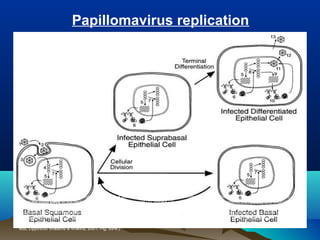
Replication cycle of a papillomavirus. To establish a wart or papilloma, the virus must infect a basal epithelial cell. Our knowledge is limited
about the initial steps in the replication cycle such as attachment (1), uptake (2), endocytosis (3), and transport to the nucleus and uncoating of
the viral DNA (4). Early-region transcription (5), translation of the early proteins (6), and steady-state viral DNA replication (7) all occur in the
basal cell and in the infected suprabasal epithelial cell. Events in the viral life cycle leading to the production of virion particles occur in the
differentiated keratinocyte: vegetative viral DNA replication (8), transcription of the late region (9), production of the capsid proteins L1 and L2
(10), assembly of the virion particles (11), nuclear breakdown (12), and release of virus (13). (From Fields Virology, 4th ed, Knipe & Howley,
eds, Lippincott Williams & Wilkins, 2001, Fig. 65-6.)
Papillomavirus replication
• Infect squamous epithelia and mucous
membrane
• Produce different types of warts or
papillomata
• Over 70 different types of HPV
• Lesion - based on types of virus
• Verruca vulgaris (common wart):
hand and feet of children
by types 1,2,3,4
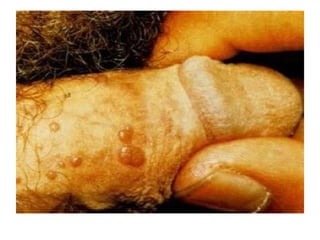
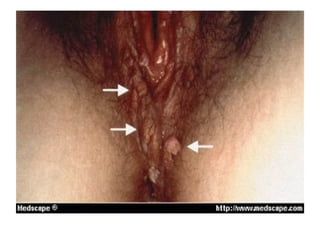
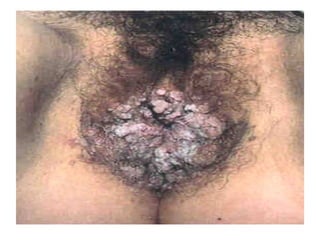
• Condyloma acuminatum (genital wart):
external genitalia
by types 6 & 11
transmitted by venereally
may turn to malignant
• HPV 16 & 18 can cause severe invasive
malignancies such as cervical cancer
Human papilloma virus infections
• Transmission
– Direct contact with broken skin or mucosa
• Skin warts
• Genital tract HPV
• Mucosal HPV
• Various HPV types show tissue
specificity
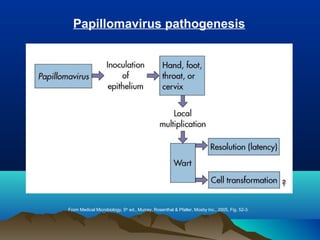
From Medical Microbiology, 5th
ed., Murray, Rosenthal & Pfaller, Mosby Inc., 2005, Fig. 52-3.
Papillomavirus pathogenesis
Cervical HPV infection
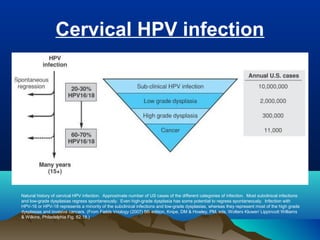
Natural history of cervical HPV infection. Approximate number of US cases of the different categories of infeciton. Most subclinical infections
and low-grade dysplasias regress spontaneously. Even high-grade dysplasia has some potential to regress spontaneously. Infection with
HPV-16 or HPV-18 represents a minority of the subclinical infections and low-grade dysplasias, whereas they represent most of the high grade
dysplasias and invasive cancers. (From Fields Vriology (2007) 5th edition, Knipe, DM & Howley, PM, eds, Wolters Kluwer/ Lippincott Williams
& Wilkins, Philadelphia Fig. 62.18.)
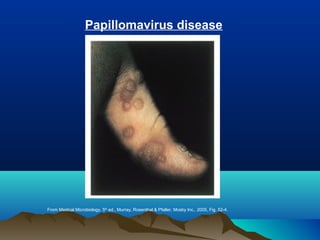
From Medical Microbiology, 5th
ed., Murray, Rosenthal & Pfaller, Mosby Inc., 2005, Fig. 52-4.
Papillomavirus disease
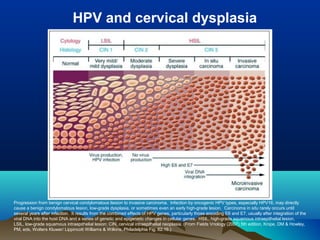
Progression from benign cervical condylomatous liesion to invasive carcinoma. Infection by oncogenic HPV types, especially HPV16, may directly
cause a benign condylomatous lesion, low-grade dysplasia, or sometimes even an early high-grade lesion. Carcinoma in situ rarely occurs until
several years after infection. It results from the combined effects of HPV genes, particularly those encoding E6 and E7, usually after integration of the
viral DNA into the host DNA and a series of genetic and epigenetic changes in cellular genes. HSIL, high-grade squamous intraepithelial lesion,
LSIL, low-grade squamous intraepithelial lesion; CIN, cervical intraepithelial neoplasia. (From Fields Vriology (2007) 5th edition, Knipe, DM & Howley,
PM, eds, Wolters Kluwer/ Lippincott Williams & Wilkins, Philadelphia Fig. 62.16.)
HPV and cervical dysplasia
HPV and head & neck cancers
• http://www.nature.com/news/hpv-sex-cancer-a
Lab diagnosis
1. Microscopy: by EM
2. Culture: Inoculation in mice
Inoculation in chick embryo CAM
Tissue culture
3. Serology: Detection of antibody by
ELISA
Diagnosis
• Pathology, cytology
• Immuno-histochemistry
• Nucleic acid
– Hybridization (Southern, in situ), PCR
– Identification of specific HPV type can
assist in evaluating prognosis and
treatment
– Integration state?
Prevention/Treatment
• Recombinant virus-like particle
vaccines
– Gardasil
• FDA approved; HPV 16, 18, 6, 11
– Cervarix
• FDA approval pending; HPV 16, 18
• Pap smear
• Surgery
Jade Goody
human papilloma virus - virology

human papilloma virus - virology

  • 3.
  • 4.
  • 5.
  • 6.
    Classification • Widespread innature, infecting many vertebrates • Highly species specific • 100 + HPV types, classified on basis of nucleic acid homology
  • 7.
    HUMAN PAPILLOMA VIRUS •Small, DNA virus • Non enveloped • Produce benign/malignant tumor • Species specific
  • 8.
    Replication cycle ofa papillomavirus. To establish a wart or papilloma, the virus must infect a basal epithelial cell. Our knowledge is limited about the initial steps in the replication cycle such as attachment (1), uptake (2), endocytosis (3), and transport to the nucleus and uncoating of the viral DNA (4). Early-region transcription (5), translation of the early proteins (6), and steady-state viral DNA replication (7) all occur in the basal cell and in the infected suprabasal epithelial cell. Events in the viral life cycle leading to the production of virion particles occur in the differentiated keratinocyte: vegetative viral DNA replication (8), transcription of the late region (9), production of the capsid proteins L1 and L2 (10), assembly of the virion particles (11), nuclear breakdown (12), and release of virus (13). (From Fields Virology, 4th ed, Knipe & Howley, eds, Lippincott Williams & Wilkins, 2001, Fig. 65-6.) Papillomavirus replication
  • 9.
    • Infect squamousepithelia and mucous membrane • Produce different types of warts or papillomata • Over 70 different types of HPV • Lesion - based on types of virus
  • 10.
    • Verruca vulgaris(common wart): hand and feet of children by types 1,2,3,4 • Condyloma acuminatum (genital wart): external genitalia by types 6 & 11 transmitted by venereally may turn to malignant • HPV 16 & 18 can cause severe invasive malignancies such as cervical cancer
  • 11.
    Human papilloma virusinfections • Transmission – Direct contact with broken skin or mucosa • Skin warts • Genital tract HPV • Mucosal HPV • Various HPV types show tissue specificity
  • 12.
    From Medical Microbiology,5th ed., Murray, Rosenthal & Pfaller, Mosby Inc., 2005, Fig. 52-3. Papillomavirus pathogenesis
  • 13.
    Cervical HPV infection Naturalhistory of cervical HPV infection. Approximate number of US cases of the different categories of infeciton. Most subclinical infections and low-grade dysplasias regress spontaneously. Even high-grade dysplasia has some potential to regress spontaneously. Infection with HPV-16 or HPV-18 represents a minority of the subclinical infections and low-grade dysplasias, whereas they represent most of the high grade dysplasias and invasive cancers. (From Fields Vriology (2007) 5th edition, Knipe, DM & Howley, PM, eds, Wolters Kluwer/ Lippincott Williams & Wilkins, Philadelphia Fig. 62.18.)
  • 14.
    From Medical Microbiology,5th ed., Murray, Rosenthal & Pfaller, Mosby Inc., 2005, Fig. 52-4. Papillomavirus disease
  • 20.
    Progression from benigncervical condylomatous liesion to invasive carcinoma. Infection by oncogenic HPV types, especially HPV16, may directly cause a benign condylomatous lesion, low-grade dysplasia, or sometimes even an early high-grade lesion. Carcinoma in situ rarely occurs until several years after infection. It results from the combined effects of HPV genes, particularly those encoding E6 and E7, usually after integration of the viral DNA into the host DNA and a series of genetic and epigenetic changes in cellular genes. HSIL, high-grade squamous intraepithelial lesion, LSIL, low-grade squamous intraepithelial lesion; CIN, cervical intraepithelial neoplasia. (From Fields Vriology (2007) 5th edition, Knipe, DM & Howley, PM, eds, Wolters Kluwer/ Lippincott Williams & Wilkins, Philadelphia Fig. 62.16.) HPV and cervical dysplasia
  • 21.
    HPV and head& neck cancers • http://www.nature.com/news/hpv-sex-cancer-a
  • 22.
    Lab diagnosis 1. Microscopy:by EM 2. Culture: Inoculation in mice Inoculation in chick embryo CAM Tissue culture 3. Serology: Detection of antibody by ELISA
  • 23.
    Diagnosis • Pathology, cytology •Immuno-histochemistry • Nucleic acid – Hybridization (Southern, in situ), PCR – Identification of specific HPV type can assist in evaluating prognosis and treatment – Integration state?
  • 24.
    Prevention/Treatment • Recombinant virus-likeparticle vaccines – Gardasil • FDA approved; HPV 16, 18, 6, 11 – Cervarix • FDA approval pending; HPV 16, 18 • Pap smear • Surgery
  • 25.