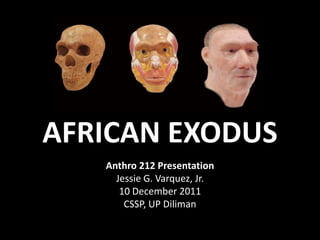
AFRICAN EXODUS
   Anthro 212 Presentation
     Jessie G. Varquez, Jr.
      10 December 2011
       CSSP, UP Diliman
Popular beliefs

• Evolution is linear

• Humans evolved from monkeys
  – “galing ang tao sa unggoy”


• The Missing Link
Key Questions

• Who are the first hominids that dispersed to
  various parts of the Old World?

• What are the physiological and behavorial
  characteristics of premodern humans?

• Where did the transition (from premodern to
  modern humans) take place?
Outline
• Pleistocene or the Ice Age

• Homo erectus
  – Acheulian stone tools

• The Neandertals
  – Mousterian stone tools

• Modern Humans
  – Origin and dispersal
Pleistocene or The Ice Age
• Began about 1.8 million years ago
• marked by periodic continental glaciations
• Characterized by numerous advances and
  retreats of ice, with at least 15 major and 50
  minor glacial advances documented in Europe
  alone
• Archaic and modern humans evolved during a
  long period of constant climate transition
  between warmer and colder in northern latitudes
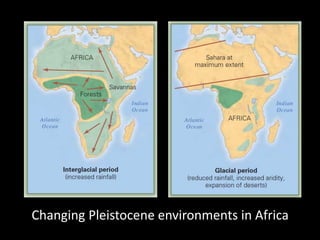
Changing Pleistocene environments in Africa
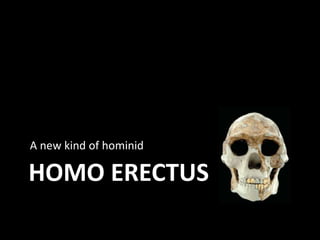
A new kind of hominid

HOMO ERECTUS
Pithecantropus erectus

The name first
proposed by Ernst
Haeckel for the oldest
hominid; Eugene
Dubois later used this
name for his first fossil
discovery (1891),
which later became
known as Homo
erectus.
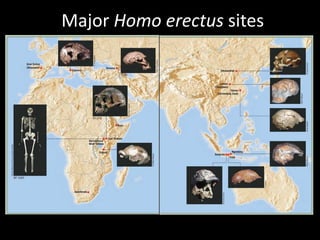
Major Homo erectus sites
Homo erectus
• Fossil finds in Africa, Europe and Asia
• Some researchers see several anatomical
  differences between African representatives of an
  erectuslike hominid and their Asian cousins. Thus,
  they place the African fossils into a separate
  species, Homo ergaster
• Increase in body size and robustness, changes in
  limb proportions, and greater encephalization all
  indicate that these hominids were more like
  modern humans in their adaptive pattern than
  theirAfrican ancestors were
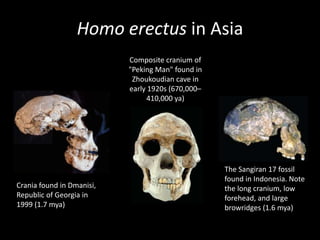
Homo erectus in Asia
                           Composite cranium of
                           "Peking Man" found in
                            Zhoukoudian cave in
                           early 1920s (670,000–
                                410,000 ya)


                                                   The Sangiran 17 fossil
                                                   found in Indonesia. Note
Crania found in Dmanisi,                           the long cranium, low
Republic of Georgia in                             forehead, and large
1999 (1.7 mya)                                     browridges (1.6 mya)
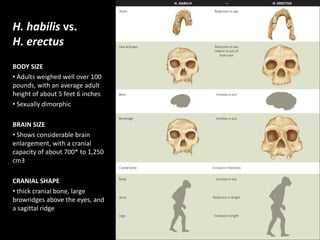
H. habilis vs.
H. erectus
BODY SIZE
• Adults weighed well over 100
pounds, with an average adult
height of about 5 feet 6 inches
• Sexually dimorphic

BRAIN SIZE
• Shows considerable brain
enlargement, with a cranial
capacity of about 700* to 1,250
cm3

CRANIAL SHAPE
• thick cranial bone, large
browridges above the eyes, and
a sagittal ridge
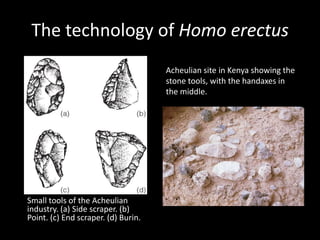
The technology of Homo erectus
                                     Acheulian site in Kenya showing the
                                     stone tools, with the handaxes in
                                     the middle.


Small tools of the Acheulian
industry. (a) Side scraper. (b)
Point. (c) End scraper. (d) Burin.
Acheulian Complex
• The culture associated with H. erectus, including
  handaxes and other types of stone tools; more
  refined than the earlier Oldowan tools; bifacial
  stone tools
• Basic H. erectus all purpose lithic tool kit for more
  than a million years
• a kind of “Acheulian Swiss army knife,” these
  tools served to cut, scrape, pound, and dig
• Lead to meat diet through hunting; explains
  morphological features
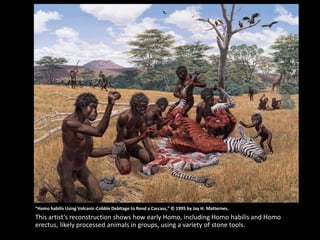
“Homo habilis Using Volcanic-Cobble Debitage to Rend a Carcass,” © 1995 by Jay H. Matternes.
This artist’s reconstruction shows how early Homo, including Homo habilis and Homo
erectus, likely processed animals in groups, using a variety of stone tools.
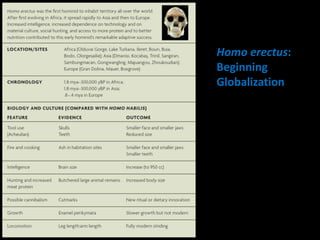
Homo erectus:
Beginning
Globalization
Premodern humans
of the Late Pleistocene

THE NEANDERTALS
Fossil
discoveries of
Neandertal
Neandertals
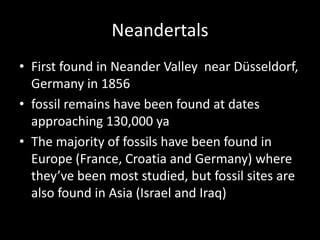
• First found in Neander Valley near Düsseldorf,
  Germany in 1856
• fossil remains have been found at dates
  approaching 130,000 ya
• The majority of fossils have been found in
  Europe (France, Croatia and Germany) where
  they’ve been most studied, but fossil sites are
  also found in Asia (Israel and Iraq)
Neandertals?
• They fit into the general scheme of human
  evolution, and yet they’re misfits.

• Many anthropologists classify Neandertals
  within H. sapiens, but as a distinctive
  subspecies, Homo sapiens neanderthalensis,
  with modern H. sapiens designated as Homo
  sapiens sapiens
Modern Human Relatives?
Some of the morphological traits associated with Neandertals can be found in
modern humans, as illustrated by this photograph of the physical
anthropologist Milford Wolpoff facing the reconstructed head of a European
Neandertal. Might Neandertals have interbred with modern human ancestors,
passing along some of these traits?
Mousterian Industry
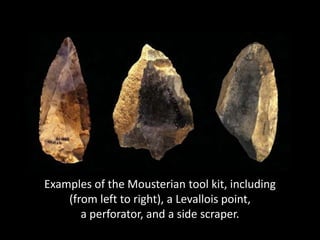
• Neandertals were associated with the culture
  known as Mousterian or Middle Paleolithic;
  includes a complex and distinctive type of fl aking
  called the Levallois
• This technique involves preparing a stone core
  and then fl aking the raw materials for tools from
  this core
• They developed specialized tools for skinning and
  preparing meat, hunting, woodworking, and
  hafting
Examples of the Mousterian tool kit, including
    (from left to right), a Levallois point,
       a perforator, and a side scraper.
Did they speak?
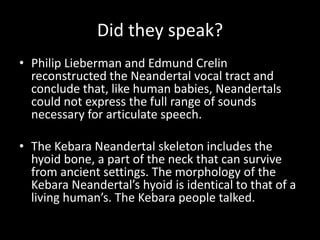
• Philip Lieberman and Edmund Crelin
  reconstructed the Neandertal vocal tract and
  conclude that, like human babies, Neandertals
  could not express the full range of sounds
  necessary for articulate speech.

• The Kebara Neandertal skeleton includes the
  hyoid bone, a part of the neck that can survive
  from ancient settings. The morphology of the
  Kebara Neandertal’s hyoid is identical to that of a
  living human’s. The Kebara people talked.
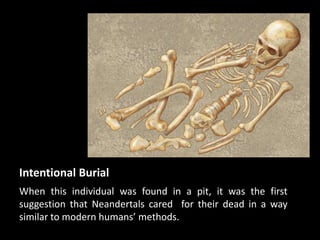
Intentional Burial
When this individual was found in a pit, it was the first
suggestion that Neandertals cared for their dead in a way
similar to modern humans’ methods.
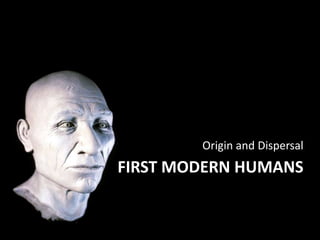
Origin and Dispersal
FIRST MODERN HUMANS
What’s so modern about modern humans?
Modern humans have a number of anatomical characteristics that
distinguish them from premodern humans. These include a small face,
small jaws, small teeth, a vertical and high forehead, a narrow nasal
aperture, a narrow body trunk, and long legs.
Earliest discoveries of modern humans

                  The earliest of these specimens
                  comes from Omo Kibish, in
                  southernmost Ethiopia. Using
                  radiometric techniques, recent
                  redating of a fragmentary skull
                  (Omo 1) demonstrates that,
                  coming from 195,000 ya, this is
                  the earliest modern human yet
                  found in Africa—or, for that
                  matter, anywhere.
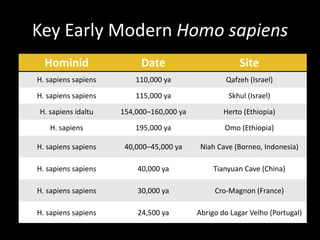
Key Early Modern Homo sapiens
  Hominid                 Date                         Site
H. sapiens sapiens       110,000 ya               Qafzeh (Israel)

H. sapiens sapiens       115,000 ya                Skhul (Israel)

H. sapiens idaltu    154,000–160,000 ya           Herto (Ethiopia)

   H. sapiens            195,000 ya               Omo (Ethiopia)

H. sapiens sapiens    40,000–45,000 ya     Niah Cave (Borneo, Indonesia)

H. sapiens sapiens       40,000 ya             Tianyuan Cave (China)

H. sapiens sapiens       30,000 ya             Cro-Magnon (France)

H. sapiens sapiens       24,500 ya        Abrigo do Lagar Velho (Portugal)
H. floresiensis:
Something New
and Different
In late 2004, the world awoke to
the startling announcement
that an extremely small-bodied,
small-brained hominid had
been discovered in Liang Bua
Cave, on the island of Flores,
east of Java.

These remains consist of an
ncomplete skeleton of an adult
female (LB1) as well as
additional pieces from nine
other individuals, which the
press have collectively
nicknamed “hobbits.”
Symbolic artifacts from the
Middle Stone Age of Africa
and the Upper Paleolithic in
Europe.

It is notable that evidence of
symbolism is found in
Blombos Cave (77,000 ya)
and Katanda (80,000 ya),
both in Africa, a full 50,000
years before any comparable
evidence is known from
Europe.

Moreover, the ochre found
at Pinnacle Point is yet
another 80,000 years older,
dating to more than 160,000
ya.
Three Competing Models

ORIGIN AND DISPERSAL
Complete Replacement Model

• aka Out-of-Africa hypothesis
• developed by British paleoanthropologists
  Christopher Stringer and Peter Andrews in 1988
• proposes that anatomically modern populations
  arose in Africa within the last 200,000 years and
  then migrated from Africa, completely replacing
  populations in Europe and Asia
• Y chromosome and mtDNA evidence
Partial Replacement Models
• suggest that modern humans originated in Africa
  and then, when their population increased,
  expanded out of Africa into other areas of the Old
  World
• some interbreeding occurred between emigrating
  Africans and resident premodern populations
  elsewhere
• assumes that no speciation event occurred, and
  all these hominids should be considered
  members of H. sapiens
Regional Continuity Model

• aka Multiregional hypothesis
• closely associated with paleoanthropologist
  Milford Wolpoff of the University of Michigan
• suggest that local populations continued their
  indigenous evolutionary development from
  premodern Middle Pleistocene forms to
  anatomically modern humans
Key Questions

• Who are the first hominids that dispersed to
  various parts of the Old World?

• What are the physiological and behavorial
  characteristics of premodern humans?

• Where did the transition (from premodern to
  modern humans) take place?
References

Fagan, Brian M. 2008. World Prehistory: A Brief Introduction,
  Seventh Edition. Upper Saddle River, New Jersey: Pearson
  Education, Inc.

Jurmain, Robert, et.al. 2006. Essentials of Physical
   Anthropology, Seventh Edition. Belmonth, CA: Wadsworth.

Larsen, Clark Spencer. 2010. Essentials of Physical
   Anthropology: Discovering our Origins. New York and
   London: W.W. Norton & Company.

* All photos were taken from the books mentioned above; except from the
   third slide.

African Exodus

  • 1.
    AFRICAN EXODUS Anthro 212 Presentation Jessie G. Varquez, Jr. 10 December 2011 CSSP, UP Diliman
  • 2.
    Popular beliefs • Evolutionis linear • Humans evolved from monkeys – “galing ang tao sa unggoy” • The Missing Link
  • 4.
    Key Questions • Whoare the first hominids that dispersed to various parts of the Old World? • What are the physiological and behavorial characteristics of premodern humans? • Where did the transition (from premodern to modern humans) take place?
  • 5.
    Outline • Pleistocene orthe Ice Age • Homo erectus – Acheulian stone tools • The Neandertals – Mousterian stone tools • Modern Humans – Origin and dispersal
  • 6.
    Pleistocene or TheIce Age • Began about 1.8 million years ago • marked by periodic continental glaciations • Characterized by numerous advances and retreats of ice, with at least 15 major and 50 minor glacial advances documented in Europe alone • Archaic and modern humans evolved during a long period of constant climate transition between warmer and colder in northern latitudes
  • 7.
  • 8.
    A new kindof hominid HOMO ERECTUS
  • 9.
    Pithecantropus erectus The namefirst proposed by Ernst Haeckel for the oldest hominid; Eugene Dubois later used this name for his first fossil discovery (1891), which later became known as Homo erectus.
  • 10.
  • 11.
    Homo erectus • Fossilfinds in Africa, Europe and Asia • Some researchers see several anatomical differences between African representatives of an erectuslike hominid and their Asian cousins. Thus, they place the African fossils into a separate species, Homo ergaster • Increase in body size and robustness, changes in limb proportions, and greater encephalization all indicate that these hominids were more like modern humans in their adaptive pattern than theirAfrican ancestors were
  • 12.
    Homo erectus inAsia Composite cranium of "Peking Man" found in Zhoukoudian cave in early 1920s (670,000– 410,000 ya) The Sangiran 17 fossil found in Indonesia. Note Crania found in Dmanisi, the long cranium, low Republic of Georgia in forehead, and large 1999 (1.7 mya) browridges (1.6 mya)
  • 13.
    H. habilis vs. H.erectus BODY SIZE • Adults weighed well over 100 pounds, with an average adult height of about 5 feet 6 inches • Sexually dimorphic BRAIN SIZE • Shows considerable brain enlargement, with a cranial capacity of about 700* to 1,250 cm3 CRANIAL SHAPE • thick cranial bone, large browridges above the eyes, and a sagittal ridge
  • 14.
    The technology ofHomo erectus Acheulian site in Kenya showing the stone tools, with the handaxes in the middle. Small tools of the Acheulian industry. (a) Side scraper. (b) Point. (c) End scraper. (d) Burin.
  • 15.
    Acheulian Complex • Theculture associated with H. erectus, including handaxes and other types of stone tools; more refined than the earlier Oldowan tools; bifacial stone tools • Basic H. erectus all purpose lithic tool kit for more than a million years • a kind of “Acheulian Swiss army knife,” these tools served to cut, scrape, pound, and dig • Lead to meat diet through hunting; explains morphological features
  • 16.
    “Homo habilis UsingVolcanic-Cobble Debitage to Rend a Carcass,” © 1995 by Jay H. Matternes. This artist’s reconstruction shows how early Homo, including Homo habilis and Homo erectus, likely processed animals in groups, using a variety of stone tools.
  • 17.
  • 18.
    Premodern humans of theLate Pleistocene THE NEANDERTALS
  • 19.
  • 20.
    Neandertals • First foundin Neander Valley near Düsseldorf, Germany in 1856 • fossil remains have been found at dates approaching 130,000 ya • The majority of fossils have been found in Europe (France, Croatia and Germany) where they’ve been most studied, but fossil sites are also found in Asia (Israel and Iraq)
  • 21.
    Neandertals? • They fitinto the general scheme of human evolution, and yet they’re misfits. • Many anthropologists classify Neandertals within H. sapiens, but as a distinctive subspecies, Homo sapiens neanderthalensis, with modern H. sapiens designated as Homo sapiens sapiens
  • 22.
    Modern Human Relatives? Someof the morphological traits associated with Neandertals can be found in modern humans, as illustrated by this photograph of the physical anthropologist Milford Wolpoff facing the reconstructed head of a European Neandertal. Might Neandertals have interbred with modern human ancestors, passing along some of these traits?
  • 23.
    Mousterian Industry • Neandertalswere associated with the culture known as Mousterian or Middle Paleolithic; includes a complex and distinctive type of fl aking called the Levallois • This technique involves preparing a stone core and then fl aking the raw materials for tools from this core • They developed specialized tools for skinning and preparing meat, hunting, woodworking, and hafting
  • 24.
    Examples of theMousterian tool kit, including (from left to right), a Levallois point, a perforator, and a side scraper.
  • 25.
    Did they speak? •Philip Lieberman and Edmund Crelin reconstructed the Neandertal vocal tract and conclude that, like human babies, Neandertals could not express the full range of sounds necessary for articulate speech. • The Kebara Neandertal skeleton includes the hyoid bone, a part of the neck that can survive from ancient settings. The morphology of the Kebara Neandertal’s hyoid is identical to that of a living human’s. The Kebara people talked.
  • 26.
    Intentional Burial When thisindividual was found in a pit, it was the first suggestion that Neandertals cared for their dead in a way similar to modern humans’ methods.
  • 28.
  • 29.
    What’s so modernabout modern humans? Modern humans have a number of anatomical characteristics that distinguish them from premodern humans. These include a small face, small jaws, small teeth, a vertical and high forehead, a narrow nasal aperture, a narrow body trunk, and long legs.
  • 30.
    Earliest discoveries ofmodern humans The earliest of these specimens comes from Omo Kibish, in southernmost Ethiopia. Using radiometric techniques, recent redating of a fragmentary skull (Omo 1) demonstrates that, coming from 195,000 ya, this is the earliest modern human yet found in Africa—or, for that matter, anywhere.
  • 31.
    Key Early ModernHomo sapiens Hominid Date Site H. sapiens sapiens 110,000 ya Qafzeh (Israel) H. sapiens sapiens 115,000 ya Skhul (Israel) H. sapiens idaltu 154,000–160,000 ya Herto (Ethiopia) H. sapiens 195,000 ya Omo (Ethiopia) H. sapiens sapiens 40,000–45,000 ya Niah Cave (Borneo, Indonesia) H. sapiens sapiens 40,000 ya Tianyuan Cave (China) H. sapiens sapiens 30,000 ya Cro-Magnon (France) H. sapiens sapiens 24,500 ya Abrigo do Lagar Velho (Portugal)
  • 32.
    H. floresiensis: Something New andDifferent In late 2004, the world awoke to the startling announcement that an extremely small-bodied, small-brained hominid had been discovered in Liang Bua Cave, on the island of Flores, east of Java. These remains consist of an ncomplete skeleton of an adult female (LB1) as well as additional pieces from nine other individuals, which the press have collectively nicknamed “hobbits.”
  • 33.
    Symbolic artifacts fromthe Middle Stone Age of Africa and the Upper Paleolithic in Europe. It is notable that evidence of symbolism is found in Blombos Cave (77,000 ya) and Katanda (80,000 ya), both in Africa, a full 50,000 years before any comparable evidence is known from Europe. Moreover, the ochre found at Pinnacle Point is yet another 80,000 years older, dating to more than 160,000 ya.
  • 34.
  • 35.
    Complete Replacement Model •aka Out-of-Africa hypothesis • developed by British paleoanthropologists Christopher Stringer and Peter Andrews in 1988 • proposes that anatomically modern populations arose in Africa within the last 200,000 years and then migrated from Africa, completely replacing populations in Europe and Asia • Y chromosome and mtDNA evidence
  • 36.
    Partial Replacement Models •suggest that modern humans originated in Africa and then, when their population increased, expanded out of Africa into other areas of the Old World • some interbreeding occurred between emigrating Africans and resident premodern populations elsewhere • assumes that no speciation event occurred, and all these hominids should be considered members of H. sapiens
  • 37.
    Regional Continuity Model •aka Multiregional hypothesis • closely associated with paleoanthropologist Milford Wolpoff of the University of Michigan • suggest that local populations continued their indigenous evolutionary development from premodern Middle Pleistocene forms to anatomically modern humans
  • 39.
    Key Questions • Whoare the first hominids that dispersed to various parts of the Old World? • What are the physiological and behavorial characteristics of premodern humans? • Where did the transition (from premodern to modern humans) take place?
  • 40.
    References Fagan, Brian M.2008. World Prehistory: A Brief Introduction, Seventh Edition. Upper Saddle River, New Jersey: Pearson Education, Inc. Jurmain, Robert, et.al. 2006. Essentials of Physical Anthropology, Seventh Edition. Belmonth, CA: Wadsworth. Larsen, Clark Spencer. 2010. Essentials of Physical Anthropology: Discovering our Origins. New York and London: W.W. Norton & Company. * All photos were taken from the books mentioned above; except from the third slide.