Sustainable Development
JOSE ARMANDO CASTILLO OCHOA 17050263
SOCIAL DIMENSION
UNIT 3
TEACHER: JUAN CARLOS LOYOLA LICEA
12/09/2018
HUMAN DEVELOPMENT INDEX
The Human Development Index (HDI) is an indicator of human
development by country, developed by the United Nations
Development Program (UNDP).
The Human Development Index (HDI) is a synthetic indicator of the
average achievements obtained in the fundamental dimensions of
human development, namely, having a long and healthy life, acquiring
knowledge and enjoying a decent standard of living.
HUMAN
DEVELOPMENT
INDEX
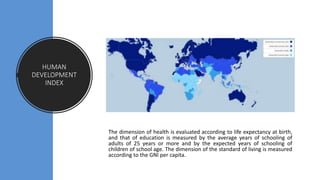
The dimension of health is evaluated according to life expectancy at birth,
and that of education is measured by the average years of schooling of
adults of 25 years or more and by the expected years of schooling of
children of school age. The dimension of the standard of living is measured
according to the GNI per capita.
Characteristics of the human development
index
• 1 - Health: measured according to life expectancy at birth.
• 2 - Education: measured by the adult literacy rate and the combined
gross enrollment ratio in primary, secondary and higher education, as
well as the years of compulsory education.
• 3 - Wealth: measured by GDP per capita PPP in international dollars
Other indices related to human development
• In addition to the HDI, UNDP prepares:
• The Multidimensional Poverty Index (MPI or MPI -Multidimensional
Poverty Index-), which since 2010 The Poverty Index (or poverty
indicators).
• The Human Poverty Index for developing countries (IPH-1, developed
from 1998).
• The Human Poverty Index for selected OECD countries (IPH-2,
developed from 1998)
Definition of human development
Process by which a society improves the living conditions of its citizens
through an increase in assets that can cover their basic and
complementary needs, and the creation of an environment in which
the human rights of all are respected they.
It is the amount of options a human being has in his own environment,
to be or do what he wants. The greater the number of options, the
more human development, the fewer options, the less human
development.
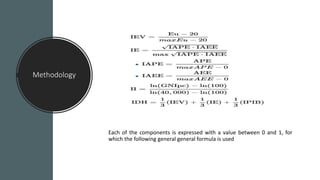
Methodology
Each of the components is expressed with a value between 0 and 1, for
which the following general general formula is used
Main obstacles and forms of exclusion
In order to achieve universal human development, it is necessary to
eradicate or reduce overt violence, discriminatory laws, exclusionary
social norms, imbalances in political participation and unequal
distribution of opportunities. Therefore, it is essential that empathy,
tolerance and moral commitments to global justice and sustainability
occupy a central place in individual and collective decisions.
CONCLUSIONS
Human development in Mexico as a goal of economic development
models has been partial, since on the one hand there are positive
developments in terms of health and education, and on the other
hand, insufficient growth rates in employed personnel, public spending
and GDP per capita. In regional terms, this bias in development is
manifested in the unequal growth of the states that make up the
Mexican Republic
BIBLIOGRAPHY
1] Afonso, A. y St. Aubyn, M. (2006). "Cross-country efficiency of
secondary education provision: A semi-parametric analysis with non-
discretionary inputs". Economic Modelling, 23(3), 476-491. [ Links ]
[2] Arcelus, F. J., Sharma, B. y Srinivasan, G. (2006). The Human
Development Index Adjusted for Efficient Resource Utilization. En UNU-
WIDER (Ed.), Inequality, Poverty and Well-Being (177-193). Helsinki:
Palgrave Macmillan UK. [ Links ]
[3] Banker, R. D., Charnes, A. y Cooper, W. W. (1984). "Some models for
estimating technical and scale inefficiencies in data envelopment
analysis". Management Science, 30(9), 1078-1092. [ Links ]]

Human development index

  • 1.
    Sustainable Development JOSE ARMANDOCASTILLO OCHOA 17050263 SOCIAL DIMENSION UNIT 3 TEACHER: JUAN CARLOS LOYOLA LICEA 12/09/2018
  • 2.
    HUMAN DEVELOPMENT INDEX TheHuman Development Index (HDI) is an indicator of human development by country, developed by the United Nations Development Program (UNDP). The Human Development Index (HDI) is a synthetic indicator of the average achievements obtained in the fundamental dimensions of human development, namely, having a long and healthy life, acquiring knowledge and enjoying a decent standard of living.
  • 3.
    HUMAN DEVELOPMENT INDEX The dimension ofhealth is evaluated according to life expectancy at birth, and that of education is measured by the average years of schooling of adults of 25 years or more and by the expected years of schooling of children of school age. The dimension of the standard of living is measured according to the GNI per capita.
  • 4.
    Characteristics of thehuman development index • 1 - Health: measured according to life expectancy at birth. • 2 - Education: measured by the adult literacy rate and the combined gross enrollment ratio in primary, secondary and higher education, as well as the years of compulsory education. • 3 - Wealth: measured by GDP per capita PPP in international dollars
  • 5.
    Other indices relatedto human development • In addition to the HDI, UNDP prepares: • The Multidimensional Poverty Index (MPI or MPI -Multidimensional Poverty Index-), which since 2010 The Poverty Index (or poverty indicators). • The Human Poverty Index for developing countries (IPH-1, developed from 1998). • The Human Poverty Index for selected OECD countries (IPH-2, developed from 1998)
  • 6.
    Definition of humandevelopment Process by which a society improves the living conditions of its citizens through an increase in assets that can cover their basic and complementary needs, and the creation of an environment in which the human rights of all are respected they. It is the amount of options a human being has in his own environment, to be or do what he wants. The greater the number of options, the more human development, the fewer options, the less human development.
  • 7.
    Methodology Each of thecomponents is expressed with a value between 0 and 1, for which the following general general formula is used
  • 8.
    Main obstacles andforms of exclusion In order to achieve universal human development, it is necessary to eradicate or reduce overt violence, discriminatory laws, exclusionary social norms, imbalances in political participation and unequal distribution of opportunities. Therefore, it is essential that empathy, tolerance and moral commitments to global justice and sustainability occupy a central place in individual and collective decisions.
  • 9.
    CONCLUSIONS Human development inMexico as a goal of economic development models has been partial, since on the one hand there are positive developments in terms of health and education, and on the other hand, insufficient growth rates in employed personnel, public spending and GDP per capita. In regional terms, this bias in development is manifested in the unequal growth of the states that make up the Mexican Republic
  • 10.
    BIBLIOGRAPHY 1] Afonso, A.y St. Aubyn, M. (2006). "Cross-country efficiency of secondary education provision: A semi-parametric analysis with non- discretionary inputs". Economic Modelling, 23(3), 476-491. [ Links ] [2] Arcelus, F. J., Sharma, B. y Srinivasan, G. (2006). The Human Development Index Adjusted for Efficient Resource Utilization. En UNU- WIDER (Ed.), Inequality, Poverty and Well-Being (177-193). Helsinki: Palgrave Macmillan UK. [ Links ] [3] Banker, R. D., Charnes, A. y Cooper, W. W. (1984). "Some models for estimating technical and scale inefficiencies in data envelopment analysis". Management Science, 30(9), 1078-1092. [ Links ]]