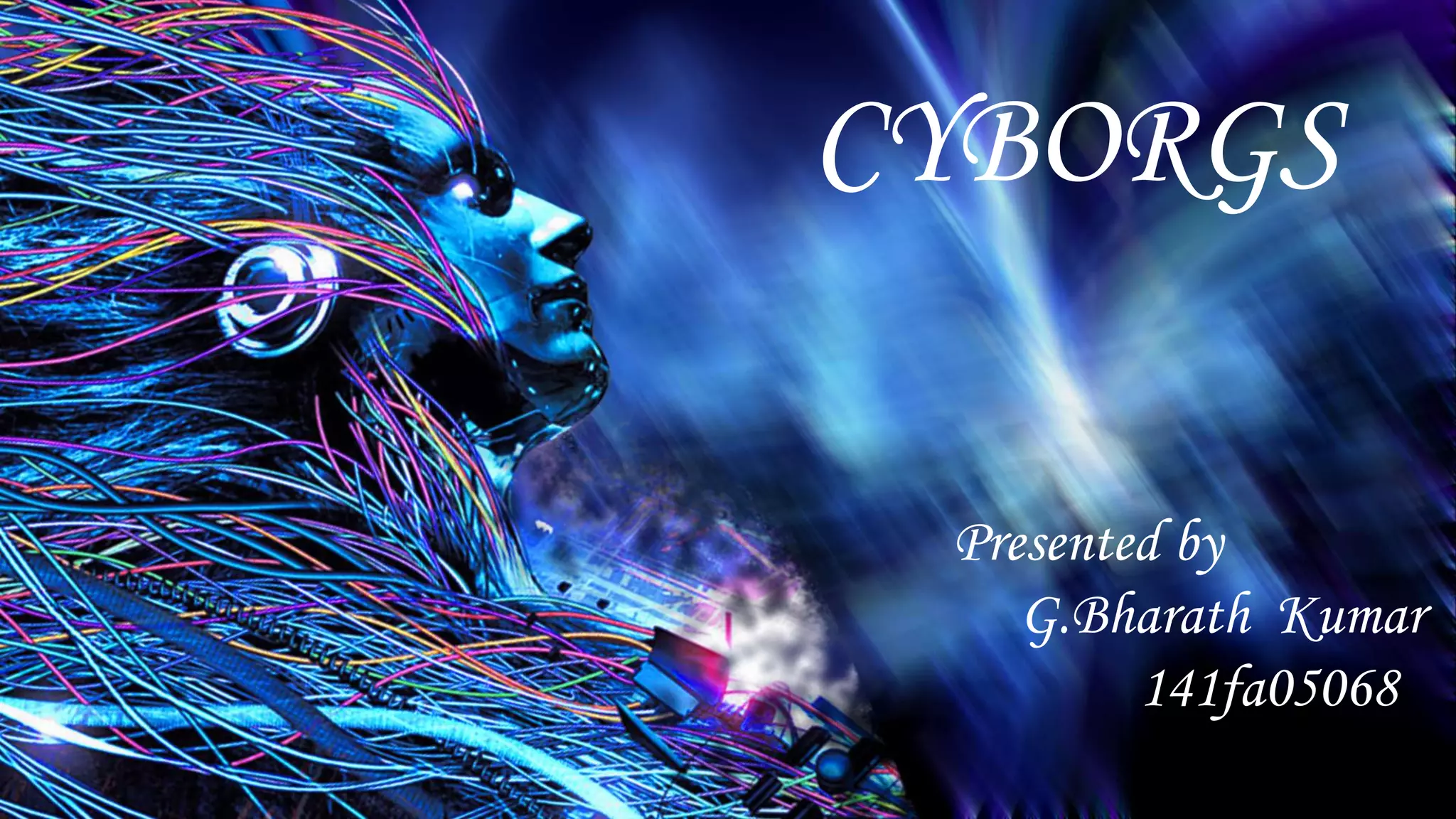
CYBORGS
Presented by
G.Bharath Kumar
141fa05068
Contents
ABSRACT
INTRODUCTION
History
Types of Cyborgs
ROBOTS & CYBORGS
APPLICATIONS
ADVANTAGES
DISADVANTAGES
CONCLUSION
Abstract
• Humans have limited capabilities.
• Humans sense the world in a restricted way.
• Can we use technology to upgrade humans?
• The paper emphasizes on the use of the cyborgs
to make the happy lives
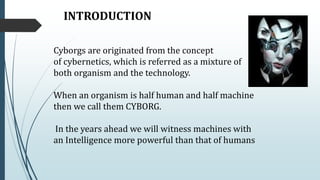
Cyborgs are originated from the concept
of cybernetics, which is referred as a mixture of
both organism and the technology.
When an organism is half human and half machine
then we call them CYBORG.
In the years ahead we will witness machines with
an Intelligence more powerful than that of humans
INTRODUCTION
History
• The term was coined by Manfred E. Clynes and
Nathan S. Kline in 1960 to refer to their conception
of an enhanced human being who could survive in
extra terrestrial environments
• Dr. Kevin Warwick heads the Cybernetics
Department at the University of Reading in the
United Kingdom.
• In 1998, implanted a silicon chip transponder in his
left hand by surgical operation.
Types of Cyborgs
1.Convenient cyborgs
Convenient cyborgs may refer to any external
provision of an exoskeleton for satisfying the
altered fancy needs of body
2.Conditional cyborgs
Conditional cyborgs includes bionic implants
replanting the Lost or damaged body for the
normal living in the present environment.
ROBOTS & CYBORGS
 A robot doesn't
necessarily have to
resemble a human.
 It can be in the shape of a
dog, or one of those giant
arms in a car
factory.
ROBOTS CYBORGS
 Cyborgs are beings that
are part mechanical and
part organic.
 It can be anyone whose
body relies on a form of
machinery in order to
survive - such as a
pacemaker or an insulin
pump - to be a cyborg.
APPLICATIONS
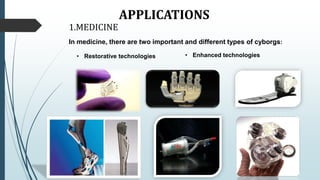
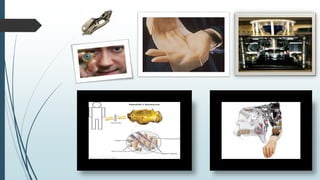
1.MEDICINE
In medicine, there are two important and different types of cyborgs:
• Restorative technologies • Enhanced technologies
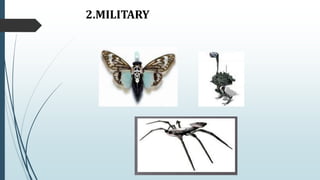
2.MILITARY
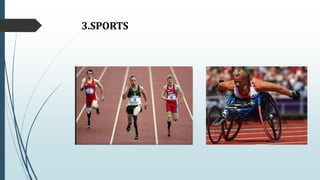
3.SPORTS
4.ART
The concept of cyborgation to associate to most people with
science fiction, they tend to believe cyborgs exist only in
imaginations of writers and artists. Cyborgs get famed through
mainly science fiction films and through stories of writers
ADVANTAGES
• Returning Function
• Increased Strength
• Added Functionality
• Possibly Longer Lifespan
• Increased Intelligence/Computational Power/Perception
DISADVANTAGES
• Possible loss of humanity
• Expensive
• Loss of Acceptable Appearance
• Likely to Die in the Creation Procedures
CONCLUSION
• Human Humans limited capabilities ,human
sense the world in a restricted way .
• Even cyborgs has some major defects and wrong
sidesas like any technologies evolving now days.
Finally I would like to say that if the future of
intelligent robots,then to protect mankind, we
will must need someTERMINATORs. They all are
CYBORGS. Because by making human CYBORGS.
REFERENCES
Clynes, M. & Kline N., 1960, “Cyborgs and Space”, Astronautics.
Fukuda, M., 2004, “Osteo-Odonto-Keratoprosthesis”
Haraway, Donna J. 1991,Simians, Cyborgs, and Women: The Reinvention
of Nature, London: Free Association Books & New York: Routledge
Thank you

Cyborgs

  • 1.
  • 2.
    Contents ABSRACT INTRODUCTION History Types of Cyborgs ROBOTS& CYBORGS APPLICATIONS ADVANTAGES DISADVANTAGES CONCLUSION
  • 3.
    Abstract • Humans havelimited capabilities. • Humans sense the world in a restricted way. • Can we use technology to upgrade humans? • The paper emphasizes on the use of the cyborgs to make the happy lives
  • 4.
    Cyborgs are originatedfrom the concept of cybernetics, which is referred as a mixture of both organism and the technology. When an organism is half human and half machine then we call them CYBORG. In the years ahead we will witness machines with an Intelligence more powerful than that of humans INTRODUCTION
  • 5.
    History • The termwas coined by Manfred E. Clynes and Nathan S. Kline in 1960 to refer to their conception of an enhanced human being who could survive in extra terrestrial environments • Dr. Kevin Warwick heads the Cybernetics Department at the University of Reading in the United Kingdom. • In 1998, implanted a silicon chip transponder in his left hand by surgical operation.
  • 6.
    Types of Cyborgs 1.Convenientcyborgs Convenient cyborgs may refer to any external provision of an exoskeleton for satisfying the altered fancy needs of body 2.Conditional cyborgs Conditional cyborgs includes bionic implants replanting the Lost or damaged body for the normal living in the present environment.
  • 7.
    ROBOTS & CYBORGS A robot doesn't necessarily have to resemble a human.  It can be in the shape of a dog, or one of those giant arms in a car factory. ROBOTS CYBORGS  Cyborgs are beings that are part mechanical and part organic.  It can be anyone whose body relies on a form of machinery in order to survive - such as a pacemaker or an insulin pump - to be a cyborg.
  • 9.
    APPLICATIONS 1.MEDICINE In medicine, thereare two important and different types of cyborgs: • Restorative technologies • Enhanced technologies
  • 11.
  • 12.
  • 13.
    4.ART The concept ofcyborgation to associate to most people with science fiction, they tend to believe cyborgs exist only in imaginations of writers and artists. Cyborgs get famed through mainly science fiction films and through stories of writers
  • 14.
    ADVANTAGES • Returning Function •Increased Strength • Added Functionality • Possibly Longer Lifespan • Increased Intelligence/Computational Power/Perception
  • 15.
    DISADVANTAGES • Possible lossof humanity • Expensive • Loss of Acceptable Appearance • Likely to Die in the Creation Procedures
  • 16.
    CONCLUSION • Human Humanslimited capabilities ,human sense the world in a restricted way . • Even cyborgs has some major defects and wrong sidesas like any technologies evolving now days. Finally I would like to say that if the future of intelligent robots,then to protect mankind, we will must need someTERMINATORs. They all are CYBORGS. Because by making human CYBORGS.
  • 17.
    REFERENCES Clynes, M. &Kline N., 1960, “Cyborgs and Space”, Astronautics. Fukuda, M., 2004, “Osteo-Odonto-Keratoprosthesis” Haraway, Donna J. 1991,Simians, Cyborgs, and Women: The Reinvention of Nature, London: Free Association Books & New York: Routledge
  • 18.