Principles of Artificial Intelligence
& Machine Learning
September 2017
Today’s Objectives
2
▪ Define Artificial Intelligence (AI) and describe its applications in business
▪ Discuss major drivers and influencers that are shaping the future of AI / ML
▪ Dive into Machine Learning (ML) and decode buzzwords such as “deep learning” and
“cognitive computing”
▪ Highlight analytical techniques and best practices used in AI / ML
▪ Share opportunities for students to get involved in Penn’s data science community
Introduction to
Artificial Intelligence
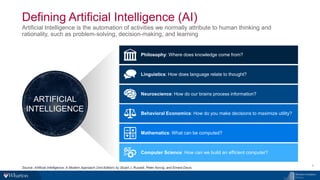
Defining Artificial Intelligence (AI)
Artificial Intelligence is the automation of activities we normally attribute to human thinking and
rationality, such as problem-solving, decision-making, and learning
4
Neuroscience: How do our brains process information?
Philosophy: Where does knowledge come from?
Linguistics: How does language relate to thought?
Behavioral Economics: How do you make decisions to maximize utility?
Mathematics: What can be computed?
Computer Science: How can we build an efficient computer?
ARTIFICIAL
INTELLIGENCE
Source: Artificial Intelligence: A Modern Approach (2nd Edition) by Stuart J. Russell, Peter Norvig, and Ernest Davis
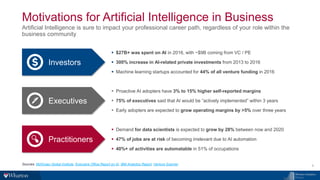
Motivations for Artificial Intelligence in Business
Artificial Intelligence is sure to impact your professional career path, regardless of your role within the
business community
5Sources: McKinsey Global Institute, Executive Office Report on AI, IBM Analytics Report, Venture Scanner
Executives
▪ Proactive AI adopters have 3% to 15% higher self-reported margins
▪ 75% of executives said that AI would be “actively implemented” within 3 years
▪ Early adopters are expected to grow operating margins by >5% over three years
▪ Demand for data scientists is expected to grow by 28% between now and 2020
▪ 47% of jobs are at risk of becoming irrelevant due to AI automation
▪ 40%+ of activities are automatable in 51% of occupations
Practitioners
▪ $27B+ was spent on AI in 2016, with ~$9B coming from VC / PE
▪ 300% increase in AI-related private investments from 2013 to 2016
▪ Machine learning startups accounted for 44% of all venture funding in 2016
Investors
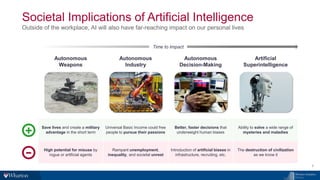
Societal Implications of Artificial Intelligence
Outside of the workplace, AI will also have far-reaching impact on our personal lives
6
Autonomous
Weapons
Autonomous
Industry
Autonomous
Decision-Making
Artificial
Superintelligence
Save lives and create a military
advantage in the short term
Universal Basic Income could free
people to pursue their passions
Better, faster decisions that
underweight human biases
Ability to solve a wide range of
mysteries and maladies
High potential for misuse by
rogue or artificial agents
Rampant unemployment,
inequality, and societal unrest
Introduction of artificial biases in
infrastructure, recruiting, etc.
The destruction of civilization
as we know it
Time to Impact
+
−
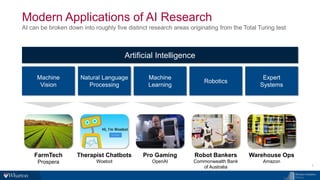
Modern Applications of AI Research
AI can be broken down into roughly five distinct research areas originating from the Total Turing test
7
FarmTech
Prospera
Artificial Intelligence
Machine
Vision
Therapist Chatbots
Woebot
Natural Language
Processing
Robot Bankers
Commonwealth Bank
of Australia
Robotics
Warehouse Ops
Amazon
Expert
Systems
Pro Gaming
OpenAI
Machine
Learning
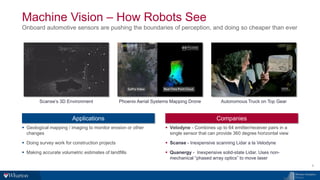
Machine Vision – How Robots See
Onboard automotive sensors are pushing the boundaries of perception, and doing so cheaper than ever
8
Autonomous Truck on Top GearScanse’s 3D Environment Phoenix Aerial Systems Mapping Drone
Applications
▪ Geological mapping / imaging to monitor erosion or other
changes
▪ Doing survey work for construction projects
▪ Making accurate volumetric estimates of landfills
Companies
▪ Velodyne - Combines up to 64 emitter/receiver pairs in a
single sensor that can provide 360 degree horizontal view
▪ Scanse - Inexpensive scanning Lidar a la Velodyne
▪ Quanergy - Inexpensive solid-state Lidar. Uses non-
mechanical “phased array optics” to move laser
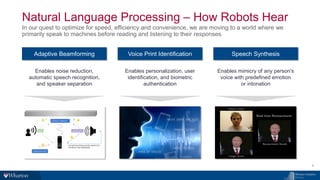
Natural Language Processing – How Robots Hear
In our quest to optimize for speed, efficiency and convenience, we are moving to a world where we
primarily speak to machines before reading and listening to their responses
9
Adaptive Beamforming
Enables noise reduction,
automatic speech recognition,
and speaker separation
Voice Print Identification
Enables personalization, user
identification, and biometric
authentication
Speech Synthesis
Enables mimicry of any person's
voice with predefined emotion
or intonation
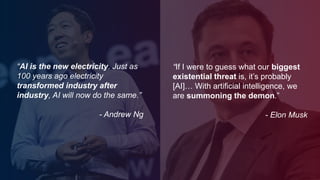
“If I were to guess what our biggest
existential threat is, it’s probably
[AI]… With artificial intelligence, we
are summoning the demon.”
- Elon Musk
“AI is the new electricity. Just as
100 years ago electricity
transformed industry after
industry, AI will now do the same.”
- Andrew Ng
Artificial Intelligence
Drivers & Influencers
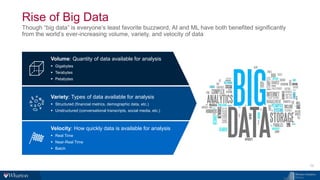
Rise of Big Data
Though “big data” is everyone’s least favorite buzzword, AI and ML have both benefited significantly
from the world’s ever-increasing volume, variety, and velocity of data
12
Volume: Quantity of data available for analysis
▪ Gigabytes
▪ Terabytes
▪ Petabytes
Variety: Types of data available for analysis
▪ Structured (financial metrics, demographic data, etc.)
▪ Unstructured (conversational transcripts, social media, etc.)
Velocity: How quickly data is available for analysis
▪ Real Time
▪ Near-Real Time
▪ Batch
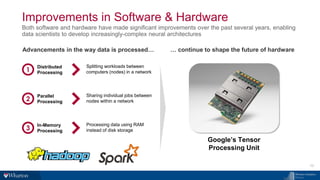
Improvements in Software & Hardware
Both software and hardware have made significant improvements over the past several years, enabling
data scientists to develop increasingly-complex neural architectures
13
Advancements in the way data is processed… … continue to shape the future of hardware
Distributed
Processing1
Splitting workloads between
computers (nodes) in a network
Parallel
Processing2
Sharing individual jobs between
nodes within a network
In-Memory
Processing3
Processing data using RAM
instead of disk storage
Google’s Tensor
Processing Unit
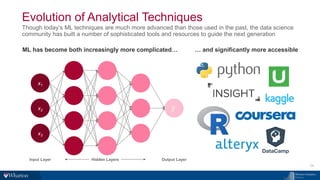
Evolution of Analytical Techniques
Though today’s ML techniques are much more advanced than those used in the past, the data science
community has built a number of sophisticated tools and resources to guide the next generation
14
Input Layer Output LayerHidden Layers
x1
x2
x3
ො𝑦
ML has become both increasingly more complicated… … and significantly more accessible
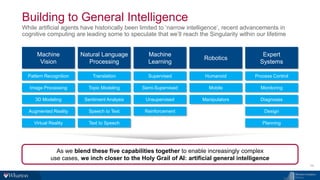
Building to General Intelligence
While artificial agents have historically been limited to ‘narrow intelligence’, recent advancements in
cognitive computing are leading some to speculate that we’ll reach the Singularity within our lifetime
15
Machine
Vision
Pattern Recognition
Image Processing
3D Modeling
Augmented Reality
Virtual Reality
Machine
Learning
Supervised
Semi-Supervised
Unsupervised
Reinforcement
Robotics
Humanoid
Mobile
Manipulators
As we blend these five capabilities together to enable increasingly complex
use cases, we inch closer to the Holy Grail of AI: artificial general intelligence
Expert
Systems
Process Control
Monitoring
Diagnoses
Design
Planning
Natural Language
Processing
Translation
Topic Modeling
Sentiment Analysis
Speech to Text
Text to Speech
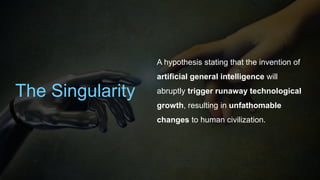
The Singularity
A hypothesis stating that the invention of
artificial general intelligence will
abruptly trigger runaway technological
growth, resulting in unfathomable
changes to human civilization.
Diving into
Machine Learning
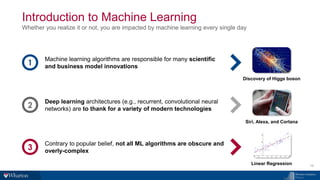
Introduction to Machine Learning
Whether you realize it or not, you are impacted by machine learning every single day
18
3
Contrary to popular belief, not all ML algorithms are obscure and
overly-complex
Linear Regression
1
Machine learning algorithms are responsible for many scientific
and business model innovations
Discovery of Higgs boson
2
Deep learning architectures (e.g., recurrent, convolutional neural
networks) are to thank for a variety of modern technologies
Siri, Alexa, and Cortana
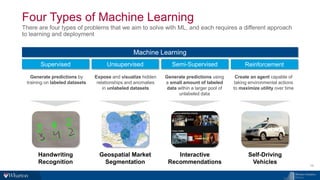
Generate predictions by
training on labeled datasets
Expose and visualize hidden
relationships and anomalies
in unlabeled datasets
Generate predictions using
a small amount of labeled
data within a larger pool of
unlabeled data
Create an agent capable of
taking environmental actions
to maximize utility over time
Four Types of Machine Learning
There are four types of problems that we aim to solve with ML, and each requires a different approach
to learning and deployment
19
Machine Learning
Supervised Unsupervised Semi-Supervised Reinforcement
Geospatial Market
Segmentation
Self-Driving
Vehicles
Handwriting
Recognition
Interactive
Recommendations
Principles of
Machine Learning
Principle #1: Generalization
When we train a machine to think, we are mostly concerned with how well it can predict the future. This
often means that we need to restrain the complexity of our model to improve its ability to generalize
21
Training Data Predictions
Time
Y
Strong Fit Overfitting (High Variance)
Training Data Predictions
Time
Y
Underfitting (High Bias)
Training Data Predictions
Time
Y
Principle #2: No Free Lunch
Unfortunately, there is no ‘magical’ algorithm that will solve all of our problems. Generating accurate
predictions requires a thorough understanding of the underlying behaviors at play within our data
22
For a given problem, pick the right algorithms… … to optimize the bias-variance trade-off
Graphic Source: Scott Fortmann-Roe
Random Forests PCA
Gradient Boosted Machines LLE
Support Vector Machines t-SNE
Multi-Layer Neural Networks LDA
Recurrent Neural Networks DBSCAN
Linear Regression K-Nearest NeighborsLogistic Regression
Multivariate Linear Reg. HCAMultinomial Logistic Reg.
Regression Classification Clustering
Convolutional Neural Networks Autoencoders
Supervised Semi-Supervised
… ….
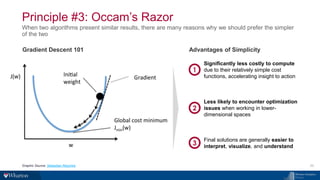
Principle #3: Occam’s Razor
When two algorithms present similar results, there are many reasons why we should prefer the simpler
of the two
23
Significantly less costly to compute
due to their relatively simple cost
functions, accelerating insight to action
1
Less likely to encounter optimization
issues when working in lower-
dimensional spaces
2
Final solutions are generally easier to
interpret, visualize, and understand3
Gradient Descent 101 Advantages of Simplicity
Graphic Source: Sebastian Raschka
Principle #4: More Data > More Complex Algorithms
Using fancy algorithms is just one piece of the data science puzzle. Including new features or increasing
the volume of data available for training will substantially improve your results.
24
“The Unreasonable Effectiveness of Data”“We don't have better
algorithms than anyone else; we
just have more data”
- Peter Norvig, Google
Principle #5: Cross-Validation
In the same way that we cannot determine a drug’s effectiveness by only testing it on a single patient,
we need to examine our model using multiple data samples (called ‘folds’) to evaluate performance
25Graphic Source: Karl Rosaen
k-fold Cross-Validation Error
Used to evaluate how well each model
generalizes an independent data set
Cross-Validation 101
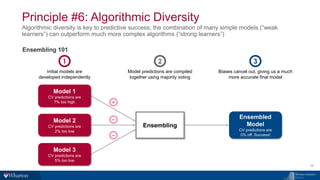
Principle #6: Algorithmic Diversity
Algorithmic diversity is key to predictive success; the combination of many simple models (“weak
learners”) can outperform much more complex algorithms (“strong learners”)
26
Model 1
CV predictions are
7% too high
Model 3
CV predictions are
5% too low
Model 2
CV predictions are
2% too low
Ensembling
Ensembled
Model
CV predictions are
0% off. Success!
Initial models are
developed independently
Model predictions are compiled
together using majority voting
Biases cancel out, giving us a much
more accurate final model
+
−
−
Ensembling 101
1 2 3
Wrapping-Up
Key Take-Aways
28
▪ We, as future business leaders, must be able to decipher the signal from
the noise with regards to AI / ML
▪ AI will have profound practical and ethical implications for our society
▪ Getting started is not as difficult as you might think
Thank you for your time
Contact Information
Nick Lind (nthorlind@gmail.com)
Jerry Lu (jylu88@gmail.com)