PSYCHOLOGICAL
DISORDERS
CHAPTER 4
CONCEPTS OF
ABNORMALITY AND
PSYCHOLOGICAL
DISORDERS
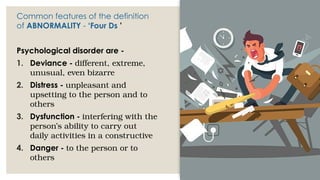
Common features of the definition
of ABNORMALITY - ‘Four Ds ’
Psychological disorder are -
1. Deviance - different, extreme,
unusual, even bizarre
2. Distress - unpleasant and
upsetting to the person and to
others
3. Dysfunction - interfering with the
person’s ability to carry out
daily activities in a constructive
4. Danger - to the person or to
others
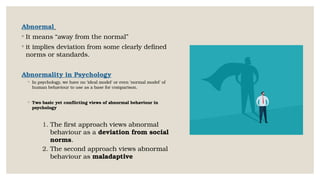
Abnormal
◦ It means “away from the normal”
◦ it implies deviation from some clearly defined
norms or standards.
Abnormality in Psychology
◦ In psychology, we have no ‘ideal model’ or even ‘normal model’ of
human behaviour to use as a base for comparison.
◦ Two basic yet conflicting views of abnormal behaviour in
psychology
1. The first approach views abnormal
behaviour as a deviation from social
norms.
2. The second approach views abnormal
behaviour as maladaptive
1. ABNORMAL BEHAVIOR AS A DEVIATION FROM SOCIAL
NORMS.
◦ Each society has norms, which are stated or unstated rules for
proper conduct.
◦ A society’s norms grow from its culture — its history, values,
institutions, habits, skills, technology, and arts.
◦ Behaviours, thoughts and emotions that break societal
norms are called abnormal.
◦ Example- a society whose culture values competition and
assertiveness may accept aggressive behaviour, whereas one
that emphasises cooperation and family values (such as in
India) may consider aggressive behaviour as unacceptable or
even abnormal.
Problems With This View
1. A society’s values may change over time, causing its views of
what is psychologically abnormal to change as well.
2. It is based on the assumption that socially accepted
behaviour is not abnormal, and that normality is nothing
2. ABNORMAL BEHAVIOUR AS MALADAPTIVE.
◦ Does the behaviour foster the well-being of the individual and the group to
which s/he belongs.
◦ Well-being
−not simply maintenance and survival but
−includes growth and fulfilment, i.e. the
actualisation of potential
◦ Conforming behaviour can be seen as abnormal if it is maladaptive, i.e. if
it interferes with optimal functioning and growth.
◦ For example, a student in the class prefers to remain silent even when s/he
has questions in her/his mind.
◦ Describing behaviour as maladaptive implies that 1) a problem exists; it also
suggests that 2) vulnerability in the individual, 3) inability to cope, or 4)
exceptional stress in the environment have led to problems in life.
View Psychological Disorders as any other illness
◦ People have vague ideas about psychological disorders
◦ Their ideas are characterised by superstition, ignorance and
fear.
◦ It is commonly believed that psychological disorder is something
to be ashamed of.
◦ The stigma attached to mental illness means that people are
hesitant to consult a doctor or psychologist because they are
ashamed of their problems.
Psychological disorder which indicates a failure in adaptation
should be viewed as any other illness.
Historical Backgroud
A. In the history of western civilisation
1. Supernatural Approach
2. Biological/ Organic Approach
3. Psychological Approach
B. In the ancient western world
4. Organismic Approach (Hippocrates, Socrates,
Plato, Galen)
C. In Middle ages
D. The Renaissance Period
E. Age of reason and enlightenment
F. Interactional/ Bio-psycho-social Approach (present)
1. Supernatural Approach
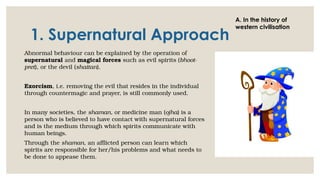
Abnormal behaviour can be explained by the operation of
supernatural and magical forces such as evil spirits (bhoot-
pret), or the devil (shaitan).
Exorcism, i.e. removing the evil that resides in the individual
through countermagic and prayer, is still commonly used.
In many societies, the shaman, or medicine man (ojha) is a
person who is believed to have contact with supernatural forces
and is the medium through which spirits communicate with
human beings.
Through the shaman, an afflicted person can learn which
spirits are responsible for her/his problems and what needs to
be done to appease them.
A. In the history of
western civilisation
2. Biological/ Organic Approach
◦ Individuals behave strangely because
their bodies and their brains are not
working properly.
◦ Body and brain processes have been
linked to many types of maladaptive
behaviour.
◦ For certain types of disorders,
correcting these defective biological
processes results in improved
functioning.
A. In the history of
western civilisation
3.
Psychological
Approach
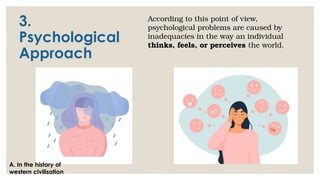
According to this point of view,
psychological problems are caused by
inadequacies in the way an individual
thinks, feels, or perceives the world.
A. In the history of
western civilisation
1. Organismic Approach
◦ In the ancient Western world, it was philosopher- physicians of ancient
Greece such as Hippocrates, Socrates, and in particular Plato who
developed the organismic approach.
◦ They viewed disturbed behaviour as arising out of conflicts between
emotion and reason.
◦ Galen’ view on the cause of disorders
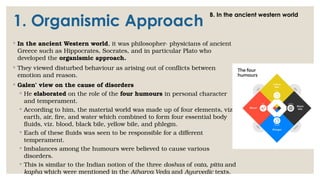
◦ He elaborated on the role of the four humours in personal character
and temperament.
◦ According to him, the material world was made up of four elements, viz.
earth, air, fire, and water which combined to form four essential body
fluids, viz. blood, black bile, yellow bile, and phlegm.
◦ Each of these fluids was seen to be responsible for a different
temperament.
◦ Imbalances among the humours were believed to cause various
disorders.
◦ This is similar to the Indian notion of the three doshas of vata, pitta and
kapha which were mentioned in the Atharva Veda and Ayurvedic texts.
B. In the ancient western world
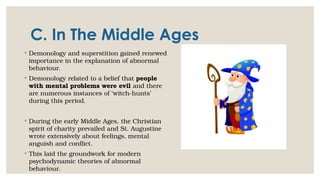
C. In The Middle Ages
◦ Demonology and superstition gained renewed
importance in the explanation of abnormal
behaviour.
◦ Demonology related to a belief that people
with mental problems were evil and there
are numerous instances of ‘witch-hunts’
during this period.
◦ During the early Middle Ages, the Christian
spirit of charity prevailed and St. Augustine
wrote extensively about feelings, mental
anguish and conflict.
◦ This laid the groundwork for modern
psychodynamic theories of abnormal
behaviour.
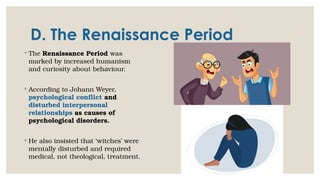
D. The Renaissance Period
◦ The Renaissance Period was
marked by increased humanism
and curiosity about behaviour.
◦ According to Johann Weyer,
psychological conflict and
disturbed interpersonal
relationships as causes of
psychological disorders.
◦ He also insisted that ‘witches’ were
mentally disturbed and required
medical, not theological, treatment.
E. Age of Reason and
Enlightenment
This was in the seventeenth and eighteenth centuries
The scientific method replaced faith and dogma as ways of
understanding abnormal behaviour.
The growth of a scientific attitude towards psychological disorders led
to
1. the Reform Movement
◦ Reforms of asylums were initiated in both Europe and America.
◦ One aspect of the reform movement was the new inclination for deinstitutionalisation which
placed emphasis on providing community care for recovered mentally ill individuals.
2. Increased compassion for people who suffered from these
disorders.
F. Interactional/ Bio-Psycho-
Social Approach
◦ In recent years, there has been a
convergence of these approaches,
which has resulted in an
interactional, or bio- psycho-social
approach.
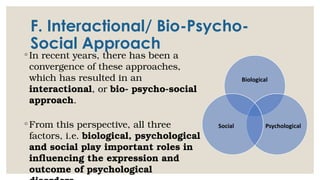
◦ From this perspective, all three
factors, i.e. biological, psychological
and social play important roles in
influencing the expression and
outcome of psychological
Classification of Psychological
Disorders
◦ A classification of disorders consists of a list of categories of specific psychological disorders grouped into various
classes on the basis of some shared characteristics.
◦ Classifications are useful because they enable users like psychologists, psychiatrists and social workers to
communicate with each other about the disorder and help in understanding the causes of psychological
disorders and the processes involved in their development and maintenance.
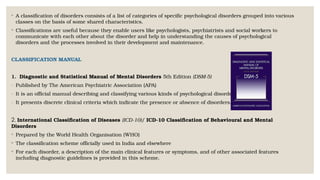
CLASSIFICATION MANUAL
1. Diagnostic and Statistical Manual of Mental Disorders 5th Edition (DSM-5)
- Published by The American Psychiatric Association (APA)
- It is an official manual describing and classifying various kinds of psychological disorders.
- It presents discrete clinical criteria which indicate the presence or absence of disorders.
2. International Classification of Diseases (ICD-10)/ ICD-10 Classification of Behavioural and Mental
Disorders
◦ Prepared by the World Health Organisation (WHO)
◦ The classification scheme officially used in India and elsewhere
◦ For each disorder, a description of the main clinical features or symptoms, and of other associated features
including diagnostic guidelines is provided in this scheme.
Factors Underlying Abnormal
Behaviour
◦ Psychologists use different approaches to understand abnormal
behaviour.
◦ Each approach emphasises a different aspect of human
behaviour, and explains and treats abnormality in line with that
aspect.
◦ These approaches also emphasise the role of different factors
such as
1. Biological
2. Psychological and Interpersonal
3. Socio-cultural
(4. Diathesis- stress Model)
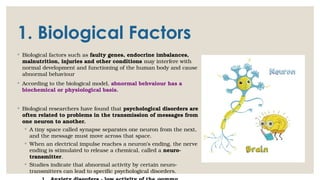
1. Biological Factors
◦ Biological factors such as faulty genes, endocrine imbalances,
malnutrition, injuries and other conditions may interfere with
normal development and functioning of the human body and cause
abnormal behaviour
◦ According to the biological model, abnormal behvaiour has a
biochemical or physiological basis.
◦ Biological researchers have found that psychological disorders are
often related to problems in the transmission of messages from
one neuron to another.
◦ A tiny space called synapse separates one neuron from the next,
and the message must move across that space.
◦ When an electrical impulse reaches a neuron’s ending, the nerve
ending is stimulated to release a chemical, called a neuro-
transmitter.
◦ Studies indicate that abnormal activity by certain neuro-
transmitters can lead to specific psychological disorders.
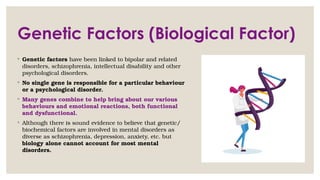
Genetic Factors (Biological Factor)
◦ Genetic factors have been linked to bipolar and related
disorders, schizophrenia, intellectual disability and other
psychological disorders.
◦ No single gene is responsible for a particular behaviour
or a psychological disorder.
◦ Many genes combine to help bring about our various
behaviours and emotional reactions, both functional
and dysfunctional.
◦ Although there is sound evidence to believe that genetic/
biochemical factors are involved in mental disorders as
diverse as schizophrenia, depression, anxiety, etc. but
biology alone cannot account for most mental
disorders.
2.
Psychologic
al Factors
There are several psychological models which provide
a psychological explanation of mental disorders.
These models maintain that psychological and
interpersonal factors cause abnormal behaviour.
These factors include
1.maternal deprivation (separation from the mother, or
lack of warmth and stimulation during early years of
life)
2.faulty parent-child relationships (rejection,
overprotection, over-permissiveness, faulty
discipline, etc.)
3.maladaptive family structures (inadequate or
disturbed family)
4.severe stress.
The psychological models include the
A.Psychodynamic Model
B.Behavioural Model
C.Cognitive Model
D.Humanistic-existential Model
INTERPERSON
AL
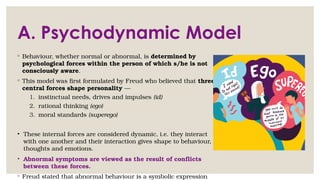
A. Psychodynamic Model
◦ Behaviour, whether normal or abnormal, is determined by
psychological forces within the person of which s/he is not
consciously aware.
◦ This model was first formulated by Freud who believed that three
central forces shape personality —
1. instinctual needs, drives and impulses (id)
2. rational thinking (ego)
3. moral standards (superego)
• These internal forces are considered dynamic, i.e. they interact
with one another and their interaction gives shape to behaviour,
thoughts and emotions.
• Abnormal symptoms are viewed as the result of conflicts
between these forces.
◦ Freud stated that abnormal behaviour is a symbolic expression
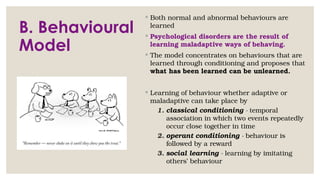
B. Behavioural
Model
◦ Both normal and abnormal behaviours are
learned
◦ Psychological disorders are the result of
learning maladaptive ways of behaving.
◦ The model concentrates on behaviours that are
learned through conditioning and proposes that
what has been learned can be unlearned.
◦ Learning of behaviour whether adaptive or
maladaptive can take place by
1. classical conditioning - temporal
association in which two events repeatedly
occur close together in time
2. operant conditioning - behaviour is
followed by a reward
3. social learning - learning by imitating
others’ behaviour
C. Cognitive Model
This model states that abnormal functioning
can result from cognitive problems.
1. People may hold assumptions and attitudes
about themselves that are irrational and
inaccurate.
2. People may also repeatedly think in illogical
ways and make overgeneralisations, that is,
they may draw broad, negative conclusions
on the basis of a single insignificant event.
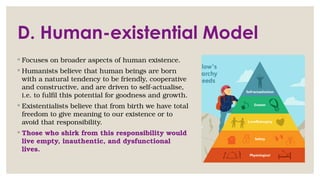
D. Human-existential Model
◦ Focuses on broader aspects of human existence.
◦ Humanists believe that human beings are born
with a natural tendency to be friendly, cooperative
and constructive, and are driven to self-actualise,
i.e. to fulfil this potential for goodness and growth.
◦ Existentialists believe that from birth we have total
freedom to give meaning to our existence or to
avoid that responsibility.
◦ Those who shirk from this responsibility would
live empty, inauthentic, and dysfunctional
lives.
3. Socio-cultural Factors
Behaviour is shaped by societal forces, factors such as family
structure and communication, social networks, societal
conditions, and societal labels and roles become more
important.
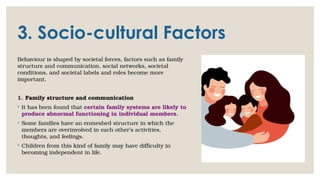
1. Family structure and communication
◦ It has been found that certain family systems are likely to
produce abnormal functioning in individual members.
◦ Some families have an enmeshed structure in which the
members are overinvolved in each other’s activities,
thoughts, and feelings.
◦ Children from this kind of family may have difficulty in
becoming independent in life.
3. Socio-cultural Factors
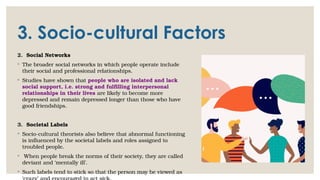
2. Social Networks
◦ The broader social networks in which people operate include
their social and professional relationships.
◦ Studies have shown that people who are isolated and lack
social support, i.e. strong and fulfilling interpersonal
relationships in their lives are likely to become more
depressed and remain depressed longer than those who have
good friendships.
3. Societal Labels
◦ Socio-cultural theorists also believe that abnormal functioning
is influenced by the societal labels and roles assigned to
troubled people.
◦ When people break the norms of their society, they are called
deviant and ‘mentally ill’.
◦ Such labels tend to stick so that the person may be viewed as
E. DIASTHESIS STRESS MODEL
◦ This model has been applied to several disorders including anxiety,
depression, and schizophrenia.
◦ This model states that psychological disorders develop when a diathesis
(biological predisposition to the disorder) is set off by a stressful situation.
◦ This model has three components.
1. The first is the diathesis or the presence of some biological aberration
which may be inherited.
2. The second component is that the diathesis may carry a vulnerability
to develop a psychological disorder. This means that the person is
‘at risk’ or ‘predisposed’ to develop the disorder.
3. The third component is the presence of pathogenic stressors, i.e.
factors/ stressors that may lead to psychopathology. If such “at risk”
MAJOR PSYCHOLOGICAL
DISORDERS
1. Anxiety Disorders
2. Obsessive Compulsive and Related Disorders
3. Trauma and Stressor Related Disorders
4. Somatic Symptom and Related Disorders
5. Dissociative Disorders
6. Depressive Disorders
7. Bipolar and Related Disorders
8. Schizophrenia Spectrum and Other Psychotic Disorders
9. Neurodevelopmental Disorders
10. Disruptive, Impulse-Control and Conduct Disorders
11. Feeding and Eating Disorders
12. Substance-Related and Addictive Disorders
1. Anxiety Disorders
Normal Anxiety - when we are waiting to take an examination, or to visit a
dentist, or even to give a solo performance. It motivates us to do our task well.
Anxiety Disorder - High levels of anxiety that are distressing and interfere
with effective functioning indicate the presence of an anxiety disorder
Definition of anxiety - a diffuse, vague, very unpleasant feeling of fear and
apprehension.
The anxious individual also shows combinations of the following
symptoms:
1. Rapid Heart Rate
2. Shortness Of Breath
3. Diarrhoea
4. Loss Of Appetite
5. Fainting
6. Dizziness
7. Sweating
8. Sleeplessness
9. Frequent Urination
10.Tremors.
1. Anxiety
Disorders
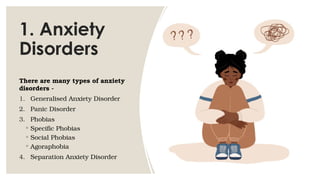
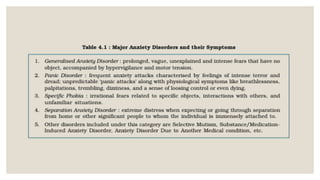
There are many types of anxiety
disorders -
1. Generalised Anxiety Disorder
2. Panic Disorder
3. Phobias
◦ Specific Phobias
◦ Social Phobias
◦ Agoraphobia
4. Separation Anxiety Disorder
1. Anxiety Disorders
2. Panic Disorder
◦ Consists of recurrent anxiety attacks in
which the person experiences intense terror.
◦ A panic attack denotes an abrupt surge of
intense anxiety rising to a peak when
thoughts of a particular stimuli are present.
Such thoughts occur in an unpredictable
manner.
◦ The clinical features include shortness of
breath, dizziness, trembling, palpitations,
choking, nausea, chest pain or discomfort,
fear of going crazy, losing control or dying.
1. Generalised anxiety disorder
• Consists of prolonged, vague,
unexplained and intense fears that are
not attached to any particular object.
• The symptoms include worry and
apprehensive feelings about the future;
hypervigilance, which involves
constantly scanning the environment
for dangers.
• It is marked by motor tension, as a
result of which the person is unable to
relax, is restless, and visibly shaky and
tense.
1. Anxiety Disorders
3. Phobias
◦ You might have met or heard of someone who was afraid to travel in a lift or climb to the tenth floor of a building,
or refused to enter a room if s/he saw a lizard. You may have also felt it yourself or seen a friend unable to speak
a word of a well-memorised and rehearsed speech before an audience. These kinds of fears are termed as
phobias.
◦ People who have phobias have irrational fears related to specific objects, people, or situations.
◦ Phobias often develop gradually or begin with a generalised anxiety disorder.
Phobias can be grouped into three main types
A. Specific Phobias - Includes irrational fears such as intense fear of a certain type of animal, or of being in an
enclosed space.
B. Social Anxiety Disorder (Social Phobia)- Intense and incapacitating fear and embarrassment when
dealing with others
C. Agoraphobia - when people develop a fear of entering unfamiliar situations. Many people with agoraphobia
are afraid of leaving their home. So their ability to carry out normal life activities is severely limited.
1. Anxiety Disorders
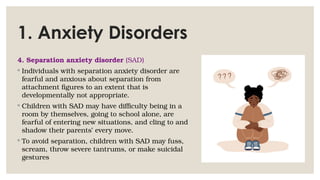
4. Separation anxiety disorder (SAD)
◦ Individuals with separation anxiety disorder are
fearful and anxious about separation from
attachment figures to an extent that is
developmentally not appropriate.
◦ Children with SAD may have difficulty being in a
room by themselves, going to school alone, are
fearful of entering new situations, and cling to and
shadow their parents’ every move.
◦ To avoid separation, children with SAD may fuss,
scream, throw severe tantrums, or make suicidal
gestures
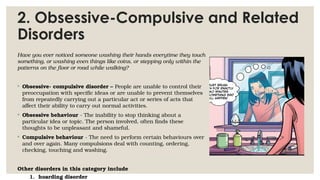
2. Obsessive-Compulsive and Related
Disorders
Have you ever noticed someone washing their hands everytime they touch
something, or washing even things like coins, or stepping only within the
patterns on the floor or road while walking?
◦ Obsessive- compulsive disorder – People are unable to control their
preoccupation with specific ideas or are unable to prevent themselves
from repeatedly carrying out a particular act or series of acts that
affect their ability to carry out normal activities.
◦ Obsessive behaviour - The inability to stop thinking about a
particular idea or topic. The person involved, often finds these
thoughts to be unpleasant and shameful.
◦ Compulsive behaviour - The need to perform certain behaviours over
and over again. Many compulsions deal with counting, ordering,
checking, touching and washing.
Other disorders in this category include
1. hoarding disorder
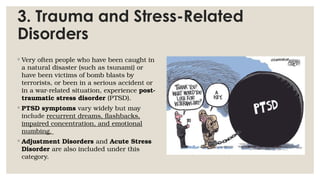
3. Trauma and Stress-Related
Disorders
◦ Very often people who have been caught in
a natural disaster (such as tsunami) or
have been victims of bomb blasts by
terrorists, or been in a serious accident or
in a war-related situation, experience post-
traumatic stress disorder (PTSD).
◦ PTSD symptoms vary widely but may
include recurrent dreams, flashbacks,
impaired concentration, and emotional
numbing.
◦ Adjustment Disorders and Acute Stress
Disorder are also included under this
category.
4.
Somatic
Symptom
and
Related
Disorders
◦ These are conditions in which there are
physical symptoms in the absence of a
physical disease.
◦ In these disorders, the individual has
psychological difficulties and complains of
physical symptoms, for which there is no
biological cause.
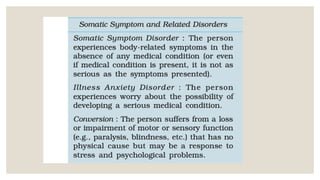
◦ These include
1. conversion disorders
2. somatic symptom disorder
3. illness anxiety disorder
4. Somatic Symptom
and Related Disorders
1. Conversion Disorder
◦ The symptoms of conversion disorders are the reported loss of part or all of some basic body
functions.
◦ Paralysis, blindness, deafness and difficulty in walking are generally among the symptoms
reported.
◦ These symptoms often occur after a stressful experience and may be quite sudden.
2. Somatic symptom disorder
◦ Involves a person having persistent body-related symptoms which may or may not be related to
any serious medical condition.
◦ People with this disorder tend to be overly preoccupied with their symptoms and they
continually worry about their health and make frequent visits to doctors.
4. Somatic Symptom and Related
Disorders
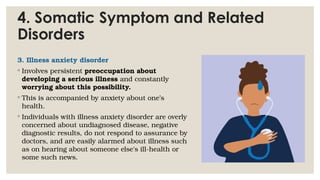
3. Illness anxiety disorder
◦ Involves persistent preoccupation about
developing a serious illness and constantly
worrying about this possibility.
◦ This is accompanied by anxiety about one’s
health.
◦ Individuals with illness anxiety disorder are overly
concerned about undiagnosed disease, negative
diagnostic results, do not respond to assurance by
doctors, and are easily alarmed about illness such
as on hearing about someone else's ill-health or
some such news.
4. Somatic Symptom
and Related Disorders
◦ Both somatic symptom disorder and illness anxiety
disorder are concerned with medical illnesses.
◦ But, the difference lies in the way this concern is
expressed.
◦ In the case of somatic symptom disorder, this
expression is in terms of physical complaints
◦ In case of illness anxiety disorder, as the name
suggests, it is the anxiety which is the main
concern.
IMPORTANT
5.
Dissociati
ve
Disorders
◦ Dissociation can be viewed as severance of
the connections between ideas and emotions.
◦ Dissociation involves feelings of unreality,
estrangement, depersonalisation, and
sometimes a loss or shift of identity.
◦ Sudden temporary alterations of
consciousness that blot out painful
experiences are a defining characteristic of
dissociative disorders.
Conditions included in this are
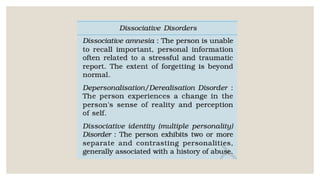
1. Dissociative Amnesia
2. Dissociative Identity Disorder
3. Depersonalisation/Derealisation Disorder
5. Dissociative Disorders
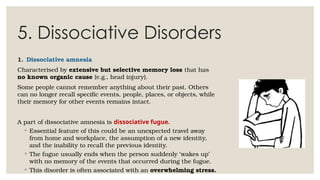
1. Dissociative amnesia
Characterised by extensive but selective memory loss that has
no known organic cause (e.g., head injury).
Some people cannot remember anything about their past. Others
can no longer recall specific events, people, places, or objects, while
their memory for other events remains intact.
A part of dissociative amnesia is dissociative fugue.
◦ Essential feature of this could be an unexpected travel away
from home and workplace, the assumption of a new identity,
and the inability to recall the previous identity.
◦ The fugue usually ends when the person suddenly ‘wakes up’
with no memory of the events that occurred during the fugue.
◦ This disorder is often associated with an overwhelming stress.
5. Dissociative Disorders
2. Dissociative Identity Disorder/Multiple Personality
Disorder
◦ It is the most dramatic of the dissociative disorders.
◦ It is often associated with traumatic experiences in childhood.
◦ In this disorder, the person assumes alternate personalities
that may or may not be aware of each other.
3. Depersonalisation/Derealisation Disorder
◦ It involves a dreamlike state in which the person has a sense
of being separated both from self and from reality.
◦ In depersonalisation, there is a change of self-perception, and
the person’s sense of reality is temporarily lost or changed.
6. Depressive Disorder
Depression
◦ One of the most widely prevalent and recognised of all mental
disorders is depression.
◦ Depression covers a variety of negative moods and behavioural
changes.
◦ Depression can refer to a symptom or a disorder.
◦ In day-to-day life, we often use the term depression to refer to normal
feelings after a significant loss, such as the break-up of a relationship,
or the failure to attain a significant goal.
Major depressive disorder
◦ A period of depressed mood and/or loss of interest or pleasure in
most activities, together with other symptoms which may include
change in body weight, constant sleep problems, tiredness, inability
to think clearly, agitation, greatly slowed behaviour, and thoughts of
6. Depressive Disorder
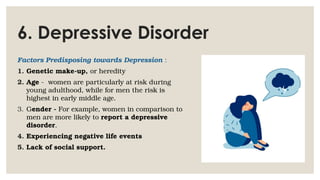
Factors Predisposing towards Depression :
1. Genetic make-up, or heredity
2. Age - women are particularly at risk during
young adulthood, while for men the risk is
highest in early middle age.
3. Gender - For example, women in comparison to
men are more likely to report a depressive
disorder.
4. Experiencing negative life events
5. Lack of social support.
7. Bipolar and Related Disorders
◦ Bipolar I disorder involves both mania and depression,
which are alternately present and sometimes interrupted by
periods of normal mood.
◦ Manic episodes rarely appear by themselves; they usually
alternate with depression.
◦ Bipolar mood disorders were earlier referred to as manic-
depressive disorders.
Some examples of types of bipolar and related disorders
include
1. Bipolar I Disorder
2. Bipolar II disorder
3. Cyclothymic Disorder
7. Bipolar and Related Disorders
SUICIDE
◦ Suicide takes place throughout the lifespan.
◦ Suicide is a result of complex interface of biological, genetic,
psychological, sociological, cultural and environmental factors.
RISK FACTORS OF SUICIDE
◦ Having mental disorders (especially depression and alcohol use
disorders)
◦ going through natural disasters
◦ experiencing violence, abuse or loss and isolation at any stage of
life
◦ Previous suicidal attempt - strongest risk factor.
7. Bipolar and Related Disorders
CAUSE
◦ Suicidal behavior indicates difficulties in problem-
solving, stress management, and emotional expression.
◦ Suicidal thoughts lead to suicidal action only when acting
on these thoughts seems to be the only way out of a
person’s difficulties.
◦ These thoughts are heightened under acute emotional
and other distress.
The ramifications of suicide on social circle and
communities tend to be devastating and long-lasting.
7. Bipolar and Related Disorders
PREVENTION OF SUICIDE
◦ Due to stigma, many people who are contemplating
or even attempting suicide do not seek help thus,
preventing timely help from reaching them.
◦ Therefore improving identification, referral, and
management of behaviour are crucial for
preventing suicide.
◦ Therefore we need to identify vulnerability;
comprehend the circumstances leading to such
behaviour and accordingly plan interventions.
7. Bipolar and Related Disorders
PREVENTION OF SUICIDE
◦ Suicides are preventable.
◦ There is a need for comprehensive multi-sectoral approach where
the government, media and civil society all play important role as
stakeholders.
◦ Some measures suggested by WHO include:
1. Limiting access to the means of suicide
2. reporting of suicide by media in a responsible way;
3. bringing in alcohol-related policies;
4. early identification, treatment and care of people at risk;
5. training health workers in assessing and managing for
suicide;
6. care for people who attempted suicide and providing
community support.
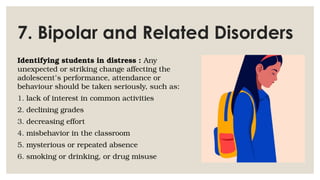
7. Bipolar and Related Disorders
Identifying students in distress : Any
unexpected or striking change affecting the
adolescent’s performance, attendance or
behaviour should be taken seriously, such as:
1. lack of interest in common activities
2. declining grades
3. decreasing effort
4. misbehavior in the classroom
5. mysterious or repeated absence
6. smoking or drinking, or drug misuse
7. Bipolar and Related Disorders
Strengthening students’ self-esteem : Having a positive self-
esteem is important in face of distress and helps in coping
adequately.
Approaches to foster self-esteem in children
1. Accentuating positive life experiences to develop positive
identity. This increases confidence in self.
2. Providing opportunities for development of physical, social
and vocational skills.
3. Establishing a trustful communication
4. Goals for the students should be specific, measurable,
achievable, relevant, to be completed within a relevant time
frame.
8. Schizophrenia and Other Psychotic
Disorders
Schizophrenia is the descriptive term for a group of psychotic disorders in which personal, social
and occupational functioning deteriorate as a result of disturbed thought processes, strange
perceptions, unusual emotional states, and motor abnormalities.
The social and psychological costs of schizophrenia are tremendous, both to patients as well as to
their families and society.
Symptoms of Schizophrenia
The symptoms of schizophrenia can be grouped into three categories
1. positive symptoms (i.e. excesses of thought, emotion, and behaviour)
2. negative symptoms (i.e. deficits of thought, emotion, and behaviour)
3. psychomotor symptoms.
A. POSITIVE SYMPTOMS
Positive symptoms are ‘pathological excesses’ or ‘bizarre additions’ to a person’s
behaviour.
1. Delusions
2. Disorganised thinking and speech
3. Heightened perception and hallucinations
4. Inappropriate affect
A. POSITIVE
SYMPTOMS
1. Delusions
◦ A false belief that is firmly held on inadequate grounds.
◦ It is not affected by rational argument, and has no basis in
reality.
Types of Delusions
1. Delusions of persecution (most common) - They believe
that they are being plotted against, spied on, slandered,
threatened, attacked or deliberately victimised.
2. Delusions of reference- They attach special and personal
meaning to the actions of others or to objects and events.
3. Delusions of grandeur- People believe themselves to be
specially empowered persons
4. Delusions of control- They believe that their feelings,
thoughts and actions are controlled by others.
A. POSITIVE
SYMPTOMS
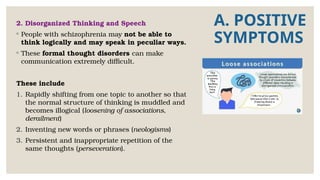
2. Disorganized Thinking and Speech
◦ People with schizophrenia may not be able to
think logically and may speak in peculiar ways.
◦ These formal thought disorders can make
communication extremely difficult.
These include
1. Rapidly shifting from one topic to another so that
the normal structure of thinking is muddled and
becomes illogical (loosening of associations,
derailment)
2. Inventing new words or phrases (neologisms)
3. Persistent and inappropriate repetition of the
same thoughts (perseveration).
A. POSITIVE
SYMPTOMS
3. Hallucinations
◦ Perceptions that occur in the absence of external stimuli.
Types of Hallucinations
◦ Auditory hallucinations (most common) - Patients hear sounds or voices that speak words, phrases
and sentences directly to the patient (second-person hallucination) or talk to one another referring
to the patient as s/he (third-person hallucination).
◦ Tactile hallucinations - i.e. forms of tingling, burning
◦ Somatic hallucinations -i.e. something happening inside the body such as a snake crawling inside
one’s stomach
◦ Visual hallucinations - i.e. vague perceptions of colour or distinct visions of people or objects
◦ Gustatory hallucinations - i.e. food or drink taste strange
◦ Olfactory hallucinations i.e. smell of poison or smoke
4. Inappropriate affect
◦ i.e. emotions that are unsuited to the situation.
B. NEGATIVE
SYMPTOMS
Negative symptoms are ‘pathological deficits’
They include
1. Alogia or poverty of speech- A reduction in speech and speech content.
2. Blunted affect - show less anger, sadness, joy, and other feelings than most
people do
3. Flat affect - show no emotions at all
4. Avolition or apathy - an inability to start or complete a course of action.
5. Social withdrawal- withdraw socially and become totally focused on their
own ideas and fantasies.
C.
PSYCHOMOTOR
SYMPTOMS
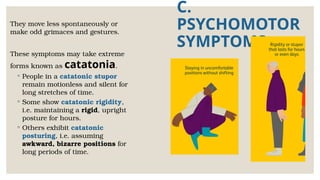
They move less spontaneously or
make odd grimaces and gestures.
These symptoms may take extreme
forms known as catatonia.
◦ People in a catatonic stupor
remain motionless and silent for
long stretches of time.
◦ Some show catatonic rigidity,
i.e. maintaining a rigid, upright
posture for hours.
◦ Others exhibit catatonic
posturing, i.e. assuming
awkward, bizarre positions for
long periods of time.
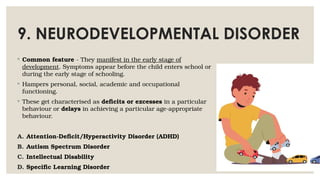
9. NEURODEVELOPMENTAL DISORDER
◦ Common feature - They manifest in the early stage of
development. Symptoms appear before the child enters school or
during the early stage of schooling.
◦ Hampers personal, social, academic and occupational
functioning.
◦ These get characterised as deficits or excesses in a particular
behaviour or delays in achieving a particular age-appropriate
behaviour.
A. Attention-Deficit/Hyperactivity Disorder (ADHD)
B. Autism Spectrum Disorder
C. Intellectual Disability
D. Specific Learning Disorder
A. ADHD
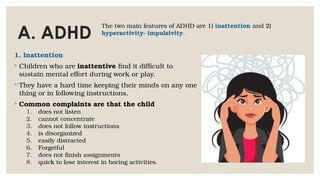
1. Inattention
◦ Children who are inattentive find it difficult to
sustain mental effort during work or play.
◦ They have a hard time keeping their minds on any one
thing or in following instructions.
◦ Common complaints are that the child
1. does not listen
2. cannot concentrate
3. does not follow instructions
4. is disorganized
5. easily distracted
6. Forgetful
7. does not finish assignments
8. quick to lose interest in boring activities.
The two main features of ADHD are 1) inattention and 2)
hyperactivity- impulsivity.
A. ADHD
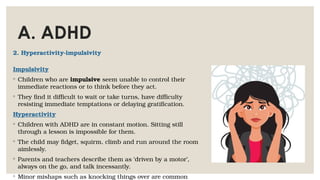
2. Hyperactivity-impulsivity
Impulsivity
◦ Children who are impulsive seem unable to control their
immediate reactions or to think before they act.
◦ They find it difficult to wait or take turns, have difficulty
resisting immediate temptations or delaying gratification.
Hyperactivity
◦ Children with ADHD are in constant motion. Sitting still
through a lesson is impossible for them.
◦ The child may fidget, squirm, climb and run around the room
aimlessly.
◦ Parents and teachers describe them as ‘driven by a motor’,
always on the go, and talk incessantly.
◦ Minor mishaps such as knocking things over are common
B. AUTISM
SPECTRUM
DISORDER
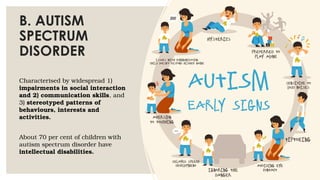
Characterised by widespread 1)
impairments in social interaction
and 2) communication skills, and
3) stereotyped patterns of
behaviours, interests and
activities.
About 70 per cent of children with
autism spectrum disorder have
intellectual disabilities.
1) Impairments in
Communication
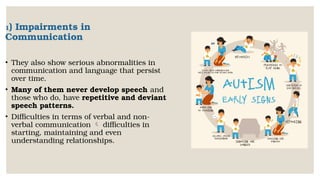
• They also show serious abnormalities in
communication and language that persist
over time.
• Many of them never develop speech and
those who do, have repetitive and deviant
speech patterns.
• Difficulties in terms of verbal and non-
verbal communication  difficulties in
starting, maintaining and even
understanding relationships.
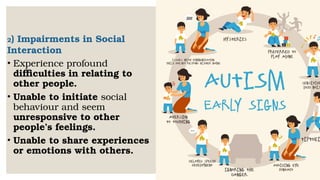
2) Impairments in Social
Interaction
• Experience profound
difficulties in relating to
other people.
• Unable to initiate social
behaviour and seem
unresponsive to other
people’s feelings.
• Unable to share experiences
or emotions with others.
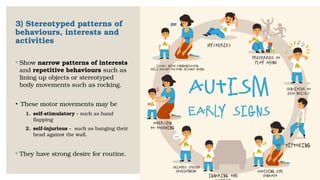
3) Stereotyped patterns of
behaviours, interests and
activities
◦ Show narrow patterns of interests
and repetitive behaviours such as
lining up objects or stereotyped
body movements such as rocking.
• These motor movements may be
1. self-stimulatory - such as hand
flapping
2. self-injurious - such as banging their
head against the wall.
◦ They have strong desire for routine.
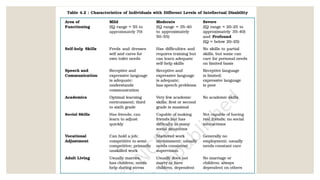
C. INTELLECTUAL DISABILITY
Intellectual disability refers to
1. below average intellectual functioning (with an IQ of approximately 70 or
below)
2. deficits or impairments in adaptive behaviour (i.e. in the areas of
communication, self-care, home living, social/interpersonal skills,
functional academic skills, work, etc.)
3. deficits are manifested before the age of 18 years.
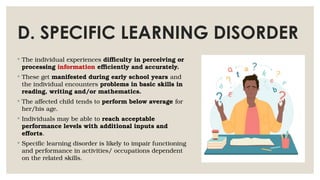
D. SPECIFIC LEARNING DISORDER
◦ The individual experiences difficulty in perceiving or
processing information efficiently and accurately.
◦ These get manifested during early school years and
the individual encounters problems in basic skills in
reading, writing and/or mathematics.
◦ The affected child tends to perform below average for
her/his age.
◦ Individuals may be able to reach acceptable
performance levels with additional inputs and
efforts.
◦ Specific learning disorder is likely to impair functioning
and performance in activities/ occupations dependent
on the related skills.
10. Disruptive, Impulse-
Control and Conduct
Disorders
The disorders included under this category are
Oppositional Defiant Disorder, Conduct Disorder
and others.
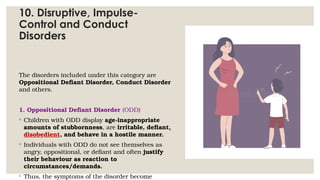
1. Oppositional Defiant Disorder (ODD)
◦ Children with ODD display age-inappropriate
amounts of stubbornness, are irritable, defiant,
disobedient, and behave in a hostile manner.
◦ Individuals with ODD do not see themselves as
angry, oppositional, or defiant and often justify
their behaviour as reaction to
circumstances/demands.
◦ Thus, the symptoms of the disorder become
10. Disruptive, Impulse-Control and Conduct Disorders
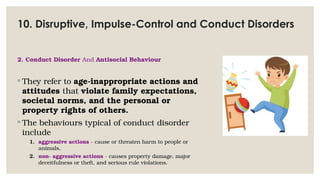
2. Conduct Disorder And Antisocial Behaviour
◦ They refer to age-inappropriate actions and
attitudes that violate family expectations,
societal norms, and the personal or
property rights of others.
◦ The behaviours typical of conduct disorder
include
1. aggressive actions - cause or threaten harm to people or
animals,
2. non- aggressive actions - causes property damage, major
deceitfulness or theft, and serious rule violations.
10. Disruptive, Impulse-Control and Conduct Disorders
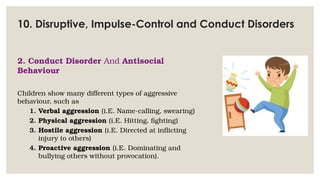
2. Conduct Disorder And Antisocial
Behaviour
Children show many different types of aggressive
behaviour, such as
1. Verbal aggression (i.E. Name-calling, swearing)
2. Physical aggression (i.E. Hitting, fighting)
3. Hostile aggression (i.E. Directed at inflicting
injury to others)
4. Proactive aggression (i.E. Dominating and
bullying others without provocation).
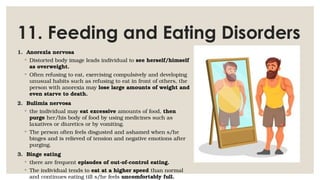
11. Feeding and Eating Disorders
1. Anorexia nervosa
◦ Distorted body image leads individual to see herself/himself
as overweight.
◦ Often refusing to eat, exercising compulsively and developing
unusual habits such as refusing to eat in front of others, the
person with anorexia may lose large amounts of weight and
even starve to death.
2. Bulimia nervosa
◦ the individual may eat excessive amounts of food, then
purge her/his body of food by using medicines such as
laxatives or diuretics or by vomiting.
◦ The person often feels disgusted and ashamed when s/he
binges and is relieved of tension and negative emotions after
purging.
3. Binge eating
◦ there are frequent episodes of out-of-control eating.
◦ The individual tends to eat at a higher speed than normal
and continues eating till s/he feels uncomfortably full.
12. SUBSTANCE RELATED AND
ADDICTIVE DISORDERS
Examples of Addictive behaviour
1. excessive intake of high calorie food resulting in extreme
obesity
2. abuse of substances such as alcohol or cocaine
Substance related and addictive disorders
◦ Disorders relating to maladaptive behaviours resulting from
regular and consistent use of the substance
◦ Include problems associated with the use and abuse of
alcohol, cocaine, tobacco and opiods among others, which
alter the way people think, feel and behave.
Frequently used substances - Alcohol, Heroin, Cocaine
A. Alcohol
◦ People who abuse alcohol drink large amounts regularly and rely
on it to help them face difficult situations.
◦ Drinking interferes with their social behaviour and ability to
think and work.
◦ Their bodies then build up a tolerance for alcohol and they need
to drink even greater amounts to feel its effects.
◦ They also experience withdrawal responses when they stop
drinking.
EFFECTS OF ALCOHOLISM
◦ Destroys millions of families, social relationships and careers.
◦ Intoxicated drivers are responsible for many road accidents.
◦ It also has serious effects on the children of persons with this
disorder. These children have higher rates of psychological
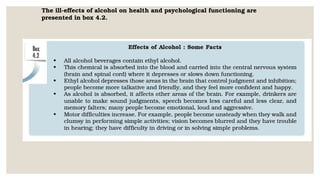
The ill-effects of alcohol on health and psychological functioning are
presented in box 4.2.
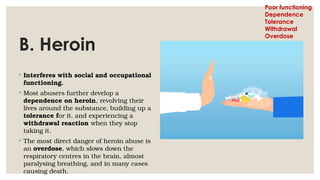
B. Heroin
◦ Interferes with social and occupational
functioning.
◦ Most abusers further develop a
dependence on heroin, revolving their
lives around the substance, building up a
tolerance for it, and experiencing a
withdrawal reaction when they stop
taking it.
◦ The most direct danger of heroin abuse is
an overdose, which slows down the
respiratory centres in the brain, almost
paralysing breathing, and in many cases
causing death.
Poor functioning
Dependence
Tolerance
Withdrawal
Overdose
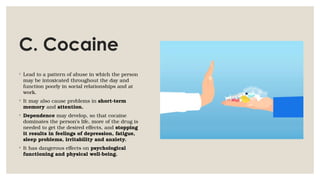
C. Cocaine
◦ Lead to a pattern of abuse in which the person
may be intoxicated throughout the day and
function poorly in social relationships and at
work.
◦ It may also cause problems in short-term
memory and attention.
◦ Dependence may develop, so that cocaine
dominates the person’s life, more of the drug is
needed to get the desired effects, and stopping
it results in feelings of depression, fatigue,
sleep problems, irritability and anxiety.
◦ It has dangerous effects on psychological
functioning and physical well-being.
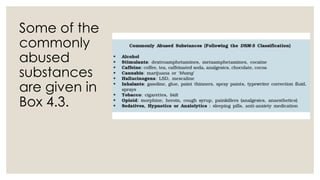
Some of the
commonly
abused
substances
are given in
Box 4.3.
THE END.

Disorders psychological chapter 4 ncert cbse

  • 1.
  • 2.
  • 3.
    Common features ofthe definition of ABNORMALITY - ‘Four Ds ’ Psychological disorder are - 1. Deviance - different, extreme, unusual, even bizarre 2. Distress - unpleasant and upsetting to the person and to others 3. Dysfunction - interfering with the person’s ability to carry out daily activities in a constructive 4. Danger - to the person or to others
  • 4.
    Abnormal ◦ It means“away from the normal” ◦ it implies deviation from some clearly defined norms or standards. Abnormality in Psychology ◦ In psychology, we have no ‘ideal model’ or even ‘normal model’ of human behaviour to use as a base for comparison. ◦ Two basic yet conflicting views of abnormal behaviour in psychology 1. The first approach views abnormal behaviour as a deviation from social norms. 2. The second approach views abnormal behaviour as maladaptive
  • 5.
    1. ABNORMAL BEHAVIORAS A DEVIATION FROM SOCIAL NORMS. ◦ Each society has norms, which are stated or unstated rules for proper conduct. ◦ A society’s norms grow from its culture — its history, values, institutions, habits, skills, technology, and arts. ◦ Behaviours, thoughts and emotions that break societal norms are called abnormal. ◦ Example- a society whose culture values competition and assertiveness may accept aggressive behaviour, whereas one that emphasises cooperation and family values (such as in India) may consider aggressive behaviour as unacceptable or even abnormal. Problems With This View 1. A society’s values may change over time, causing its views of what is psychologically abnormal to change as well. 2. It is based on the assumption that socially accepted behaviour is not abnormal, and that normality is nothing
  • 6.
    2. ABNORMAL BEHAVIOURAS MALADAPTIVE. ◦ Does the behaviour foster the well-being of the individual and the group to which s/he belongs. ◦ Well-being −not simply maintenance and survival but −includes growth and fulfilment, i.e. the actualisation of potential ◦ Conforming behaviour can be seen as abnormal if it is maladaptive, i.e. if it interferes with optimal functioning and growth. ◦ For example, a student in the class prefers to remain silent even when s/he has questions in her/his mind. ◦ Describing behaviour as maladaptive implies that 1) a problem exists; it also suggests that 2) vulnerability in the individual, 3) inability to cope, or 4) exceptional stress in the environment have led to problems in life.
  • 7.
    View Psychological Disordersas any other illness ◦ People have vague ideas about psychological disorders ◦ Their ideas are characterised by superstition, ignorance and fear. ◦ It is commonly believed that psychological disorder is something to be ashamed of. ◦ The stigma attached to mental illness means that people are hesitant to consult a doctor or psychologist because they are ashamed of their problems. Psychological disorder which indicates a failure in adaptation should be viewed as any other illness.
  • 8.
    Historical Backgroud A. Inthe history of western civilisation 1. Supernatural Approach 2. Biological/ Organic Approach 3. Psychological Approach B. In the ancient western world 4. Organismic Approach (Hippocrates, Socrates, Plato, Galen) C. In Middle ages D. The Renaissance Period E. Age of reason and enlightenment F. Interactional/ Bio-psycho-social Approach (present)
  • 9.
    1. Supernatural Approach Abnormalbehaviour can be explained by the operation of supernatural and magical forces such as evil spirits (bhoot- pret), or the devil (shaitan). Exorcism, i.e. removing the evil that resides in the individual through countermagic and prayer, is still commonly used. In many societies, the shaman, or medicine man (ojha) is a person who is believed to have contact with supernatural forces and is the medium through which spirits communicate with human beings. Through the shaman, an afflicted person can learn which spirits are responsible for her/his problems and what needs to be done to appease them. A. In the history of western civilisation
  • 10.
    2. Biological/ OrganicApproach ◦ Individuals behave strangely because their bodies and their brains are not working properly. ◦ Body and brain processes have been linked to many types of maladaptive behaviour. ◦ For certain types of disorders, correcting these defective biological processes results in improved functioning. A. In the history of western civilisation
  • 11.
    3. Psychological Approach According to thispoint of view, psychological problems are caused by inadequacies in the way an individual thinks, feels, or perceives the world. A. In the history of western civilisation
  • 12.
    1. Organismic Approach ◦In the ancient Western world, it was philosopher- physicians of ancient Greece such as Hippocrates, Socrates, and in particular Plato who developed the organismic approach. ◦ They viewed disturbed behaviour as arising out of conflicts between emotion and reason. ◦ Galen’ view on the cause of disorders ◦ He elaborated on the role of the four humours in personal character and temperament. ◦ According to him, the material world was made up of four elements, viz. earth, air, fire, and water which combined to form four essential body fluids, viz. blood, black bile, yellow bile, and phlegm. ◦ Each of these fluids was seen to be responsible for a different temperament. ◦ Imbalances among the humours were believed to cause various disorders. ◦ This is similar to the Indian notion of the three doshas of vata, pitta and kapha which were mentioned in the Atharva Veda and Ayurvedic texts. B. In the ancient western world
  • 13.
    C. In TheMiddle Ages ◦ Demonology and superstition gained renewed importance in the explanation of abnormal behaviour. ◦ Demonology related to a belief that people with mental problems were evil and there are numerous instances of ‘witch-hunts’ during this period. ◦ During the early Middle Ages, the Christian spirit of charity prevailed and St. Augustine wrote extensively about feelings, mental anguish and conflict. ◦ This laid the groundwork for modern psychodynamic theories of abnormal behaviour.
  • 14.
    D. The RenaissancePeriod ◦ The Renaissance Period was marked by increased humanism and curiosity about behaviour. ◦ According to Johann Weyer, psychological conflict and disturbed interpersonal relationships as causes of psychological disorders. ◦ He also insisted that ‘witches’ were mentally disturbed and required medical, not theological, treatment.
  • 15.
    E. Age ofReason and Enlightenment This was in the seventeenth and eighteenth centuries The scientific method replaced faith and dogma as ways of understanding abnormal behaviour. The growth of a scientific attitude towards psychological disorders led to 1. the Reform Movement ◦ Reforms of asylums were initiated in both Europe and America. ◦ One aspect of the reform movement was the new inclination for deinstitutionalisation which placed emphasis on providing community care for recovered mentally ill individuals. 2. Increased compassion for people who suffered from these disorders.
  • 16.
    F. Interactional/ Bio-Psycho- SocialApproach ◦ In recent years, there has been a convergence of these approaches, which has resulted in an interactional, or bio- psycho-social approach. ◦ From this perspective, all three factors, i.e. biological, psychological and social play important roles in influencing the expression and outcome of psychological
  • 17.
  • 18.
    ◦ A classificationof disorders consists of a list of categories of specific psychological disorders grouped into various classes on the basis of some shared characteristics. ◦ Classifications are useful because they enable users like psychologists, psychiatrists and social workers to communicate with each other about the disorder and help in understanding the causes of psychological disorders and the processes involved in their development and maintenance. CLASSIFICATION MANUAL 1. Diagnostic and Statistical Manual of Mental Disorders 5th Edition (DSM-5) - Published by The American Psychiatric Association (APA) - It is an official manual describing and classifying various kinds of psychological disorders. - It presents discrete clinical criteria which indicate the presence or absence of disorders. 2. International Classification of Diseases (ICD-10)/ ICD-10 Classification of Behavioural and Mental Disorders ◦ Prepared by the World Health Organisation (WHO) ◦ The classification scheme officially used in India and elsewhere ◦ For each disorder, a description of the main clinical features or symptoms, and of other associated features including diagnostic guidelines is provided in this scheme.
  • 19.
    Factors Underlying Abnormal Behaviour ◦Psychologists use different approaches to understand abnormal behaviour. ◦ Each approach emphasises a different aspect of human behaviour, and explains and treats abnormality in line with that aspect. ◦ These approaches also emphasise the role of different factors such as 1. Biological 2. Psychological and Interpersonal 3. Socio-cultural (4. Diathesis- stress Model)
  • 20.
    1. Biological Factors ◦Biological factors such as faulty genes, endocrine imbalances, malnutrition, injuries and other conditions may interfere with normal development and functioning of the human body and cause abnormal behaviour ◦ According to the biological model, abnormal behvaiour has a biochemical or physiological basis. ◦ Biological researchers have found that psychological disorders are often related to problems in the transmission of messages from one neuron to another. ◦ A tiny space called synapse separates one neuron from the next, and the message must move across that space. ◦ When an electrical impulse reaches a neuron’s ending, the nerve ending is stimulated to release a chemical, called a neuro- transmitter. ◦ Studies indicate that abnormal activity by certain neuro- transmitters can lead to specific psychological disorders.
  • 21.
    Genetic Factors (BiologicalFactor) ◦ Genetic factors have been linked to bipolar and related disorders, schizophrenia, intellectual disability and other psychological disorders. ◦ No single gene is responsible for a particular behaviour or a psychological disorder. ◦ Many genes combine to help bring about our various behaviours and emotional reactions, both functional and dysfunctional. ◦ Although there is sound evidence to believe that genetic/ biochemical factors are involved in mental disorders as diverse as schizophrenia, depression, anxiety, etc. but biology alone cannot account for most mental disorders.
  • 22.
    2. Psychologic al Factors There areseveral psychological models which provide a psychological explanation of mental disorders. These models maintain that psychological and interpersonal factors cause abnormal behaviour. These factors include 1.maternal deprivation (separation from the mother, or lack of warmth and stimulation during early years of life) 2.faulty parent-child relationships (rejection, overprotection, over-permissiveness, faulty discipline, etc.) 3.maladaptive family structures (inadequate or disturbed family) 4.severe stress. The psychological models include the A.Psychodynamic Model B.Behavioural Model C.Cognitive Model D.Humanistic-existential Model INTERPERSON AL
  • 23.
    A. Psychodynamic Model ◦Behaviour, whether normal or abnormal, is determined by psychological forces within the person of which s/he is not consciously aware. ◦ This model was first formulated by Freud who believed that three central forces shape personality — 1. instinctual needs, drives and impulses (id) 2. rational thinking (ego) 3. moral standards (superego) • These internal forces are considered dynamic, i.e. they interact with one another and their interaction gives shape to behaviour, thoughts and emotions. • Abnormal symptoms are viewed as the result of conflicts between these forces. ◦ Freud stated that abnormal behaviour is a symbolic expression
  • 24.
    B. Behavioural Model ◦ Bothnormal and abnormal behaviours are learned ◦ Psychological disorders are the result of learning maladaptive ways of behaving. ◦ The model concentrates on behaviours that are learned through conditioning and proposes that what has been learned can be unlearned. ◦ Learning of behaviour whether adaptive or maladaptive can take place by 1. classical conditioning - temporal association in which two events repeatedly occur close together in time 2. operant conditioning - behaviour is followed by a reward 3. social learning - learning by imitating others’ behaviour
  • 25.
    C. Cognitive Model Thismodel states that abnormal functioning can result from cognitive problems. 1. People may hold assumptions and attitudes about themselves that are irrational and inaccurate. 2. People may also repeatedly think in illogical ways and make overgeneralisations, that is, they may draw broad, negative conclusions on the basis of a single insignificant event.
  • 26.
    D. Human-existential Model ◦Focuses on broader aspects of human existence. ◦ Humanists believe that human beings are born with a natural tendency to be friendly, cooperative and constructive, and are driven to self-actualise, i.e. to fulfil this potential for goodness and growth. ◦ Existentialists believe that from birth we have total freedom to give meaning to our existence or to avoid that responsibility. ◦ Those who shirk from this responsibility would live empty, inauthentic, and dysfunctional lives.
  • 27.
    3. Socio-cultural Factors Behaviouris shaped by societal forces, factors such as family structure and communication, social networks, societal conditions, and societal labels and roles become more important. 1. Family structure and communication ◦ It has been found that certain family systems are likely to produce abnormal functioning in individual members. ◦ Some families have an enmeshed structure in which the members are overinvolved in each other’s activities, thoughts, and feelings. ◦ Children from this kind of family may have difficulty in becoming independent in life.
  • 28.
    3. Socio-cultural Factors 2.Social Networks ◦ The broader social networks in which people operate include their social and professional relationships. ◦ Studies have shown that people who are isolated and lack social support, i.e. strong and fulfilling interpersonal relationships in their lives are likely to become more depressed and remain depressed longer than those who have good friendships. 3. Societal Labels ◦ Socio-cultural theorists also believe that abnormal functioning is influenced by the societal labels and roles assigned to troubled people. ◦ When people break the norms of their society, they are called deviant and ‘mentally ill’. ◦ Such labels tend to stick so that the person may be viewed as
  • 29.
    E. DIASTHESIS STRESSMODEL ◦ This model has been applied to several disorders including anxiety, depression, and schizophrenia. ◦ This model states that psychological disorders develop when a diathesis (biological predisposition to the disorder) is set off by a stressful situation. ◦ This model has three components. 1. The first is the diathesis or the presence of some biological aberration which may be inherited. 2. The second component is that the diathesis may carry a vulnerability to develop a psychological disorder. This means that the person is ‘at risk’ or ‘predisposed’ to develop the disorder. 3. The third component is the presence of pathogenic stressors, i.e. factors/ stressors that may lead to psychopathology. If such “at risk”
  • 30.
    MAJOR PSYCHOLOGICAL DISORDERS 1. AnxietyDisorders 2. Obsessive Compulsive and Related Disorders 3. Trauma and Stressor Related Disorders 4. Somatic Symptom and Related Disorders 5. Dissociative Disorders 6. Depressive Disorders 7. Bipolar and Related Disorders 8. Schizophrenia Spectrum and Other Psychotic Disorders 9. Neurodevelopmental Disorders 10. Disruptive, Impulse-Control and Conduct Disorders 11. Feeding and Eating Disorders 12. Substance-Related and Addictive Disorders
  • 31.
    1. Anxiety Disorders NormalAnxiety - when we are waiting to take an examination, or to visit a dentist, or even to give a solo performance. It motivates us to do our task well. Anxiety Disorder - High levels of anxiety that are distressing and interfere with effective functioning indicate the presence of an anxiety disorder Definition of anxiety - a diffuse, vague, very unpleasant feeling of fear and apprehension. The anxious individual also shows combinations of the following symptoms: 1. Rapid Heart Rate 2. Shortness Of Breath 3. Diarrhoea 4. Loss Of Appetite 5. Fainting 6. Dizziness 7. Sweating 8. Sleeplessness 9. Frequent Urination 10.Tremors.
  • 32.
    1. Anxiety Disorders There aremany types of anxiety disorders - 1. Generalised Anxiety Disorder 2. Panic Disorder 3. Phobias ◦ Specific Phobias ◦ Social Phobias ◦ Agoraphobia 4. Separation Anxiety Disorder
  • 33.
    1. Anxiety Disorders 2.Panic Disorder ◦ Consists of recurrent anxiety attacks in which the person experiences intense terror. ◦ A panic attack denotes an abrupt surge of intense anxiety rising to a peak when thoughts of a particular stimuli are present. Such thoughts occur in an unpredictable manner. ◦ The clinical features include shortness of breath, dizziness, trembling, palpitations, choking, nausea, chest pain or discomfort, fear of going crazy, losing control or dying. 1. Generalised anxiety disorder • Consists of prolonged, vague, unexplained and intense fears that are not attached to any particular object. • The symptoms include worry and apprehensive feelings about the future; hypervigilance, which involves constantly scanning the environment for dangers. • It is marked by motor tension, as a result of which the person is unable to relax, is restless, and visibly shaky and tense.
  • 34.
    1. Anxiety Disorders 3.Phobias ◦ You might have met or heard of someone who was afraid to travel in a lift or climb to the tenth floor of a building, or refused to enter a room if s/he saw a lizard. You may have also felt it yourself or seen a friend unable to speak a word of a well-memorised and rehearsed speech before an audience. These kinds of fears are termed as phobias. ◦ People who have phobias have irrational fears related to specific objects, people, or situations. ◦ Phobias often develop gradually or begin with a generalised anxiety disorder. Phobias can be grouped into three main types A. Specific Phobias - Includes irrational fears such as intense fear of a certain type of animal, or of being in an enclosed space. B. Social Anxiety Disorder (Social Phobia)- Intense and incapacitating fear and embarrassment when dealing with others C. Agoraphobia - when people develop a fear of entering unfamiliar situations. Many people with agoraphobia are afraid of leaving their home. So their ability to carry out normal life activities is severely limited.
  • 35.
    1. Anxiety Disorders 4.Separation anxiety disorder (SAD) ◦ Individuals with separation anxiety disorder are fearful and anxious about separation from attachment figures to an extent that is developmentally not appropriate. ◦ Children with SAD may have difficulty being in a room by themselves, going to school alone, are fearful of entering new situations, and cling to and shadow their parents’ every move. ◦ To avoid separation, children with SAD may fuss, scream, throw severe tantrums, or make suicidal gestures
  • 37.
    2. Obsessive-Compulsive andRelated Disorders Have you ever noticed someone washing their hands everytime they touch something, or washing even things like coins, or stepping only within the patterns on the floor or road while walking? ◦ Obsessive- compulsive disorder – People are unable to control their preoccupation with specific ideas or are unable to prevent themselves from repeatedly carrying out a particular act or series of acts that affect their ability to carry out normal activities. ◦ Obsessive behaviour - The inability to stop thinking about a particular idea or topic. The person involved, often finds these thoughts to be unpleasant and shameful. ◦ Compulsive behaviour - The need to perform certain behaviours over and over again. Many compulsions deal with counting, ordering, checking, touching and washing. Other disorders in this category include 1. hoarding disorder
  • 38.
    3. Trauma andStress-Related Disorders ◦ Very often people who have been caught in a natural disaster (such as tsunami) or have been victims of bomb blasts by terrorists, or been in a serious accident or in a war-related situation, experience post- traumatic stress disorder (PTSD). ◦ PTSD symptoms vary widely but may include recurrent dreams, flashbacks, impaired concentration, and emotional numbing. ◦ Adjustment Disorders and Acute Stress Disorder are also included under this category.
  • 39.
    4. Somatic Symptom and Related Disorders ◦ These areconditions in which there are physical symptoms in the absence of a physical disease. ◦ In these disorders, the individual has psychological difficulties and complains of physical symptoms, for which there is no biological cause. ◦ These include 1. conversion disorders 2. somatic symptom disorder 3. illness anxiety disorder
  • 40.
    4. Somatic Symptom andRelated Disorders 1. Conversion Disorder ◦ The symptoms of conversion disorders are the reported loss of part or all of some basic body functions. ◦ Paralysis, blindness, deafness and difficulty in walking are generally among the symptoms reported. ◦ These symptoms often occur after a stressful experience and may be quite sudden. 2. Somatic symptom disorder ◦ Involves a person having persistent body-related symptoms which may or may not be related to any serious medical condition. ◦ People with this disorder tend to be overly preoccupied with their symptoms and they continually worry about their health and make frequent visits to doctors.
  • 41.
    4. Somatic Symptomand Related Disorders 3. Illness anxiety disorder ◦ Involves persistent preoccupation about developing a serious illness and constantly worrying about this possibility. ◦ This is accompanied by anxiety about one’s health. ◦ Individuals with illness anxiety disorder are overly concerned about undiagnosed disease, negative diagnostic results, do not respond to assurance by doctors, and are easily alarmed about illness such as on hearing about someone else's ill-health or some such news.
  • 42.
    4. Somatic Symptom andRelated Disorders ◦ Both somatic symptom disorder and illness anxiety disorder are concerned with medical illnesses. ◦ But, the difference lies in the way this concern is expressed. ◦ In the case of somatic symptom disorder, this expression is in terms of physical complaints ◦ In case of illness anxiety disorder, as the name suggests, it is the anxiety which is the main concern. IMPORTANT
  • 44.
    5. Dissociati ve Disorders ◦ Dissociation canbe viewed as severance of the connections between ideas and emotions. ◦ Dissociation involves feelings of unreality, estrangement, depersonalisation, and sometimes a loss or shift of identity. ◦ Sudden temporary alterations of consciousness that blot out painful experiences are a defining characteristic of dissociative disorders. Conditions included in this are 1. Dissociative Amnesia 2. Dissociative Identity Disorder 3. Depersonalisation/Derealisation Disorder
  • 45.
    5. Dissociative Disorders 1.Dissociative amnesia Characterised by extensive but selective memory loss that has no known organic cause (e.g., head injury). Some people cannot remember anything about their past. Others can no longer recall specific events, people, places, or objects, while their memory for other events remains intact. A part of dissociative amnesia is dissociative fugue. ◦ Essential feature of this could be an unexpected travel away from home and workplace, the assumption of a new identity, and the inability to recall the previous identity. ◦ The fugue usually ends when the person suddenly ‘wakes up’ with no memory of the events that occurred during the fugue. ◦ This disorder is often associated with an overwhelming stress.
  • 46.
    5. Dissociative Disorders 2.Dissociative Identity Disorder/Multiple Personality Disorder ◦ It is the most dramatic of the dissociative disorders. ◦ It is often associated with traumatic experiences in childhood. ◦ In this disorder, the person assumes alternate personalities that may or may not be aware of each other. 3. Depersonalisation/Derealisation Disorder ◦ It involves a dreamlike state in which the person has a sense of being separated both from self and from reality. ◦ In depersonalisation, there is a change of self-perception, and the person’s sense of reality is temporarily lost or changed.
  • 48.
    6. Depressive Disorder Depression ◦One of the most widely prevalent and recognised of all mental disorders is depression. ◦ Depression covers a variety of negative moods and behavioural changes. ◦ Depression can refer to a symptom or a disorder. ◦ In day-to-day life, we often use the term depression to refer to normal feelings after a significant loss, such as the break-up of a relationship, or the failure to attain a significant goal. Major depressive disorder ◦ A period of depressed mood and/or loss of interest or pleasure in most activities, together with other symptoms which may include change in body weight, constant sleep problems, tiredness, inability to think clearly, agitation, greatly slowed behaviour, and thoughts of
  • 49.
    6. Depressive Disorder FactorsPredisposing towards Depression : 1. Genetic make-up, or heredity 2. Age - women are particularly at risk during young adulthood, while for men the risk is highest in early middle age. 3. Gender - For example, women in comparison to men are more likely to report a depressive disorder. 4. Experiencing negative life events 5. Lack of social support.
  • 50.
    7. Bipolar andRelated Disorders ◦ Bipolar I disorder involves both mania and depression, which are alternately present and sometimes interrupted by periods of normal mood. ◦ Manic episodes rarely appear by themselves; they usually alternate with depression. ◦ Bipolar mood disorders were earlier referred to as manic- depressive disorders. Some examples of types of bipolar and related disorders include 1. Bipolar I Disorder 2. Bipolar II disorder 3. Cyclothymic Disorder
  • 51.
    7. Bipolar andRelated Disorders SUICIDE ◦ Suicide takes place throughout the lifespan. ◦ Suicide is a result of complex interface of biological, genetic, psychological, sociological, cultural and environmental factors. RISK FACTORS OF SUICIDE ◦ Having mental disorders (especially depression and alcohol use disorders) ◦ going through natural disasters ◦ experiencing violence, abuse or loss and isolation at any stage of life ◦ Previous suicidal attempt - strongest risk factor.
  • 52.
    7. Bipolar andRelated Disorders CAUSE ◦ Suicidal behavior indicates difficulties in problem- solving, stress management, and emotional expression. ◦ Suicidal thoughts lead to suicidal action only when acting on these thoughts seems to be the only way out of a person’s difficulties. ◦ These thoughts are heightened under acute emotional and other distress. The ramifications of suicide on social circle and communities tend to be devastating and long-lasting.
  • 53.
    7. Bipolar andRelated Disorders PREVENTION OF SUICIDE ◦ Due to stigma, many people who are contemplating or even attempting suicide do not seek help thus, preventing timely help from reaching them. ◦ Therefore improving identification, referral, and management of behaviour are crucial for preventing suicide. ◦ Therefore we need to identify vulnerability; comprehend the circumstances leading to such behaviour and accordingly plan interventions.
  • 54.
    7. Bipolar andRelated Disorders PREVENTION OF SUICIDE ◦ Suicides are preventable. ◦ There is a need for comprehensive multi-sectoral approach where the government, media and civil society all play important role as stakeholders. ◦ Some measures suggested by WHO include: 1. Limiting access to the means of suicide 2. reporting of suicide by media in a responsible way; 3. bringing in alcohol-related policies; 4. early identification, treatment and care of people at risk; 5. training health workers in assessing and managing for suicide; 6. care for people who attempted suicide and providing community support.
  • 55.
    7. Bipolar andRelated Disorders Identifying students in distress : Any unexpected or striking change affecting the adolescent’s performance, attendance or behaviour should be taken seriously, such as: 1. lack of interest in common activities 2. declining grades 3. decreasing effort 4. misbehavior in the classroom 5. mysterious or repeated absence 6. smoking or drinking, or drug misuse
  • 56.
    7. Bipolar andRelated Disorders Strengthening students’ self-esteem : Having a positive self- esteem is important in face of distress and helps in coping adequately. Approaches to foster self-esteem in children 1. Accentuating positive life experiences to develop positive identity. This increases confidence in self. 2. Providing opportunities for development of physical, social and vocational skills. 3. Establishing a trustful communication 4. Goals for the students should be specific, measurable, achievable, relevant, to be completed within a relevant time frame.
  • 57.
    8. Schizophrenia andOther Psychotic Disorders Schizophrenia is the descriptive term for a group of psychotic disorders in which personal, social and occupational functioning deteriorate as a result of disturbed thought processes, strange perceptions, unusual emotional states, and motor abnormalities. The social and psychological costs of schizophrenia are tremendous, both to patients as well as to their families and society. Symptoms of Schizophrenia The symptoms of schizophrenia can be grouped into three categories 1. positive symptoms (i.e. excesses of thought, emotion, and behaviour) 2. negative symptoms (i.e. deficits of thought, emotion, and behaviour) 3. psychomotor symptoms.
  • 58.
    A. POSITIVE SYMPTOMS Positivesymptoms are ‘pathological excesses’ or ‘bizarre additions’ to a person’s behaviour. 1. Delusions 2. Disorganised thinking and speech 3. Heightened perception and hallucinations 4. Inappropriate affect
  • 59.
    A. POSITIVE SYMPTOMS 1. Delusions ◦A false belief that is firmly held on inadequate grounds. ◦ It is not affected by rational argument, and has no basis in reality. Types of Delusions 1. Delusions of persecution (most common) - They believe that they are being plotted against, spied on, slandered, threatened, attacked or deliberately victimised. 2. Delusions of reference- They attach special and personal meaning to the actions of others or to objects and events. 3. Delusions of grandeur- People believe themselves to be specially empowered persons 4. Delusions of control- They believe that their feelings, thoughts and actions are controlled by others.
  • 60.
    A. POSITIVE SYMPTOMS 2. DisorganizedThinking and Speech ◦ People with schizophrenia may not be able to think logically and may speak in peculiar ways. ◦ These formal thought disorders can make communication extremely difficult. These include 1. Rapidly shifting from one topic to another so that the normal structure of thinking is muddled and becomes illogical (loosening of associations, derailment) 2. Inventing new words or phrases (neologisms) 3. Persistent and inappropriate repetition of the same thoughts (perseveration).
  • 61.
    A. POSITIVE SYMPTOMS 3. Hallucinations ◦Perceptions that occur in the absence of external stimuli. Types of Hallucinations ◦ Auditory hallucinations (most common) - Patients hear sounds or voices that speak words, phrases and sentences directly to the patient (second-person hallucination) or talk to one another referring to the patient as s/he (third-person hallucination). ◦ Tactile hallucinations - i.e. forms of tingling, burning ◦ Somatic hallucinations -i.e. something happening inside the body such as a snake crawling inside one’s stomach ◦ Visual hallucinations - i.e. vague perceptions of colour or distinct visions of people or objects ◦ Gustatory hallucinations - i.e. food or drink taste strange ◦ Olfactory hallucinations i.e. smell of poison or smoke 4. Inappropriate affect ◦ i.e. emotions that are unsuited to the situation.
  • 62.
    B. NEGATIVE SYMPTOMS Negative symptomsare ‘pathological deficits’ They include 1. Alogia or poverty of speech- A reduction in speech and speech content. 2. Blunted affect - show less anger, sadness, joy, and other feelings than most people do 3. Flat affect - show no emotions at all 4. Avolition or apathy - an inability to start or complete a course of action. 5. Social withdrawal- withdraw socially and become totally focused on their own ideas and fantasies.
  • 63.
    C. PSYCHOMOTOR SYMPTOMS They move lessspontaneously or make odd grimaces and gestures. These symptoms may take extreme forms known as catatonia. ◦ People in a catatonic stupor remain motionless and silent for long stretches of time. ◦ Some show catatonic rigidity, i.e. maintaining a rigid, upright posture for hours. ◦ Others exhibit catatonic posturing, i.e. assuming awkward, bizarre positions for long periods of time.
  • 64.
    9. NEURODEVELOPMENTAL DISORDER ◦Common feature - They manifest in the early stage of development. Symptoms appear before the child enters school or during the early stage of schooling. ◦ Hampers personal, social, academic and occupational functioning. ◦ These get characterised as deficits or excesses in a particular behaviour or delays in achieving a particular age-appropriate behaviour. A. Attention-Deficit/Hyperactivity Disorder (ADHD) B. Autism Spectrum Disorder C. Intellectual Disability D. Specific Learning Disorder
  • 65.
    A. ADHD 1. Inattention ◦Children who are inattentive find it difficult to sustain mental effort during work or play. ◦ They have a hard time keeping their minds on any one thing or in following instructions. ◦ Common complaints are that the child 1. does not listen 2. cannot concentrate 3. does not follow instructions 4. is disorganized 5. easily distracted 6. Forgetful 7. does not finish assignments 8. quick to lose interest in boring activities. The two main features of ADHD are 1) inattention and 2) hyperactivity- impulsivity.
  • 66.
    A. ADHD 2. Hyperactivity-impulsivity Impulsivity ◦Children who are impulsive seem unable to control their immediate reactions or to think before they act. ◦ They find it difficult to wait or take turns, have difficulty resisting immediate temptations or delaying gratification. Hyperactivity ◦ Children with ADHD are in constant motion. Sitting still through a lesson is impossible for them. ◦ The child may fidget, squirm, climb and run around the room aimlessly. ◦ Parents and teachers describe them as ‘driven by a motor’, always on the go, and talk incessantly. ◦ Minor mishaps such as knocking things over are common
  • 67.
    B. AUTISM SPECTRUM DISORDER Characterised bywidespread 1) impairments in social interaction and 2) communication skills, and 3) stereotyped patterns of behaviours, interests and activities. About 70 per cent of children with autism spectrum disorder have intellectual disabilities.
  • 68.
    1) Impairments in Communication •They also show serious abnormalities in communication and language that persist over time. • Many of them never develop speech and those who do, have repetitive and deviant speech patterns. • Difficulties in terms of verbal and non- verbal communication  difficulties in starting, maintaining and even understanding relationships.
  • 69.
    2) Impairments inSocial Interaction • Experience profound difficulties in relating to other people. • Unable to initiate social behaviour and seem unresponsive to other people’s feelings. • Unable to share experiences or emotions with others.
  • 70.
    3) Stereotyped patternsof behaviours, interests and activities ◦ Show narrow patterns of interests and repetitive behaviours such as lining up objects or stereotyped body movements such as rocking. • These motor movements may be 1. self-stimulatory - such as hand flapping 2. self-injurious - such as banging their head against the wall. ◦ They have strong desire for routine.
  • 71.
    C. INTELLECTUAL DISABILITY Intellectualdisability refers to 1. below average intellectual functioning (with an IQ of approximately 70 or below) 2. deficits or impairments in adaptive behaviour (i.e. in the areas of communication, self-care, home living, social/interpersonal skills, functional academic skills, work, etc.) 3. deficits are manifested before the age of 18 years.
  • 73.
    D. SPECIFIC LEARNINGDISORDER ◦ The individual experiences difficulty in perceiving or processing information efficiently and accurately. ◦ These get manifested during early school years and the individual encounters problems in basic skills in reading, writing and/or mathematics. ◦ The affected child tends to perform below average for her/his age. ◦ Individuals may be able to reach acceptable performance levels with additional inputs and efforts. ◦ Specific learning disorder is likely to impair functioning and performance in activities/ occupations dependent on the related skills.
  • 74.
    10. Disruptive, Impulse- Controland Conduct Disorders The disorders included under this category are Oppositional Defiant Disorder, Conduct Disorder and others. 1. Oppositional Defiant Disorder (ODD) ◦ Children with ODD display age-inappropriate amounts of stubbornness, are irritable, defiant, disobedient, and behave in a hostile manner. ◦ Individuals with ODD do not see themselves as angry, oppositional, or defiant and often justify their behaviour as reaction to circumstances/demands. ◦ Thus, the symptoms of the disorder become
  • 75.
    10. Disruptive, Impulse-Controland Conduct Disorders 2. Conduct Disorder And Antisocial Behaviour ◦ They refer to age-inappropriate actions and attitudes that violate family expectations, societal norms, and the personal or property rights of others. ◦ The behaviours typical of conduct disorder include 1. aggressive actions - cause or threaten harm to people or animals, 2. non- aggressive actions - causes property damage, major deceitfulness or theft, and serious rule violations.
  • 76.
    10. Disruptive, Impulse-Controland Conduct Disorders 2. Conduct Disorder And Antisocial Behaviour Children show many different types of aggressive behaviour, such as 1. Verbal aggression (i.E. Name-calling, swearing) 2. Physical aggression (i.E. Hitting, fighting) 3. Hostile aggression (i.E. Directed at inflicting injury to others) 4. Proactive aggression (i.E. Dominating and bullying others without provocation).
  • 77.
    11. Feeding andEating Disorders 1. Anorexia nervosa ◦ Distorted body image leads individual to see herself/himself as overweight. ◦ Often refusing to eat, exercising compulsively and developing unusual habits such as refusing to eat in front of others, the person with anorexia may lose large amounts of weight and even starve to death. 2. Bulimia nervosa ◦ the individual may eat excessive amounts of food, then purge her/his body of food by using medicines such as laxatives or diuretics or by vomiting. ◦ The person often feels disgusted and ashamed when s/he binges and is relieved of tension and negative emotions after purging. 3. Binge eating ◦ there are frequent episodes of out-of-control eating. ◦ The individual tends to eat at a higher speed than normal and continues eating till s/he feels uncomfortably full.
  • 78.
    12. SUBSTANCE RELATEDAND ADDICTIVE DISORDERS Examples of Addictive behaviour 1. excessive intake of high calorie food resulting in extreme obesity 2. abuse of substances such as alcohol or cocaine Substance related and addictive disorders ◦ Disorders relating to maladaptive behaviours resulting from regular and consistent use of the substance ◦ Include problems associated with the use and abuse of alcohol, cocaine, tobacco and opiods among others, which alter the way people think, feel and behave. Frequently used substances - Alcohol, Heroin, Cocaine
  • 79.
    A. Alcohol ◦ Peoplewho abuse alcohol drink large amounts regularly and rely on it to help them face difficult situations. ◦ Drinking interferes with their social behaviour and ability to think and work. ◦ Their bodies then build up a tolerance for alcohol and they need to drink even greater amounts to feel its effects. ◦ They also experience withdrawal responses when they stop drinking. EFFECTS OF ALCOHOLISM ◦ Destroys millions of families, social relationships and careers. ◦ Intoxicated drivers are responsible for many road accidents. ◦ It also has serious effects on the children of persons with this disorder. These children have higher rates of psychological
  • 80.
    The ill-effects ofalcohol on health and psychological functioning are presented in box 4.2.
  • 81.
    B. Heroin ◦ Interfereswith social and occupational functioning. ◦ Most abusers further develop a dependence on heroin, revolving their lives around the substance, building up a tolerance for it, and experiencing a withdrawal reaction when they stop taking it. ◦ The most direct danger of heroin abuse is an overdose, which slows down the respiratory centres in the brain, almost paralysing breathing, and in many cases causing death. Poor functioning Dependence Tolerance Withdrawal Overdose
  • 82.
    C. Cocaine ◦ Leadto a pattern of abuse in which the person may be intoxicated throughout the day and function poorly in social relationships and at work. ◦ It may also cause problems in short-term memory and attention. ◦ Dependence may develop, so that cocaine dominates the person’s life, more of the drug is needed to get the desired effects, and stopping it results in feelings of depression, fatigue, sleep problems, irritability and anxiety. ◦ It has dangerous effects on psychological functioning and physical well-being.
  • 83.
  • 84.

Editor's Notes

  • #46 detachment from oneself (depersonalization) or from the environment (derealization).
  • #59  Delusions of persecution: "The neighbors are spying on me and plotting to steal my ideas." Delusions of reference: "The song on the radio is sending me a secret message meant just for me." Delusions of grandeur: "I am the rightful ruler of the world and have superhuman abilities." Delusions of control: "My thoughts and actions are being manipulated by aliens using invisible technology."
  • #60  Loosening of associations (derailment): "I went to the store to buy milk, and the stars are bright tonight, and my shoe is untied." Neologisms: "The blarnitzer in my kitchen makes the best coffee." Perseveration: "I need to wash my hands, I need to wash my hands, I need to wash my hands."
  • #62  Alogia (poverty of speech): When asked about their day, they respond with short answers like "It was okay" without elaborating. Blunted affect: They talk about a significant life event, like a wedding or a funeral, with minimal facial expression and emotional tone. Flat affect: During a conversation about a highly emotional topic, they maintain a completely neutral facial expression and monotone voice. Avolition (apathy): Despite having a list of tasks to do, they spend the entire day sitting on the couch, unable to start any of them. Social withdrawal: They stop participating in social activities and prefer to stay in their room, engaging in solitary activities like reading or daydreaming
  • #67 Impairments in Social Interaction: Example: A child with autism may have difficulty making eye contact, understanding social cues, or engaging in reciprocal conversations. They might not respond to their name being called or may prefer playing alone rather than interacting with peers. Impairments in Communication Skills: Example: An individual with autism might have delayed speech development, use language in atypical ways (e.g., repeating phrases or echolalia), or have difficulty starting and maintaining conversations. Nonverbal communication, such as gestures and facial expressions, may also be limited or unusual. Stereotyped Patterns of Behaviours, Interests, and Activities: Example: A person with autism might engage in repetitive movements like hand-flapping, insist on following specific routines, or have intense, narrow interests (e.g., becoming fixated on a particular topic like trains or maps and talking about it extensively).
  • #70 Self-stimulatory behaviors, often referred to as "stimming," are repetitive movements or sounds that individuals with autism use to self-soothe, regulate sensory input, or express emotions.
  • #74 Has to do with authority figure