HSDPA Overview
HS 
DP 
igh 
peed 
ownlink 
acket 
ccess 
A
HSDPA General Principles 
• HSDPA was introduced in 3GPP Release 5 
• HSDPA is an optional feature in WCDMA RAN 
• HSDPA includes the following key function: 
• Fast link adaptation 
•Fast hybrid ARQ with soft combining 
•Fast channel-dependent scheduling
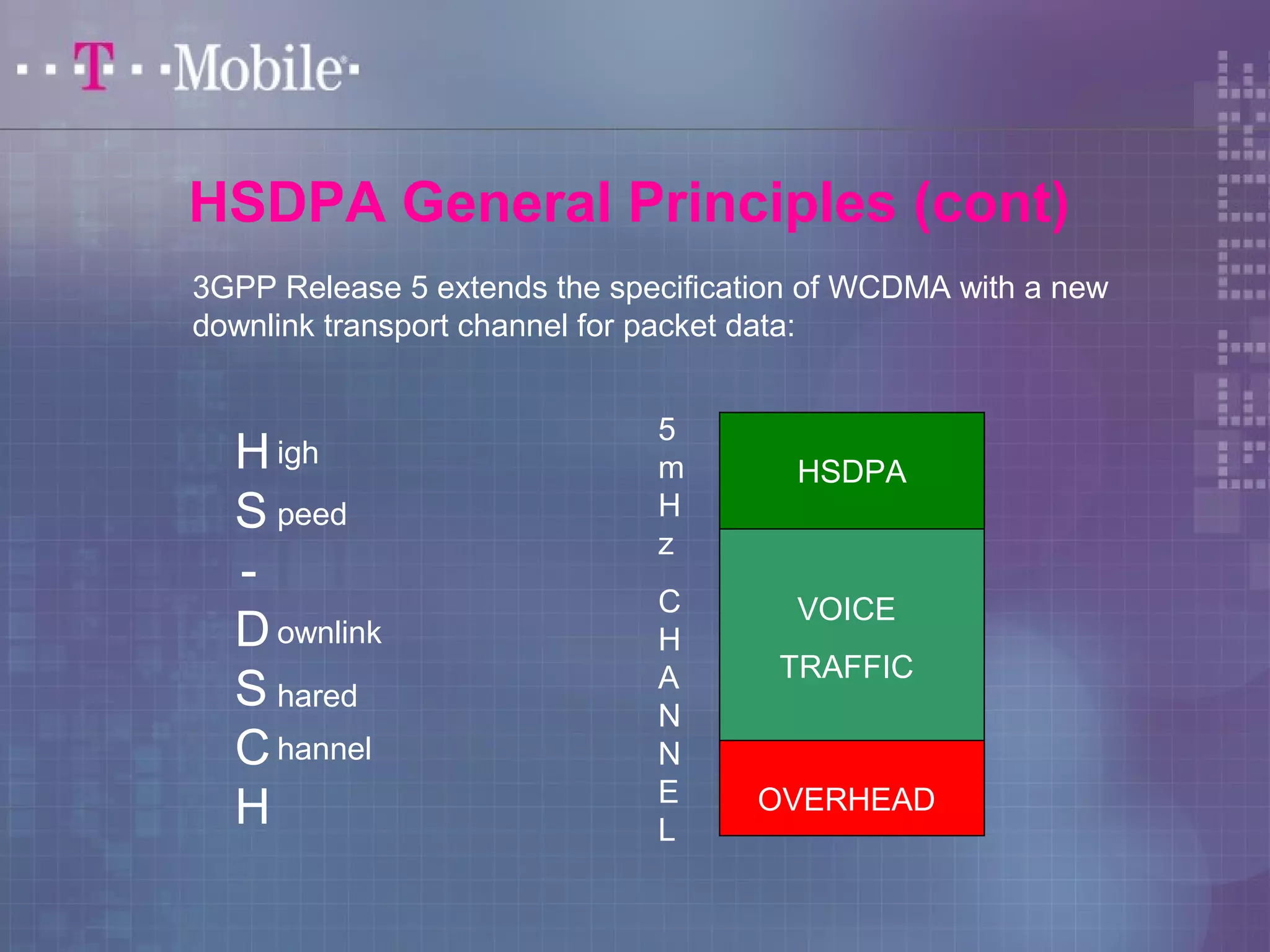
HSDPA General Principles (cont) 
3GPP Release 5 extends the specification of WCDMA with a new 
downlink transport channel for packet data: 
HS-DS 
CH 
igh 
peed 
ownlink 
hared 
hannel 
5 
mHz 
CHA 
NNEL 
UHNSUDSPEAD 
VOICE 
TRAFFIC 
OVERHEAD
Key Functions
Fast link adaptation 
 Fast adjustment ooff ddaattaa rraattee eevveerryy TTTTII((22mmss)) 
 TTrraannssmmiissssiioonn ppoowweerr rreemmaaiinnss ccoonnssttaanntt dduurriinngg aa TTTTII 
 TToo ffuurrtthheerr iinnccrreeaassee ccaappaacciittyy aanndd ddaattaa rraatteess 1166-- 
qquuaaddrraattuurree aammpplliittuuddee mmoodduullaattiioonn ((1166QQAAMM)) mmaayy bbee 
uusseedd
Fast hybrid ARQ with soft combining 
 The UE can rapidly rreeqquueesstt rreettrraannssmmiissssiioonn ooff 
eerrrroonneeoouussllyy rreecceeiivveedd ddaattaa 
 PPrriioorr ttoo ddeeccooddiinngg tthhee UUEE ccoommbbiinneess iinnffoorrmmaattiioonn 
ffrroomm tthhee oorriiggiinnaall ttrraannssmmiissssiioonn wwiitthh tthhaatt ooff llaatteerr 
rreettrraannssmmiissssiioonnss ((ssoofftt ccoommbbiinniinngg))
Fast channel-dependent scheduling 
 The scheduler ddeetteerrmmiinneess tthhee UUEE ttoo wwhhiicchh tthhee 
sshhaarreedd cchhaannnneell ttrraannssmmiissssiioonn iiss ddiirreecctteedd aatt aannyy 
ggiivveenn mmoommeenntt 
 CChhaannnneell--ddeeppeennddeenntt sscchheedduulliinngg mmeeaannss tthhaatt tthhee 
sscchheedduulleerr mmaayy ccoonnssiiddeerr iinnssttaannttaanneeoouuss rraaddiioo 
cchhaannnneell ccoonnddiittiioonnss
To enable fast lliinnkk aaddaappttaattiioonn,, ffaasstt hhyybbrriidd 
AARRQQ,, aanndd ffaasstt sscchheedduulliinngg,, aa nneeww mmeeddiiuumm-- 
aacccceessss ccoonnttrrooll ssuubbllaayyeerr ((MMAACC--hhss)) hhaass 
bbeeeenn ppllaacceedd iinn tthhee RRBBSS.. 
TThhee MMAACC--dd aanndd RRLLCC llaayyeerrss iinn tthhee RRNNCC aarree 
rreettaaiinneedd
Channel Structure
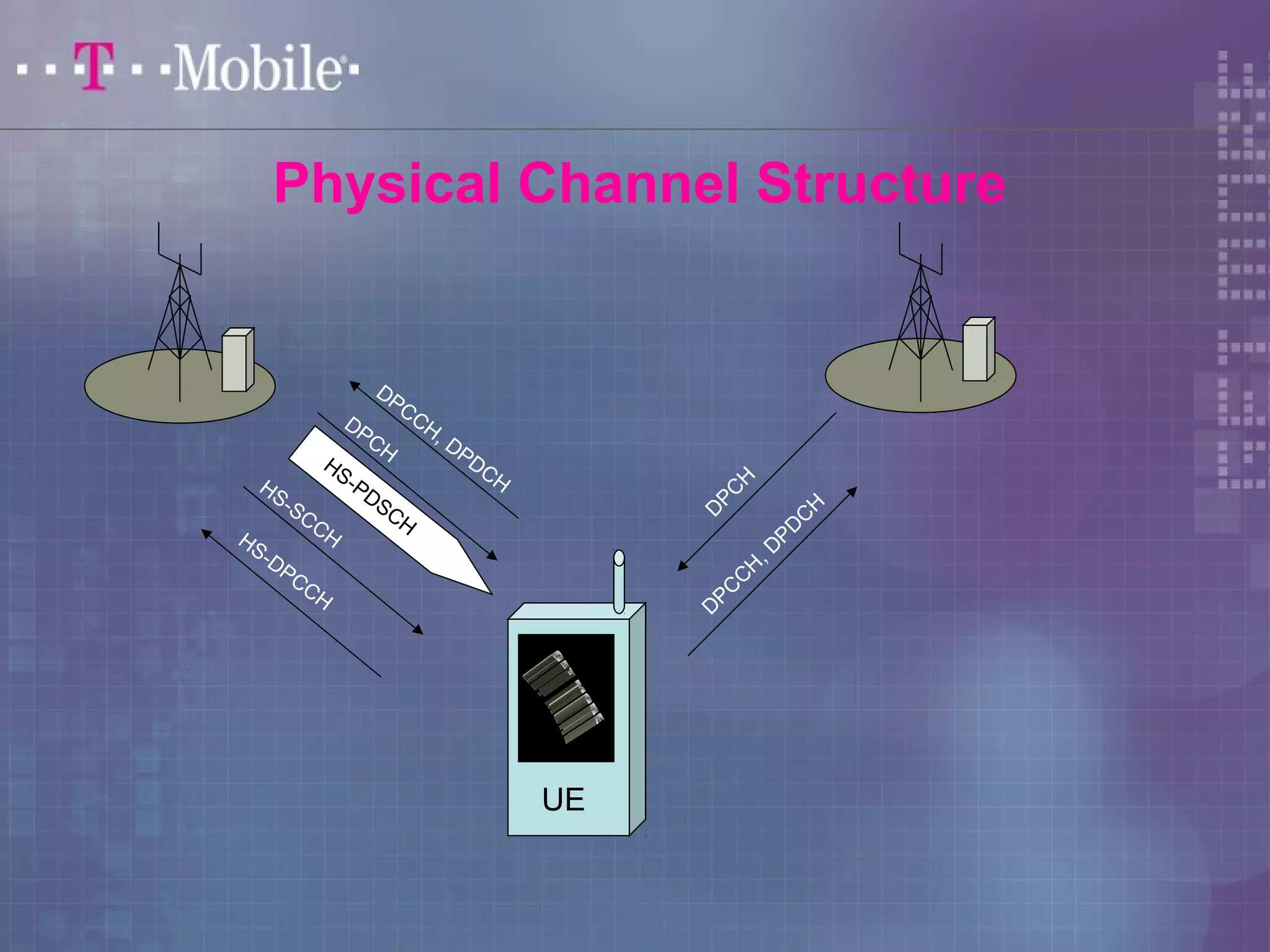
The channels introduced with HSDPA 
share the same carrier as other channels. 
No additional spectrum needs to be 
allocated to introduce HSDPA services. 
The transport channel HS-DSCH is 
mapped on one or several High-Speed 
Physical Downlink Shared Channels (HS-PDSCHs) 
which are simultaneously 
received by the UE.
3GPP standard allows up to 15 HS-PDSCs 
per cell with the spreading factor fixed at 
16. 
In the initial release of UE’s and WCDMA 
RAN, each cell has up to 5 HS-PDSCHs. 
Channelization codes from the shared 
code resource are dynamically allocated 
by the RBS every 2 ms.
Time multiplexing is the primary means of 
sharing common code resources among 
users. 
Code multiplexing is useful for providing 
small payloads or supporting UEs that 
cannot despread the full set of codes when 
the number of codes is high (>5).
The downlink High-Speed Shared Control 
Channel (HS-SCCH) carries control 
information from the MAC-hs in the RBS to 
the scheduled UE. 
In WCDMA RAN, the HS-DSCH is shared 
in the time domain. 
Since only the currently scheduled UE 
needs to receive the HS-SCCH, there is 
only one such channel configured in each 
cell.
An uplink channel, the High Speed 
Dedicated Physical Control Channel (HS-DPCH) 
must be set up for each UE that 
uses high-speed services. 
Channel quality reported by means of CQI 
is used by the scheduling and link 
adaptation functions explained further in 
HSDPA User Plane.
UEs that use high-speed services must 
always have a set of dedicated uplink and 
downlink channels. 
These dedicated channels use soft 
handover while HS-PDSCH and HS-SCCH 
do not.
Physical Channel Structure 
DPCCH, DPDCH 
DPCH 
HS-PDSCH 
HS-SCCH 
HS-DPCCH 
DPCH 
DPCCH, DPDCH 
UE
Iub Flow Control 
There is flow control between the RNC and 
the RBS, explained further in HSDPA User 
Plane. 
Iub flow control handles the trade-off 
between having enough data in the MAC-hs 
buffers to fully utilize the available air 
interface resources and keeping the MAC-hs 
buffers short to decrease the memory 
space.
Scheduling 
The scheduler is part of the MAC-hs in the 
RBS, explained further in HSDPA User 
Plane. 
An increase in capacity can be obtained if 
the scheduler employs channel-dependent 
scheduling (proportional fair scheduling) 
instead of resources sequentially (round-robin 
scheduling).
Scheduling 
As the load of a cell increases, the number 
of UEs queued for scheduling increases. 
This in turn raises the probability of 
scheduling UEs with good channel quality. 
There are two kinds of variations in 
channel quality, short-term and long-term.
For many packet data applications, 
relatively large short-term variation in 
service quality are acceptable, while long-term 
variations must be restricted. 
A practical scheduling strategy utilizes the 
short-term variations and maintains some 
degree of long-term fairness between the 
users.
Scheduling comparison from 
Parsippany Trial
Link Adaptation and 
Higher Order Modulation 
Link adaptation and higher order 
modulation can be combined to maximize 
the instantaneous use of the fading 
channel 
The HS-DSCH adjusts the data rate to 
match the instantaneous radio conditions 
and the available transmission power in 
the RBS.
Link Adaptation and 
Higher Order Modulation 
The system adjusts the data rate by 
varying the effective code rate, changing 
the modulation scheme, and changing the 
number of codes (TFRC selection, see 
HSDPA User Plane) 
Besides QPSK, the HSDSCH can use 
16QAM to provide higher data rates.
Hybrid ARQ with 
Soft Combining 
The hybrid ARQ mechanism allows the UE 
to rapidly request retransmissions of 
erroneously received transport blocks (see 
HSDPA user plane.) 
The UE attempts to decode each transport 
block reporting to the RBS its success or 
failure 5 ms after the reception of the 
transport blocks.
Hybrid ARQ with 
Soft Combining 
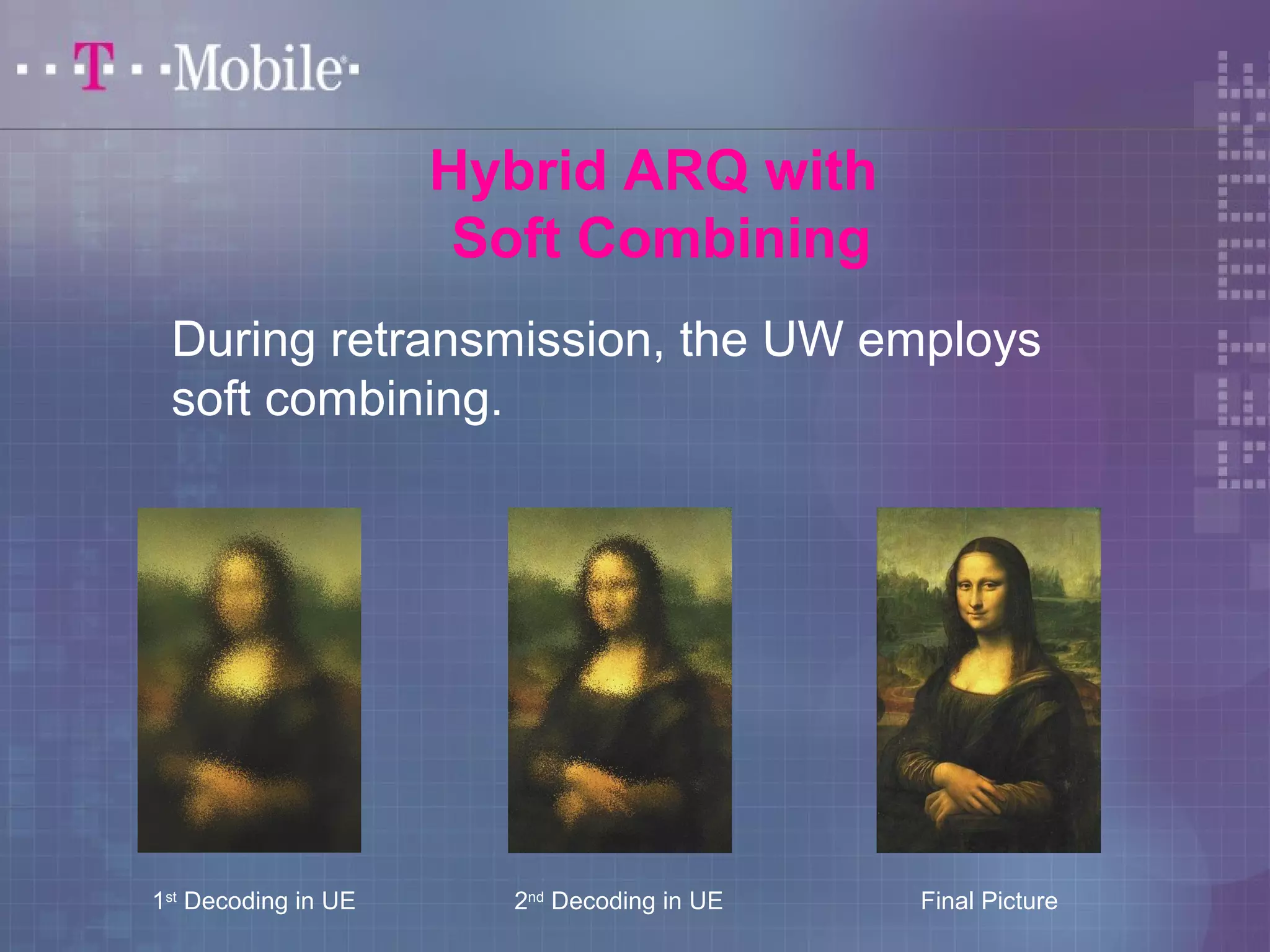
During retransmission, the UW employs 
soft combining. 
1st Decoding in UE 2nd Decoding in UE Final Picture
Hybrid ARQ with 
Soft Combining 
The retransmission may be sent by Chase 
combining or by incremental redundancy. 
Chase combining is used in WCDMA RAN
Hybrid ARQ with 
Soft Combining 
The round-trip time for the MAC-hs 
protocol is about 12 ms, which is longer 
than TTI (2 ms). 
To avoid having to wait for ACK/NACK 
indicator from the UE before the next PDU 
is transmitted, the RBS supports multiple 
hybrid ARQ processes, see HSDPA User 
plane.
Compared with a 3GPP R99 UE, an HS-DSCH- 
enabled UE must contain 
processing capacity for the hybrid ARQ 
operation, multi-code processing, HS-SCCH 
reception, and HS-DPCCH 
signaling. 
User Equipment
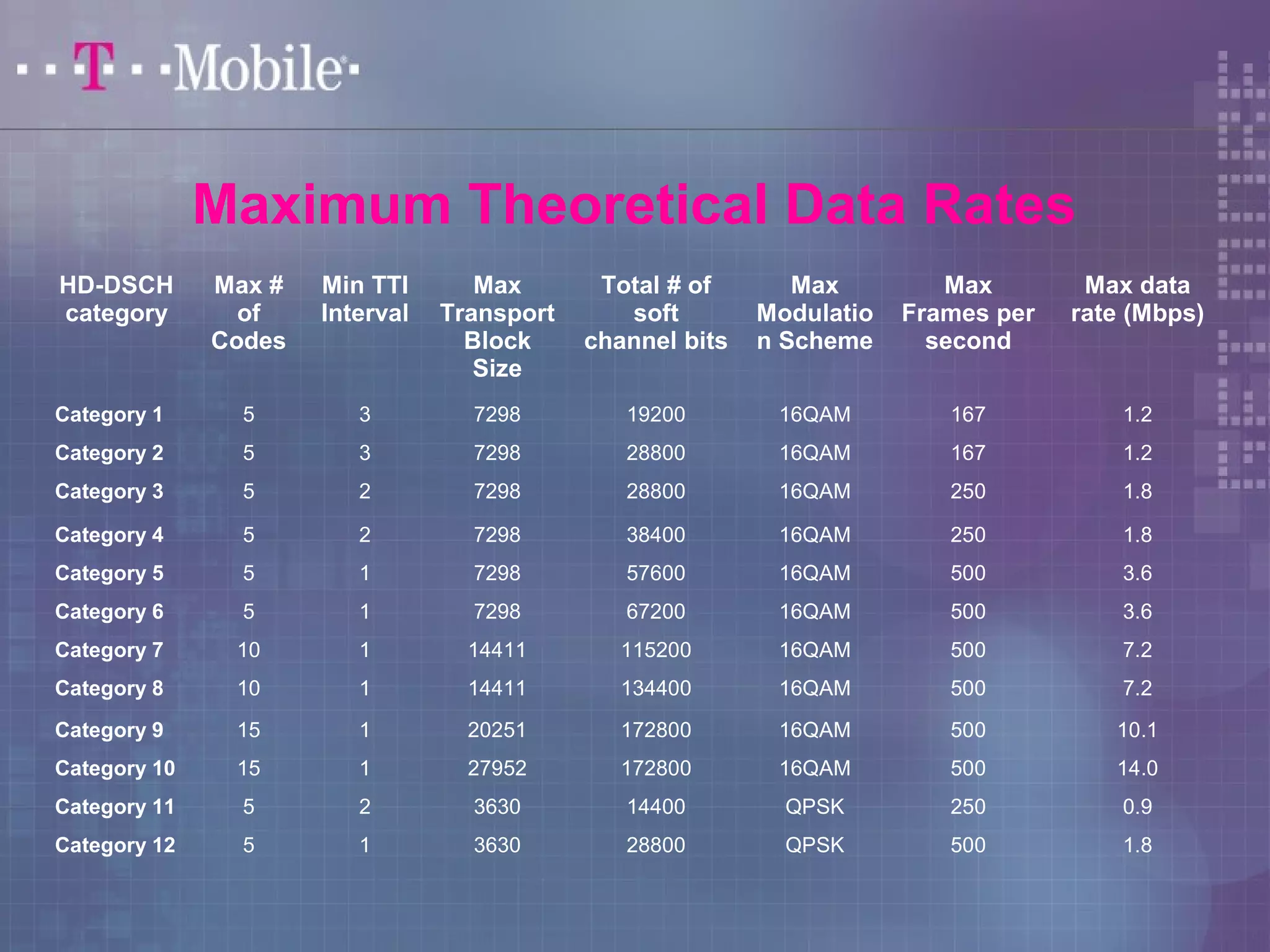
Maximum Theoretical Data Rates 
HD-DSCH 
category 
Max # 
of 
Codes 
Min TTI 
Interval 
Max 
Transport 
Block 
Size 
Total # of 
soft 
channel bits 
Max 
Modulatio 
n Scheme 
Max 
Frames per 
second 
Max data 
rate (Mbps) 
Category 1 5 3 7298 19200 16QAM 167 1.2 
Category 2 5 3 7298 28800 16QAM 167 1.2 
Category 3 5 2 7298 28800 16QAM 250 1.8 
Category 4 5 2 7298 38400 16QAM 250 1.8 
Category 5 5 1 7298 57600 16QAM 500 3.6 
Category 6 5 1 7298 67200 16QAM 500 3.6 
Category 7 10 1 14411 115200 16QAM 500 7.2 
Category 8 10 1 14411 134400 16QAM 500 7.2 
Category 9 15 1 20251 172800 16QAM 500 10.1 
Category 10 15 1 27952 172800 16QAM 500 14.0 
Category 11 5 2 3630 14400 QPSK 250 0.9 
Category 12 5 1 3630 28800 QPSK 500 1.8
Connection Handling and 
Mobility 
In the network it is possible to have cells 
where the HS-DSCH is enabled and other 
cells where it is disabled. Furthermore, 
there are UEs with and without HSDPA 
capability. 
At RAB establishment, the UE makes a 
HS-DSCH cell selection, (see Connection 
Handling)
Connection Handling and 
Mobility 
If the HS-DSCH is disabled in the best cell 
but enabled in a cell that has a coverage 
relation to the best cell and if the UE is 
close enough to the RBS, the connection 
is set up in the latter cell. 
If this feature is not supported or if the HS-DSCH 
is disabled in the best cell, the 
connection is established on an interactive 
DCH.
Connection Handling and 
Mobility 
When a new cell in the active set becomes 
the best cell, or when the current serving 
HS-DSCH cell is to be removed from the 
active set for some reason, the UE makes 
a serving HS-DSCH cell change, (see 
Handover)
Connection Handling and 
Mobility 
The bit rate of the downlink user data 
depends on the HS-DSCH UE category, 
the number of HS=PDSCH codes, and 
whether 16QAM is used. 
Theoretically, the max bit rate is 2.08 
Mbps using QPSK and 4.32 Mbps using 
16QAM for the initial release of UEs and 
WCDMA RAN, (see HSDPA User Plane)
Connection Handling and 
Mobility 
There are two interactive RABs, with 
different uplink rates, that support HS-DSCH. 
An uplink rate of 64 kbps or 384 kbps is 
selected when the RAB is established, 
(see Connection Handling)
Connection Handling and 
Mobility 
There is no channel switching between the 
uplink rates. 
In case of inactivity in the user data 
transmission uplink and downlink, the 
connection is released, (see Channel 
Switching)
Connection Handling and 
Mobility 
The power of the HS-DSCH is give as an 
offset relative the DPCCH; there are 
different values depending on whether or 
not the UE is in soft handover. 
Repetition factors indicate how many 
times the CQI and ACK/NACK indicators 
are transmitted on the HS-DPCCH, (see 
Power Control)
Connection Handling and 
Mobility 
The power of the HS-SCCH is 
configurable and given as an offset 
relative the P-CPICH. 
The ordinary power control of the 
dedicated channels is not affected by the 
introduction of the HS-DSCH.
Capacity Management 
The admission control and congestion 
control functions control the load in the 
WCDMA cell with support from other radio 
network functions, (see Capacity 
Management) 
It is possible to set the load thresholds for 
when the non-HS-DSCH traffic should be 
rejected.
Capacity Management 
If the total load of the cell becomes too 
high, the congestion control is able to 
release radio links in a predetermined 
priority order, to decrease load.
Load Sharing 
The inter-frequency load sharing function 
distributes the call accesses between 
cells, to even out the traffic load between 
cells on different frequencies coverage the 
same area, (see Load Sharing)
Questions and discussion
References 
[1] UE Radio Access Capabilities, 3GPP TS 25.306 
[2] HSDPA Overview WCDMA RAN User Description, Ericsson 91/1553-HSD 101 02/4 Uen A 
[3] Mastering HSDPA, Award Solutions, Inc.
Thank you for your participation!

Hsdpa overview

  • 1.
  • 2.
    HS DP igh peed ownlink acket ccess A
  • 3.
    HSDPA General Principles • HSDPA was introduced in 3GPP Release 5 • HSDPA is an optional feature in WCDMA RAN • HSDPA includes the following key function: • Fast link adaptation •Fast hybrid ARQ with soft combining •Fast channel-dependent scheduling
  • 4.
    HSDPA General Principles(cont) 3GPP Release 5 extends the specification of WCDMA with a new downlink transport channel for packet data: HS-DS CH igh peed ownlink hared hannel 5 mHz CHA NNEL UHNSUDSPEAD VOICE TRAFFIC OVERHEAD
  • 5.
  • 6.
    Fast link adaptation  Fast adjustment ooff ddaattaa rraattee eevveerryy TTTTII((22mmss))  TTrraannssmmiissssiioonn ppoowweerr rreemmaaiinnss ccoonnssttaanntt dduurriinngg aa TTTTII  TToo ffuurrtthheerr iinnccrreeaassee ccaappaacciittyy aanndd ddaattaa rraatteess 1166-- qquuaaddrraattuurree aammpplliittuuddee mmoodduullaattiioonn ((1166QQAAMM)) mmaayy bbee uusseedd
  • 7.
    Fast hybrid ARQwith soft combining  The UE can rapidly rreeqquueesstt rreettrraannssmmiissssiioonn ooff eerrrroonneeoouussllyy rreecceeiivveedd ddaattaa  PPrriioorr ttoo ddeeccooddiinngg tthhee UUEE ccoommbbiinneess iinnffoorrmmaattiioonn ffrroomm tthhee oorriiggiinnaall ttrraannssmmiissssiioonn wwiitthh tthhaatt ooff llaatteerr rreettrraannssmmiissssiioonnss ((ssoofftt ccoommbbiinniinngg))
  • 8.
    Fast channel-dependent scheduling  The scheduler ddeetteerrmmiinneess tthhee UUEE ttoo wwhhiicchh tthhee sshhaarreedd cchhaannnneell ttrraannssmmiissssiioonn iiss ddiirreecctteedd aatt aannyy ggiivveenn mmoommeenntt  CChhaannnneell--ddeeppeennddeenntt sscchheedduulliinngg mmeeaannss tthhaatt tthhee sscchheedduulleerr mmaayy ccoonnssiiddeerr iinnssttaannttaanneeoouuss rraaddiioo cchhaannnneell ccoonnddiittiioonnss
  • 9.
    To enable fastlliinnkk aaddaappttaattiioonn,, ffaasstt hhyybbrriidd AARRQQ,, aanndd ffaasstt sscchheedduulliinngg,, aa nneeww mmeeddiiuumm-- aacccceessss ccoonnttrrooll ssuubbllaayyeerr ((MMAACC--hhss)) hhaass bbeeeenn ppllaacceedd iinn tthhee RRBBSS.. TThhee MMAACC--dd aanndd RRLLCC llaayyeerrss iinn tthhee RRNNCC aarree rreettaaiinneedd
  • 10.
  • 11.
    The channels introducedwith HSDPA share the same carrier as other channels. No additional spectrum needs to be allocated to introduce HSDPA services. The transport channel HS-DSCH is mapped on one or several High-Speed Physical Downlink Shared Channels (HS-PDSCHs) which are simultaneously received by the UE.
  • 12.
    3GPP standard allowsup to 15 HS-PDSCs per cell with the spreading factor fixed at 16. In the initial release of UE’s and WCDMA RAN, each cell has up to 5 HS-PDSCHs. Channelization codes from the shared code resource are dynamically allocated by the RBS every 2 ms.
  • 13.
    Time multiplexing isthe primary means of sharing common code resources among users. Code multiplexing is useful for providing small payloads or supporting UEs that cannot despread the full set of codes when the number of codes is high (>5).
  • 14.
    The downlink High-SpeedShared Control Channel (HS-SCCH) carries control information from the MAC-hs in the RBS to the scheduled UE. In WCDMA RAN, the HS-DSCH is shared in the time domain. Since only the currently scheduled UE needs to receive the HS-SCCH, there is only one such channel configured in each cell.
  • 15.
    An uplink channel,the High Speed Dedicated Physical Control Channel (HS-DPCH) must be set up for each UE that uses high-speed services. Channel quality reported by means of CQI is used by the scheduling and link adaptation functions explained further in HSDPA User Plane.
  • 16.
    UEs that usehigh-speed services must always have a set of dedicated uplink and downlink channels. These dedicated channels use soft handover while HS-PDSCH and HS-SCCH do not.
  • 17.
    Physical Channel Structure DPCCH, DPDCH DPCH HS-PDSCH HS-SCCH HS-DPCCH DPCH DPCCH, DPDCH UE
  • 18.
    Iub Flow Control There is flow control between the RNC and the RBS, explained further in HSDPA User Plane. Iub flow control handles the trade-off between having enough data in the MAC-hs buffers to fully utilize the available air interface resources and keeping the MAC-hs buffers short to decrease the memory space.
  • 19.
    Scheduling The scheduleris part of the MAC-hs in the RBS, explained further in HSDPA User Plane. An increase in capacity can be obtained if the scheduler employs channel-dependent scheduling (proportional fair scheduling) instead of resources sequentially (round-robin scheduling).
  • 20.
    Scheduling As theload of a cell increases, the number of UEs queued for scheduling increases. This in turn raises the probability of scheduling UEs with good channel quality. There are two kinds of variations in channel quality, short-term and long-term.
  • 21.
    For many packetdata applications, relatively large short-term variation in service quality are acceptable, while long-term variations must be restricted. A practical scheduling strategy utilizes the short-term variations and maintains some degree of long-term fairness between the users.
  • 22.
    Scheduling comparison from Parsippany Trial
  • 23.
    Link Adaptation and Higher Order Modulation Link adaptation and higher order modulation can be combined to maximize the instantaneous use of the fading channel The HS-DSCH adjusts the data rate to match the instantaneous radio conditions and the available transmission power in the RBS.
  • 24.
    Link Adaptation and Higher Order Modulation The system adjusts the data rate by varying the effective code rate, changing the modulation scheme, and changing the number of codes (TFRC selection, see HSDPA User Plane) Besides QPSK, the HSDSCH can use 16QAM to provide higher data rates.
  • 25.
    Hybrid ARQ with Soft Combining The hybrid ARQ mechanism allows the UE to rapidly request retransmissions of erroneously received transport blocks (see HSDPA user plane.) The UE attempts to decode each transport block reporting to the RBS its success or failure 5 ms after the reception of the transport blocks.
  • 26.
    Hybrid ARQ with Soft Combining During retransmission, the UW employs soft combining. 1st Decoding in UE 2nd Decoding in UE Final Picture
  • 27.
    Hybrid ARQ with Soft Combining The retransmission may be sent by Chase combining or by incremental redundancy. Chase combining is used in WCDMA RAN
  • 28.
    Hybrid ARQ with Soft Combining The round-trip time for the MAC-hs protocol is about 12 ms, which is longer than TTI (2 ms). To avoid having to wait for ACK/NACK indicator from the UE before the next PDU is transmitted, the RBS supports multiple hybrid ARQ processes, see HSDPA User plane.
  • 29.
    Compared with a3GPP R99 UE, an HS-DSCH- enabled UE must contain processing capacity for the hybrid ARQ operation, multi-code processing, HS-SCCH reception, and HS-DPCCH signaling. User Equipment
  • 30.
    Maximum Theoretical DataRates HD-DSCH category Max # of Codes Min TTI Interval Max Transport Block Size Total # of soft channel bits Max Modulatio n Scheme Max Frames per second Max data rate (Mbps) Category 1 5 3 7298 19200 16QAM 167 1.2 Category 2 5 3 7298 28800 16QAM 167 1.2 Category 3 5 2 7298 28800 16QAM 250 1.8 Category 4 5 2 7298 38400 16QAM 250 1.8 Category 5 5 1 7298 57600 16QAM 500 3.6 Category 6 5 1 7298 67200 16QAM 500 3.6 Category 7 10 1 14411 115200 16QAM 500 7.2 Category 8 10 1 14411 134400 16QAM 500 7.2 Category 9 15 1 20251 172800 16QAM 500 10.1 Category 10 15 1 27952 172800 16QAM 500 14.0 Category 11 5 2 3630 14400 QPSK 250 0.9 Category 12 5 1 3630 28800 QPSK 500 1.8
  • 31.
    Connection Handling and Mobility In the network it is possible to have cells where the HS-DSCH is enabled and other cells where it is disabled. Furthermore, there are UEs with and without HSDPA capability. At RAB establishment, the UE makes a HS-DSCH cell selection, (see Connection Handling)
  • 32.
    Connection Handling and Mobility If the HS-DSCH is disabled in the best cell but enabled in a cell that has a coverage relation to the best cell and if the UE is close enough to the RBS, the connection is set up in the latter cell. If this feature is not supported or if the HS-DSCH is disabled in the best cell, the connection is established on an interactive DCH.
  • 33.
    Connection Handling and Mobility When a new cell in the active set becomes the best cell, or when the current serving HS-DSCH cell is to be removed from the active set for some reason, the UE makes a serving HS-DSCH cell change, (see Handover)
  • 34.
    Connection Handling and Mobility The bit rate of the downlink user data depends on the HS-DSCH UE category, the number of HS=PDSCH codes, and whether 16QAM is used. Theoretically, the max bit rate is 2.08 Mbps using QPSK and 4.32 Mbps using 16QAM for the initial release of UEs and WCDMA RAN, (see HSDPA User Plane)
  • 35.
    Connection Handling and Mobility There are two interactive RABs, with different uplink rates, that support HS-DSCH. An uplink rate of 64 kbps or 384 kbps is selected when the RAB is established, (see Connection Handling)
  • 36.
    Connection Handling and Mobility There is no channel switching between the uplink rates. In case of inactivity in the user data transmission uplink and downlink, the connection is released, (see Channel Switching)
  • 37.
    Connection Handling and Mobility The power of the HS-DSCH is give as an offset relative the DPCCH; there are different values depending on whether or not the UE is in soft handover. Repetition factors indicate how many times the CQI and ACK/NACK indicators are transmitted on the HS-DPCCH, (see Power Control)
  • 38.
    Connection Handling and Mobility The power of the HS-SCCH is configurable and given as an offset relative the P-CPICH. The ordinary power control of the dedicated channels is not affected by the introduction of the HS-DSCH.
  • 39.
    Capacity Management Theadmission control and congestion control functions control the load in the WCDMA cell with support from other radio network functions, (see Capacity Management) It is possible to set the load thresholds for when the non-HS-DSCH traffic should be rejected.
  • 40.
    Capacity Management Ifthe total load of the cell becomes too high, the congestion control is able to release radio links in a predetermined priority order, to decrease load.
  • 41.
    Load Sharing Theinter-frequency load sharing function distributes the call accesses between cells, to even out the traffic load between cells on different frequencies coverage the same area, (see Load Sharing)
  • 42.
  • 43.
    References [1] UERadio Access Capabilities, 3GPP TS 25.306 [2] HSDPA Overview WCDMA RAN User Description, Ericsson 91/1553-HSD 101 02/4 Uen A [3] Mastering HSDPA, Award Solutions, Inc.
  • 44.
    Thank you foryour participation!