TABLE OF CONTENTS
INTRODUCTION...................................................................................................... 3
BROADBAND DEVELOPMENTS ................................................................................ 5
WIRELESS DATA MARKET ....................................................................................... 8
  Trends ................................................................................................................ 8
  EDGE/HSPA Deployment...................................................................................... 11
  Statistics ........................................................................................................... 12
WIRELESS TECHNOLOGY EVOLUTION AND MIGRATION ....................................... 12
  Technical Approaches (TDMA, CDMA, OFDMA) ........................................................ 13
  3GPP Evolutionary Approach ................................................................................ 14
  Spectrum .......................................................................................................... 17
  Core-Network Evolution ....................................................................................... 18
  Service Evolution................................................................................................ 19
  Broadband-Wireless Deployment Considerations ..................................................... 20
  Feature and Network Roadmap............................................................................. 21
COMPETING TECHNOLOGIES ................................................................................ 24
  CDMA2000 ........................................................................................................ 24
  WiMAX .............................................................................................................. 27
  Flash OFDM ....................................................................................................... 30
  IEEE 802.20....................................................................................................... 30
  Wi-Fi and Municipal Wi-Fi Systems ........................................................................ 31
  Market Fit.......................................................................................................... 31
COMPARISON OF WIRELESS TECHNOLOGIES ....................................................... 33
  Data Throughput ................................................................................................ 33
  HSDPA Throughput in Representative Scenarios ...................................................... 36
  Release 99 and HSUPA Uplink Performance ............................................................ 39
  Latency ............................................................................................................. 41
  Spectral Efficiency .............................................................................................. 42
  Cost and Volume Comparison ............................................................................... 47
  Competitive Summary......................................................................................... 49
CONCLUSION........................................................................................................ 50
APPENDIX: TECHNOLOGY DETAILS ...................................................................... 52
  EDGE ................................................................................................................ 52
  Evolved EDGE .................................................................................................... 58
  UMTS/HSPA Technology ...................................................................................... 66
  UMTS Release 99 Data Capabilities........................................................................ 67
  HSDPA .............................................................................................................. 68
  HSUPA .............................................................................................................. 73
  Evolution of HSPA (HSPA+).................................................................................. 74
  HSPA VoIP......................................................................................................... 79
  3GPP LTE .......................................................................................................... 80
  4G and IMT-Advanced ......................................................................................... 83
  UMTS TDD......................................................................................................... 84
  TD-SCDMA ........................................................................................................ 85
  IMS .................................................................................................................. 85
  Broadcast/Multicast Services ................................................................................ 86
  EPS .................................................................................................................. 87
ACRONYMS ........................................................................................................... 89
ADDITIONAL INFORMATION ................................................................................ 93
REFERENCES ........................................................................................................ 93


EDGE, HSPA, LTE: The Mobile Broadband Advantage                                                                   Page 2
Introduction
Universal Mobile Telecommunications System (UMTS) with High Speed Packet Access
(HSPA) technology and its evolution to beyond Third Generation (3G) is becoming the
primary global mobile-broadband solution. Building on the phenomenal success of Global
System for Mobile Communications (GSM), the GSM/UMTS ecosystem is becoming the most
successful communications technology family ever. UMTS/HSPA, in particular, has many key
technical and business advantages over other mobile wireless technologies. Whereas other
wireless technologies show great potential on paper, UMTS has global commercial
deployments that are providing customers mobile-broadband service today.
Operators worldwide are now deploying High Speed Downlink Packet Access (HSDPA), one
of the most powerful cellular-data technologies ever developed. HSDPA, already widely
available, follows the successful deployment of UMTS networks around the world and, for
many of these networks, is a relatively straightforward upgrade. Any operator deploying
UMTS today is doing so with HSDPA. The UMTS-to-HSPDA upgrade is similar to Enhanced
Data Rates for GSM Evolution (EDGE), which has already proven to be a remarkably
effective upgrade to GSM networks, and HSPDA is now supported by an overwhelming
number of operators and vendors worldwide.
High Speed Uplink Packet Access (HSUPA) is poised to follow HSDPA, with the combination
of the two technologies called simply HSPA. HSPA is strongly positioned to be the dominant
mobile-data technology for the rest of the decade. To leverage operator investments in
HSPA, standards bodies are examining a series of enhancements to create “HSPA
Evolution,” also referred to as “HSPA+.” HSPA Evolution represents a logical development of
the Wideband Code Division Multiple Access (WCDMA) approach, and it is the stepping-
stone to an entirely new Third Generation Partnership Project (3GPP) radio platform called
3GPP Long Term Evolution (LTE). LTE, which uses Orthogonal Frequency Division Multiple
Access (OFDMA), should be ready for deployment in the 2009 timeframe. Simultaneously,
standards bodies—recognizing the significant worldwide investments in GSM networks—
have defined enhancements that will significantly increase EDGE data capabilities through
an effort called Evolved EDGE.
Combined with these improvements in radio-access technology, 3GPP has also spearheaded
the development of major core-network architecture enhancements such as the IP
Multimedia Subsystem (IMS) and the Evolved Packet System (EPS) as well as developments
in Fixed Mobile Convergence (FMC). These developments will facilitate new types of
services, the integration of legacy and new networks, the convergence between fixed and
wireless systems, and the transition from circuit-switched approaches for voice traffic to a
fully packet-switched model.
The result is a balanced portfolio of complementary technologies that covers both radio-
access and core networks, provides operators maximum flexibility in how they enhance their
networks over time, and supports both voice and data services.
This paper discusses the evolution of EDGE, HSPA enhancements, 3GPP LTE, the capabilities
of these technologies, and their position relative to other primary competing technologies.
The following are some of the important observations and conclusions of this paper:
       GSM/UMTS has an overwhelming global position in terms of subscribers,
       deployment, and services. Its success will marginalize other wide-area wireless
       technologies.
       GSM/UMTS will comprise the overwhelming majority of subscribers over the next five
       to ten years, even as new wireless technologies are adopted.


EDGE, HSPA, LTE: The Mobile Broadband Advantage                                      Page 3
HSPA Evolution provides a strategic performance roadmap advantage for incumbent
      GSM/UMTS operators. HSPA+ (in 5+5 MHz radio allocations) with 2x2 MIMO,
      successive interference cancellation, and 64 Quadrature Amplitude Modulation (QAM)
      is more spectrally efficient than Worldwide Interoperability for Microwave Access
      (WiMAX) Wave 2 with 2x2 MIMO and Evolved Data Optimized (EV-DO) Revision B.
      LTE specifications are being completed, and the 3GPP OFDMA approach matches or
      exceeds the capabilities of any other OFDMA system.
      The deployment of LTE and its coexistence with UMTS/HSPA will be analogous to the
      deployment of UMTS and its coexistence with GSM.
      OFDMA approaches may provide higher spectral efficiency and higher peak rates.
      However, HSPA+ systems using advanced techniques are expected to nearly match
      the performance of highly optimized OFDMA-based approaches such as LTE in 5+5
      megahertz (MHz) radio allocations.
      WiMAX is maturing and gaining credibility, but it will still only represent a very small
      percentage of wireless subscribers over the next five to ten years. Meanwhile,
      GSM/UMTS operators are much more likely to migrate to LTE.
      The 3GPP roadmap provides operators maximum flexibility in deploying and evolving
      their networks. It is comprised of three avenues: the continued evolution of GSM
      system capabilities, UMTS evolution, and 3GPP LTE. Each of these technologies is
      designed to coexist harmoniously with the others.
      Compared to UMTS/HSPA/LTE, competing technologies have no significant
      deployment cost advantages.
      EDGE technology has proven extremely successful and is widely deployed on GSM
      networks globally. Advanced capabilities with Evolved EDGE will more than quadruple
      current EDGE throughput rates.
      UMTS/HSPA represents tremendous radio innovation and capability, which allows it
      to support a wide range of applications, including simultaneous voice and data on the
      same devices.
      The high spectral efficiency of HSPA for data and WCDMA for voice provides UMTS
      operators an efficient high-capacity network for all services. In the longer term,
      UMTS allows a clean migration to packet-switched voice.
      In current deployments, HSDPA users under favorable conditions regularly
      experience throughput rates well in excess of 1 megabit per second (Mbps). Planned
      HSDPA enhancements will increase these peak user-achievable throughput rates,
      with vendors already measuring in excess of 3 Mbps on some commercial networks.
      HSUPA users under favorable conditions will initially experience peak achievable
      rates in excess of 1 Mbps in the uplink.
      3GPP is developing an LTE technology path with the goal of initially deploying next-
      generation networks in the 2009 timeframe. Peak theoretical rates are 326 Mbps.
      LTE uses OFDMA on the downlink and Single Carrier Frequency Division Multiple
      Access (SC-FDMA) on the uplink.
      With relative ease, operators can transition their UMTS networks to HSDPA/HSUPA
      and, in the future, to HSPA+ and LTE.
      With a UMTS multiradio network, a common core network can efficiently support
      GSM, WCDMA, and HSPA access networks and offer high efficiency for both high and
      low data rates as well as for both high and low traffic density configurations.


EDGE, HSPA, LTE: The Mobile Broadband Advantage                                         Page 4
Meanwhile, EPS provides a new core network that supports both LTE and
       interoperability with legacy GSM/UMTS radio-access networks.
       Various innovations such as EPS and UMTS one-tunnel architecture will “flatten” the
       network, simplifying deployment and reducing latency.
       Voice over Internet Protocol (VoIP) with HSPA will eventually add to voice capacity
       and reduce infrastructure costs. In the meantime, UMTS enjoys high circuit-switched
       voice spectral efficiency, and it can combine voice and data on the same radio
       channel.
       LTE assumes a full Internet Protocol (IP) network architecture, and it is designed to
       support voice in the packet domain.
       Ongoing 3GPP evolution includes significant enhancements with each new
       specification release. Among these enhancements are higher throughput rates,
       enhanced multimedia support, and integration with other types of wireless networks.
This paper begins with an overview of the market, looking at trends, EDGE and UMTS/HSPA
deployment, and market statistics. It then examines the evolution of wireless technology,
particularly 3GPP technologies, including spectrum considerations, core-network evolution,
broadband-wireless deployment considerations, and a feature and network roadmap. Next,
the paper discusses other wireless technologies, including Code Division Multiple Access
2000 (CDMA2000), Ultra Mobile Broadband (UMB), and WiMAX. Finally, it technically
compares the different wireless technologies based on features such as performance and
spectral efficiency.
The appendix explains in detail the capabilities and workings of the different technologies,
including EDGE, Evolved EDGE, WCDMA,1 HSPA, HSPA Evolution, LTE, IMS, and EPS.


Broadband Developments
As wireless technology represents an increasing portion of the global communications
infrastructure, it is important to understand overall broadband trends and the role between
wireless and wireline technologies. Sometimes wireless and wireline technologies compete
with each other, but in most instances they are complementary. For the most part, backhaul
transport and core infrastructure for wireless networks are based on wireline approaches,
whether optical or copper. This applies as readily to Wi-Fi networks as it does to cellular
networks.
Given that the inherent capacity of one fiber optical link exceeds the entire available radio
frequency (RF) spectrum, data flow over wireless links will never represent more than a
small percentage of total global communications traffic. Nevertheless, wireless technology is
playing a profound role in networking and communications, because it provides two
fundamental capabilities: mobility and access. Mobility is communication with geographic
freedom and while in motion. Access is communication services, whether telephony or
Internet, easily provided across geographic areas and often more easily accomplished than
with wireline approaches, especially in greenfield situations where there is little existing
communications infrastructure.
The overwhelming global success of mobile telephony, and now the growing adoption of
mobile data, conclusively demonstrates the desire for mobile-oriented communications.

1
 Although many use the terms “UMTS” and “WCDMA” interchangeably, in this paper we use “WCDMA”
when referring to the radio interface technology used within UMTS and “UMTS” to refer to the
complete system. HSDPA is an enhancement to WCDMA.


EDGE, HSPA, LTE: The Mobile Broadband Advantage                                        Page 5
However, the question of using wireless technology for access is more complex, because the
performance and capacity of wireless technologies relative to wireline approaches, what
wireline infrastructure may already be available, and ongoing developments with wireline
technology must be considered.
Mobile broadband combines the new necessity of high-speed data services with mobility.
Thus, the opportunities are limitless when considering the many diverse markets mobile
broadband can successfully address. In developing countries, there is no doubt that 3G
technology will cater to both enterprises and their high-end mobile workers and consumers,
for whom 3G will be a cost-effective option, competing with digital subscriber line (DSL), for
home use.
In the developed world, users’ desire to be connected anytime, anywhere will be a primary
source of demand. While consumer demand for social and search services such as
Facebook, MySpace, YouTube, Yahoo, and Google increases the demand for mobile-
broadband capabilities, the majority of early adopters are enterprises. Better connectivity
means a business is more efficient. As a result, enterprise broadband-connectivity adoption
is taking on the same “look and feel” as early mobile-phone service adoption. In the early
1990s, doctors, lawyers, sales people, and executives already had home phones, office desk
phones, and even receptionists. However, it was the productivity increases associated with
being connected to a cellular network that accelerated mobile-broadband growth throughout
the world. ABI in August 2007 predicted, “mobile data applications and services used by
business customers will generate over $100 billion of worldwide revenue by 2012. Mobile
data services revenues will become 26 percent of Average Revenue Per User (ARPU) by
2012, a 29 percent compound annual growth rate.” 2
Overall, whether in business or in our personal lives, the world of voice and data is quickly
becoming one that must be untethered, but always connected.
Although it is true that 3G systems are now offering throughputs of about 1 Mbps—which is
comparable to what many users experience with DSL or cable-modem service—the overall
capacity of wireless systems is generally lower than it is with wireline systems. This is
especially true when wireless is compared to optical fiber, which some operators are now
deploying to people’s homes. With wireline operators looking to provide 20 to 100 Mbps to
either people’s homes or businesses via next-generation cable-modem services, very high-
speed DSL (VDSL), or fiber—especially for services such as high-definition IP Television
(IPTV)—the question becomes, is it possible to match these rates using wireless
approaches. The answer is “yes” from a purely technical perspective, but it is “no” from a
practical point of view. It is only possible to achieve these rates by using large amounts of
spectrum, generally more than is available for current 3G systems, and by using relatively
small cell sizes. Otherwise, it simply will not be possible to deliver the hundreds of gigabytes
per month that users will soon be consuming over their broadband connections.
What makes much more sense today is using wireless technology for access only when
there are no good wireline alternatives. Hence, the interest developing countries have in
broadband-wireless technologies. What changes the dynamics of the business model in
these areas is that operators can deploy lower cost, lower capacity voice (which is
inherently low bandwidth) and data services, mostly because of the lack of wireline
offerings. Deploying at lower capacity—as measured by lower bits per second (bps) per
square kilometer—means larger cell sizes, and thus fewer cell sites and much lower
deployment costs.


2
 August 1, 2007 press release from ABI Research on its study “Mobile Business Applications
and Services.”


EDGE, HSPA, LTE: The Mobile Broadband Advantage                                          Page 6
In extremely localized environments, Wi-Fi technology has been hugely successful. It is
simple to deploy, is inexpensive, uses unlicensed bands, provides true broadband
performance, and delivers a clear benefit of untethered networking. This success hints at a
large opportunity for FMC, where the wireless link serves a small local area (such as a
home) and interconnects to a wireline network. Approaches include both Wi-Fi and
femtocells that use operators’ licensed bands. Meanwhile, wireline links in the local area are
best suited for high-speed links such as enterprise-server connections.
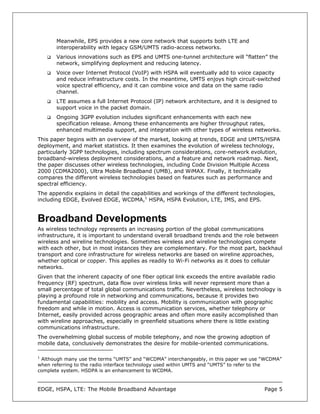
Today’s wireless market winners, as shown in Figure 1, are wireless local-area networks
(WLANs), high-capacity wireline-broadband networks (for example, fiber), lower capacity
mobile-broadband networks (as represented by EDGE, HSPA, and LTE), and medium-
capacity access networks where good wireline options do not exist. Today, the high-capacity
broadband-wireless market remains unproven, despite the fact that some new wireless
technologies—such as WiMAX—are targeting this very market.

     Figure 1: Good and Questionable Uses of Wireless/Wireline Technologies


                                                   Good use
                                   Key
                                              Questionable use


                      Cordless telephony, wireless      Mobile broadband,
                           headsets, Wi-Fi and       EDGE, HSPA, LTE
                       fixed-mobile convergence    Developing countries access
          Wireless
                           Backbone networks,
                                                         Direct competition with
                         e.g., enterprise server
                                                          wireline broadband
                               connections

                           High-capacity links,        Fixed broadband services,
                          e.g., gigabit Ethernet              e.g., IPTV
           Wireline
                              Telephony,
                       mobile computer networks

                               Local Area                      Wide Area

This is not a static situation, however. In the longer term, a number of developments could
make high-capacity broadband-wireless systems more competitive with wireline
approaches. Among these developments are mesh capabilities to reduce deployment costs,
higher spectral efficiency, low-cost commoditized base stations, and future spectrum
allocations for mobile-broadband systems. However, any such future success is somewhat
speculative and dependent on many developments, including technology and broadband
application evolution.
3GPP technologies clearly address proven market needs; hence, their overwhelming
success. The 3GPP roadmap, which anticipates continual performance and capacity
improvements, provides the technical means to deliver on proven business models. As the


EDGE, HSPA, LTE: The Mobile Broadband Advantage                                        Page 7
applications for mobile broadband continue to expand, HSPA, HSPA+, and LTE will continue
to provide a competitive platform for tomorrow’s new business opportunities.


Wireless Data Market
By June 2007, a staggering 2.5 billion subscribers were using GSM/UMTS—fully 37 percent
of the world’s total 6.6 billion population.3 Informa’s World Cellular Information Service
projects over 3 billion GSM/UMTS customers by 2009, with 511 million of these subscribers
using UMTS services.4 3G Americas President Chris Pearson states, “This level of wireless
technology growth exceeds that of almost all other lifestyle-changing innovations.”5 Clearly,
GSM/UMTS has established global dominance. Although voice still constitutes most cellular
traffic, wireless data now exceeds well over 10 percent of ARPU. In the United States,
wireless data is close to 15 percent ARPU for GSM operators. This number could easily
double within three years, and operators across North and South America are confirming
this growth with their reports of rising data ARPU.
This section examines trends and deployment and then provides market data that
demonstrates the rapid growth of wireless data.


      Trends
      Users are adopting wireless data across a wide range of applications, including e-mail,
      game downloads, instant messaging (IM), ringtones, and video. Wireless data in
      enterprise applications like group collaboration, enterprise resource planning (ERP),
      customer relationship management (CRM), and database access is also gaining
      acceptance. The simultaneous adoption by both consumers, for entertainment-related
      services, and businesses, to enhance productivity, increases the return-on-investment
      potential for wireless operators.
      A number of important factors are accelerating the adoption of wireless data. These
      include increased user awareness, innovative feature phones, powerful smartphones,
      and global coverage. But two factors stand out: network capability and applications.
      Technologies such as GSM, WCDMA, and HSPA support a wide range of applications,
      including standard networking applications and those designed for wireless. Meanwhile,
      application and content suppliers are optimizing their offerings, or in many cases
      developing entirely new applications and content, to target the needs and desires of
      mobile users.
      Computing itself is becoming more mobile, and notebook computers and smartphones
      are now prevalent. In fact, all mobile phones are becoming “smart,” with some form of
      data capability, and leading notebook vendors are now offering computers with
      integrated 3G capabilities. Computer manufacturers are also experimenting with new
      form factors, such as ultra-mobile PCs. Lifestyles at home and at work are increasingly
      mobile, with more people traveling more often for business or pleasure or in retirement.
      Meanwhile, the Internet is becoming progressively more intertwined with people’s lives,
      providing communications, social networking, information, enhancements to
      memberships and subscriptions, community involvement, and commerce. Wireless
      access to the Internet in this environment is a powerful catalyst for the creation of new

3
    US Census Bureau
4
    3G Americas press release of June 13, 2006.
5
    3G Americas press release of June 5, 2007.


EDGE, HSPA, LTE: The Mobile Broadband Advantage                                          Page 8
services. It also provides operators and other third-party providers many new business
    opportunities.
    With data constituting a rising percentage of total cellular traffic, it is essential that
    operators deploy spectrally efficient data technologies that meet customer requirements
    for performance—especially because data applications can demand significantly more
    network resources than traditional voice services. Operators have a huge investment in
    spectrum and in their networks; data services must leverage these investments. It is
    only a matter of time before today’s more than 2 billion cellular customers start taking
    full advantage of data capabilities. This adoption will offer tremendous opportunities,
    and their associated risks, to operators as they choose the most commercially viable
    evolution path for migrating their customers. The EDGE/HSPA/LTE evolution paths
    provide data capabilities to address market needs and deliver ever-higher data
    throughputs, lower latency, and increased spectral efficiency.
    Although wireless data has always offered a tantalizing vision of always-connected
    mobile computing, adoption has been slower than that for voice services. In the past
    several years, however, adoption has accelerated thanks to a number of key
    developments. Networks are much more capable, delivering higher throughputs at lower
    cost. Awareness of data capabilities has increased, especially through the pervasive
    success of Short Message Service (SMS), wireless e-mail, downloadable ringtones, and
    downloadable games. Widespread availability of services has also been important. The
    features found in cellular telephones are expanding at a rapid rate and today include
    large color displays, graphics viewers, still cameras, movie cameras, MP3 players, IM
    clients, e-mail clients, Push-to-Talk over Cellular (PoC), downloadable executable
    content capabilities, and browsers that support multiple formats. All these capabilities
    consume data.
    Meanwhile, smartphones, which emphasize a rich computing environment on a phone,
    represent the convergence of the personal digital assistant, a fully capable mobile
    computer, and a phone, all in a device that is only slightly larger than the average
    cellular telephone. Many users would prefer to carry one device that “does it all.”
    Smartphones, originally targeted for the high end of the market, are now available at
    much lower price points and affordable to a much larger market segment. In fact, Berg
    Insight predicted in July 2007 that the global shipments of smartphones running
    advanced operating systems would reach 113 million units by the end of the year.
    Increasing at an average annual compound growth rate of 25.6 percent, shipments are
    forecasted to reach 365 million units by 2012. Smartphones will then account for over
    22 percent of all handsets worldwide, compared to 10 percent today.6 Informa projects
    similar growth, expecting 333 million smartphones sold in 2011.7
    As a consequence, this rich network and device environment is spawning the availability
    of a wide range of wireless applications and content. Because of its growing size—and its
    unassailable potential—application and content developers simply cannot afford to ignore
    this market. And they aren’t. Consumer content developers are already successfully
    providing downloadable ringtones and games. Enabled by 3G network capabilities,
    downloadable and streaming music and video are not far behind. In the enterprise
    space, all the major developers now offer mobilized “wireless-friendly” components for
    their applications. A recent article in Network Computing surveyed major enterprise

6
 Berg Insight, Smartphone Operating Systems,
http://www.berginsight.com/ReportPDF/ProductSheet/BI-SOS-PS.pdf, July 2007
7
  Source: press release, October 17, 2006, on Informa report “Mobile Applications & Operating
Systems: 3rd edition.”


EDGE, HSPA, LTE: The Mobile Broadband Advantage                                                 Page 9
application vendors, including IBM, Oracle, Salesforce.com, SAP, and Sybase, and found
      comprehensive support for mobile platforms from each of these vendors.8
      Acting as catalysts, a wide array of middleware providers are addressing issues such as
      increased security (for example, Virtual Private Networks [VPNs]), switching between
      different networks (for example, WLANs to 3G), session maintenance under adverse
      radio conditions, and policy mechanisms that control application access to networks.
      A number of other powerful catalysts are spurring wireless-data innovation. Pricing for
      unlimited9 usage has declined substantially for both laptop and handset plans, thus
      encouraging greater numbers of users to adopt data services. Operators are seeing
      considerable success with music sales. New services such as video sharing are being
      enabled by IMS, which will also facilitate FMC and seamless communications experiences
      that span cellular and Wi-Fi networks. Meanwhile, users are responding enthusiastically
      to location-based services, banks are letting their account holders manipulate their
      accounts using handheld devices, and users have an increasing number of mobile
      options for real-time travel information and manipulation of that information.
      In the enterprise space, the first stage of wireless technology adoption was essentially to
      replace modem connectivity. The next was to offer existing applications on new
      platforms like smartphones. But the final, and much more important, stage is where
      jobs are reengineered to take full advantage of continuous connectivity. Selective
      tactical adoption of mobile applications such as wireless e-mail is a good starting point
      for many organizations. However, companies that carefully adopt mobile applications in
      a more strategic fashion across multiple business units are finding they can significantly
      increase their competitiveness.
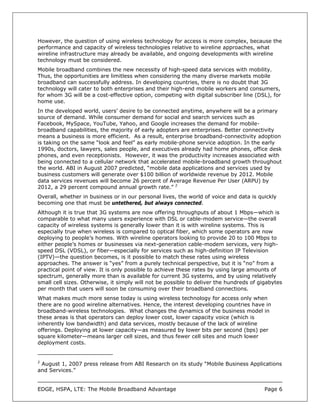
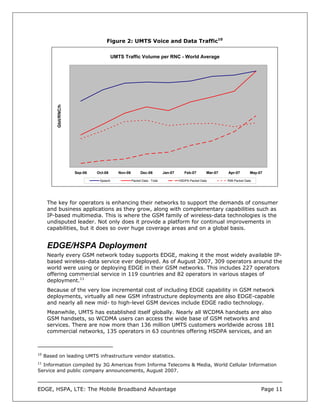
      Based on one leading UMTS infrastructure vendor’s statistics, as shown in Figure 2,
      comparing voice traffic to data traffic shows the growth of wireless data. By May 2007,
      in HSDPA coverage areas on a global basis, the volume of data traffic (indicated in
      gigabit per radio network controller [RNC] per hour) had matched voice traffic.


8
    “Reach Me if You Can,” May 2007, Peter Rysavy, http://www.rysavy.com/papers.html
9
    Typically, some restrictions apply.


EDGE, HSPA, LTE: The Mobile Broadband Advantage                                         Page 10
Figure 2: UMTS Voice and Data Traffic10


          Gbit/RNC/h
                                         UMTS Traffic Volume per RNC - World Average


                       Sep-06   Oct-06      Nov-06         Dec-06          Jan-07      Feb-07       Mar-07   Apr-07        May-07

                                 Speech              Packet Data - Total            HSDPA Packet Data        R99 Packet Data


      The key for operators is enhancing their networks to support the demands of consumer
      and business applications as they grow, along with complementary capabilities such as
      IP-based multimedia. This is where the GSM family of wireless-data technologies is the
      undisputed leader. Not only does it provide a platform for continual improvements in
      capabilities, but it does so over huge coverage areas and on a global basis.


      EDGE/HSPA Deployment
      Nearly every GSM network today supports EDGE, making it the most widely available IP-
      based wireless-data service ever deployed. As of August 2007, 309 operators around the
      world were using or deploying EDGE in their GSM networks. This includes 227 operators
      offering commercial service in 119 countries and 82 operators in various stages of
      deployment.11
      Because of the very low incremental cost of including EDGE capability in GSM network
      deployments, virtually all new GSM infrastructure deployments are also EDGE-capable
      and nearly all new mid- to high-level GSM devices include EDGE radio technology.
      Meanwhile, UMTS has established itself globally. Nearly all WCDMA handsets are also
      GSM handsets, so WCDMA users can access the wide base of GSM networks and
      services. There are now more than 136 million UMTS customers worldwide across 181
      commercial networks, 135 operators in 63 countries offering HSDPA services, and an


10
     Based on leading UMTS infrastructure vendor statistics.
11
  Information compiled by 3G Americas from Informa Telecoms & Media, World Cellular Information
Service and public company announcements, August 2007.


EDGE, HSPA, LTE: The Mobile Broadband Advantage                                                                                 Page 11
additional 75 operators committed to the technology.12 This is a tripling of HSDPA
      deployments in just one year. All UMTS operators will deploy HSDPA for two main
      reasons: the incremental cost of HSDPA is relatively low, and HSDPA makes such
      efficient use of spectrum for data that it results in a much lower overall cost per
      megabyte of data delivered. Already, there are over 300 commercial HSDPA devices
      available worldwide, and this number is quickly growing.


      Statistics
      A variety of statistics shows the growth in wireless data. For example, CTIA reported
      that in 2006 wireless-data service revenues in the United States rose to $15.2 billion, a
      77 percent increase over 2005 revenues of $8.6 billion.13 The number of devices that
      support wireless data has partly fueled that data use. According to a study by the Online
      Publishers Association, 76 percent of all mobile phones are Web-enabled.14 3G is also
      fueling data adoption. ABI Research indicates that 3G service has increased data ARPU
      from 5 to 20 percent.15
      Chetan Sharma Consulting cites similar wireless-data revenue figures to those of CTIA
      and predicts that wireless-data service in the United States will exceed $27 billion in
      2007.16 Sharma states that average data ARPU has climbed 50 percent since 2005, while
      average voice ARPU declined 7 percent in the same timeframe. The result is a 1 percent
      decline in overall ARPU in the United States since 2005. On a global basis, most carriers’
      revenues from wireless data now exceed 10 percent, and operators like KDDI, NTT
      DoCoMo, and O2 UK are exceeding 30 percent.17
      From a device perspective, Informa WCIS in July 2007 projected the following sales of
      WCDMA handsets:
      2007: 173 million
      2008: 278 million
      2009: 392 million
                          18
      2010: 499 million
      It is clear that both EDGE and UMTS/HSDPA are dominant wireless technologies. And
      powerful data capabilities and global presence mean these technologies will likely
      continue to capture most of the available wireless-data market.


Wireless Technology Evolution and Migration
This section discusses the evolution and migration of wireless-data technologies from EDGE
to LTE as well as the evolution of underlying wireless approaches. Progress happens in


12
     “World Cellular Information Service,” Informa Telecoms & Media, August 2007.
13
     Joseph Palenchar, TWICE. April 10, 2007.
14
     Online Publishers Association study, March 8, 2007
15
     “Pressure Intensifies on ARPU.” Rhonda Wickham, Wireless Week. March 1, 2007
16
     “US Wireless Market – 2006 Update.” Chetan Sharma, Chetan Sharma Consulting. March 2007
17
     Ibid.
18
     “World Cellular Information Service,” Informa Telecoms & Media, August 2007.


EDGE, HSPA, LTE: The Mobile Broadband Advantage                                          Page 12
multiple phases, first with EDGE, and then UMTS, followed by evolved 3G capabilities such
as HSDPA, HSUPA, HSPA+, and eventually LTE. Meanwhile, underlying approaches have
evolved from Time Division Multiple Access (TDMA) to CDMA, and now from CDMA to
OFDMA, which is the basis of LTE.


      Technical Approaches (TDMA, CDMA, OFDMA)
      Considerable discussion in the wireless industry has focused on the relative benefits of
      TDMA, CDMA, and, more recently, OFDMA. Many times, one technology or the other is
      positioned as having fundamental advantages over another. However, any of these three
      approaches, when fully optimized, can effectively match the capabilities of any other.
      GSM, which is based on TDMA, is a case in point. Through innovations like frequency
      hopping, the Adaptive Multi Rate (AMR) vocoder for voice, and EDGE for data
      performance optimization, GSM is able to effectively compete with the capacity and data
      throughput of CDMA2000 One Carrier Radio Transmission Technology (1xRTT).
      Despite the evolution of TDMA capabilities, the cellular industry has generally adopted
      CDMA for 3G networking technology. Although there are some significant differences
      between CDMA2000 and WCDMA/HSDPA, such as channel bandwidths and chip rates,
      both technologies use many of the same techniques to achieve roughly the same degree
      of spectral efficiency and expected typical performance. These techniques include
      efficient schedulers, higher order modulation, Turbo codes, and adaptive modulation and
      coding.
      Today, people are asking whether Orthogonal Frequency Division Multiplexing (OFDM)
      and OFDMA19 provide any inherent advantage over TDMA or CDMA. For systems
      employing less than 10 MHz of bandwidth, the answer is largely “no.” Because it
      transmits mutually orthogonal subchannels at a lower symbol rate, the fundamental
      advantage of OFDM is that it elegantly addresses the problem of intersymbol
      interference induced by multipath and greatly simplifies channel equalization. As such,
      OFDM systems, assuming they employ all the other standard techniques for maximizing
      spectral efficiency, may achieve slightly higher spectral efficiency than CDMA systems.
      However, advanced receiver architectures—including options such as practical
      equalization approaches and interference cancellation techniques—are already
      commercially available in chipsets and can nearly match this performance advantage.
      It is with larger bandwidths (10 to 20 MHz), and in combination with advanced antenna
      approaches such as MIMO or Adaptive Antenna Systems (AAS), that OFDM enables less
      computationally complex implementations than those based on CDMA. Hence, OFDM is
      more readily realizable in mobile devices. However, studies have shown that the
      complexity advantage of OFDM may be quite small (that is, less than a factor of two) if
      frequency domain equalizers are used for CDMA-based technologies. Still, the advantage
      of reducing complexity is one reason 3GPP chose OFDM for its LTE project. It is also one
      reason newer WLAN standards, which employ 20 MHz radio channels, are based on
      OFDM. In other words, OFDM is currently a favored approach under consideration for
      radio systems that have extremely high peak rates. OFDM also has an advantage in that
      it can scale easily for different amounts of available bandwidth. This in turn allows OFDM
      to be progressively deployed in available spectrum by using different numbers of
      subcarriers.
      An OFDMA technology such as LTE can also take better advantage of wider radio
      channels (for example, 10 MHz) by not requiring guard bands between radio carriers (for

19
     OFDMA is simply OFDM where the system assigns different subcarriers to different users


EDGE, HSPA, LTE: The Mobile Broadband Advantage                                               Page 13
example, HSPA carriers). In recent years, the ability of OFDM to cope with multipath has
   also made it the technology of choice for the design of Digital Broadcast Systems.
   In 5 MHz of spectrum, as used by UMTS/HSPA, continual advances with CDMA
   technology—realized in HSPA+ through approaches such as equalization, MIMO,
   interference cancellation, and high-order modulation—will allow CDMA to largely match
   OFDMA-based systems.
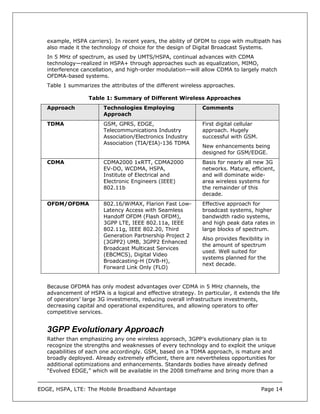
   Table 1 summarizes the attributes of the different wireless approaches.

                   Table 1: Summary of Different Wireless Approaches
   Approach              Technologies Employing                Comments
                         Approach
   TDMA                  GSM, GPRS, EDGE,                      First digital cellular
                         Telecommunications Industry           approach. Hugely
                         Association/Electronics Industry      successful with GSM.
                         Association (TIA/EIA)-136 TDMA
                                                               New enhancements being
                                                               designed for GSM/EDGE.
   CDMA                  CDMA2000 1xRTT, CDMA2000              Basis for nearly all new 3G
                         EV-DO, WCDMA, HSPA,                   networks. Mature, efficient,
                         Institute of Electrical and           and will dominate wide-
                         Electronic Engineers (IEEE)           area wireless systems for
                         802.11b                               the remainder of this
                                                               decade.
   OFDM/OFDMA            802.16/WiMAX, Flarion Fast Low-       Effective approach for
                         Latency Access with Seamless          broadcast systems, higher
                         Handoff OFDM (Flash OFDM),            bandwidth radio systems,
                         3GPP LTE, IEEE 802.11a, IEEE          and high peak data rates in
                         802.11g, IEEE 802.20, Third           large blocks of spectrum.
                         Generation Partnership Project 2
                                                               Also provides flexibility in
                         (3GPP2) UMB, 3GPP2 Enhanced
                                                               the amount of spectrum
                         Broadcast Multicast Services
                                                               used. Well suited for
                         (EBCMCS), Digital Video
                                                               systems planned for the
                         Broadcasting-H (DVB-H),
                                                               next decade.
                         Forward Link Only (FLO)


   Because OFDMA has only modest advantages over CDMA in 5 MHz channels, the
   advancement of HSPA is a logical and effective strategy. In particular, it extends the life
   of operators’ large 3G investments, reducing overall infrastructure investments,
   decreasing capital and operational expenditures, and allowing operators to offer
   competitive services.


   3GPP Evolutionary Approach
   Rather than emphasizing any one wireless approach, 3GPP’s evolutionary plan is to
   recognize the strengths and weaknesses of every technology and to exploit the unique
   capabilities of each one accordingly. GSM, based on a TDMA approach, is mature and
   broadly deployed. Already extremely efficient, there are nevertheless opportunities for
   additional optimizations and enhancements. Standards bodies have already defined
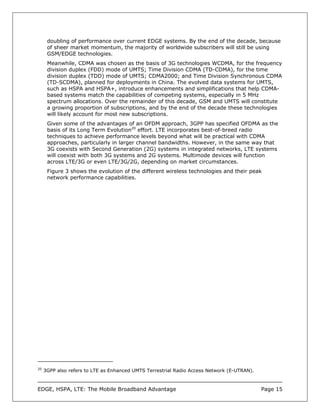
   “Evolved EDGE,” which will be available in the 2008 timeframe and bring more than a


EDGE, HSPA, LTE: The Mobile Broadband Advantage                                         Page 14
doubling of performance over current EDGE systems. By the end of the decade, because
      of sheer market momentum, the majority of worldwide subscribers will still be using
      GSM/EDGE technologies.
      Meanwhile, CDMA was chosen as the basis of 3G technologies WCDMA, for the frequency
      division duplex (FDD) mode of UMTS; Time Division CDMA (TD-CDMA), for the time
      division duplex (TDD) mode of UMTS; CDMA2000; and Time Division Synchronous CDMA
      (TD-SCDMA), planned for deployments in China. The evolved data systems for UMTS,
      such as HSPA and HSPA+, introduce enhancements and simplifications that help CDMA-
      based systems match the capabilities of competing systems, especially in 5 MHz
      spectrum allocations. Over the remainder of this decade, GSM and UMTS will constitute
      a growing proportion of subscriptions, and by the end of the decade these technologies
      will likely account for most new subscriptions.
      Given some of the advantages of an OFDM approach, 3GPP has specified OFDMA as the
      basis of its Long Term Evolution20 effort. LTE incorporates best-of-breed radio
      techniques to achieve performance levels beyond what will be practical with CDMA
      approaches, particularly in larger channel bandwidths. However, in the same way that
      3G coexists with Second Generation (2G) systems in integrated networks, LTE systems
      will coexist with both 3G systems and 2G systems. Multimode devices will function
      across LTE/3G or even LTE/3G/2G, depending on market circumstances.
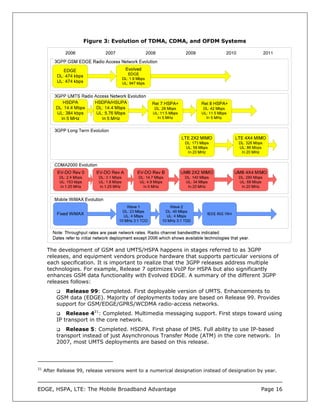
      Figure 3 shows the evolution of the different wireless technologies and their peak
      network performance capabilities.


20
     3GPP also refers to LTE as Enhanced UMTS Terrestrial Radio Access Network (E-UTRAN).


EDGE, HSPA, LTE: The Mobile Broadband Advantage                                             Page 15
Figure 3: Evolution of TDMA, CDMA, and OFDM Systems


      The development of GSM and UMTS/HSPA happens in stages referred to as 3GPP
      releases, and equipment vendors produce hardware that supports particular versions of
      each specification. It is important to realize that the 3GPP releases address multiple
      technologies. For example, Release 7 optimizes VoIP for HSPA but also significantly
      enhances GSM data functionality with Evolved EDGE. A summary of the different 3GPP
      releases follows:
             Release 99: Completed. First deployable version of UMTS. Enhancements to
          GSM data (EDGE). Majority of deployments today are based on Release 99. Provides
          support for GSM/EDGE/GPRS/WCDMA radio-access networks.
              Release 421: Completed. Multimedia messaging support. First steps toward using
          IP transport in the core network.
              Release 5: Completed. HSDPA. First phase of IMS. Full ability to use IP-based
          transport instead of just Asynchronous Transfer Mode (ATM) in the core network. In
          2007, most UMTS deployments are based on this release.


21
     After Release 99, release versions went to a numerical designation instead of designation by year.


EDGE, HSPA, LTE: The Mobile Broadband Advantage                                                 Page 16
Release 6: Completed. HSUPA. Enhanced multimedia support through
      Multimedia Broadcast/Multicast Services (MBMS). Performance specifications for
      advanced receivers. WLAN integration option. IMS enhancements. Initial VoIP
      capability.
          Release 7: Completed. Provides enhanced GSM data functionality with Evolved
      EDGE. Specifies HSPA Evolution (HSPA+), which includes higher order modulation
      and MIMO. Also includes fine-tuning and incremental improvements of features from
      previous releases. Results include performance enhancements, improved spectral
      efficiency, increased capacity, and better resistance to interference. Continuous
      Packet Connectivity (CPC) enables efficient “always-on” service and enhanced uplink
      UL VoIP capacity as well as reductions in call setup delay for PoC. Radio
      enhancements include 64 QAM in the downlink DL and 16 QAM in the uplinks.
         Release 8: Under development. Further HSPA Evolution features such as
      simultaneous use of MIMO and 64 QAM. Specifies OFDMA-based 3GPP LTE. Defines
      EPS, previously called System Architecture Evolution (SAE).
      Whereas operators and vendors actively involved in the development of wireless
      technology are heavily focused on 3GPP release versions, most users of the
      technology are more interested in particular features and capabilities, such as
      whether a device supports HSDPA. For this reason, the detailed discussion of the
      technologies in this paper emphasizes features as opposed to 3GPP releases.


   Spectrum
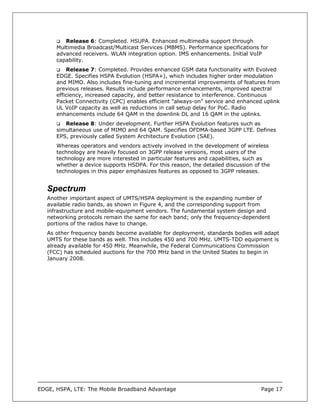
   Another important aspect of UMTS/HSPA deployment is the expanding number of
   available radio bands, as shown in Figure 4, and the corresponding support from
   infrastructure and mobile-equipment vendors. The fundamental system design and
   networking protocols remain the same for each band; only the frequency-dependent
   portions of the radios have to change.
   As other frequency bands become available for deployment, standards bodies will adapt
   UMTS for these bands as well. This includes 450 and 700 MHz. UMTS-TDD equipment is
   already available for 450 MHz. Meanwhile, the Federal Communications Commission
   (FCC) has scheduled auctions for the 700 MHz band in the United States to begin in
   January 2008.


EDGE, HSPA, LTE: The Mobile Broadband Advantage                                   Page 17
Figure 4: Main Bands for UMTS Deployment22

                                    Up to
                      2600         190 MHz New 3G Band
                      2100          2x 60 MHz Mainstream WCDMA band
                      1900          2x 60 MHz U.S. and Am ericas
                 1700/ 2100 2x 45 MHz New 3G band in U.S.
                      1800          2x 75 MHz Europe, Asia, Brazil
                      1700          2x 30 MHz Japan, China
                       900          2x 35 MHz Europe, Asia, Brazil
                   800, 850         2x 25 MHz Am ericas, Japan, Asia
                       700          TBD New band in the U.S.

      Additional bands beyond these are also becoming available for UMTS, including
      frequencies at 1500 and 2300 MHz.
      Different countries have regulated spectrum more loosely than others. For example,
      operators in the United States can use either 2G or 3G technologies in cellular, Personal
      Communications Service (PCS), and 3G bands, whereas in Europe there are greater
      restrictions—though efforts are underway that will likely result in greater flexibility,
      including the use of 3G technologies in current 2G bands.
      With the projected increase in the use of mobile-broadband technologies, the amount of
      spectrum required by the next generation of wireless technology (that is, after 3GPP LTE
      in projects such as International Mobile Telecommunications (IMT) Advanced) could be
      as high as 1 gigahertz (GHz), given the desire to operate radio channels as wide as 100
      MHz. Ideally, this spectrum would fall below 5 GHz. One of the objectives of the World
      Radiocommunication Conference 2007 (WRC-07) is to identify which bands can
      potentially be assigned to these services. This is a long-term undertaking, and it may be
      well into the next decade before any such new spectrum becomes available. However,
      given the expanding size and economic significance of the mobile-computing industry,
      decisions made on new spectrum—especially with respect to global harmonization—will
      have profound consequences.


      Core-Network Evolution
      3GPP is defining a series of enhancements to the core network to improve network
      performance and the range of services provided and to enable a shift to all-IP
      architectures.
      One way to improve core-network performance is by using flatter architectures. The
      more hierarchical a network, the more easily it can be managed centrally; however, the
      tradeoff is reduced performance, especially for data communications, because packets

22
     Source: 3G Americas’ member company.


EDGE, HSPA, LTE: The Mobile Broadband Advantage                                         Page 18
must traverse and be processed by multiple nodes in the network. To improve data
   performance and, in particular, to reduce latency (delays), 3GPP has defined a number
   of enhancements in Release 7 and Release 8 that reduce the number of processing
   nodes and result in a flatter architecture.
   In Release 7, an option called one-tunnel architecture allows operators to configure their
   networks so that user data bypasses a serving node and travels directly via a gateway
   node. There is also an option to integrate the functionality of the radio-network
   controller directly into the base station.
   For Release 8, 3GPP has defined an entirely new core network, called the Evolved Packet
   System. The key features and capabilities of EPS include:
          Reduced latency and higher data performance through a flatter architecture.
          Support for both LTE radio-access networks and interworking with GSM/UMTS
      radio-access networks.
          The ability to integrate non-3GPP networks such as WiMAX.
          Optimization for all services provided via IP.
   This paper provides further details in the sections on HSPA Evolution (HSPA+) and EPS.


   Service Evolution
   Not only do 3GPP technologies provide continual improvements in capacity and data
   performance, they also evolve capabilities that expand the services available to
   subscribers. Key service advances include FMC, IMS, and broadcasting technologies. This
   section provides an overview of these topics, and the appendix provides greater detail
   on each of these items.
   FMC refers to the integration of fixed services (such as telephony provided by wireline or
   Wi-Fi) with mobile cellular-based services. Though FMC is still in its early stages of
   deployment by operators, it promises to provide significant benefits to both users and
   operators. For users, FMC will simplify how they communicate, making it possible for
   them to use one device (for example, a cell phone) at work and at home, where it might
   connect via a Wi-Fi network or a femtocell. When mobile, users connect via a cellular
   network. Users will also benefit from single voice mailboxes and single phone numbers
   as well as the ability to control how and with whom they communicate. For operators,
   FMC allows the consolidation of core services across multiple-access networks. For
   instance, an operator could offer complete VoIP-based voice service that supports access
   via DSL, Wi-Fi, or 3G.
   FMC has various approaches, including enabling technologies such as Unlicensed Mobile
   Access (UMA), femtocells, and IMS. With UMA, GSM/UMTS devices can connect via Wi-Fi
   or cellular connections for both voice and data. UMA is a 3GPP technology, and it has
   been deployed by a number of operators, including T-Mobile in the United States. An
   alternative to using Wi-Fi for the “fixed” portion of FMC is femtocells. These are tiny base
   stations that cost little more than a Wi-Fi access point and, like Wi-Fi, femtocells
   leverage a subscriber's existing wireline-broadband connection (for example, DSL).
   Instead of operating on unlicensed bands, femtocells use the operator’s licensed bands
   at very low power levels. The key advantage of the femtocell approach is that any
   single-mode mobile-communications device a user has can now operate using the
   femtocell.
   IMS is another key technology for convergence. It allows access to core services and
   applications via multiple-access networks. IMS is more powerful than UMA, because it


EDGE, HSPA, LTE: The Mobile Broadband Advantage                                       Page 19
supports not only FMC but also a much broader range of potential applications. In the
      United States, AT&T has committed to an IMS approach and has already deployed an
      IMS-based video sharing service. Though defined by 3GPP, both Third Generation
      Partnership Project 2 (3GPP2) and WiMAX have adopted IMS.
      IMS allows the creative blending of different types of communications and information,
      including voice, video, IM, presence information, location, and documents. It provides
      application developers the ability to create applications that have never before been
      possible, and it allows people to communicate in entirely new ways by dynamically using
      multiple services. For example, during an interactive chat session, a user could launch a
      voice call. Or during a voice call, a user could suddenly establish a simultaneous video
      connection or start transferring files. While browsing the Web, a user could decide to
      speak to a customer-service representative. IMS will be a key platform for all-IP
      architectures for both HSPA and LTE.
      A key milestone in the development of IMS across many platforms was the June 2007
      announcement that 3GPP had agreed on how Common IMS would meet the needs of the
      fixed, mobile, cable, and broadband-wireless communities. A rechartered "Services"
      group (new SA1) of the project will specify the requirements for Common IMS, and
      Common IMS developments will form part of 3GPP Release 8, which is expected to be
      functionally frozen by the end of 2007.23
      Another important new service is support for mobile TV through what is called multicast
      or broadcast functions. 3GPP has defined multicast/broadcast capabilities for both HSPA
      and LTE.


      Broadband-Wireless Deployment Considerations
      Much of the debate in the wireless industry is on the merits of different radio
      technologies, yet other factors are equally important in determining the services and
      capabilities of a wireless network. These factors include the amount of spectrum
      available, backhaul, and network topology.
      Spectrum has always been a major consideration for deploying any wireless network,
      but it is particularly important when looking at high-performance broadband systems.
      HSPA and HSPA+ can deliver high throughput rates on the downlink and uplink with low
      latency in 5 MHz channels when deployed in single frequency (1/1) reuse. By this we
      mean that every cell sector (typically three per cell) in every cell uses the same radio
      channel(s).
      As previously discussed, an OFDMA approach in a 5 MHz radio channel will yield a
      marginal performance advantage. To achieve higher data rates requires wider radio
      channels, such as 10 or 20 MHz wide channels in combination with emerging OFDMA
      radio technologies. However, very few operators today have access to this much
      spectrum. It was challenging enough for GSM operators to obtain UMTS spectrum. If
      delivering very high data rates is the objective, then the system must minimize
      interference. This result is best achieved by employing looser reuse, such as having
      every sector use only one-third of the available radio channels (1/3 reuse). The 10 MHz
      radio channel could now demand as much as 30 MHz of available spectrum.
      Backhaul is another factor. As the throughput of the radio link increases, the circuits
      connecting the cell sites to the core network must be able to handle the increased load.
      With many cell sites today serviced by just a small number of T1 circuits, each able to

23
     Source: Cellular News, http://www.cellular-news.com/story/24389.php, June 18, 2007


EDGE, HSPA, LTE: The Mobile Broadband Advantage                                           Page 20
carry only 1.5 Mbps, operators will have to invest in significant backhaul capacity
   upgrades to obtain the full benefit of next-generation wireless technologies. An OFDMA
   system with 1.5 bps per hertz (Hz) of spectral efficiency in 10 MHz on three sectors has
   up to 45 Mbps average cell throughput.
   Additionally, any technology’s ability to reach its peak spectrum efficiency is somewhat
   contingent on the system’s ability to reach the instantaneous peak data rates allowed by
   that technology. For example, a system claiming spectrum efficiency of 1.5 bps/Hz (as
   described above) might rely on the possibility to reach 100 Mbps instantaneously to
   achieve this level of spectrum efficiency. Any constraint on the transport system below
   100 Mbps will restrict the range of achievable throughput and in turn impact the spectral
   efficiency of the system.
   The mismatch between today’s backhaul capabilities and radio performance is one
   reason that typical user rates on 3G systems are lower than theoretical rates. Operators
   are enhancing their backhaul approaches, and there are many available and emerging
   wireline technologies—such as VDSL and optical Ethernet—as well as competitive point-
   to-point microwave systems that make this possible. But it will take time.
   Finally, the overall network topology also plays an important role, especially with respect
   to latency. Low latency is critical in achieving very high data rates, because of the way it
   affects TCP/IP traffic. How traffic routes through the core network—how many hops and
   nodes it must pass through—can influence the overall performance of the network. One
   way to increase performance is by using flatter architectures, meaning a less
   hierarchical network with more direct routing from mobile device to end system. The
   core EPS network for 3GPP LTE emphasizes such a flatter architecture.
   In summary, it can be misleading to say that one wireless technology outperforms
   another without a full understanding of how that technology will be deployed in a
   complete system that also takes spectrum into account.


   Feature and Network Roadmap
   GSM operators first enhanced their networks to support data capability through the
   addition of GPRS infrastructure, with the ability to use existing cell sites, transceivers,
   and interconnection facilities. Since installing GPRS, GSM operators have largely
   upgraded data service to EDGE, and any new GSM network includes EDGE capability.
   Operators have deployed UMTS/HSPA worldwide. Although UMTS involves a new radio-
   access network, several factors facilitate deployment. First, most UMTS cell sites can be
   collocated in GSM cell sites enabled by multiradio cabinets that can accommodate
   GSM/EDGE as well as UMTS equipment. Second, much of the GSM/GPRS core network
   can be used. This means that all core-network elements above the Serving GPRS
   Support Node (SGSN) and Mobile Switching Center (MSC)—the Gateway GPRS Support
   Node (GGSN), the Home Location Register (HLR), billing and subscriber administration
   systems, service platforms, and so forth—will need at most a software upgrade to
   support 3G UMTS/HSPA. And while early 3G deployment used separate 2G/3G SGSNs
   and MSCs, all new MSC and/or SGSN products are capable of supporting both GSM and
   UMTS radio-access networks.
   New features such as HSDPA, HSUPA, and MBMS are being designed so that the same
   upgraded UMTS radio channel can support a mixture of terminals, including those based
   on 3GPP Release 99, Release 5, and Release 6. In other words, a network supporting
   Release 5 features (for example, HSDPA) can support Release 99, Release 5, and
   Release 6 terminals (for example, HSUPA) operating in a Release 5 mode. Alternatively,
   a network supporting Release 6 features can support Release 99, Release 5, and Release


EDGE, HSPA, LTE: The Mobile Broadband Advantage                                         Page 21
6 terminals. This flexibility assures the maximum degree of forward- and backward-
   compatibility. Note also that most UMTS terminals today support GSM, thus facilitating
   use across large coverage areas and multiple networks.
   Once deployed, operators will be able to minimize the costs of managing GSM/EDGE and
   UMTS networks, because these networks share many of the same aspects, including:
           Packet-data architecture
           Quality of Service (QoS) architecture
           Subscriber account management
           Service platforms
   Deployment of UMTS will occur in several stages, beginning with a portion of the
   coverage area having UMTS and then progressing through widespread UMTS coverage.
   Users largely don’t even need to know to what type of network they are connected,
   because their multimode GSM/UMTS devices can seamlessly hand off between networks.
   The changes being planned for the core network are another aspect of evolution. Here,
   the intent is to reduce the number of nodes that packets must traverse. This will result
   in both reduced deployment costs and reduced latency. The key enabling technology is
   the Evolved Packet System, which is described in detail later in this paper.
   Table 2 shows the rollout of EDGE/HSPA/LTE features over time.

           Table 2: Expected UMTS/LTE Feature and Capability Availability
    Year         Features
    2007         HSDPA devices up to 7.2 Mbps peak network rates
                 Release 6 HSUPA-capable networks and devices
                 Radio enhancements such as mobile equalization possibly combined with
                 receive diversity that increase peak speeds and network capacity
                 Initial IMS-based services (for example, video sharing)
                 Initial FMC offerings (IMS, UMA, femtocells)
    2008         HSPA VoIP networks available through Release 7, QoS, IMS
                 Enhanced IMS-based services (for example, integrated
                 voice/multimedia/presence/location)
                 Networks and devices capable of Release 7 HSPA+, including MIMO,
                 boosting HSPA peak speeds to 28 Mbps
                 Evolved EDGE capabilities available to significantly increase EDGE
                 throughput rates
                 Greater availability of FMC
    2009         LTE introduced for next-generation throughput and latency performance
                 using 2X2 MIMO
                 Advanced core architectures available through EPS, primarily for LTE but
                 also for HSPA+
                 HSPA+ peak speeds further increased to peak rates of 42 Mbps based on
                 Release 8


EDGE, HSPA, LTE: The Mobile Broadband Advantage                                       Page 22
Year                               Features
                                       Most new services implemented in the packet domain over HSPA+ and LTE
    2010 and                           LTE enhancements such as 4X2 MIMO and 4X4 MIMO
    later


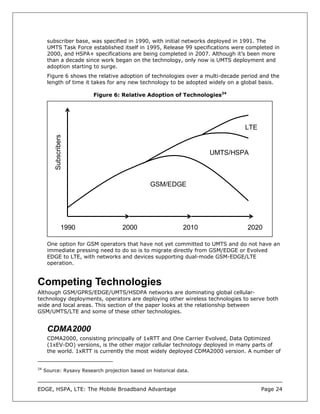
   To summarize throughput performance, Figure 5 shows the peak data rates possible
   with HSPA, HSPA+, and LTE using different types of MIMO and different spectrum
   bandwidth. Peak HSPA+ values are currently projected at 28 Mbps, with 2X2 MIMO 16
   QAM modulation, and 42 Mbps, assuming 2X2 MIMO and 64 QAM modulation.

   Figure 5: HSPA, HSPA Evolution, and LTE Possible Peak Downlink Data Rates
     MIMO order (Tx/Rx Antennas)


                                                    HSPA+                                    LTE
                                   4               84 Mbps                                 326 Mbps


                                                    HSPA+                                    LTE
                                   2               42 Mbps                                 173 Mbps


                                           LTE      HSPA+             LTE                     LTE
                                   1    5.4 Mbps   21 Mbps          45 Mbps                 90 Mbps


                                        1.25         5                10                      20

                                                             Carrier Bandwidth (MHz)

   Over time, the separate GSM/EDGE Access Network (GERAN), UMTS Access Network
   (UTRAN), and core-infrastructure elements will undergo consolidation, thus lowering
   total network cost and improving integrated operation of the separate access networks.
   For actual users with multimode devices, the networks they access will be largely
   transparent. Today, nearly all UMTS phones and modems support GSM/GPRS/EDGE.
   Despite rapid UMTS deployment, market momentum means that even by the end of the
   decade most worldwide subscribers will still be using GSM. By then, however, most new
   subscribers will be taking advantage of UMTS. Only over many years, as subscribers
   upgrade their equipment, will most network usage migrate to UMTS. Similarly, even as
   operators start to deploy LTE networks at the end of this decade and the beginning of
   the next, it will probably be the middle of the next decade before a large percentage of
   subscribers are actually using LTE. During these years, most networks and devices will
   be tri-mode—supporting GSM, UMTS, and LTE. The history of wireless-network
   deployment provides a useful perspective. GSM, which in 2007 is still growing its


EDGE, HSPA, LTE: The Mobile Broadband Advantage                                                       Page 23
subscriber base, was specified in 1990, with initial networks deployed in 1991. The
      UMTS Task Force established itself in 1995, Release 99 specifications were completed in
      2000, and HSPA+ specifications are being completed in 2007. Although it’s been more
      than a decade since work began on the technology, only now is UMTS deployment and
      adoption starting to surge.
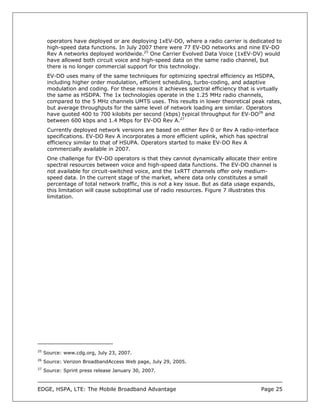
      Figure 6 shows the relative adoption of technologies over a multi-decade period and the
      length of time it takes for any new technology to be adopted widely on a global basis.

                         Figure 6: Relative Adoption of Technologies24


                                                                                LTE
          Subscribers


                                                                     UMTS/HSPA


                                                 GSM/EDGE


                  1990               2000                     2010               2020

      One option for GSM operators that have not yet committed to UMTS and do not have an
      immediate pressing need to do so is to migrate directly from GSM/EDGE or Evolved
      EDGE to LTE, with networks and devices supporting dual-mode GSM-EDGE/LTE
      operation.


Competing Technologies
Although GSM/GPRS/EDGE/UMTS/HSDPA networks are dominating global cellular-
technology deployments, operators are deploying other wireless technologies to serve both
wide and local areas. This section of the paper looks at the relationship between
GSM/UMTS/LTE and some of these other technologies.


      CDMA2000
      CDMA2000, consisting principally of 1xRTT and One Carrier Evolved, Data Optimized
      (1xEV-DO) versions, is the other major cellular technology deployed in many parts of
      the world. 1xRTT is currently the most widely deployed CDMA2000 version. A number of


24
     Source: Rysavy Research projection based on historical data.


EDGE, HSPA, LTE: The Mobile Broadband Advantage                                       Page 24
operators have deployed or are deploying 1xEV-DO, where a radio carrier is dedicated to
      high-speed data functions. In July 2007 there were 77 EV-DO networks and nine EV-DO
      Rev A networks deployed worldwide.25 One Carrier Evolved Data Voice (1xEV-DV) would
      have allowed both circuit voice and high-speed data on the same radio channel, but
      there is no longer commercial support for this technology.
      EV-DO uses many of the same techniques for optimizing spectral efficiency as HSDPA,
      including higher order modulation, efficient scheduling, turbo-coding, and adaptive
      modulation and coding. For these reasons it achieves spectral efficiency that is virtually
      the same as HSDPA. The 1x technologies operate in the 1.25 MHz radio channels,
      compared to the 5 MHz channels UMTS uses. This results in lower theoretical peak rates,
      but average throughputs for the same level of network loading are similar. Operators
      have quoted 400 to 700 kilobits per second (kbps) typical throughput for EV-DO26 and
      between 600 kbps and 1.4 Mbps for EV-DO Rev A.27
      Currently deployed network versions are based on either Rev 0 or Rev A radio-interface
      specifications. EV-DO Rev A incorporates a more efficient uplink, which has spectral
      efficiency similar to that of HSUPA. Operators started to make EV-DO Rev A
      commercially available in 2007.
      One challenge for EV-DO operators is that they cannot dynamically allocate their entire
      spectral resources between voice and high-speed data functions. The EV-DO channel is
      not available for circuit-switched voice, and the 1xRTT channels offer only medium-
      speed data. In the current stage of the market, where data only constitutes a small
      percentage of total network traffic, this is not a key issue. But as data usage expands,
      this limitation will cause suboptimal use of radio resources. Figure 7 illustrates this
      limitation.


25
     Source: www.cdg.org, July 23, 2007.
26
     Source: Verizon BroadbandAccess Web page, July 29, 2005.
27
     Source: Sprint press release January 30, 2007.


EDGE, HSPA, LTE: The Mobile Broadband Advantage                                         Page 25
Figure 7: Radio Resource Management 1xRTT/1xEV-DO versus UMTS/HSPA

                                             1xRTT and 1xEV-DO                                    UMTS/HSPA
                                       Speech      Unavailable High-                        Efficient Allocation of Resources
                                       Blocking   Speed Data Capacity                           Between Voice and Data


                               EV-DO
     Three 1.25 MHz Channels


                                                                        One 5 MHz Channel
                               1xRTT


                               1xRTT


                                                  High-Speed Data

                                                  Voice


   Another limitation of using a separate channel for EV-DO data services is that it
   currently prevents users from engaging in simultaneous voice and high-speed data
   services, whereas this is possible with UMTS and HSPA. Many users enjoy having a
   tethered data connection from their laptop—by using Bluetooth, for example—and being
   able to initiate and receive phone calls while maintaining their data sessions.
   EV-DO will eventually provide voice service using VoIP protocols through EV-DO Rev A,
   which includes a higher speed uplink, QoS mechanisms in the network, and protocol
   optimizations to reduce packet overhead as well as addresses problems such as jitter.
   One vendor has indicated it expects infrastructure to support VoIP on EV-DO Rev A in
   the 2007 to 2008 timeframe, and one large EV-DO operator has indicated it could deploy
   VoIP in the 2008 to 2009 timeframe.
   Even then, however, operators will face difficult choices: How many radio channels at
   each base station should be made available for 1xRTT to support legacy terminals versus
   how many radio channels should be allocated to EV-DO. In contrast, UMTS allows both
   circuit-switched and packet-switched traffic to occupy the same radio channel, where the
   amount of power each uses can be dynamically adjusted. This makes it simple to
   migrate users over time from circuit-switched voice to packet-switched voice.
   Although advocates sometimes position VoIP as the “Holy Grail” of voice management, it
   actually introduces many issues that operators must manage. First and foremost, there
   is presently no global end-to-end VoIP system that allows voice to remain in an IP
   format to endpoints outside of the cellular network. Such a system will inevitably
   become the norm some time in the next decade. In the meantime, most VoIP calls will
   need to go back into the circuit-switched telephone network for termination outside the
   cellular network.


EDGE, HSPA, LTE: The Mobile Broadband Advantage                                                                      Page 26
Beyond Rev A, 3GPP2 has defined EV-DO Rev B as allowing the combination of up to 15
      1.25 MHz radio channels in 20 MHz—significantly boosting peak theoretical rates to 73.5
      Mbps. More likely, an operator would combine three radio channels in 5 MHz. Such an
      approach by itself does not increase overall capacity, but it does offer users high peak
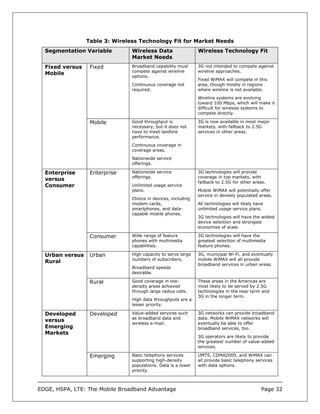
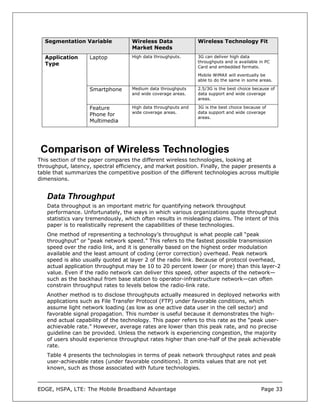
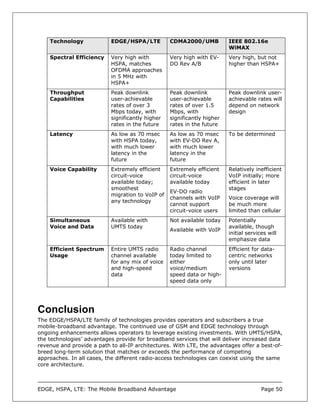
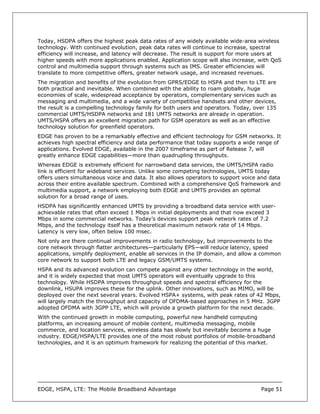
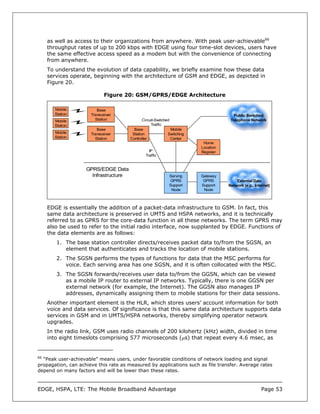
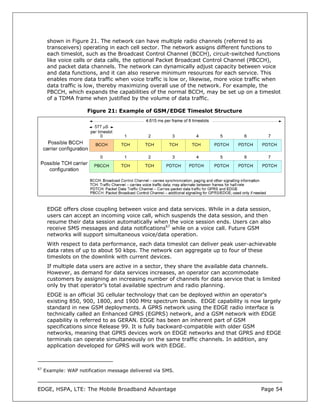
      data rates. No operators have yet publicly committed to EV-DO Rev B; beyond Rev B,
      UMB will be based on an OFDMA approach like LTE. UMB supports radio channels from
      1.25 to 20 MHz. In a 20 MHz radio channel, using 4X4 MIMO, UMB will deliver a peak
      data rate of 280 Mbps. UMB and LTE are being developed basically simultaneously, so it
      is logical to assume that both technologies will exploit the same advances in wireless
      technology. Both UMB and LTE are more recent than other OFDMA technologies, so it is
      also logical to assume that their capabilities will exceed initial OFDMA designs.
      CDMA2000 is clearly a viable and effective wireless technology and, to its credit, many
      of its innovations have been brought to market ahead of competing technologies. Today,
      however, the GSM family of technologies—including UMTS—adds more customers in one
      year than the entire base of CDMA2000 customers. And the GSM family has in excess of
      2.5 billion subscribers—more than six times the total number of subscribers as the
      CDMA2000 family of technologies.28


      WiMAX
      WiMAX has emerged as a potential alternative to cellular technology for wide-area
      wireless networks. Based on OFDMA and recently submitted to the International
      Telecommunications Union (ITU) for consideration as an IMT-2000 (3G technology)
      under the name OFDMA TDD WMAN (Wireless Metropolitan Area Network), WiMAX is
      trying to challenge existing wireless technologies—promising greater capabilities and
      greater efficiencies than alternative approaches such as HSPA. But as WiMAX,
      particularly mobile WiMAX, has come closer to reality, vendors have continued to
      enhance HSPA, and actual WiMAX advantages are no longer apparent. Any potential
      advantages certainly do not justify replacing 3G systems with WiMAX. Instead, WiMAX
      has gained the greatest traction in developing countries as an alternative to wireline
      deployment. In the United States, Clearwire and Sprint Nextel have agreed to work
      together to deploy a nationwide WiMAX network.
      Like GSM/UMTS, WiMAX is not a single technology; it is a family of interoperable
      technologies. The original specification, IEEE 802.16, was completed in 2001 and
      intended primarily for telecom backhaul applications in point-to-point line-of-sight
      configurations using spectrum above 10 GHz. This original version of IEEE 802.16 uses a
      radio interface based on a single-carrier waveform.
      The next major step in the evolution of IEEE 802.16 occurred in 2004, with the release
      of the IEEE 802.16-2004 standard. It added multiple radio interfaces, including one
      based on OFDM-256 and one based on OFDMA. IEEE 802.16-2004 also supports point-
      to-multipoint communications, sub-10 GHz operation, and non-line-of-sight
      communications. Like the original version of the standard, operation is fixed, meaning
      that subscriber stations are typically immobile. Potential applications include wireless
      Internet Service Provider (ISP) service, local telephony bypass, as an alternative to
      cable modem or DSL service, and for cellular backhaul for connections from cellular base
      stations to operator infrastructure networks. Vendors can design equipment for either
      licensed or unlicensed bands.


28
     Source: Informa Telecoms & Media, World Cellular Information Service, June 2007.


EDGE, HSPA, LTE: The Mobile Broadband Advantage                                         Page 27
Vendors are now delivering IEEE 802.16-2004-certified equipment. This standard does
   not compete directly with cellular-data and private Wi-Fi networks; thus, it can provide
   complementary services. In addition to operator-hosted access solutions, private entities
   such as municipal governments, universities, and corporations will be able to use this
   version of WiMAX in unlicensed bands (for example, 5.8 GHz) for local connectivity,
   though there has been little or no development in this area.
   The IEEE has also completed a mobile-broadband standard—IEEE 802.16e-2005—that
   adds mobility capabilities including support for radio operation while mobile, handovers
   across base stations, and handovers across operators. Unlike IEEE 802.16-2004, which
   operates in both licensed and unlicensed bands, IEEE 802.16e-2005 (referred to as
   mobile WiMAX) makes the most sense in licensed bands. Operators are preparing to
   deploy mobile WiMAX networks in 2007 and 2008. Current WiMAX profiles emphasize
   TDD operation. Mobile WiMAX networks are not backward-compatible with IEEE 802.16-
   2004 networks.
   IEEE 802.16e-2005 employs many of the same mechanisms as HSPA to maximize
   throughput and spectral efficiency, including high-order modulation, efficient coding,
   adaptive modulation and coding, and Hybrid Automatic Repeat Request (HARQ). The
   principal difference from HSDPA is IEEE 802.16e-2005’s use of OFDMA. As discussed in
   the section “Technical Approaches (TDMA, CDMA, OFDMA)” above, OFDM provides a
   potential implementation advantage for wide radio channels (for example, 10 to 20
   MHz). In 5 to 10 MHz radio channels, there is no evidence indicating that IEEE 802.16e-
   2005 will have any significant performance advantage on the downlink.
   It should be noted, however, that IEEE 802.16e-2005 contains some aspects that may
   limit its performance, particularly in scenarios where a sector contains a large number of
   mobile users. The performance of the MAC layer is inefficient when scheduling large
   numbers of users, and some aspects—such as power control of the mobile station—are
   provided using MAC signaling messages rather than the fast power control used in
   WCDMA and other technologies.
   OFDM systems—including IEEE 802.16e-2005—exhibit greater orthogonality on the
   uplink, so IEEE 802.16e-2005 may have slightly greater uplink spectral efficiency than
   even HSUPA. IEEE 802.16e-2005 achieves its greatest spectral efficiency in a 1/1 reuse
   pattern, where each sector uses the same radio channel. However, this may introduce
   greater levels of other-cell interference that may in turn introduce problems, because
   these signals would not be orthogonal. Another deployment option for IEEE 802.16e-
   2005 is 1/3, where each cell site uses the same frequency band but each sector uses
   one of three radio channels. The 1/3 configuration is not as spectrally efficient as 1/1,
   but it improves both cell throughput and higher user data rates at the cell edge. A final
   option is 1/1 reuse with interference mitigation techniques that emulate 1/3 reuse only
   for cell edge users.
   One deployment consideration is that TDD requires network synchronization. It is not
   possible for one cell site to be transmitting and an adjacent cell site to be receiving at
   the same. Different operators in the same band must either coordinate their networks or
   have guard bands to ensure they don’t interfere with each other. This may introduce
   problems as more operators introduce networks in the same spectrum band; for
   example, the 2.5 GHz band in the United States may be used for both TDD and FDD
   operation.
   Although IEEE 802.16e exploits significant radio innovations, it faces challenges like
   spectrum, economies of scale, and technology. Very few operators have access to
   spectrum for WiMAX that would permit them to provide widespread coverage.


EDGE, HSPA, LTE: The Mobile Broadband Advantage                                       Page 28
In reference to economies of scale, GSM/UMTS/HSPA subscribers number in the billions.
     However, even by the end of the decade the number of WiMAX subscribers is likely to be
     quite low. Arthur D. Little summarizes different forecasts for total WiMAX subscribers
     worldwide as between 20 million and 100 million by 2012,29 a tiny fraction of global
     wireless subscribers. This is consistent with a recent forecast by Senza Fili Consulting
     that projects 54 million WiMAX subscribers by 2012, with emerging markets driving
     growth.30
     Finally, from a technology standpoint, mobile WiMAX on paper may be slightly more
     capable than today’s available versions of HSPA. But by the time it becomes available,
     mobile WiMAX will actually have to compete against evolved HSPA systems that will
     offer both similar capabilities and enhanced performance. And by then, LTE will not be
     that far from deployment.
     One specific area where WiMAX has a technical disadvantage is cell size. In fact, 3G
     systems have a significant link budget advantage over mobile WiMAX because of soft-
     handoff diversity gain and an FDD duplexing advantage over TDD.31 Arthur D. Little
     reports that the radii of typical HSPA cells will be two to four times greater than typical
     mobile WiMAX cells for high-throughput operation. 32 WiMAX cells can be made of
     comparable size to HSPA, but at the detriment of data rates no higher than HSPA and
     with no capital expenditure (CAPEX) advantage. One vendor estimates that for the same
     power output, frequency, and capacity, mobile WiMAX requires 1.7 times more cell sites
     than HSPA.33
     With respect to spectral efficiency, WiMAX is comparable to HSPA+, as discussed in the
     section “Spectral Efficiency” below. As for data performance, HSPA+ in Release 8—with
     a peak rate of 42 Mbps—exceeds mobile WiMAX in 10 MHz in TDD 2:1 using 2X2 MIMO
     of 40 Mbps.34 The sometimes quoted peak rate of 63.4 Mbps for mobile WiMAX in 10
     MHz assumes no bandwidth applied to the uplink.
     Some have cited intellectual property rights as an area where WiMAX has an advantage.
     However, there is little substantial, publicly available information to support such claims.
     First, the large HSPA vendors have invested heavily in these technologies—hopefully
     giving them significant leverage with which to negotiate reasonable intellectual property
     rights (IPR) rates with other vendors. Second, the mobile WiMAX industry is in its
     infancy, and there is considerable lack of clarity when it comes to how different
     companies will assert and resolve IPR issues.
     Finally, wireless-data business models must also be considered. Today’s cellular
     networks can finance the deployment of data capabilities through a successful voice


29
   Source: "HSPA and mobile WiMax for Mobile Broadband WirelessAccess", 27 March 2007, Arthur D.
Little Limited.
30
  Source: Press release of June 19, 2007 describing the report "WiMAX: Ambitions and Reality. A
detailed market assessment and forecast at the global, regional and country level (2006-2012)"
31
  With a 2:1 TDD system, the reverse link only transmits one third of the time. To obtain the same
cell edge data rates, the mobile system must transmit at 4.77 dB higher transmit power.
32
   Source: "HSPA and mobile WiMax for Mobile Broadband WirelessAccess", 27 March 2007, Arthur D.
Little Limited.
33
  Source: Ericsson public white paper, “HSPA, the undisputed choice for mobile broadband, May
2007”.
34
  Source: Ericsson public white paper, “HSPA, the undisputed choice for mobile broadband, May
2007”.


EDGE, HSPA, LTE: The Mobile Broadband Advantage                                             Page 29
business. Building new networks for broadband wireless mandates substantial capacity
     per subscriber. Consumers who download 1 gigabyte of data each month represent a ten
     times greater load on the network than a 1,000-minute a month voice user. And if the
     future is in multimedia services such as movie downloads, it is important to recognize
     that downloading a single high-definition movie—even with advanced compression—
     consumes approximately 2 gigabytes. It is not clear how easily the available revenue per
     subscriber will be able to finance large-scale deployment of network capacity. Despite
     numerous attempts, no terrestrial wireless-data-only network has ever succeeded as a
     business.35 Although there is discussion of providing voice services over WiMAX using
     VoIP, mobile-voice users demand ubiquitous coverage—including indoor coverage.
     Matching the cellular footprint with WiMAX will require significant operator investments.


     Flash OFDM
     Flash OFDM is a proprietary wireless-networking technology developed by Flarion
     Technologies. Qualcomm purchased this company for a reported $600 to $800 million in
     2006. A number of operators in Asia and Europe have trialed Flash OFDM. The first
     commercial network was launched in Slovakia in 2005 by T-Mobile Slovakia using
     frequencies released from NMT analog service in the 450 MHz band. Another deployment
     commitment is in Finland, where the government has granted an operating license in the
     450 MHz band for a nationwide network.
     Flash OFDM is based on OFDM in the 1.25 MHz radio channels. It employs frequency
     hopping in the tones (subchannels), which provides frequency diversity and enables 1/1
     reuse. The network is all IP-based and implements voice functions using VoIP. Flarion
     claims typical downlink speeds of 1 to 1.5 Mbps and average uplink speeds of 300 to
     500 kbps, with typical latency of less than 50 msec.
     From a spectral efficiency point of view, Flash OFDM claims to achieve approximately the
     same downlink value as HSPA, in combination with mobile receive diversity, and
     approximately the same uplink value as HSUPA. Because the technology is proprietary,
     details are not available for an objective assessment. Although Flash OFDM has a time-
     to-market advantage in that its equipment is already available, it has major
     disadvantages in that support is available only from a limited vendor base and the
     technology is not based on open standards.
     It is not clear at this time whether Qualcomm intends to pursue deployment and
     development of the Flash OFDM technology or whether it intends to use the technology
     as a base for designing future OFDM systems.


     IEEE 802.20
     IEEE 802.20 is a mobile-broadband specification being developed by the Mobile
     Broadband Wireless Access Working Group of the IEEE. Initial contributions are similar in
     nature to IEEE 802.16e-2005, in that they use OFDMA, specify physical layer (PHY) and
     Medium Access Control (MAC) networking layers, address flexible channelization to 20
     MHz, and provide peak data rates of over 100 Mbps. With vendors focused heavily on
     LTE, UMB, and WiMAX for next-generation wireless services, it is not clear whether there
     is sufficient momentum in this standard to make it a viable technology. At this time, no
     operator has committed to the possible standard.


35
  Source: Andy Seybold, January 18, 2006, commentary: “Will Data-Only Networks Ever Make
Money?” http://www.outlook4mobility.com/commentary2006/jan1806.htm


EDGE, HSPA, LTE: The Mobile Broadband Advantage                                       Page 30
Wi-Fi and Municipal Wi-Fi Systems
   In the local area, the IEEE 802.11 family of technologies has experienced rapid growth,
   mainly in private deployments. In addition, operators—including cellular operators—are
   offering hotspot service in public areas such as airports, fast-food restaurants, and
   hotels. For the most part, hotspots are complementary with cellular-data networks,
   because the hotspot can provide broadband services in extremely dense user areas and
   the cellular network can provide broadband services across much larger areas. Various
   organizations are looking at integrating WLAN service with GSM/UMTS data services.
   The GSM Association has developed recommendations for SIM-based authentication of
   hotspots, and 3GPP has multiple initiatives that address WLAN integration into its
   networks, including 3GPP System to WLAN Interworking, UMA, IMS, and EPS.
   Many cities are now deploying metro Wi-Fi systems that will provide Wi-Fi access in
   downtown areas. These systems are based on a mesh technology, where access points
   forward packets to nodes that have backhaul connections. Although some industry
   observers are predicting that these systems will have an adverse effect on 3G data
   services, metro Wi-Fi and 3G are more likely to be complementary in nature. Wi-Fi can
   generally provide better application performance over limited coverage areas, whereas
   3G systems can provide access over much larger coverage areas.
   Metro systems today are still quite immature and face the following challenges:
          Today’s mesh systems are all proprietary. The IEEE is developing a mesh
          networking standard—IEEE 802.16s—but this may not be ready until 2008. Even
          then, it is not clear that vendors will adopt this standard for outdoor systems.
          Coverage in most metro systems is designed to provide an outdoor signal. As
          such, the signal does not penetrate many buildings in the coverage area and
          repeaters are needed to propagate the signal indoors. Many early network
          deployments have experienced poorer coverage than initially expected, and the
          number of recommended access points per square mile has increased steadily.
          Operation is in unlicensed bands in the 2.4 GHz radio channel. Given only three
          relatively non-overlapping radio channels at 2.4 GHz, interference between public
          and private systems is inevitable.
          Though mesh architecture simplifies backhaul, there are still considerable
          expenses and networking considerations in backhauling a large number of
          outdoor access points.
          No proven business models exist.
   Nevertheless, metro networks have attracted considerable interest, and many projects
   are proceeding. Technical issues will likely be resolved over time, and as more devices
   support both 3G and Wi-Fi, users can look forward to multiple access options.


   Market Fit
   3G and WiMAX encompass a huge range of evolving capabilities. But how well do these
   technologies actually address market needs? Table 3 matches technology capabilities
   with different market segments.


EDGE, HSPA, LTE: The Mobile Broadband Advantage                                      Page 31
Table 3: Wireless Technology Fit for Market Needs
  Segmentation Variable         Wireless Data                  Wireless Technology Fit
                                Market Needs
  Fixed versus    Fixed         Broadband capability must      3G not intended to compete against
                                compete against wireline       wireline approaches.
  Mobile
                                options.
                                                               Fixed WiMAX will compete in this
                                Continuous coverage not        area, though mostly in regions
                                required.                      where wireline is not available.
                                                               Wireline systems are evolving
                                                               toward 100 Mbps, which will make it
                                                               difficult for wireless systems to
                                                               compete directly.

                  Mobile        Good throughput is             3G is now available in most major
                                necessary, but it does not     markets, with fallback to 2.5G
                                have to meet landline          services in other areas.
                                performance.
                                Continuous coverage in
                                coverage areas.
                                Nationwide service
                                offerings.

  Enterprise      Enterprise    Nationwide service             3G technologies will provide
                                offerings.                     coverage in top markets, with
  versus
                                                               fallback to 2.5G for other areas.
  Consumer                      Unlimited usage service
                                plans.                         Mobile WiMAX will potentially offer
                                                               service in densely populated areas.
                                Choice in devices, including
                                modem cards,                   All technologies will likely have
                                smartphones, and data-         unlimited usage service plans.
                                capable mobile phones.
                                                               3G technologies will have the widest
                                                               device selection and strongest
                                                               economies of scale.

                  Consumer      Wide range of feature          3G technologies will have the
                                phones with multimedia         greatest selection of multimedia
                                capabilities.                  feature phones.

  Urban versus    Urban         High capacity to serve large   3G, municipal Wi-Fi, and eventually
                                numbers of subscribers.        mobile WiMAX will all provide
  Rural
                                                               broadband services in urban areas.
                                Broadband speeds
                                desirable.

                  Rural         Good coverage in low-          These areas in the Americas are
                                density areas achieved         most likely to be served by 2.5G
                                through large radius cells.    technologies in the near term and
                                                               3G in the longer term.
                                High data throughputs are a
                                lesser priority.

  Developed       Developed     Value-added services such      3G networks can provide broadband
                                as broadband data and          data. Mobile WiMAX networks will
  versus
                                wireless e-mail.               eventually be able to offer
  Emerging                                                     broadband services, too.
  Markets
                                                               3G operators are likely to provide
                                                               the greatest number of value-added
                                                               services.

                  Emerging      Basic telephony services       UMTS, CDMA2000, and WiMAX can
                                supporting high-density        all provide basic telephony services
                                populations. Data is a lower   with data options.
                                priority.


EDGE, HSPA, LTE: The Mobile Broadband Advantage                                                Page 32
Segmentation Variable             Wireless Data               Wireless Technology Fit
                                    Market Needs
  Application      Laptop           High data throughputs.      3G can deliver high data
                                                                throughputs and is available in PC
  Type
                                                                Card and embedded formats.
                                                                Mobile WiMAX will eventually be
                                                                able to do the same in some areas.

                   Smartphone       Medium data throughputs     2.5/3G is the best choice because of
                                    and wide coverage areas.    data support and wide coverage
                                                                areas.

                   Feature          High data throughputs and   3G is the best choice because of
                                    wide coverage areas.        data support and wide coverage
                   Phone for
                                                                areas.
                   Multimedia


 Comparison of Wireless Technologies
This section of the paper compares the different wireless technologies, looking at
throughput, latency, spectral efficiency, and market position. Finally, the paper presents a
table that summarizes the competitive position of the different technologies across multiple
dimensions.


   Data Throughput
   Data throughput is an important metric for quantifying network throughput
   performance. Unfortunately, the ways in which various organizations quote throughput
   statistics vary tremendously, which often results in misleading claims. The intent of this
   paper is to realistically represent the capabilities of these technologies.
   One method of representing a technology’s throughput is what people call “peak
   throughput” or “peak network speed.” This refers to the fastest possible transmission
   speed over the radio link, and it is generally based on the highest order modulation
   available and the least amount of coding (error correction) overhead. Peak network
   speed is also usually quoted at layer 2 of the radio link. Because of protocol overhead,
   actual application throughput may be 10 to 20 percent lower (or more) than this layer-2
   value. Even if the radio network can deliver this speed, other aspects of the network—
   such as the backhaul from base station to operator-infrastructure network—can often
   constrain throughput rates to levels below the radio-link rate.
   Another method is to disclose throughputs actually measured in deployed networks with
   applications such as File Transfer Protocol (FTP) under favorable conditions, which
   assume light network loading (as low as one active data user in the cell sector) and
   favorable signal propagation. This number is useful because it demonstrates the high-
   end actual capability of the technology. This paper refers to this rate as the “peak user-
   achievable rate.” However, average rates are lower than this peak rate, and no precise
   guideline can be provided. Unless the network is experiencing congestion, the majority
   of users should experience throughput rates higher than one-half of the peak achievable
   rate.
   Table 4 presents the technologies in terms of peak network throughput rates and peak
   user-achievable rates (under favorable conditions). It omits values that are not yet
   known, such as those associated with future technologies.


EDGE, HSPA, LTE: The Mobile Broadband Advantage                                              Page 33
Table 4: Throughput Performance of Different Wireless Technologies
                         (Blue Indicates Theoretical Peak Rates)

                                    Downlink                          Uplink
                                    Peak             Peak             Peak           Peak
                                    Network          Achievable       Network        Achievable
                                    Speed            User Rate        Speed          User Rate
      EDGE (type 2 MS)               473.6 kbps                       473.6 kbps
      EDGE (type 1 MS)               236.8 kbps          200 kbps     236.8 kbps       200 kbps
      Evolved EDGE                   1184 kbps37                         473.6
      (type 1 MS)36                                                      kbps38
      Evolved EDGE                     1894.440                          947.2
      (type 2 MS)39                      kbps                            kbps41

      UMTS WCDMA Rel’99              2.048 Mbps                        768 kbps
      UMTS WCDMA Rel’99                384 kbps          350 kbps      384 kbps        350 kbps
      (Practical Terminal)
      HSDPA Initial Devices            1.8 Mbps          > 1 Mbps      384 kbps        350 kbps
      (2006)
      HSDPA Current Devices42          3.6 Mbps       > 2 Mbps43       384 kbps        350 kbps
      HSDPA Emerging Devices           7.2 Mbps          > 3 Mbps      384 kbps        350 kbps
      HSDPA                           14.4 Mbps                        384 kbps
            44
      HSPA Initial                     7.2 Mbps          > 4 Mbps      1.46 Mbps        1 Mbps
      Implementation
      HSPA Future                      7.2 Mbps                        5.76 Mbps
      Implementation
      HSPA                            14.4 Mbps                        5.76 Mbps
      HSPA+ (2X2 MIMO,                 28 Mbps                         11.5 Mbps
      DL 16 QAM, UL 16 QAM)


36
   A type 1 evolved EDGE MS can receive on up to eight timeslots using two radio channels and can
transmit on up to four timeslots in one radio channel using 16 QAM modulation with turbo coding.
37
     Type 1 mobile, class 12 hardware, 10 slots downlink (dual carrier), MTCS-8-B (118.4 kbps/slot)
38
     4 slots uplink, MCS-8-B
39
   A type 2-evolved EDGE MS can receive on up to 16 times slots using two radio channels and can
transmit on up to eight timeslots in one radio channel using 16 QAM modulation with turbo coding.
40
     Type 2 mobile, 16 slots downlink (dual carrier) at MTCS-8-B
41
     Type 2 mobile, 8 slots uplink, MCS-8-B
42
     Some devices in 2007 are limited to 1.8 Mbps peak
43
     Rates above 1 Mbps requires network that has sufficient backhaul capacity
44
  High Speed Packet Access (HSPA) consists of systems supporting both High Speed Downlink Packet
Access (HSDPA) and High Speed Uplink Packet Access (HSUPA).


EDGE, HSPA, LTE: The Mobile Broadband Advantage                                               Page 34
Downlink                       Uplink
                              Peak           Peak            Peak          Peak
                              Network        Achievable      Network       Achievable
                              Speed          User Rate       Speed         User Rate
   HSPA+ (2X2 MIMO,              42 Mbps                     11.5 Mbps
   DL 64 QAM, UL 16 QAM)
   LTE (2X2 MIMO)               173 Mbps                      58 Mbps
   LTE (4X4 MIMO)               326 Mbps                      86 Mbps

   CDMA2000 1XRTT               153 kbps       130 kbps       153 kbps       130 kbps
   CDMA2000 1XRTT               307 kbps                      307 kbps
   CDMA2000 EV-DO Rev 0         2.4 Mbps       > 1 Mbps       153 kbps       150 kbps
   CDMA2000 EV-DO Rev A         3.1 Mbps      > 1.5 Mbps      1.8 Mbps       > 1 Mbps
   CDMA2000 EV-DO Rev B         9.3 Mbps                      5.4 Mbps
   (3 radio channels MHz)
   CDMA2000 EV-DO Rev B         73.5 Mbps                     27 Mbps
   Theoretical (15 radio
   channels)
   Ultra Mobile Broadband       140 Mbps                      34 Mbps
   (2X2 MIMO)
   Ultra Mobile Broadband       280 Mbps                      68 Mbps
   (4X4 MIMO)

   802.16e WiMAX expected        23 Mbps                       4 Mbps
   Wave 1 (10 MHz TDD
   DL/UL=3, 1X2 SIMO)
   802.16e WiMAX expected        46 Mbps                       4 Mbps
   Wave 2 (10 MHz TDD,
   DL/UL=3, 2x2 MIMO)
   802.16m                         TBD                           TBD


   Yet another approach to representing a technology’s throughput is to quote an average
   or typical speed for users that takes more factors into account, such as the operator’s
   actual network configuration, backhaul constraints, and a higher though generally
   unspecified level of loading. U.S. operators have quoted typical throughput rates, but
   this is less common in other countries.
   Rysavy Research’s 2002 paper for 3G Americas on wireless data anticipated EDGE
   average performance of 110 to 130 kbps and UMTS average performance of 200 to 300
   kbps. Actual results from operator and vendor field trials matched these predicted
   results, validating the methodology used to predict performance. In the 2004 and 2005
   versions of this paper, the 550 to 800 kbps throughput performance of initial HSDPA
   devices has also materialized as fairly accurate.


EDGE, HSPA, LTE: The Mobile Broadband Advantage                                    Page 35
HSDPA Throughput in Representative Scenarios
      It is instructive to look at actual HSDPA throughput in commercial networks. Figure 8
      shows the downlink throughput performance of a 7.2 Mbps device. It results in a median
      throughput of 1.9 Mbps when mobile, 1.8 Mbps with poor coverage, and 3.8 Mbps with
      good coverage.

     Figure 8: HSDPA Performance of a 7.2 Mbps Device in a Commercial Network45


     Good Coverage                                  Bad Coverage
      Median bitrate                                Median bitrate
       3.8 Mbps                                      1.8 Mbps                    -106 dBm


                                 Mobile
                                Median bitrate
                                 1.9 Mbps


      Figure 9, Figure 10 and Figure 11 show earlier test results from a network in Europe
      with a light data load but supporting voice traffic. Neither the median value nor the
      actual histogram should be taken as absolute. Rather, the distribution shows
      representative HSDPA performance. Actual performance will vary by network,
      geography, network load, devices, and so forth. However, distributions will generally
      have these kinds of profiles, and the performance is relatively typical of HSDPA on
      today’s networks.
      Under a favorable signal condition46 with a 1.8 Mbps device,47 the median bit rate
      measured was 1.48 Mbps. The blue line in Figure 9 is the Cumulative Distribution
      Function (CDF), which shows the probability of throughput being at least that high.


45
     Source: 3G Americas member company contribution.
46
  Received signal code power (RSCP) was -70 dBm and the Signal Energy per chip over Noise Power
Spectral Density (EC/N0) was -4.5 dB.
47
     Peak network rate of 1.8 Mbps at layer 2.


EDGE, HSPA, LTE: The Mobile Broadband Advantage                                         Page 36
Figure 9: Histogram of HSDPA Throughput Under Favorable Radio Conditions48

               100,00%                                                                                                                45,00%


                90,00%                                                                                                                40,00%


                80,00%
                                                                                                                                      35,00%

                70,00%
                                                                                                                                      30,00%

                60,00%
                                                                                                                                      25,00%
     CDF [%]


                50,00%
                                                                                                                                      20,00%
                40,00%

                                                                                                                                      15,00%
                30,00%

                                                                                                                                      10,00%
                20,00%


                10,00%                                                                                                                5,00%


                0,00%                                                                                                                 0,00%
                         0   100   200   300   400   500   600   700   800    900    1000   1100   1200   1300   1400   1500   1600
                                                                 Throughput [kbps]


               Figure 10 shows the distribution of throughput under unfavorable radio conditions.49
               Though measured values were lower than those under good radio conditions, the median
               rate was still quite high, at 930 kbps.


48
  Source: Ericsson white paper, “HSDPA performance and evolution”,
http://www.ericsson.com/ericsson/corpinfo/publications/review/2006_03/files/6_hsdpa.pdf
49
  Received signal code power (RSCP) was -110 dBm and the Signal Energy per chip over Noise Power
Spectral Density (EC/N0) was -13 dB.


EDGE, HSPA, LTE: The Mobile Broadband Advantage                                                                                  Page 37
Figure 10: Histogram of HSDPA Throughput Under Unfavorable Radio
                                                    Conditions50

               100,00%                                                                                                                  14,00%


                90,00%
                                                                                                                                        12,00%
                80,00%


                70,00%                                                                                                                  10,00%


                60,00%
                                                                                                                                        8,00%
     CDF [%]


                50,00%

                                                                                                                                        6,00%
                40,00%


                30,00%                                                                                                                  4,00%

                20,00%
                                                                                                                                        2,00%
                10,00%


                 0,00%                                                                                                                  0,00%
                           0   100   200   300   400   500   600   700   800    900    1000   1100   1200   1300   1400   1500   1600
                                                                   Throughput [kbps]


               Figure 11 shows the distribution of throughput measured with favorable radio
               conditions51 while driving through a coverage area. Though lower than stationary
               operation throughput, the median throughput rate was still 1.2 Mbps.
               It is interesting to note how the range of data rates experienced by a user increases
               when moving from an area with favorable conditions to areas with less favorable
               conditions or when in a mobile environment.


50
  Source: Ericsson white paper, “HSDPA performance and evolution”,
http://www.ericsson.com/ericsson/corpinfo/publications/review/2006_03/files/6_hsdpa.pdf
51
  Received signal code power (RSCP) was -70 dBm and the Signal Energy per chip over Noise Power
Spectral Density (EC/N0) was -5.5 dB.


EDGE, HSPA, LTE: The Mobile Broadband Advantage                                                                                  Page 38
Figure 11: Histogram of HSDPA Throughput Under Favorable Radio Conditions
                                          While Mobile52

           100,00%                                                                                                                20,00%


            90,00%                                                                                                                18,00%


            80,00%                                                                                                                16,00%


            70,00%                                                                                                                14,00%


            60,00%                                                                                                                12,00%

                                                                                                                                           PDF
     CDF


            50,00%                                                                                                                10,00%
                                                                                                                                           CDF

            40,00%                                                                                                                8,00%


            30,00%                                                                                                                6,00%


            20,00%                                                                                                                4,00%


            10,00%                                                                                                                2,00%


            0,00%                                                                                                                 0,00%
                     0   100   200   300   400   500   600   700   800    900    1000   1100   1200   1300   1400   1500   1600
                                                             Throughput [kbps]


           Release 99 and HSUPA Uplink Performance
           HSUPA will dramatically increase uplink throughputs over 3GPP Release 99. However,
           even Release 99 networks have seen significant uplink increases. Many networks were
           initially deployed with a 64 kbps uplink rate. Later, this increased to 128 kbps. Now,
           operators have increased speeds further, to 384 kbps peak rates, with peak user-
           achievable rates of 350 kbps.
           Figure 12, under conservative assumptions, shows the average throughputs when using
           a Release 99 128 kbps Bearer or a Release 99 384 kbps Bearer and when using HSUPA
           in a system limited to 1.46 Mbps maximum throughput. It plots throughputs versus cell
           range and shows operation at 1900 MHz in a suburban area with 10 simultaneous voice
           users. The cell range is only one of the dimensions that can affect the average
           throughput. Similar to HSDPA, the fast scheduling and Automatic Repeat Request (ARQ)
           used in HSUPA allow the system to adjust the instantaneous data rate to the
           instantaneous propagation and interference conditions faced by the terminal. Figure 12
           also shows that average throughput of more than 500 kbps is achievable at 1900 MHz in
           a suburban area for a typical inter-site distance of 2.5 kilometers (1.7 km max cell
           range), but it will be lower for higher inter-site distances.


52
  Source: Ericsson white paper, “HSDPA performance and evolution”,
http://www.ericsson.com/ericsson/corpinfo/publications/review/2006_03/files/6_hsdpa.pdf


EDGE, HSPA, LTE: The Mobile Broadband Advantage                                                                                      Page 39
Figure 12: Average Release 99 Uplink and HSUPA Throughput53

                                                    Achievable Ave. UL UMTS1900 & HSUPA1900 Thrpt over the Cell Area vs Cell Range
       1200 kbps


                   Ave. Thrpt over Cell Area
       1000 kbps
                                                                                                                                  SubUrban Area
                                                                                                                                  Indoor Coverage w ith 15dB Penetration Losses
                                                                                                                                  10 Voice Users Simultaneously
        800 kbps                                                                                                                  AMR12.2 for Voice Users
                                                                                                                                  Cat3 E-DCH
                                                                                                                                  21 dBm UE

        600 kbps                                                                                                                              Ave. HSUPA Cell Area Thrpt
                                                                                                                                              Ave. UL R'99 Cell Area Thrpt - 384kMax
                                                                                                                                              Ave. UL R'99 Cell Area Thrpt - 128kMax
        400 kbps


        200 kbps


                                                                                                                                                                                       Max Cell Range
          0 kbps
              0.40 km                                 0.90 km                1.40 km                 1.90 km                 2.40 km                    2.90 km                   3.40 km         3.90 km


      The anticipated 1 Mbps achievable uplink throughput can be seen in the measured
      throughput of a commercial network, as documented in Figure 13.

                                               Figure 13: Uplink Throughput in a Commercial Network54

                                                                                                                                                                                  100
                                                Mobile
                                                                                                                                                                                  90

                                                                                                                                                                                  80
                                                 Median bitrate                                                                                                                   70

                                                  1.0 Mbps                                                                                                                        60

                                                                                                                                                                                  50

                                                                                                                                                                                  40

                                                                                                                                                                                  30

                                                                                                                                                                                  20

                                                                                                                                                                                  10

                                                                                                                                                                                  0
                                                0
                                                    70
                                                         140


                                                                     280
                                                                           350


                                                                                       490
                                                                                             560
                                                                                                   630
                                                                                                         700


                                                                                                                     840
                                                                                                                           910


                                                                                                                                       1050


                                                                                                                                                             1260
                                                               210


                                                                                 420


                                                                                                               770


                                                                                                                                 980


                                                                                                                                               1120
                                                                                                                                                      1190


                                                                                                                                                                    1330
                                                                                                                                                                           1400


53
     Source: 3G Americas member company contribution.
54
     Source: 3G Americas member company contribution.


EDGE, HSPA, LTE: The Mobile Broadband Advantage                                                                                                                                               Page 40
Latency
     Just as important as throughput is network latency, defined as the round-trip time it
     takes data to traverse the network. Each successive data technology from GPRS forward
     reduces latency, with HSDPA having latency as low as 70 milliseconds (msec). HSUPA
     brings latency down even further, as will 3GPP LTE. Ongoing improvements in each
     technology mean all these values will go down as vendors and operators fine-tune their
     systems. Figure 14 shows the latency of different 3GPP technologies.

                               Figure 14: Latency of Different Technologies55


                      700


                      600


                      500
       Milliseconds


                      400


                      300


                      200


                      100


                            GPRS     EDGE     EDGE WCDMA HSDPA HSUPA                  LTE
                            Rel’97   Rel’99   Rel’4 Rel’99


     The values shown in Figure 14 reflect measurements of commercially deployed
     technologies. Some vendors have reported significantly lower values in networks using
     their equipment, such as 150 msec for EDGE, 70 msec for HSDPA, and 50 msec for
     HSPA. With further refinements and the use of 2 msec Transmission Time Interval (TTI)
     in the HSPA uplink, 25 msec roundtrip is a realistic goal. LTE will reduce latency even
     further, to as low as 5 msec in the radio-access network.


55
   Source: 3G Americas' member companies. Measured between subscriber unit and Gi interface, just
external to wireless network. Does not include Internet latency. Note that there is some variation in
latency based on network configuration and operating conditions.


EDGE, HSPA, LTE: The Mobile Broadband Advantage                                              Page 41
Spectral Efficiency
   To better understand the reasons for deploying the different data technologies and to
   better predict the evolution of capability, it is useful to examine spectral efficiency. The
   evolution of data services will be characterized by an increasing number of users with
   ever-higher bandwidth demands. As the wireless-data market grows, deploying wireless
   technologies with high spectral efficiency will be of paramount importance. Keeping all
   other things equal, such as frequency band, amount of spectrum, and cell site spacing,
   an increase in spectral efficiency translates to a proportional increase in the number of
   users supported at the same load per user—or, for the same number of users, an
   increase in throughput available to each user. Delivering broadband services to large
   numbers of users can be best achieved with high spectral efficiency systems, especially
   because the only other alternatives are using more spectrum or deploying more cell
   sites.
   However, increased spectral efficiency comes at a price. It generally implies greater
   complexity for both user and base station equipment. Complexity can arise from the
   increased number of calculations performed to process signals or from additional radio
   components. Hence, operators and vendors must balance market needs against network
   and equipment costs. One core aspect of evolving wireless technology is managing the
   complexity associated with achieving higher spectral efficiency. The reason technologies
   such as OFDMA are attractive is that they allow higher spectral efficiency with lower
   overall complexity; hence their use in technologies such as LTE, UMB, and WiMAX.
   The roadmap for the EDGE/HSPA/LTE family of technologies provides a wide portfolio of
   options to increase spectral efficiency. The exact timing for deploying these options is
   difficult to predict, because much will depend on the growth of the wireless data market
   and what types of applications become popular.
   When determining the best area on which to focus future technology enhancements, it is
   interesting to note that HSDPA, 1xEV-DO, and IEEE 802.16e-2005 all have highly
   optimized links—that is, physical layers. In fact, as shown in Figure 15, the link layer
   performance of these technologies is approaching the theoretical limits as defined by the
   Shannon bound. (The Shannon bound is a theoretical limit to the information transfer
   rate [per unit bandwidth] that can be supported by any communications link. The bound
   is a function of the Signal to Noise Ratio [SNR] of the communications link.) Figure 15
   also shows that HSDPA, 1xEV-DO, and IEEE 802.16e-2005 are all within 2 to 3 decibels
   (dB) of the Shannon bound, indicating that there is not much room for improvement
   from a link layer perspective.


EDGE, HSPA, LTE: The Mobile Broadband Advantage                                        Page 42
Figure 15: Performance Relative to Theoretical Limits
                                                     for HSPDA, EV-DO, and IEEE 802.16e-200556
                                          6
                                                        Shannon bound
                                                        Shannon bound with 3dB margin
                                          5             HSDPA
                                                        EV-DO
         Achievable Efficiency (bps/Hz)


                                                        IEEE 802.16e-2005
                                          4


                                          3


                                          2


                                          1


                                          0
                                          -15     -10          -5        0          5    10        15     20
                                                                     Required SNR (dB)


      The curves in Figure 15 apply to an Additive White Gaussian Noise Channel (AWGN). If
      the channel is slowly varying and the effect of frequency selectivity can be overcome
      through an equalizer in either HSDPA or OFDM, then the channel can be known almost
      perfectly and the effects of fading and non-AWGN interference can be ignored—thus
      justifying the AWGN assumption. For instance, at 3 km per hour, and fading at 2 GHz,
      the Doppler spread is about 5.5 Hz. The coherence time of the channel is thus 1 sec/5.5
      or 180 msec. Frames are well within the coherence time of the channel, because they
      are typically 20 msec or less. As such, the channel appears “constant” over a frame and
      the Shannon bound applies. Much more of the traffic in a cellular system is at slow
      speeds (for example, 3 km/hr) rather than at higher speeds. Thus, the Shannon bound
      is relevant for a realistic deployment environment.
      As the speed of the mobile station increases and the channel estimation becomes less
      accurate, additional margin is needed. However, this additional margin would impact the
      different standards fairly equally.
      The Shannon bound only applies to a single user; it does not attempt to indicate
      aggregate channel throughput with multiple users. However, it does indicate that link
      layer performance is reaching theoretical limits. As such, the focus of future technology
      enhancements should be on improving system performance aspects that maximize the
      experienced SNRs in the system rather than on investigating new air interfaces that
      attempt to improve the link layer performance.


56
     Source: 3G Americas’ member company.


EDGE, HSPA, LTE: The Mobile Broadband Advantage                                                         Page 43
Examples of technologies that improve SNR in the system are those that minimize
     interference through intelligent antennas or interference coordination between sectors
     and cells. Note that MIMO techniques using spatial multiplexing to potentially increase
     the overall information transfer rate by a factor proportional to the number of transmit
     or receive antennas do not violate the Shannon bound, because the per antenna transfer
     rate (that is, the per communications link transfer rate) is still limited by the Shannon
     bound.
     Figure 16 compares the spectral efficiency of different wireless technologies based on a
     consensus view of 3G Americas contributors to this paper. It shows the continuing
     evolution of the capabilities of all the technologies discussed. The values shown are
     conservative and intended to be reasonably representative of real-world conditions. Most
     simulation results produce values under idealized conditions; as such, some of the
     values shown are lower (for all technologies) than the values indicated in other papers
     and publications. For instance, 3GPP studies indicate higher HSDPA and LTE spectral
     efficiencies than those shown below.

                                                           Figure 16: Comparison of Downlink Spectral Efficiency57
                                                                    Future                                             Future
                                                                                              Future
                                                    2.5             improvements
                                                                                              improvements             Improvements
                                                    2.4
                                                                    LTE                       UMB                      Expected
                                                    2.3             4X4 MIMO                  4X4 MIMO                 IEEE 802.16m
                                                    2.2
      Spectral Efficiency (bps/Hz/sector) 5+5 MHz


                                                    2.1
                                                    2.0
                                                    1.9
                                                    1.8
                                                    1.7
                                                    1.6
                                                    1.5
                                                                    LTE                       UMB
                                                    1.4             2X2 MIMO                  2X2 MIMO
                                                    1.3
                                                                    HSPA+
                                                    1.2             SIC, 64 QAM
                                                    1.1
                                                                    HSPA+                                              WiMAX
                                                    1.0             2X2 MIMO                                           Wave 2
                                                    0.9                                       Rev B
                                                                    HSDPA                                              WiMAX
                                                    0.8                                       Rev A,                   Wave 1
                                                                    MRxD,
                                                    0.7                                       MRxD,
                                                                    Equalizer
                                                                                              Equalizer
                                                    0.6
                                                    0.5
                                                    0.4             HSDPA
                                                    0.3                                       EV-DO Rev 0
                                                    0.2
                                                    0.1             UMTS R’99


                                                          UMTS to LTE             CDMA2000 to UMB            IEEE 802.16e


57
  Source: Joint analysis by 3G Americas’ members. 5+5 MHz for UMTS/HSPA/LTE and CDMA2000,
and 10 MHz DL/UL=3:1 TDD for WiMAX.


EDGE, HSPA, LTE: The Mobile Broadband Advantage                                                                                 Page 44
The values shown in Figure 16 are not all the combinations of available features. Rather,
   they are representative milestones in ongoing improvements in spectral efficiency. For
   instance, there are terminals that employ mobile-receive diversity but not equalization.
   Relative to WCDMA Release 99, HSDPA increases capacity by almost a factor of three.
   Type 3 receivers that include Minimum Mean Square Error (MMSE) equalization and
   Mobile Receive Diversity (MRxD) will effectively double HSDPA spectral efficiency.
   HSPA+ in Release 7 includes 2X2 MIMO, which further increases spectral efficiency by
   about 20 percent and matches WiMAX Wave 2 spectral efficiency. Methods such as
   successive interference cancellation (SIC) and 64 QAM allow gains in spectral efficiency
   as high as 1.3 bps/Hz, which is close to LTE performance in 5+5 MHz. Terminals with
   SIC can also be used with Release 7 systems.
   Beyond HSPA, 3GPP LTE will also result in further spectral efficiency gains, initially with
   2X2 MIMO and then optionally with 4X2 and 4X4 MIMO. LTE becomes more spectrally
   efficient with wider channels, such as 10 and 20 MHz.
   Similar gains are available for CDMA2000. Mobile WiMAX also experiences gains in
   spectral efficiency as various optimizations, like MRxD and MIMO, are applied. WiMAX
   Wave 2 includes 2X2 MIMO. Enhancements to WiMAX will come from potentially new
   profiles, as well as a new version of the standard IEE 802.16m which likely will match
   LTE and UMB spectral efficiency.
   The main reason that HSPA+ with MIMO is shown as spectrally more efficient than
   WiMAX with MIMO is because HSPA MIMO supports closed-loop operation with precode
   weighting and multicode word MIMO, which enables the use of SIC receivers. Other
   reasons are that HSPA supports incremental-redundancy HARQ, while the initial WiMAX
   profiles support only Chase combining HARQ, and that WiMAX has larger control
   overhead in the downlink than HSPA, because the uplink in WiMAX is fully scheduled.
   OFDMA technology requires scheduling to avoid two mobile devices transmitting on the
   same tones simultaneously. An uplink MAP zone in the downlink channel does this
   scheduling.
   Conversely, HSUPA can use autonomous transmission on the uplink. Hence, there is no
   downlink overhead required to schedule the uplink. This leads to a disadvantage for
   HSUPA in the uplink when compared to WiMAX, as Figure 17 shows, because the HSUPA
   uplink is not orthogonal. But autonomous transmission does provide the advantage of
   lower downlink control overhead for HSPA relative to WiMAX. It also helps to mitigate
   other-cell interference, which may become a problem when WiMAX is deployed.
   LTE also has higher spectral efficiency than WiMAX, because it includes incremental
   redundancy and supports closed-loop operation with precoder weighting as well as
   multicode word MIMO, thus enabling the use of SIC receivers.
   An important conclusion of this comparison is that all the major wireless technologies
   achieve comparable spectral efficiency through the use of comparable radio techniques.
   Figure 17 compares the uplink spectral efficiency of the different systems.


EDGE, HSPA, LTE: The Mobile Broadband Advantage                                        Page 45
Figure 17: Comparison of Uplink Spectral Efficiency58

      Spectral Efficiency (bps/Hz/sector) 5+5 MHz
                                                    0.9

                                                    0.8             Future                      Future                   Future
                                                                    Improvements                Improvements             Improvements
                                                    0.7
                                                                    LTE 2X2                     UMB                      Expected
                                                                                                                         IEEE 802.16m
                                                                    LTE 1X2
                                                    0.6
                                                    0.5
                                                                    HSPA+                       EV-DO Rev B,
                                                                    Interference                Interference             WiMAX
                                                    0.4             Cancellation,               Cancellation             Wave 2
                                                                    16 QAM
                                                                                                                         WiMAX
                                                    0.3                                                                  Wave 1
                                                                                                EV-DO Rev A
                                                    0.2             HSUPA Rel 6

                                                                    UMTS R’99                   EV-DO Rev 0
                                                    0.1             to Rel 5


                                                          UMTS to LTE               CDMA2000 to UMB            IEEE 802.16e
     HSUPA significantly increases uplink capacity, as does Rev A of 1xEV-DO, compared to
     Rev 0. OFDM-based systems can exhibit improved uplink capacity relative to CDMA
     technologies, but this improvement depends on factors such as the scheduling efficiency
     and the exact deployment scenario.
     Figure 17 shows WiMAX uplink spectral efficiency to be lower than 3GPP and 3GPP2
     technologies employing interference cancellation. This is because of the high pilot
     overhead in IEEE 802.16e, which accounts for up to 33 percent of tones. With the
     optional but more efficient pilot structure implemented, it is likely that IEEE 802.16e
     uplink spectral efficiency will be on par.
     Opportunities will arise to improve voice capacity using VoIP over HSPA channels.
     Depending on the specific enhancements implemented, voice capacity could double over
     existing circuit-switched systems. It should be noted, however, that the gains are not
     related specifically to the use of VoIP; rather, gains relate to advances in radio
     techniques applied to the data channels. Many of these same advances could also be
     applied to current circuit-switched modes. However, other benefits of VoIP are driving
     the migration to packet voice. Among these benefits are a consolidated IP core network
     for operators and sophisticated multimedia applications for users.
     Figure 18 compares voice spectral efficiency. It assumes a round-robin type of
     scheduler, as opposed to a proportional-fair scheduler that is normally used for
     asynchronous data.


58
  Source: Joint analysis by 3G Americas’ members. 5+5 MHz for UMTS/HSPA/LTE and CDMA2000,
and 10 MHz DL/UL=3:1 TDD for WiMAX.


EDGE, HSPA, LTE: The Mobile Broadband Advantage                                                                                   Page 46
Figure 18: Comparison of Voice Spectral Efficiency59


                                                    Future                     Future                       Future
                                    500             Improvements               Improvements                 Improvements
                                                    LTE VoIP                   UMB VoIP                     Expected
                                    450             12.2 k                                                  802.16m
      Number of User in 10+10 MHz


                                    400
                                                                                                            New
                                    350                                                                     802.16e
                                                                                                            Profile
                                                                                                            6k
                                    300             Interference               Interference
                                                    Cancellation               Cancellation 6 k
                                    250             5.9 k
                                                                               EVRC-B 6 k
                                                    Rel 7 5.9 k
                                    200                                        EV-DO Rev A
                                                    Rel 7, VoIP                VoIP 8 k
                                                                                                            Extended
                                                    7.95 k
                                    150                                                                     Real Time
                                                    UMTS R’99                  1xRTT                        Polling Service
                                                    Code Limited                                            8k
                                    100             AMR 7.95 k
                                                                                                            Unsolicited
                                                    Adaptive
                                    50                                                                      Grant
                                                    Modulation Rate
                                                                                                            Scheduling
                                                                                                            VoIP 8 k

                                          UMTS to LTE              CDMA2000 to UMB                IEEE 802.16e


     EV-DO technologies could possibly exhibit a slightly higher spectral efficiency for VoIP
     than HSPA technologies (though not for packet data in general), as they operate purely
     in the packet domain and do not have circuit-switched control overhead.60 However,
     HSPA has a significant advantage of being able to support simultaneous circuit-switched
     and packet-switched users on the same radio channel.
     Initial versions of VoIP with IEEE 802.16e are not expected to be nearly as spectrally
     efficient as current circuit-switched approaches with CDMA-based systems, though
     future versions of WiMAX will become more efficient in this regard.


     Cost and Volume Comparison
     So far, this paper has compared wireless technologies on the basis of technical capability
     and demonstrated that many of the different options have similar technical attributes.
     This is for the simple reason that they employ many of the same approaches.
     However, there is a point of comparison where the differences between the technologies
     diverge tremendously; namely, the difference in volume involved, including subscribers
     and the amount of infrastructure required. This difference should translate to
     dramatically reduced costs for the highest volume solutions, specifically GSM/UMTS.
     Based on projections and numbers already presented in this paper, 3G subscribers on

59
  Source: Joint analysis by 3G Americas’ members. 10 + 10 MHz for UMTS/HSPA/LTE and CDMA2000,
and 20 MHz DL/UL=3:1 TDD for WiMAX.
60
  Transmit Power Control (TPC) bits on the uplink Dedicated Physical Control Channel
DPCCH in UMTS R’99.


EDGE, HSPA, LTE: The Mobile Broadband Advantage                                                                           Page 47
UMTS networks will number in the many hundreds of millions by the end of this decade,
      whereas subscribers to emerging wireless technologies such as IEEE 802.16e-2005 will
      number in the tens of millions. See Figure 19 for details.

        Figure 19: Relative Volume of Subscribers Across Wireless Technologies61


                                CDMA         GSM       UMTS        Others
                    5,000
         Millions


                    4,000

                    3,000

                    2,000

                    1,000

                       0
                            2007    2008       2009       2010       2011       2012

      Although proponents for technologies such as mobile WiMAX point to lower costs for
      their alternatives, there doesn’t seem to be any inherent cost advantage—even on an
      equal volume basis. And when factoring in the lower volumes, any real-world cost
      advantage is debatable.
      From a deployment point of view, the type of technology used (for example, HSPA
      versus WiMAX) only applies to the digital card at the base station. However, the cost of
      the digital card is only a small fraction of the base station cost, with the remainder
      covering antennas, power amplifiers, cables, racks, RF cards, and digital cards. As for
      the rest of the network, including construction, backhaul, and core-network components,
      costs are similar regardless of Radio Access Network (RAN) technology. Spectrum costs
      for each technology can differ greatly, depending on a country’s regulations and the
      spectrum band. As a general rule in most parts of the world, spectrum sold at 3.5 GHz
      will cost much less than spectrum sold at 850 MHz (all other things being equal).
      The advantages of high volume can be seen in projections for GSM handsets. At last
      year’s 3GSM World Congress, GSM Association CEO Rob Conway indicated that the
      organization’s “Emerging Market Handset” initiative would enable sub-$15 devices by
      2008. This follows the successful availability of sub-$30 handsets.62


61
     Source: Informa Telecoms & Media, WCIS Forecast, July 2007
62
  Reported in the article “Mobile phones on the catwalk” by Paul Rasmussen. GSM Association,
Wireless Business Review, Spring 2006.


EDGE, HSPA, LTE: The Mobile Broadband Advantage                                           Page 48
As for UMTS/HSPA versus CDMA2000, higher deployment—by a factor of five—could
      translate to significant cost savings. For example, research and development
      amortization results in a four-to-one difference in base station costs.63 Similarly, just as
      GSM handsets are considered much less expensive than 1xRTT handsets, UMTS
      wholesale terminal prices could be the market leader in low-cost or mass-market 3G
      terminals. Developments such as single-chip UMTS complementary metal oxide
      semiconductor (CMOS) transceivers could be particularly effective in making
      UMTS/HSDPA devices more affordable to the mass market.64 On the heels of the success
      of the GSM low-cost handset program, GSMA in early 2007 announced the winner of its
      “3G for All” program, in which eight handset vendors submitted 19 mass-market 3G
      device prototypes for consideration by 12 leading GSM operators. The winner, LG-
      KU250, is possibly the lowest cost UMTS device and is now available in many of the
      world’s markets.


      Competitive Summary
      Based on the information presented in this paper, Table 5 summarizes the competitive
      position of the different technologies discussed.

               Table 5: Competitive Position of Major Wireless Technologies
       Technology              EDGE/HSPA/LTE          CDMA2000/UMB           IEEE 802.16e
                                                                             WiMAX
       Subscribers             Over 2.5 billion       351 million65 today;   Less than 100
                               today; 3.4 billion     slower growth          million by 2012
                               expected by 2009       expected than
                                                      GSM/UMTS
       Maturity                Extremely mature       Extremely mature       Emerging/immature
       Adoption                Cellular operators     Cellular operators     Extremely limited to
                               globally               globally               date
       Coverage                Global                 Global with the        None
                                                      general exception
                                                      of Western Europe
       Devices                 Broad selection of     Broad selection of     None yet; initial
                               GSM/EDGE/UMTS/         1xRTT/EV-DO            devices likely to
                               HSPA                   devices                emphasize data
                               devices
       Radio Technology        Highly optimized       Highly optimized       Optimized OFDMA
                               TDMA for EDGE,         CDMA for               in Wave 1,
                               highly optimized       Rev 0/A/B,             highly optimized
                               CDMA for HSPA,         highly optimized       OFDMA in Wave 2
                               highly optimized       OFDMA for Rev C
                               OFDMA for LTE


63
     Source: 3G Americas member analysis.
64
     Source: Qualcomm press release Feb 13, 2007.
65
     Source: CDG, July 2007.


EDGE, HSPA, LTE: The Mobile Broadband Advantage                                           Page 49
Technology             EDGE/HSPA/LTE          CDMA2000/UMB           IEEE 802.16e
                                                                         WiMAX
    Spectral Efficiency    Very high with         Very high with EV-     Very high, but not
                           HSPA, matches          DO Rev A/B             higher than HSPA+
                           OFDMA approaches
                           in 5 MHz with
                           HSPA+
    Throughput             Peak downlink          Peak downlink          Peak downlink user-
    Capabilities           user-achievable        user-achievable        achievable rates will
                           rates of over 3        rates of over 1.5      depend on network
                           Mbps today, with       Mbps, with             design
                           significantly higher   significantly higher
                           rates in the future    rates in the future
    Latency                As low as 70 msec      As low as 70 msec      To be determined
                           with HSPA today,       with EV-DO Rev A,
                           with much lower        with much lower
                           latency in the         latency in the
                           future                 future
    Voice Capability       Extremely efficient    Extremely efficient    Relatively inefficient
                           circuit-voice          circuit-voice          VoIP initially; more
                           available today;       available today        efficient in later
                           smoothest                                     stages
                                                  EV-DO radio
                           migration to VoIP of
                                                  channels with VoIP     Voice coverage will
                           any technology
                                                  cannot support         be much more
                                                  circuit-voice users    limited than cellular
    Simultaneous           Available with         Not available today    Potentially
    Voice and Data         UMTS today                                    available, though
                                                  Available with VoIP
                                                                         initial services will
                                                                         emphasize data
    Efficient Spectrum     Entire UMTS radio      Radio channel          Efficient for data-
    Usage                  channel available      today limited to       centric networks
                           for any mix of voice   either                 only until later
                           and high-speed         voice/medium           versions
                           data                   speed data or high-
                                                  speed data only


Conclusion
The EDGE/HSPA/LTE family of technologies provides operators and subscribers a true
mobile-broadband advantage. The continued use of GSM and EDGE technology through
ongoing enhancements allows operators to leverage existing investments. With UMTS/HSPA,
the technologies’ advantages provide for broadband services that will deliver increased data
revenue and provide a path to all-IP architectures. With LTE, the advantages offer a best-of-
breed long-term solution that matches or exceeds the performance of competing
approaches. In all cases, the different radio-access technologies can coexist using the same
core architecture.


EDGE, HSPA, LTE: The Mobile Broadband Advantage                                        Page 50
Today, HSDPA offers the highest peak data rates of any widely available wide-area wireless
technology. With continued evolution, peak data rates will continue to increase, spectral
efficiency will increase, and latency will decrease. The result is support for more users at
higher speeds with more applications enabled. Application scope will also increase, with QoS
control and multimedia support through systems such as IMS. Greater efficiencies will
translate to more competitive offers, greater network usage, and increased revenues.
The migration and benefits of the evolution from GPRS/EDGE to HSPA and then to LTE are
both practical and inevitable. When combined with the ability to roam globally, huge
economies of scale, widespread acceptance by operators, complementary services such as
messaging and multimedia, and a wide variety of competitive handsets and other devices,
the result is a compelling technology family for both users and operators. Today, over 135
commercial UMTS/HSDPA networks and 181 UMTS networks are already in operation.
UMTS/HSPA offers an excellent migration path for GSM operators as well as an effective
technology solution for greenfield operators.
EDGE has proven to be a remarkably effective and efficient technology for GSM networks. It
achieves high spectral efficiency and data performance that today supports a wide range of
applications. Evolved EDGE, available in the 2007 timeframe as part of Release 7, will
greatly enhance EDGE capabilities—more than quadrupling throughputs.
Whereas EDGE is extremely efficient for narrowband data services, the UMTS/HSPA radio
link is efficient for wideband services. Unlike some competing technologies, UMTS today
offers users simultaneous voice and data. It also allows operators to support voice and data
across their entire available spectrum. Combined with a comprehensive QoS framework and
multimedia support, a network employing both EDGE and UMTS provides an optimal
solution for a broad range of uses.
HSDPA has significantly enhanced UMTS by providing a broadband data service with user-
achievable rates that often exceed 1 Mbps in initial deployments and that now exceed 3
Mbps in some commercial networks. Today’s devices support peak network rates of 7.2
Mbps, and the technology itself has a theoretical maximum network rate of 14 Mbps.
Latency is very low, often below 100 msec.
Not only are there continual improvements in radio technology, but improvements to the
core network through flatter architectures—particularly EPS—will reduce latency, speed
applications, simplify deployment, enable all services in the IP domain, and allow a common
core network to support both LTE and legacy GSM/UMTS systems.
HSPA and its advanced evolution can compete against any other technology in the world,
and it is widely expected that most UMTS operators will eventually upgrade to this
technology. While HSDPA improves throughput speeds and spectral efficiency for the
downlink, HSUPA improves these for the uplink. Other innovations, such as MIMO, will be
deployed over the next several years. Evolved HSPA+ systems, with peak rates of 42 Mbps,
will largely match the throughput and capacity of OFDMA-based approaches in 5 MHz. 3GPP
adopted OFDMA with 3GPP LTE, which will provide a growth platform for the next decade.
With the continued growth in mobile computing, powerful new handheld computing
platforms, an increasing amount of mobile content, multimedia messaging, mobile
commerce, and location services, wireless data has slowly but inevitably become a huge
industry. EDGE/HSPA/LTE provides one of the most robust portfolios of mobile-broadband
technologies, and it is an optimum framework for realizing the potential of this market.


EDGE, HSPA, LTE: The Mobile Broadband Advantage                                     Page 51
Appendix: Technology Details
The EDGE/HSPA/LTE family of data technologies provides ever-increasing capabilities that
support ever more demanding applications. EDGE, now available globally, already makes a
wealth of applications feasible, including enterprise applications, messaging, e-mail, Web
browsing, consumer applications, and even some multimedia applications. With UMTS and
HSDPA, users are enjoying videophones, high-fidelity music, richer multimedia applications,
and efficient access to their enterprise applications.
It is important to understand the needs enterprises and consumers have for these services.
The obvious needs are broad coverage and high data throughput. Less obvious for users,
but as critical for effective application performance, are the needs for low latency, QoS
control, and spectral efficiency. Spectral efficiency, in particular, is of paramount concern,
because it translates to higher average throughputs (and thus more responsive
applications) for more active users in a coverage area. The discussion below, which
examines each technology individually, details how the progression from EDGE to HSPA to
LTE is one of increased throughput, enhanced security, reduced latency, improved QoS, and
increased spectral efficiency.
It is also helpful to specifically note the throughput requirements necessary for different
applications:
       Microbrowsing (for example, Wireless Application Protocol [WAP]): 8 to 128 kbps
       Multimedia messaging: 8 to 64 kbps
       Video telephony: 64 to 384 kbps
       General-purpose Web browsing: 32 kbps to more than 1 Mbps
       Enterprise applications, including e-mail, database access, and VPNs: 32 kbps to
       more than 1 Mbps
       Video and audio streaming: 32 to 384 kbps
Note that GPRS and EDGE already satisfy the demands of many applications. With HSPA,
applications operate faster and the range of supported applications expands even further.
Under favorable conditions, EDGE delivers peak user-achievable throughput rates close to
200 kbps and initial deployments of HSDPA deliver peak user-achievable downlink
throughput rates of well over 1 Mbps, easily meeting the demands of many applications.
Latency has continued to improve, too, with HSDPA networks today having round-trip times
as low as 70 msec. The combination of low latency and high throughput translates to a
broadband experience for users, where applications are extremely responsive.
In this section, we consider different technical approaches for wireless and the parallel
evolution of 3GPP technologies. We then provide details on GPRS/EDGE, UMTS/HSPA, LTE,
and supporting technologies such as IMS.


   EDGE
   Today, most GSM networks support EDGE. It is an enhancement to GPRS, which is the
   packet data service for GSM networks. GPRS provides a packet-based IP connectivity
   solution supporting a wide range of enterprise and consumer applications. GSM networks
   with EDGE operate as wireless extensions to the Internet and give users Internet access


EDGE, HSPA, LTE: The Mobile Broadband Advantage                                        Page 52
as well as access to their organizations from anywhere. With peak user-achievable66
     throughput rates of up to 200 kbps with EDGE using four time-slot devices, users have
     the same effective access speed as a modem but with the convenience of connecting
     from anywhere.
     To understand the evolution of data capability, we briefly examine how these data
     services operate, beginning with the architecture of GSM and EDGE, as depicted in
     Figure 20.

                             Figure 20: GSM/GPRS/EDGE Architecture

       Mobile            Base
       Station        Transceiver                                                     Public Switched
       Mobile           Station               Circuit-Switched                       Telephone Network
       Station                                     Traffic
                         Base            Base                  Mobile
       Mobile         Transceiver       Station              Switching
       Station          Station        Controller              Center
                                                                          Home
                                                                         Location
                                                 IP                      Register
                                               Traffic


                    GPRS/EDGE Data
                      Infrastructure                         Serving     Gateway
                                                             GPRS         GPRS          External Data
                                                             Support     Support    Network (e.g., Internet)
                                                              Node        Node


     EDGE is essentially the addition of a packet-data infrastructure to GSM. In fact, this
     same data architecture is preserved in UMTS and HSPA networks, and it is technically
     referred to as GPRS for the core-data function in all these networks. The term GPRS may
     also be used to refer to the initial radio interface, now supplanted by EDGE. Functions of
     the data elements are as follows:
        1. The base station controller directs/receives packet data to/from the SGSN, an
           element that authenticates and tracks the location of mobile stations.
        2. The SGSN performs the types of functions for data that the MSC performs for
           voice. Each serving area has one SGSN, and it is often collocated with the MSC.
        3. The SGSN forwards/receives user data to/from the GGSN, which can be viewed
           as a mobile IP router to external IP networks. Typically, there is one GGSN per
           external network (for example, the Internet). The GGSN also manages IP
           addresses, dynamically assigning them to mobile stations for their data sessions.
     Another important element is the HLR, which stores users’ account information for both
     voice and data services. Of significance is that this same data architecture supports data
     services in GSM and in UMTS/HSPA networks, thereby simplifying operator network
     upgrades.
     In the radio link, GSM uses radio channels of 200 kilohertz (kHz) width, divided in time
     into eight timeslots comprising 577 microseconds (µs) that repeat every 4.6 msec, as


66
  “Peak user-achievable” means users, under favorable conditions of network loading and signal
propagation, can achieve this rate as measured by applications such as file transfer. Average rates
depend on many factors and will be lower than these rates.


EDGE, HSPA, LTE: The Mobile Broadband Advantage                                                       Page 53
shown in Figure 21. The network can have multiple radio channels (referred to as
      transceivers) operating in each cell sector. The network assigns different functions to
      each timeslot, such as the Broadcast Control Channel (BCCH), circuit-switched functions
      like voice calls or data calls, the optional Packet Broadcast Control Channel (PBCCH),
      and packet data channels. The network can dynamically adjust capacity between voice
      and data functions, and it can also reserve minimum resources for each service. This
      enables more data traffic when voice traffic is low or, likewise, more voice traffic when
      data traffic is low, thereby maximizing overall use of the network. For example, the
      PBCCH, which expands the capabilities of the normal BCCH, may be set up on a timeslot
      of a TDMA frame when justified by the volume of data traffic.

                      Figure 21: Example of GSM/EDGE Timeslot Structure


      EDGE offers close coupling between voice and data services. While in a data session,
      users can accept an incoming voice call, which suspends the data session, and then
      resume their data session automatically when the voice session ends. Users can also
      receive SMS messages and data notifications67 while on a voice call. Future GSM
      networks will support simultaneous voice/data operation.
      With respect to data performance, each data timeslot can deliver peak user-achievable
      data rates of up to about 50 kbps. The network can aggregate up to four of these
      timeslots on the downlink with current devices.
      If multiple data users are active in a sector, they share the available data channels.
      However, as demand for data services increases, an operator can accommodate
      customers by assigning an increasing number of channels for data service that is limited
      only by that operator’s total available spectrum and radio planning.
      EDGE is an official 3G cellular technology that can be deployed within an operator's
      existing 850, 900, 1800, and 1900 MHz spectrum bands. EDGE capability is now largely
      standard in new GSM deployments. A GPRS network using the EDGE radio interface is
      technically called an Enhanced GPRS (EGPRS) network, and a GSM network with EDGE
      capability is referred to as GERAN. EDGE has been an inherent part of GSM
      specifications since Release 99. It is fully backward-compatible with older GSM
      networks, meaning that GPRS devices work on EDGE networks and that GPRS and EDGE
      terminals can operate simultaneously on the same traffic channels. In addition, any
      application developed for GPRS will work with EDGE.


67
     Example: WAP notification message delivered via SMS.


EDGE, HSPA, LTE: The Mobile Broadband Advantage                                        Page 54
EDGE employs three advanced techniques in the radio link that allow it to achieve
      extremely high spectral efficiency for narrowband cellular-data68 services. The first
      technique is the use of a modulation scheme called Octagonal Phase Shift Keying (8-
      PSK), which allows the radio signal to transmit 3 bits of information in each radio
      symbol.69 In contrast, before Release 99, GSM/GPRS networks used only Gaussian
      Minimum Shift Keying (GMSK), which transmits 1 bit of information per radio symbol.
      The second technique employs multiple coding schemes, where the network can adjust
      the number of bits dedicated to error control based on the radio environment. EDGE has
      five coding schemes available for 8-PSK and four coding schemes for GMSK, thus
      providing up to nine different Modulation and Coding Schemes (MCSs). (See Table 6 for
      more details.) Evolved EDGE, as discussed below, will include the addition of new
      modulation and coding schemes as well as the use of higher symbol rates.
      EDGE dynamically selects the optimum modulation and coding scheme for the current
      radio environment in a process called link adaptation. In the third technique, if blocks of
      data are received in error, EDGE retransmits the data using different coding. The newly
      received data is combined with the previous data transmissions, significantly increasing
      the likelihood of a successful transmission. This mechanism, which provides an effective
      link gain of around 2 dB, assures the fastest possible receipt of correct data and is called
      incremental redundancy.
      Table 6 shows the different MCSs for EDGE.

                          Table 6: EDGE Modulation and Coding Schemes70
                     Modulation and              Modulation           Throughput per
                     Coding Scheme                                    Timeslot (kbps)
                           MCS-9                    8-PSK                    59.2
                           MCS-8                    8-PSK                    54.4
                           MCS-7                    8-PSK                    44.8
                           MCS-6                    8-PSK                    29.6
                           MCS-5                    8-PSK                    22.4
                           MCS-4                     GMSK                    17.6
                           MCS-3                     GMSK                    14.8
                           MCS-2                     GMSK                    11.2
                           MCS-1                     GMSK                     8.8


      The resulting throughput per GSM timeslot at the link layer with EDGE can vary from 8.8
      kbps under adverse conditions to 59.2 kbps with a very good Carrier to Interference
      (C/I) ratio. GSM with EDGE can theoretically provide 59.2 kbps in each of eight
      timeslots, for a maximum total peak network rate of 473.6 kbps in eight timeslots.
      Today’s devices aggregate up to four timeslots and result in peak user-achievable rates

68
     Narrowband data refers to rates of up to about 100 kbps.
69
  A radio symbol is the momentary change of phase, amplitude, or frequency to the carrier signal to
encode binary data.
70
     Radio Link Control (RLC) – layer 2 - throughputs. Application rates are typically 20 percent lower.


EDGE, HSPA, LTE: The Mobile Broadband Advantage                                                  Page 55
of 200 kbps, measured at the application level, and typical data rates in the 120 to 180
   kbps range.
   EDGE makes full use of the capacity in the available radio spectrum. In this regard,
   EDGE is as effective a technique for expanding data capacity as the AMR codec is for
   expanding voice capacity. Having these two technologies working together makes GSM
   an extremely efficient cellular network, one that continues to serve operators well and
   that will remain viable for many years—even as 3G networks such as UMTS become
   common.
   Because higher order modulation (8-PSK) and low coding rates require higher C/I, one
   question is whether the higher rates are available throughout the entire coverage area.
   The answer is that EDGE will indeed provide these rates. Two sets of curves illustrate
   the performance gain (see Figure 22 and Figure 23). The first, as shown in Figure 22,
   illustrates downlink throughput (kbps per timeslot) versus path-loss distance out to 11
   km. The average gain over this distance for EGPRS over GPRS coding schemes 1
   through 4 is 2.6. The average gain over GPRS coding schemes 1 and 2 is 3.6.

                                            Figure 22: Throughput versus Distance for EGPRS/EDGE71

           Es/No=42.3 dB                                                     Path loss [dB]
                                             120.8   132.1   138.8 143.5   147.1 150.1 152.6 154.8      156.7 158.4   160.0
                                            60
             DL Throughput per TSL [Kbps]


                                                                                                         EGPRS
                                            50                                                           GPRS CS1-2
                                                                                                         GPRS CS1-4
                                            40

                                            30                     Average
                                                                    gai n:
                                            20                       3.6

                                            10

                                             0
                                                 1    2       3      4       5       6      7       8    9       10    11
                                                                           Pathloss distance [km]        Es/No=8.3 dB


   The second curve, as shown in Figure 23, depicts throughput per timeslot versus C/I:
                                    15 percent of the coverage area, shown in the yellow section, experiences a
                                    two-fold performance improvement relative to GPRS (coding schemes 1 and
                                    2).

71
   Source: 3G Americas’ member company. Coverage limited scenario. DL refers to downlink and TSL
refers to timeslot.


EDGE, HSPA, LTE: The Mobile Broadband Advantage                                                                       Page 56
70 percent of the coverage area, shown in the green and blue sections,
                                          experiences a four-fold performance improvement.
                                          15 percent of the coverage area, shown in the pink section, experiences a
                                          five-fold performance improvement.

              Figure 23: EDGE Performance Improvement Over Coverage Area72


                                                   Typical urban macro cell C/I distribution
                                                    15%       35%         35%           15%
                                          60                                                     EDGE
              Throughput per TSL [kb/s]


                                                   75%           25%
                                          50
                                                                              EGPRS
                                          40                                   data
                                                            75%           25% boos t

                                          30
                                                                             75%          25%
                                          20                                                     GPRS CS 1-4

                                          10                                                     GPRS CS 1-2

                                           0
                                               0            10          20           30
                                                                  C/I [dB]

      In Figure 23, the horizontal double-tipped arrows show how the 15 percent, 50 percent
      and 85 percent colored borders that depict the C/I distribution in a cell shift depending
      on network load.73 The diagram uses a 50 percent network load, and the arrows show
      how C/I and throughputs vary between network loads of 25 and 75 percent.
      With respect to deployment, the GSM network can allocate EDGE timeslots in the 5/15
      or 4/12 reuse layer74 (which includes the BCCH) as well as in the 1/3 reuse or even the
      1/1 reuse hopping layers. This flexibility facilitates the launch of data services with a
      certain amount of data capacity and allows this capacity to be readily increased as
      required.


72
     Source: 3G Americas’ member companies. 7 Km cell site distance, 1/3 reuse.
73
  Network load represents what percentage of the timeslots in the system are fully utilized. For
example, 100 percent load means all timeslots across the system are fully utilized at full power, and
50 percent load means half of the timeslots across the system are in use at full power.
74
   4/12 reuse means that available radio channels are used across four cells, each with three sectors.
Each sector has 1/12 of the total channels. The pattern is repeated every four cells.


EDGE, HSPA, LTE: The Mobile Broadband Advantage                                                                Page 57
Many operators that originally planned to use only UMTS for next-generation data
   services have deployed EDGE as a complementary 3G technology. There are multiple
   reasons for this, including:
      1. EDGE provides average data capabilities for the “sweet spot” of approximately
         100 kbps, thereby enabling many communications-oriented applications.
      2. EDGE has proven itself in the field as a cost-effective solution and is now a
         mature technology.
      3. EDGE is spectrally efficient, thereby allowing operators to support large numbers
         of voice and data users in existing spectrum.
      4. EDGE provides a cost-effective wide-area data service that offers continuity and
         is complementary with a UMTS/HSPA network deployed in high traffic areas.
   It is important to note that EDGE technology is continuing to improve. For example,
   Release 4 significantly reduced EDGE latency (network round-trip time)—from the
   typical 500 to 600 msec to about 300 msec. Operators also continue to make
   improvements in how EDGE functions, including network optimizations that boost
   capacity and reduce latency. The impact for users is that EDGE networks today are more
   robust, with applications functioning more responsively. Release 7’s Evolved EDGE will
   also introduce significant new features.
   Devices themselves are increasing in capability. Dual Transfer Mode (DTM) devices,
   already available from vendors, will allow simultaneous voice and data communications.
   For example, during a voice call users will be able to retrieve e-mail, do multimedia
   messaging, browse the Web, and do Internet conferencing. This is particularly useful
   when connecting phones to laptops via cable or Bluetooth and using them as modems.
   DTM is a 3GPP-specified technology that enables new applications like video sharing
   while providing a consistent service experience (service continuity) with UMTS. Typically,
   a DTM end-to-end solution requires only a software upgrade to the GSM/EDGE radio
   network.
   Although HSPA networks provide an even better user experience for some applications,
   the fact is that many applications—such as e-mail on smartphones—are served perfectly
   well by EDGE. Combining the efficiency of EDGE for data with the efficiency of GSM for
   voice, operators can use GSM technology to deliver a broad range of services that will
   satisfy their customers for many years.


   Evolved EDGE
   Recognizing the value of the huge installed base of GSM networks, 3GPP is currently
   working to improve EDGE capabilities for Release 7. This work is part of the GERAN
   Evolution effort, which also includes voice enhancements not discussed in this paper.
   Although EDGE today already serves many applications like wireless e-mail extremely
   well, it makes good sense to continue to evolve EDGE capabilities. From an economic
   standpoint, it is less costly than upgrading to UMTS, because most enhancements are
   designed to be software based, and it is highly asset efficient, because it involves fewer
   long-tem capital investments to upgrade an existing system. With 85 percent of the
   world market using GSM, which is already equipped for simple roaming and billing, it is
   easy to offer global service to subscribers. Evolved EDGE offers higher data rates and
   system capacity, and cable-modem speeds are realistically achievable.


EDGE, HSPA, LTE: The Mobile Broadband Advantage                                       Page 58
Evolved EDGE also provides better service continuity between EDGE and HSPA, meaning
   that a user will not have a hugely different experience when moving between
   environments.
   Although GSM and EDGE are already highly optimized technologies, advances in radio
   techniques will enable further efficiencies. Some of the objectives of Evolved EDGE
   include:
          A 100 percent increase in peak data rates.
          A 50 percent increase in spectral efficiency and capacity in C/I-limited scenarios.
          A sensitivity increase in the downlink of 3 dB for voice and data.
          A reduction of latency for initial access and round-trip time, thereby enabling
          support for conversational services such as VoIP and PoC.
          To achieve compatibility with existing frequency planning, thus facilitating
          deployment in existing networks.
          To coexist with legacy mobile stations by allowing both old and new stations to
          share the same radio resources.
          To avoid impacts on infrastructure by enabling improvements through a software
          upgrade.
          To be applicable to DTM (simultaneous voice and data) and the A/Gb mode
          interface. The A/Gb mode interface is part of the 2G core network, so this goal is
          required for full backward-compatibility with legacy GPRS/EDGE.
   The methods being standardized in Release 7 to achieve these objectives include:
          Downlink dual-carrier reception to increase the number of timeslots that can be
          received from four on one carrier to 10 on two carriers for a 150 percent increase
          in throughput.
          The addition of Quadrature Phase Shift Keying (QPSK), 16 QAM, and 32 QAM as
          well as an increased symbol rate (1.2x) in the uplink and a new set of
          modulation/coding schemes that will increase maximum throughput per timeslot
          by 38 percent. Currently, EDGE uses 8-PSK modulation. Simulations indicate a
          realizable 25 percent increase in user-achievable peak rates.
          The ability to use four timeslots in the uplink (possible since release).
          A reduction in overall latency. This is achieved by lowering the TTI to 10 msec
          and by including the acknowledge information in the data packet. These
          enhancements will have a dramatic effect on throughput for many applications.
          Downlink diversity reception of the same radio channel to increase the robustness
          in interference and to improve the receiver sensitivity. Simulations have
          demonstrated sensitivity gains of 3 dB and a decrease in required C/I of up to 18
          dB for a single cochannel interferer. Significant increases in system capacity can
          be achieved, as explained below.
   Dual-Carrier Receiver
   A key part of the evolution of EDGE is the utilization of more than one radio frequency
   carrier. This overcomes the inherent limitation of the narrow channel bandwidth of GSM.
   Using two radio-frequency carriers requires two receiver chains in the downlink, as
   shown in Figure 24. As previously stated, using two carriers enables the reception of
   more than twice as many radio blocks simultaneously.


EDGE, HSPA, LTE: The Mobile Broadband Advantage                                          Page 59
Figure 24: Evolved EDGE Two-Carrier Operation
                                              Slot N + 1
                     Slot N                 (Idle Frame)               Slot N + 2         Slot N + 3

     Rx1
     Rx2
    Tx (1)


                                                                              Neighbor Cell Measurements
                                                                              Uplink Timeslot
                                                                              Downlink Timeslot


   Having a second receiver chain also permits the mobile device to use one receive chain
   for neighbour cell monitoring, which then permits the mobile device to receive up to five
   timeslots in the downlink instead of four, as shown in Figure 25.

                      Figure 25: Evolved EDGE Neighbor Cell Monitoring
                                                   Slot N + 1
                          Slot N                 (Idle Frame)            Slot N + 2        Slot N + 3

             Rx1
             Rx2
           Tx (1)

     NCM – Rx1
     NCM – Rx2


                    Neighbor Cell Measurements              Uplink Timeslot              Downlink Timeslot


   Alternatively, the original number of radio blocks can be divided between the two
   carriers. This eliminates the need for the network to have contiguous timeslots on one
   frequency.


EDGE, HSPA, LTE: The Mobile Broadband Advantage                                                              Page 60
Figure 26: EDGE Multi-Carrier Receive Logic – Mobile Part

                                                          Multi-carrier radio
                                                        resource control logic                        Timeslot and frequency
                                                                                                       allocation messages
                              Transceiver carrier    Timeslot and       Demodulator
                               frequency control    radio frequency     and decoding
                                                                                                 Radio resource control
                                                    assignment unit        control


                                                                        Decode
                                                                        control
                  RF Transceiver
                    front ends

                        Carrier 1                       Baseband           Downlink                                                           User application
                                                       processing:          logical                                                                data
                                                      demodulation,
                                                                                                           Radio protocol
                                                         channel
                                                                                                               stack
                        Carrier 2                       decoding


                        Carrier N


   Channel capacity with dual-carrier reception improves greatly, not by increasing basic
   efficiencies of the air-interface but because of statistical improvement in the ability to
   assign radio resources, which increases trunking efficiency.
   As network loading increases, it is statistically unlikely that contiguous timeslots will be
   available. With today’s EDGE devices, it is not possible to change radio frequencies when
   going from one timeslot to the next. However, with an Evolved EDGE dual receiver this
   becomes possible, thus enabling contiguous timeslots across different radio channels.
   Figure 27 shows a dual-radio receiver approach optimizing the use of available timeslots.
   (“Rx1” refers to receiver 1, “Rx2” refers to receiver 2, “NCM” refers to neighbour cell
   monitoring, and “M2” refers to receiver 2 doing system monitoring.)

                         Figure 27: Optimization of Timeslot Usage Example

                                                        5 Timeslot Allocation “Scavenged” from
         Each Receiver Changes
        Tuned Frequency Between
                                                             Different Frequency Carriers
                its Slots
                                                         Idle Frame
       Rx1   F1          F3        F5                                             F1        F3        F5                F1          F3        F5

       Rx2         F2         F4                                                       F2        F4                            F2        F4


       Tx


      NCM
                   Neighbor Cell Measurements                                Uplink Timeslot                                              Downlink Timeslot

   Through intelligent selection, a dual-carrier receiver architecture can support either
   dual-carrier reception or mobile-station receive diversity, depending on the operating
   environment.


EDGE, HSPA, LTE: The Mobile Broadband Advantage                                                                                                          Page 61
Mobile Station Receive Diversity
   Figure 28 illustrates how mobile-station receive diversity increases system capacity.
   (BCCH refers to the Broadcast Control Channel and TCH refers to the Traffic Channel.)
   The BCCH carrier repeats over 12 cells in a 4/12 frequency reuse pattern, which requires
   2.4 MHz for GSM. A fractionally loaded system may repeat f12 through f15 on each of
   the cells. This is a 1/1 frequency reuse pattern with higher system utilization but also
   potentially high cochannel interference in loaded conditions.

          Figure 28: Example of 4/12 Frequency Reuse with 1/1 Overlay


   In today’s EDGE systems, f12 through f15 in the 1/1 reuse layer can only be loaded to
   around 25 percent of capacity. Thus, with four of these frequencies, it is possible to
   obtain 100 percent of the capacity of the frequencies in the 4/12 reuse layer or to
   double the capacity by adding 800 KHz of spectrum.
   However, using Evolved EDGE and receive-diversity-enabled mobile devices that have a
   high tolerance to cochannel interference, it is possible to increase the load on the 1/1
   layer from 25 to 50 percent and possibly to as high as 75 percent. An increase to 50
   percent translates to a doubling of capacity on the 1/1 layer without requiring any new
   spectrum and to a 200 percent gain compared to a 4/12 reuse layer.
   Higher Order Modulation and Higher Symbol Rate Schemes
   The addition of higher order modulation schemes enhances EDGE network capacity with
   little capital investment by extending the range of the existing wireless technology. More
   bits per symbol mean more data transmitted per unit time. This yields a fundamental
   technological improvement in information capacity and faster data rates. Use of higher
   order modulation exploits localized optimal coverage circumstances, thereby taking
   advantage of the geographical locations associated with probabilities of high C/I ratio
   and enabling very high data transfer rates whenever possible.
   These enhancements are only now being considered, because factors such as processing
   power, variability of interference, and signal level made higher order modulations
   impractical for mobile wireless systems just a few years ago. However, newer
   techniques for demodulation, such as advanced receivers and receive diversity, help
   enable their use.
   Two different levels of support for higher order modulation are defined for both the
   uplink and the downlink. In the uplink, the first support level includes GMSK, 8-PSK,


EDGE, HSPA, LTE: The Mobile Broadband Advantage                                      Page 62
and 16 QAM at the legacy symbol rate. This level of support reuses MCSs 1 through 6
   from EGPRS and adds five new 16 QAM modulated MCSs.

                  Table 7: Uplink Modulation and Coding Schemes
              Modulation     Uplink HOM/HSR Support Level A
              and Coding
                             Modulation      Peak Throughput (kbps) –
              Scheme
                             Type            4 slots
              Name
              MCS-1          GMSK             35.2
              MCS-2          GMSK             44.8
              MCS-3          GMSK             59.2
              MCS-4          GMSK             70.4
              MCS-5          8-PSK            89.6
              MCS-6          8-PSK           118.4
              HCS-1-A        16 QAM          179.2
              HCS-2-A        16 QAM          204.8
              HCS-3-A        16 QAM          236.8
              HCS-4-A        16 QAM          268.8
              HCS-5-A        16 QAM          307.2


   The second support level in the uplink includes QPSK, 16 QAM, and 32 QAM modulation
   as well as a higher (1.2x) symbol rate. MCSs 1 through 4 from EGPRS are reused, and
   eight new MCSs are added.

    Table 8: Uplink Modulation and Coding Schemes with Higher Symbol Rate
               Modulation     Uplink HOM/HSR Support Level B
               and Coding
                              Modulation      Peak Throughput (kbps)
               Scheme
                              Type            – 4 slots
               Name
               MCS-1          GMSK             35.2
               MCS-2          GMSK             44.8
               MCS-3          GMSK             59.2
               MCS-4          GMSK             70.4
               HCS-1-B        QPSK             89.6
               HCS-2-B        QPSK            118.4
               HCS-3-B        16 QAM          179.2
               HCS-4-B        16 QAM          236.8
               HCS-5-B        16 QAM          268.8
               HCS-6-B        32 QAM          355.2


EDGE, HSPA, LTE: The Mobile Broadband Advantage                                 Page 63
HCS-7-B        32 QAM         435.2
               HCS-8-B        32 QAM         473.6


   The first downlink support level adds 8-PSK, 16 QAM, and 32 QAM at the legacy symbol
   rate. Turbo codes are used for all new modulations. MCSs 1 through 4 are reused, and
   eight new MCSs are added.

                Table 9: Downlink Modulation and Coding Schemes
              Modulation     Downlink HOM/HSR Support Level A
              and Coding
                             Modulation      Peak Throughput (kbps) –
              Scheme
                             Type            4 slots
              Name
              MCS-1          GMSK             35.2
              MCS-2          GMSK             44.8
              MCS-3          GMSK             59.2
              MCS-4          GMSK             70.4
              HTCS-1-A       8-PSK            89.6
              HTCS-2-A       8-PSK           108.8
              HTCS-3-A       8-PSK           131.2
              HTCS-4-A       16 QAM          179.2
              HTCS-5-A       16 QAM          217.6
              HTCS-6-A       32 QAM          262.0
              HTCS-7-A       32 QAM          326.4
              HTCS-8-A       32 QAM          393.6


   The second downlink support level includes QPSK, 16 QAM, and 32 QAM modulations at
   a higher (1.2x) symbol rate. MCSs 1 through 4 are reused, and eight new MCSs are
   defined.

    Table 10: Downlink Modulation and Coding Schemes with Higher Symbol Rate
              Modulation     Downlink HOM/HSR Support Level B
              and Coding
                             Modulation      Peak Throughput (kbps) –
              Scheme
                             Type            4 slots
              Name
              MCS-1          GMSK             35.2
              MCS-2          GMSK             44.8
              MCS-3          GMSK             59.2
              MCS-4          GMSK             70.4
              HTCS-1-B       QPSK             89.6


EDGE, HSPA, LTE: The Mobile Broadband Advantage                                 Page 64
HTCS-2-B         QPSK              118.4
                 HTCS-3-B         16 QAM            179.2
                 HTCS-4-B         16 QAM            2368
                 HTCS-5-B         16 QAM            268.8
                 HTCS-6-B         32 QAM            355.2
                 HTCS-7-B         32 QAM            435.2
                 HTCS-8-B         32 QAM            473.6


     The combination of Release 7 EDGE Evolution enhancements shows a dramatic potential
     increase in throughput. For example, in the downlink, a Type 2 mobile device (one that
     can support simultaneous transmission and reception) using HTCS-8-B as the MCS and a
     dual-carrier receiver can achieve the following performance:
                Highest data rate per timeslot (layer 2) = 118.4 kbps
                Timeslots per carrier = 8
                Carriers used in the downlink = 2
                Total downlink data rate = 118.4 kbps X 8 X 2 = 1894.4 kbps75
     This translates to a peak network rate close to 2 Mbps and a user-achievable data rate
     of well over 1 Mbps!
     Other Methods Under Consideration
     This paper has emphasized those Evolved EDGE features that 3GPP has agreed upon for
     Release 7. However, there are other features being proposed that would boost EDGE
     capabilities even further. These include the addition of turbo coding in the uplink, 64
     QAM modulation, and dual uplink carriers.
     Advanced modulation enhancements include the addition of turbo coding and 64 QAM to
     the higher order modulation enhancements already described. These enhancements
     increase the robustness of the channel and take advantage of local areas of high C/I
     ratios.
     A second uplink carrier could also double uplink throughput. Two approaches have been
     discussed. The first is a fully flexible dual-transmitter approach. This approach has no
     impact on the network but may have significant impact on the feasibility of the mobile
     station, particularly in the handheld form factor; it is currently being researched and
     discussed. The second approach is a constrained form of uplink dual carrier, where the
     spacing of the two carriers is less than 1 MHz and a single wideband transmitter
     generates the signal. This approach is easier to implement in a mobile handset, but it
     may impact legacy frequency planning. Proposals have been put forward outlining ways
     to coexist with legacy frequency planning; these ideas are being researched and
     discussed.
     In conclusion, it is interesting to note the sophistication and capability that is achievable
     with, and planned for, GSM.


75
   In near future, two carriers more practically realized in notebook computer platform than handheld
platforms.


EDGE, HSPA, LTE: The Mobile Broadband Advantage                                              Page 65
UMTS/HSPA Technology
   UMTS has garnered the overwhelming majority of new 3G spectrum licenses, with 177
   commercial networks already in operation. Compared to emerging wireless technologies,
   UMTS technology is mature and benefits from research and development that began in
   the early 1990s. It has been thoroughly trialed, tested, and commercially deployed.
   UMTS deployment is now accelerating with stable network infrastructures and attractive,
   reliable mobile devices that have rich capabilities. With the addition of HSPA for high-
   speed packet data services, UMTS/HSPA is quickly emerging as the dominant global
   mobile-broadband network.
   UMTS employs a wideband CDMA radio-access technology. The primary benefits of
   UMTS include high spectral efficiency for voice and data, simultaneous voice and data
   capability for users, high user densities that can be supported with low infrastructure
   costs, support for high-bandwidth data applications, and a clean migration to VoIP in the
   future. Operators can also use their entire available spectrum for both voice and high-
   speed data services.
   Additionally, operators can use a common core network that supports multiple radio-
   access networks, including GSM, EDGE, WCDMA, HSPA, and evolutions of these
   technologies. This is called the UMTS multiradio network, and it gives operators
   maximum flexibility in providing different services across their coverage areas (see
   Figure 29).

                           Figure 29: UMTS Multiradio Network


                                                                   Packet-Switched
            GSM/EDGE
                                                                      Networks

                                          UMTS
              WCDMA,                   Core Network                Circuit-Switched
              HSDPA                     (MSC, HLR,                     Networks
                                       SGSN, GGSN)

               Other                                                Other Cellular
            e.g., WLAN                                               Operators


      Radio-Access Networks                                       External Networks

   The UMTS radio-access network consists of base stations referred to as Node B
   (corresponding to GSM base transceiver systems) that connect to RNCs (corresponding
   to GSM base station controllers [BSCs]). The RNCs connect to the core network, as do
   the BSCs. When both GSM and WCDMA access networks are available, the network can
   hand over users between these networks. This is important for managing capacity as
   well as in areas where the operator has continuous GSM coverage but has only deployed
   WCDMA in some locations.


EDGE, HSPA, LTE: The Mobile Broadband Advantage                                      Page 66
Whereas GSM can effectively operate like a spread-spectrum system76 based on time
      division in combination with frequency hopping, WCDMA is a direct-sequence spread-
      spectrum system. WCDMA is spectrally more efficient than GSM, but it is the wideband
      nature of WCDMA that provides its greatest advantage—the ability to translate the
      available spectrum into high data rates. This wideband technology approach results in
      the flexibility to manage multiple traffic types, including voice, narrowband data, and
      wideband data.
      WCDMA allocates different codes for different channels, whether for voice or data, and it
      can adjust the amount of capacity, or code space, of each channel every 10 msec with
      WCDMA Release 99 and every 2 msec with HSPA. WCDMA creates high-bandwidth traffic
      channels by reducing the amount of spreading (using a shorter code) and higher order
      modulation schemes for HSPA. Packet data users can share the same codes as other
      users, or the network can assign dedicated channels to users.
      To further expand the number of effectively operating applications, UMTS employs a
      sophisticated QoS architecture for data that provides four fundamental traffic classes,
      including:
          1. Conversational. Real-time interactive data with controlled bandwidth and
             minimum delay, such as VoIP or video conferencing.
          2. Streaming. Continuous data with controlled bandwidth and some delay, such as
             music or video.
          3. Interactive. Back-and-forth data without bandwidth control and some delay,
             such as Web browsing.
          4. Background. Lower priority data that is non-real-time, such as batch transfers.
      This QoS architecture involves negotiation and prioritization of traffic in the radio-access
      network, the core network, and the interfaces to external networks such as the Internet.
      Consequently, applications can negotiate QoS parameters on an end-to-end basis
      between a mobile terminal and a fixed-end system across the Internet or private
      intranets. This capability is essential for expanding the scope of supported applications,
      particularly multimedia applications including packetized video telephony and VoIP.


      UMTS Release 99 Data Capabilities
      Initial UMTS network deployments were based on 3GPP Release 99 specifications, which
      included data capabilities. Since then, Release 5 has defined HSDPA and Release 6 has
      defined HSUPA. With HSPA-capable devices, the network uses HSPA (HSDPA/HSUPA) for
      data. Operators with Release 99 networks are upgrading them to Release 5 or Release
      6. Because Release 99 networks and devices are still in the field, this section describes
      the data service available with Release 99. In advance of Release 6, the uplink in HSDPA
      (Release 5) networks uses the Release 99 approach.
      In UMTS Release 99, the maximum theoretical downlink rate is just over 2 Mbps.
      Although exact throughput depends on the channel sizes the operator chooses to make
      available, the capabilities of devices, and the number of users active in the network,
      users can obtain peak throughput rates of 350 kbps in commercial networks. Peak
      downlink network speeds are 384 kbps. Uplink peak network throughput rates are also


76
     Spread spectrum systems can either be direct sequence or frequency hopping.


EDGE, HSPA, LTE: The Mobile Broadband Advantage                                           Page 67
384 kbps in newer deployments, with user-achievable peak rates of 350 kbps.77 This
   satisfies many communications-oriented applications.
   Channel throughputs are determined by the amount of channel spreading. With more
   spreading, as in voice channels, the data stream has greater redundancy and the
   operator can employ more channels. In comparison, a high-speed data channel has less
   spreading and fewer available channels. Voice channels use downlink spreading factors
   of 128 or 256, whereas a 384 kbps data channel uses a downlink spreading factor of 8.
   The commonly quoted rate of more than 2 Mbps downlink throughput for UMTS can be
   achieved by combining three data channels of 768 kbps, each with a spreading factor of
   4.
   The actual throughput speeds a user can obtain with WCDMA Release 99 depend on the
   Radio Access Bearer (RAB) assigned by the network. Possible values include 768, 384,
   128, 64, 32, and 16 kbps. The different rates correspond to the amount of spreading. A
   lower degree of spreading results in more code space assigned to that RAB; hence,
   higher throughput. In today’s Release 99 networks, operators have limited the range of
   operational data rates using Release 99 channels to 384 kbps as a result of the
   emergence of HSDPA, which provides a much more elegant way to reach data
   throughput in the 2 Mbps range and higher.
   Beyond the maximum throughput supported by the RAB assigned by the network, user
   throughput is also impacted by the radio conditions and the amount of data to transfer.
   The RAN takes these elements into account to continuously adjust the instantaneous
   transfer rate based on operational conditions and within the QoS constraints of the RAB.
   The network assigns RABs based on available resources, and how the network assigns
   RABs varies by infrastructure vendor.
   WCDMA has lower network latency than EDGE, with about 100 to 200 msec measured in
   actual networks. Although UMTS Release 99 offers attractive data services, these
   services become much more efficient and more powerful with HSDPA.


   HSDPA
   HSDPA is a tremendous performance upgrade for packet data that delivers peak
   theoretical rates of 14 Mbps. Peak user-achievable throughput rates in initial
   deployments are well over 1 Mbps, often reaching 1.5 Mbps—three to five times faster
   than Release 99 data—and will increase over time with enhanced terminals and network
   capabilities. Specified as part of 3GPP Release 5, operators are now deploying HSDPA
   around the world. In the United States, AT&T has HSDPA service in all major markets
   and T-Mobile is planning to deploy it in its recently acquired 1.7/2.1 GHz spectrum.
   HSDPA is gaining traction in Latin America, with deployments by Personal and Movistar
   in Argentina, Movistar in Mexico and Uruguay, Ancel in Uruguay, AT&T in Puerto Rico,
   and Entel PCS in Chile. By the end of 2008, HSDPA is expected to be widely deployed
   throughout Latin America. HSDPA is fully backward-compatible with UMTS Release 99,
   and any application developed for Release 99 will work with HSDPA. The same radio
   carrier can simultaneously service UMTS voice and data users as well as HSDPA data
   users. HSDPA also has significantly lower latency, measured today on some networks as
   low as 70 msec on the data channel.


77
   Initial UMTS networks had peak uplink rates of 64 kbps or 128 kbps, but many deployments
emphasize 384 kbps.


EDGE, HSPA, LTE: The Mobile Broadband Advantage                                           Page 68
HSDPA achieves its high speeds through techniques similar to those that push EDGE
   performance past GPRS, including higher order modulation, variable coding, and soft
   combining, as well as through the addition of powerful new techniques such as fast
   scheduling. HSDPA elevates the performance level of WCDMA technology to provide
   broadband services, and it has the highest theoretical peak throughput of any cellular
   technology currently available. The higher spectral efficiency and higher data rates not
   only enable new classes of applications but also support a greater number of users
   accessing the network.
   HSDPA achieves its performance gains from the following radio features:
          High-speed channels shared in both code and time domains
          Short TTI
          Fast scheduling and user diversity
          Higher order modulation
          Fast link adaptation
          Fast HARQ
   These features function as follows:
   High-Speed Shared Channels and Short Transmission Time Interval: First,
   HSDPA uses high-speed data channels called High Speed Physical Downlink Shared
   Channels (HS-PDSCH). Up to 15 of these channels can operate in the 5 MHz WCDMA
   radio channel. Each uses a fixed spreading factor of 16. User transmissions are assigned
   to one or more of these channels for a short TTI of 2 msec, significantly less than the
   interval of 10 to 20 msec used in Release 99 WCDMA. The network can then readjust
   how users are assigned to different HS-PDSCH every 2 msec. The result is that
   resources are assigned in both time (the TTI interval) and code domains (the HS-PDSCH
   channels). Figure 30 illustrates different users obtaining different radio resources.


EDGE, HSPA, LTE: The Mobile Broadband Advantage                                      Page 69
Figure 30: High Speed–Downlink Shared Channels (Example)


                                       User 1   User 2          User 3   User 4
      Channelization Codes


                              2 msec

                                                         Time


   Fast Scheduling and User Diversity: Fast scheduling exploits the short TTI by
   assigning users channels that have the best instantaneous channel conditions rather
   than in a round-robin fashion. Because channel conditions vary somewhat randomly
   across users, most users can be serviced with optimum radio conditions and thereby
   obtain optimum data throughput. Figure 31 shows how a scheduler might choose
   between two users based on their varying radio conditions to emphasize the user with
   better instantaneous signal quality. With about 30 users active in a sector, the network
   achieves significant user diversity and significantly higher spectral efficiency. The system
   also makes sure that each user receives a minimum level of throughput. This approach
   is sometimes called proportional fair scheduling.


EDGE, HSPA, LTE: The Mobile Broadband Advantage                                         Page 70
Figure 31: User Diversity


                                                                              User 1
                                                                                       High data rate
      Signal Quality


                                                                              User 2


                                                                                       Low data rate


                                                                                        Time
                       User 2   User 1   User 2   User 1   User 2    User 1


   Higher Order Modulation: HSDPA uses both the modulation used in WCDMA—namely
   QPSK—and, under good radio conditions, an advanced modulation scheme—16 QAM.
   The benefit of 16 QAM is that 4 bits of data are transmitted in each radio symbol as
   opposed to 2 bits with QPSK. Data throughput is increased with 16 QAM, while QPSK is
   available under adverse conditions. HSPA Evolution will add 64 QAM modulation to
   further increase throughput rates.
   Fast Link Adaptation: Depending on the condition of the radio channel, different levels
   of forward-error correction (channel coding) can also be employed. For example, a
   three-quarter coding rate means that three quarters of the bits transmitted are user bits
   and one quarter is error-correcting bits. The process of selecting and quickly updating
   the optimum modulation and coding rate is referred to as fast link adaptation. This is
   done in close coordination with fast scheduling, as described above.
   Fast Hybrid Automatic Repeat Request: Another HSDPA technique is Fast Hybrid
   Automatic Repeat Request (Fast Hybrid ARQ). “Fast” refers to the medium-access
   control mechanisms implemented in Node B (along with scheduling and link adaptation),
   as opposed to the BSC in GPRS/EDGE, and “hybrid” refers to a process of combining
   repeated data transmissions with prior transmissions to increase the likelihood of
   successful decoding. Managing and responding to real-time radio variations at the base
   station, as opposed to an internal network node, reduces delays and further improves
   overall data throughput.
   Using the approaches just described, HSDPA maximizes data throughputs and capacity
   and minimizes delays. For users, this translates to better network performance under
   loaded conditions, faster application performance, a greater range of applications that
   functions well, and increased productivity.
   Field results validate the theoretical throughput results. Using 1.8 Mbps peak-rate
   devices, vendors have measured consistent throughput rates in actual deployments of
   over 1 Mbps. These rates rise to over 2 Mbps for 3.6 Mbps devices and to close to 4


EDGE, HSPA, LTE: The Mobile Broadband Advantage                                                Page 71
Mbps for 7.2 Mbps devices, assuming other portions of the network (for example,
      backhaul) can support the high throughput rates.
      Initial HSDPA devices had peak rates of 1.8 Mbps.78 By the second half of 2006, users
      were able to purchase both HSDPA handsets and data cards supporting peak network
      rates of 3.6 Mbps. In 2007, devices with peak data rates of 7.2 Mbps became available.
      Many operator networks support 3.6 Mbps peak operation, and some even support the
      maximum rate of 14.4 Mbps.
      Table 11 defines the different categories of HSDPA devices. (Soft channel bits are to the
      number of bits the system uses for error correction.)

                            Table 11: HSDPA Terminal Categories

       HS-DSCH             Maximum              L1 Peak     QPSK/               Soft
       Category            Number of            Rate (Mbps) 16QAM               Channel
                           HS-DSCH codes                                        Bits
       Category 1                   5                1.2             Both          19200
       Category 2                   5                1.2             Both          28800
       Category 3                   5                1.8             Both          28800
       Category 4                   5                1.8             Both          38400
       Category 5                   5                3.6             Both          57600
       Category 6                   5                3.6             Both          67200
       Category 7                  10                7.2             Both         115200
       Category 8                  10                7.2             Both         134400
       Category 9                  15               10.2             Both         172800
       Category 10                 15               14.4             Both         172800
       Category 11                  5                0.9            QPSK           14400
       Category 12                  5                1.8            QPSK           28800


      The attraction of HSDPA is that it is fully compatible with WCDMA Release 99 and can be
      deployed as a software-only upgrade to newer WCDMA networks. This approach has
      already proven extremely effective with GPRS upgrades to EDGE. HSDPA, which uses
      many of the same proven radio techniques that EDGE applied to GPRS, is essentially the
      same approach applied to WCDMA. WCDMA Release 99 provided the initial foundation,
      while HSPA, and later HSPA+, unleashes the full inherent potential of the radio channel.
      The market has responded enthusiastically to HSDPA. By July 2007, there were 311
      different HSDPA-capable handsets and devices, including 137 mobile phones, 64 PC data
      cards, 23 USB modems, 51 notebooks with embedded HSDPA capability, 32 wireless
      routers, three media players, and one camera.79


78
  Throughput available above the physical layer using QPSK modulation and a small amount of coding
overhead.
79
     Source: www.gsacom.com


EDGE, HSPA, LTE: The Mobile Broadband Advantage                                          Page 72
And the technology is not standing still. Advanced radio technologies are becoming
   available. Among these technologies are mobile-receive diversity and equalization (for
   example, MMSE), which improve the quality of the received radio signal prior to
   demodulation and decoding. This improvement enables not only higher peak HSDPA
   throughput speeds but makes these speeds available over a greater percentage of the
   coverage area.


   HSUPA
   Whereas HSDPA optimizes downlink performance, HSUPA—which uses the Enhanced
   Dedicated Channel (E-DCH)—constitutes a set of improvements that optimizes uplink
   performance. Networks and devices supporting HSUPA became available in 2007. These
   improvements include higher throughputs, reduced latency, and increased spectral
   efficiency. HSUPA is standardized in Release 6. It will result in an approximately 85
   percent increase in overall cell throughput on the uplink and more than 50 percent gain
   in user throughput. HSUPA also reduces packet delays.
   Although the primary downlink traffic channel supporting HSDPA serves is a shared
   channel designed for the support of services delivered through the packet-switched
   domain, the primary uplink traffic channel defined for HSUPA is a dedicated channel that
   could be used for services delivered through either the circuit-switched or the packet-
   switched domains. Nevertheless, by extension and for simplicity, the WCDMA-enhanced
   uplink capabilities are often identified in the literature as HSUPA.
   Such an improved uplink will benefit users in a number of ways. For instance, some user
   applications transmit large amounts of data from the mobile station, such as sending
   video clips or large presentation files. For future applications like VoIP, improvements
   will balance the capacity of the uplink with the capacity of the downlink.
   HSUPA achieves its performance gains through the following approaches:
          An enhanced dedicated physical channel
          A short TTI, as low as 2 msec, which allows faster responses to changing radio
          conditions and error conditions
          Fast Node B-based scheduling, which allows the base station to efficiently
          allocate radio resources
          Fast Hybrid ARQ, which improves the efficiency of error processing
   The combination of TTI, fast scheduling, and Fast Hybrid ARQ also serves to reduce
   latency, which can benefit many applications as much as improved throughput. HSUPA
   can operate with or without HSDPA in the downlink, though it is likely that most
   networks will use the two approaches together. The improved uplink mechanisms also
   translate to better coverage and, for rural deployments, larger cell sizes.
   HSUPA can achieve different throughput rates based on various parameters, including
   the number of codes used, the spreading factor of the codes, the TTI value, and the
   transport block size in bytes, as illustrated in Table 12.


EDGE, HSPA, LTE: The Mobile Broadband Advantage                                        Page 73
Table 12: HSUPA Peak Throughput Rates

            HSUPA              Codes                       Transport
                                                 TTI                       Data Rate
           Category         x Spreading                    Block Size
               1              1 x SF4             10           7296        0.73 Mbps
               2              2 x SF4             10          14592        1.46 Mbps
               2              2 x SF4             2            2919        1.46 Mbps
               3              2 x SF4             10          14592        1.46 Mbps
               4              2 x SF2             10          20000         2 Mbps
               4              2 x SF2             2            5837        2.9 Mbps
               5              2 x SF2             10          20000         2 Mbps
               6          2xSF2 + 2xSF4           10          20000         2 Mbps
               6          2xSF2 + 2xSF4           2           11520        5.76 Mbps


   Initial devices are Category 3, enabling peak user rates of over 1 Mbps as measured in
   actual network deployments. Category 6 devices will ultimately allow speeds close to 5
   Mbps, though only with the addition of interference cancellation methods that boost
   SNR.
   Beyond throughput enhancements, HSUPA also significantly reduces latency. In
   optimized networks, latency will fall below 50 msec, relative to current HSDPA networks
   at 70 msec. And with a later introduction of a 2 msec TTI, latency will be as low as 30
   msec.


   Evolution of HSPA (HSPA+)
   OFDMA systems have attracted considerable attention through technologies such as
   3GPP LTE, WiMAX, and UMB. However, as already discussed in this paper, CDMA
   approaches can match OFDMA approaches in reduced channel bandwidths. The goal in
   evolving HSPA is to exploit available radio technologies—largely enabled by increases in
   digital signal processing power—to maximize CDMA-based radio performance. This not
   only makes HSPA competitive, it significantly extends the life of sizeable operator
   infrastructure investments.
   Wireless and networking technologists have defined a series of enhancements for HSPA,
   some of which are specified in Release 7 and some of which are being studied for
   Release 8.
   One important area is advanced receivers, where 3GPP has specified a number of
   advanced designs. These designs include Type 1, which uses mobile-receive diversity;
   Type 2, which uses channel equalization; and Type 3, which includes a combination of
   receive diversity and channel equalization. Type 3i devices, which are not yet available,
   will employ interference cancellation. Note that the different types of receivers are
   release-independent. For example, Type 3i receivers will work and provide a capacity
   gain in a Release 5 network.


EDGE, HSPA, LTE: The Mobile Broadband Advantage                                      Page 74
The first approach is mobile-receive diversity. This technique relies on the optimal
   combination of received signals from separate receiving antennas. The antenna spacing
   yields signals that have somewhat independent fading characteristics. Hence, the
   combined signal can be more effectively decoded, which results in an almost doubling of
   downlink capacity when employed in conjunction with techniques such as channel
   equalization. Receive diversity is effective even for small devices such as PC Card
   modems and smartphones.
   Current receiver architectures based on rake receivers are effective for speeds up to a
   few megabits per second. But at higher speeds, the combination of reduced symbol
   period and multipath interference results in inter-symbol interference and diminishes
   rake receiver performance. This problem can be solved by advanced-receiver
   architectures with channel equalizers that yield additional capacity gains over HSDPA
   with receive diversity. Alternate advanced-receiver approaches include interference
   cancellation and generalized rake receivers (G-Rake). Different vendors are emphasizing
   different approaches. However, the performance requirements for advanced-receiver
   architectures are specified in 3GPP Release 6. The combination of mobile-receive
   diversity and channel equalization (Type 3) is especially attractive, because it results in
   a large capacity gain independent of the radio channel.
   What makes such enhancements attractive is that the networks do not require any
   changes other than increased capacity within the infrastructure to support the higher
   bandwidth. Moreover, the network can support a combination of devices, including both
   earlier devices that do not include these enhancements and later devices that do. Device
   vendors can selectively apply these enhancements to their higher performing devices.
   Another standardized capability is MIMO, a technique that employs multiple transmit
   antennas and multiple receive antennas, often in combination with multiple radios and
   multiple parallel data streams. The most common use of the term “MIMO” applies to
   spatial multiplexing. The transmitter sends different data streams over each antenna.
   Whereas multipath is an impediment for other radio systems, MIMO—as illustrated in
   Figure 32—actually exploits multipath, relying on signals to travel across different
   communications paths. This results in multiple data paths effectively operating
   somewhat in parallel and, through appropriate decoding, in a multiplicative gain in
   throughput.


EDGE, HSPA, LTE: The Mobile Broadband Advantage                                       Page 75
Figure 32: MIMO Using Multiple Paths to Boost Throughput and Capacity


              Encoder                                                          Decoder


     Tests of MIMO have proven very promising in WLANs operating in relative isolation,
     where interference is not a dominant factor. Spatial multiplexing MIMO should also
     benefit HSPA “hotspots” serving local areas such as airports, campuses, and malls,
     where the technology will increase capacity and peak data rates. However, in a fully
     loaded network with interference from adjacent cells, overall capacity gains will be more
     modest—in the range of 20 to 33 percent over mobile-receive diversity. Relative to a
     1x1 antenna system, however, 2X2 MIMO can deliver cell throughput gains of about 80
     percent. 3GPP is standardizing spatial multiplexing MIMO in Release 7 using Double
     Transmit Adaptive Array (D-TxAA).80
     Although MIMO can significantly improve peak rates, other techniques such as Space
     Division Multiple Access (SDMA)—also a form of MIMO—may be even more effective
     than MIMO for improving capacity in high spectral efficiency systems using a reuse
     factor of 1.
     In Release 7, CPC enhancements reduce the uplink interference created by the
     dedicated physical control channels of packet data users when those channels have no
     user data to transmit. This, in turn, increases the number of simultaneously connected
     HSUPA users. CPC allows both discontinuous uplink transmission and discontinuous
     downlink reception, where the modem can turn off its receiver after a certain period of
     HSDPA inactivity. CPC is especially beneficial to VoIP on the uplink, which consumes the
     most power, because the radio can turn off between VoIP packets. See Figure 33.


80
  For further details on these techniques, refer to the 3G Americas white paper “Mobile Broadband:
The Global Evolution of UMTS/HSPA. 3GPP Release 7 and Beyond.”


EDGE, HSPA, LTE: The Mobile Broadband Advantage                                             Page 76
Figure 33: Continuous Packet Connectivity


             Data
             Pilot

                           Without CPC


             Data
             Pilot

                           With CPC

   Another way of increasing performance is to use higher order modulation. HSPA uses 16
   QAM on the downlink and QPSK on the uplink. But radio links can achieve higher
   throughputs, adding 64 QAM on the downlink and 16 QAM on the uplink—precisely what
   is added in HSPA+. Higher order modulation requires a better SNR, which is enabled
   through other enhancements such as receive diversity and equalization.
   Taking advantage of these various radio technologies, 3GPP has standardized in Release
   7 a number of features, including higher order modulation and MIMO. Collectively, these
   capabilities are referred to as HSPA+. Release 8 will include further enhancements.
   The goals of HSPA+ are to:
          Exploit the full potential of a CDMA approach before moving to an OFDM platform
          in 3GPP LTE.
          Achieve performance close to LTE in 5 MHz of spectrum.
          Provide smooth interworking between HSPA+ and LTE, thereby facilitating the
          operation of both technologies. As such, operators may choose to leverage the
          EPS planned for LTE.
          Allow operation in a packet-only mode for both voice and data.
          Be backward-compatible with previous systems while incurring no performance
          degradation with either earlier or newer devices.
          Facilitate migration from current HSPA infrastructure to HSPA+ infrastructure.
   Depending on the features implemented, HSPA+ can exceed the capabilities of IEEE
   802.16e-2005 (mobile WiMAX) in the same amount of spectrum. This is mainly because
   HSPA MIMO supports closed-loop operation with precode weighting, as well as multicode
   word MIMO, and enables the use of SIC receivers. It is also partly because HSPA
   supports Incremental Redundancy (IR) and has lower overhead than WiMAX.
   Table 13 summarizes the capabilities of HSPA and HSPA+ based on various methods.


EDGE, HSPA, LTE: The Mobile Broadband Advantage                                    Page 77
Table 13: HSPA Throughput Evolution
     Technology                                   Downlink           Uplink (Mbps)
                                                  (Mbps)              Peak Data
                                                  Peak Data              Rate
                                                   Rate
     HSPA as defined in Release 6                   14.4                  5.76

     Release 7 HSPA+ DL 64 QAM,                      21.1                 11.5
     UL 16 QAM
     Release 7 HSPA+ 2X2 MIMO,                       28.0                 11.5
     DL 16 QAM, UL 16 QAM
     Release 8 HSPA+ 2X2 MIMO
     DL 64 QAM, UL 16 QAM                            42.2                 11.5
     HSPA+ 4X4 MIMO,
     (theoretical, not yet specified)                 84                  11.5


   Beyond the peak rate of 42 Mbps defined in Release 8, 4X4 MIMO could further boost
   rates to 80 Mbps—though this is somewhat speculative at this time, given the associated
   complexity. However, it remains an option for future improvement.
   HSPA+ with 28 Mbps capability will be available for deployment by the end of 2008, and
   HSPA+ with 42 Mbps capability on the downlink and 11.5 Mbps on the uplink could be
   ready for deployment by 2009.
   Given the large amount of backhaul bandwidth required to support HSPA+, as well as
   additional MIMO radios at cell sites, operators are likely to initially deploy HSPA+ in
   limited “hotspot” coverage areas such as airports, enterprise campuses, and in-building
   networks. However, with advances in backhaul transport like metropolitan Ethernet,
   operators will be able to expand coverage.
   The prior discussion emphasizes throughput speeds, but HSPA+ will also more than
   double HSPA capacity as well as reduce latency below 25 msec. Sleep to data-transfer
   times of less than 200 msec will improve users’ “always-connected” experience, and
   reduced power consumption with VoIP will result in talk times that are more than 50
   percent higher.
   From a deployment point of view, operators will be able to introduce HSPA+ capabilities
   through either a software upgrade or hardware expansions to existing cabinets to
   increase capacity.
   Another way HSPA performance can be improved is through a flatter architecture. In
   Release 7 there is the option of a one-tunnel architecture by which the network
   establishes a direct transfer path for user data between RNC and GGSN, while the SGSN
   still performs all control functions. This brings several benefits such as eliminating
   hardware in the SGSN and simplified engineering of the network.
   There is also an integrated RNC/NodeB option where RNC functions are integrated in the
   Node B. This is particularly beneficial in femtocell deployments, as an RNC would
   otherwise need to support thousands of femtocells. The integrated RNC/NodeB for
   HSPA+ has been agreed as an optional architecture alternative for packet-switched
   based services. Support of circuit-switched services in HSPA+ must be deployed using
   the traditional hierarchical architecture.


EDGE, HSPA, LTE: The Mobile Broadband Advantage                                    Page 78
These new architectures, as shown in Figure 34, are similar to the EPS architecture,
      especially on the packet-switched core network side where they provide synergies with
      the introduction of LTE.

                          Figure 34: HSPA One-Tunnel Architecture81

                        Traditional HSPA   HSPA with One-Tunnel   Possible HSPA+ with
                          Architecture         Architecture     One-Tunnel Architecture
                              GGSN                  GGSN                     GGSN
         User Plane
                              SGSN               SGSN                     SGSN
       Control Plane
                              RNC                   RNC

                             Node B                Node B                   Node B

      HSPA, HSPA+, and other advanced functions provide a compelling advantage for UMTS
      over competing technologies: The ability today to support voice and data services on the
      same carrier and across the whole available radio spectrum; to offer these services
      simultaneously to users; to deliver data at ever-increasing broadband rates; and to do
      so in a spectrally efficient manner.


      HSPA VoIP
      Once HSDPA and HSUPA are available, operators will have the option of moving voice
      traffic over to these high-speed data channels using VoIP. This will eventually increase
      voice capacity, allow operators to consolidate their infrastructure on an IP platform, and
      enable innovative new applications that combine voice with data functions in the packet
      domain. VoIP is possible in Release 6, but it is enhancements in Release 7 that make it
      highly efficient and thus attractive to network operators. VoIP will be implemented in
      conjunction with IMS, discussed later in this paper.
      One attractive aspect of deploying VoIP with HSPA is that operators can smoothly
      migrate users from circuit-switched operation to packet-switched operation over time.
      Because the UMTS radio channel supports both circuit-switched voice and packet-
      switched data, some voice users can be on legacy circuit-switched voice and others can
      be on VoIP. Figure 35 shows a system’s voice capacity with the joint operation of circuit-
      switched and IP-based voice services.


81
     Source: 3G Americas white paper, 2007, “UMTS Evolution from 3GPP Release 7 to Release 8.”


EDGE, HSPA, LTE: The Mobile Broadband Advantage                                            Page 79
Figure 35: Ability for UMTS to Support Circuit and Packet Voice Users82

                 1.4
                                                                                      VoIP
                 1.2
                                                                                      CS
                         1
                                                                                      CS + VoIP
                 0.8
                 Relative Capacity


                 0.6

                 0.4

                 0.2

                         0
                                     0 Power reserved for PS traffic (W)
                                         2     4    6      8    10     12   14
                                                                                 PS Evolution


      VoIP capacity gains are quantified in detail in the main part of in this paper. They range
      from 20 percent to as high as 100 percent with the implementation of interference
      cancellation and the minimization of IP overhead through a scheme called Robust
      Header Compression (ROHC).
      Whereas packet voice is the only way voice will be supported in LTE, with HSPA+ it may
      not be used immediately for primary voice services. This is because UMTS already has a
      highly efficient circuit-switched voice service and already allows simultaneous voice/data
      operation. Moreover, packet voice requires a considerable amount of new infrastructure
      in the core network. As a result, packet voice will likely be used initially as part of other
      services (for example, those based on IMS), and only over time will it transition to
      primary voice service.


      3GPP LTE
      Although HSPA and HSPA+ offer a highly efficient broadband-wireless service that will
      enjoy success for the remainder of the decade, and well into the next, 3GPP is working
      on a project called Long Term Evolution as part of Release 8. LTE will allow operators to
      achieve even higher peak throughputs in higher spectrum bandwidth. Work on LTE
      began in 2004, with an official work item started in 2006 and a completed specification
      expected in early 2008. Initial possible deployment is targeted for 2009.
      LTE uses OFDMA on the downlink, which is well suited to achieve high peak data rates in
      high spectrum bandwidth. WCDMA radio technology is basically as efficient as OFDM for
      delivering peak data rates of about 10 Mbps in 5 MHz of bandwidth. However, achieving
      peak rates in the 100 Mbps range with wider radio channels would result in highly
      complex terminals, and it is not practical with current technology. This is where OFDM
      provides a practical implementation advantage. Scheduling approaches in the frequency
      domain can also minimize interference, thereby boosting spectral efficiency. The OFDMA


82
     Source: 3G Americas member contribution.


EDGE, HSPA, LTE: The Mobile Broadband Advantage                                                   Page 80
approach is also highly flexible in channelization, and LTE will operate in various radio
      channel sizes ranging from 1.25 to 20 MHz.
      On the uplink, however, a pure OFDMA approach results in high Peak to Average Ratio
      (PAR) of the signal, which compromises power efficiency and, ultimately, battery life.
      Hence, LTE uses an approach called SC-FDMA, which is somewhat similar to OFDMA but
      has a 2 to 6 dB PAR advantage over the OFDMA method used by other technologies such
      as IEEE 802.16e.
      LTE capabilities include:
             Downlink peak data rates up to 326 Mbps with 20 MHz bandwidth.
             Uplink peak data rates up to 86.4 Mbps with 20 MHz bandwidth.
             Operation in both TDD and FDD modes.
             Scalable bandwidth up to 20 MHz, covering 1.25, 2.5, 5, 10, 15, and 20 MHz in
             the study phase. Channels that are 1.6 MHz wide are under consideration for the
             unpaired frequency band, where a TDD approach will be used.
             Increased spectral efficiency over Release 6 HSPA by a factor of two to four.
             Reduced latency, to 10 msec round-trip time between user equipment and the
             base station, and to less than 100 msec transition time from inactive to active.
      The overall intent is to provide an extremely high-performance radio-access technology
      that offers full vehicular speed mobility and that can readily coexist with HSPA and
      earlier networks. Because of scalable bandwidth, operators will be able to easily migrate
      their networks and users from HSPA to LTE over time.
      Table 14 shows LTE peak data rates based on different downlink and uplink designs.

                             Table 14: LTE Peak Throughput Rates
         LTE Configuration                        Downlink (Mbps)        Uplink (Mbps)
                                                   Peak Data Rate        Peak Data Rate
         Using 2X2 MIMO in the Downlink and             172.8                  57.6
         16 QAM in the Uplink

         Using 4X4 MIMO in the Downlink and               326.4                 86.4
         64 QAM in the Uplink


      LTE is not only efficient for data but, because of a highly efficient uplink, is extremely
      efficient for VoIP traffic. In 10 MHz of spectrum, LTE VoIP capacity will reach almost 500
      users.83
      LTE implements OFDM in the downlink. The basic principle of OFDM is to split a high-rate
      data stream into a number of parallel low-rate data streams, each a narrowband signal
      carried by a subcarrier. The different narrowband streams are generated in the
      frequency domain and then combined to form the broadband stream using a
      mathematical algorithm called an Inverse Fast Fourier Transform (IFFT) that is
      implemented in digital-signal processors. In LTE, the subcarriers have a 15 kHz spacing
      from each other. LTE maintains this spacing regardless of the overall channel bandwidth,


83
     Source: 3GPP Multi-member analysis.


EDGE, HSPA, LTE: The Mobile Broadband Advantage                                           Page 81
which simplifies radio design, especially in supporting radio channels of different widths.
   The number of subcarriers ranges from 75 in a 1.25 MHz channel to 1,200 in a 20 MHz
   channel.
   The composite signal is obtained after the IFFT is extended by repeating the initial part
   of the signal (called the Cyclic Prefix [CP]). This extended signal represents an OFDM
   symbol. The CP is basically a guard time during which reflected signals will reach the
   receiver. It results in an almost complete elimination of Intersymbol Interference (ISI),
   which otherwise makes extremely high data rate transmissions problematic. The system
   is called orthogonal, because the subcarriers are generated in the frequency domain
   (making them inherently orthogonal), and the IFFT conserves that characteristic. OFDM
   systems may lose their orthogonal nature as a result of the Doppler shift induced by the
   speed of the transmitter or the receiver. 3GPP specifically selected the subcarrier
   spacing of 15 kHz to avoid any performance degradation in high-speed conditions.
   WiMAX systems that use a lower subcarrier spacing (~11 kHz) will be more impacted in
   high-speed conditions than LTE.

                      Figure 36: OFDM Symbol with Cyclic Prefix


           Cyclic Prefix                     Data
           (4.8 µsec)                        (66.7 µsec)


   The multiple-access aspect of OFDMA comes from being able to assign different users
   different subcarriers over time. A minimum resource block that the system can assign to
   a user transmission consists of 12 subcarriers over 14 symbols (approx 1.0 msec.)
   Figure 37 shows how the system can assign these resource blocks to different users over
   both time and frequency.


EDGE, HSPA, LTE: The Mobile Broadband Advantage                                       Page 82
Figure 37: LTE OFDMA Downlink Resource Assignment in Time and Frequency


                                                                           User 1

                                                                           User 2

                                                                           User 3
               Frequency


                                                                           User 4


                           Time

                             Minimum resource block consists of
                             14 symbols and 12 subcarriers


   By having control over which subcarriers are assigned in which sectors, LTE can easily
   control frequency reuse. By using all the subcarriers in each sector, the system would
   operate at a frequency reuse of 1; but by using a different one third of the subcarriers in
   each sector, the system achieves a looser frequency reuse of 1/3. The looser frequency
   reduces overall spectral efficiency but delivers high peak rates to users.


   4G and IMT-Advanced
   LTE will address the market needs of the next decade. After that, operators may deploy
   Fourth Generation (4G) networks using LTE technology as a foundation. Currently, there
   are no official standards efforts or formal definitions for 4G. Preliminary research is
   focused on technologies capable of delivering peak rates of 1 gigabits per second (Gbps)
   in hotspot-type scenarios and 100 Mbps while mobile, being fully IP-based, and
   supporting full network agility for handovers between different types of networks (for
   example, 4G to 3G to WLAN). The high data rates will require radio channels of 100 MHz
   or greater, most likely in new spectrum, as discussed above in the section “Spectrum.”
   Some companies are attempting to co-opt the term “4G” to refer to wireless systems
   that promise performance beyond current 3G systems. However, all these systems are
   on par with HSPA/HSPA+ and LTE, and these companies’ use of the term “4G” is
   inappropriate. ITU is the internationally recognized organization producing the official
   definition of next-generation wireless technologies. Through its Radio Communications
   Sector (ITU-R), ITU is currently working on a definition of 4G using the name IMT-
   Advanced. Current 3G systems came about through the ITU’s prior project on
   International Mobile Telecommunications 2000 (IMT-2000).
   Specifically, the ITU has a framework for 4G in ITU-R Working Party 8F and a work item
   titled “Question ITU-R 229-1/8 - Future development of IMT-2000 and systems beyond
   IMT-2000.” By early 2008, the ITU will issue a set of requirements for IMT-Advanced.
   The ITU recently published a document, Recommendation ITU-R M.1645, titled


EDGE, HSPA, LTE: The Mobile Broadband Advantage                                       Page 83
“Framework and overall objectives of the future development of IMT-2000 and systems
      beyond IMT-2000.”
      Globally, there are a variety of wireless research and development projects, initiatives,
      and organizations that are advancing the capabilities of wireless systems. These include
      the Wireless World Research Forum, Wireless World Initiatives, Information and
      Communication Technologies (ICT) research under the European Union’s Seventh
      Framework Programme (FP7), Japan Mobile IT Forum (mITF), the Electronic and
      Telecommunications Research Institute (ETRI) in Korea, and the Next Generation Mobile
      Committee (NGMC).
      Given this paper’s projection of mid-next-decade before OFDMA-based systems like LTE
      have a large percentage of subscribers, it could be well toward the end of the next
      decade before any IMT-Advanced system has a large subscriber base. Needless to say,
      vendors will be looking at how to leverage and enhance current OFDMA systems like
      LTE, UMB, and WiMAX to meet the requirements of IMT-Advanced.


      UMTS TDD
      Most WCDMA and HSDPA deployments are based on FDD, where the operator uses
      different radio bands for transmit and receive. An alternate approach is TDD, in which
      both transmit and receive functions alternate in time on the same radio channel. 3GPP
      specifications include a TDD version of UMTS, called UMTS TDD.
      TDD does not provide any inherent advantage for voice functions, which need balanced
      links—namely, the same amount of capacity in both the uplink and the downlink. Many
      data applications, however, are asymmetric, often with the downlink consuming more
      bandwidth than the uplink, especially for applications like Web browsing or multimedia
      downloads. A TDD radio interface can dynamically adjust the downlink-to-uplink ratio
      accordingly, hence balancing both forward-link and reverse-link capacity. Note that for
      UMTS FDD, the higher spectral efficiency achievable in the downlink versus the uplink is
      critical in addressing the asymmetrical nature of most data traffic.
      The UMTS TDD specification also includes the capability to use joint detection in
      receiver-signal processing, which offers improved performance. The vendor IP Wireless,
      acquired by NextWave in May 2007, has commercialized UMTS TDD.
      One consideration, however, relates to available spectrum. Various countries around the
      world, including Europe, Asia, and the Pacific region, have licensed spectrum available
      specifically for TDD systems. For this spectrum, UMTS TDD is a good choice. It is also a
      good choice in any spectrum that does not provide a duplex gap between forward and
      reverse links. Note, however, that the European Telecommunications Standardization
      Institute (ETSI) has recently been looking at the possibility of deploying UMTS FDD in
      the TDD bands by pairing this spectrum with 2.6 GHz spectrum. This initiative is
      sponsored by a number of European GSM/UMTS operators that own TDD spectrum.
      In the United States, there is limited spectrum specifically allocated for TDD systems.84
      UMTS TDD is not a good choice in FDD bands; it would not be able to operate effectively
      in both bands, thereby making the overall system efficiency relatively poor. One
      potential band for UMTS TDD is the Broadband Radio Service (BRS) band at 2.5 MHz,
      previously called the Multichannel Multipoint Distribution Service (MMDS) band.


84
     The 1910-1920 MHz band targeted unlicensed TDD systems, but has never been used.


EDGE, HSPA, LTE: The Mobile Broadband Advantage                                         Page 84
As discussed in more detail in the “WiMAX” section, TDD systems require network
   synchronization and careful coordination between operators or guard bands, which may
   be problematic in certain bands.


   TD-SCDMA
   TD-SCDMA is one of the official 3G wireless technologies being developed, mostly for
   deployment in China. Specified through 3GPP as a variant of the UMTS TDD System and
   operating with a 1.28 Megachips per second (Mcps) chip rate against 3.84 Mcps for
   UMTS TDD, the primary attribute of TD-SCDMA is that it is designed to support very high
   subscriber densities. This makes it a possible alternative for wireless local loops. TD-
   SCDMA uses the same core network as UMTS, and it is possible for the same core
   network to support both UMTS and TD-SCDMA radio-access networks.
   TD-SCDMA technology is not as mature as UMTS and CDMA2000, and in 2007 there
   were no deployments. However, China has begun issuing 3G licenses (also available for
   UMTS and CDMA200), and China Mobile has indicated that it will build a trial network
   based on the TD-SCDMA standard. Though there are no planned deployments in any
   country other than China, TD-SCDMA could theoretically be deployed anywhere unpaired
   spectrum is available—such as the bands licensed for UMTS TDD—assuming appropriate
   resolution of regulatory issues.


   IMS
   IMS is a service platform that allows operators to support IP multimedia applications.
   Potential applications include video sharing, PoC, VoIP, streaming video, interactive
   gaming, and so forth. IMS by itself does not provide all these applications. Rather, it
   provides a framework of application servers, subscriber databases, and gateways to
   make them possible. The exact services will depend on cellular operators and application
   developers that make these applications available to operators.
   The core networking protocol used within IMS is Session Initiation Protocol (SIP), which
   includes the companion Session Description Protocol (SDP) used to convey configuration
   information such as supported voice codecs. Other protocols include Real Time Transport
   Protocol (RTP) and Real Time Streaming Protocol (RTSP) for transporting actual
   sessions. The QoS mechanisms in UMTS will be an important component of some IMS
   applications.
   Although originally specified by 3GPP, numerous other organizations around the world
   are supporting IMS. These include the Internet Engineering Taskforce (IETF), which
   specifies key protocols such as SIP, and the Open Mobile Alliance, which specifies end-
   to-end service-layer applications. Other organizations supporting IMS include the GSM
   Association (GSMA), the ETSI, CableLabs, The Parlay Group, the ITU, the American
   National Standards Institute (ANSI), the Telecoms and Internet converged Services and
   Protocols for Advanced Networks (TISPAN), and the Java Community Process (JCP).
   IMS is relatively independent of the radio-access network and can, and likely will, be
   used by other radio-access networks or even by wireline networks. Operators are
   already trialing IMS, and one initial application under consideration—PoC—is being
   specified by the Open Mobile Alliance. Other applications include picture and video
   sharing that occur in parallel with voice communications. Operators looking to roll out
   VoIP over networks could also use IMS. 3GPP initially introduced IMS in Release 5 and
   has enhanced it in each subsequent specification release.
   As shown in Figure 38, IMS operates just outside the packet core.


EDGE, HSPA, LTE: The Mobile Broadband Advantage                                     Page 85
Figure 38: IP Multimedia Subsystem

                                               SIP Application
              IMS                                  Server


                      Home Subscriber
                        Server (HSS)                               Media Resource
                                                            SIP
                                                                   Function Control
                                   DIAMETER
                                                                   Media Resource
                  Call Session Control Function (CSCF)             Gateway Control
                               (SIP Proxy)


            UMTS/HSPA
            Packet Core           DSL               Wi-Fi
              Network

                  Multiple Possible Access Networks

   The benefits of using IMS include handling all communication in the packet domain,
   tighter integration with the Internet, and a lower cost infrastructure that is based on IP
   building blocks and common between voice and data services. This allows operators to
   potentially deliver data and voice services at lower cost, thus providing these services at
   lower prices and further driving demand and usage.
   IMS applications can reside either in the operator’s network or in third-party networks,
   including enterprises. By managing services and applications centrally—and
   independently of the access network—IMS can enable network convergence. This allows
   operators to offer common services across 3G, Wi-Fi, and even wireline networks.


   Broadcast/Multicast Services
   An important capability for 3G and evolved 3G systems is broadcasting and multicasting,
   where multiple users receive the same information using the same radio resource. This
   creates a much more efficient approach for delivering content, such as video
   programming, to which multiple users have subscriptions. In a broadcast, every
   subscriber unit in a service area receives the information, whereas in a multicast, only
   users with subscriptions receive the information. Service areas for both broadcast and
   multicast can span either the entire network or a specific geographical area. Because
   multiple users in a cell are tuned to the same content, broadcasting and multicasting
   result in much greater spectrum efficiency for services such as mobile TV.
   3GPP has defined highly-efficient broadcast/multicast capabilities for UMTS in Release 6
   with MBMS. LTE will also have a broadcast/multicast capability. OFDM is particularly well
   suited for broadcasting because the mobile system can combine the signal from multiple
   base stations and because of the narrowband nature of OFDM. Normally, these signals
   would interfere with each other. As such, the LTE broadcast capability is expected to be
   quite efficient.


EDGE, HSPA, LTE: The Mobile Broadband Advantage                                       Page 86
Figure 39: OFDM Enables Efficient Broadcasting


   An alternate approach for mobile TV is to use an entirely separate broadcast network
   with technologies such as Digital Video Broadcasting – Handheld (DVB-H) or Media
   Forward Link Only (MediaFLO), which various operators around the world have opted to
   do. Though this requires a separate radio in the mobile device, the networks are highly
   optimized for broadcast.


   EPS
   3GPP is defining EPS in Release 8 as a framework for an evolution or migration of the
   3GPP system to a higher-data-rate, lower-latency packet-optimized system that
   supports multiple radio-access technologies. The focus of this work is on the packet-
   switched domain, with the assumption that the system will support all services—
   including voice—in this domain. (EPS was previously called System Architecture
   Evolution.)
   Although it will most likely be deployed in conjunction with LTE, EPS could also be
   deployed for use with HSPA+, where it could provide a stepping-stone to LTE. EPS will
   be optimized for all services to be delivered via IP in a manner that is as efficient as
   possible—through minimization of latency within the system, for example. It will support
   service continuity across heterogeneous networks, which will be important for LTE
   operators that must simultaneously support GSM/GPRS/EDGE/UMTS/HSPA customers.
   One important performance aspect of EPS is a flatter architecture. For packet flow, EPS
   includes two network elements, called Evolved Node B (eNodeB) and the Access
   Gateway (AGW). The eNodeB (base station) integrates the functions traditionally
   performed by the radio-network controller, which previously was a separate node
   controlling multiple Node Bs. Meanwhile, the AGW integrates the functions traditionally
   performed by the SGSN. The AGW has both control functions, handled through the
   Mobile Management Entity (MME), and user plane (data communications) functions. The
   user plane functions consist of two elements: a serving gateway that addresses 3GPP
   mobility and terminates eNodeB connections, and a Packet Data Network (PDN) gateway
   that addresses service requirements and also terminates access by non-3GPP networks.


EDGE, HSPA, LTE: The Mobile Broadband Advantage                                    Page 87
The MME, serving gateway, and PDN gateways can be collocated in the same physical
   node or distributed, based on vendor implementations and deployment scenarios.
   The EPS architecture is similar to the HSPA One-Tunnel Architecture, discussed in the
   “HSPA+” section, which allows for easy integration of HSPA networks to the EPS. EPS
   also allows integration of non-3GPP networks such as WiMAX.
   EPS will use IMS as a component. It will also manage QoS across the whole system,
   which will be essential for enabling a rich set of multimedia-based services.
   Figure 40 shows the EPS architecture.

                               Figure 40: EPS Architecture


                            Rel’7 Legacy GSM/UMTS
          GERAN

                                   SGSN

          UTRAN
                      One-Tunnel
                        Option


                                                                 PCRF
                              MME
                  Control


                                                                                IP
       Evolved RAN,         User Plane        Serving      PDN               Services,
         e.g., LTE                            Gateway     Gateway              IMS

                                                        EPS Access Gateway


                                         Non 3GPP
                                         IP Access


   Elements of the EPS architecture include:
          Support for legacy GERAN and UTRAN networks connected via SGSN.
          Support for new radio-access networks such as LTE.
          The Serving Gateway that terminates the interface toward the 3GPP radio-access
          networks.
          The PDN gateway that controls IP data services, does routing, allocates IP
          addresses, enforces policy, and provides access for non-3GPP access networks.
          The MME that supports user equipment context and identity as well as
          authenticates and authorizes users.
          The Policy Control and Charging Rules Function (PCRF) that manages QoS
          aspects.


EDGE, HSPA, LTE: The Mobile Broadband Advantage                                      Page 88
Acronyms
The following acronyms are used in this paper. Acronyms are defined on first use.
1xEV-DO – One Carrier Evolved, Data Optimized
1xEV-DV – One Carrier Evolved, Data Voice
1XRTT – One Carrier Radio Transmission Technology
2G – Second Generation
3G – Third Generation
3GPP – Third Generation Partnership Project
3GPP2 – Third Generation Partnership Project 2
4G – Fourth Generation
8-PSK – Octagonal Phase Shift Keying
AAS – Adaptive Antenna Systems
AGW – Access Gateway
AMR – Adaptive Multi Rate
ANSI – American National Standards Institute
ARQ – Automatic Repeat Request
ARPU – Average Revenue Per User
ATM – Asynchronous Transfer Mode
AWGN – Additive White Gaussian Noise Channel
BCCH – Broadcast Control Channel
bps – bits per second
BRS – Broadband Radio Service
BSC – Base Station Controller
BTS – Base Transceiving Station
C/I – Carrier to Interference Ratio
CAPEX – Capital Expenditure
CDF – Cumulative Distribution Function
CDMA – Code Division Multiple Access
CMOS – Complementary Metal Oxide Semiconductor
CP – Cyclic Prefix
CPC – Continuous Packet Connectivity
CRM – Customer Relationship Management
dB – Decibel
DSL – Digital Subscriber Line
DTM – Dual Transfer Mode
D-TxAA – Double Transmit Adaptive Array
DVB-H – Digital Video Broadcasting Handheld
E–DCH – Enhanced Dedicated Channel
EBCMCS – Enhanced Broadcast Multicast Services


EDGE, HSPA, LTE: The Mobile Broadband Advantage                                     Page 89
EDGE – Enhanced Data Rates for GSM Evolution
EGPRS – Enhanced General Packet Radio Service
eNodeB – Evolved Node B
EPS – Evolved Packet System
ERP – Enterprise Resource Planning
ETRI – Electronic and Telecommunications Research Institute
ETSI – European Telecommunications Institute
E-UTRAN – Enhanced UMTS Terrestrial Radio Access Network
EV-DO – One Carrier Evolved, Data Optimized
EV-DV – One Carrier Evolved, Data Voice
FCC – Federal Communications Commission
FDD – Frequency Division Duplex
Flash OFDM – Fast Low-Latency Access with Seamless Handoff OFDM
FLO – Forward Link Only
FMC – Fixed Mobile Convergence
FP7 – Seventh Framework Programme
FTP – File Transfer Protocol
G-Rake – Generalized Rake Receiver
Gbps – Gigabits Per Second
GERAN – GSM EDGE Radio Access Network
GGSN – Gateway GPRS Support Node
GHz — Gigahertz
GMSK – Gaussian Minimum Shift Keying
GPRS – General Packet Radio Service
GSM – Global System for Mobile communications
GSMA – GSM Association
HARQ – Hybrid Automatic Repeat Request
HLR – Home Location Register
HSDPA – High Speed Downlink Packet Access
HS-PDSCH - High Speed Physical Downlink Shared Channels
HSPA – High Speed Packet Access (HSDPA with HSUPA)
HSPA+ – HSPA Evolution
HSUPA – High Speed Uplink Packet Access
Hz – Hertz
ICT – Information and Communication Technologies
IEEE – Institute of Electrical and Electronic Engineers
IETF – Internet Engineering Taskforce
IFFT – Inverse Fast Fourier Transform
IM – Instant Messaging
IMS – IP Multimedia Subsystem


EDGE, HSPA, LTE: The Mobile Broadband Advantage                   Page 90
IMT – International Mobile Telecommunications
IPR - Intellectual Property Rights
IP – Internet Protocol
IPTV – Internet Protocol Television
IR – Incremental Redundancy
ISI – Intersymbol Interference
ISP – Internet Service Provider
ITU – International Telecommunications Union
JCP – Java Community Process
kbps – Kilobits Per Second
kHz — Kilohertz
km – Kilometer
MAC – Medium Access Control
MBMS - Multimedia Broadcast/Multicast Service
Mbps – Megabits Per Second
Mcps – Megachips Per Second
MCS – Modulation and Coding Scheme
MediaFLO – Media Forward Link Only
MHz – Megahertz
MIMO – Multiple Input Multiple Output
mITF – Japan Mobile IT Forum
MMDS – Multichannel Multipoint Distribution Service
MME – Mobile Management Entity
MMSE – Minimum Mean Square Error
MRxD – Mobile Receive Diversity
MSC – Mobile Switching Center
msec – millisecond
NGMC – Next Generation Mobile Committee
OFDM – Orthogonal Frequency Division Multiplexing
OFDMA – Orthogonal Frequency Division Multiple Access
PAR – Peak to Average Ratio
PBCCH – Packet Broadcast Control Channel
PCRF – Policy Control and Charging Rules Function
PCS – Personal Communications Service
PHY – Physical Layer
PDN – Packet Data Network
PoC – Push-to-talk over Cellular
QAM – Quadrature Amplitude Modulation
QoS – Quality of Service
QPSK – Quadrature Phase Shift Keying


EDGE, HSPA, LTE: The Mobile Broadband Advantage         Page 91
RAB – Radio Access Bearer
RAN – Radio Access Network
RF – Radio Frequency
RNC – Radio Network Controller
ROHC – Robust Header Compression
RTP – Real Time Transport Protocol
RTSP – Real Time Streaming Protocol
SC-FDMA – Single Carrier Frequency Division Multiple Access
SAE – System Architecture Evolution
SDMA – Space Division Multiple Access
SDP – Session Description Protocol
SGSN – Serving GPRS Support Node
SIC – Successive Interference Cancellation
SIP – Session Initiation Protocol
SMS – Short Message Service
SNR – Signal to Noise Ratio
TCH – Traffic Channel
TDD – Time Division Duplex
TDMA – Time Division Multiple Access
TD-SCDMA – Time Division Synchronous Code Division Multiple Access
TD-CDMA – Time Division Code Division Multiple Access
TIA/EIA – Telecommunications Industry Association/Electronics Industry Association
TISPAN – Telecoms and Internet converged Services and Protocols for Advanced Networks
TTI – Transmission Time Interval
UMA – Unlicensed Mobile Access
UMB – Ultra Mobile Broadband
UMTS – Universal Mobile Telecommunications System
µs – Microseconds
UTRAN – UMTS Terrestrial Radio Access Network
VDSL – Very High Speed DSL
VoIP – Voice over Internet Protocol
VPN – Virtual Private Network
WAP – Wireless Application Protocol
WCDMA – Wideband CDMA
Wi-Fi – Wireless Fidelity
WiMAX – Worldwide Interoperability for Microwave Access
WLAN – Wireless Local Area Network
WMAN – Wireless Metropolitan Area Network
WRC-07 – World Radiocommunication Conference 2007


EDGE, HSPA, LTE: The Mobile Broadband Advantage                                      Page 92
Additional Information
3G Americas maintains complete and current lists of market information, including EDGE,
UMTS, and HSPDA deployments worldwide, available for free download on its Web site:
www.3gamericas.org.
If there are any questions regarding the download of this information, please call +1 425
372 8922 or e-mail Angela Dy, Public Relations Administrator, at info@3gamericas.org.


References
3G Americas: “The Evolution of UMTS, 3GPP Release 5 and Beyond,” June 2004
3G Americas: “The Global Evolution of UMTS/HSDPA - 3GPP Release 6 and Beyond,” July
2005
3G Americas: “Mobile Broadband: The Global Evolution of UMTS/HSPA – 3GPP Release 7
and Beyond,” July 2006
3G Americas: “UMTS Evolution from 3GPP Release 7 to Release 8, HSPA and SAE/LTE”, July
2007.
3GPP LTE Performance Summary, Downlink, Uplink, VoIP. Multi-vendor assessment. 2007.
ABI Research: press release on study “Mobile Business Applications and Services,” August
1, 2007
Alcatel Lucent: “Next Generation Technology Evolution”, June 2007, submission to 3G
Americas
Arthur D Little: “HSPA and Mobile WiMAX for Mobile Broadband Wireless Access – An
Independent Report Prepared for the GSM Association, March 27, 2007
AT&T Wireless: research data, July 2002, November 2003, June 2004, submission to 3G
Americas
Berg Insight, Smartphone Operating Systems,
http://www.berginsight.com/ReportPDF/ProductSheet/BI-SOS-PS.pdf, July 2007,
CDMA Developer Group, http://www.cdg.org, July 23, 2007
Cingular Wireless: “Competitive Technology Outlook,” June 2006, submission to 3G
Americas
Cingular Wireless: “Spectrum Efficiency Comparison, GSM vs. UMTS vs. 1XRTT” - research
material, March 14, 2002, submission to 3G Americas
Cingular Wireless: uplink throughput data, June 2006, submission to 3G Americas
Dow Jones NY: “3G Retains its Buzz but Potential Remains Unclear,” January 27, 2006
GSA - The Global mobile Suppliers Association, http://www.gsacom.com, July 2007
Ericsson: “The 3G Long-Term Evolution – Radio Interface Concepts and Performance
Evaluation,” 2006
Ericsson: “3GPP Improved UE Receiver Requirements,” June 2006, submission to 3G
Americas
Ericsson white paper, “Basic Concepts of HSPA”, February 2007.
Ericsson: “Cellular Evolution,” May 2006, submission to 3G Americas


EDGE, HSPA, LTE: The Mobile Broadband Advantage                                     Page 93
Ericsson: “Delay Versus Capacity Trade Off,” July 2005, submission to 3G Americas
Ericsson: “HSDPA Performance,” July 2005, submission to 3G Americas
Ericsson: “HSPA and WiMAX Performance,” July 2007, submission to 3G Americas
Ericsson white paper: “HSPA, the Undisputed Choice for Mobile Broadband,” May 2007
Ericsson white paper: “HSDPA Performance and Evolution”, No 3, 2006.
Ericsson: “Long Term Evolution of 3G,” Ericsson Review No. 2, 2005
Ericsson: “Measurement TCP Throughput over HSDPA,” July 2005, submission to 3G
Americas
Ericsson white paper: “Technical Overview and Performance of HSPA and Mobile WiMAX”,
June 2007
Ericsson: “Technology Comparison,” July 2005, submission to 3G Americas
Ericsson: “Uplink Capacity Evaluations,” July 2005, submission to 3G Americas
Ericsson white papers: “Broadband Data Performance of Third-Generation Mobile Systems”
and “GSM to WCDMA the Global Choice” by Johan Skold, Magnus Lundevall, Stefan Parkvall,
and Magnus Sundelin. 2002
Ericsson: “Advanced Receivers for WCDMA Terminal Platforms and Base Stations,” Ericsson
Review No. 2, 2006
Ericsson: “GSM/EDGE Continued Evolution,” Ericsson Review No. 1, 2006
Ericsson: “HSDPA performance - HSDPA and R99 on Same Carrier,” June 2006, submission
to 3G Americas
Ericsson: HSPA voice migration, June 2006, submission to 3G Americas
Ericsson: Marten Ericson, Stefan Wanstedt, Jonas Pettersson, “Effects of Simultaneous
Circuit and Packet Switched Voice Traffic on Total Capacity”
Ericsson: “Providing Reliable and Efficient VoIP over WCDMA,” Ericsson Review No. 2, 2005
Ericsson: “WCDMA vs. CDMA Business View,” 2006, submission to 3G Americas
Ericsson white paper: “WCDMA Evolved, The first step – HSDPA,” May 2004
Ericsson white paper: “WiMAX – Copper in the Air,” April 2006
Ericsson, Nokia, Siemens: “Agreed Data Performance Characterization for EGPRS, WCDMA
and CDMA2000 1XRTT,” September 20, 2002, submission to 3G Americas
Senza Fili Consulting: Trendsmedia Telebriefing, June 21, 2006
Senza Fili Consulting: Press release of June 19, 2007 describing the report "WiMAX:
Ambitions and Reality. A detailed market assessment and forecast at the global, regional
and country level (2006-2012)"
Gartner Group: “Forecast: Mobile Terminals, Worldwide, 2000-2009 (4Q05 Update),”
January 12, 2006
GSM Association: “Mobile phones on the catwalk” by Paul Rasmussen. Wireless Business
Review, Spring 2006
Timo Halonen, Javier Romero and Juan Melero: “GSM, GPRS and EDGE Performance - GSM
Evolution towards 3G/UMTS,” May 13, 2002


EDGE, HSPA, LTE: The Mobile Broadband Advantage                                     Page 94
Harri Holma and Antti Toskala: “WCDMA for UMTS,” 3rd edition, John Wiley & Sons, July
2004
Informa Telecoms & Media: World Cellular Information Service“Global UMTS Network
Status,” July 26, 2005
Informa Telecoms & Media: World Cellular Information Service, August 2006
Informa Telecoms & Media: press release on report “Mobile Applications & Operating
Systems: 3rd edition,” October 17, 2006
Informa Telecoms & Media: “World Cellular Information Service,” August 2007.
Informa Telecoms & Media: “WCIS Forecast,” July 2007
iSuppli Corp.: “Mobile-Phone Premium Content Market to Reach $40 billion by 2010,”
www.cellular-news.com/story/16425.php, March 8, 2006
Lucent: “3GPP Rel’7 Enhancement Concepts,” July 2005, submission to 3G Americas
Lucent: “Benefits of MIMO: BLAST vs. SDMA,” July 2005, submission to 3G Americas
Lucent: “Comparative Spectral Efficiency,” July 2005, submission to 3G Americas
Lucent: “HSDPA Test Results,” July 2005, submission to 3G Americas
Lucent: “Link Capacity for Various Rate-Controlled Technologies,” July 2005, submission to
3G Americas
Lucent: “Performance of VoIP on Dynamic Shared Channels,” July 2005, submission to 3G
Americas
Lucent: “UMTS Data Performance from Simulations and Field Data Measurements,”
submission to 3G Americas
Lucent: “Technical Comparison,” August 2006, submission to 3G Americas
E. McCune, “System Implications of Heat in Wireless High-Speed Data Networks, “ IEEE
RAWCON 2000 Conference Proceedings, Denver, CO, September 2000
Motorola: “Performance of 3GPP High Speed Downlink Packet Access (HSDPA),” by Robert
Love, Amitava Ghosh, Weimin Xiao, and Rapeepat Ratasuk, 2004
Motorola, Fan Wang et al, “WiMAX Overview and System Performance.”
Nokia: “3GPP vs. 3GPP2 Cellular VoIP Driver Comparison,” June 2006, submission to 3G
Americas
Nokia: “A Comparison Between EDGE and Alternative Technologies,” June 5, 2001,
www.3gamericas.org
Nokia datasheet: “Nokia High Speed Packet Access Solution,” 2004
Nokia: “HSDPA and the Shannon Limit,” July 2005, submission to 3G Americas
Nokia: “HSDPA Performance Measurements with Commercial QPSK (CAT 12) and 16QAM
(CAT 6),” June 2006, submission to 3G Americas
Nokia: performance data for HSDPA and E-DCH, July 2005, submission to 3G Americas
Nokia: performance analysis of WCDMA and HSDPA, July 2004, submission to 3G Americas
Nokia: “EGPRS Throughput versus Path Loss,” October 5, 2002, submission to 3G Americas
Nokia: “Future Voice Traffic: Primary vs. Secondary?” June 2006, submission to 3G
Americas


EDGE, HSPA, LTE: The Mobile Broadband Advantage                                      Page 95
Nokia: “VoIP over HSPA with 3GPP Release 7,” by Harry Holma, et. al., 2006
Nokia: “Overview on HSPA+,” June 2006, submission to 3G Americas
Nokia: “Positioning of Future Access Network Alternatives,” June 2006, submission to 3G
Americas
Nokia: “HSUPA Simulation Results,” May 2006, submission to 3G Americas
Nokia: “SAE Evolved Architecture,” June 2006, submission to 3G Americas
Nokia: “WCDMA CS vs. HSPA VoIP Capacity Difference,” June 2006, submission to 3G
Americas
Nokia Siemens Networks “Technology Performance Comparison”, June 2007, submission to
3G Americas
Nortel: “4G Technology Comparison”, June 2007, submission to 3G Americas
Nortel: “A MIMO-OFDM Prototype for Next-Generation Wireless WANs,” by Christian Dubuc,
David Starks, Tim Creasy, and Yong Hou, December 2004, IEEE Communications
Nortel white paper: “GSM to LTE Evolution,” June 2007
Nortel: IEEE 802.16e-2005 and HSDPA performance analysis, July 2005, submission to 3G
Americas
Nortel: MIMO-OFDM performance analysis, July 2005, submission to 3G Americas
Nortel: “Nortel’s GSM/EDGE Radio Access Network (GERAN) Evolution,” 2006
Nortel: latency and spectral efficiency data, July 2006, submission to 3G Americas
Nortel: “Technology Comparison, Aggregated Industry Viewpoint,” submission to 3G
Americas
Nortel: “WiMAX: Untethering the Internet User,” by Bill Gage, Charlie Martin, Ed Sich, and
Wen Tong, Nortel Technical Journal, Issue 2
Nortel: “What 3G Applications & Services to Launch?” June 2004, submission to 3G
Americas
Joseph Palenchar: TWICE, April 10, 2007
Research in Motion: “EDGE Evolution, GERAN Update,” June 2006
Research in Motion: “Evolution of High Speed Wireless Data Standards in 3GPP”, May 15,
2007
Rysavy Research article: “Reach Me if You Can,” http://www.rysavy.com/papers.html, May
2007
Rysavy Research: “Hard Numbers and Experts' Insights on Migration to 4G Wireless
Technology,” published by Datacomm Research, February 2005
Andy Seybold: “Will Data-Only Networks Ever Make Money?” January 18, 2006,
commentary, http://www.outlook4mobility.com/commentary2006/jan1806.htm
Chetan Sharma: “US Wireless Market – 2006 Update.”, March 2007
The Shosteck Group, July 2006
Tropian Inc.: “Solving the Heat Problem in Wireless Data Terminals”, E. McCune
Yankee Group: “Global Wireless/Mobile Premium Forecast,” November 2005, © Copyright
1997-2006. Yankee Group Research Inc. All rights reserved.


EDGE, HSPA, LTE: The Mobile Broadband Advantage                                      Page 96
This white paper was written for 3G Americas by Rysavy Research (http://www.rysavy.com) and utilized a
composite of statistical information from multiple resources.


The contents of this paper reflect the research, analysis and conclusions of Rysavy Research and
may not necessarily represent the comprehensive opinions and individual view points of each
particular 3G Americas Board member company.

Rysavy Research provides this document and the information contained herein to you for
informational purposes only. Rysavy Research provides this information solely on the basis that
you will take responsibility for making your own assessments of the information.

Although Rysavy Research has exercised reasonable care in providing this information to you,
Rysavy Research does not warrant that the information is error-free. Rysavy Research disclaims
and in no event shall be liable for any losses or damages of any kind, whether direct, indirect,
incidental, consequential, or punitive arising out of or in any way related to the use of the
information.


EDGE, HSPA, LTE: The Mobile Broadband Advantage                                                      Page 97

EDGE, HSPA, LTE: The Mobile Broadband Advantage

  • 2.
    TABLE OF CONTENTS INTRODUCTION......................................................................................................3 BROADBAND DEVELOPMENTS ................................................................................ 5 WIRELESS DATA MARKET ....................................................................................... 8 Trends ................................................................................................................ 8 EDGE/HSPA Deployment...................................................................................... 11 Statistics ........................................................................................................... 12 WIRELESS TECHNOLOGY EVOLUTION AND MIGRATION ....................................... 12 Technical Approaches (TDMA, CDMA, OFDMA) ........................................................ 13 3GPP Evolutionary Approach ................................................................................ 14 Spectrum .......................................................................................................... 17 Core-Network Evolution ....................................................................................... 18 Service Evolution................................................................................................ 19 Broadband-Wireless Deployment Considerations ..................................................... 20 Feature and Network Roadmap............................................................................. 21 COMPETING TECHNOLOGIES ................................................................................ 24 CDMA2000 ........................................................................................................ 24 WiMAX .............................................................................................................. 27 Flash OFDM ....................................................................................................... 30 IEEE 802.20....................................................................................................... 30 Wi-Fi and Municipal Wi-Fi Systems ........................................................................ 31 Market Fit.......................................................................................................... 31 COMPARISON OF WIRELESS TECHNOLOGIES ....................................................... 33 Data Throughput ................................................................................................ 33 HSDPA Throughput in Representative Scenarios ...................................................... 36 Release 99 and HSUPA Uplink Performance ............................................................ 39 Latency ............................................................................................................. 41 Spectral Efficiency .............................................................................................. 42 Cost and Volume Comparison ............................................................................... 47 Competitive Summary......................................................................................... 49 CONCLUSION........................................................................................................ 50 APPENDIX: TECHNOLOGY DETAILS ...................................................................... 52 EDGE ................................................................................................................ 52 Evolved EDGE .................................................................................................... 58 UMTS/HSPA Technology ...................................................................................... 66 UMTS Release 99 Data Capabilities........................................................................ 67 HSDPA .............................................................................................................. 68 HSUPA .............................................................................................................. 73 Evolution of HSPA (HSPA+).................................................................................. 74 HSPA VoIP......................................................................................................... 79 3GPP LTE .......................................................................................................... 80 4G and IMT-Advanced ......................................................................................... 83 UMTS TDD......................................................................................................... 84 TD-SCDMA ........................................................................................................ 85 IMS .................................................................................................................. 85 Broadcast/Multicast Services ................................................................................ 86 EPS .................................................................................................................. 87 ACRONYMS ........................................................................................................... 89 ADDITIONAL INFORMATION ................................................................................ 93 REFERENCES ........................................................................................................ 93 EDGE, HSPA, LTE: The Mobile Broadband Advantage Page 2
  • 3.
    Introduction Universal Mobile TelecommunicationsSystem (UMTS) with High Speed Packet Access (HSPA) technology and its evolution to beyond Third Generation (3G) is becoming the primary global mobile-broadband solution. Building on the phenomenal success of Global System for Mobile Communications (GSM), the GSM/UMTS ecosystem is becoming the most successful communications technology family ever. UMTS/HSPA, in particular, has many key technical and business advantages over other mobile wireless technologies. Whereas other wireless technologies show great potential on paper, UMTS has global commercial deployments that are providing customers mobile-broadband service today. Operators worldwide are now deploying High Speed Downlink Packet Access (HSDPA), one of the most powerful cellular-data technologies ever developed. HSDPA, already widely available, follows the successful deployment of UMTS networks around the world and, for many of these networks, is a relatively straightforward upgrade. Any operator deploying UMTS today is doing so with HSDPA. The UMTS-to-HSPDA upgrade is similar to Enhanced Data Rates for GSM Evolution (EDGE), which has already proven to be a remarkably effective upgrade to GSM networks, and HSPDA is now supported by an overwhelming number of operators and vendors worldwide. High Speed Uplink Packet Access (HSUPA) is poised to follow HSDPA, with the combination of the two technologies called simply HSPA. HSPA is strongly positioned to be the dominant mobile-data technology for the rest of the decade. To leverage operator investments in HSPA, standards bodies are examining a series of enhancements to create “HSPA Evolution,” also referred to as “HSPA+.” HSPA Evolution represents a logical development of the Wideband Code Division Multiple Access (WCDMA) approach, and it is the stepping- stone to an entirely new Third Generation Partnership Project (3GPP) radio platform called 3GPP Long Term Evolution (LTE). LTE, which uses Orthogonal Frequency Division Multiple Access (OFDMA), should be ready for deployment in the 2009 timeframe. Simultaneously, standards bodies—recognizing the significant worldwide investments in GSM networks— have defined enhancements that will significantly increase EDGE data capabilities through an effort called Evolved EDGE. Combined with these improvements in radio-access technology, 3GPP has also spearheaded the development of major core-network architecture enhancements such as the IP Multimedia Subsystem (IMS) and the Evolved Packet System (EPS) as well as developments in Fixed Mobile Convergence (FMC). These developments will facilitate new types of services, the integration of legacy and new networks, the convergence between fixed and wireless systems, and the transition from circuit-switched approaches for voice traffic to a fully packet-switched model. The result is a balanced portfolio of complementary technologies that covers both radio- access and core networks, provides operators maximum flexibility in how they enhance their networks over time, and supports both voice and data services. This paper discusses the evolution of EDGE, HSPA enhancements, 3GPP LTE, the capabilities of these technologies, and their position relative to other primary competing technologies. The following are some of the important observations and conclusions of this paper: GSM/UMTS has an overwhelming global position in terms of subscribers, deployment, and services. Its success will marginalize other wide-area wireless technologies. GSM/UMTS will comprise the overwhelming majority of subscribers over the next five to ten years, even as new wireless technologies are adopted. EDGE, HSPA, LTE: The Mobile Broadband Advantage Page 3
  • 4.
    HSPA Evolution providesa strategic performance roadmap advantage for incumbent GSM/UMTS operators. HSPA+ (in 5+5 MHz radio allocations) with 2x2 MIMO, successive interference cancellation, and 64 Quadrature Amplitude Modulation (QAM) is more spectrally efficient than Worldwide Interoperability for Microwave Access (WiMAX) Wave 2 with 2x2 MIMO and Evolved Data Optimized (EV-DO) Revision B. LTE specifications are being completed, and the 3GPP OFDMA approach matches or exceeds the capabilities of any other OFDMA system. The deployment of LTE and its coexistence with UMTS/HSPA will be analogous to the deployment of UMTS and its coexistence with GSM. OFDMA approaches may provide higher spectral efficiency and higher peak rates. However, HSPA+ systems using advanced techniques are expected to nearly match the performance of highly optimized OFDMA-based approaches such as LTE in 5+5 megahertz (MHz) radio allocations. WiMAX is maturing and gaining credibility, but it will still only represent a very small percentage of wireless subscribers over the next five to ten years. Meanwhile, GSM/UMTS operators are much more likely to migrate to LTE. The 3GPP roadmap provides operators maximum flexibility in deploying and evolving their networks. It is comprised of three avenues: the continued evolution of GSM system capabilities, UMTS evolution, and 3GPP LTE. Each of these technologies is designed to coexist harmoniously with the others. Compared to UMTS/HSPA/LTE, competing technologies have no significant deployment cost advantages. EDGE technology has proven extremely successful and is widely deployed on GSM networks globally. Advanced capabilities with Evolved EDGE will more than quadruple current EDGE throughput rates. UMTS/HSPA represents tremendous radio innovation and capability, which allows it to support a wide range of applications, including simultaneous voice and data on the same devices. The high spectral efficiency of HSPA for data and WCDMA for voice provides UMTS operators an efficient high-capacity network for all services. In the longer term, UMTS allows a clean migration to packet-switched voice. In current deployments, HSDPA users under favorable conditions regularly experience throughput rates well in excess of 1 megabit per second (Mbps). Planned HSDPA enhancements will increase these peak user-achievable throughput rates, with vendors already measuring in excess of 3 Mbps on some commercial networks. HSUPA users under favorable conditions will initially experience peak achievable rates in excess of 1 Mbps in the uplink. 3GPP is developing an LTE technology path with the goal of initially deploying next- generation networks in the 2009 timeframe. Peak theoretical rates are 326 Mbps. LTE uses OFDMA on the downlink and Single Carrier Frequency Division Multiple Access (SC-FDMA) on the uplink. With relative ease, operators can transition their UMTS networks to HSDPA/HSUPA and, in the future, to HSPA+ and LTE. With a UMTS multiradio network, a common core network can efficiently support GSM, WCDMA, and HSPA access networks and offer high efficiency for both high and low data rates as well as for both high and low traffic density configurations. EDGE, HSPA, LTE: The Mobile Broadband Advantage Page 4
  • 5.
    Meanwhile, EPS providesa new core network that supports both LTE and interoperability with legacy GSM/UMTS radio-access networks. Various innovations such as EPS and UMTS one-tunnel architecture will “flatten” the network, simplifying deployment and reducing latency. Voice over Internet Protocol (VoIP) with HSPA will eventually add to voice capacity and reduce infrastructure costs. In the meantime, UMTS enjoys high circuit-switched voice spectral efficiency, and it can combine voice and data on the same radio channel. LTE assumes a full Internet Protocol (IP) network architecture, and it is designed to support voice in the packet domain. Ongoing 3GPP evolution includes significant enhancements with each new specification release. Among these enhancements are higher throughput rates, enhanced multimedia support, and integration with other types of wireless networks. This paper begins with an overview of the market, looking at trends, EDGE and UMTS/HSPA deployment, and market statistics. It then examines the evolution of wireless technology, particularly 3GPP technologies, including spectrum considerations, core-network evolution, broadband-wireless deployment considerations, and a feature and network roadmap. Next, the paper discusses other wireless technologies, including Code Division Multiple Access 2000 (CDMA2000), Ultra Mobile Broadband (UMB), and WiMAX. Finally, it technically compares the different wireless technologies based on features such as performance and spectral efficiency. The appendix explains in detail the capabilities and workings of the different technologies, including EDGE, Evolved EDGE, WCDMA,1 HSPA, HSPA Evolution, LTE, IMS, and EPS. Broadband Developments As wireless technology represents an increasing portion of the global communications infrastructure, it is important to understand overall broadband trends and the role between wireless and wireline technologies. Sometimes wireless and wireline technologies compete with each other, but in most instances they are complementary. For the most part, backhaul transport and core infrastructure for wireless networks are based on wireline approaches, whether optical or copper. This applies as readily to Wi-Fi networks as it does to cellular networks. Given that the inherent capacity of one fiber optical link exceeds the entire available radio frequency (RF) spectrum, data flow over wireless links will never represent more than a small percentage of total global communications traffic. Nevertheless, wireless technology is playing a profound role in networking and communications, because it provides two fundamental capabilities: mobility and access. Mobility is communication with geographic freedom and while in motion. Access is communication services, whether telephony or Internet, easily provided across geographic areas and often more easily accomplished than with wireline approaches, especially in greenfield situations where there is little existing communications infrastructure. The overwhelming global success of mobile telephony, and now the growing adoption of mobile data, conclusively demonstrates the desire for mobile-oriented communications. 1 Although many use the terms “UMTS” and “WCDMA” interchangeably, in this paper we use “WCDMA” when referring to the radio interface technology used within UMTS and “UMTS” to refer to the complete system. HSDPA is an enhancement to WCDMA. EDGE, HSPA, LTE: The Mobile Broadband Advantage Page 5
  • 6.
    However, the questionof using wireless technology for access is more complex, because the performance and capacity of wireless technologies relative to wireline approaches, what wireline infrastructure may already be available, and ongoing developments with wireline technology must be considered. Mobile broadband combines the new necessity of high-speed data services with mobility. Thus, the opportunities are limitless when considering the many diverse markets mobile broadband can successfully address. In developing countries, there is no doubt that 3G technology will cater to both enterprises and their high-end mobile workers and consumers, for whom 3G will be a cost-effective option, competing with digital subscriber line (DSL), for home use. In the developed world, users’ desire to be connected anytime, anywhere will be a primary source of demand. While consumer demand for social and search services such as Facebook, MySpace, YouTube, Yahoo, and Google increases the demand for mobile- broadband capabilities, the majority of early adopters are enterprises. Better connectivity means a business is more efficient. As a result, enterprise broadband-connectivity adoption is taking on the same “look and feel” as early mobile-phone service adoption. In the early 1990s, doctors, lawyers, sales people, and executives already had home phones, office desk phones, and even receptionists. However, it was the productivity increases associated with being connected to a cellular network that accelerated mobile-broadband growth throughout the world. ABI in August 2007 predicted, “mobile data applications and services used by business customers will generate over $100 billion of worldwide revenue by 2012. Mobile data services revenues will become 26 percent of Average Revenue Per User (ARPU) by 2012, a 29 percent compound annual growth rate.” 2 Overall, whether in business or in our personal lives, the world of voice and data is quickly becoming one that must be untethered, but always connected. Although it is true that 3G systems are now offering throughputs of about 1 Mbps—which is comparable to what many users experience with DSL or cable-modem service—the overall capacity of wireless systems is generally lower than it is with wireline systems. This is especially true when wireless is compared to optical fiber, which some operators are now deploying to people’s homes. With wireline operators looking to provide 20 to 100 Mbps to either people’s homes or businesses via next-generation cable-modem services, very high- speed DSL (VDSL), or fiber—especially for services such as high-definition IP Television (IPTV)—the question becomes, is it possible to match these rates using wireless approaches. The answer is “yes” from a purely technical perspective, but it is “no” from a practical point of view. It is only possible to achieve these rates by using large amounts of spectrum, generally more than is available for current 3G systems, and by using relatively small cell sizes. Otherwise, it simply will not be possible to deliver the hundreds of gigabytes per month that users will soon be consuming over their broadband connections. What makes much more sense today is using wireless technology for access only when there are no good wireline alternatives. Hence, the interest developing countries have in broadband-wireless technologies. What changes the dynamics of the business model in these areas is that operators can deploy lower cost, lower capacity voice (which is inherently low bandwidth) and data services, mostly because of the lack of wireline offerings. Deploying at lower capacity—as measured by lower bits per second (bps) per square kilometer—means larger cell sizes, and thus fewer cell sites and much lower deployment costs. 2 August 1, 2007 press release from ABI Research on its study “Mobile Business Applications and Services.” EDGE, HSPA, LTE: The Mobile Broadband Advantage Page 6
  • 7.
    In extremely localizedenvironments, Wi-Fi technology has been hugely successful. It is simple to deploy, is inexpensive, uses unlicensed bands, provides true broadband performance, and delivers a clear benefit of untethered networking. This success hints at a large opportunity for FMC, where the wireless link serves a small local area (such as a home) and interconnects to a wireline network. Approaches include both Wi-Fi and femtocells that use operators’ licensed bands. Meanwhile, wireline links in the local area are best suited for high-speed links such as enterprise-server connections. Today’s wireless market winners, as shown in Figure 1, are wireless local-area networks (WLANs), high-capacity wireline-broadband networks (for example, fiber), lower capacity mobile-broadband networks (as represented by EDGE, HSPA, and LTE), and medium- capacity access networks where good wireline options do not exist. Today, the high-capacity broadband-wireless market remains unproven, despite the fact that some new wireless technologies—such as WiMAX—are targeting this very market. Figure 1: Good and Questionable Uses of Wireless/Wireline Technologies Good use Key Questionable use Cordless telephony, wireless Mobile broadband, headsets, Wi-Fi and EDGE, HSPA, LTE fixed-mobile convergence Developing countries access Wireless Backbone networks, Direct competition with e.g., enterprise server wireline broadband connections High-capacity links, Fixed broadband services, e.g., gigabit Ethernet e.g., IPTV Wireline Telephony, mobile computer networks Local Area Wide Area This is not a static situation, however. In the longer term, a number of developments could make high-capacity broadband-wireless systems more competitive with wireline approaches. Among these developments are mesh capabilities to reduce deployment costs, higher spectral efficiency, low-cost commoditized base stations, and future spectrum allocations for mobile-broadband systems. However, any such future success is somewhat speculative and dependent on many developments, including technology and broadband application evolution. 3GPP technologies clearly address proven market needs; hence, their overwhelming success. The 3GPP roadmap, which anticipates continual performance and capacity improvements, provides the technical means to deliver on proven business models. As the EDGE, HSPA, LTE: The Mobile Broadband Advantage Page 7
  • 8.
    applications for mobilebroadband continue to expand, HSPA, HSPA+, and LTE will continue to provide a competitive platform for tomorrow’s new business opportunities. Wireless Data Market By June 2007, a staggering 2.5 billion subscribers were using GSM/UMTS—fully 37 percent of the world’s total 6.6 billion population.3 Informa’s World Cellular Information Service projects over 3 billion GSM/UMTS customers by 2009, with 511 million of these subscribers using UMTS services.4 3G Americas President Chris Pearson states, “This level of wireless technology growth exceeds that of almost all other lifestyle-changing innovations.”5 Clearly, GSM/UMTS has established global dominance. Although voice still constitutes most cellular traffic, wireless data now exceeds well over 10 percent of ARPU. In the United States, wireless data is close to 15 percent ARPU for GSM operators. This number could easily double within three years, and operators across North and South America are confirming this growth with their reports of rising data ARPU. This section examines trends and deployment and then provides market data that demonstrates the rapid growth of wireless data. Trends Users are adopting wireless data across a wide range of applications, including e-mail, game downloads, instant messaging (IM), ringtones, and video. Wireless data in enterprise applications like group collaboration, enterprise resource planning (ERP), customer relationship management (CRM), and database access is also gaining acceptance. The simultaneous adoption by both consumers, for entertainment-related services, and businesses, to enhance productivity, increases the return-on-investment potential for wireless operators. A number of important factors are accelerating the adoption of wireless data. These include increased user awareness, innovative feature phones, powerful smartphones, and global coverage. But two factors stand out: network capability and applications. Technologies such as GSM, WCDMA, and HSPA support a wide range of applications, including standard networking applications and those designed for wireless. Meanwhile, application and content suppliers are optimizing their offerings, or in many cases developing entirely new applications and content, to target the needs and desires of mobile users. Computing itself is becoming more mobile, and notebook computers and smartphones are now prevalent. In fact, all mobile phones are becoming “smart,” with some form of data capability, and leading notebook vendors are now offering computers with integrated 3G capabilities. Computer manufacturers are also experimenting with new form factors, such as ultra-mobile PCs. Lifestyles at home and at work are increasingly mobile, with more people traveling more often for business or pleasure or in retirement. Meanwhile, the Internet is becoming progressively more intertwined with people’s lives, providing communications, social networking, information, enhancements to memberships and subscriptions, community involvement, and commerce. Wireless access to the Internet in this environment is a powerful catalyst for the creation of new 3 US Census Bureau 4 3G Americas press release of June 13, 2006. 5 3G Americas press release of June 5, 2007. EDGE, HSPA, LTE: The Mobile Broadband Advantage Page 8
  • 9.
    services. It alsoprovides operators and other third-party providers many new business opportunities. With data constituting a rising percentage of total cellular traffic, it is essential that operators deploy spectrally efficient data technologies that meet customer requirements for performance—especially because data applications can demand significantly more network resources than traditional voice services. Operators have a huge investment in spectrum and in their networks; data services must leverage these investments. It is only a matter of time before today’s more than 2 billion cellular customers start taking full advantage of data capabilities. This adoption will offer tremendous opportunities, and their associated risks, to operators as they choose the most commercially viable evolution path for migrating their customers. The EDGE/HSPA/LTE evolution paths provide data capabilities to address market needs and deliver ever-higher data throughputs, lower latency, and increased spectral efficiency. Although wireless data has always offered a tantalizing vision of always-connected mobile computing, adoption has been slower than that for voice services. In the past several years, however, adoption has accelerated thanks to a number of key developments. Networks are much more capable, delivering higher throughputs at lower cost. Awareness of data capabilities has increased, especially through the pervasive success of Short Message Service (SMS), wireless e-mail, downloadable ringtones, and downloadable games. Widespread availability of services has also been important. The features found in cellular telephones are expanding at a rapid rate and today include large color displays, graphics viewers, still cameras, movie cameras, MP3 players, IM clients, e-mail clients, Push-to-Talk over Cellular (PoC), downloadable executable content capabilities, and browsers that support multiple formats. All these capabilities consume data. Meanwhile, smartphones, which emphasize a rich computing environment on a phone, represent the convergence of the personal digital assistant, a fully capable mobile computer, and a phone, all in a device that is only slightly larger than the average cellular telephone. Many users would prefer to carry one device that “does it all.” Smartphones, originally targeted for the high end of the market, are now available at much lower price points and affordable to a much larger market segment. In fact, Berg Insight predicted in July 2007 that the global shipments of smartphones running advanced operating systems would reach 113 million units by the end of the year. Increasing at an average annual compound growth rate of 25.6 percent, shipments are forecasted to reach 365 million units by 2012. Smartphones will then account for over 22 percent of all handsets worldwide, compared to 10 percent today.6 Informa projects similar growth, expecting 333 million smartphones sold in 2011.7 As a consequence, this rich network and device environment is spawning the availability of a wide range of wireless applications and content. Because of its growing size—and its unassailable potential—application and content developers simply cannot afford to ignore this market. And they aren’t. Consumer content developers are already successfully providing downloadable ringtones and games. Enabled by 3G network capabilities, downloadable and streaming music and video are not far behind. In the enterprise space, all the major developers now offer mobilized “wireless-friendly” components for their applications. A recent article in Network Computing surveyed major enterprise 6 Berg Insight, Smartphone Operating Systems, http://www.berginsight.com/ReportPDF/ProductSheet/BI-SOS-PS.pdf, July 2007 7 Source: press release, October 17, 2006, on Informa report “Mobile Applications & Operating Systems: 3rd edition.” EDGE, HSPA, LTE: The Mobile Broadband Advantage Page 9
  • 10.
    application vendors, includingIBM, Oracle, Salesforce.com, SAP, and Sybase, and found comprehensive support for mobile platforms from each of these vendors.8 Acting as catalysts, a wide array of middleware providers are addressing issues such as increased security (for example, Virtual Private Networks [VPNs]), switching between different networks (for example, WLANs to 3G), session maintenance under adverse radio conditions, and policy mechanisms that control application access to networks. A number of other powerful catalysts are spurring wireless-data innovation. Pricing for unlimited9 usage has declined substantially for both laptop and handset plans, thus encouraging greater numbers of users to adopt data services. Operators are seeing considerable success with music sales. New services such as video sharing are being enabled by IMS, which will also facilitate FMC and seamless communications experiences that span cellular and Wi-Fi networks. Meanwhile, users are responding enthusiastically to location-based services, banks are letting their account holders manipulate their accounts using handheld devices, and users have an increasing number of mobile options for real-time travel information and manipulation of that information. In the enterprise space, the first stage of wireless technology adoption was essentially to replace modem connectivity. The next was to offer existing applications on new platforms like smartphones. But the final, and much more important, stage is where jobs are reengineered to take full advantage of continuous connectivity. Selective tactical adoption of mobile applications such as wireless e-mail is a good starting point for many organizations. However, companies that carefully adopt mobile applications in a more strategic fashion across multiple business units are finding they can significantly increase their competitiveness. Based on one leading UMTS infrastructure vendor’s statistics, as shown in Figure 2, comparing voice traffic to data traffic shows the growth of wireless data. By May 2007, in HSDPA coverage areas on a global basis, the volume of data traffic (indicated in gigabit per radio network controller [RNC] per hour) had matched voice traffic. 8 “Reach Me if You Can,” May 2007, Peter Rysavy, http://www.rysavy.com/papers.html 9 Typically, some restrictions apply. EDGE, HSPA, LTE: The Mobile Broadband Advantage Page 10
  • 11.
    Figure 2: UMTSVoice and Data Traffic10 Gbit/RNC/h UMTS Traffic Volume per RNC - World Average Sep-06 Oct-06 Nov-06 Dec-06 Jan-07 Feb-07 Mar-07 Apr-07 May-07 Speech Packet Data - Total HSDPA Packet Data R99 Packet Data The key for operators is enhancing their networks to support the demands of consumer and business applications as they grow, along with complementary capabilities such as IP-based multimedia. This is where the GSM family of wireless-data technologies is the undisputed leader. Not only does it provide a platform for continual improvements in capabilities, but it does so over huge coverage areas and on a global basis. EDGE/HSPA Deployment Nearly every GSM network today supports EDGE, making it the most widely available IP- based wireless-data service ever deployed. As of August 2007, 309 operators around the world were using or deploying EDGE in their GSM networks. This includes 227 operators offering commercial service in 119 countries and 82 operators in various stages of deployment.11 Because of the very low incremental cost of including EDGE capability in GSM network deployments, virtually all new GSM infrastructure deployments are also EDGE-capable and nearly all new mid- to high-level GSM devices include EDGE radio technology. Meanwhile, UMTS has established itself globally. Nearly all WCDMA handsets are also GSM handsets, so WCDMA users can access the wide base of GSM networks and services. There are now more than 136 million UMTS customers worldwide across 181 commercial networks, 135 operators in 63 countries offering HSDPA services, and an 10 Based on leading UMTS infrastructure vendor statistics. 11 Information compiled by 3G Americas from Informa Telecoms & Media, World Cellular Information Service and public company announcements, August 2007. EDGE, HSPA, LTE: The Mobile Broadband Advantage Page 11
  • 12.
    additional 75 operatorscommitted to the technology.12 This is a tripling of HSDPA deployments in just one year. All UMTS operators will deploy HSDPA for two main reasons: the incremental cost of HSDPA is relatively low, and HSDPA makes such efficient use of spectrum for data that it results in a much lower overall cost per megabyte of data delivered. Already, there are over 300 commercial HSDPA devices available worldwide, and this number is quickly growing. Statistics A variety of statistics shows the growth in wireless data. For example, CTIA reported that in 2006 wireless-data service revenues in the United States rose to $15.2 billion, a 77 percent increase over 2005 revenues of $8.6 billion.13 The number of devices that support wireless data has partly fueled that data use. According to a study by the Online Publishers Association, 76 percent of all mobile phones are Web-enabled.14 3G is also fueling data adoption. ABI Research indicates that 3G service has increased data ARPU from 5 to 20 percent.15 Chetan Sharma Consulting cites similar wireless-data revenue figures to those of CTIA and predicts that wireless-data service in the United States will exceed $27 billion in 2007.16 Sharma states that average data ARPU has climbed 50 percent since 2005, while average voice ARPU declined 7 percent in the same timeframe. The result is a 1 percent decline in overall ARPU in the United States since 2005. On a global basis, most carriers’ revenues from wireless data now exceed 10 percent, and operators like KDDI, NTT DoCoMo, and O2 UK are exceeding 30 percent.17 From a device perspective, Informa WCIS in July 2007 projected the following sales of WCDMA handsets: 2007: 173 million 2008: 278 million 2009: 392 million 18 2010: 499 million It is clear that both EDGE and UMTS/HSDPA are dominant wireless technologies. And powerful data capabilities and global presence mean these technologies will likely continue to capture most of the available wireless-data market. Wireless Technology Evolution and Migration This section discusses the evolution and migration of wireless-data technologies from EDGE to LTE as well as the evolution of underlying wireless approaches. Progress happens in 12 “World Cellular Information Service,” Informa Telecoms & Media, August 2007. 13 Joseph Palenchar, TWICE. April 10, 2007. 14 Online Publishers Association study, March 8, 2007 15 “Pressure Intensifies on ARPU.” Rhonda Wickham, Wireless Week. March 1, 2007 16 “US Wireless Market – 2006 Update.” Chetan Sharma, Chetan Sharma Consulting. March 2007 17 Ibid. 18 “World Cellular Information Service,” Informa Telecoms & Media, August 2007. EDGE, HSPA, LTE: The Mobile Broadband Advantage Page 12
  • 13.
    multiple phases, firstwith EDGE, and then UMTS, followed by evolved 3G capabilities such as HSDPA, HSUPA, HSPA+, and eventually LTE. Meanwhile, underlying approaches have evolved from Time Division Multiple Access (TDMA) to CDMA, and now from CDMA to OFDMA, which is the basis of LTE. Technical Approaches (TDMA, CDMA, OFDMA) Considerable discussion in the wireless industry has focused on the relative benefits of TDMA, CDMA, and, more recently, OFDMA. Many times, one technology or the other is positioned as having fundamental advantages over another. However, any of these three approaches, when fully optimized, can effectively match the capabilities of any other. GSM, which is based on TDMA, is a case in point. Through innovations like frequency hopping, the Adaptive Multi Rate (AMR) vocoder for voice, and EDGE for data performance optimization, GSM is able to effectively compete with the capacity and data throughput of CDMA2000 One Carrier Radio Transmission Technology (1xRTT). Despite the evolution of TDMA capabilities, the cellular industry has generally adopted CDMA for 3G networking technology. Although there are some significant differences between CDMA2000 and WCDMA/HSDPA, such as channel bandwidths and chip rates, both technologies use many of the same techniques to achieve roughly the same degree of spectral efficiency and expected typical performance. These techniques include efficient schedulers, higher order modulation, Turbo codes, and adaptive modulation and coding. Today, people are asking whether Orthogonal Frequency Division Multiplexing (OFDM) and OFDMA19 provide any inherent advantage over TDMA or CDMA. For systems employing less than 10 MHz of bandwidth, the answer is largely “no.” Because it transmits mutually orthogonal subchannels at a lower symbol rate, the fundamental advantage of OFDM is that it elegantly addresses the problem of intersymbol interference induced by multipath and greatly simplifies channel equalization. As such, OFDM systems, assuming they employ all the other standard techniques for maximizing spectral efficiency, may achieve slightly higher spectral efficiency than CDMA systems. However, advanced receiver architectures—including options such as practical equalization approaches and interference cancellation techniques—are already commercially available in chipsets and can nearly match this performance advantage. It is with larger bandwidths (10 to 20 MHz), and in combination with advanced antenna approaches such as MIMO or Adaptive Antenna Systems (AAS), that OFDM enables less computationally complex implementations than those based on CDMA. Hence, OFDM is more readily realizable in mobile devices. However, studies have shown that the complexity advantage of OFDM may be quite small (that is, less than a factor of two) if frequency domain equalizers are used for CDMA-based technologies. Still, the advantage of reducing complexity is one reason 3GPP chose OFDM for its LTE project. It is also one reason newer WLAN standards, which employ 20 MHz radio channels, are based on OFDM. In other words, OFDM is currently a favored approach under consideration for radio systems that have extremely high peak rates. OFDM also has an advantage in that it can scale easily for different amounts of available bandwidth. This in turn allows OFDM to be progressively deployed in available spectrum by using different numbers of subcarriers. An OFDMA technology such as LTE can also take better advantage of wider radio channels (for example, 10 MHz) by not requiring guard bands between radio carriers (for 19 OFDMA is simply OFDM where the system assigns different subcarriers to different users EDGE, HSPA, LTE: The Mobile Broadband Advantage Page 13
  • 14.
    example, HSPA carriers).In recent years, the ability of OFDM to cope with multipath has also made it the technology of choice for the design of Digital Broadcast Systems. In 5 MHz of spectrum, as used by UMTS/HSPA, continual advances with CDMA technology—realized in HSPA+ through approaches such as equalization, MIMO, interference cancellation, and high-order modulation—will allow CDMA to largely match OFDMA-based systems. Table 1 summarizes the attributes of the different wireless approaches. Table 1: Summary of Different Wireless Approaches Approach Technologies Employing Comments Approach TDMA GSM, GPRS, EDGE, First digital cellular Telecommunications Industry approach. Hugely Association/Electronics Industry successful with GSM. Association (TIA/EIA)-136 TDMA New enhancements being designed for GSM/EDGE. CDMA CDMA2000 1xRTT, CDMA2000 Basis for nearly all new 3G EV-DO, WCDMA, HSPA, networks. Mature, efficient, Institute of Electrical and and will dominate wide- Electronic Engineers (IEEE) area wireless systems for 802.11b the remainder of this decade. OFDM/OFDMA 802.16/WiMAX, Flarion Fast Low- Effective approach for Latency Access with Seamless broadcast systems, higher Handoff OFDM (Flash OFDM), bandwidth radio systems, 3GPP LTE, IEEE 802.11a, IEEE and high peak data rates in 802.11g, IEEE 802.20, Third large blocks of spectrum. Generation Partnership Project 2 Also provides flexibility in (3GPP2) UMB, 3GPP2 Enhanced the amount of spectrum Broadcast Multicast Services used. Well suited for (EBCMCS), Digital Video systems planned for the Broadcasting-H (DVB-H), next decade. Forward Link Only (FLO) Because OFDMA has only modest advantages over CDMA in 5 MHz channels, the advancement of HSPA is a logical and effective strategy. In particular, it extends the life of operators’ large 3G investments, reducing overall infrastructure investments, decreasing capital and operational expenditures, and allowing operators to offer competitive services. 3GPP Evolutionary Approach Rather than emphasizing any one wireless approach, 3GPP’s evolutionary plan is to recognize the strengths and weaknesses of every technology and to exploit the unique capabilities of each one accordingly. GSM, based on a TDMA approach, is mature and broadly deployed. Already extremely efficient, there are nevertheless opportunities for additional optimizations and enhancements. Standards bodies have already defined “Evolved EDGE,” which will be available in the 2008 timeframe and bring more than a EDGE, HSPA, LTE: The Mobile Broadband Advantage Page 14
  • 15.
    doubling of performanceover current EDGE systems. By the end of the decade, because of sheer market momentum, the majority of worldwide subscribers will still be using GSM/EDGE technologies. Meanwhile, CDMA was chosen as the basis of 3G technologies WCDMA, for the frequency division duplex (FDD) mode of UMTS; Time Division CDMA (TD-CDMA), for the time division duplex (TDD) mode of UMTS; CDMA2000; and Time Division Synchronous CDMA (TD-SCDMA), planned for deployments in China. The evolved data systems for UMTS, such as HSPA and HSPA+, introduce enhancements and simplifications that help CDMA- based systems match the capabilities of competing systems, especially in 5 MHz spectrum allocations. Over the remainder of this decade, GSM and UMTS will constitute a growing proportion of subscriptions, and by the end of the decade these technologies will likely account for most new subscriptions. Given some of the advantages of an OFDM approach, 3GPP has specified OFDMA as the basis of its Long Term Evolution20 effort. LTE incorporates best-of-breed radio techniques to achieve performance levels beyond what will be practical with CDMA approaches, particularly in larger channel bandwidths. However, in the same way that 3G coexists with Second Generation (2G) systems in integrated networks, LTE systems will coexist with both 3G systems and 2G systems. Multimode devices will function across LTE/3G or even LTE/3G/2G, depending on market circumstances. Figure 3 shows the evolution of the different wireless technologies and their peak network performance capabilities. 20 3GPP also refers to LTE as Enhanced UMTS Terrestrial Radio Access Network (E-UTRAN). EDGE, HSPA, LTE: The Mobile Broadband Advantage Page 15
  • 16.
    Figure 3: Evolutionof TDMA, CDMA, and OFDM Systems The development of GSM and UMTS/HSPA happens in stages referred to as 3GPP releases, and equipment vendors produce hardware that supports particular versions of each specification. It is important to realize that the 3GPP releases address multiple technologies. For example, Release 7 optimizes VoIP for HSPA but also significantly enhances GSM data functionality with Evolved EDGE. A summary of the different 3GPP releases follows: Release 99: Completed. First deployable version of UMTS. Enhancements to GSM data (EDGE). Majority of deployments today are based on Release 99. Provides support for GSM/EDGE/GPRS/WCDMA radio-access networks. Release 421: Completed. Multimedia messaging support. First steps toward using IP transport in the core network. Release 5: Completed. HSDPA. First phase of IMS. Full ability to use IP-based transport instead of just Asynchronous Transfer Mode (ATM) in the core network. In 2007, most UMTS deployments are based on this release. 21 After Release 99, release versions went to a numerical designation instead of designation by year. EDGE, HSPA, LTE: The Mobile Broadband Advantage Page 16
  • 17.
    Release 6: Completed.HSUPA. Enhanced multimedia support through Multimedia Broadcast/Multicast Services (MBMS). Performance specifications for advanced receivers. WLAN integration option. IMS enhancements. Initial VoIP capability. Release 7: Completed. Provides enhanced GSM data functionality with Evolved EDGE. Specifies HSPA Evolution (HSPA+), which includes higher order modulation and MIMO. Also includes fine-tuning and incremental improvements of features from previous releases. Results include performance enhancements, improved spectral efficiency, increased capacity, and better resistance to interference. Continuous Packet Connectivity (CPC) enables efficient “always-on” service and enhanced uplink UL VoIP capacity as well as reductions in call setup delay for PoC. Radio enhancements include 64 QAM in the downlink DL and 16 QAM in the uplinks. Release 8: Under development. Further HSPA Evolution features such as simultaneous use of MIMO and 64 QAM. Specifies OFDMA-based 3GPP LTE. Defines EPS, previously called System Architecture Evolution (SAE). Whereas operators and vendors actively involved in the development of wireless technology are heavily focused on 3GPP release versions, most users of the technology are more interested in particular features and capabilities, such as whether a device supports HSDPA. For this reason, the detailed discussion of the technologies in this paper emphasizes features as opposed to 3GPP releases. Spectrum Another important aspect of UMTS/HSPA deployment is the expanding number of available radio bands, as shown in Figure 4, and the corresponding support from infrastructure and mobile-equipment vendors. The fundamental system design and networking protocols remain the same for each band; only the frequency-dependent portions of the radios have to change. As other frequency bands become available for deployment, standards bodies will adapt UMTS for these bands as well. This includes 450 and 700 MHz. UMTS-TDD equipment is already available for 450 MHz. Meanwhile, the Federal Communications Commission (FCC) has scheduled auctions for the 700 MHz band in the United States to begin in January 2008. EDGE, HSPA, LTE: The Mobile Broadband Advantage Page 17
  • 18.
    Figure 4: MainBands for UMTS Deployment22 Up to 2600 190 MHz New 3G Band 2100 2x 60 MHz Mainstream WCDMA band 1900 2x 60 MHz U.S. and Am ericas 1700/ 2100 2x 45 MHz New 3G band in U.S. 1800 2x 75 MHz Europe, Asia, Brazil 1700 2x 30 MHz Japan, China 900 2x 35 MHz Europe, Asia, Brazil 800, 850 2x 25 MHz Am ericas, Japan, Asia 700 TBD New band in the U.S. Additional bands beyond these are also becoming available for UMTS, including frequencies at 1500 and 2300 MHz. Different countries have regulated spectrum more loosely than others. For example, operators in the United States can use either 2G or 3G technologies in cellular, Personal Communications Service (PCS), and 3G bands, whereas in Europe there are greater restrictions—though efforts are underway that will likely result in greater flexibility, including the use of 3G technologies in current 2G bands. With the projected increase in the use of mobile-broadband technologies, the amount of spectrum required by the next generation of wireless technology (that is, after 3GPP LTE in projects such as International Mobile Telecommunications (IMT) Advanced) could be as high as 1 gigahertz (GHz), given the desire to operate radio channels as wide as 100 MHz. Ideally, this spectrum would fall below 5 GHz. One of the objectives of the World Radiocommunication Conference 2007 (WRC-07) is to identify which bands can potentially be assigned to these services. This is a long-term undertaking, and it may be well into the next decade before any such new spectrum becomes available. However, given the expanding size and economic significance of the mobile-computing industry, decisions made on new spectrum—especially with respect to global harmonization—will have profound consequences. Core-Network Evolution 3GPP is defining a series of enhancements to the core network to improve network performance and the range of services provided and to enable a shift to all-IP architectures. One way to improve core-network performance is by using flatter architectures. The more hierarchical a network, the more easily it can be managed centrally; however, the tradeoff is reduced performance, especially for data communications, because packets 22 Source: 3G Americas’ member company. EDGE, HSPA, LTE: The Mobile Broadband Advantage Page 18
  • 19.
    must traverse andbe processed by multiple nodes in the network. To improve data performance and, in particular, to reduce latency (delays), 3GPP has defined a number of enhancements in Release 7 and Release 8 that reduce the number of processing nodes and result in a flatter architecture. In Release 7, an option called one-tunnel architecture allows operators to configure their networks so that user data bypasses a serving node and travels directly via a gateway node. There is also an option to integrate the functionality of the radio-network controller directly into the base station. For Release 8, 3GPP has defined an entirely new core network, called the Evolved Packet System. The key features and capabilities of EPS include: Reduced latency and higher data performance through a flatter architecture. Support for both LTE radio-access networks and interworking with GSM/UMTS radio-access networks. The ability to integrate non-3GPP networks such as WiMAX. Optimization for all services provided via IP. This paper provides further details in the sections on HSPA Evolution (HSPA+) and EPS. Service Evolution Not only do 3GPP technologies provide continual improvements in capacity and data performance, they also evolve capabilities that expand the services available to subscribers. Key service advances include FMC, IMS, and broadcasting technologies. This section provides an overview of these topics, and the appendix provides greater detail on each of these items. FMC refers to the integration of fixed services (such as telephony provided by wireline or Wi-Fi) with mobile cellular-based services. Though FMC is still in its early stages of deployment by operators, it promises to provide significant benefits to both users and operators. For users, FMC will simplify how they communicate, making it possible for them to use one device (for example, a cell phone) at work and at home, where it might connect via a Wi-Fi network or a femtocell. When mobile, users connect via a cellular network. Users will also benefit from single voice mailboxes and single phone numbers as well as the ability to control how and with whom they communicate. For operators, FMC allows the consolidation of core services across multiple-access networks. For instance, an operator could offer complete VoIP-based voice service that supports access via DSL, Wi-Fi, or 3G. FMC has various approaches, including enabling technologies such as Unlicensed Mobile Access (UMA), femtocells, and IMS. With UMA, GSM/UMTS devices can connect via Wi-Fi or cellular connections for both voice and data. UMA is a 3GPP technology, and it has been deployed by a number of operators, including T-Mobile in the United States. An alternative to using Wi-Fi for the “fixed” portion of FMC is femtocells. These are tiny base stations that cost little more than a Wi-Fi access point and, like Wi-Fi, femtocells leverage a subscriber's existing wireline-broadband connection (for example, DSL). Instead of operating on unlicensed bands, femtocells use the operator’s licensed bands at very low power levels. The key advantage of the femtocell approach is that any single-mode mobile-communications device a user has can now operate using the femtocell. IMS is another key technology for convergence. It allows access to core services and applications via multiple-access networks. IMS is more powerful than UMA, because it EDGE, HSPA, LTE: The Mobile Broadband Advantage Page 19
  • 20.
    supports not onlyFMC but also a much broader range of potential applications. In the United States, AT&T has committed to an IMS approach and has already deployed an IMS-based video sharing service. Though defined by 3GPP, both Third Generation Partnership Project 2 (3GPP2) and WiMAX have adopted IMS. IMS allows the creative blending of different types of communications and information, including voice, video, IM, presence information, location, and documents. It provides application developers the ability to create applications that have never before been possible, and it allows people to communicate in entirely new ways by dynamically using multiple services. For example, during an interactive chat session, a user could launch a voice call. Or during a voice call, a user could suddenly establish a simultaneous video connection or start transferring files. While browsing the Web, a user could decide to speak to a customer-service representative. IMS will be a key platform for all-IP architectures for both HSPA and LTE. A key milestone in the development of IMS across many platforms was the June 2007 announcement that 3GPP had agreed on how Common IMS would meet the needs of the fixed, mobile, cable, and broadband-wireless communities. A rechartered "Services" group (new SA1) of the project will specify the requirements for Common IMS, and Common IMS developments will form part of 3GPP Release 8, which is expected to be functionally frozen by the end of 2007.23 Another important new service is support for mobile TV through what is called multicast or broadcast functions. 3GPP has defined multicast/broadcast capabilities for both HSPA and LTE. Broadband-Wireless Deployment Considerations Much of the debate in the wireless industry is on the merits of different radio technologies, yet other factors are equally important in determining the services and capabilities of a wireless network. These factors include the amount of spectrum available, backhaul, and network topology. Spectrum has always been a major consideration for deploying any wireless network, but it is particularly important when looking at high-performance broadband systems. HSPA and HSPA+ can deliver high throughput rates on the downlink and uplink with low latency in 5 MHz channels when deployed in single frequency (1/1) reuse. By this we mean that every cell sector (typically three per cell) in every cell uses the same radio channel(s). As previously discussed, an OFDMA approach in a 5 MHz radio channel will yield a marginal performance advantage. To achieve higher data rates requires wider radio channels, such as 10 or 20 MHz wide channels in combination with emerging OFDMA radio technologies. However, very few operators today have access to this much spectrum. It was challenging enough for GSM operators to obtain UMTS spectrum. If delivering very high data rates is the objective, then the system must minimize interference. This result is best achieved by employing looser reuse, such as having every sector use only one-third of the available radio channels (1/3 reuse). The 10 MHz radio channel could now demand as much as 30 MHz of available spectrum. Backhaul is another factor. As the throughput of the radio link increases, the circuits connecting the cell sites to the core network must be able to handle the increased load. With many cell sites today serviced by just a small number of T1 circuits, each able to 23 Source: Cellular News, http://www.cellular-news.com/story/24389.php, June 18, 2007 EDGE, HSPA, LTE: The Mobile Broadband Advantage Page 20
  • 21.
    carry only 1.5Mbps, operators will have to invest in significant backhaul capacity upgrades to obtain the full benefit of next-generation wireless technologies. An OFDMA system with 1.5 bps per hertz (Hz) of spectral efficiency in 10 MHz on three sectors has up to 45 Mbps average cell throughput. Additionally, any technology’s ability to reach its peak spectrum efficiency is somewhat contingent on the system’s ability to reach the instantaneous peak data rates allowed by that technology. For example, a system claiming spectrum efficiency of 1.5 bps/Hz (as described above) might rely on the possibility to reach 100 Mbps instantaneously to achieve this level of spectrum efficiency. Any constraint on the transport system below 100 Mbps will restrict the range of achievable throughput and in turn impact the spectral efficiency of the system. The mismatch between today’s backhaul capabilities and radio performance is one reason that typical user rates on 3G systems are lower than theoretical rates. Operators are enhancing their backhaul approaches, and there are many available and emerging wireline technologies—such as VDSL and optical Ethernet—as well as competitive point- to-point microwave systems that make this possible. But it will take time. Finally, the overall network topology also plays an important role, especially with respect to latency. Low latency is critical in achieving very high data rates, because of the way it affects TCP/IP traffic. How traffic routes through the core network—how many hops and nodes it must pass through—can influence the overall performance of the network. One way to increase performance is by using flatter architectures, meaning a less hierarchical network with more direct routing from mobile device to end system. The core EPS network for 3GPP LTE emphasizes such a flatter architecture. In summary, it can be misleading to say that one wireless technology outperforms another without a full understanding of how that technology will be deployed in a complete system that also takes spectrum into account. Feature and Network Roadmap GSM operators first enhanced their networks to support data capability through the addition of GPRS infrastructure, with the ability to use existing cell sites, transceivers, and interconnection facilities. Since installing GPRS, GSM operators have largely upgraded data service to EDGE, and any new GSM network includes EDGE capability. Operators have deployed UMTS/HSPA worldwide. Although UMTS involves a new radio- access network, several factors facilitate deployment. First, most UMTS cell sites can be collocated in GSM cell sites enabled by multiradio cabinets that can accommodate GSM/EDGE as well as UMTS equipment. Second, much of the GSM/GPRS core network can be used. This means that all core-network elements above the Serving GPRS Support Node (SGSN) and Mobile Switching Center (MSC)—the Gateway GPRS Support Node (GGSN), the Home Location Register (HLR), billing and subscriber administration systems, service platforms, and so forth—will need at most a software upgrade to support 3G UMTS/HSPA. And while early 3G deployment used separate 2G/3G SGSNs and MSCs, all new MSC and/or SGSN products are capable of supporting both GSM and UMTS radio-access networks. New features such as HSDPA, HSUPA, and MBMS are being designed so that the same upgraded UMTS radio channel can support a mixture of terminals, including those based on 3GPP Release 99, Release 5, and Release 6. In other words, a network supporting Release 5 features (for example, HSDPA) can support Release 99, Release 5, and Release 6 terminals (for example, HSUPA) operating in a Release 5 mode. Alternatively, a network supporting Release 6 features can support Release 99, Release 5, and Release EDGE, HSPA, LTE: The Mobile Broadband Advantage Page 21
  • 22.
    6 terminals. Thisflexibility assures the maximum degree of forward- and backward- compatibility. Note also that most UMTS terminals today support GSM, thus facilitating use across large coverage areas and multiple networks. Once deployed, operators will be able to minimize the costs of managing GSM/EDGE and UMTS networks, because these networks share many of the same aspects, including: Packet-data architecture Quality of Service (QoS) architecture Subscriber account management Service platforms Deployment of UMTS will occur in several stages, beginning with a portion of the coverage area having UMTS and then progressing through widespread UMTS coverage. Users largely don’t even need to know to what type of network they are connected, because their multimode GSM/UMTS devices can seamlessly hand off between networks. The changes being planned for the core network are another aspect of evolution. Here, the intent is to reduce the number of nodes that packets must traverse. This will result in both reduced deployment costs and reduced latency. The key enabling technology is the Evolved Packet System, which is described in detail later in this paper. Table 2 shows the rollout of EDGE/HSPA/LTE features over time. Table 2: Expected UMTS/LTE Feature and Capability Availability Year Features 2007 HSDPA devices up to 7.2 Mbps peak network rates Release 6 HSUPA-capable networks and devices Radio enhancements such as mobile equalization possibly combined with receive diversity that increase peak speeds and network capacity Initial IMS-based services (for example, video sharing) Initial FMC offerings (IMS, UMA, femtocells) 2008 HSPA VoIP networks available through Release 7, QoS, IMS Enhanced IMS-based services (for example, integrated voice/multimedia/presence/location) Networks and devices capable of Release 7 HSPA+, including MIMO, boosting HSPA peak speeds to 28 Mbps Evolved EDGE capabilities available to significantly increase EDGE throughput rates Greater availability of FMC 2009 LTE introduced for next-generation throughput and latency performance using 2X2 MIMO Advanced core architectures available through EPS, primarily for LTE but also for HSPA+ HSPA+ peak speeds further increased to peak rates of 42 Mbps based on Release 8 EDGE, HSPA, LTE: The Mobile Broadband Advantage Page 22
  • 23.
    Year Features Most new services implemented in the packet domain over HSPA+ and LTE 2010 and LTE enhancements such as 4X2 MIMO and 4X4 MIMO later To summarize throughput performance, Figure 5 shows the peak data rates possible with HSPA, HSPA+, and LTE using different types of MIMO and different spectrum bandwidth. Peak HSPA+ values are currently projected at 28 Mbps, with 2X2 MIMO 16 QAM modulation, and 42 Mbps, assuming 2X2 MIMO and 64 QAM modulation. Figure 5: HSPA, HSPA Evolution, and LTE Possible Peak Downlink Data Rates MIMO order (Tx/Rx Antennas) HSPA+ LTE 4 84 Mbps 326 Mbps HSPA+ LTE 2 42 Mbps 173 Mbps LTE HSPA+ LTE LTE 1 5.4 Mbps 21 Mbps 45 Mbps 90 Mbps 1.25 5 10 20 Carrier Bandwidth (MHz) Over time, the separate GSM/EDGE Access Network (GERAN), UMTS Access Network (UTRAN), and core-infrastructure elements will undergo consolidation, thus lowering total network cost and improving integrated operation of the separate access networks. For actual users with multimode devices, the networks they access will be largely transparent. Today, nearly all UMTS phones and modems support GSM/GPRS/EDGE. Despite rapid UMTS deployment, market momentum means that even by the end of the decade most worldwide subscribers will still be using GSM. By then, however, most new subscribers will be taking advantage of UMTS. Only over many years, as subscribers upgrade their equipment, will most network usage migrate to UMTS. Similarly, even as operators start to deploy LTE networks at the end of this decade and the beginning of the next, it will probably be the middle of the next decade before a large percentage of subscribers are actually using LTE. During these years, most networks and devices will be tri-mode—supporting GSM, UMTS, and LTE. The history of wireless-network deployment provides a useful perspective. GSM, which in 2007 is still growing its EDGE, HSPA, LTE: The Mobile Broadband Advantage Page 23
  • 24.
    subscriber base, wasspecified in 1990, with initial networks deployed in 1991. The UMTS Task Force established itself in 1995, Release 99 specifications were completed in 2000, and HSPA+ specifications are being completed in 2007. Although it’s been more than a decade since work began on the technology, only now is UMTS deployment and adoption starting to surge. Figure 6 shows the relative adoption of technologies over a multi-decade period and the length of time it takes for any new technology to be adopted widely on a global basis. Figure 6: Relative Adoption of Technologies24 LTE Subscribers UMTS/HSPA GSM/EDGE 1990 2000 2010 2020 One option for GSM operators that have not yet committed to UMTS and do not have an immediate pressing need to do so is to migrate directly from GSM/EDGE or Evolved EDGE to LTE, with networks and devices supporting dual-mode GSM-EDGE/LTE operation. Competing Technologies Although GSM/GPRS/EDGE/UMTS/HSDPA networks are dominating global cellular- technology deployments, operators are deploying other wireless technologies to serve both wide and local areas. This section of the paper looks at the relationship between GSM/UMTS/LTE and some of these other technologies. CDMA2000 CDMA2000, consisting principally of 1xRTT and One Carrier Evolved, Data Optimized (1xEV-DO) versions, is the other major cellular technology deployed in many parts of the world. 1xRTT is currently the most widely deployed CDMA2000 version. A number of 24 Source: Rysavy Research projection based on historical data. EDGE, HSPA, LTE: The Mobile Broadband Advantage Page 24
  • 25.
    operators have deployedor are deploying 1xEV-DO, where a radio carrier is dedicated to high-speed data functions. In July 2007 there were 77 EV-DO networks and nine EV-DO Rev A networks deployed worldwide.25 One Carrier Evolved Data Voice (1xEV-DV) would have allowed both circuit voice and high-speed data on the same radio channel, but there is no longer commercial support for this technology. EV-DO uses many of the same techniques for optimizing spectral efficiency as HSDPA, including higher order modulation, efficient scheduling, turbo-coding, and adaptive modulation and coding. For these reasons it achieves spectral efficiency that is virtually the same as HSDPA. The 1x technologies operate in the 1.25 MHz radio channels, compared to the 5 MHz channels UMTS uses. This results in lower theoretical peak rates, but average throughputs for the same level of network loading are similar. Operators have quoted 400 to 700 kilobits per second (kbps) typical throughput for EV-DO26 and between 600 kbps and 1.4 Mbps for EV-DO Rev A.27 Currently deployed network versions are based on either Rev 0 or Rev A radio-interface specifications. EV-DO Rev A incorporates a more efficient uplink, which has spectral efficiency similar to that of HSUPA. Operators started to make EV-DO Rev A commercially available in 2007. One challenge for EV-DO operators is that they cannot dynamically allocate their entire spectral resources between voice and high-speed data functions. The EV-DO channel is not available for circuit-switched voice, and the 1xRTT channels offer only medium- speed data. In the current stage of the market, where data only constitutes a small percentage of total network traffic, this is not a key issue. But as data usage expands, this limitation will cause suboptimal use of radio resources. Figure 7 illustrates this limitation. 25 Source: www.cdg.org, July 23, 2007. 26 Source: Verizon BroadbandAccess Web page, July 29, 2005. 27 Source: Sprint press release January 30, 2007. EDGE, HSPA, LTE: The Mobile Broadband Advantage Page 25
  • 26.
    Figure 7: RadioResource Management 1xRTT/1xEV-DO versus UMTS/HSPA 1xRTT and 1xEV-DO UMTS/HSPA Speech Unavailable High- Efficient Allocation of Resources Blocking Speed Data Capacity Between Voice and Data EV-DO Three 1.25 MHz Channels One 5 MHz Channel 1xRTT 1xRTT High-Speed Data Voice Another limitation of using a separate channel for EV-DO data services is that it currently prevents users from engaging in simultaneous voice and high-speed data services, whereas this is possible with UMTS and HSPA. Many users enjoy having a tethered data connection from their laptop—by using Bluetooth, for example—and being able to initiate and receive phone calls while maintaining their data sessions. EV-DO will eventually provide voice service using VoIP protocols through EV-DO Rev A, which includes a higher speed uplink, QoS mechanisms in the network, and protocol optimizations to reduce packet overhead as well as addresses problems such as jitter. One vendor has indicated it expects infrastructure to support VoIP on EV-DO Rev A in the 2007 to 2008 timeframe, and one large EV-DO operator has indicated it could deploy VoIP in the 2008 to 2009 timeframe. Even then, however, operators will face difficult choices: How many radio channels at each base station should be made available for 1xRTT to support legacy terminals versus how many radio channels should be allocated to EV-DO. In contrast, UMTS allows both circuit-switched and packet-switched traffic to occupy the same radio channel, where the amount of power each uses can be dynamically adjusted. This makes it simple to migrate users over time from circuit-switched voice to packet-switched voice. Although advocates sometimes position VoIP as the “Holy Grail” of voice management, it actually introduces many issues that operators must manage. First and foremost, there is presently no global end-to-end VoIP system that allows voice to remain in an IP format to endpoints outside of the cellular network. Such a system will inevitably become the norm some time in the next decade. In the meantime, most VoIP calls will need to go back into the circuit-switched telephone network for termination outside the cellular network. EDGE, HSPA, LTE: The Mobile Broadband Advantage Page 26
  • 27.
    Beyond Rev A,3GPP2 has defined EV-DO Rev B as allowing the combination of up to 15 1.25 MHz radio channels in 20 MHz—significantly boosting peak theoretical rates to 73.5 Mbps. More likely, an operator would combine three radio channels in 5 MHz. Such an approach by itself does not increase overall capacity, but it does offer users high peak data rates. No operators have yet publicly committed to EV-DO Rev B; beyond Rev B, UMB will be based on an OFDMA approach like LTE. UMB supports radio channels from 1.25 to 20 MHz. In a 20 MHz radio channel, using 4X4 MIMO, UMB will deliver a peak data rate of 280 Mbps. UMB and LTE are being developed basically simultaneously, so it is logical to assume that both technologies will exploit the same advances in wireless technology. Both UMB and LTE are more recent than other OFDMA technologies, so it is also logical to assume that their capabilities will exceed initial OFDMA designs. CDMA2000 is clearly a viable and effective wireless technology and, to its credit, many of its innovations have been brought to market ahead of competing technologies. Today, however, the GSM family of technologies—including UMTS—adds more customers in one year than the entire base of CDMA2000 customers. And the GSM family has in excess of 2.5 billion subscribers—more than six times the total number of subscribers as the CDMA2000 family of technologies.28 WiMAX WiMAX has emerged as a potential alternative to cellular technology for wide-area wireless networks. Based on OFDMA and recently submitted to the International Telecommunications Union (ITU) for consideration as an IMT-2000 (3G technology) under the name OFDMA TDD WMAN (Wireless Metropolitan Area Network), WiMAX is trying to challenge existing wireless technologies—promising greater capabilities and greater efficiencies than alternative approaches such as HSPA. But as WiMAX, particularly mobile WiMAX, has come closer to reality, vendors have continued to enhance HSPA, and actual WiMAX advantages are no longer apparent. Any potential advantages certainly do not justify replacing 3G systems with WiMAX. Instead, WiMAX has gained the greatest traction in developing countries as an alternative to wireline deployment. In the United States, Clearwire and Sprint Nextel have agreed to work together to deploy a nationwide WiMAX network. Like GSM/UMTS, WiMAX is not a single technology; it is a family of interoperable technologies. The original specification, IEEE 802.16, was completed in 2001 and intended primarily for telecom backhaul applications in point-to-point line-of-sight configurations using spectrum above 10 GHz. This original version of IEEE 802.16 uses a radio interface based on a single-carrier waveform. The next major step in the evolution of IEEE 802.16 occurred in 2004, with the release of the IEEE 802.16-2004 standard. It added multiple radio interfaces, including one based on OFDM-256 and one based on OFDMA. IEEE 802.16-2004 also supports point- to-multipoint communications, sub-10 GHz operation, and non-line-of-sight communications. Like the original version of the standard, operation is fixed, meaning that subscriber stations are typically immobile. Potential applications include wireless Internet Service Provider (ISP) service, local telephony bypass, as an alternative to cable modem or DSL service, and for cellular backhaul for connections from cellular base stations to operator infrastructure networks. Vendors can design equipment for either licensed or unlicensed bands. 28 Source: Informa Telecoms & Media, World Cellular Information Service, June 2007. EDGE, HSPA, LTE: The Mobile Broadband Advantage Page 27
  • 28.
    Vendors are nowdelivering IEEE 802.16-2004-certified equipment. This standard does not compete directly with cellular-data and private Wi-Fi networks; thus, it can provide complementary services. In addition to operator-hosted access solutions, private entities such as municipal governments, universities, and corporations will be able to use this version of WiMAX in unlicensed bands (for example, 5.8 GHz) for local connectivity, though there has been little or no development in this area. The IEEE has also completed a mobile-broadband standard—IEEE 802.16e-2005—that adds mobility capabilities including support for radio operation while mobile, handovers across base stations, and handovers across operators. Unlike IEEE 802.16-2004, which operates in both licensed and unlicensed bands, IEEE 802.16e-2005 (referred to as mobile WiMAX) makes the most sense in licensed bands. Operators are preparing to deploy mobile WiMAX networks in 2007 and 2008. Current WiMAX profiles emphasize TDD operation. Mobile WiMAX networks are not backward-compatible with IEEE 802.16- 2004 networks. IEEE 802.16e-2005 employs many of the same mechanisms as HSPA to maximize throughput and spectral efficiency, including high-order modulation, efficient coding, adaptive modulation and coding, and Hybrid Automatic Repeat Request (HARQ). The principal difference from HSDPA is IEEE 802.16e-2005’s use of OFDMA. As discussed in the section “Technical Approaches (TDMA, CDMA, OFDMA)” above, OFDM provides a potential implementation advantage for wide radio channels (for example, 10 to 20 MHz). In 5 to 10 MHz radio channels, there is no evidence indicating that IEEE 802.16e- 2005 will have any significant performance advantage on the downlink. It should be noted, however, that IEEE 802.16e-2005 contains some aspects that may limit its performance, particularly in scenarios where a sector contains a large number of mobile users. The performance of the MAC layer is inefficient when scheduling large numbers of users, and some aspects—such as power control of the mobile station—are provided using MAC signaling messages rather than the fast power control used in WCDMA and other technologies. OFDM systems—including IEEE 802.16e-2005—exhibit greater orthogonality on the uplink, so IEEE 802.16e-2005 may have slightly greater uplink spectral efficiency than even HSUPA. IEEE 802.16e-2005 achieves its greatest spectral efficiency in a 1/1 reuse pattern, where each sector uses the same radio channel. However, this may introduce greater levels of other-cell interference that may in turn introduce problems, because these signals would not be orthogonal. Another deployment option for IEEE 802.16e- 2005 is 1/3, where each cell site uses the same frequency band but each sector uses one of three radio channels. The 1/3 configuration is not as spectrally efficient as 1/1, but it improves both cell throughput and higher user data rates at the cell edge. A final option is 1/1 reuse with interference mitigation techniques that emulate 1/3 reuse only for cell edge users. One deployment consideration is that TDD requires network synchronization. It is not possible for one cell site to be transmitting and an adjacent cell site to be receiving at the same. Different operators in the same band must either coordinate their networks or have guard bands to ensure they don’t interfere with each other. This may introduce problems as more operators introduce networks in the same spectrum band; for example, the 2.5 GHz band in the United States may be used for both TDD and FDD operation. Although IEEE 802.16e exploits significant radio innovations, it faces challenges like spectrum, economies of scale, and technology. Very few operators have access to spectrum for WiMAX that would permit them to provide widespread coverage. EDGE, HSPA, LTE: The Mobile Broadband Advantage Page 28
  • 29.
    In reference toeconomies of scale, GSM/UMTS/HSPA subscribers number in the billions. However, even by the end of the decade the number of WiMAX subscribers is likely to be quite low. Arthur D. Little summarizes different forecasts for total WiMAX subscribers worldwide as between 20 million and 100 million by 2012,29 a tiny fraction of global wireless subscribers. This is consistent with a recent forecast by Senza Fili Consulting that projects 54 million WiMAX subscribers by 2012, with emerging markets driving growth.30 Finally, from a technology standpoint, mobile WiMAX on paper may be slightly more capable than today’s available versions of HSPA. But by the time it becomes available, mobile WiMAX will actually have to compete against evolved HSPA systems that will offer both similar capabilities and enhanced performance. And by then, LTE will not be that far from deployment. One specific area where WiMAX has a technical disadvantage is cell size. In fact, 3G systems have a significant link budget advantage over mobile WiMAX because of soft- handoff diversity gain and an FDD duplexing advantage over TDD.31 Arthur D. Little reports that the radii of typical HSPA cells will be two to four times greater than typical mobile WiMAX cells for high-throughput operation. 32 WiMAX cells can be made of comparable size to HSPA, but at the detriment of data rates no higher than HSPA and with no capital expenditure (CAPEX) advantage. One vendor estimates that for the same power output, frequency, and capacity, mobile WiMAX requires 1.7 times more cell sites than HSPA.33 With respect to spectral efficiency, WiMAX is comparable to HSPA+, as discussed in the section “Spectral Efficiency” below. As for data performance, HSPA+ in Release 8—with a peak rate of 42 Mbps—exceeds mobile WiMAX in 10 MHz in TDD 2:1 using 2X2 MIMO of 40 Mbps.34 The sometimes quoted peak rate of 63.4 Mbps for mobile WiMAX in 10 MHz assumes no bandwidth applied to the uplink. Some have cited intellectual property rights as an area where WiMAX has an advantage. However, there is little substantial, publicly available information to support such claims. First, the large HSPA vendors have invested heavily in these technologies—hopefully giving them significant leverage with which to negotiate reasonable intellectual property rights (IPR) rates with other vendors. Second, the mobile WiMAX industry is in its infancy, and there is considerable lack of clarity when it comes to how different companies will assert and resolve IPR issues. Finally, wireless-data business models must also be considered. Today’s cellular networks can finance the deployment of data capabilities through a successful voice 29 Source: "HSPA and mobile WiMax for Mobile Broadband WirelessAccess", 27 March 2007, Arthur D. Little Limited. 30 Source: Press release of June 19, 2007 describing the report "WiMAX: Ambitions and Reality. A detailed market assessment and forecast at the global, regional and country level (2006-2012)" 31 With a 2:1 TDD system, the reverse link only transmits one third of the time. To obtain the same cell edge data rates, the mobile system must transmit at 4.77 dB higher transmit power. 32 Source: "HSPA and mobile WiMax for Mobile Broadband WirelessAccess", 27 March 2007, Arthur D. Little Limited. 33 Source: Ericsson public white paper, “HSPA, the undisputed choice for mobile broadband, May 2007”. 34 Source: Ericsson public white paper, “HSPA, the undisputed choice for mobile broadband, May 2007”. EDGE, HSPA, LTE: The Mobile Broadband Advantage Page 29
  • 30.
    business. Building newnetworks for broadband wireless mandates substantial capacity per subscriber. Consumers who download 1 gigabyte of data each month represent a ten times greater load on the network than a 1,000-minute a month voice user. And if the future is in multimedia services such as movie downloads, it is important to recognize that downloading a single high-definition movie—even with advanced compression— consumes approximately 2 gigabytes. It is not clear how easily the available revenue per subscriber will be able to finance large-scale deployment of network capacity. Despite numerous attempts, no terrestrial wireless-data-only network has ever succeeded as a business.35 Although there is discussion of providing voice services over WiMAX using VoIP, mobile-voice users demand ubiquitous coverage—including indoor coverage. Matching the cellular footprint with WiMAX will require significant operator investments. Flash OFDM Flash OFDM is a proprietary wireless-networking technology developed by Flarion Technologies. Qualcomm purchased this company for a reported $600 to $800 million in 2006. A number of operators in Asia and Europe have trialed Flash OFDM. The first commercial network was launched in Slovakia in 2005 by T-Mobile Slovakia using frequencies released from NMT analog service in the 450 MHz band. Another deployment commitment is in Finland, where the government has granted an operating license in the 450 MHz band for a nationwide network. Flash OFDM is based on OFDM in the 1.25 MHz radio channels. It employs frequency hopping in the tones (subchannels), which provides frequency diversity and enables 1/1 reuse. The network is all IP-based and implements voice functions using VoIP. Flarion claims typical downlink speeds of 1 to 1.5 Mbps and average uplink speeds of 300 to 500 kbps, with typical latency of less than 50 msec. From a spectral efficiency point of view, Flash OFDM claims to achieve approximately the same downlink value as HSPA, in combination with mobile receive diversity, and approximately the same uplink value as HSUPA. Because the technology is proprietary, details are not available for an objective assessment. Although Flash OFDM has a time- to-market advantage in that its equipment is already available, it has major disadvantages in that support is available only from a limited vendor base and the technology is not based on open standards. It is not clear at this time whether Qualcomm intends to pursue deployment and development of the Flash OFDM technology or whether it intends to use the technology as a base for designing future OFDM systems. IEEE 802.20 IEEE 802.20 is a mobile-broadband specification being developed by the Mobile Broadband Wireless Access Working Group of the IEEE. Initial contributions are similar in nature to IEEE 802.16e-2005, in that they use OFDMA, specify physical layer (PHY) and Medium Access Control (MAC) networking layers, address flexible channelization to 20 MHz, and provide peak data rates of over 100 Mbps. With vendors focused heavily on LTE, UMB, and WiMAX for next-generation wireless services, it is not clear whether there is sufficient momentum in this standard to make it a viable technology. At this time, no operator has committed to the possible standard. 35 Source: Andy Seybold, January 18, 2006, commentary: “Will Data-Only Networks Ever Make Money?” http://www.outlook4mobility.com/commentary2006/jan1806.htm EDGE, HSPA, LTE: The Mobile Broadband Advantage Page 30
  • 31.
    Wi-Fi and MunicipalWi-Fi Systems In the local area, the IEEE 802.11 family of technologies has experienced rapid growth, mainly in private deployments. In addition, operators—including cellular operators—are offering hotspot service in public areas such as airports, fast-food restaurants, and hotels. For the most part, hotspots are complementary with cellular-data networks, because the hotspot can provide broadband services in extremely dense user areas and the cellular network can provide broadband services across much larger areas. Various organizations are looking at integrating WLAN service with GSM/UMTS data services. The GSM Association has developed recommendations for SIM-based authentication of hotspots, and 3GPP has multiple initiatives that address WLAN integration into its networks, including 3GPP System to WLAN Interworking, UMA, IMS, and EPS. Many cities are now deploying metro Wi-Fi systems that will provide Wi-Fi access in downtown areas. These systems are based on a mesh technology, where access points forward packets to nodes that have backhaul connections. Although some industry observers are predicting that these systems will have an adverse effect on 3G data services, metro Wi-Fi and 3G are more likely to be complementary in nature. Wi-Fi can generally provide better application performance over limited coverage areas, whereas 3G systems can provide access over much larger coverage areas. Metro systems today are still quite immature and face the following challenges: Today’s mesh systems are all proprietary. The IEEE is developing a mesh networking standard—IEEE 802.16s—but this may not be ready until 2008. Even then, it is not clear that vendors will adopt this standard for outdoor systems. Coverage in most metro systems is designed to provide an outdoor signal. As such, the signal does not penetrate many buildings in the coverage area and repeaters are needed to propagate the signal indoors. Many early network deployments have experienced poorer coverage than initially expected, and the number of recommended access points per square mile has increased steadily. Operation is in unlicensed bands in the 2.4 GHz radio channel. Given only three relatively non-overlapping radio channels at 2.4 GHz, interference between public and private systems is inevitable. Though mesh architecture simplifies backhaul, there are still considerable expenses and networking considerations in backhauling a large number of outdoor access points. No proven business models exist. Nevertheless, metro networks have attracted considerable interest, and many projects are proceeding. Technical issues will likely be resolved over time, and as more devices support both 3G and Wi-Fi, users can look forward to multiple access options. Market Fit 3G and WiMAX encompass a huge range of evolving capabilities. But how well do these technologies actually address market needs? Table 3 matches technology capabilities with different market segments. EDGE, HSPA, LTE: The Mobile Broadband Advantage Page 31
  • 32.
    Table 3: WirelessTechnology Fit for Market Needs Segmentation Variable Wireless Data Wireless Technology Fit Market Needs Fixed versus Fixed Broadband capability must 3G not intended to compete against compete against wireline wireline approaches. Mobile options. Fixed WiMAX will compete in this Continuous coverage not area, though mostly in regions required. where wireline is not available. Wireline systems are evolving toward 100 Mbps, which will make it difficult for wireless systems to compete directly. Mobile Good throughput is 3G is now available in most major necessary, but it does not markets, with fallback to 2.5G have to meet landline services in other areas. performance. Continuous coverage in coverage areas. Nationwide service offerings. Enterprise Enterprise Nationwide service 3G technologies will provide offerings. coverage in top markets, with versus fallback to 2.5G for other areas. Consumer Unlimited usage service plans. Mobile WiMAX will potentially offer service in densely populated areas. Choice in devices, including modem cards, All technologies will likely have smartphones, and data- unlimited usage service plans. capable mobile phones. 3G technologies will have the widest device selection and strongest economies of scale. Consumer Wide range of feature 3G technologies will have the phones with multimedia greatest selection of multimedia capabilities. feature phones. Urban versus Urban High capacity to serve large 3G, municipal Wi-Fi, and eventually numbers of subscribers. mobile WiMAX will all provide Rural broadband services in urban areas. Broadband speeds desirable. Rural Good coverage in low- These areas in the Americas are density areas achieved most likely to be served by 2.5G through large radius cells. technologies in the near term and 3G in the longer term. High data throughputs are a lesser priority. Developed Developed Value-added services such 3G networks can provide broadband as broadband data and data. Mobile WiMAX networks will versus wireless e-mail. eventually be able to offer Emerging broadband services, too. Markets 3G operators are likely to provide the greatest number of value-added services. Emerging Basic telephony services UMTS, CDMA2000, and WiMAX can supporting high-density all provide basic telephony services populations. Data is a lower with data options. priority. EDGE, HSPA, LTE: The Mobile Broadband Advantage Page 32
  • 33.
    Segmentation Variable Wireless Data Wireless Technology Fit Market Needs Application Laptop High data throughputs. 3G can deliver high data throughputs and is available in PC Type Card and embedded formats. Mobile WiMAX will eventually be able to do the same in some areas. Smartphone Medium data throughputs 2.5/3G is the best choice because of and wide coverage areas. data support and wide coverage areas. Feature High data throughputs and 3G is the best choice because of wide coverage areas. data support and wide coverage Phone for areas. Multimedia Comparison of Wireless Technologies This section of the paper compares the different wireless technologies, looking at throughput, latency, spectral efficiency, and market position. Finally, the paper presents a table that summarizes the competitive position of the different technologies across multiple dimensions. Data Throughput Data throughput is an important metric for quantifying network throughput performance. Unfortunately, the ways in which various organizations quote throughput statistics vary tremendously, which often results in misleading claims. The intent of this paper is to realistically represent the capabilities of these technologies. One method of representing a technology’s throughput is what people call “peak throughput” or “peak network speed.” This refers to the fastest possible transmission speed over the radio link, and it is generally based on the highest order modulation available and the least amount of coding (error correction) overhead. Peak network speed is also usually quoted at layer 2 of the radio link. Because of protocol overhead, actual application throughput may be 10 to 20 percent lower (or more) than this layer-2 value. Even if the radio network can deliver this speed, other aspects of the network— such as the backhaul from base station to operator-infrastructure network—can often constrain throughput rates to levels below the radio-link rate. Another method is to disclose throughputs actually measured in deployed networks with applications such as File Transfer Protocol (FTP) under favorable conditions, which assume light network loading (as low as one active data user in the cell sector) and favorable signal propagation. This number is useful because it demonstrates the high- end actual capability of the technology. This paper refers to this rate as the “peak user- achievable rate.” However, average rates are lower than this peak rate, and no precise guideline can be provided. Unless the network is experiencing congestion, the majority of users should experience throughput rates higher than one-half of the peak achievable rate. Table 4 presents the technologies in terms of peak network throughput rates and peak user-achievable rates (under favorable conditions). It omits values that are not yet known, such as those associated with future technologies. EDGE, HSPA, LTE: The Mobile Broadband Advantage Page 33
  • 34.
    Table 4: ThroughputPerformance of Different Wireless Technologies (Blue Indicates Theoretical Peak Rates) Downlink Uplink Peak Peak Peak Peak Network Achievable Network Achievable Speed User Rate Speed User Rate EDGE (type 2 MS) 473.6 kbps 473.6 kbps EDGE (type 1 MS) 236.8 kbps 200 kbps 236.8 kbps 200 kbps Evolved EDGE 1184 kbps37 473.6 (type 1 MS)36 kbps38 Evolved EDGE 1894.440 947.2 (type 2 MS)39 kbps kbps41 UMTS WCDMA Rel’99 2.048 Mbps 768 kbps UMTS WCDMA Rel’99 384 kbps 350 kbps 384 kbps 350 kbps (Practical Terminal) HSDPA Initial Devices 1.8 Mbps > 1 Mbps 384 kbps 350 kbps (2006) HSDPA Current Devices42 3.6 Mbps > 2 Mbps43 384 kbps 350 kbps HSDPA Emerging Devices 7.2 Mbps > 3 Mbps 384 kbps 350 kbps HSDPA 14.4 Mbps 384 kbps 44 HSPA Initial 7.2 Mbps > 4 Mbps 1.46 Mbps 1 Mbps Implementation HSPA Future 7.2 Mbps 5.76 Mbps Implementation HSPA 14.4 Mbps 5.76 Mbps HSPA+ (2X2 MIMO, 28 Mbps 11.5 Mbps DL 16 QAM, UL 16 QAM) 36 A type 1 evolved EDGE MS can receive on up to eight timeslots using two radio channels and can transmit on up to four timeslots in one radio channel using 16 QAM modulation with turbo coding. 37 Type 1 mobile, class 12 hardware, 10 slots downlink (dual carrier), MTCS-8-B (118.4 kbps/slot) 38 4 slots uplink, MCS-8-B 39 A type 2-evolved EDGE MS can receive on up to 16 times slots using two radio channels and can transmit on up to eight timeslots in one radio channel using 16 QAM modulation with turbo coding. 40 Type 2 mobile, 16 slots downlink (dual carrier) at MTCS-8-B 41 Type 2 mobile, 8 slots uplink, MCS-8-B 42 Some devices in 2007 are limited to 1.8 Mbps peak 43 Rates above 1 Mbps requires network that has sufficient backhaul capacity 44 High Speed Packet Access (HSPA) consists of systems supporting both High Speed Downlink Packet Access (HSDPA) and High Speed Uplink Packet Access (HSUPA). EDGE, HSPA, LTE: The Mobile Broadband Advantage Page 34
  • 35.
    Downlink Uplink Peak Peak Peak Peak Network Achievable Network Achievable Speed User Rate Speed User Rate HSPA+ (2X2 MIMO, 42 Mbps 11.5 Mbps DL 64 QAM, UL 16 QAM) LTE (2X2 MIMO) 173 Mbps 58 Mbps LTE (4X4 MIMO) 326 Mbps 86 Mbps CDMA2000 1XRTT 153 kbps 130 kbps 153 kbps 130 kbps CDMA2000 1XRTT 307 kbps 307 kbps CDMA2000 EV-DO Rev 0 2.4 Mbps > 1 Mbps 153 kbps 150 kbps CDMA2000 EV-DO Rev A 3.1 Mbps > 1.5 Mbps 1.8 Mbps > 1 Mbps CDMA2000 EV-DO Rev B 9.3 Mbps 5.4 Mbps (3 radio channels MHz) CDMA2000 EV-DO Rev B 73.5 Mbps 27 Mbps Theoretical (15 radio channels) Ultra Mobile Broadband 140 Mbps 34 Mbps (2X2 MIMO) Ultra Mobile Broadband 280 Mbps 68 Mbps (4X4 MIMO) 802.16e WiMAX expected 23 Mbps 4 Mbps Wave 1 (10 MHz TDD DL/UL=3, 1X2 SIMO) 802.16e WiMAX expected 46 Mbps 4 Mbps Wave 2 (10 MHz TDD, DL/UL=3, 2x2 MIMO) 802.16m TBD TBD Yet another approach to representing a technology’s throughput is to quote an average or typical speed for users that takes more factors into account, such as the operator’s actual network configuration, backhaul constraints, and a higher though generally unspecified level of loading. U.S. operators have quoted typical throughput rates, but this is less common in other countries. Rysavy Research’s 2002 paper for 3G Americas on wireless data anticipated EDGE average performance of 110 to 130 kbps and UMTS average performance of 200 to 300 kbps. Actual results from operator and vendor field trials matched these predicted results, validating the methodology used to predict performance. In the 2004 and 2005 versions of this paper, the 550 to 800 kbps throughput performance of initial HSDPA devices has also materialized as fairly accurate. EDGE, HSPA, LTE: The Mobile Broadband Advantage Page 35
  • 36.
    HSDPA Throughput inRepresentative Scenarios It is instructive to look at actual HSDPA throughput in commercial networks. Figure 8 shows the downlink throughput performance of a 7.2 Mbps device. It results in a median throughput of 1.9 Mbps when mobile, 1.8 Mbps with poor coverage, and 3.8 Mbps with good coverage. Figure 8: HSDPA Performance of a 7.2 Mbps Device in a Commercial Network45 Good Coverage Bad Coverage Median bitrate Median bitrate 3.8 Mbps 1.8 Mbps -106 dBm Mobile Median bitrate 1.9 Mbps Figure 9, Figure 10 and Figure 11 show earlier test results from a network in Europe with a light data load but supporting voice traffic. Neither the median value nor the actual histogram should be taken as absolute. Rather, the distribution shows representative HSDPA performance. Actual performance will vary by network, geography, network load, devices, and so forth. However, distributions will generally have these kinds of profiles, and the performance is relatively typical of HSDPA on today’s networks. Under a favorable signal condition46 with a 1.8 Mbps device,47 the median bit rate measured was 1.48 Mbps. The blue line in Figure 9 is the Cumulative Distribution Function (CDF), which shows the probability of throughput being at least that high. 45 Source: 3G Americas member company contribution. 46 Received signal code power (RSCP) was -70 dBm and the Signal Energy per chip over Noise Power Spectral Density (EC/N0) was -4.5 dB. 47 Peak network rate of 1.8 Mbps at layer 2. EDGE, HSPA, LTE: The Mobile Broadband Advantage Page 36
  • 37.
    Figure 9: Histogramof HSDPA Throughput Under Favorable Radio Conditions48 100,00% 45,00% 90,00% 40,00% 80,00% 35,00% 70,00% 30,00% 60,00% 25,00% CDF [%] 50,00% 20,00% 40,00% 15,00% 30,00% 10,00% 20,00% 10,00% 5,00% 0,00% 0,00% 0 100 200 300 400 500 600 700 800 900 1000 1100 1200 1300 1400 1500 1600 Throughput [kbps] Figure 10 shows the distribution of throughput under unfavorable radio conditions.49 Though measured values were lower than those under good radio conditions, the median rate was still quite high, at 930 kbps. 48 Source: Ericsson white paper, “HSDPA performance and evolution”, http://www.ericsson.com/ericsson/corpinfo/publications/review/2006_03/files/6_hsdpa.pdf 49 Received signal code power (RSCP) was -110 dBm and the Signal Energy per chip over Noise Power Spectral Density (EC/N0) was -13 dB. EDGE, HSPA, LTE: The Mobile Broadband Advantage Page 37
  • 38.
    Figure 10: Histogramof HSDPA Throughput Under Unfavorable Radio Conditions50 100,00% 14,00% 90,00% 12,00% 80,00% 70,00% 10,00% 60,00% 8,00% CDF [%] 50,00% 6,00% 40,00% 30,00% 4,00% 20,00% 2,00% 10,00% 0,00% 0,00% 0 100 200 300 400 500 600 700 800 900 1000 1100 1200 1300 1400 1500 1600 Throughput [kbps] Figure 11 shows the distribution of throughput measured with favorable radio conditions51 while driving through a coverage area. Though lower than stationary operation throughput, the median throughput rate was still 1.2 Mbps. It is interesting to note how the range of data rates experienced by a user increases when moving from an area with favorable conditions to areas with less favorable conditions or when in a mobile environment. 50 Source: Ericsson white paper, “HSDPA performance and evolution”, http://www.ericsson.com/ericsson/corpinfo/publications/review/2006_03/files/6_hsdpa.pdf 51 Received signal code power (RSCP) was -70 dBm and the Signal Energy per chip over Noise Power Spectral Density (EC/N0) was -5.5 dB. EDGE, HSPA, LTE: The Mobile Broadband Advantage Page 38
  • 39.
    Figure 11: Histogramof HSDPA Throughput Under Favorable Radio Conditions While Mobile52 100,00% 20,00% 90,00% 18,00% 80,00% 16,00% 70,00% 14,00% 60,00% 12,00% PDF CDF 50,00% 10,00% CDF 40,00% 8,00% 30,00% 6,00% 20,00% 4,00% 10,00% 2,00% 0,00% 0,00% 0 100 200 300 400 500 600 700 800 900 1000 1100 1200 1300 1400 1500 1600 Throughput [kbps] Release 99 and HSUPA Uplink Performance HSUPA will dramatically increase uplink throughputs over 3GPP Release 99. However, even Release 99 networks have seen significant uplink increases. Many networks were initially deployed with a 64 kbps uplink rate. Later, this increased to 128 kbps. Now, operators have increased speeds further, to 384 kbps peak rates, with peak user- achievable rates of 350 kbps. Figure 12, under conservative assumptions, shows the average throughputs when using a Release 99 128 kbps Bearer or a Release 99 384 kbps Bearer and when using HSUPA in a system limited to 1.46 Mbps maximum throughput. It plots throughputs versus cell range and shows operation at 1900 MHz in a suburban area with 10 simultaneous voice users. The cell range is only one of the dimensions that can affect the average throughput. Similar to HSDPA, the fast scheduling and Automatic Repeat Request (ARQ) used in HSUPA allow the system to adjust the instantaneous data rate to the instantaneous propagation and interference conditions faced by the terminal. Figure 12 also shows that average throughput of more than 500 kbps is achievable at 1900 MHz in a suburban area for a typical inter-site distance of 2.5 kilometers (1.7 km max cell range), but it will be lower for higher inter-site distances. 52 Source: Ericsson white paper, “HSDPA performance and evolution”, http://www.ericsson.com/ericsson/corpinfo/publications/review/2006_03/files/6_hsdpa.pdf EDGE, HSPA, LTE: The Mobile Broadband Advantage Page 39
  • 40.
    Figure 12: AverageRelease 99 Uplink and HSUPA Throughput53 Achievable Ave. UL UMTS1900 & HSUPA1900 Thrpt over the Cell Area vs Cell Range 1200 kbps Ave. Thrpt over Cell Area 1000 kbps SubUrban Area Indoor Coverage w ith 15dB Penetration Losses 10 Voice Users Simultaneously 800 kbps AMR12.2 for Voice Users Cat3 E-DCH 21 dBm UE 600 kbps Ave. HSUPA Cell Area Thrpt Ave. UL R'99 Cell Area Thrpt - 384kMax Ave. UL R'99 Cell Area Thrpt - 128kMax 400 kbps 200 kbps Max Cell Range 0 kbps 0.40 km 0.90 km 1.40 km 1.90 km 2.40 km 2.90 km 3.40 km 3.90 km The anticipated 1 Mbps achievable uplink throughput can be seen in the measured throughput of a commercial network, as documented in Figure 13. Figure 13: Uplink Throughput in a Commercial Network54 100 Mobile 90 80 Median bitrate 70 1.0 Mbps 60 50 40 30 20 10 0 0 70 140 280 350 490 560 630 700 840 910 1050 1260 210 420 770 980 1120 1190 1330 1400 53 Source: 3G Americas member company contribution. 54 Source: 3G Americas member company contribution. EDGE, HSPA, LTE: The Mobile Broadband Advantage Page 40
  • 41.
    Latency Just as important as throughput is network latency, defined as the round-trip time it takes data to traverse the network. Each successive data technology from GPRS forward reduces latency, with HSDPA having latency as low as 70 milliseconds (msec). HSUPA brings latency down even further, as will 3GPP LTE. Ongoing improvements in each technology mean all these values will go down as vendors and operators fine-tune their systems. Figure 14 shows the latency of different 3GPP technologies. Figure 14: Latency of Different Technologies55 700 600 500 Milliseconds 400 300 200 100 GPRS EDGE EDGE WCDMA HSDPA HSUPA LTE Rel’97 Rel’99 Rel’4 Rel’99 The values shown in Figure 14 reflect measurements of commercially deployed technologies. Some vendors have reported significantly lower values in networks using their equipment, such as 150 msec for EDGE, 70 msec for HSDPA, and 50 msec for HSPA. With further refinements and the use of 2 msec Transmission Time Interval (TTI) in the HSPA uplink, 25 msec roundtrip is a realistic goal. LTE will reduce latency even further, to as low as 5 msec in the radio-access network. 55 Source: 3G Americas' member companies. Measured between subscriber unit and Gi interface, just external to wireless network. Does not include Internet latency. Note that there is some variation in latency based on network configuration and operating conditions. EDGE, HSPA, LTE: The Mobile Broadband Advantage Page 41
  • 42.
    Spectral Efficiency To better understand the reasons for deploying the different data technologies and to better predict the evolution of capability, it is useful to examine spectral efficiency. The evolution of data services will be characterized by an increasing number of users with ever-higher bandwidth demands. As the wireless-data market grows, deploying wireless technologies with high spectral efficiency will be of paramount importance. Keeping all other things equal, such as frequency band, amount of spectrum, and cell site spacing, an increase in spectral efficiency translates to a proportional increase in the number of users supported at the same load per user—or, for the same number of users, an increase in throughput available to each user. Delivering broadband services to large numbers of users can be best achieved with high spectral efficiency systems, especially because the only other alternatives are using more spectrum or deploying more cell sites. However, increased spectral efficiency comes at a price. It generally implies greater complexity for both user and base station equipment. Complexity can arise from the increased number of calculations performed to process signals or from additional radio components. Hence, operators and vendors must balance market needs against network and equipment costs. One core aspect of evolving wireless technology is managing the complexity associated with achieving higher spectral efficiency. The reason technologies such as OFDMA are attractive is that they allow higher spectral efficiency with lower overall complexity; hence their use in technologies such as LTE, UMB, and WiMAX. The roadmap for the EDGE/HSPA/LTE family of technologies provides a wide portfolio of options to increase spectral efficiency. The exact timing for deploying these options is difficult to predict, because much will depend on the growth of the wireless data market and what types of applications become popular. When determining the best area on which to focus future technology enhancements, it is interesting to note that HSDPA, 1xEV-DO, and IEEE 802.16e-2005 all have highly optimized links—that is, physical layers. In fact, as shown in Figure 15, the link layer performance of these technologies is approaching the theoretical limits as defined by the Shannon bound. (The Shannon bound is a theoretical limit to the information transfer rate [per unit bandwidth] that can be supported by any communications link. The bound is a function of the Signal to Noise Ratio [SNR] of the communications link.) Figure 15 also shows that HSDPA, 1xEV-DO, and IEEE 802.16e-2005 are all within 2 to 3 decibels (dB) of the Shannon bound, indicating that there is not much room for improvement from a link layer perspective. EDGE, HSPA, LTE: The Mobile Broadband Advantage Page 42
  • 43.
    Figure 15: PerformanceRelative to Theoretical Limits for HSPDA, EV-DO, and IEEE 802.16e-200556 6 Shannon bound Shannon bound with 3dB margin 5 HSDPA EV-DO Achievable Efficiency (bps/Hz) IEEE 802.16e-2005 4 3 2 1 0 -15 -10 -5 0 5 10 15 20 Required SNR (dB) The curves in Figure 15 apply to an Additive White Gaussian Noise Channel (AWGN). If the channel is slowly varying and the effect of frequency selectivity can be overcome through an equalizer in either HSDPA or OFDM, then the channel can be known almost perfectly and the effects of fading and non-AWGN interference can be ignored—thus justifying the AWGN assumption. For instance, at 3 km per hour, and fading at 2 GHz, the Doppler spread is about 5.5 Hz. The coherence time of the channel is thus 1 sec/5.5 or 180 msec. Frames are well within the coherence time of the channel, because they are typically 20 msec or less. As such, the channel appears “constant” over a frame and the Shannon bound applies. Much more of the traffic in a cellular system is at slow speeds (for example, 3 km/hr) rather than at higher speeds. Thus, the Shannon bound is relevant for a realistic deployment environment. As the speed of the mobile station increases and the channel estimation becomes less accurate, additional margin is needed. However, this additional margin would impact the different standards fairly equally. The Shannon bound only applies to a single user; it does not attempt to indicate aggregate channel throughput with multiple users. However, it does indicate that link layer performance is reaching theoretical limits. As such, the focus of future technology enhancements should be on improving system performance aspects that maximize the experienced SNRs in the system rather than on investigating new air interfaces that attempt to improve the link layer performance. 56 Source: 3G Americas’ member company. EDGE, HSPA, LTE: The Mobile Broadband Advantage Page 43
  • 44.
    Examples of technologiesthat improve SNR in the system are those that minimize interference through intelligent antennas or interference coordination between sectors and cells. Note that MIMO techniques using spatial multiplexing to potentially increase the overall information transfer rate by a factor proportional to the number of transmit or receive antennas do not violate the Shannon bound, because the per antenna transfer rate (that is, the per communications link transfer rate) is still limited by the Shannon bound. Figure 16 compares the spectral efficiency of different wireless technologies based on a consensus view of 3G Americas contributors to this paper. It shows the continuing evolution of the capabilities of all the technologies discussed. The values shown are conservative and intended to be reasonably representative of real-world conditions. Most simulation results produce values under idealized conditions; as such, some of the values shown are lower (for all technologies) than the values indicated in other papers and publications. For instance, 3GPP studies indicate higher HSDPA and LTE spectral efficiencies than those shown below. Figure 16: Comparison of Downlink Spectral Efficiency57 Future Future Future 2.5 improvements improvements Improvements 2.4 LTE UMB Expected 2.3 4X4 MIMO 4X4 MIMO IEEE 802.16m 2.2 Spectral Efficiency (bps/Hz/sector) 5+5 MHz 2.1 2.0 1.9 1.8 1.7 1.6 1.5 LTE UMB 1.4 2X2 MIMO 2X2 MIMO 1.3 HSPA+ 1.2 SIC, 64 QAM 1.1 HSPA+ WiMAX 1.0 2X2 MIMO Wave 2 0.9 Rev B HSDPA WiMAX 0.8 Rev A, Wave 1 MRxD, 0.7 MRxD, Equalizer Equalizer 0.6 0.5 0.4 HSDPA 0.3 EV-DO Rev 0 0.2 0.1 UMTS R’99 UMTS to LTE CDMA2000 to UMB IEEE 802.16e 57 Source: Joint analysis by 3G Americas’ members. 5+5 MHz for UMTS/HSPA/LTE and CDMA2000, and 10 MHz DL/UL=3:1 TDD for WiMAX. EDGE, HSPA, LTE: The Mobile Broadband Advantage Page 44
  • 45.
    The values shownin Figure 16 are not all the combinations of available features. Rather, they are representative milestones in ongoing improvements in spectral efficiency. For instance, there are terminals that employ mobile-receive diversity but not equalization. Relative to WCDMA Release 99, HSDPA increases capacity by almost a factor of three. Type 3 receivers that include Minimum Mean Square Error (MMSE) equalization and Mobile Receive Diversity (MRxD) will effectively double HSDPA spectral efficiency. HSPA+ in Release 7 includes 2X2 MIMO, which further increases spectral efficiency by about 20 percent and matches WiMAX Wave 2 spectral efficiency. Methods such as successive interference cancellation (SIC) and 64 QAM allow gains in spectral efficiency as high as 1.3 bps/Hz, which is close to LTE performance in 5+5 MHz. Terminals with SIC can also be used with Release 7 systems. Beyond HSPA, 3GPP LTE will also result in further spectral efficiency gains, initially with 2X2 MIMO and then optionally with 4X2 and 4X4 MIMO. LTE becomes more spectrally efficient with wider channels, such as 10 and 20 MHz. Similar gains are available for CDMA2000. Mobile WiMAX also experiences gains in spectral efficiency as various optimizations, like MRxD and MIMO, are applied. WiMAX Wave 2 includes 2X2 MIMO. Enhancements to WiMAX will come from potentially new profiles, as well as a new version of the standard IEE 802.16m which likely will match LTE and UMB spectral efficiency. The main reason that HSPA+ with MIMO is shown as spectrally more efficient than WiMAX with MIMO is because HSPA MIMO supports closed-loop operation with precode weighting and multicode word MIMO, which enables the use of SIC receivers. Other reasons are that HSPA supports incremental-redundancy HARQ, while the initial WiMAX profiles support only Chase combining HARQ, and that WiMAX has larger control overhead in the downlink than HSPA, because the uplink in WiMAX is fully scheduled. OFDMA technology requires scheduling to avoid two mobile devices transmitting on the same tones simultaneously. An uplink MAP zone in the downlink channel does this scheduling. Conversely, HSUPA can use autonomous transmission on the uplink. Hence, there is no downlink overhead required to schedule the uplink. This leads to a disadvantage for HSUPA in the uplink when compared to WiMAX, as Figure 17 shows, because the HSUPA uplink is not orthogonal. But autonomous transmission does provide the advantage of lower downlink control overhead for HSPA relative to WiMAX. It also helps to mitigate other-cell interference, which may become a problem when WiMAX is deployed. LTE also has higher spectral efficiency than WiMAX, because it includes incremental redundancy and supports closed-loop operation with precoder weighting as well as multicode word MIMO, thus enabling the use of SIC receivers. An important conclusion of this comparison is that all the major wireless technologies achieve comparable spectral efficiency through the use of comparable radio techniques. Figure 17 compares the uplink spectral efficiency of the different systems. EDGE, HSPA, LTE: The Mobile Broadband Advantage Page 45
  • 46.
    Figure 17: Comparisonof Uplink Spectral Efficiency58 Spectral Efficiency (bps/Hz/sector) 5+5 MHz 0.9 0.8 Future Future Future Improvements Improvements Improvements 0.7 LTE 2X2 UMB Expected IEEE 802.16m LTE 1X2 0.6 0.5 HSPA+ EV-DO Rev B, Interference Interference WiMAX 0.4 Cancellation, Cancellation Wave 2 16 QAM WiMAX 0.3 Wave 1 EV-DO Rev A 0.2 HSUPA Rel 6 UMTS R’99 EV-DO Rev 0 0.1 to Rel 5 UMTS to LTE CDMA2000 to UMB IEEE 802.16e HSUPA significantly increases uplink capacity, as does Rev A of 1xEV-DO, compared to Rev 0. OFDM-based systems can exhibit improved uplink capacity relative to CDMA technologies, but this improvement depends on factors such as the scheduling efficiency and the exact deployment scenario. Figure 17 shows WiMAX uplink spectral efficiency to be lower than 3GPP and 3GPP2 technologies employing interference cancellation. This is because of the high pilot overhead in IEEE 802.16e, which accounts for up to 33 percent of tones. With the optional but more efficient pilot structure implemented, it is likely that IEEE 802.16e uplink spectral efficiency will be on par. Opportunities will arise to improve voice capacity using VoIP over HSPA channels. Depending on the specific enhancements implemented, voice capacity could double over existing circuit-switched systems. It should be noted, however, that the gains are not related specifically to the use of VoIP; rather, gains relate to advances in radio techniques applied to the data channels. Many of these same advances could also be applied to current circuit-switched modes. However, other benefits of VoIP are driving the migration to packet voice. Among these benefits are a consolidated IP core network for operators and sophisticated multimedia applications for users. Figure 18 compares voice spectral efficiency. It assumes a round-robin type of scheduler, as opposed to a proportional-fair scheduler that is normally used for asynchronous data. 58 Source: Joint analysis by 3G Americas’ members. 5+5 MHz for UMTS/HSPA/LTE and CDMA2000, and 10 MHz DL/UL=3:1 TDD for WiMAX. EDGE, HSPA, LTE: The Mobile Broadband Advantage Page 46
  • 47.
    Figure 18: Comparisonof Voice Spectral Efficiency59 Future Future Future 500 Improvements Improvements Improvements LTE VoIP UMB VoIP Expected 450 12.2 k 802.16m Number of User in 10+10 MHz 400 New 350 802.16e Profile 6k 300 Interference Interference Cancellation Cancellation 6 k 250 5.9 k EVRC-B 6 k Rel 7 5.9 k 200 EV-DO Rev A Rel 7, VoIP VoIP 8 k Extended 7.95 k 150 Real Time UMTS R’99 1xRTT Polling Service Code Limited 8k 100 AMR 7.95 k Unsolicited Adaptive 50 Grant Modulation Rate Scheduling VoIP 8 k UMTS to LTE CDMA2000 to UMB IEEE 802.16e EV-DO technologies could possibly exhibit a slightly higher spectral efficiency for VoIP than HSPA technologies (though not for packet data in general), as they operate purely in the packet domain and do not have circuit-switched control overhead.60 However, HSPA has a significant advantage of being able to support simultaneous circuit-switched and packet-switched users on the same radio channel. Initial versions of VoIP with IEEE 802.16e are not expected to be nearly as spectrally efficient as current circuit-switched approaches with CDMA-based systems, though future versions of WiMAX will become more efficient in this regard. Cost and Volume Comparison So far, this paper has compared wireless technologies on the basis of technical capability and demonstrated that many of the different options have similar technical attributes. This is for the simple reason that they employ many of the same approaches. However, there is a point of comparison where the differences between the technologies diverge tremendously; namely, the difference in volume involved, including subscribers and the amount of infrastructure required. This difference should translate to dramatically reduced costs for the highest volume solutions, specifically GSM/UMTS. Based on projections and numbers already presented in this paper, 3G subscribers on 59 Source: Joint analysis by 3G Americas’ members. 10 + 10 MHz for UMTS/HSPA/LTE and CDMA2000, and 20 MHz DL/UL=3:1 TDD for WiMAX. 60 Transmit Power Control (TPC) bits on the uplink Dedicated Physical Control Channel DPCCH in UMTS R’99. EDGE, HSPA, LTE: The Mobile Broadband Advantage Page 47
  • 48.
    UMTS networks willnumber in the many hundreds of millions by the end of this decade, whereas subscribers to emerging wireless technologies such as IEEE 802.16e-2005 will number in the tens of millions. See Figure 19 for details. Figure 19: Relative Volume of Subscribers Across Wireless Technologies61 CDMA GSM UMTS Others 5,000 Millions 4,000 3,000 2,000 1,000 0 2007 2008 2009 2010 2011 2012 Although proponents for technologies such as mobile WiMAX point to lower costs for their alternatives, there doesn’t seem to be any inherent cost advantage—even on an equal volume basis. And when factoring in the lower volumes, any real-world cost advantage is debatable. From a deployment point of view, the type of technology used (for example, HSPA versus WiMAX) only applies to the digital card at the base station. However, the cost of the digital card is only a small fraction of the base station cost, with the remainder covering antennas, power amplifiers, cables, racks, RF cards, and digital cards. As for the rest of the network, including construction, backhaul, and core-network components, costs are similar regardless of Radio Access Network (RAN) technology. Spectrum costs for each technology can differ greatly, depending on a country’s regulations and the spectrum band. As a general rule in most parts of the world, spectrum sold at 3.5 GHz will cost much less than spectrum sold at 850 MHz (all other things being equal). The advantages of high volume can be seen in projections for GSM handsets. At last year’s 3GSM World Congress, GSM Association CEO Rob Conway indicated that the organization’s “Emerging Market Handset” initiative would enable sub-$15 devices by 2008. This follows the successful availability of sub-$30 handsets.62 61 Source: Informa Telecoms & Media, WCIS Forecast, July 2007 62 Reported in the article “Mobile phones on the catwalk” by Paul Rasmussen. GSM Association, Wireless Business Review, Spring 2006. EDGE, HSPA, LTE: The Mobile Broadband Advantage Page 48
  • 49.
    As for UMTS/HSPAversus CDMA2000, higher deployment—by a factor of five—could translate to significant cost savings. For example, research and development amortization results in a four-to-one difference in base station costs.63 Similarly, just as GSM handsets are considered much less expensive than 1xRTT handsets, UMTS wholesale terminal prices could be the market leader in low-cost or mass-market 3G terminals. Developments such as single-chip UMTS complementary metal oxide semiconductor (CMOS) transceivers could be particularly effective in making UMTS/HSDPA devices more affordable to the mass market.64 On the heels of the success of the GSM low-cost handset program, GSMA in early 2007 announced the winner of its “3G for All” program, in which eight handset vendors submitted 19 mass-market 3G device prototypes for consideration by 12 leading GSM operators. The winner, LG- KU250, is possibly the lowest cost UMTS device and is now available in many of the world’s markets. Competitive Summary Based on the information presented in this paper, Table 5 summarizes the competitive position of the different technologies discussed. Table 5: Competitive Position of Major Wireless Technologies Technology EDGE/HSPA/LTE CDMA2000/UMB IEEE 802.16e WiMAX Subscribers Over 2.5 billion 351 million65 today; Less than 100 today; 3.4 billion slower growth million by 2012 expected by 2009 expected than GSM/UMTS Maturity Extremely mature Extremely mature Emerging/immature Adoption Cellular operators Cellular operators Extremely limited to globally globally date Coverage Global Global with the None general exception of Western Europe Devices Broad selection of Broad selection of None yet; initial GSM/EDGE/UMTS/ 1xRTT/EV-DO devices likely to HSPA devices emphasize data devices Radio Technology Highly optimized Highly optimized Optimized OFDMA TDMA for EDGE, CDMA for in Wave 1, highly optimized Rev 0/A/B, highly optimized CDMA for HSPA, highly optimized OFDMA in Wave 2 highly optimized OFDMA for Rev C OFDMA for LTE 63 Source: 3G Americas member analysis. 64 Source: Qualcomm press release Feb 13, 2007. 65 Source: CDG, July 2007. EDGE, HSPA, LTE: The Mobile Broadband Advantage Page 49
  • 50.
    Technology EDGE/HSPA/LTE CDMA2000/UMB IEEE 802.16e WiMAX Spectral Efficiency Very high with Very high with EV- Very high, but not HSPA, matches DO Rev A/B higher than HSPA+ OFDMA approaches in 5 MHz with HSPA+ Throughput Peak downlink Peak downlink Peak downlink user- Capabilities user-achievable user-achievable achievable rates will rates of over 3 rates of over 1.5 depend on network Mbps today, with Mbps, with design significantly higher significantly higher rates in the future rates in the future Latency As low as 70 msec As low as 70 msec To be determined with HSPA today, with EV-DO Rev A, with much lower with much lower latency in the latency in the future future Voice Capability Extremely efficient Extremely efficient Relatively inefficient circuit-voice circuit-voice VoIP initially; more available today; available today efficient in later smoothest stages EV-DO radio migration to VoIP of channels with VoIP Voice coverage will any technology cannot support be much more circuit-voice users limited than cellular Simultaneous Available with Not available today Potentially Voice and Data UMTS today available, though Available with VoIP initial services will emphasize data Efficient Spectrum Entire UMTS radio Radio channel Efficient for data- Usage channel available today limited to centric networks for any mix of voice either only until later and high-speed voice/medium versions data speed data or high- speed data only Conclusion The EDGE/HSPA/LTE family of technologies provides operators and subscribers a true mobile-broadband advantage. The continued use of GSM and EDGE technology through ongoing enhancements allows operators to leverage existing investments. With UMTS/HSPA, the technologies’ advantages provide for broadband services that will deliver increased data revenue and provide a path to all-IP architectures. With LTE, the advantages offer a best-of- breed long-term solution that matches or exceeds the performance of competing approaches. In all cases, the different radio-access technologies can coexist using the same core architecture. EDGE, HSPA, LTE: The Mobile Broadband Advantage Page 50
  • 51.
    Today, HSDPA offersthe highest peak data rates of any widely available wide-area wireless technology. With continued evolution, peak data rates will continue to increase, spectral efficiency will increase, and latency will decrease. The result is support for more users at higher speeds with more applications enabled. Application scope will also increase, with QoS control and multimedia support through systems such as IMS. Greater efficiencies will translate to more competitive offers, greater network usage, and increased revenues. The migration and benefits of the evolution from GPRS/EDGE to HSPA and then to LTE are both practical and inevitable. When combined with the ability to roam globally, huge economies of scale, widespread acceptance by operators, complementary services such as messaging and multimedia, and a wide variety of competitive handsets and other devices, the result is a compelling technology family for both users and operators. Today, over 135 commercial UMTS/HSDPA networks and 181 UMTS networks are already in operation. UMTS/HSPA offers an excellent migration path for GSM operators as well as an effective technology solution for greenfield operators. EDGE has proven to be a remarkably effective and efficient technology for GSM networks. It achieves high spectral efficiency and data performance that today supports a wide range of applications. Evolved EDGE, available in the 2007 timeframe as part of Release 7, will greatly enhance EDGE capabilities—more than quadrupling throughputs. Whereas EDGE is extremely efficient for narrowband data services, the UMTS/HSPA radio link is efficient for wideband services. Unlike some competing technologies, UMTS today offers users simultaneous voice and data. It also allows operators to support voice and data across their entire available spectrum. Combined with a comprehensive QoS framework and multimedia support, a network employing both EDGE and UMTS provides an optimal solution for a broad range of uses. HSDPA has significantly enhanced UMTS by providing a broadband data service with user- achievable rates that often exceed 1 Mbps in initial deployments and that now exceed 3 Mbps in some commercial networks. Today’s devices support peak network rates of 7.2 Mbps, and the technology itself has a theoretical maximum network rate of 14 Mbps. Latency is very low, often below 100 msec. Not only are there continual improvements in radio technology, but improvements to the core network through flatter architectures—particularly EPS—will reduce latency, speed applications, simplify deployment, enable all services in the IP domain, and allow a common core network to support both LTE and legacy GSM/UMTS systems. HSPA and its advanced evolution can compete against any other technology in the world, and it is widely expected that most UMTS operators will eventually upgrade to this technology. While HSDPA improves throughput speeds and spectral efficiency for the downlink, HSUPA improves these for the uplink. Other innovations, such as MIMO, will be deployed over the next several years. Evolved HSPA+ systems, with peak rates of 42 Mbps, will largely match the throughput and capacity of OFDMA-based approaches in 5 MHz. 3GPP adopted OFDMA with 3GPP LTE, which will provide a growth platform for the next decade. With the continued growth in mobile computing, powerful new handheld computing platforms, an increasing amount of mobile content, multimedia messaging, mobile commerce, and location services, wireless data has slowly but inevitably become a huge industry. EDGE/HSPA/LTE provides one of the most robust portfolios of mobile-broadband technologies, and it is an optimum framework for realizing the potential of this market. EDGE, HSPA, LTE: The Mobile Broadband Advantage Page 51
  • 52.
    Appendix: Technology Details TheEDGE/HSPA/LTE family of data technologies provides ever-increasing capabilities that support ever more demanding applications. EDGE, now available globally, already makes a wealth of applications feasible, including enterprise applications, messaging, e-mail, Web browsing, consumer applications, and even some multimedia applications. With UMTS and HSDPA, users are enjoying videophones, high-fidelity music, richer multimedia applications, and efficient access to their enterprise applications. It is important to understand the needs enterprises and consumers have for these services. The obvious needs are broad coverage and high data throughput. Less obvious for users, but as critical for effective application performance, are the needs for low latency, QoS control, and spectral efficiency. Spectral efficiency, in particular, is of paramount concern, because it translates to higher average throughputs (and thus more responsive applications) for more active users in a coverage area. The discussion below, which examines each technology individually, details how the progression from EDGE to HSPA to LTE is one of increased throughput, enhanced security, reduced latency, improved QoS, and increased spectral efficiency. It is also helpful to specifically note the throughput requirements necessary for different applications: Microbrowsing (for example, Wireless Application Protocol [WAP]): 8 to 128 kbps Multimedia messaging: 8 to 64 kbps Video telephony: 64 to 384 kbps General-purpose Web browsing: 32 kbps to more than 1 Mbps Enterprise applications, including e-mail, database access, and VPNs: 32 kbps to more than 1 Mbps Video and audio streaming: 32 to 384 kbps Note that GPRS and EDGE already satisfy the demands of many applications. With HSPA, applications operate faster and the range of supported applications expands even further. Under favorable conditions, EDGE delivers peak user-achievable throughput rates close to 200 kbps and initial deployments of HSDPA deliver peak user-achievable downlink throughput rates of well over 1 Mbps, easily meeting the demands of many applications. Latency has continued to improve, too, with HSDPA networks today having round-trip times as low as 70 msec. The combination of low latency and high throughput translates to a broadband experience for users, where applications are extremely responsive. In this section, we consider different technical approaches for wireless and the parallel evolution of 3GPP technologies. We then provide details on GPRS/EDGE, UMTS/HSPA, LTE, and supporting technologies such as IMS. EDGE Today, most GSM networks support EDGE. It is an enhancement to GPRS, which is the packet data service for GSM networks. GPRS provides a packet-based IP connectivity solution supporting a wide range of enterprise and consumer applications. GSM networks with EDGE operate as wireless extensions to the Internet and give users Internet access EDGE, HSPA, LTE: The Mobile Broadband Advantage Page 52
  • 53.
    as well asaccess to their organizations from anywhere. With peak user-achievable66 throughput rates of up to 200 kbps with EDGE using four time-slot devices, users have the same effective access speed as a modem but with the convenience of connecting from anywhere. To understand the evolution of data capability, we briefly examine how these data services operate, beginning with the architecture of GSM and EDGE, as depicted in Figure 20. Figure 20: GSM/GPRS/EDGE Architecture Mobile Base Station Transceiver Public Switched Mobile Station Circuit-Switched Telephone Network Station Traffic Base Base Mobile Mobile Transceiver Station Switching Station Station Controller Center Home Location IP Register Traffic GPRS/EDGE Data Infrastructure Serving Gateway GPRS GPRS External Data Support Support Network (e.g., Internet) Node Node EDGE is essentially the addition of a packet-data infrastructure to GSM. In fact, this same data architecture is preserved in UMTS and HSPA networks, and it is technically referred to as GPRS for the core-data function in all these networks. The term GPRS may also be used to refer to the initial radio interface, now supplanted by EDGE. Functions of the data elements are as follows: 1. The base station controller directs/receives packet data to/from the SGSN, an element that authenticates and tracks the location of mobile stations. 2. The SGSN performs the types of functions for data that the MSC performs for voice. Each serving area has one SGSN, and it is often collocated with the MSC. 3. The SGSN forwards/receives user data to/from the GGSN, which can be viewed as a mobile IP router to external IP networks. Typically, there is one GGSN per external network (for example, the Internet). The GGSN also manages IP addresses, dynamically assigning them to mobile stations for their data sessions. Another important element is the HLR, which stores users’ account information for both voice and data services. Of significance is that this same data architecture supports data services in GSM and in UMTS/HSPA networks, thereby simplifying operator network upgrades. In the radio link, GSM uses radio channels of 200 kilohertz (kHz) width, divided in time into eight timeslots comprising 577 microseconds (µs) that repeat every 4.6 msec, as 66 “Peak user-achievable” means users, under favorable conditions of network loading and signal propagation, can achieve this rate as measured by applications such as file transfer. Average rates depend on many factors and will be lower than these rates. EDGE, HSPA, LTE: The Mobile Broadband Advantage Page 53
  • 54.
    shown in Figure21. The network can have multiple radio channels (referred to as transceivers) operating in each cell sector. The network assigns different functions to each timeslot, such as the Broadcast Control Channel (BCCH), circuit-switched functions like voice calls or data calls, the optional Packet Broadcast Control Channel (PBCCH), and packet data channels. The network can dynamically adjust capacity between voice and data functions, and it can also reserve minimum resources for each service. This enables more data traffic when voice traffic is low or, likewise, more voice traffic when data traffic is low, thereby maximizing overall use of the network. For example, the PBCCH, which expands the capabilities of the normal BCCH, may be set up on a timeslot of a TDMA frame when justified by the volume of data traffic. Figure 21: Example of GSM/EDGE Timeslot Structure EDGE offers close coupling between voice and data services. While in a data session, users can accept an incoming voice call, which suspends the data session, and then resume their data session automatically when the voice session ends. Users can also receive SMS messages and data notifications67 while on a voice call. Future GSM networks will support simultaneous voice/data operation. With respect to data performance, each data timeslot can deliver peak user-achievable data rates of up to about 50 kbps. The network can aggregate up to four of these timeslots on the downlink with current devices. If multiple data users are active in a sector, they share the available data channels. However, as demand for data services increases, an operator can accommodate customers by assigning an increasing number of channels for data service that is limited only by that operator’s total available spectrum and radio planning. EDGE is an official 3G cellular technology that can be deployed within an operator's existing 850, 900, 1800, and 1900 MHz spectrum bands. EDGE capability is now largely standard in new GSM deployments. A GPRS network using the EDGE radio interface is technically called an Enhanced GPRS (EGPRS) network, and a GSM network with EDGE capability is referred to as GERAN. EDGE has been an inherent part of GSM specifications since Release 99. It is fully backward-compatible with older GSM networks, meaning that GPRS devices work on EDGE networks and that GPRS and EDGE terminals can operate simultaneously on the same traffic channels. In addition, any application developed for GPRS will work with EDGE. 67 Example: WAP notification message delivered via SMS. EDGE, HSPA, LTE: The Mobile Broadband Advantage Page 54
  • 55.
    EDGE employs threeadvanced techniques in the radio link that allow it to achieve extremely high spectral efficiency for narrowband cellular-data68 services. The first technique is the use of a modulation scheme called Octagonal Phase Shift Keying (8- PSK), which allows the radio signal to transmit 3 bits of information in each radio symbol.69 In contrast, before Release 99, GSM/GPRS networks used only Gaussian Minimum Shift Keying (GMSK), which transmits 1 bit of information per radio symbol. The second technique employs multiple coding schemes, where the network can adjust the number of bits dedicated to error control based on the radio environment. EDGE has five coding schemes available for 8-PSK and four coding schemes for GMSK, thus providing up to nine different Modulation and Coding Schemes (MCSs). (See Table 6 for more details.) Evolved EDGE, as discussed below, will include the addition of new modulation and coding schemes as well as the use of higher symbol rates. EDGE dynamically selects the optimum modulation and coding scheme for the current radio environment in a process called link adaptation. In the third technique, if blocks of data are received in error, EDGE retransmits the data using different coding. The newly received data is combined with the previous data transmissions, significantly increasing the likelihood of a successful transmission. This mechanism, which provides an effective link gain of around 2 dB, assures the fastest possible receipt of correct data and is called incremental redundancy. Table 6 shows the different MCSs for EDGE. Table 6: EDGE Modulation and Coding Schemes70 Modulation and Modulation Throughput per Coding Scheme Timeslot (kbps) MCS-9 8-PSK 59.2 MCS-8 8-PSK 54.4 MCS-7 8-PSK 44.8 MCS-6 8-PSK 29.6 MCS-5 8-PSK 22.4 MCS-4 GMSK 17.6 MCS-3 GMSK 14.8 MCS-2 GMSK 11.2 MCS-1 GMSK 8.8 The resulting throughput per GSM timeslot at the link layer with EDGE can vary from 8.8 kbps under adverse conditions to 59.2 kbps with a very good Carrier to Interference (C/I) ratio. GSM with EDGE can theoretically provide 59.2 kbps in each of eight timeslots, for a maximum total peak network rate of 473.6 kbps in eight timeslots. Today’s devices aggregate up to four timeslots and result in peak user-achievable rates 68 Narrowband data refers to rates of up to about 100 kbps. 69 A radio symbol is the momentary change of phase, amplitude, or frequency to the carrier signal to encode binary data. 70 Radio Link Control (RLC) – layer 2 - throughputs. Application rates are typically 20 percent lower. EDGE, HSPA, LTE: The Mobile Broadband Advantage Page 55
  • 56.
    of 200 kbps,measured at the application level, and typical data rates in the 120 to 180 kbps range. EDGE makes full use of the capacity in the available radio spectrum. In this regard, EDGE is as effective a technique for expanding data capacity as the AMR codec is for expanding voice capacity. Having these two technologies working together makes GSM an extremely efficient cellular network, one that continues to serve operators well and that will remain viable for many years—even as 3G networks such as UMTS become common. Because higher order modulation (8-PSK) and low coding rates require higher C/I, one question is whether the higher rates are available throughout the entire coverage area. The answer is that EDGE will indeed provide these rates. Two sets of curves illustrate the performance gain (see Figure 22 and Figure 23). The first, as shown in Figure 22, illustrates downlink throughput (kbps per timeslot) versus path-loss distance out to 11 km. The average gain over this distance for EGPRS over GPRS coding schemes 1 through 4 is 2.6. The average gain over GPRS coding schemes 1 and 2 is 3.6. Figure 22: Throughput versus Distance for EGPRS/EDGE71 Es/No=42.3 dB Path loss [dB] 120.8 132.1 138.8 143.5 147.1 150.1 152.6 154.8 156.7 158.4 160.0 60 DL Throughput per TSL [Kbps] EGPRS 50 GPRS CS1-2 GPRS CS1-4 40 30 Average gai n: 20 3.6 10 0 1 2 3 4 5 6 7 8 9 10 11 Pathloss distance [km] Es/No=8.3 dB The second curve, as shown in Figure 23, depicts throughput per timeslot versus C/I: 15 percent of the coverage area, shown in the yellow section, experiences a two-fold performance improvement relative to GPRS (coding schemes 1 and 2). 71 Source: 3G Americas’ member company. Coverage limited scenario. DL refers to downlink and TSL refers to timeslot. EDGE, HSPA, LTE: The Mobile Broadband Advantage Page 56
  • 57.
    70 percent ofthe coverage area, shown in the green and blue sections, experiences a four-fold performance improvement. 15 percent of the coverage area, shown in the pink section, experiences a five-fold performance improvement. Figure 23: EDGE Performance Improvement Over Coverage Area72 Typical urban macro cell C/I distribution 15% 35% 35% 15% 60 EDGE Throughput per TSL [kb/s] 75% 25% 50 EGPRS 40 data 75% 25% boos t 30 75% 25% 20 GPRS CS 1-4 10 GPRS CS 1-2 0 0 10 20 30 C/I [dB] In Figure 23, the horizontal double-tipped arrows show how the 15 percent, 50 percent and 85 percent colored borders that depict the C/I distribution in a cell shift depending on network load.73 The diagram uses a 50 percent network load, and the arrows show how C/I and throughputs vary between network loads of 25 and 75 percent. With respect to deployment, the GSM network can allocate EDGE timeslots in the 5/15 or 4/12 reuse layer74 (which includes the BCCH) as well as in the 1/3 reuse or even the 1/1 reuse hopping layers. This flexibility facilitates the launch of data services with a certain amount of data capacity and allows this capacity to be readily increased as required. 72 Source: 3G Americas’ member companies. 7 Km cell site distance, 1/3 reuse. 73 Network load represents what percentage of the timeslots in the system are fully utilized. For example, 100 percent load means all timeslots across the system are fully utilized at full power, and 50 percent load means half of the timeslots across the system are in use at full power. 74 4/12 reuse means that available radio channels are used across four cells, each with three sectors. Each sector has 1/12 of the total channels. The pattern is repeated every four cells. EDGE, HSPA, LTE: The Mobile Broadband Advantage Page 57
  • 58.
    Many operators thatoriginally planned to use only UMTS for next-generation data services have deployed EDGE as a complementary 3G technology. There are multiple reasons for this, including: 1. EDGE provides average data capabilities for the “sweet spot” of approximately 100 kbps, thereby enabling many communications-oriented applications. 2. EDGE has proven itself in the field as a cost-effective solution and is now a mature technology. 3. EDGE is spectrally efficient, thereby allowing operators to support large numbers of voice and data users in existing spectrum. 4. EDGE provides a cost-effective wide-area data service that offers continuity and is complementary with a UMTS/HSPA network deployed in high traffic areas. It is important to note that EDGE technology is continuing to improve. For example, Release 4 significantly reduced EDGE latency (network round-trip time)—from the typical 500 to 600 msec to about 300 msec. Operators also continue to make improvements in how EDGE functions, including network optimizations that boost capacity and reduce latency. The impact for users is that EDGE networks today are more robust, with applications functioning more responsively. Release 7’s Evolved EDGE will also introduce significant new features. Devices themselves are increasing in capability. Dual Transfer Mode (DTM) devices, already available from vendors, will allow simultaneous voice and data communications. For example, during a voice call users will be able to retrieve e-mail, do multimedia messaging, browse the Web, and do Internet conferencing. This is particularly useful when connecting phones to laptops via cable or Bluetooth and using them as modems. DTM is a 3GPP-specified technology that enables new applications like video sharing while providing a consistent service experience (service continuity) with UMTS. Typically, a DTM end-to-end solution requires only a software upgrade to the GSM/EDGE radio network. Although HSPA networks provide an even better user experience for some applications, the fact is that many applications—such as e-mail on smartphones—are served perfectly well by EDGE. Combining the efficiency of EDGE for data with the efficiency of GSM for voice, operators can use GSM technology to deliver a broad range of services that will satisfy their customers for many years. Evolved EDGE Recognizing the value of the huge installed base of GSM networks, 3GPP is currently working to improve EDGE capabilities for Release 7. This work is part of the GERAN Evolution effort, which also includes voice enhancements not discussed in this paper. Although EDGE today already serves many applications like wireless e-mail extremely well, it makes good sense to continue to evolve EDGE capabilities. From an economic standpoint, it is less costly than upgrading to UMTS, because most enhancements are designed to be software based, and it is highly asset efficient, because it involves fewer long-tem capital investments to upgrade an existing system. With 85 percent of the world market using GSM, which is already equipped for simple roaming and billing, it is easy to offer global service to subscribers. Evolved EDGE offers higher data rates and system capacity, and cable-modem speeds are realistically achievable. EDGE, HSPA, LTE: The Mobile Broadband Advantage Page 58
  • 59.
    Evolved EDGE alsoprovides better service continuity between EDGE and HSPA, meaning that a user will not have a hugely different experience when moving between environments. Although GSM and EDGE are already highly optimized technologies, advances in radio techniques will enable further efficiencies. Some of the objectives of Evolved EDGE include: A 100 percent increase in peak data rates. A 50 percent increase in spectral efficiency and capacity in C/I-limited scenarios. A sensitivity increase in the downlink of 3 dB for voice and data. A reduction of latency for initial access and round-trip time, thereby enabling support for conversational services such as VoIP and PoC. To achieve compatibility with existing frequency planning, thus facilitating deployment in existing networks. To coexist with legacy mobile stations by allowing both old and new stations to share the same radio resources. To avoid impacts on infrastructure by enabling improvements through a software upgrade. To be applicable to DTM (simultaneous voice and data) and the A/Gb mode interface. The A/Gb mode interface is part of the 2G core network, so this goal is required for full backward-compatibility with legacy GPRS/EDGE. The methods being standardized in Release 7 to achieve these objectives include: Downlink dual-carrier reception to increase the number of timeslots that can be received from four on one carrier to 10 on two carriers for a 150 percent increase in throughput. The addition of Quadrature Phase Shift Keying (QPSK), 16 QAM, and 32 QAM as well as an increased symbol rate (1.2x) in the uplink and a new set of modulation/coding schemes that will increase maximum throughput per timeslot by 38 percent. Currently, EDGE uses 8-PSK modulation. Simulations indicate a realizable 25 percent increase in user-achievable peak rates. The ability to use four timeslots in the uplink (possible since release). A reduction in overall latency. This is achieved by lowering the TTI to 10 msec and by including the acknowledge information in the data packet. These enhancements will have a dramatic effect on throughput for many applications. Downlink diversity reception of the same radio channel to increase the robustness in interference and to improve the receiver sensitivity. Simulations have demonstrated sensitivity gains of 3 dB and a decrease in required C/I of up to 18 dB for a single cochannel interferer. Significant increases in system capacity can be achieved, as explained below. Dual-Carrier Receiver A key part of the evolution of EDGE is the utilization of more than one radio frequency carrier. This overcomes the inherent limitation of the narrow channel bandwidth of GSM. Using two radio-frequency carriers requires two receiver chains in the downlink, as shown in Figure 24. As previously stated, using two carriers enables the reception of more than twice as many radio blocks simultaneously. EDGE, HSPA, LTE: The Mobile Broadband Advantage Page 59
  • 60.
    Figure 24: EvolvedEDGE Two-Carrier Operation Slot N + 1 Slot N (Idle Frame) Slot N + 2 Slot N + 3 Rx1 Rx2 Tx (1) Neighbor Cell Measurements Uplink Timeslot Downlink Timeslot Having a second receiver chain also permits the mobile device to use one receive chain for neighbour cell monitoring, which then permits the mobile device to receive up to five timeslots in the downlink instead of four, as shown in Figure 25. Figure 25: Evolved EDGE Neighbor Cell Monitoring Slot N + 1 Slot N (Idle Frame) Slot N + 2 Slot N + 3 Rx1 Rx2 Tx (1) NCM – Rx1 NCM – Rx2 Neighbor Cell Measurements Uplink Timeslot Downlink Timeslot Alternatively, the original number of radio blocks can be divided between the two carriers. This eliminates the need for the network to have contiguous timeslots on one frequency. EDGE, HSPA, LTE: The Mobile Broadband Advantage Page 60
  • 61.
    Figure 26: EDGEMulti-Carrier Receive Logic – Mobile Part Multi-carrier radio resource control logic Timeslot and frequency allocation messages Transceiver carrier Timeslot and Demodulator frequency control radio frequency and decoding Radio resource control assignment unit control Decode control RF Transceiver front ends Carrier 1 Baseband Downlink User application processing: logical data demodulation, Radio protocol channel stack Carrier 2 decoding Carrier N Channel capacity with dual-carrier reception improves greatly, not by increasing basic efficiencies of the air-interface but because of statistical improvement in the ability to assign radio resources, which increases trunking efficiency. As network loading increases, it is statistically unlikely that contiguous timeslots will be available. With today’s EDGE devices, it is not possible to change radio frequencies when going from one timeslot to the next. However, with an Evolved EDGE dual receiver this becomes possible, thus enabling contiguous timeslots across different radio channels. Figure 27 shows a dual-radio receiver approach optimizing the use of available timeslots. (“Rx1” refers to receiver 1, “Rx2” refers to receiver 2, “NCM” refers to neighbour cell monitoring, and “M2” refers to receiver 2 doing system monitoring.) Figure 27: Optimization of Timeslot Usage Example 5 Timeslot Allocation “Scavenged” from Each Receiver Changes Tuned Frequency Between Different Frequency Carriers its Slots Idle Frame Rx1 F1 F3 F5 F1 F3 F5 F1 F3 F5 Rx2 F2 F4 F2 F4 F2 F4 Tx NCM Neighbor Cell Measurements Uplink Timeslot Downlink Timeslot Through intelligent selection, a dual-carrier receiver architecture can support either dual-carrier reception or mobile-station receive diversity, depending on the operating environment. EDGE, HSPA, LTE: The Mobile Broadband Advantage Page 61
  • 62.
    Mobile Station ReceiveDiversity Figure 28 illustrates how mobile-station receive diversity increases system capacity. (BCCH refers to the Broadcast Control Channel and TCH refers to the Traffic Channel.) The BCCH carrier repeats over 12 cells in a 4/12 frequency reuse pattern, which requires 2.4 MHz for GSM. A fractionally loaded system may repeat f12 through f15 on each of the cells. This is a 1/1 frequency reuse pattern with higher system utilization but also potentially high cochannel interference in loaded conditions. Figure 28: Example of 4/12 Frequency Reuse with 1/1 Overlay In today’s EDGE systems, f12 through f15 in the 1/1 reuse layer can only be loaded to around 25 percent of capacity. Thus, with four of these frequencies, it is possible to obtain 100 percent of the capacity of the frequencies in the 4/12 reuse layer or to double the capacity by adding 800 KHz of spectrum. However, using Evolved EDGE and receive-diversity-enabled mobile devices that have a high tolerance to cochannel interference, it is possible to increase the load on the 1/1 layer from 25 to 50 percent and possibly to as high as 75 percent. An increase to 50 percent translates to a doubling of capacity on the 1/1 layer without requiring any new spectrum and to a 200 percent gain compared to a 4/12 reuse layer. Higher Order Modulation and Higher Symbol Rate Schemes The addition of higher order modulation schemes enhances EDGE network capacity with little capital investment by extending the range of the existing wireless technology. More bits per symbol mean more data transmitted per unit time. This yields a fundamental technological improvement in information capacity and faster data rates. Use of higher order modulation exploits localized optimal coverage circumstances, thereby taking advantage of the geographical locations associated with probabilities of high C/I ratio and enabling very high data transfer rates whenever possible. These enhancements are only now being considered, because factors such as processing power, variability of interference, and signal level made higher order modulations impractical for mobile wireless systems just a few years ago. However, newer techniques for demodulation, such as advanced receivers and receive diversity, help enable their use. Two different levels of support for higher order modulation are defined for both the uplink and the downlink. In the uplink, the first support level includes GMSK, 8-PSK, EDGE, HSPA, LTE: The Mobile Broadband Advantage Page 62
  • 63.
    and 16 QAMat the legacy symbol rate. This level of support reuses MCSs 1 through 6 from EGPRS and adds five new 16 QAM modulated MCSs. Table 7: Uplink Modulation and Coding Schemes Modulation Uplink HOM/HSR Support Level A and Coding Modulation Peak Throughput (kbps) – Scheme Type 4 slots Name MCS-1 GMSK 35.2 MCS-2 GMSK 44.8 MCS-3 GMSK 59.2 MCS-4 GMSK 70.4 MCS-5 8-PSK 89.6 MCS-6 8-PSK 118.4 HCS-1-A 16 QAM 179.2 HCS-2-A 16 QAM 204.8 HCS-3-A 16 QAM 236.8 HCS-4-A 16 QAM 268.8 HCS-5-A 16 QAM 307.2 The second support level in the uplink includes QPSK, 16 QAM, and 32 QAM modulation as well as a higher (1.2x) symbol rate. MCSs 1 through 4 from EGPRS are reused, and eight new MCSs are added. Table 8: Uplink Modulation and Coding Schemes with Higher Symbol Rate Modulation Uplink HOM/HSR Support Level B and Coding Modulation Peak Throughput (kbps) Scheme Type – 4 slots Name MCS-1 GMSK 35.2 MCS-2 GMSK 44.8 MCS-3 GMSK 59.2 MCS-4 GMSK 70.4 HCS-1-B QPSK 89.6 HCS-2-B QPSK 118.4 HCS-3-B 16 QAM 179.2 HCS-4-B 16 QAM 236.8 HCS-5-B 16 QAM 268.8 HCS-6-B 32 QAM 355.2 EDGE, HSPA, LTE: The Mobile Broadband Advantage Page 63
  • 64.
    HCS-7-B 32 QAM 435.2 HCS-8-B 32 QAM 473.6 The first downlink support level adds 8-PSK, 16 QAM, and 32 QAM at the legacy symbol rate. Turbo codes are used for all new modulations. MCSs 1 through 4 are reused, and eight new MCSs are added. Table 9: Downlink Modulation and Coding Schemes Modulation Downlink HOM/HSR Support Level A and Coding Modulation Peak Throughput (kbps) – Scheme Type 4 slots Name MCS-1 GMSK 35.2 MCS-2 GMSK 44.8 MCS-3 GMSK 59.2 MCS-4 GMSK 70.4 HTCS-1-A 8-PSK 89.6 HTCS-2-A 8-PSK 108.8 HTCS-3-A 8-PSK 131.2 HTCS-4-A 16 QAM 179.2 HTCS-5-A 16 QAM 217.6 HTCS-6-A 32 QAM 262.0 HTCS-7-A 32 QAM 326.4 HTCS-8-A 32 QAM 393.6 The second downlink support level includes QPSK, 16 QAM, and 32 QAM modulations at a higher (1.2x) symbol rate. MCSs 1 through 4 are reused, and eight new MCSs are defined. Table 10: Downlink Modulation and Coding Schemes with Higher Symbol Rate Modulation Downlink HOM/HSR Support Level B and Coding Modulation Peak Throughput (kbps) – Scheme Type 4 slots Name MCS-1 GMSK 35.2 MCS-2 GMSK 44.8 MCS-3 GMSK 59.2 MCS-4 GMSK 70.4 HTCS-1-B QPSK 89.6 EDGE, HSPA, LTE: The Mobile Broadband Advantage Page 64
  • 65.
    HTCS-2-B QPSK 118.4 HTCS-3-B 16 QAM 179.2 HTCS-4-B 16 QAM 2368 HTCS-5-B 16 QAM 268.8 HTCS-6-B 32 QAM 355.2 HTCS-7-B 32 QAM 435.2 HTCS-8-B 32 QAM 473.6 The combination of Release 7 EDGE Evolution enhancements shows a dramatic potential increase in throughput. For example, in the downlink, a Type 2 mobile device (one that can support simultaneous transmission and reception) using HTCS-8-B as the MCS and a dual-carrier receiver can achieve the following performance: Highest data rate per timeslot (layer 2) = 118.4 kbps Timeslots per carrier = 8 Carriers used in the downlink = 2 Total downlink data rate = 118.4 kbps X 8 X 2 = 1894.4 kbps75 This translates to a peak network rate close to 2 Mbps and a user-achievable data rate of well over 1 Mbps! Other Methods Under Consideration This paper has emphasized those Evolved EDGE features that 3GPP has agreed upon for Release 7. However, there are other features being proposed that would boost EDGE capabilities even further. These include the addition of turbo coding in the uplink, 64 QAM modulation, and dual uplink carriers. Advanced modulation enhancements include the addition of turbo coding and 64 QAM to the higher order modulation enhancements already described. These enhancements increase the robustness of the channel and take advantage of local areas of high C/I ratios. A second uplink carrier could also double uplink throughput. Two approaches have been discussed. The first is a fully flexible dual-transmitter approach. This approach has no impact on the network but may have significant impact on the feasibility of the mobile station, particularly in the handheld form factor; it is currently being researched and discussed. The second approach is a constrained form of uplink dual carrier, where the spacing of the two carriers is less than 1 MHz and a single wideband transmitter generates the signal. This approach is easier to implement in a mobile handset, but it may impact legacy frequency planning. Proposals have been put forward outlining ways to coexist with legacy frequency planning; these ideas are being researched and discussed. In conclusion, it is interesting to note the sophistication and capability that is achievable with, and planned for, GSM. 75 In near future, two carriers more practically realized in notebook computer platform than handheld platforms. EDGE, HSPA, LTE: The Mobile Broadband Advantage Page 65
  • 66.
    UMTS/HSPA Technology UMTS has garnered the overwhelming majority of new 3G spectrum licenses, with 177 commercial networks already in operation. Compared to emerging wireless technologies, UMTS technology is mature and benefits from research and development that began in the early 1990s. It has been thoroughly trialed, tested, and commercially deployed. UMTS deployment is now accelerating with stable network infrastructures and attractive, reliable mobile devices that have rich capabilities. With the addition of HSPA for high- speed packet data services, UMTS/HSPA is quickly emerging as the dominant global mobile-broadband network. UMTS employs a wideband CDMA radio-access technology. The primary benefits of UMTS include high spectral efficiency for voice and data, simultaneous voice and data capability for users, high user densities that can be supported with low infrastructure costs, support for high-bandwidth data applications, and a clean migration to VoIP in the future. Operators can also use their entire available spectrum for both voice and high- speed data services. Additionally, operators can use a common core network that supports multiple radio- access networks, including GSM, EDGE, WCDMA, HSPA, and evolutions of these technologies. This is called the UMTS multiradio network, and it gives operators maximum flexibility in providing different services across their coverage areas (see Figure 29). Figure 29: UMTS Multiradio Network Packet-Switched GSM/EDGE Networks UMTS WCDMA, Core Network Circuit-Switched HSDPA (MSC, HLR, Networks SGSN, GGSN) Other Other Cellular e.g., WLAN Operators Radio-Access Networks External Networks The UMTS radio-access network consists of base stations referred to as Node B (corresponding to GSM base transceiver systems) that connect to RNCs (corresponding to GSM base station controllers [BSCs]). The RNCs connect to the core network, as do the BSCs. When both GSM and WCDMA access networks are available, the network can hand over users between these networks. This is important for managing capacity as well as in areas where the operator has continuous GSM coverage but has only deployed WCDMA in some locations. EDGE, HSPA, LTE: The Mobile Broadband Advantage Page 66
  • 67.
    Whereas GSM caneffectively operate like a spread-spectrum system76 based on time division in combination with frequency hopping, WCDMA is a direct-sequence spread- spectrum system. WCDMA is spectrally more efficient than GSM, but it is the wideband nature of WCDMA that provides its greatest advantage—the ability to translate the available spectrum into high data rates. This wideband technology approach results in the flexibility to manage multiple traffic types, including voice, narrowband data, and wideband data. WCDMA allocates different codes for different channels, whether for voice or data, and it can adjust the amount of capacity, or code space, of each channel every 10 msec with WCDMA Release 99 and every 2 msec with HSPA. WCDMA creates high-bandwidth traffic channels by reducing the amount of spreading (using a shorter code) and higher order modulation schemes for HSPA. Packet data users can share the same codes as other users, or the network can assign dedicated channels to users. To further expand the number of effectively operating applications, UMTS employs a sophisticated QoS architecture for data that provides four fundamental traffic classes, including: 1. Conversational. Real-time interactive data with controlled bandwidth and minimum delay, such as VoIP or video conferencing. 2. Streaming. Continuous data with controlled bandwidth and some delay, such as music or video. 3. Interactive. Back-and-forth data without bandwidth control and some delay, such as Web browsing. 4. Background. Lower priority data that is non-real-time, such as batch transfers. This QoS architecture involves negotiation and prioritization of traffic in the radio-access network, the core network, and the interfaces to external networks such as the Internet. Consequently, applications can negotiate QoS parameters on an end-to-end basis between a mobile terminal and a fixed-end system across the Internet or private intranets. This capability is essential for expanding the scope of supported applications, particularly multimedia applications including packetized video telephony and VoIP. UMTS Release 99 Data Capabilities Initial UMTS network deployments were based on 3GPP Release 99 specifications, which included data capabilities. Since then, Release 5 has defined HSDPA and Release 6 has defined HSUPA. With HSPA-capable devices, the network uses HSPA (HSDPA/HSUPA) for data. Operators with Release 99 networks are upgrading them to Release 5 or Release 6. Because Release 99 networks and devices are still in the field, this section describes the data service available with Release 99. In advance of Release 6, the uplink in HSDPA (Release 5) networks uses the Release 99 approach. In UMTS Release 99, the maximum theoretical downlink rate is just over 2 Mbps. Although exact throughput depends on the channel sizes the operator chooses to make available, the capabilities of devices, and the number of users active in the network, users can obtain peak throughput rates of 350 kbps in commercial networks. Peak downlink network speeds are 384 kbps. Uplink peak network throughput rates are also 76 Spread spectrum systems can either be direct sequence or frequency hopping. EDGE, HSPA, LTE: The Mobile Broadband Advantage Page 67
  • 68.
    384 kbps innewer deployments, with user-achievable peak rates of 350 kbps.77 This satisfies many communications-oriented applications. Channel throughputs are determined by the amount of channel spreading. With more spreading, as in voice channels, the data stream has greater redundancy and the operator can employ more channels. In comparison, a high-speed data channel has less spreading and fewer available channels. Voice channels use downlink spreading factors of 128 or 256, whereas a 384 kbps data channel uses a downlink spreading factor of 8. The commonly quoted rate of more than 2 Mbps downlink throughput for UMTS can be achieved by combining three data channels of 768 kbps, each with a spreading factor of 4. The actual throughput speeds a user can obtain with WCDMA Release 99 depend on the Radio Access Bearer (RAB) assigned by the network. Possible values include 768, 384, 128, 64, 32, and 16 kbps. The different rates correspond to the amount of spreading. A lower degree of spreading results in more code space assigned to that RAB; hence, higher throughput. In today’s Release 99 networks, operators have limited the range of operational data rates using Release 99 channels to 384 kbps as a result of the emergence of HSDPA, which provides a much more elegant way to reach data throughput in the 2 Mbps range and higher. Beyond the maximum throughput supported by the RAB assigned by the network, user throughput is also impacted by the radio conditions and the amount of data to transfer. The RAN takes these elements into account to continuously adjust the instantaneous transfer rate based on operational conditions and within the QoS constraints of the RAB. The network assigns RABs based on available resources, and how the network assigns RABs varies by infrastructure vendor. WCDMA has lower network latency than EDGE, with about 100 to 200 msec measured in actual networks. Although UMTS Release 99 offers attractive data services, these services become much more efficient and more powerful with HSDPA. HSDPA HSDPA is a tremendous performance upgrade for packet data that delivers peak theoretical rates of 14 Mbps. Peak user-achievable throughput rates in initial deployments are well over 1 Mbps, often reaching 1.5 Mbps—three to five times faster than Release 99 data—and will increase over time with enhanced terminals and network capabilities. Specified as part of 3GPP Release 5, operators are now deploying HSDPA around the world. In the United States, AT&T has HSDPA service in all major markets and T-Mobile is planning to deploy it in its recently acquired 1.7/2.1 GHz spectrum. HSDPA is gaining traction in Latin America, with deployments by Personal and Movistar in Argentina, Movistar in Mexico and Uruguay, Ancel in Uruguay, AT&T in Puerto Rico, and Entel PCS in Chile. By the end of 2008, HSDPA is expected to be widely deployed throughout Latin America. HSDPA is fully backward-compatible with UMTS Release 99, and any application developed for Release 99 will work with HSDPA. The same radio carrier can simultaneously service UMTS voice and data users as well as HSDPA data users. HSDPA also has significantly lower latency, measured today on some networks as low as 70 msec on the data channel. 77 Initial UMTS networks had peak uplink rates of 64 kbps or 128 kbps, but many deployments emphasize 384 kbps. EDGE, HSPA, LTE: The Mobile Broadband Advantage Page 68
  • 69.
    HSDPA achieves itshigh speeds through techniques similar to those that push EDGE performance past GPRS, including higher order modulation, variable coding, and soft combining, as well as through the addition of powerful new techniques such as fast scheduling. HSDPA elevates the performance level of WCDMA technology to provide broadband services, and it has the highest theoretical peak throughput of any cellular technology currently available. The higher spectral efficiency and higher data rates not only enable new classes of applications but also support a greater number of users accessing the network. HSDPA achieves its performance gains from the following radio features: High-speed channels shared in both code and time domains Short TTI Fast scheduling and user diversity Higher order modulation Fast link adaptation Fast HARQ These features function as follows: High-Speed Shared Channels and Short Transmission Time Interval: First, HSDPA uses high-speed data channels called High Speed Physical Downlink Shared Channels (HS-PDSCH). Up to 15 of these channels can operate in the 5 MHz WCDMA radio channel. Each uses a fixed spreading factor of 16. User transmissions are assigned to one or more of these channels for a short TTI of 2 msec, significantly less than the interval of 10 to 20 msec used in Release 99 WCDMA. The network can then readjust how users are assigned to different HS-PDSCH every 2 msec. The result is that resources are assigned in both time (the TTI interval) and code domains (the HS-PDSCH channels). Figure 30 illustrates different users obtaining different radio resources. EDGE, HSPA, LTE: The Mobile Broadband Advantage Page 69
  • 70.
    Figure 30: HighSpeed–Downlink Shared Channels (Example) User 1 User 2 User 3 User 4 Channelization Codes 2 msec Time Fast Scheduling and User Diversity: Fast scheduling exploits the short TTI by assigning users channels that have the best instantaneous channel conditions rather than in a round-robin fashion. Because channel conditions vary somewhat randomly across users, most users can be serviced with optimum radio conditions and thereby obtain optimum data throughput. Figure 31 shows how a scheduler might choose between two users based on their varying radio conditions to emphasize the user with better instantaneous signal quality. With about 30 users active in a sector, the network achieves significant user diversity and significantly higher spectral efficiency. The system also makes sure that each user receives a minimum level of throughput. This approach is sometimes called proportional fair scheduling. EDGE, HSPA, LTE: The Mobile Broadband Advantage Page 70
  • 71.
    Figure 31: UserDiversity User 1 High data rate Signal Quality User 2 Low data rate Time User 2 User 1 User 2 User 1 User 2 User 1 Higher Order Modulation: HSDPA uses both the modulation used in WCDMA—namely QPSK—and, under good radio conditions, an advanced modulation scheme—16 QAM. The benefit of 16 QAM is that 4 bits of data are transmitted in each radio symbol as opposed to 2 bits with QPSK. Data throughput is increased with 16 QAM, while QPSK is available under adverse conditions. HSPA Evolution will add 64 QAM modulation to further increase throughput rates. Fast Link Adaptation: Depending on the condition of the radio channel, different levels of forward-error correction (channel coding) can also be employed. For example, a three-quarter coding rate means that three quarters of the bits transmitted are user bits and one quarter is error-correcting bits. The process of selecting and quickly updating the optimum modulation and coding rate is referred to as fast link adaptation. This is done in close coordination with fast scheduling, as described above. Fast Hybrid Automatic Repeat Request: Another HSDPA technique is Fast Hybrid Automatic Repeat Request (Fast Hybrid ARQ). “Fast” refers to the medium-access control mechanisms implemented in Node B (along with scheduling and link adaptation), as opposed to the BSC in GPRS/EDGE, and “hybrid” refers to a process of combining repeated data transmissions with prior transmissions to increase the likelihood of successful decoding. Managing and responding to real-time radio variations at the base station, as opposed to an internal network node, reduces delays and further improves overall data throughput. Using the approaches just described, HSDPA maximizes data throughputs and capacity and minimizes delays. For users, this translates to better network performance under loaded conditions, faster application performance, a greater range of applications that functions well, and increased productivity. Field results validate the theoretical throughput results. Using 1.8 Mbps peak-rate devices, vendors have measured consistent throughput rates in actual deployments of over 1 Mbps. These rates rise to over 2 Mbps for 3.6 Mbps devices and to close to 4 EDGE, HSPA, LTE: The Mobile Broadband Advantage Page 71
  • 72.
    Mbps for 7.2Mbps devices, assuming other portions of the network (for example, backhaul) can support the high throughput rates. Initial HSDPA devices had peak rates of 1.8 Mbps.78 By the second half of 2006, users were able to purchase both HSDPA handsets and data cards supporting peak network rates of 3.6 Mbps. In 2007, devices with peak data rates of 7.2 Mbps became available. Many operator networks support 3.6 Mbps peak operation, and some even support the maximum rate of 14.4 Mbps. Table 11 defines the different categories of HSDPA devices. (Soft channel bits are to the number of bits the system uses for error correction.) Table 11: HSDPA Terminal Categories HS-DSCH Maximum L1 Peak QPSK/ Soft Category Number of Rate (Mbps) 16QAM Channel HS-DSCH codes Bits Category 1 5 1.2 Both 19200 Category 2 5 1.2 Both 28800 Category 3 5 1.8 Both 28800 Category 4 5 1.8 Both 38400 Category 5 5 3.6 Both 57600 Category 6 5 3.6 Both 67200 Category 7 10 7.2 Both 115200 Category 8 10 7.2 Both 134400 Category 9 15 10.2 Both 172800 Category 10 15 14.4 Both 172800 Category 11 5 0.9 QPSK 14400 Category 12 5 1.8 QPSK 28800 The attraction of HSDPA is that it is fully compatible with WCDMA Release 99 and can be deployed as a software-only upgrade to newer WCDMA networks. This approach has already proven extremely effective with GPRS upgrades to EDGE. HSDPA, which uses many of the same proven radio techniques that EDGE applied to GPRS, is essentially the same approach applied to WCDMA. WCDMA Release 99 provided the initial foundation, while HSPA, and later HSPA+, unleashes the full inherent potential of the radio channel. The market has responded enthusiastically to HSDPA. By July 2007, there were 311 different HSDPA-capable handsets and devices, including 137 mobile phones, 64 PC data cards, 23 USB modems, 51 notebooks with embedded HSDPA capability, 32 wireless routers, three media players, and one camera.79 78 Throughput available above the physical layer using QPSK modulation and a small amount of coding overhead. 79 Source: www.gsacom.com EDGE, HSPA, LTE: The Mobile Broadband Advantage Page 72
  • 73.
    And the technologyis not standing still. Advanced radio technologies are becoming available. Among these technologies are mobile-receive diversity and equalization (for example, MMSE), which improve the quality of the received radio signal prior to demodulation and decoding. This improvement enables not only higher peak HSDPA throughput speeds but makes these speeds available over a greater percentage of the coverage area. HSUPA Whereas HSDPA optimizes downlink performance, HSUPA—which uses the Enhanced Dedicated Channel (E-DCH)—constitutes a set of improvements that optimizes uplink performance. Networks and devices supporting HSUPA became available in 2007. These improvements include higher throughputs, reduced latency, and increased spectral efficiency. HSUPA is standardized in Release 6. It will result in an approximately 85 percent increase in overall cell throughput on the uplink and more than 50 percent gain in user throughput. HSUPA also reduces packet delays. Although the primary downlink traffic channel supporting HSDPA serves is a shared channel designed for the support of services delivered through the packet-switched domain, the primary uplink traffic channel defined for HSUPA is a dedicated channel that could be used for services delivered through either the circuit-switched or the packet- switched domains. Nevertheless, by extension and for simplicity, the WCDMA-enhanced uplink capabilities are often identified in the literature as HSUPA. Such an improved uplink will benefit users in a number of ways. For instance, some user applications transmit large amounts of data from the mobile station, such as sending video clips or large presentation files. For future applications like VoIP, improvements will balance the capacity of the uplink with the capacity of the downlink. HSUPA achieves its performance gains through the following approaches: An enhanced dedicated physical channel A short TTI, as low as 2 msec, which allows faster responses to changing radio conditions and error conditions Fast Node B-based scheduling, which allows the base station to efficiently allocate radio resources Fast Hybrid ARQ, which improves the efficiency of error processing The combination of TTI, fast scheduling, and Fast Hybrid ARQ also serves to reduce latency, which can benefit many applications as much as improved throughput. HSUPA can operate with or without HSDPA in the downlink, though it is likely that most networks will use the two approaches together. The improved uplink mechanisms also translate to better coverage and, for rural deployments, larger cell sizes. HSUPA can achieve different throughput rates based on various parameters, including the number of codes used, the spreading factor of the codes, the TTI value, and the transport block size in bytes, as illustrated in Table 12. EDGE, HSPA, LTE: The Mobile Broadband Advantage Page 73
  • 74.
    Table 12: HSUPAPeak Throughput Rates HSUPA Codes Transport TTI Data Rate Category x Spreading Block Size 1 1 x SF4 10 7296 0.73 Mbps 2 2 x SF4 10 14592 1.46 Mbps 2 2 x SF4 2 2919 1.46 Mbps 3 2 x SF4 10 14592 1.46 Mbps 4 2 x SF2 10 20000 2 Mbps 4 2 x SF2 2 5837 2.9 Mbps 5 2 x SF2 10 20000 2 Mbps 6 2xSF2 + 2xSF4 10 20000 2 Mbps 6 2xSF2 + 2xSF4 2 11520 5.76 Mbps Initial devices are Category 3, enabling peak user rates of over 1 Mbps as measured in actual network deployments. Category 6 devices will ultimately allow speeds close to 5 Mbps, though only with the addition of interference cancellation methods that boost SNR. Beyond throughput enhancements, HSUPA also significantly reduces latency. In optimized networks, latency will fall below 50 msec, relative to current HSDPA networks at 70 msec. And with a later introduction of a 2 msec TTI, latency will be as low as 30 msec. Evolution of HSPA (HSPA+) OFDMA systems have attracted considerable attention through technologies such as 3GPP LTE, WiMAX, and UMB. However, as already discussed in this paper, CDMA approaches can match OFDMA approaches in reduced channel bandwidths. The goal in evolving HSPA is to exploit available radio technologies—largely enabled by increases in digital signal processing power—to maximize CDMA-based radio performance. This not only makes HSPA competitive, it significantly extends the life of sizeable operator infrastructure investments. Wireless and networking technologists have defined a series of enhancements for HSPA, some of which are specified in Release 7 and some of which are being studied for Release 8. One important area is advanced receivers, where 3GPP has specified a number of advanced designs. These designs include Type 1, which uses mobile-receive diversity; Type 2, which uses channel equalization; and Type 3, which includes a combination of receive diversity and channel equalization. Type 3i devices, which are not yet available, will employ interference cancellation. Note that the different types of receivers are release-independent. For example, Type 3i receivers will work and provide a capacity gain in a Release 5 network. EDGE, HSPA, LTE: The Mobile Broadband Advantage Page 74
  • 75.
    The first approachis mobile-receive diversity. This technique relies on the optimal combination of received signals from separate receiving antennas. The antenna spacing yields signals that have somewhat independent fading characteristics. Hence, the combined signal can be more effectively decoded, which results in an almost doubling of downlink capacity when employed in conjunction with techniques such as channel equalization. Receive diversity is effective even for small devices such as PC Card modems and smartphones. Current receiver architectures based on rake receivers are effective for speeds up to a few megabits per second. But at higher speeds, the combination of reduced symbol period and multipath interference results in inter-symbol interference and diminishes rake receiver performance. This problem can be solved by advanced-receiver architectures with channel equalizers that yield additional capacity gains over HSDPA with receive diversity. Alternate advanced-receiver approaches include interference cancellation and generalized rake receivers (G-Rake). Different vendors are emphasizing different approaches. However, the performance requirements for advanced-receiver architectures are specified in 3GPP Release 6. The combination of mobile-receive diversity and channel equalization (Type 3) is especially attractive, because it results in a large capacity gain independent of the radio channel. What makes such enhancements attractive is that the networks do not require any changes other than increased capacity within the infrastructure to support the higher bandwidth. Moreover, the network can support a combination of devices, including both earlier devices that do not include these enhancements and later devices that do. Device vendors can selectively apply these enhancements to their higher performing devices. Another standardized capability is MIMO, a technique that employs multiple transmit antennas and multiple receive antennas, often in combination with multiple radios and multiple parallel data streams. The most common use of the term “MIMO” applies to spatial multiplexing. The transmitter sends different data streams over each antenna. Whereas multipath is an impediment for other radio systems, MIMO—as illustrated in Figure 32—actually exploits multipath, relying on signals to travel across different communications paths. This results in multiple data paths effectively operating somewhat in parallel and, through appropriate decoding, in a multiplicative gain in throughput. EDGE, HSPA, LTE: The Mobile Broadband Advantage Page 75
  • 76.
    Figure 32: MIMOUsing Multiple Paths to Boost Throughput and Capacity Encoder Decoder Tests of MIMO have proven very promising in WLANs operating in relative isolation, where interference is not a dominant factor. Spatial multiplexing MIMO should also benefit HSPA “hotspots” serving local areas such as airports, campuses, and malls, where the technology will increase capacity and peak data rates. However, in a fully loaded network with interference from adjacent cells, overall capacity gains will be more modest—in the range of 20 to 33 percent over mobile-receive diversity. Relative to a 1x1 antenna system, however, 2X2 MIMO can deliver cell throughput gains of about 80 percent. 3GPP is standardizing spatial multiplexing MIMO in Release 7 using Double Transmit Adaptive Array (D-TxAA).80 Although MIMO can significantly improve peak rates, other techniques such as Space Division Multiple Access (SDMA)—also a form of MIMO—may be even more effective than MIMO for improving capacity in high spectral efficiency systems using a reuse factor of 1. In Release 7, CPC enhancements reduce the uplink interference created by the dedicated physical control channels of packet data users when those channels have no user data to transmit. This, in turn, increases the number of simultaneously connected HSUPA users. CPC allows both discontinuous uplink transmission and discontinuous downlink reception, where the modem can turn off its receiver after a certain period of HSDPA inactivity. CPC is especially beneficial to VoIP on the uplink, which consumes the most power, because the radio can turn off between VoIP packets. See Figure 33. 80 For further details on these techniques, refer to the 3G Americas white paper “Mobile Broadband: The Global Evolution of UMTS/HSPA. 3GPP Release 7 and Beyond.” EDGE, HSPA, LTE: The Mobile Broadband Advantage Page 76
  • 77.
    Figure 33: ContinuousPacket Connectivity Data Pilot Without CPC Data Pilot With CPC Another way of increasing performance is to use higher order modulation. HSPA uses 16 QAM on the downlink and QPSK on the uplink. But radio links can achieve higher throughputs, adding 64 QAM on the downlink and 16 QAM on the uplink—precisely what is added in HSPA+. Higher order modulation requires a better SNR, which is enabled through other enhancements such as receive diversity and equalization. Taking advantage of these various radio technologies, 3GPP has standardized in Release 7 a number of features, including higher order modulation and MIMO. Collectively, these capabilities are referred to as HSPA+. Release 8 will include further enhancements. The goals of HSPA+ are to: Exploit the full potential of a CDMA approach before moving to an OFDM platform in 3GPP LTE. Achieve performance close to LTE in 5 MHz of spectrum. Provide smooth interworking between HSPA+ and LTE, thereby facilitating the operation of both technologies. As such, operators may choose to leverage the EPS planned for LTE. Allow operation in a packet-only mode for both voice and data. Be backward-compatible with previous systems while incurring no performance degradation with either earlier or newer devices. Facilitate migration from current HSPA infrastructure to HSPA+ infrastructure. Depending on the features implemented, HSPA+ can exceed the capabilities of IEEE 802.16e-2005 (mobile WiMAX) in the same amount of spectrum. This is mainly because HSPA MIMO supports closed-loop operation with precode weighting, as well as multicode word MIMO, and enables the use of SIC receivers. It is also partly because HSPA supports Incremental Redundancy (IR) and has lower overhead than WiMAX. Table 13 summarizes the capabilities of HSPA and HSPA+ based on various methods. EDGE, HSPA, LTE: The Mobile Broadband Advantage Page 77
  • 78.
    Table 13: HSPAThroughput Evolution Technology Downlink Uplink (Mbps) (Mbps) Peak Data Peak Data Rate Rate HSPA as defined in Release 6 14.4 5.76 Release 7 HSPA+ DL 64 QAM, 21.1 11.5 UL 16 QAM Release 7 HSPA+ 2X2 MIMO, 28.0 11.5 DL 16 QAM, UL 16 QAM Release 8 HSPA+ 2X2 MIMO DL 64 QAM, UL 16 QAM 42.2 11.5 HSPA+ 4X4 MIMO, (theoretical, not yet specified) 84 11.5 Beyond the peak rate of 42 Mbps defined in Release 8, 4X4 MIMO could further boost rates to 80 Mbps—though this is somewhat speculative at this time, given the associated complexity. However, it remains an option for future improvement. HSPA+ with 28 Mbps capability will be available for deployment by the end of 2008, and HSPA+ with 42 Mbps capability on the downlink and 11.5 Mbps on the uplink could be ready for deployment by 2009. Given the large amount of backhaul bandwidth required to support HSPA+, as well as additional MIMO radios at cell sites, operators are likely to initially deploy HSPA+ in limited “hotspot” coverage areas such as airports, enterprise campuses, and in-building networks. However, with advances in backhaul transport like metropolitan Ethernet, operators will be able to expand coverage. The prior discussion emphasizes throughput speeds, but HSPA+ will also more than double HSPA capacity as well as reduce latency below 25 msec. Sleep to data-transfer times of less than 200 msec will improve users’ “always-connected” experience, and reduced power consumption with VoIP will result in talk times that are more than 50 percent higher. From a deployment point of view, operators will be able to introduce HSPA+ capabilities through either a software upgrade or hardware expansions to existing cabinets to increase capacity. Another way HSPA performance can be improved is through a flatter architecture. In Release 7 there is the option of a one-tunnel architecture by which the network establishes a direct transfer path for user data between RNC and GGSN, while the SGSN still performs all control functions. This brings several benefits such as eliminating hardware in the SGSN and simplified engineering of the network. There is also an integrated RNC/NodeB option where RNC functions are integrated in the Node B. This is particularly beneficial in femtocell deployments, as an RNC would otherwise need to support thousands of femtocells. The integrated RNC/NodeB for HSPA+ has been agreed as an optional architecture alternative for packet-switched based services. Support of circuit-switched services in HSPA+ must be deployed using the traditional hierarchical architecture. EDGE, HSPA, LTE: The Mobile Broadband Advantage Page 78
  • 79.
    These new architectures,as shown in Figure 34, are similar to the EPS architecture, especially on the packet-switched core network side where they provide synergies with the introduction of LTE. Figure 34: HSPA One-Tunnel Architecture81 Traditional HSPA HSPA with One-Tunnel Possible HSPA+ with Architecture Architecture One-Tunnel Architecture GGSN GGSN GGSN User Plane SGSN SGSN SGSN Control Plane RNC RNC Node B Node B Node B HSPA, HSPA+, and other advanced functions provide a compelling advantage for UMTS over competing technologies: The ability today to support voice and data services on the same carrier and across the whole available radio spectrum; to offer these services simultaneously to users; to deliver data at ever-increasing broadband rates; and to do so in a spectrally efficient manner. HSPA VoIP Once HSDPA and HSUPA are available, operators will have the option of moving voice traffic over to these high-speed data channels using VoIP. This will eventually increase voice capacity, allow operators to consolidate their infrastructure on an IP platform, and enable innovative new applications that combine voice with data functions in the packet domain. VoIP is possible in Release 6, but it is enhancements in Release 7 that make it highly efficient and thus attractive to network operators. VoIP will be implemented in conjunction with IMS, discussed later in this paper. One attractive aspect of deploying VoIP with HSPA is that operators can smoothly migrate users from circuit-switched operation to packet-switched operation over time. Because the UMTS radio channel supports both circuit-switched voice and packet- switched data, some voice users can be on legacy circuit-switched voice and others can be on VoIP. Figure 35 shows a system’s voice capacity with the joint operation of circuit- switched and IP-based voice services. 81 Source: 3G Americas white paper, 2007, “UMTS Evolution from 3GPP Release 7 to Release 8.” EDGE, HSPA, LTE: The Mobile Broadband Advantage Page 79
  • 80.
    Figure 35: Abilityfor UMTS to Support Circuit and Packet Voice Users82 1.4 VoIP 1.2 CS 1 CS + VoIP 0.8 Relative Capacity 0.6 0.4 0.2 0 0 Power reserved for PS traffic (W) 2 4 6 8 10 12 14 PS Evolution VoIP capacity gains are quantified in detail in the main part of in this paper. They range from 20 percent to as high as 100 percent with the implementation of interference cancellation and the minimization of IP overhead through a scheme called Robust Header Compression (ROHC). Whereas packet voice is the only way voice will be supported in LTE, with HSPA+ it may not be used immediately for primary voice services. This is because UMTS already has a highly efficient circuit-switched voice service and already allows simultaneous voice/data operation. Moreover, packet voice requires a considerable amount of new infrastructure in the core network. As a result, packet voice will likely be used initially as part of other services (for example, those based on IMS), and only over time will it transition to primary voice service. 3GPP LTE Although HSPA and HSPA+ offer a highly efficient broadband-wireless service that will enjoy success for the remainder of the decade, and well into the next, 3GPP is working on a project called Long Term Evolution as part of Release 8. LTE will allow operators to achieve even higher peak throughputs in higher spectrum bandwidth. Work on LTE began in 2004, with an official work item started in 2006 and a completed specification expected in early 2008. Initial possible deployment is targeted for 2009. LTE uses OFDMA on the downlink, which is well suited to achieve high peak data rates in high spectrum bandwidth. WCDMA radio technology is basically as efficient as OFDM for delivering peak data rates of about 10 Mbps in 5 MHz of bandwidth. However, achieving peak rates in the 100 Mbps range with wider radio channels would result in highly complex terminals, and it is not practical with current technology. This is where OFDM provides a practical implementation advantage. Scheduling approaches in the frequency domain can also minimize interference, thereby boosting spectral efficiency. The OFDMA 82 Source: 3G Americas member contribution. EDGE, HSPA, LTE: The Mobile Broadband Advantage Page 80
  • 81.
    approach is alsohighly flexible in channelization, and LTE will operate in various radio channel sizes ranging from 1.25 to 20 MHz. On the uplink, however, a pure OFDMA approach results in high Peak to Average Ratio (PAR) of the signal, which compromises power efficiency and, ultimately, battery life. Hence, LTE uses an approach called SC-FDMA, which is somewhat similar to OFDMA but has a 2 to 6 dB PAR advantage over the OFDMA method used by other technologies such as IEEE 802.16e. LTE capabilities include: Downlink peak data rates up to 326 Mbps with 20 MHz bandwidth. Uplink peak data rates up to 86.4 Mbps with 20 MHz bandwidth. Operation in both TDD and FDD modes. Scalable bandwidth up to 20 MHz, covering 1.25, 2.5, 5, 10, 15, and 20 MHz in the study phase. Channels that are 1.6 MHz wide are under consideration for the unpaired frequency band, where a TDD approach will be used. Increased spectral efficiency over Release 6 HSPA by a factor of two to four. Reduced latency, to 10 msec round-trip time between user equipment and the base station, and to less than 100 msec transition time from inactive to active. The overall intent is to provide an extremely high-performance radio-access technology that offers full vehicular speed mobility and that can readily coexist with HSPA and earlier networks. Because of scalable bandwidth, operators will be able to easily migrate their networks and users from HSPA to LTE over time. Table 14 shows LTE peak data rates based on different downlink and uplink designs. Table 14: LTE Peak Throughput Rates LTE Configuration Downlink (Mbps) Uplink (Mbps) Peak Data Rate Peak Data Rate Using 2X2 MIMO in the Downlink and 172.8 57.6 16 QAM in the Uplink Using 4X4 MIMO in the Downlink and 326.4 86.4 64 QAM in the Uplink LTE is not only efficient for data but, because of a highly efficient uplink, is extremely efficient for VoIP traffic. In 10 MHz of spectrum, LTE VoIP capacity will reach almost 500 users.83 LTE implements OFDM in the downlink. The basic principle of OFDM is to split a high-rate data stream into a number of parallel low-rate data streams, each a narrowband signal carried by a subcarrier. The different narrowband streams are generated in the frequency domain and then combined to form the broadband stream using a mathematical algorithm called an Inverse Fast Fourier Transform (IFFT) that is implemented in digital-signal processors. In LTE, the subcarriers have a 15 kHz spacing from each other. LTE maintains this spacing regardless of the overall channel bandwidth, 83 Source: 3GPP Multi-member analysis. EDGE, HSPA, LTE: The Mobile Broadband Advantage Page 81
  • 82.
    which simplifies radiodesign, especially in supporting radio channels of different widths. The number of subcarriers ranges from 75 in a 1.25 MHz channel to 1,200 in a 20 MHz channel. The composite signal is obtained after the IFFT is extended by repeating the initial part of the signal (called the Cyclic Prefix [CP]). This extended signal represents an OFDM symbol. The CP is basically a guard time during which reflected signals will reach the receiver. It results in an almost complete elimination of Intersymbol Interference (ISI), which otherwise makes extremely high data rate transmissions problematic. The system is called orthogonal, because the subcarriers are generated in the frequency domain (making them inherently orthogonal), and the IFFT conserves that characteristic. OFDM systems may lose their orthogonal nature as a result of the Doppler shift induced by the speed of the transmitter or the receiver. 3GPP specifically selected the subcarrier spacing of 15 kHz to avoid any performance degradation in high-speed conditions. WiMAX systems that use a lower subcarrier spacing (~11 kHz) will be more impacted in high-speed conditions than LTE. Figure 36: OFDM Symbol with Cyclic Prefix Cyclic Prefix Data (4.8 µsec) (66.7 µsec) The multiple-access aspect of OFDMA comes from being able to assign different users different subcarriers over time. A minimum resource block that the system can assign to a user transmission consists of 12 subcarriers over 14 symbols (approx 1.0 msec.) Figure 37 shows how the system can assign these resource blocks to different users over both time and frequency. EDGE, HSPA, LTE: The Mobile Broadband Advantage Page 82
  • 83.
    Figure 37: LTEOFDMA Downlink Resource Assignment in Time and Frequency User 1 User 2 User 3 Frequency User 4 Time Minimum resource block consists of 14 symbols and 12 subcarriers By having control over which subcarriers are assigned in which sectors, LTE can easily control frequency reuse. By using all the subcarriers in each sector, the system would operate at a frequency reuse of 1; but by using a different one third of the subcarriers in each sector, the system achieves a looser frequency reuse of 1/3. The looser frequency reduces overall spectral efficiency but delivers high peak rates to users. 4G and IMT-Advanced LTE will address the market needs of the next decade. After that, operators may deploy Fourth Generation (4G) networks using LTE technology as a foundation. Currently, there are no official standards efforts or formal definitions for 4G. Preliminary research is focused on technologies capable of delivering peak rates of 1 gigabits per second (Gbps) in hotspot-type scenarios and 100 Mbps while mobile, being fully IP-based, and supporting full network agility for handovers between different types of networks (for example, 4G to 3G to WLAN). The high data rates will require radio channels of 100 MHz or greater, most likely in new spectrum, as discussed above in the section “Spectrum.” Some companies are attempting to co-opt the term “4G” to refer to wireless systems that promise performance beyond current 3G systems. However, all these systems are on par with HSPA/HSPA+ and LTE, and these companies’ use of the term “4G” is inappropriate. ITU is the internationally recognized organization producing the official definition of next-generation wireless technologies. Through its Radio Communications Sector (ITU-R), ITU is currently working on a definition of 4G using the name IMT- Advanced. Current 3G systems came about through the ITU’s prior project on International Mobile Telecommunications 2000 (IMT-2000). Specifically, the ITU has a framework for 4G in ITU-R Working Party 8F and a work item titled “Question ITU-R 229-1/8 - Future development of IMT-2000 and systems beyond IMT-2000.” By early 2008, the ITU will issue a set of requirements for IMT-Advanced. The ITU recently published a document, Recommendation ITU-R M.1645, titled EDGE, HSPA, LTE: The Mobile Broadband Advantage Page 83
  • 84.
    “Framework and overallobjectives of the future development of IMT-2000 and systems beyond IMT-2000.” Globally, there are a variety of wireless research and development projects, initiatives, and organizations that are advancing the capabilities of wireless systems. These include the Wireless World Research Forum, Wireless World Initiatives, Information and Communication Technologies (ICT) research under the European Union’s Seventh Framework Programme (FP7), Japan Mobile IT Forum (mITF), the Electronic and Telecommunications Research Institute (ETRI) in Korea, and the Next Generation Mobile Committee (NGMC). Given this paper’s projection of mid-next-decade before OFDMA-based systems like LTE have a large percentage of subscribers, it could be well toward the end of the next decade before any IMT-Advanced system has a large subscriber base. Needless to say, vendors will be looking at how to leverage and enhance current OFDMA systems like LTE, UMB, and WiMAX to meet the requirements of IMT-Advanced. UMTS TDD Most WCDMA and HSDPA deployments are based on FDD, where the operator uses different radio bands for transmit and receive. An alternate approach is TDD, in which both transmit and receive functions alternate in time on the same radio channel. 3GPP specifications include a TDD version of UMTS, called UMTS TDD. TDD does not provide any inherent advantage for voice functions, which need balanced links—namely, the same amount of capacity in both the uplink and the downlink. Many data applications, however, are asymmetric, often with the downlink consuming more bandwidth than the uplink, especially for applications like Web browsing or multimedia downloads. A TDD radio interface can dynamically adjust the downlink-to-uplink ratio accordingly, hence balancing both forward-link and reverse-link capacity. Note that for UMTS FDD, the higher spectral efficiency achievable in the downlink versus the uplink is critical in addressing the asymmetrical nature of most data traffic. The UMTS TDD specification also includes the capability to use joint detection in receiver-signal processing, which offers improved performance. The vendor IP Wireless, acquired by NextWave in May 2007, has commercialized UMTS TDD. One consideration, however, relates to available spectrum. Various countries around the world, including Europe, Asia, and the Pacific region, have licensed spectrum available specifically for TDD systems. For this spectrum, UMTS TDD is a good choice. It is also a good choice in any spectrum that does not provide a duplex gap between forward and reverse links. Note, however, that the European Telecommunications Standardization Institute (ETSI) has recently been looking at the possibility of deploying UMTS FDD in the TDD bands by pairing this spectrum with 2.6 GHz spectrum. This initiative is sponsored by a number of European GSM/UMTS operators that own TDD spectrum. In the United States, there is limited spectrum specifically allocated for TDD systems.84 UMTS TDD is not a good choice in FDD bands; it would not be able to operate effectively in both bands, thereby making the overall system efficiency relatively poor. One potential band for UMTS TDD is the Broadband Radio Service (BRS) band at 2.5 MHz, previously called the Multichannel Multipoint Distribution Service (MMDS) band. 84 The 1910-1920 MHz band targeted unlicensed TDD systems, but has never been used. EDGE, HSPA, LTE: The Mobile Broadband Advantage Page 84
  • 85.
    As discussed inmore detail in the “WiMAX” section, TDD systems require network synchronization and careful coordination between operators or guard bands, which may be problematic in certain bands. TD-SCDMA TD-SCDMA is one of the official 3G wireless technologies being developed, mostly for deployment in China. Specified through 3GPP as a variant of the UMTS TDD System and operating with a 1.28 Megachips per second (Mcps) chip rate against 3.84 Mcps for UMTS TDD, the primary attribute of TD-SCDMA is that it is designed to support very high subscriber densities. This makes it a possible alternative for wireless local loops. TD- SCDMA uses the same core network as UMTS, and it is possible for the same core network to support both UMTS and TD-SCDMA radio-access networks. TD-SCDMA technology is not as mature as UMTS and CDMA2000, and in 2007 there were no deployments. However, China has begun issuing 3G licenses (also available for UMTS and CDMA200), and China Mobile has indicated that it will build a trial network based on the TD-SCDMA standard. Though there are no planned deployments in any country other than China, TD-SCDMA could theoretically be deployed anywhere unpaired spectrum is available—such as the bands licensed for UMTS TDD—assuming appropriate resolution of regulatory issues. IMS IMS is a service platform that allows operators to support IP multimedia applications. Potential applications include video sharing, PoC, VoIP, streaming video, interactive gaming, and so forth. IMS by itself does not provide all these applications. Rather, it provides a framework of application servers, subscriber databases, and gateways to make them possible. The exact services will depend on cellular operators and application developers that make these applications available to operators. The core networking protocol used within IMS is Session Initiation Protocol (SIP), which includes the companion Session Description Protocol (SDP) used to convey configuration information such as supported voice codecs. Other protocols include Real Time Transport Protocol (RTP) and Real Time Streaming Protocol (RTSP) for transporting actual sessions. The QoS mechanisms in UMTS will be an important component of some IMS applications. Although originally specified by 3GPP, numerous other organizations around the world are supporting IMS. These include the Internet Engineering Taskforce (IETF), which specifies key protocols such as SIP, and the Open Mobile Alliance, which specifies end- to-end service-layer applications. Other organizations supporting IMS include the GSM Association (GSMA), the ETSI, CableLabs, The Parlay Group, the ITU, the American National Standards Institute (ANSI), the Telecoms and Internet converged Services and Protocols for Advanced Networks (TISPAN), and the Java Community Process (JCP). IMS is relatively independent of the radio-access network and can, and likely will, be used by other radio-access networks or even by wireline networks. Operators are already trialing IMS, and one initial application under consideration—PoC—is being specified by the Open Mobile Alliance. Other applications include picture and video sharing that occur in parallel with voice communications. Operators looking to roll out VoIP over networks could also use IMS. 3GPP initially introduced IMS in Release 5 and has enhanced it in each subsequent specification release. As shown in Figure 38, IMS operates just outside the packet core. EDGE, HSPA, LTE: The Mobile Broadband Advantage Page 85
  • 86.
    Figure 38: IPMultimedia Subsystem SIP Application IMS Server Home Subscriber Server (HSS) Media Resource SIP Function Control DIAMETER Media Resource Call Session Control Function (CSCF) Gateway Control (SIP Proxy) UMTS/HSPA Packet Core DSL Wi-Fi Network Multiple Possible Access Networks The benefits of using IMS include handling all communication in the packet domain, tighter integration with the Internet, and a lower cost infrastructure that is based on IP building blocks and common between voice and data services. This allows operators to potentially deliver data and voice services at lower cost, thus providing these services at lower prices and further driving demand and usage. IMS applications can reside either in the operator’s network or in third-party networks, including enterprises. By managing services and applications centrally—and independently of the access network—IMS can enable network convergence. This allows operators to offer common services across 3G, Wi-Fi, and even wireline networks. Broadcast/Multicast Services An important capability for 3G and evolved 3G systems is broadcasting and multicasting, where multiple users receive the same information using the same radio resource. This creates a much more efficient approach for delivering content, such as video programming, to which multiple users have subscriptions. In a broadcast, every subscriber unit in a service area receives the information, whereas in a multicast, only users with subscriptions receive the information. Service areas for both broadcast and multicast can span either the entire network or a specific geographical area. Because multiple users in a cell are tuned to the same content, broadcasting and multicasting result in much greater spectrum efficiency for services such as mobile TV. 3GPP has defined highly-efficient broadcast/multicast capabilities for UMTS in Release 6 with MBMS. LTE will also have a broadcast/multicast capability. OFDM is particularly well suited for broadcasting because the mobile system can combine the signal from multiple base stations and because of the narrowband nature of OFDM. Normally, these signals would interfere with each other. As such, the LTE broadcast capability is expected to be quite efficient. EDGE, HSPA, LTE: The Mobile Broadband Advantage Page 86
  • 87.
    Figure 39: OFDMEnables Efficient Broadcasting An alternate approach for mobile TV is to use an entirely separate broadcast network with technologies such as Digital Video Broadcasting – Handheld (DVB-H) or Media Forward Link Only (MediaFLO), which various operators around the world have opted to do. Though this requires a separate radio in the mobile device, the networks are highly optimized for broadcast. EPS 3GPP is defining EPS in Release 8 as a framework for an evolution or migration of the 3GPP system to a higher-data-rate, lower-latency packet-optimized system that supports multiple radio-access technologies. The focus of this work is on the packet- switched domain, with the assumption that the system will support all services— including voice—in this domain. (EPS was previously called System Architecture Evolution.) Although it will most likely be deployed in conjunction with LTE, EPS could also be deployed for use with HSPA+, where it could provide a stepping-stone to LTE. EPS will be optimized for all services to be delivered via IP in a manner that is as efficient as possible—through minimization of latency within the system, for example. It will support service continuity across heterogeneous networks, which will be important for LTE operators that must simultaneously support GSM/GPRS/EDGE/UMTS/HSPA customers. One important performance aspect of EPS is a flatter architecture. For packet flow, EPS includes two network elements, called Evolved Node B (eNodeB) and the Access Gateway (AGW). The eNodeB (base station) integrates the functions traditionally performed by the radio-network controller, which previously was a separate node controlling multiple Node Bs. Meanwhile, the AGW integrates the functions traditionally performed by the SGSN. The AGW has both control functions, handled through the Mobile Management Entity (MME), and user plane (data communications) functions. The user plane functions consist of two elements: a serving gateway that addresses 3GPP mobility and terminates eNodeB connections, and a Packet Data Network (PDN) gateway that addresses service requirements and also terminates access by non-3GPP networks. EDGE, HSPA, LTE: The Mobile Broadband Advantage Page 87
  • 88.
    The MME, servinggateway, and PDN gateways can be collocated in the same physical node or distributed, based on vendor implementations and deployment scenarios. The EPS architecture is similar to the HSPA One-Tunnel Architecture, discussed in the “HSPA+” section, which allows for easy integration of HSPA networks to the EPS. EPS also allows integration of non-3GPP networks such as WiMAX. EPS will use IMS as a component. It will also manage QoS across the whole system, which will be essential for enabling a rich set of multimedia-based services. Figure 40 shows the EPS architecture. Figure 40: EPS Architecture Rel’7 Legacy GSM/UMTS GERAN SGSN UTRAN One-Tunnel Option PCRF MME Control IP Evolved RAN, User Plane Serving PDN Services, e.g., LTE Gateway Gateway IMS EPS Access Gateway Non 3GPP IP Access Elements of the EPS architecture include: Support for legacy GERAN and UTRAN networks connected via SGSN. Support for new radio-access networks such as LTE. The Serving Gateway that terminates the interface toward the 3GPP radio-access networks. The PDN gateway that controls IP data services, does routing, allocates IP addresses, enforces policy, and provides access for non-3GPP access networks. The MME that supports user equipment context and identity as well as authenticates and authorizes users. The Policy Control and Charging Rules Function (PCRF) that manages QoS aspects. EDGE, HSPA, LTE: The Mobile Broadband Advantage Page 88
  • 89.
    Acronyms The following acronymsare used in this paper. Acronyms are defined on first use. 1xEV-DO – One Carrier Evolved, Data Optimized 1xEV-DV – One Carrier Evolved, Data Voice 1XRTT – One Carrier Radio Transmission Technology 2G – Second Generation 3G – Third Generation 3GPP – Third Generation Partnership Project 3GPP2 – Third Generation Partnership Project 2 4G – Fourth Generation 8-PSK – Octagonal Phase Shift Keying AAS – Adaptive Antenna Systems AGW – Access Gateway AMR – Adaptive Multi Rate ANSI – American National Standards Institute ARQ – Automatic Repeat Request ARPU – Average Revenue Per User ATM – Asynchronous Transfer Mode AWGN – Additive White Gaussian Noise Channel BCCH – Broadcast Control Channel bps – bits per second BRS – Broadband Radio Service BSC – Base Station Controller BTS – Base Transceiving Station C/I – Carrier to Interference Ratio CAPEX – Capital Expenditure CDF – Cumulative Distribution Function CDMA – Code Division Multiple Access CMOS – Complementary Metal Oxide Semiconductor CP – Cyclic Prefix CPC – Continuous Packet Connectivity CRM – Customer Relationship Management dB – Decibel DSL – Digital Subscriber Line DTM – Dual Transfer Mode D-TxAA – Double Transmit Adaptive Array DVB-H – Digital Video Broadcasting Handheld E–DCH – Enhanced Dedicated Channel EBCMCS – Enhanced Broadcast Multicast Services EDGE, HSPA, LTE: The Mobile Broadband Advantage Page 89
  • 90.
    EDGE – EnhancedData Rates for GSM Evolution EGPRS – Enhanced General Packet Radio Service eNodeB – Evolved Node B EPS – Evolved Packet System ERP – Enterprise Resource Planning ETRI – Electronic and Telecommunications Research Institute ETSI – European Telecommunications Institute E-UTRAN – Enhanced UMTS Terrestrial Radio Access Network EV-DO – One Carrier Evolved, Data Optimized EV-DV – One Carrier Evolved, Data Voice FCC – Federal Communications Commission FDD – Frequency Division Duplex Flash OFDM – Fast Low-Latency Access with Seamless Handoff OFDM FLO – Forward Link Only FMC – Fixed Mobile Convergence FP7 – Seventh Framework Programme FTP – File Transfer Protocol G-Rake – Generalized Rake Receiver Gbps – Gigabits Per Second GERAN – GSM EDGE Radio Access Network GGSN – Gateway GPRS Support Node GHz — Gigahertz GMSK – Gaussian Minimum Shift Keying GPRS – General Packet Radio Service GSM – Global System for Mobile communications GSMA – GSM Association HARQ – Hybrid Automatic Repeat Request HLR – Home Location Register HSDPA – High Speed Downlink Packet Access HS-PDSCH - High Speed Physical Downlink Shared Channels HSPA – High Speed Packet Access (HSDPA with HSUPA) HSPA+ – HSPA Evolution HSUPA – High Speed Uplink Packet Access Hz – Hertz ICT – Information and Communication Technologies IEEE – Institute of Electrical and Electronic Engineers IETF – Internet Engineering Taskforce IFFT – Inverse Fast Fourier Transform IM – Instant Messaging IMS – IP Multimedia Subsystem EDGE, HSPA, LTE: The Mobile Broadband Advantage Page 90
  • 91.
    IMT – InternationalMobile Telecommunications IPR - Intellectual Property Rights IP – Internet Protocol IPTV – Internet Protocol Television IR – Incremental Redundancy ISI – Intersymbol Interference ISP – Internet Service Provider ITU – International Telecommunications Union JCP – Java Community Process kbps – Kilobits Per Second kHz — Kilohertz km – Kilometer MAC – Medium Access Control MBMS - Multimedia Broadcast/Multicast Service Mbps – Megabits Per Second Mcps – Megachips Per Second MCS – Modulation and Coding Scheme MediaFLO – Media Forward Link Only MHz – Megahertz MIMO – Multiple Input Multiple Output mITF – Japan Mobile IT Forum MMDS – Multichannel Multipoint Distribution Service MME – Mobile Management Entity MMSE – Minimum Mean Square Error MRxD – Mobile Receive Diversity MSC – Mobile Switching Center msec – millisecond NGMC – Next Generation Mobile Committee OFDM – Orthogonal Frequency Division Multiplexing OFDMA – Orthogonal Frequency Division Multiple Access PAR – Peak to Average Ratio PBCCH – Packet Broadcast Control Channel PCRF – Policy Control and Charging Rules Function PCS – Personal Communications Service PHY – Physical Layer PDN – Packet Data Network PoC – Push-to-talk over Cellular QAM – Quadrature Amplitude Modulation QoS – Quality of Service QPSK – Quadrature Phase Shift Keying EDGE, HSPA, LTE: The Mobile Broadband Advantage Page 91
  • 92.
    RAB – RadioAccess Bearer RAN – Radio Access Network RF – Radio Frequency RNC – Radio Network Controller ROHC – Robust Header Compression RTP – Real Time Transport Protocol RTSP – Real Time Streaming Protocol SC-FDMA – Single Carrier Frequency Division Multiple Access SAE – System Architecture Evolution SDMA – Space Division Multiple Access SDP – Session Description Protocol SGSN – Serving GPRS Support Node SIC – Successive Interference Cancellation SIP – Session Initiation Protocol SMS – Short Message Service SNR – Signal to Noise Ratio TCH – Traffic Channel TDD – Time Division Duplex TDMA – Time Division Multiple Access TD-SCDMA – Time Division Synchronous Code Division Multiple Access TD-CDMA – Time Division Code Division Multiple Access TIA/EIA – Telecommunications Industry Association/Electronics Industry Association TISPAN – Telecoms and Internet converged Services and Protocols for Advanced Networks TTI – Transmission Time Interval UMA – Unlicensed Mobile Access UMB – Ultra Mobile Broadband UMTS – Universal Mobile Telecommunications System µs – Microseconds UTRAN – UMTS Terrestrial Radio Access Network VDSL – Very High Speed DSL VoIP – Voice over Internet Protocol VPN – Virtual Private Network WAP – Wireless Application Protocol WCDMA – Wideband CDMA Wi-Fi – Wireless Fidelity WiMAX – Worldwide Interoperability for Microwave Access WLAN – Wireless Local Area Network WMAN – Wireless Metropolitan Area Network WRC-07 – World Radiocommunication Conference 2007 EDGE, HSPA, LTE: The Mobile Broadband Advantage Page 92
  • 93.
    Additional Information 3G Americasmaintains complete and current lists of market information, including EDGE, UMTS, and HSPDA deployments worldwide, available for free download on its Web site: www.3gamericas.org. If there are any questions regarding the download of this information, please call +1 425 372 8922 or e-mail Angela Dy, Public Relations Administrator, at info@3gamericas.org. References 3G Americas: “The Evolution of UMTS, 3GPP Release 5 and Beyond,” June 2004 3G Americas: “The Global Evolution of UMTS/HSDPA - 3GPP Release 6 and Beyond,” July 2005 3G Americas: “Mobile Broadband: The Global Evolution of UMTS/HSPA – 3GPP Release 7 and Beyond,” July 2006 3G Americas: “UMTS Evolution from 3GPP Release 7 to Release 8, HSPA and SAE/LTE”, July 2007. 3GPP LTE Performance Summary, Downlink, Uplink, VoIP. Multi-vendor assessment. 2007. ABI Research: press release on study “Mobile Business Applications and Services,” August 1, 2007 Alcatel Lucent: “Next Generation Technology Evolution”, June 2007, submission to 3G Americas Arthur D Little: “HSPA and Mobile WiMAX for Mobile Broadband Wireless Access – An Independent Report Prepared for the GSM Association, March 27, 2007 AT&T Wireless: research data, July 2002, November 2003, June 2004, submission to 3G Americas Berg Insight, Smartphone Operating Systems, http://www.berginsight.com/ReportPDF/ProductSheet/BI-SOS-PS.pdf, July 2007, CDMA Developer Group, http://www.cdg.org, July 23, 2007 Cingular Wireless: “Competitive Technology Outlook,” June 2006, submission to 3G Americas Cingular Wireless: “Spectrum Efficiency Comparison, GSM vs. UMTS vs. 1XRTT” - research material, March 14, 2002, submission to 3G Americas Cingular Wireless: uplink throughput data, June 2006, submission to 3G Americas Dow Jones NY: “3G Retains its Buzz but Potential Remains Unclear,” January 27, 2006 GSA - The Global mobile Suppliers Association, http://www.gsacom.com, July 2007 Ericsson: “The 3G Long-Term Evolution – Radio Interface Concepts and Performance Evaluation,” 2006 Ericsson: “3GPP Improved UE Receiver Requirements,” June 2006, submission to 3G Americas Ericsson white paper, “Basic Concepts of HSPA”, February 2007. Ericsson: “Cellular Evolution,” May 2006, submission to 3G Americas EDGE, HSPA, LTE: The Mobile Broadband Advantage Page 93
  • 94.
    Ericsson: “Delay VersusCapacity Trade Off,” July 2005, submission to 3G Americas Ericsson: “HSDPA Performance,” July 2005, submission to 3G Americas Ericsson: “HSPA and WiMAX Performance,” July 2007, submission to 3G Americas Ericsson white paper: “HSPA, the Undisputed Choice for Mobile Broadband,” May 2007 Ericsson white paper: “HSDPA Performance and Evolution”, No 3, 2006. Ericsson: “Long Term Evolution of 3G,” Ericsson Review No. 2, 2005 Ericsson: “Measurement TCP Throughput over HSDPA,” July 2005, submission to 3G Americas Ericsson white paper: “Technical Overview and Performance of HSPA and Mobile WiMAX”, June 2007 Ericsson: “Technology Comparison,” July 2005, submission to 3G Americas Ericsson: “Uplink Capacity Evaluations,” July 2005, submission to 3G Americas Ericsson white papers: “Broadband Data Performance of Third-Generation Mobile Systems” and “GSM to WCDMA the Global Choice” by Johan Skold, Magnus Lundevall, Stefan Parkvall, and Magnus Sundelin. 2002 Ericsson: “Advanced Receivers for WCDMA Terminal Platforms and Base Stations,” Ericsson Review No. 2, 2006 Ericsson: “GSM/EDGE Continued Evolution,” Ericsson Review No. 1, 2006 Ericsson: “HSDPA performance - HSDPA and R99 on Same Carrier,” June 2006, submission to 3G Americas Ericsson: HSPA voice migration, June 2006, submission to 3G Americas Ericsson: Marten Ericson, Stefan Wanstedt, Jonas Pettersson, “Effects of Simultaneous Circuit and Packet Switched Voice Traffic on Total Capacity” Ericsson: “Providing Reliable and Efficient VoIP over WCDMA,” Ericsson Review No. 2, 2005 Ericsson: “WCDMA vs. CDMA Business View,” 2006, submission to 3G Americas Ericsson white paper: “WCDMA Evolved, The first step – HSDPA,” May 2004 Ericsson white paper: “WiMAX – Copper in the Air,” April 2006 Ericsson, Nokia, Siemens: “Agreed Data Performance Characterization for EGPRS, WCDMA and CDMA2000 1XRTT,” September 20, 2002, submission to 3G Americas Senza Fili Consulting: Trendsmedia Telebriefing, June 21, 2006 Senza Fili Consulting: Press release of June 19, 2007 describing the report "WiMAX: Ambitions and Reality. A detailed market assessment and forecast at the global, regional and country level (2006-2012)" Gartner Group: “Forecast: Mobile Terminals, Worldwide, 2000-2009 (4Q05 Update),” January 12, 2006 GSM Association: “Mobile phones on the catwalk” by Paul Rasmussen. Wireless Business Review, Spring 2006 Timo Halonen, Javier Romero and Juan Melero: “GSM, GPRS and EDGE Performance - GSM Evolution towards 3G/UMTS,” May 13, 2002 EDGE, HSPA, LTE: The Mobile Broadband Advantage Page 94
  • 95.
    Harri Holma andAntti Toskala: “WCDMA for UMTS,” 3rd edition, John Wiley & Sons, July 2004 Informa Telecoms & Media: World Cellular Information Service“Global UMTS Network Status,” July 26, 2005 Informa Telecoms & Media: World Cellular Information Service, August 2006 Informa Telecoms & Media: press release on report “Mobile Applications & Operating Systems: 3rd edition,” October 17, 2006 Informa Telecoms & Media: “World Cellular Information Service,” August 2007. Informa Telecoms & Media: “WCIS Forecast,” July 2007 iSuppli Corp.: “Mobile-Phone Premium Content Market to Reach $40 billion by 2010,” www.cellular-news.com/story/16425.php, March 8, 2006 Lucent: “3GPP Rel’7 Enhancement Concepts,” July 2005, submission to 3G Americas Lucent: “Benefits of MIMO: BLAST vs. SDMA,” July 2005, submission to 3G Americas Lucent: “Comparative Spectral Efficiency,” July 2005, submission to 3G Americas Lucent: “HSDPA Test Results,” July 2005, submission to 3G Americas Lucent: “Link Capacity for Various Rate-Controlled Technologies,” July 2005, submission to 3G Americas Lucent: “Performance of VoIP on Dynamic Shared Channels,” July 2005, submission to 3G Americas Lucent: “UMTS Data Performance from Simulations and Field Data Measurements,” submission to 3G Americas Lucent: “Technical Comparison,” August 2006, submission to 3G Americas E. McCune, “System Implications of Heat in Wireless High-Speed Data Networks, “ IEEE RAWCON 2000 Conference Proceedings, Denver, CO, September 2000 Motorola: “Performance of 3GPP High Speed Downlink Packet Access (HSDPA),” by Robert Love, Amitava Ghosh, Weimin Xiao, and Rapeepat Ratasuk, 2004 Motorola, Fan Wang et al, “WiMAX Overview and System Performance.” Nokia: “3GPP vs. 3GPP2 Cellular VoIP Driver Comparison,” June 2006, submission to 3G Americas Nokia: “A Comparison Between EDGE and Alternative Technologies,” June 5, 2001, www.3gamericas.org Nokia datasheet: “Nokia High Speed Packet Access Solution,” 2004 Nokia: “HSDPA and the Shannon Limit,” July 2005, submission to 3G Americas Nokia: “HSDPA Performance Measurements with Commercial QPSK (CAT 12) and 16QAM (CAT 6),” June 2006, submission to 3G Americas Nokia: performance data for HSDPA and E-DCH, July 2005, submission to 3G Americas Nokia: performance analysis of WCDMA and HSDPA, July 2004, submission to 3G Americas Nokia: “EGPRS Throughput versus Path Loss,” October 5, 2002, submission to 3G Americas Nokia: “Future Voice Traffic: Primary vs. Secondary?” June 2006, submission to 3G Americas EDGE, HSPA, LTE: The Mobile Broadband Advantage Page 95
  • 96.
    Nokia: “VoIP overHSPA with 3GPP Release 7,” by Harry Holma, et. al., 2006 Nokia: “Overview on HSPA+,” June 2006, submission to 3G Americas Nokia: “Positioning of Future Access Network Alternatives,” June 2006, submission to 3G Americas Nokia: “HSUPA Simulation Results,” May 2006, submission to 3G Americas Nokia: “SAE Evolved Architecture,” June 2006, submission to 3G Americas Nokia: “WCDMA CS vs. HSPA VoIP Capacity Difference,” June 2006, submission to 3G Americas Nokia Siemens Networks “Technology Performance Comparison”, June 2007, submission to 3G Americas Nortel: “4G Technology Comparison”, June 2007, submission to 3G Americas Nortel: “A MIMO-OFDM Prototype for Next-Generation Wireless WANs,” by Christian Dubuc, David Starks, Tim Creasy, and Yong Hou, December 2004, IEEE Communications Nortel white paper: “GSM to LTE Evolution,” June 2007 Nortel: IEEE 802.16e-2005 and HSDPA performance analysis, July 2005, submission to 3G Americas Nortel: MIMO-OFDM performance analysis, July 2005, submission to 3G Americas Nortel: “Nortel’s GSM/EDGE Radio Access Network (GERAN) Evolution,” 2006 Nortel: latency and spectral efficiency data, July 2006, submission to 3G Americas Nortel: “Technology Comparison, Aggregated Industry Viewpoint,” submission to 3G Americas Nortel: “WiMAX: Untethering the Internet User,” by Bill Gage, Charlie Martin, Ed Sich, and Wen Tong, Nortel Technical Journal, Issue 2 Nortel: “What 3G Applications & Services to Launch?” June 2004, submission to 3G Americas Joseph Palenchar: TWICE, April 10, 2007 Research in Motion: “EDGE Evolution, GERAN Update,” June 2006 Research in Motion: “Evolution of High Speed Wireless Data Standards in 3GPP”, May 15, 2007 Rysavy Research article: “Reach Me if You Can,” http://www.rysavy.com/papers.html, May 2007 Rysavy Research: “Hard Numbers and Experts' Insights on Migration to 4G Wireless Technology,” published by Datacomm Research, February 2005 Andy Seybold: “Will Data-Only Networks Ever Make Money?” January 18, 2006, commentary, http://www.outlook4mobility.com/commentary2006/jan1806.htm Chetan Sharma: “US Wireless Market – 2006 Update.”, March 2007 The Shosteck Group, July 2006 Tropian Inc.: “Solving the Heat Problem in Wireless Data Terminals”, E. McCune Yankee Group: “Global Wireless/Mobile Premium Forecast,” November 2005, © Copyright 1997-2006. Yankee Group Research Inc. All rights reserved. EDGE, HSPA, LTE: The Mobile Broadband Advantage Page 96
  • 97.
    This white paperwas written for 3G Americas by Rysavy Research (http://www.rysavy.com) and utilized a composite of statistical information from multiple resources. The contents of this paper reflect the research, analysis and conclusions of Rysavy Research and may not necessarily represent the comprehensive opinions and individual view points of each particular 3G Americas Board member company. Rysavy Research provides this document and the information contained herein to you for informational purposes only. Rysavy Research provides this information solely on the basis that you will take responsibility for making your own assessments of the information. Although Rysavy Research has exercised reasonable care in providing this information to you, Rysavy Research does not warrant that the information is error-free. Rysavy Research disclaims and in no event shall be liable for any losses or damages of any kind, whether direct, indirect, incidental, consequential, or punitive arising out of or in any way related to the use of the information. EDGE, HSPA, LTE: The Mobile Broadband Advantage Page 97