SUBTITLE
DAY, MONTH, YEAR
Visual Arts Syllabus
STAGE 6
COURSE OVERVIEW
LIBRARY RESOURCING
ROSEMARY GORMAN
BOARD INSPECTOR CREATIVE ARTS
March, 2015
CREATIVE ARTS
Key Learning Area
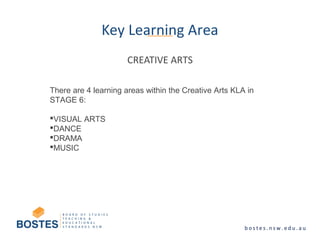
There are 4 learning areas within the Creative Arts KLA in
STAGE 6:
VISUAL ARTS
DANCE
DRAMA
MUSIC
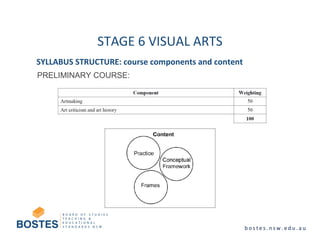
STAGE 6 VISUAL ARTS
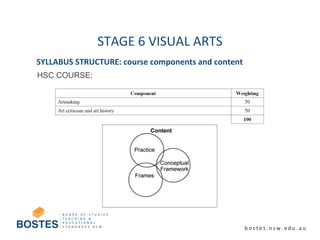
SYLLABUS STRUCTURE: course components and content
PRELIMINARY COURSE:
STAGE 6 VISUAL ARTS
SYLLABUS STRUCTURE: course components and content
HSC COURSE:
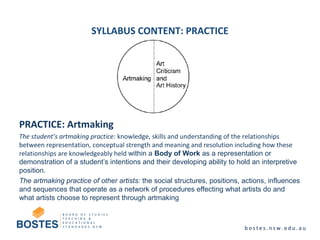
SYLLABUS CONTENT: PRACTICE
PRACTICE: Artmaking
The student’s artmaking practice: knowledge, skills and understanding of the relationships
between representation, conceptual strength and meaning and resolution including how these
relationships are knowledgeably held within a Body of Work as a representation or
demonstration of a student’s intentions and their developing ability to hold an interpretive
position.
The artmaking practice of other artists: the social structures, positions, actions, influences
and sequences that operate as a network of procedures effecting what artists do and
what artists choose to represent through artmaking
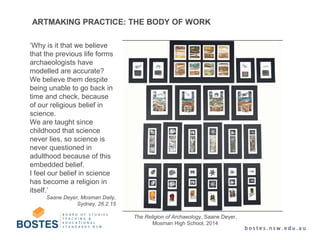
The Religion of Archaeology, Saane Deyer,
Mosman High School, 2014
ARTMAKING PRACTICE: THE BODY OF WORK
‘Why is it that we believe
that the previous life forms
archaeologists have
modelled are accurate?
We believe them despite
being unable to go back in
time and check, because
of our religious belief in
science.
We are taught since
childhood that science
never lies, so science is
never questioned in
adulthood because of this
embedded belief.
I feel our belief in science
has become a religion in
itself.’
Saane Deyer, Mosman Daily,
Sydney, 26.2.15
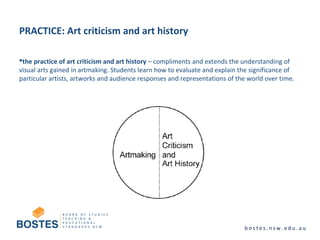
PRACTICE: Art criticism and art history
the practice of art criticism and art history – compliments and extends the understanding of
visual arts gained in artmaking. Students learn how to evaluate and explain the significance of
particular artists, artworks and audience responses and representations of the world over time.
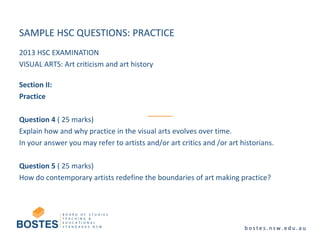
SAMPLE HSC QUESTIONS: PRACTICE
2013 HSC EXAMINATION
VISUAL ARTS: Art criticism and art history
Section II:
Practice
Question 4 ( 25 marks)
Explain how and why practice in the visual arts evolves over time.
In your answer you may refer to artists and/or art critics and /or art historians.
Question 5 ( 25 marks)
How do contemporary artists redefine the boundaries of art making practice?
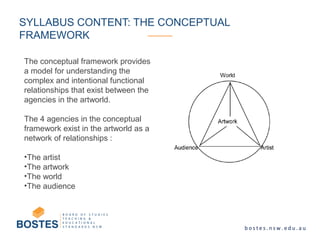
SYLLABUS CONTENT: THE CONCEPTUAL
FRAMEWORK
The conceptual framework provides
a model for understanding the
complex and intentional functional
relationships that exist between the
agencies in the artworld.
The 4 agencies in the conceptual
framework exist in the artworld as a
network of relationships :
•The artist
•The artwork
•The world
•The audience
ARTIST:
who is an artist, what do artists do, why and how do they do it
the practice of artists in different times and places
ARTWORK:
artworks as objects (material, physical, symbolic and virtual)
artworks as systems of representation, belief and imagination
categories of artworks; art, craft, design, 2D, 3D, 4D time based and muli-
modal and digital works and including categories of genre and diversity of
material practice
artwork as an outcome of practice as described by contextual circumstances
related to time and place
changing interpretations and explanations of artworks over time
THE CONCEPTUAL FRAMEWORK:
WORLD:
how the world is understood and represented in art
includes representations of experience class, ideology, age, events,
significance, theoretical positions, ideologies and philiosophies
possibilities
AUDIENCE:
as a body of critical consumers inclusive of art critics and art historians,
writers, teachers, students, entrepreneurs, patrons, collectors, members of
the public, gallery directors, dealers etc
the changing nature of audiences over time
the spaces where audiences are present – galleries, museums, public
spaces, on line
THE CONCEPTUAL FRAMEWORK:
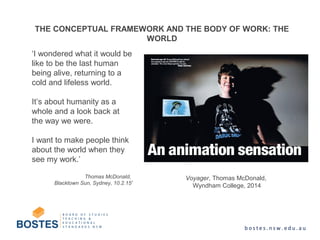
THE CONCEPTUAL FRAMEWORK AND THE BODY OF WORK: THE
WORLD
‘I wondered what it would be
like to be the last human
being alive, returning to a
cold and lifeless world.
It’s about humanity as a
whole and a look back at
the way we were.
I want to make people think
about the world when they
see my work.’
Thomas McDonald,
Blacktown Sun, Sydney, 10.2.15'
Voyager, Thomas McDonald,
Wyndham College, 2014
SAMPLE HSC QUESTIONS:
2013 HSC EXAMINATION
VISUAL ARTS: Art criticism and art history
Section II:
Conceptual Framework
Question 6 (25 marks)
‘Art is not what you see, but what you make others see…..’ Edgar Degas
Examine this statement with reference to a range of examples.
Question 7 ( 25 marks)
What is the role of art in public spaces?
In your answer you may refer to events, festivals, community projects, memorials,
street art, cyber works, site specific artworks and/or other examples.
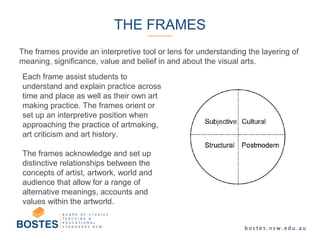
The frames provide an interpretive tool or lens for understanding the layering of
meaning, significance, value and belief in and about the visual arts.
THE FRAMES
Each frame assist students to
understand and explain practice across
time and place as well as their own art
making practice. The frames orient or
set up an interpretive position when
approaching the practice of artmaking,
art criticism and art history.
The frames acknowledge and set up
distinctive relationships between the
concepts of artist, artwork, world and
audience that allow for a range of
alternative meanings, accounts and
values within the artworld.
subjective frame: personal psychological experience
cultural frame: cultural and social meaning
structural frame: communication and the system of signs
postmodern frame: ideas which challenge mainstream values of histories and
ideas
THE FRAMES
THE FRAMESAND THE BODY OF WORK: STRUCTURAL FRAME
‘This sculpture required
me to experiment with
materials and methods I
had not previously used
(including alginate,
silicone, bitumen and
modelling compounds) a
process I found
enjoyable and absorbing
in spite of the darkness
of the subject matter.’
Alice Reti-Steel, Lithgow Mercury,
28.2.15
‘Sour Light Crude’, Alice Reti-Steel, Lithgow High School, 2014
THE FRAMES AND THE BODY OF WORK: STRUCTURAL FRAME
‘The 2010 Gulf of Mexico
spill continues to affect
that region, hence the oil
pool in my sculpture
mimics the shape of the
United States portion of
the north American land
mass.’
Alice Reti-Steel, Lithgow
Mercury, 28.2.15
‘Sour Light Crude’, Alice Reti-Steel, Lithgow High School, 2014
2013 HSC Examination
VISUAL ARTS: Art criticism and art history
Section II:
Frames
Question 8 (25 marks)
‘If I could say it in words, there would be no reason to paint.’ Edward Hopper
Discuss this statement with reference to how artists communicate concepts
using visual language.
Question 9 ( 25 marks)
Analyse how artworks represent and document cultural histories.
SAMPLE HSC QUESTIONS: FRAMES
Art Gallery Publications:
•AGNSW
http://www.artgallery.nsw.gov.au/research
/gallery-publications/
•MCA
http://www.mca.com.au/
•NGA
http://nga.gov.au/Publications/
•NGV
http://www.ngv.vic.gov.au/explore/publications/
KEY RESOURCES:
Data Bases:
Artstor
http://www.artstor.org/index.shtml
Oxford Art Online
http://www.oxfordartonline.com/public/;jsessionid=55731E77B808EF85693CDE
47C37F8BDC
KEY RESOURCES:
Data Bases:
Useful aggregating sites:
Yale University Library
http://guides.library.yale.edu/artsdatabases
AGNSW:
http://www.artgallery.nsw.gov.au/research/tools/
UWA:
http://guides.is.uwa.edu.au/history_art
KEY RESOURCES:
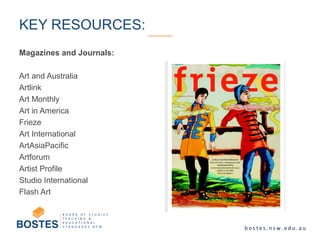
Magazines and Journals:
Art and Australia
Artlink
Art Monthly
Art in America
Frieze
Art International
ArtAsiaPacific
Artforum
Artist Profile
Studio International
Flash Art
KEY RESOURCES:
Textbooks:
Piper Press
http://www.piperpress.com.au/piperpress.com.au/Art_Books.html
Ariel Booksellers
http://www.arielbooks.com.au/
TASCHEN
http://www.taschen.com/?
utm_source=bingads&utm_medium=cpc&utm_campaign=taschen_uk
THAMES & HUDSON
http://thameshudson.com.au/
KEY RESOURCES:
GPO BOX 5300
CLARENCE ST
SYDNEY, 2001
EMAIL: rosemary.gorman@bostes.nsw.edu.au
PHONE NUMBER: 9367 8161
ROSEMARY GORMAN

Hsc froum2015 visual_arts

  • 1.
    SUBTITLE DAY, MONTH, YEAR VisualArts Syllabus STAGE 6 COURSE OVERVIEW LIBRARY RESOURCING ROSEMARY GORMAN BOARD INSPECTOR CREATIVE ARTS March, 2015
  • 2.
    CREATIVE ARTS Key LearningArea There are 4 learning areas within the Creative Arts KLA in STAGE 6: VISUAL ARTS DANCE DRAMA MUSIC
  • 3.
    STAGE 6 VISUALARTS SYLLABUS STRUCTURE: course components and content PRELIMINARY COURSE:
  • 4.
    STAGE 6 VISUALARTS SYLLABUS STRUCTURE: course components and content HSC COURSE:
  • 5.
    SYLLABUS CONTENT: PRACTICE PRACTICE:Artmaking The student’s artmaking practice: knowledge, skills and understanding of the relationships between representation, conceptual strength and meaning and resolution including how these relationships are knowledgeably held within a Body of Work as a representation or demonstration of a student’s intentions and their developing ability to hold an interpretive position. The artmaking practice of other artists: the social structures, positions, actions, influences and sequences that operate as a network of procedures effecting what artists do and what artists choose to represent through artmaking
  • 6.
    The Religion ofArchaeology, Saane Deyer, Mosman High School, 2014 ARTMAKING PRACTICE: THE BODY OF WORK ‘Why is it that we believe that the previous life forms archaeologists have modelled are accurate? We believe them despite being unable to go back in time and check, because of our religious belief in science. We are taught since childhood that science never lies, so science is never questioned in adulthood because of this embedded belief. I feel our belief in science has become a religion in itself.’ Saane Deyer, Mosman Daily, Sydney, 26.2.15
  • 7.
    PRACTICE: Art criticismand art history the practice of art criticism and art history – compliments and extends the understanding of visual arts gained in artmaking. Students learn how to evaluate and explain the significance of particular artists, artworks and audience responses and representations of the world over time.
  • 8.
    SAMPLE HSC QUESTIONS:PRACTICE 2013 HSC EXAMINATION VISUAL ARTS: Art criticism and art history Section II: Practice Question 4 ( 25 marks) Explain how and why practice in the visual arts evolves over time. In your answer you may refer to artists and/or art critics and /or art historians. Question 5 ( 25 marks) How do contemporary artists redefine the boundaries of art making practice?
  • 9.
    SYLLABUS CONTENT: THECONCEPTUAL FRAMEWORK The conceptual framework provides a model for understanding the complex and intentional functional relationships that exist between the agencies in the artworld. The 4 agencies in the conceptual framework exist in the artworld as a network of relationships : •The artist •The artwork •The world •The audience
  • 10.
    ARTIST: who is anartist, what do artists do, why and how do they do it the practice of artists in different times and places ARTWORK: artworks as objects (material, physical, symbolic and virtual) artworks as systems of representation, belief and imagination categories of artworks; art, craft, design, 2D, 3D, 4D time based and muli- modal and digital works and including categories of genre and diversity of material practice artwork as an outcome of practice as described by contextual circumstances related to time and place changing interpretations and explanations of artworks over time THE CONCEPTUAL FRAMEWORK:
  • 11.
    WORLD: how the worldis understood and represented in art includes representations of experience class, ideology, age, events, significance, theoretical positions, ideologies and philiosophies possibilities AUDIENCE: as a body of critical consumers inclusive of art critics and art historians, writers, teachers, students, entrepreneurs, patrons, collectors, members of the public, gallery directors, dealers etc the changing nature of audiences over time the spaces where audiences are present – galleries, museums, public spaces, on line THE CONCEPTUAL FRAMEWORK:
  • 12.
    THE CONCEPTUAL FRAMEWORKAND THE BODY OF WORK: THE WORLD ‘I wondered what it would be like to be the last human being alive, returning to a cold and lifeless world. It’s about humanity as a whole and a look back at the way we were. I want to make people think about the world when they see my work.’ Thomas McDonald, Blacktown Sun, Sydney, 10.2.15' Voyager, Thomas McDonald, Wyndham College, 2014
  • 13.
    SAMPLE HSC QUESTIONS: 2013HSC EXAMINATION VISUAL ARTS: Art criticism and art history Section II: Conceptual Framework Question 6 (25 marks) ‘Art is not what you see, but what you make others see…..’ Edgar Degas Examine this statement with reference to a range of examples. Question 7 ( 25 marks) What is the role of art in public spaces? In your answer you may refer to events, festivals, community projects, memorials, street art, cyber works, site specific artworks and/or other examples.
  • 14.
    The frames providean interpretive tool or lens for understanding the layering of meaning, significance, value and belief in and about the visual arts. THE FRAMES Each frame assist students to understand and explain practice across time and place as well as their own art making practice. The frames orient or set up an interpretive position when approaching the practice of artmaking, art criticism and art history. The frames acknowledge and set up distinctive relationships between the concepts of artist, artwork, world and audience that allow for a range of alternative meanings, accounts and values within the artworld.
  • 15.
    subjective frame: personalpsychological experience cultural frame: cultural and social meaning structural frame: communication and the system of signs postmodern frame: ideas which challenge mainstream values of histories and ideas THE FRAMES
  • 16.
    THE FRAMESAND THEBODY OF WORK: STRUCTURAL FRAME ‘This sculpture required me to experiment with materials and methods I had not previously used (including alginate, silicone, bitumen and modelling compounds) a process I found enjoyable and absorbing in spite of the darkness of the subject matter.’ Alice Reti-Steel, Lithgow Mercury, 28.2.15 ‘Sour Light Crude’, Alice Reti-Steel, Lithgow High School, 2014
  • 17.
    THE FRAMES ANDTHE BODY OF WORK: STRUCTURAL FRAME ‘The 2010 Gulf of Mexico spill continues to affect that region, hence the oil pool in my sculpture mimics the shape of the United States portion of the north American land mass.’ Alice Reti-Steel, Lithgow Mercury, 28.2.15 ‘Sour Light Crude’, Alice Reti-Steel, Lithgow High School, 2014
  • 18.
    2013 HSC Examination VISUALARTS: Art criticism and art history Section II: Frames Question 8 (25 marks) ‘If I could say it in words, there would be no reason to paint.’ Edward Hopper Discuss this statement with reference to how artists communicate concepts using visual language. Question 9 ( 25 marks) Analyse how artworks represent and document cultural histories. SAMPLE HSC QUESTIONS: FRAMES
  • 19.
  • 20.
    Data Bases: Artstor http://www.artstor.org/index.shtml Oxford ArtOnline http://www.oxfordartonline.com/public/;jsessionid=55731E77B808EF85693CDE 47C37F8BDC KEY RESOURCES:
  • 21.
    Data Bases: Useful aggregatingsites: Yale University Library http://guides.library.yale.edu/artsdatabases AGNSW: http://www.artgallery.nsw.gov.au/research/tools/ UWA: http://guides.is.uwa.edu.au/history_art KEY RESOURCES:
  • 22.
    Magazines and Journals: Artand Australia Artlink Art Monthly Art in America Frieze Art International ArtAsiaPacific Artforum Artist Profile Studio International Flash Art KEY RESOURCES:
  • 23.
  • 24.
    GPO BOX 5300 CLARENCEST SYDNEY, 2001 EMAIL: rosemary.gorman@bostes.nsw.edu.au PHONE NUMBER: 9367 8161 ROSEMARY GORMAN

Editor's Notes

  • #2 Tips Keep the title short This is a presentation, not an academic journal article. If you need more than five words to capture the main idea, it’s not the main idea. Here are some tips: use the sub-head to qualify or describe your title if necessary. Don’t use “BOSTES” in the title; that’s what the logo is for. Identify the date and audience There are a couple of reasons to include a date and audience. First, it’s polite to show you know who you are speaking to. Second, we use a single presentation on a number of occasions and this is a form of version control.
  • #3 Notes Focus on key messages Avoid unnecessary details  Organise points from the most to the least important Aim for three points per slide and six words per point Use graphs in your slides, images to complement your words Graphs provide a visual summary of data and are easy for the audience to process (column, pie, line etc) Flowcharts show relationships, milestones and processes Tables keep things neat (timelines, agenda items etc) A picture is worth a thousand words – consider using screenshots to show your point Videos allow you to show rather than tell, and can reinforce your message Make handouts from speaker notes
  • #10 Notes Focus on key messages Avoid unnecessary details  Organise points from the most to the least important Aim for three points per slide and six words per point Use graphs in your slides, images to complement your words Graphs provide a visual summary of data and are easy for the audience to process (column, pie, line etc) Flowcharts show relationships, milestones and processes Tables keep things neat (timelines, agenda items etc) A picture is worth a thousand words – consider using screenshots to show your point Videos allow you to show rather than tell, and can reinforce your message Make handouts from speaker notes
  • #15 Notes Focus on key messages Avoid unnecessary details  Organise points from the most to the least important Aim for three points per slide and six words per point Use graphs in your slides, images to complement your words Graphs provide a visual summary of data and are easy for the audience to process (column, pie, line etc) Flowcharts show relationships, milestones and processes Tables keep things neat (timelines, agenda items etc) A picture is worth a thousand words – consider using screenshots to show your point Videos allow you to show rather than tell, and can reinforce your message Make handouts from speaker notes
  • #16 Notes Focus on key messages Avoid unnecessary details  Organise points from the most to the least important Aim for three points per slide and six words per point Use graphs in your slides, images to complement your words Graphs provide a visual summary of data and are easy for the audience to process (column, pie, line etc) Flowcharts show relationships, milestones and processes Tables keep things neat (timelines, agenda items etc) A picture is worth a thousand words – consider using screenshots to show your point Videos allow you to show rather than tell, and can reinforce your message Make handouts from speaker notes
  • #19 Notes Focus on key messages Avoid unnecessary details  Organise points from the most to the least important Aim for three points per slide and six words per point Use graphs in your slides, images to complement your words Graphs provide a visual summary of data and are easy for the audience to process (column, pie, line etc) Flowcharts show relationships, milestones and processes Tables keep things neat (timelines, agenda items etc) A picture is worth a thousand words – consider using screenshots to show your point Videos allow you to show rather than tell, and can reinforce your message Make handouts from speaker notes
  • #25 Tips Include contact name, address, email address and phone number.