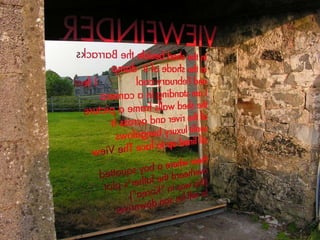
Public Art Practice  Cliodhna Shaffrey  Sarah Searson  Developed by Visual Artists Ireland  Hosted by Dublin City Council’s LAB  - November  2009
Outline for the  Day Session 1:  10.30 – 1.00 pm Current Contexts – Approaches to public art practices Cliodhna Shaffrey and Sarah Searson  1.00 -40  Lunch – Emma Clarke, Artist  Session 2:  1.40 – 3.30pm,  Proposals Claire Nidecker, Mark Garry and Theresa Nanigian  Session 3: 3.30pm -4.00pm  Discussion - Realizing a commission: Public, Audience, Communication
10.30   Current contexts  Approaches in public art practice: - New National Guidelines, (review) overview and implications.  Commission practices 11.20 -12.00  Case studies  Ten minute break   12.10    Mark Garry Artist presentation ­-considering dual contexts, audience, place and practice. 1.00 -1.40    Light lunch  1.40 -2.30   All about making proposals - Research  & Responding to proposals  Concepts and writing   Budgeting Presentation Assessment 2.30-3.00   Claire Nidecker ­ Artist Presentation   using images and visual presentation in your proposal ­ hints and tips. 3.00 -3.30   Theresa Nanigian ­ Artist presentation   3.30 ­ 4.00   Audience and context:   Introduction Ruairí Ó Cuív 15 -20 minute    4.00-4.30   Understanding organisations  Realisation of projects/work - getting things on the right path; mediation around projects; When things go wrong.   Q&A session chaired by Ruairí Ó Cuív, with Theresa Nanigan, Cliodhna Shaffrey, Claire Nidecker, Sarah Searson    
Session: 1 Current contexts  Approaches in public art practice: looking at current commissioning approaches and a range of artistic practices. considering: New National Guidelines, (review) overview and implications.  Commission practices: - temporary and permanent  Interdisciplinary work  Curatorial directions Inter-agencies and partnerships Cliodhna Shaffrey and Sarah Searson
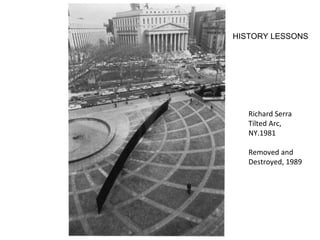
Richard Serra Tilted Arc, NY.1981 Removed and Destroyed, 1989 HISTORY LESSONS
The Tilted Arc, decision prompts general questions about public art, an increasingly controversial subject through the late 1980s and early 1990s in the U.S. and abroad. The role of government funding,  an artist's rights to his or her work, the role of the public in determining the value of a work of art, and whether public art should be judged by its popularity are all heatedly debated.  Serra's career continues to flourish, despite the controversy. "I don't think it is the function of art to be pleasing," he comments at the time. "Art is not democratic. It is not for the people.” Serra argued that his work was site-specific, but since the controversy others have argued that his work was not site-specific because it did not take the public as people (who used the space) into consideration.
SO WHAT IS IT FOR A WORK OF ART TO BE PUBLIC? Should the selection of art be driven by public taste? If a piece of public art is widely disliked by the community does that mean the art in question is  a failure? WHAT is the intention for the work? Who is the public?
It is not the job of art to reach consensus across different 'publics'. Dominic Thorpe Discussion on public art might start from the recognition that complete consensus is impossible because the public comprises of many different subspheres, organisations and institutions , each with many voices in terms of race, gender, ethnicity, sexuality and class.  Michael Kelly on the Serra and Lin cases It is art which is absolutely engaged with the world and this engagement often evokes spirited disagreement. Patricia C. Phillips
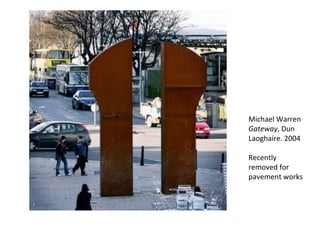
Michael Warren Gateway , Dun Laoghaire. 2004 Recently removed for pavement works
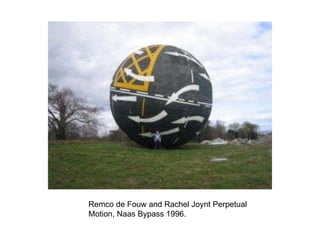
Remco de Fouw and Rachel Joynt Perpetual Motion, Naas Bypass 1996.
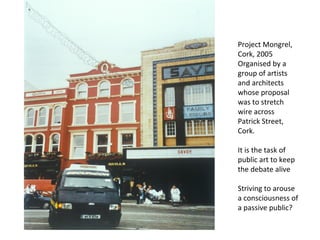
Project Mongrel, Cork, 2005 Organised by a group of artists and architects whose proposal was to stretch wire across Patrick Street, Cork. It is the task of public art to keep the debate alive Striving to arouse a consciousness of a passive public?
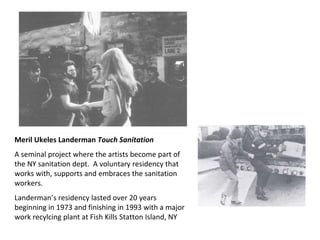
Meril Ukeles Landerman  Touch Sanitation   A seminal project where the artists become part of the NY sanitation dept.  A voluntary residency that works with, supports and embraces the sanitation workers. Landerman’s residency lasted over 20 years beginning in 1973 and finishing in 1993 with a major work recylcing plant at Fish Kills Statton Island, NY
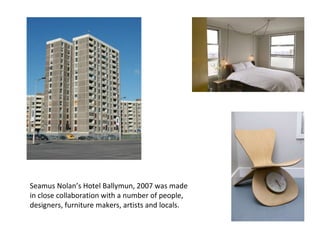
Seamus Nolan’s Hotel Ballymun, 2007 was made in close collaboration with a number of people, designers, furniture makers, artists and locals.
Patricia C. Phillips, former editor of Artforum Magazine writes:– 'public art excludes no media, materials, process or form, the work can be permanent or temporary, it can be commissioned through funding programmes, such as the percent for art scheme or initiated by artists requiring no sanction. With a broadening concept of public – it can happen almost anytime, with anyone and virtually anywhere…even in galleries, museums and private settings.  Public art is always art'.
‘  artists don’t have to jump through the hoops of the funders and commissioners, they must come into situations with their own INTENTIONS, and let the challenging process of negotiation begin. Ailbhe Murphy speaking at TRADE 07
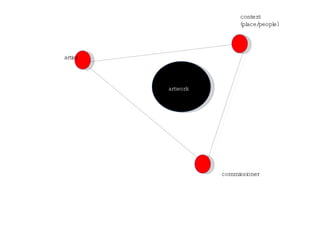
artist context (place/people) commissioner artwork
TRENDS LAST YEARS - Current Climate: BOOM– significant available funding and opportunities for artists.  RECESSION Policy on public art national guidelines – 2004 and current review. FREEDOM Local arts plans.  BUT NO MONEY NOW Public art specialists in local authorities (and their decline). MORE OF Artists-led initatives: Flexibility for artists’ responses – decorative, site, functional socially engaged, process-research, event, social Curated and programmatic approaches Off-site artistic programmes-  Growth in number of small-scale festivals and curated events Curated approach to commissioning  use of limited competition and direct commissions and the artists’ panel. Professionalisation of artists practice and MA and PhD in Public Art / Contemporary Art ARTISTISTIC PRACTICE  Situation – the specifics of context Intention –  the artists’ intention for the work / closeness to practice Awareness of audience and (people)/ different kinds of audiences;  Making demands on the public Embedded in contemporary arts practice and artist’s ethos An emphasis on the relational and more temporary artworks Books The re-imergence of sculpture / permanent work (inside/ unmonumental/ subversive with new material and technology)  Collaborative practice and interdisciplinary approaches Process  All art form disciplines
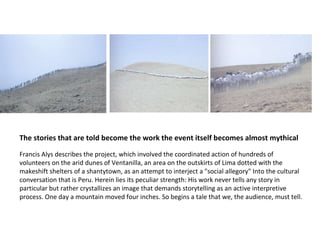
Francis Alys describes the project, which involved the coordinated action of hundreds of volunteers on the arid dunes of Ventanilla, an area on the outskirts of Lima dotted with the makeshift shelters of a shantytown, as an attempt to interject a "social allegory" Into the cultural conversation that is Peru. Herein lies its peculiar strength: His work never tells any story in particular but rather crystallizes an image that demands storytelling as an active interpretive process. One day a mountain moved four inches. So begins a tale that we, the audience, must tell. The stories that are told become the work the event itself becomes almost mythical
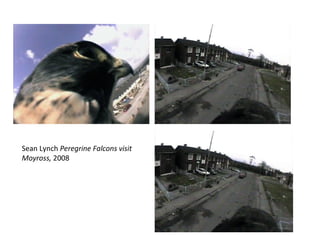
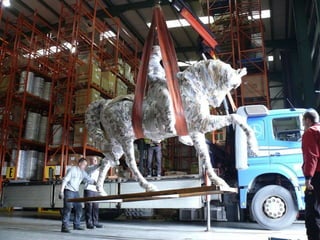
Sean Lynch  Peregrine Falcons visit Moyross,  2008
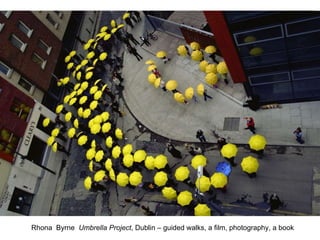
Rhona  Byrne  Umbrella Project , Dublin – guided walks, a film, photography, a book
 
CRITICAL DEBATES RAISED  you’re asked to do something on the margin: you don’t get the main space, you’re put in the corner.  Vito Acconci Essentialising communities  ( Miwon Kwon) Confining art to set agendas Artist as Ethnographer ( Hal Foster/ Miwon Kwon )  Exploitation of participants.  Grant Kestler  /  Miwon Kwon Education and improvement over  solidarity  Censorship  Clare Dorothy Addressing issues of ownership  –  Rick Lowe (Project Row Houses, Texas) How does public art  confront darker  or more painful complicated considerations and not miss opportunities to act in  solidarity?   Grant Kester Whose history is represented?  The lure of the local ( Lucy Lippard) nostalgic versions of place. Gentrification , displacement, cleaning up and the drive for marketing of place -  Malcolm Miles/  Roselyn Deutche/ Rebecca Solnit/ Ed Soja. Taste -  should the selection of art be driven by public taste
Grant Kester writes of a  a very different image of the artist; -  one defined in terms of open-ness, of listening and a willingness to accept dependence and intersubjective vulnerability. Simon  Sheike   there is no ideal generalized spectator,  people will encounter art with their own specific backgrounds, experiences and intentionalities  Simon Sheike,  In the Place of the Public Sphere? Or, the World in Fragments: http://www.republicart.net/disc/publicum/sheikh03_en.htm
Types of Practice & Levels of Engagement/ Ways of Working Artists who make work  with little/no involvement of others  except for technical expertise. Artists who  invite participation   Artists who  embed  themselves within the social fabric of a city or place.  Artists who work from  a collaborative basis  – effecting a kind of social sculpture.  Artists who  act as investigators/ researchers/ anthropologists   observing,  mapping  or tracking aspects of place or communities. From Clare Dorothy  –  Curating in the wrong place, where have all the penguines gone?
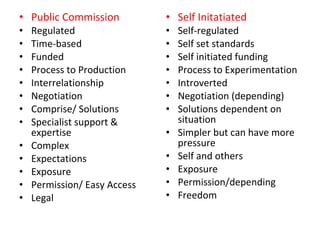
Public Commission Regulated Time-based Funded Process to Production Interrelationship Negotiation Comprise/ Solutions Specialist support & expertise Complex Expectations Exposure Permission/ Easy Access Legal Self Initatiated Self-regulated Self set standards Self initiated funding Process to Experimentation Introverted Negotiation (depending) Solutions dependent on situation Simpler but can have more pressure Self and others  Exposure Permission/depending Freedom
Public Art Cultures
Per Cent for Art  –Local Authorities; government bodies; Regeneration Schemes:  Structured  Arts Council  European Funding Local Authorities More ad hoc and self generated  Organisations and Agencies – Create, The National Sculture Factory, Sculpture Center  Arts Events and Festivals – Fringe, Galway Arts Festival Festival of World Cultures  Off-site projects of galleries and museums – Science Museum, Model Niland
Common per cent opportunities  Local Authority – Housing, Roads (NRA), Major engineering works  Education – Colleges, Schools  Heath Sector –Hospitals and health care  More occasionally – Marine, Defence  on a much more ad hoc basis
Ten  General Comments  The conditions for making Public Art in Ireland
In the UK – public art has been closely associated with development  With private developments where is has been made part of planning gain, with mixed results.  Ref ixia – debates  Ireland – hasn't really developed agencies of either serious calibre or high/broad value which allows for arms-length  programmatic approaches to developing public art.  Very directly embedded with in organisations  Eg Creative time, Artangle,  Situations. Questions about curatorial direction and competencies – difficulties in navigating , brokering organisational cultures are generally kept  in house Budgets through the per cent for art scheme do not adequately  provide for major physical or infrastructural interventions by artists – even with pooling  Artists in Ireland, and associated professional don't have a strong professional working relationships
Attitudes – One off projects  with problem solving – working on site or out of site coming mostly uniquely for each time the scheme is used, problematic rather than challenging. Relationship based on goodwill or organisational give, which can set up situations off parity or kilter,  seeing things evolve as ancillary.  Artists can be overwhelmed by trying to navigate processes, and not have the training, or experience to working effectively in teams are not included in overall project management early enough and are not driven through the process of manufacture at pace Artists are not the only creatives involved, lack of exposure to cross-disciplinary teams, can make compromise  feel like loss  There is a debate here – artists as creators, project managers, budget holders,  vs the UK – where there is a sense that artists are being removed from the process of making public art altogether


Public art is index-linked  in a more real and tangible way than any other sphere of funding in the Irish art world
New National Guide-lines for Public Art in Ireland  Inter-departmental Working Group  Concerns about priority in various Government Depts Difficulties – particularly with NRA about and round systemisation
Public Art Advisory Group - 2004 Mary McCarthy Deputy Director, European City of Culture – Cork  2005 Mary McDonagh Public Art Officer, Sligo County Council Tom de Paor Architect Declan McGonagle Artistic Director, City Arts Centre Caoimhín Mac Giolla Leith, Art Curator, Critic & Academic John Fairleigh Writer & Editor Catherine Nunes Artistic Director, International Dance Festival Jane O’Leary Composer & Director of Concorde Ensemble Mick Hannigan Director of Cork Film Festival Maureen Kennelly Arts Consultant
Key Outcomes  2004 Time Early Integration  Artistic Advice  Artists’ Brief – A clear, researched and unambiguous brief creates a clear Responsibility of the Commissioning Body and Support Staff Pooling of Finance  Broaden Artfroms  Process of selection
Public Art Advisory Group - 2009 Chaired by Sarah Glennie, Director of the Irish Film Institute. Rhona Byrne, visual artist Ciaran Taylor, performer ElaineAgnew, composer Rionach Ni Neill, dancer Philip Delamere, artsofficer Ruaidh O’Cuiv, public art manager,  Siobhan Geoghegan, Common Ground, Toby Dennett, Operations Manager,  Monica Corcoran, Local Government Public art Jenny Haughton.
Expected Key Outcomes The Brief  - Moving away from structured briefs much broader understanding  to drive the process  A vision drives the process – perhaps more curatorial drive  With associated implications  Much broader in its scope of artfroms  - particularly more programmatic approach Use of Professional development or artfrom agencies to produce work  Less rigid and more fluid
Current Climate – concern about how the guidelines link into the operational realties of organisations  Greater need for financial transparency  Understanding about value for money  Community Engagement  The role of the artists Procurement – issues
What is under threat – in the current climate  The ability to pursue long-term principles and goals – the critical mass to be well embedded. Develop and promote a culture of risk-taking or leadership (under-the-radar)  ref Limerick Maintain commitment to providing specialist staff  and support Good enough attitude – weak leadership, vision drive, failure to back quality Erosion of retain capacity, organisational memory  Failure to mix-it up large quality work, with smaller projects  Compound existing cultures – lack of faith
Approaches  Geographical, Ground Up – Clare, work in Sligo  ArtForm Development  - broader inclusion eg Wexford but also opportunites to commission – eg InContext Developing from Political Premise – Electoral Wards – Dun Laoghaire Regeneration – Re-imaging Cavan (Lead by an architectural ) Responsive to defined context – low on artist driven cultures  Seamus Nolan – or Paddy Paddy Bloomer and Nicky Keogh
 
Public art panel – Mayo County Council  Programmatic approach to public art  - Ballymun Direct commissioning – Office of  Public Works  Procurement procedures  - Dept of Defence  Mix of these  What tends to drive these approaches  Familiarity with the process,  Having expertise and confidence  Budgets Range  or of concerns – from a desire for engagement with an artist to a sense of entitlement
Key process and committees – and the  background people  SPC – Special Policy Committee  Local Area Committee  Council Meeting  Public art working group  Public art selection group Selection Panels  Community Representations Political  Representation  Artistic Representation  Area expertise  eg an architect, engineer or other associated person – such as head of school
Where is the funding going  Publications  Launches  Project management costs  Some Staff costs  Project budgets Other expertise  Selection committees Mediation  Education and Outreach Evaluations
Mayo – an approach to public art
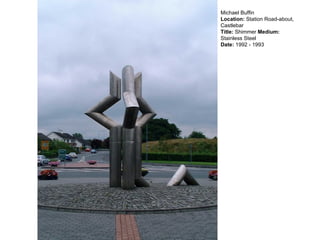
Michael Buffin Location:  Station Road-about, Castlebar Title:  Shimmer  Medium:  Stainless Steel Date:  1992 - 1993
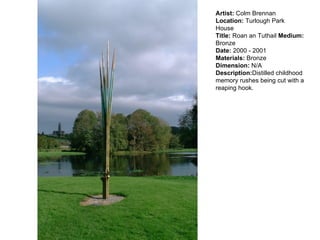
Artist:  Colm Brennan  Location:  Turlough Park House  Title:  Roan an Tuthail  Medium:  Bronze Date:  2000 - 2001 Materials:  Bronze Dimension:  N/A Description: Distilled childhood memory rushes being cut with a reaping hook.
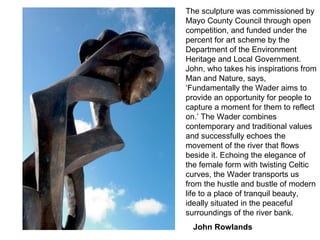
The sculpture was commissioned by Mayo County Council through open competition, and funded under the percent for art scheme by the Department of the Environment Heritage and Local Government. John, who takes his inspirations from Man and Nature, says, ‘Fundamentally the Wader aims to provide an opportunity for people to capture a moment for them to reflect on.’ The Wader combines contemporary and traditional values and successfully echoes the movement of the river that flows beside it. Echoing the elegance of the female form with twisting Celtic curves, the Wader transports us from the hustle and bustle of modern life to a place of tranquil beauty, ideally situated in the peaceful surroundings of the river bank. John Rowlands
Mayo County Council has been extremely proactive in applying funding made available under the Department of the Environment's Percent for Art Scheme for the commissioning of Public Art. With a developmental approach towards Public Art policy the Council endeavours to represent national best practice. To date, there has been a tradition of site specific, permanent sculptural works. Therefore to reflect current best practice, as outlined in  Public Art: Per Cent for art Scheme - General National Guidelines 2004, it is now the council's intention to develop a wider range of both commissioning practices and to encourage a wider diversity of contemporary art forms where applicable. The Public Art Programme will also reflect the guiding principles of the Strategic Arts Plan 2003-2006 for Mayo County Council, of quality, inclusion, access and long-term value.
What's the back story – why form a panel again  Inherited a system and reinvented – architecture  and engineer freedom  Where there has been a culture of ad hoc-ness it protects through systems  The panel can set the tone and direction for a process – without committee It limits the number and scope of artists that they intend to work with It offers security for the arts service – meaning that the artists they will be working with are defined
Mayo County Council Public Art Panel Forming pannel – three experts – Visual, Music and Literature  300 application for inclusion on the panel  60 -70 Short-listed  By far the largest percentage are from a Visual background  Other artforms are emerging to be less competitive – due to a desire to include them Looking for people who are interested in smaller commission  All experts vote – meaning that the person with specific knowledge can be out numbered  - propsals in mind
Not open to application – set its limits Can offer opportunities for risk taking  Opportunity to quietly form an approach Under the radar.  Change through due process
A F T E R   Responding to a  changing landscape Leitrim and Roscommon 2008 www.after.ie
AFTER is a landmark public art event that addresses the unprecedented effects of Ireland’s recent economic boom on the rural landscape.  It was initiated through the TRADE programme run by Roscommon and Leitrim arts offices and has grown into an artist-led public art event.  Acclaimed international artist Alfredo Jaar facilitated exchange and discussion among the five AFTER artists during a year-long engagement as part of a residency.  The project developed an alternative and innovative model for arts practice, which benefits from the artists’ specific knowledge of their respective locales and their shared concerns for the environment.  
The scope of the five combined AFTER project saw them address diverse publics and locations across the Roscommon and Leitrim region and beyond. Each project manifested different strategies both in conceptualizing and engaging with the idea of “the public”.  
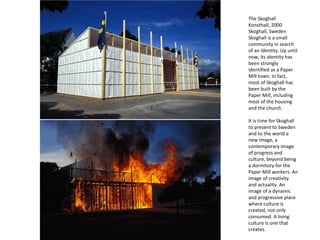
The Skoghall Konsthall, 2000 Skoghall, Sweden Skoghall is a small community in search of an identity. Up until now, its identity has been strongly identified as a Paper Mill town. In fact, most of Skoghall has been built by the Paper Mill, including most of the housing and the church. It is time for Skoghall to present to Sweden and to the world a new image, a contemporary image of progress and culture, beyond being a dormitory for the Paper Mill workers. An image of creativity and actuality. An image of a dynamic and progressive place where culture is created, not only consumed. A living culture is one that creates.
 
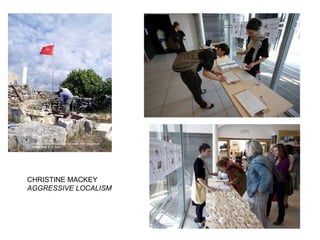
CHRISTINE MACKEY AGGRESSIVE LOCALISM
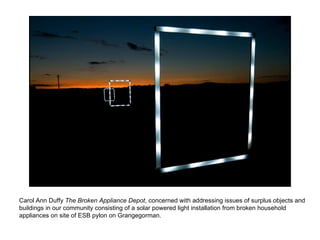
Carol Ann Duffy  The Broken Appliance Depot , concerned with addressing issues of surplus objects and buildings in our community consisting of a solar powered light installation from broken household appliances on site of ESB pylon on Grangegorman.
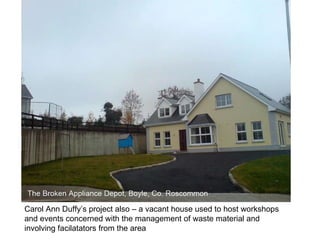
Carol Ann Duffy’s project also – a vacant house used to host workshops and events concerned with the management of waste material and involving facilatators from the area
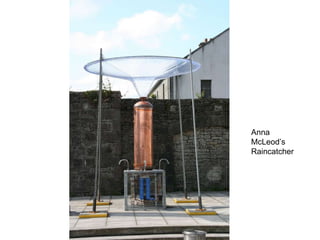
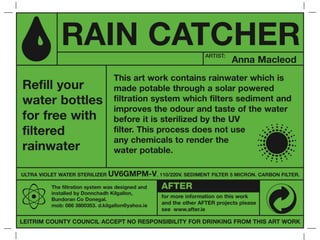
Anna McLeod’s Raincatcher
 
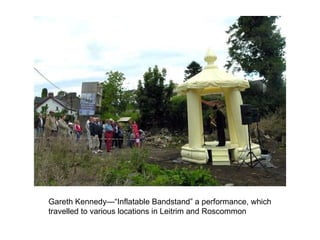
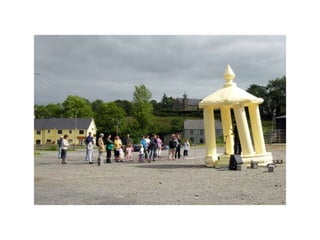
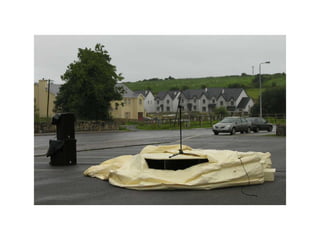
Gareth Kennedy—“Inflatable Bandstand” a performance, which travelled to various locations in Leitrim and Roscommon  


Mark Garry
1.50 -2.30 All about making proposals
RESEARCH AND RESPONDING
IN PUBLICLY FUNDED COMMISSIONS THERE IS USUALLY A BRIEF The BRIEF  is often the starting point.  Different Commissions seek or call for different responses.
THE RESPONSIBILITY OF THE BRIEF IS TO GIVE ARTISTS CLEAR GUIDANCE WITHOUT LIMITING POTENTIAL AND AT THE SAME TIME TO BE HONEST AND FAIR.  DIFFERENT TYPES OF BRIEFS F ocused briefs asking for specific responses Often for site specific, permanent works or particular medium.  Roads, Schools, Airports. Open with appar ant greater  artistic freedom i.e they offer flexibility in reponse.  Local authority Programmes: In Context, S. Dublin/ Wicklow/ Breaking Ground Writing your own brief:  You determine process and outcomes  –  e.g. Fingal County Council
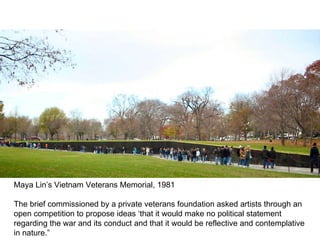
Maya Lin’s Vietnam Veterans Memorial, 1981 The brief commissioned by a private veterans foundation asked artists through an open competition to propose ideas ‘that it would make no political statement regarding the war and its conduct and that it would be reflective and contemplative in nature.”
UNDERSTAND HOW YOU LIKE TO WORK  - WHAT YOU ENJOY IN YOUR PRACTICE WHAT ARE THE INTENTIONS FOR YOUR WORK AND CONSIDER YOUR RESPONSIBILITIES & PUSH YOUR AMBITIONS.  BE CRITICAL ASK FOR PEER FEEDBACK AND CONSIDER WORKABILITY OF YOUR IDEAS.
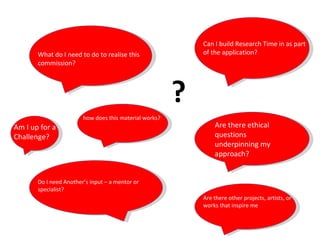
What do I need to do to realise this commission? Can I build Research Time in as part of the application?  Do I need Another’s input – a mentor or specialist?  Are there ethical questions underpinning my approach? Am I up for a Challenge?  Are there other projects, artists, or works that inspire me  ? how does this material works?
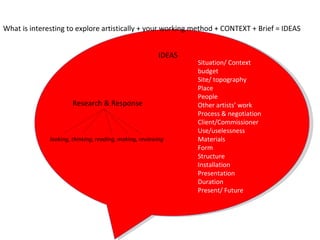
IDEAS What is interesting to explore artistically + your working method + CONTEXT + Brief = IDEAS Research & Response Situation/ Context budget Site/ topography Place People Other artists’ work Process & negotiation Client/Commissioner Use/uselessness Materials Form Structure Installation Presentation Duration Present/ Future looking, thinking, reading, making, reviewing
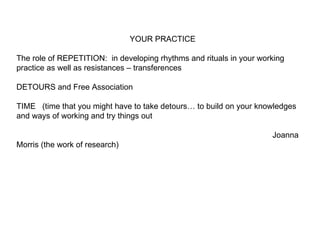
YOUR PRACTICE The role of REPETITION:  in developing rhythms and rituals in your working practice as well as resistances – transferences DETOURS and Free Association TIME  (time that you might have to take detours… to build on your knowledges and ways of working and try things out  Joanna Morris (the work of research)
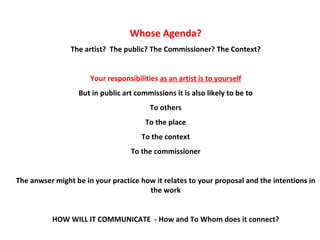
Whose Agenda? The artist?  The public? The Commissioner? The Context? Your responsibilities  as an artist is to yourself But in public art commissions it is also likely to be to To others To the place To the context To the commissioner T he anwser might be in your practice how it relates to your proposal and the intentions in the work HOW WILL IT COMMUNICATE  - How and To Whom does it connect?
RESPONDING TO A COMMISSION It is tempting to apply because there is money on offer, but only do so if you feel that the commission / public art project is appropriate to your practise and you have good ideas.  Do not compromise your artistic practice when making proposals (especially for public art commissions) by changing what you are and what you do for the sake of gaining an opportunity. Many public art commissions require a context specific element (reflecting the community of place and interest) and generic projects – i.e. producing work which could happen anywhere at anytime have less chance of being successful.  The key is to find a connection between your work and practice to the context be it the people, geography, nature of the place, identity, fiction, etc Collaborative practise – working with other artists or across artform / or with communities can prove very fulfilling.  These require specialist expertise and approaches to working.  Consider working with other experts both artistic and others depending on the commission
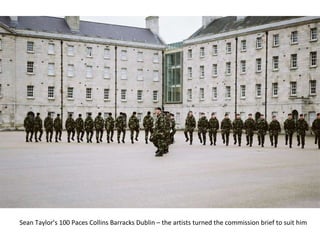
Sean Taylor’s 100 Paces Collins Barracks Dublin – the artists turned the commission brief to suit him
 
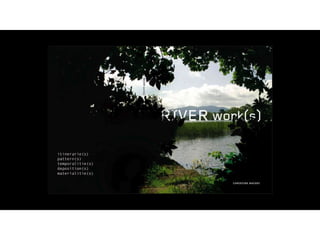
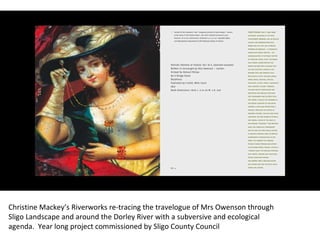
Christine Mackey’s Riverworks re-tracing the travelogue of Mrs Owenson through Sligo Landscape and around the Dorley River with a subversive and ecological agenda.  Year long project commissioned by Sligo County Council
approaches to commissions Permanent and Temporary Artworks  Require thinking about the concept and impacts Permanent work often requires the main conceptual process to take place by submission stage and therefore requires considerable working out prior to submission. Temporary work requires setting out ideas and approaches without being necessarily providing defined outcomes and impacts but that does not mean to say that ambitions and process cannot be clearly defined. B oth the above depend on the commissioner’s culture.
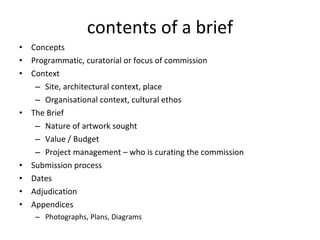
contents of a brief Concepts Programmatic, curatorial or focus of commission Context Site, architectural context, place Organisational context, cultural ethos The Brief Nature of artwork sought Value / Budget Project management  –  who is curating the commission Submission process Dates Adjudication Appendices Photographs, Plans, Diagrams
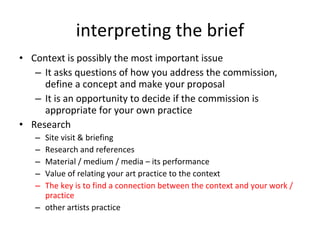
interpreting the brief Context is possibly the most important issue It asks questions of how you address the commission, define a concept and make your proposal It is an opportunity to decide if the commission is appropriate for your own practice  Research Site visit & briefing Research and references Material / medium / media  –  its performance Value of relating your art practice to the context The key is to find a connection between the context and your work / practice other artists practice
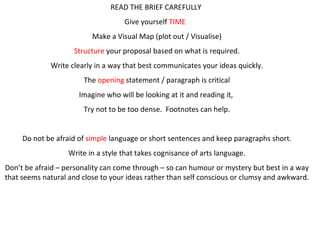
READ THE BRIEF CAREFULLY  Give yourself  TIME  Make a Visual Map (plot out / Visualise) Structure  your proposal based on what is required. Write clearly in a way that best communicates your ideas quickly. The  opening  statement / paragraph is critical Imagine who will be looking at it and reading it,  Try not to be too dense.  Footnotes can help. Do not be afraid of  simple  language or short sentences and keep paragraphs short. Write in a style that takes cognisance of arts language. Don’t be afraid – personality can come through – so can humour or mystery but best in a way that seems natural and close to your ideas rather than self conscious or clumsy and awkward.
Get someone else (a peer / another artist) to read your proposal If you hate writing – get someone else to write for you but check everything. REMEMBER -  WRITING/ Sketching out IS A PROCESS   Ideas Come in this Process Clarity  emerges when you write and helps structure your thoughts, ideas occur. Check all requirements  – what you have been asked for. Edit your material well, especially reference to your recent/past work – Keep the shit detector fully functioning. Do not submit more than you are asked for.  Do not submit too little to allow fair assessment Make it joyful, easy to move through, thoughtful and clear
W r i t I n g  a  P r o p o s a l/ HEADINGS Title: Description:   About your proposal/  concepts  and thoughts behind it, research methodologies.  what you want to do, what it will involve, theoretical underpinning of concepts. Context:   The context for this work – social, physical, geographic, multi-sited, virtual etc. Research & Development People (this might be collaborators or other expertise) Audience/ Participants Costs: Materials / Media –  Location: Mediation Documentation Evaluation Networks / future possibilities for the project.  Maintenance  (outlne as required) Technical details  (specific as required). Timeframe Visuals  might intersperse with your text in a way that makes it more lively and engaging.
 
finance Budget Make sure you stay within budget  Unless you have proven funding from other sources  Breakdown of budget Artist’s Fees Other professional fees  –  seeking quotes Material and Production Costs – with analysis Transport and installation costs Insurances  Contingency  Vat if relevant (need to check if fee is VAT inclusive)
Artists Fees artists' fees are tricky one  Its difficult to provide any concrete guidance.  Fees are generally not separated out from the total project budget and so artists have to to estimate their own fee based on overall costs. One recommendation puts artists fees between 20 - 25% of the total budget.
However, in reality the artists fee often gets eaten up by the production costs and in some cases artists have come away with no fee or very little.  Artists should ensure that they are paid properly for undertaking the project.  Commissioners should be aware of looking after artists fees
THE SELECTION PROCESSES A small group of people select a work of art and decide in the name of the public what its art should be. It is a democratic process Generally selection panels consist of a mix of representative of the commissioners, artistic experts, community representatives, politicians, etc. Selection criteria becomes a guiding bases for making decisions. Things like quality of ideas, imagination, appropriateness, the unexpected alongside technical issues and keeping within budget and workability of your proposal are all criteria on which decisions are reached.
Working through commissions
Become a project strategist  Beginning well  tone/ ideal/ set up  Middle - working through  solving problems and  managing changes and people End - handing back wrap-up, moving on – most  important legacy
Key Areas to think about – the artists and their clients  Agreements and contracts Understand or get a sense of your client – and their commitment  Comprise and its role within the project  Meetings and contacts – time  Self management  (self sufficient, support, time and focus for making/production) Articulating change – two way
Do as much  possible pre-contract to set the tone for the project
Use your own professional resources – peers, artists, resource organisations. Push agendas and go for the idea and concept  - stand firm and when to give in or see another way (comprise - walk away)  Track and Review the experience gained and the project work
Getting Started  Sort out all the nuts and bolts at the beginning  - thinking deep into the project.  Straight lines and the curve balls – project mapping. Set the conditions for right and good working – clarify the ways you work and the way the commissioner works Work on  developed relationships not goodwill-  spending time here will offer capacity to work through pressures.  Essentially here you are look for mutual definition.  Understand your needs and your gaps and communicate them Take time to demystify – decloud the process – primarily for yourself
Communicate – do not be afraid drive home knowledge or skills gaps Pinpoint where you think the pressure points are Conceptual changes  Time-lines Public engagement  Budgets Press, marketing, public speaking and so on  Ask and talk about the pressure points from the commissioners Time and availability  Supports offered  Expected contractions  Wider organisational cultures  Focused meetings to talk a lot about the project and round the work so you both get to understand the context. Every effort to remove/ shift Power dynamics should taken  Work towards directional power – so the focus is on problem solving
Getting the relationships right for you or at least understanding contexts Clarity and communications – two way – agreement here How and who will you be expected to work with? Can you have a direct liaison person, what is the scope of their decision making powers Do you want this named in the contract Are there protocols about contacting other key people within the organisation? Managing expectations – flag issues, in advance – be clear with the organisation the impact of their decisions.  Perform managing yourself well – this is not painful
Contracts  Good contracts should protect the interests of the commissioners and the artist.  Generally the contract is issued by the commissioner – if this is not forthcoming write your own... Hints and tips Talk with other artists  Always have a pre-contract meeting – do not be passive about the contract. Look for the key things of importance to you to be included the contract eg Be clear and happy with the contents – no matter how confident of the goodwill of your key lesion person
Contractual Issues Permanent Works (fixed and one off copies) Maintenance, decommissioning, ownerships Lending and touring of works Storage  Budget over runs or savings  Index-links Books CDs DVDS (and other multiples) Projects and Residencies (outcomes) Live Art / Performance The payment schedules - chashflow Tax Clearance Cert –  www.revenue.ie   Insurances Royalties
ownership of work Contract and agreements should consider ownership of work. The commissioner who pays for the work usually has ownership of the work with copyright remaining with the creator.  This really needs talking through  in the case of multiple copies such as a photographic series or recordings an agreement should clarify what the commissioner can assume ownership of – e.g. one set of photographs. notes, writings, sketches and drawings relating to the works process remains with the artist unless otherwise agreed with the commissioner as part of the contract
What are the main things to think about set in train?
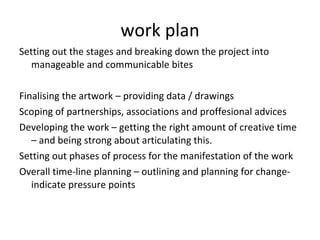
work plan Setting out the stages and breaking down the project into manageable and communicable bites  Finalising the artwork – providing data / drawings Scoping of partnerships, associations and proffesional advices  Developing the work – getting the right amount of creative time – and being strong about articulating this.  Setting out phases of process for the manifestation of the work Overall time-line planning – outlining and planning for change- indicate pressure points
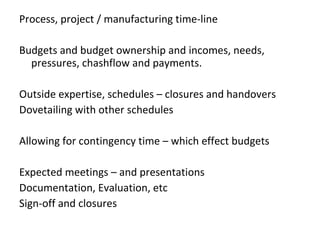
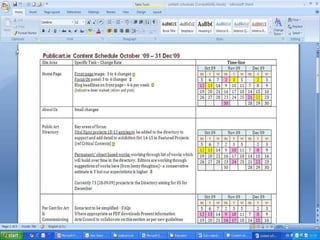
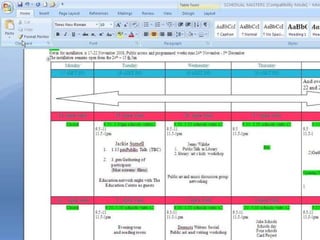
Process, project / manufacturing time-line Budgets and budget ownership and incomes, needs, pressures, chashflow and payments. Outside expertise, schedules – closures and handovers  Dovetailing with other schedules  Allowing for contingency time – which effect budgets  Expected meetings – and presentations  Documentation, Evaluation, etc Sign-off and closures
 
 
Copyright things you can do to support protection
Copyright gives protection and rights for reproduction. all forms and media are eligible for copyright protection as long as they are original. ideas and principles underlying a work are not protected. Copyright arises spontaneously on creation of a work there is no registration  required. misunderstandings as to ownership can arise when a work is commissioned. commissioners often assume that because they paid for the work, they own the copyright.  This is not the case the copyright remains with the artist unless it is assigned to the commissioner in a written agreement. Commissioner has the right to use the work for which it was commissioned
maintenance and decommissioning Maintenance should have been thought out together in advance Providing a maintenance instructions, or key technical personal indicate a time-line  Decommissioning and re-siting  A real issue for some commissioners and commissions
documentation and evaluation Documentation is very valuable for the artist and is often required by the commissioners Photography or DVD  Catalogue or Publication Recording the Process  Statements and Analysis Websites, blogs
evaluation Commissioners often want evaluation, particularly of process based commissions Best to set this up at start Visual or film record of the work Analysis: Statement from different parties Impacts: Artist, Public / Clients Mapping  Critical reflection
Mediation  To really consider how the concepts are communicated – written and visual  Interaction with your work  To whom they are communicated and how – this can range from communities – local and specialised  Back with the commissioning organisation  Projects in assocatiation with your work, residency so on
Outreach, education  Thinking through this – dont forget outsourse!
things that can go wrong Finance Technical challenges Relationships Commissioners  Public / Clients Ownership Censorship Collaborations Audience  The unexpected Expectations not considered

Public Art Dublin 2009

  • 1.
    Public Art Practice Cliodhna Shaffrey Sarah Searson Developed by Visual Artists Ireland Hosted by Dublin City Council’s LAB - November 2009
  • 2.
    Outline for the Day Session 1: 10.30 – 1.00 pm Current Contexts – Approaches to public art practices Cliodhna Shaffrey and Sarah Searson 1.00 -40 Lunch – Emma Clarke, Artist Session 2: 1.40 – 3.30pm, Proposals Claire Nidecker, Mark Garry and Theresa Nanigian Session 3: 3.30pm -4.00pm Discussion - Realizing a commission: Public, Audience, Communication
  • 3.
    10.30   Current contexts Approaches in public art practice: - New National Guidelines, (review) overview and implications.  Commission practices 11.20 -12.00  Case studies Ten minute break   12.10    Mark Garry Artist presentation ­-considering dual contexts, audience, place and practice. 1.00 -1.40    Light lunch 1.40 -2.30   All about making proposals - Research  & Responding to proposals  Concepts and writing   Budgeting Presentation Assessment 2.30-3.00   Claire Nidecker ­ Artist Presentation   using images and visual presentation in your proposal ­ hints and tips. 3.00 -3.30   Theresa Nanigian ­ Artist presentation  3.30 ­ 4.00   Audience and context:   Introduction Ruairí Ó Cuív 15 -20 minute    4.00-4.30   Understanding organisations  Realisation of projects/work - getting things on the right path; mediation around projects; When things go wrong.   Q&A session chaired by Ruairí Ó Cuív, with Theresa Nanigan, Cliodhna Shaffrey, Claire Nidecker, Sarah Searson    
  • 4.
    Session: 1 Currentcontexts Approaches in public art practice: looking at current commissioning approaches and a range of artistic practices. considering: New National Guidelines, (review) overview and implications. Commission practices: - temporary and permanent Interdisciplinary work Curatorial directions Inter-agencies and partnerships Cliodhna Shaffrey and Sarah Searson
  • 5.
    Richard Serra TiltedArc, NY.1981 Removed and Destroyed, 1989 HISTORY LESSONS
  • 6.
    The Tilted Arc,decision prompts general questions about public art, an increasingly controversial subject through the late 1980s and early 1990s in the U.S. and abroad. The role of government funding, an artist's rights to his or her work, the role of the public in determining the value of a work of art, and whether public art should be judged by its popularity are all heatedly debated. Serra's career continues to flourish, despite the controversy. "I don't think it is the function of art to be pleasing," he comments at the time. "Art is not democratic. It is not for the people.” Serra argued that his work was site-specific, but since the controversy others have argued that his work was not site-specific because it did not take the public as people (who used the space) into consideration.
  • 7.
    SO WHAT ISIT FOR A WORK OF ART TO BE PUBLIC? Should the selection of art be driven by public taste? If a piece of public art is widely disliked by the community does that mean the art in question is a failure? WHAT is the intention for the work? Who is the public?
  • 8.
    It is notthe job of art to reach consensus across different 'publics'. Dominic Thorpe Discussion on public art might start from the recognition that complete consensus is impossible because the public comprises of many different subspheres, organisations and institutions , each with many voices in terms of race, gender, ethnicity, sexuality and class. Michael Kelly on the Serra and Lin cases It is art which is absolutely engaged with the world and this engagement often evokes spirited disagreement. Patricia C. Phillips
  • 9.
    Michael Warren Gateway, Dun Laoghaire. 2004 Recently removed for pavement works
  • 10.
    Remco de Fouwand Rachel Joynt Perpetual Motion, Naas Bypass 1996.
  • 11.
    Project Mongrel, Cork,2005 Organised by a group of artists and architects whose proposal was to stretch wire across Patrick Street, Cork. It is the task of public art to keep the debate alive Striving to arouse a consciousness of a passive public?
  • 12.
    Meril Ukeles Landerman Touch Sanitation A seminal project where the artists become part of the NY sanitation dept. A voluntary residency that works with, supports and embraces the sanitation workers. Landerman’s residency lasted over 20 years beginning in 1973 and finishing in 1993 with a major work recylcing plant at Fish Kills Statton Island, NY
  • 13.
    Seamus Nolan’s HotelBallymun, 2007 was made in close collaboration with a number of people, designers, furniture makers, artists and locals.
  • 14.
    Patricia C. Phillips,former editor of Artforum Magazine writes:– 'public art excludes no media, materials, process or form, the work can be permanent or temporary, it can be commissioned through funding programmes, such as the percent for art scheme or initiated by artists requiring no sanction. With a broadening concept of public – it can happen almost anytime, with anyone and virtually anywhere…even in galleries, museums and private settings.  Public art is always art'.
  • 15.
    ‘ artistsdon’t have to jump through the hoops of the funders and commissioners, they must come into situations with their own INTENTIONS, and let the challenging process of negotiation begin. Ailbhe Murphy speaking at TRADE 07
  • 16.
    artist context (place/people)commissioner artwork
  • 17.
    TRENDS LAST YEARS- Current Climate: BOOM– significant available funding and opportunities for artists. RECESSION Policy on public art national guidelines – 2004 and current review. FREEDOM Local arts plans. BUT NO MONEY NOW Public art specialists in local authorities (and their decline). MORE OF Artists-led initatives: Flexibility for artists’ responses – decorative, site, functional socially engaged, process-research, event, social Curated and programmatic approaches Off-site artistic programmes- Growth in number of small-scale festivals and curated events Curated approach to commissioning use of limited competition and direct commissions and the artists’ panel. Professionalisation of artists practice and MA and PhD in Public Art / Contemporary Art ARTISTISTIC PRACTICE Situation – the specifics of context Intention – the artists’ intention for the work / closeness to practice Awareness of audience and (people)/ different kinds of audiences; Making demands on the public Embedded in contemporary arts practice and artist’s ethos An emphasis on the relational and more temporary artworks Books The re-imergence of sculpture / permanent work (inside/ unmonumental/ subversive with new material and technology) Collaborative practice and interdisciplinary approaches Process All art form disciplines
  • 18.
    Francis Alys describesthe project, which involved the coordinated action of hundreds of volunteers on the arid dunes of Ventanilla, an area on the outskirts of Lima dotted with the makeshift shelters of a shantytown, as an attempt to interject a "social allegory" Into the cultural conversation that is Peru. Herein lies its peculiar strength: His work never tells any story in particular but rather crystallizes an image that demands storytelling as an active interpretive process. One day a mountain moved four inches. So begins a tale that we, the audience, must tell. The stories that are told become the work the event itself becomes almost mythical
  • 19.
    Sean Lynch Peregrine Falcons visit Moyross, 2008
  • 20.
    Rhona Byrne Umbrella Project , Dublin – guided walks, a film, photography, a book
  • 21.
  • 22.
    CRITICAL DEBATES RAISED you’re asked to do something on the margin: you don’t get the main space, you’re put in the corner. Vito Acconci Essentialising communities ( Miwon Kwon) Confining art to set agendas Artist as Ethnographer ( Hal Foster/ Miwon Kwon ) Exploitation of participants. Grant Kestler / Miwon Kwon Education and improvement over solidarity Censorship Clare Dorothy Addressing issues of ownership – Rick Lowe (Project Row Houses, Texas) How does public art confront darker or more painful complicated considerations and not miss opportunities to act in solidarity? Grant Kester Whose history is represented? The lure of the local ( Lucy Lippard) nostalgic versions of place. Gentrification , displacement, cleaning up and the drive for marketing of place - Malcolm Miles/ Roselyn Deutche/ Rebecca Solnit/ Ed Soja. Taste - should the selection of art be driven by public taste
  • 23.
    Grant Kester writesof a a very different image of the artist; - one defined in terms of open-ness, of listening and a willingness to accept dependence and intersubjective vulnerability. Simon Sheike there is no ideal generalized spectator, people will encounter art with their own specific backgrounds, experiences and intentionalities Simon Sheike, In the Place of the Public Sphere? Or, the World in Fragments: http://www.republicart.net/disc/publicum/sheikh03_en.htm
  • 24.
    Types of Practice& Levels of Engagement/ Ways of Working Artists who make work with little/no involvement of others except for technical expertise. Artists who invite participation Artists who embed themselves within the social fabric of a city or place. Artists who work from a collaborative basis – effecting a kind of social sculpture. Artists who act as investigators/ researchers/ anthropologists observing, mapping or tracking aspects of place or communities. From Clare Dorothy – Curating in the wrong place, where have all the penguines gone?
  • 25.
    Public Commission RegulatedTime-based Funded Process to Production Interrelationship Negotiation Comprise/ Solutions Specialist support & expertise Complex Expectations Exposure Permission/ Easy Access Legal Self Initatiated Self-regulated Self set standards Self initiated funding Process to Experimentation Introverted Negotiation (depending) Solutions dependent on situation Simpler but can have more pressure Self and others Exposure Permission/depending Freedom
  • 26.
  • 27.
    Per Cent forArt –Local Authorities; government bodies; Regeneration Schemes: Structured Arts Council European Funding Local Authorities More ad hoc and self generated Organisations and Agencies – Create, The National Sculture Factory, Sculpture Center Arts Events and Festivals – Fringe, Galway Arts Festival Festival of World Cultures Off-site projects of galleries and museums – Science Museum, Model Niland
  • 28.
    Common per centopportunities Local Authority – Housing, Roads (NRA), Major engineering works Education – Colleges, Schools Heath Sector –Hospitals and health care More occasionally – Marine, Defence on a much more ad hoc basis
  • 29.
    Ten GeneralComments The conditions for making Public Art in Ireland
  • 30.
    In the UK– public art has been closely associated with development With private developments where is has been made part of planning gain, with mixed results. Ref ixia – debates Ireland – hasn't really developed agencies of either serious calibre or high/broad value which allows for arms-length programmatic approaches to developing public art. Very directly embedded with in organisations Eg Creative time, Artangle, Situations. Questions about curatorial direction and competencies – difficulties in navigating , brokering organisational cultures are generally kept in house Budgets through the per cent for art scheme do not adequately provide for major physical or infrastructural interventions by artists – even with pooling Artists in Ireland, and associated professional don't have a strong professional working relationships
  • 31.
    Attitudes – Oneoff projects with problem solving – working on site or out of site coming mostly uniquely for each time the scheme is used, problematic rather than challenging. Relationship based on goodwill or organisational give, which can set up situations off parity or kilter, seeing things evolve as ancillary. Artists can be overwhelmed by trying to navigate processes, and not have the training, or experience to working effectively in teams are not included in overall project management early enough and are not driven through the process of manufacture at pace Artists are not the only creatives involved, lack of exposure to cross-disciplinary teams, can make compromise feel like loss There is a debate here – artists as creators, project managers, budget holders, vs the UK – where there is a sense that artists are being removed from the process of making public art altogether
  • 32.
  • 33.
  • 34.
  • 35.
  • 36.
    Public art isindex-linked in a more real and tangible way than any other sphere of funding in the Irish art world
  • 37.
    New National Guide-linesfor Public Art in Ireland Inter-departmental Working Group Concerns about priority in various Government Depts Difficulties – particularly with NRA about and round systemisation
  • 38.
    Public Art AdvisoryGroup - 2004 Mary McCarthy Deputy Director, European City of Culture – Cork 2005 Mary McDonagh Public Art Officer, Sligo County Council Tom de Paor Architect Declan McGonagle Artistic Director, City Arts Centre Caoimhín Mac Giolla Leith, Art Curator, Critic & Academic John Fairleigh Writer & Editor Catherine Nunes Artistic Director, International Dance Festival Jane O’Leary Composer & Director of Concorde Ensemble Mick Hannigan Director of Cork Film Festival Maureen Kennelly Arts Consultant
  • 39.
    Key Outcomes 2004 Time Early Integration Artistic Advice Artists’ Brief – A clear, researched and unambiguous brief creates a clear Responsibility of the Commissioning Body and Support Staff Pooling of Finance Broaden Artfroms Process of selection
  • 40.
    Public Art AdvisoryGroup - 2009 Chaired by Sarah Glennie, Director of the Irish Film Institute. Rhona Byrne, visual artist Ciaran Taylor, performer ElaineAgnew, composer Rionach Ni Neill, dancer Philip Delamere, artsofficer Ruaidh O’Cuiv, public art manager, Siobhan Geoghegan, Common Ground, Toby Dennett, Operations Manager, Monica Corcoran, Local Government Public art Jenny Haughton.
  • 41.
    Expected Key OutcomesThe Brief - Moving away from structured briefs much broader understanding to drive the process A vision drives the process – perhaps more curatorial drive With associated implications Much broader in its scope of artfroms - particularly more programmatic approach Use of Professional development or artfrom agencies to produce work Less rigid and more fluid
  • 42.
    Current Climate –concern about how the guidelines link into the operational realties of organisations Greater need for financial transparency Understanding about value for money Community Engagement The role of the artists Procurement – issues
  • 43.
    What is underthreat – in the current climate The ability to pursue long-term principles and goals – the critical mass to be well embedded. Develop and promote a culture of risk-taking or leadership (under-the-radar) ref Limerick Maintain commitment to providing specialist staff and support Good enough attitude – weak leadership, vision drive, failure to back quality Erosion of retain capacity, organisational memory Failure to mix-it up large quality work, with smaller projects Compound existing cultures – lack of faith
  • 44.
    Approaches Geographical,Ground Up – Clare, work in Sligo ArtForm Development - broader inclusion eg Wexford but also opportunites to commission – eg InContext Developing from Political Premise – Electoral Wards – Dun Laoghaire Regeneration – Re-imaging Cavan (Lead by an architectural ) Responsive to defined context – low on artist driven cultures Seamus Nolan – or Paddy Paddy Bloomer and Nicky Keogh
  • 45.
  • 46.
    Public art panel– Mayo County Council Programmatic approach to public art - Ballymun Direct commissioning – Office of Public Works Procurement procedures - Dept of Defence Mix of these What tends to drive these approaches Familiarity with the process, Having expertise and confidence Budgets Range or of concerns – from a desire for engagement with an artist to a sense of entitlement
  • 47.
    Key process andcommittees – and the background people SPC – Special Policy Committee Local Area Committee Council Meeting Public art working group Public art selection group Selection Panels Community Representations Political Representation Artistic Representation Area expertise eg an architect, engineer or other associated person – such as head of school
  • 48.
    Where is thefunding going Publications Launches Project management costs Some Staff costs Project budgets Other expertise Selection committees Mediation Education and Outreach Evaluations
  • 49.
    Mayo – anapproach to public art
  • 50.
    Michael Buffin Location: Station Road-about, Castlebar Title: Shimmer Medium: Stainless Steel Date: 1992 - 1993
  • 51.
    Artist: ColmBrennan Location: Turlough Park House Title: Roan an Tuthail Medium: Bronze Date: 2000 - 2001 Materials: Bronze Dimension: N/A Description: Distilled childhood memory rushes being cut with a reaping hook.
  • 52.
    The sculpture wascommissioned by Mayo County Council through open competition, and funded under the percent for art scheme by the Department of the Environment Heritage and Local Government. John, who takes his inspirations from Man and Nature, says, ‘Fundamentally the Wader aims to provide an opportunity for people to capture a moment for them to reflect on.’ The Wader combines contemporary and traditional values and successfully echoes the movement of the river that flows beside it. Echoing the elegance of the female form with twisting Celtic curves, the Wader transports us from the hustle and bustle of modern life to a place of tranquil beauty, ideally situated in the peaceful surroundings of the river bank. John Rowlands
  • 53.
    Mayo County Councilhas been extremely proactive in applying funding made available under the Department of the Environment's Percent for Art Scheme for the commissioning of Public Art. With a developmental approach towards Public Art policy the Council endeavours to represent national best practice. To date, there has been a tradition of site specific, permanent sculptural works. Therefore to reflect current best practice, as outlined in Public Art: Per Cent for art Scheme - General National Guidelines 2004, it is now the council's intention to develop a wider range of both commissioning practices and to encourage a wider diversity of contemporary art forms where applicable. The Public Art Programme will also reflect the guiding principles of the Strategic Arts Plan 2003-2006 for Mayo County Council, of quality, inclusion, access and long-term value.
  • 54.
    What's the backstory – why form a panel again Inherited a system and reinvented – architecture and engineer freedom Where there has been a culture of ad hoc-ness it protects through systems The panel can set the tone and direction for a process – without committee It limits the number and scope of artists that they intend to work with It offers security for the arts service – meaning that the artists they will be working with are defined
  • 55.
    Mayo County CouncilPublic Art Panel Forming pannel – three experts – Visual, Music and Literature 300 application for inclusion on the panel 60 -70 Short-listed By far the largest percentage are from a Visual background Other artforms are emerging to be less competitive – due to a desire to include them Looking for people who are interested in smaller commission All experts vote – meaning that the person with specific knowledge can be out numbered - propsals in mind
  • 56.
    Not open toapplication – set its limits Can offer opportunities for risk taking Opportunity to quietly form an approach Under the radar. Change through due process
  • 57.
    A F TE R Responding to a changing landscape Leitrim and Roscommon 2008 www.after.ie
  • 58.
    AFTER is alandmark public art event that addresses the unprecedented effects of Ireland’s recent economic boom on the rural landscape. It was initiated through the TRADE programme run by Roscommon and Leitrim arts offices and has grown into an artist-led public art event. Acclaimed international artist Alfredo Jaar facilitated exchange and discussion among the five AFTER artists during a year-long engagement as part of a residency. The project developed an alternative and innovative model for arts practice, which benefits from the artists’ specific knowledge of their respective locales and their shared concerns for the environment.  
  • 59.
    The scope ofthe five combined AFTER project saw them address diverse publics and locations across the Roscommon and Leitrim region and beyond. Each project manifested different strategies both in conceptualizing and engaging with the idea of “the public”.  
  • 60.
    The Skoghall Konsthall,2000 Skoghall, Sweden Skoghall is a small community in search of an identity. Up until now, its identity has been strongly identified as a Paper Mill town. In fact, most of Skoghall has been built by the Paper Mill, including most of the housing and the church. It is time for Skoghall to present to Sweden and to the world a new image, a contemporary image of progress and culture, beyond being a dormitory for the Paper Mill workers. An image of creativity and actuality. An image of a dynamic and progressive place where culture is created, not only consumed. A living culture is one that creates.
  • 61.
  • 62.
  • 63.
    Carol Ann Duffy The Broken Appliance Depot , concerned with addressing issues of surplus objects and buildings in our community consisting of a solar powered light installation from broken household appliances on site of ESB pylon on Grangegorman.
  • 64.
    Carol Ann Duffy’sproject also – a vacant house used to host workshops and events concerned with the management of waste material and involving facilatators from the area
  • 65.
  • 66.
  • 67.
    Gareth Kennedy—“Inflatable Bandstand”a performance, which travelled to various locations in Leitrim and Roscommon  
  • 68.
  • 69.
  • 70.
  • 71.
  • 72.
  • 73.
    1.50 -2.30 Allabout making proposals
  • 74.
  • 75.
    IN PUBLICLY FUNDEDCOMMISSIONS THERE IS USUALLY A BRIEF The BRIEF is often the starting point. Different Commissions seek or call for different responses.
  • 76.
    THE RESPONSIBILITY OFTHE BRIEF IS TO GIVE ARTISTS CLEAR GUIDANCE WITHOUT LIMITING POTENTIAL AND AT THE SAME TIME TO BE HONEST AND FAIR. DIFFERENT TYPES OF BRIEFS F ocused briefs asking for specific responses Often for site specific, permanent works or particular medium. Roads, Schools, Airports. Open with appar ant greater artistic freedom i.e they offer flexibility in reponse. Local authority Programmes: In Context, S. Dublin/ Wicklow/ Breaking Ground Writing your own brief: You determine process and outcomes – e.g. Fingal County Council
  • 77.
    Maya Lin’s VietnamVeterans Memorial, 1981 The brief commissioned by a private veterans foundation asked artists through an open competition to propose ideas ‘that it would make no political statement regarding the war and its conduct and that it would be reflective and contemplative in nature.”
  • 78.
    UNDERSTAND HOW YOULIKE TO WORK - WHAT YOU ENJOY IN YOUR PRACTICE WHAT ARE THE INTENTIONS FOR YOUR WORK AND CONSIDER YOUR RESPONSIBILITIES & PUSH YOUR AMBITIONS. BE CRITICAL ASK FOR PEER FEEDBACK AND CONSIDER WORKABILITY OF YOUR IDEAS.
  • 79.
    What do Ineed to do to realise this commission? Can I build Research Time in as part of the application? Do I need Another’s input – a mentor or specialist? Are there ethical questions underpinning my approach? Am I up for a Challenge? Are there other projects, artists, or works that inspire me ? how does this material works?
  • 80.
    IDEAS What isinteresting to explore artistically + your working method + CONTEXT + Brief = IDEAS Research & Response Situation/ Context budget Site/ topography Place People Other artists’ work Process & negotiation Client/Commissioner Use/uselessness Materials Form Structure Installation Presentation Duration Present/ Future looking, thinking, reading, making, reviewing
  • 81.
    YOUR PRACTICE Therole of REPETITION: in developing rhythms and rituals in your working practice as well as resistances – transferences DETOURS and Free Association TIME (time that you might have to take detours… to build on your knowledges and ways of working and try things out Joanna Morris (the work of research)
  • 82.
    Whose Agenda? Theartist? The public? The Commissioner? The Context? Your responsibilities as an artist is to yourself But in public art commissions it is also likely to be to To others To the place To the context To the commissioner T he anwser might be in your practice how it relates to your proposal and the intentions in the work HOW WILL IT COMMUNICATE - How and To Whom does it connect?
  • 83.
    RESPONDING TO ACOMMISSION It is tempting to apply because there is money on offer, but only do so if you feel that the commission / public art project is appropriate to your practise and you have good ideas. Do not compromise your artistic practice when making proposals (especially for public art commissions) by changing what you are and what you do for the sake of gaining an opportunity. Many public art commissions require a context specific element (reflecting the community of place and interest) and generic projects – i.e. producing work which could happen anywhere at anytime have less chance of being successful. The key is to find a connection between your work and practice to the context be it the people, geography, nature of the place, identity, fiction, etc Collaborative practise – working with other artists or across artform / or with communities can prove very fulfilling. These require specialist expertise and approaches to working. Consider working with other experts both artistic and others depending on the commission
  • 84.
    Sean Taylor’s 100Paces Collins Barracks Dublin – the artists turned the commission brief to suit him
  • 85.
  • 86.
    Christine Mackey’s Riverworksre-tracing the travelogue of Mrs Owenson through Sligo Landscape and around the Dorley River with a subversive and ecological agenda. Year long project commissioned by Sligo County Council
  • 87.
    approaches to commissionsPermanent and Temporary Artworks Require thinking about the concept and impacts Permanent work often requires the main conceptual process to take place by submission stage and therefore requires considerable working out prior to submission. Temporary work requires setting out ideas and approaches without being necessarily providing defined outcomes and impacts but that does not mean to say that ambitions and process cannot be clearly defined. B oth the above depend on the commissioner’s culture.
  • 88.
    contents of abrief Concepts Programmatic, curatorial or focus of commission Context Site, architectural context, place Organisational context, cultural ethos The Brief Nature of artwork sought Value / Budget Project management – who is curating the commission Submission process Dates Adjudication Appendices Photographs, Plans, Diagrams
  • 89.
    interpreting the briefContext is possibly the most important issue It asks questions of how you address the commission, define a concept and make your proposal It is an opportunity to decide if the commission is appropriate for your own practice Research Site visit & briefing Research and references Material / medium / media – its performance Value of relating your art practice to the context The key is to find a connection between the context and your work / practice other artists practice
  • 90.
    READ THE BRIEFCAREFULLY Give yourself TIME Make a Visual Map (plot out / Visualise) Structure your proposal based on what is required. Write clearly in a way that best communicates your ideas quickly. The opening statement / paragraph is critical Imagine who will be looking at it and reading it, Try not to be too dense. Footnotes can help. Do not be afraid of simple language or short sentences and keep paragraphs short. Write in a style that takes cognisance of arts language. Don’t be afraid – personality can come through – so can humour or mystery but best in a way that seems natural and close to your ideas rather than self conscious or clumsy and awkward.
  • 91.
    Get someone else(a peer / another artist) to read your proposal If you hate writing – get someone else to write for you but check everything. REMEMBER - WRITING/ Sketching out IS A PROCESS Ideas Come in this Process Clarity emerges when you write and helps structure your thoughts, ideas occur. Check all requirements – what you have been asked for. Edit your material well, especially reference to your recent/past work – Keep the shit detector fully functioning. Do not submit more than you are asked for. Do not submit too little to allow fair assessment Make it joyful, easy to move through, thoughtful and clear
  • 92.
    W r it I n g a P r o p o s a l/ HEADINGS Title: Description: About your proposal/ concepts and thoughts behind it, research methodologies. what you want to do, what it will involve, theoretical underpinning of concepts. Context: The context for this work – social, physical, geographic, multi-sited, virtual etc. Research & Development People (this might be collaborators or other expertise) Audience/ Participants Costs: Materials / Media – Location: Mediation Documentation Evaluation Networks / future possibilities for the project. Maintenance (outlne as required) Technical details (specific as required). Timeframe Visuals might intersperse with your text in a way that makes it more lively and engaging.
  • 93.
  • 94.
    finance Budget Makesure you stay within budget Unless you have proven funding from other sources Breakdown of budget Artist’s Fees Other professional fees – seeking quotes Material and Production Costs – with analysis Transport and installation costs Insurances Contingency Vat if relevant (need to check if fee is VAT inclusive)
  • 95.
    Artists Fees artists'fees are tricky one Its difficult to provide any concrete guidance. Fees are generally not separated out from the total project budget and so artists have to to estimate their own fee based on overall costs. One recommendation puts artists fees between 20 - 25% of the total budget.
  • 96.
    However, in realitythe artists fee often gets eaten up by the production costs and in some cases artists have come away with no fee or very little. Artists should ensure that they are paid properly for undertaking the project. Commissioners should be aware of looking after artists fees
  • 97.
    THE SELECTION PROCESSESA small group of people select a work of art and decide in the name of the public what its art should be. It is a democratic process Generally selection panels consist of a mix of representative of the commissioners, artistic experts, community representatives, politicians, etc. Selection criteria becomes a guiding bases for making decisions. Things like quality of ideas, imagination, appropriateness, the unexpected alongside technical issues and keeping within budget and workability of your proposal are all criteria on which decisions are reached.
  • 98.
  • 99.
    Become a projectstrategist Beginning well tone/ ideal/ set up Middle - working through solving problems and managing changes and people End - handing back wrap-up, moving on – most important legacy
  • 100.
    Key Areas tothink about – the artists and their clients Agreements and contracts Understand or get a sense of your client – and their commitment Comprise and its role within the project Meetings and contacts – time Self management (self sufficient, support, time and focus for making/production) Articulating change – two way
  • 101.
    Do as much possible pre-contract to set the tone for the project
  • 102.
    Use your ownprofessional resources – peers, artists, resource organisations. Push agendas and go for the idea and concept - stand firm and when to give in or see another way (comprise - walk away) Track and Review the experience gained and the project work
  • 103.
    Getting Started Sort out all the nuts and bolts at the beginning - thinking deep into the project. Straight lines and the curve balls – project mapping. Set the conditions for right and good working – clarify the ways you work and the way the commissioner works Work on developed relationships not goodwill- spending time here will offer capacity to work through pressures. Essentially here you are look for mutual definition. Understand your needs and your gaps and communicate them Take time to demystify – decloud the process – primarily for yourself
  • 104.
    Communicate – donot be afraid drive home knowledge or skills gaps Pinpoint where you think the pressure points are Conceptual changes Time-lines Public engagement Budgets Press, marketing, public speaking and so on Ask and talk about the pressure points from the commissioners Time and availability Supports offered Expected contractions Wider organisational cultures Focused meetings to talk a lot about the project and round the work so you both get to understand the context. Every effort to remove/ shift Power dynamics should taken Work towards directional power – so the focus is on problem solving
  • 105.
    Getting the relationshipsright for you or at least understanding contexts Clarity and communications – two way – agreement here How and who will you be expected to work with? Can you have a direct liaison person, what is the scope of their decision making powers Do you want this named in the contract Are there protocols about contacting other key people within the organisation? Managing expectations – flag issues, in advance – be clear with the organisation the impact of their decisions. Perform managing yourself well – this is not painful
  • 106.
    Contracts Goodcontracts should protect the interests of the commissioners and the artist. Generally the contract is issued by the commissioner – if this is not forthcoming write your own... Hints and tips Talk with other artists Always have a pre-contract meeting – do not be passive about the contract. Look for the key things of importance to you to be included the contract eg Be clear and happy with the contents – no matter how confident of the goodwill of your key lesion person
  • 107.
    Contractual Issues PermanentWorks (fixed and one off copies) Maintenance, decommissioning, ownerships Lending and touring of works Storage Budget over runs or savings Index-links Books CDs DVDS (and other multiples) Projects and Residencies (outcomes) Live Art / Performance The payment schedules - chashflow Tax Clearance Cert – www.revenue.ie Insurances Royalties
  • 108.
    ownership of workContract and agreements should consider ownership of work. The commissioner who pays for the work usually has ownership of the work with copyright remaining with the creator. This really needs talking through in the case of multiple copies such as a photographic series or recordings an agreement should clarify what the commissioner can assume ownership of – e.g. one set of photographs. notes, writings, sketches and drawings relating to the works process remains with the artist unless otherwise agreed with the commissioner as part of the contract
  • 109.
    What are themain things to think about set in train?
  • 110.
    work plan Settingout the stages and breaking down the project into manageable and communicable bites Finalising the artwork – providing data / drawings Scoping of partnerships, associations and proffesional advices Developing the work – getting the right amount of creative time – and being strong about articulating this. Setting out phases of process for the manifestation of the work Overall time-line planning – outlining and planning for change- indicate pressure points
  • 111.
    Process, project /manufacturing time-line Budgets and budget ownership and incomes, needs, pressures, chashflow and payments. Outside expertise, schedules – closures and handovers Dovetailing with other schedules Allowing for contingency time – which effect budgets Expected meetings – and presentations Documentation, Evaluation, etc Sign-off and closures
  • 112.
  • 113.
  • 114.
    Copyright things youcan do to support protection
  • 115.
    Copyright gives protectionand rights for reproduction. all forms and media are eligible for copyright protection as long as they are original. ideas and principles underlying a work are not protected. Copyright arises spontaneously on creation of a work there is no registration required. misunderstandings as to ownership can arise when a work is commissioned. commissioners often assume that because they paid for the work, they own the copyright. This is not the case the copyright remains with the artist unless it is assigned to the commissioner in a written agreement. Commissioner has the right to use the work for which it was commissioned
  • 116.
    maintenance and decommissioningMaintenance should have been thought out together in advance Providing a maintenance instructions, or key technical personal indicate a time-line Decommissioning and re-siting A real issue for some commissioners and commissions
  • 117.
    documentation and evaluationDocumentation is very valuable for the artist and is often required by the commissioners Photography or DVD Catalogue or Publication Recording the Process Statements and Analysis Websites, blogs
  • 118.
    evaluation Commissioners oftenwant evaluation, particularly of process based commissions Best to set this up at start Visual or film record of the work Analysis: Statement from different parties Impacts: Artist, Public / Clients Mapping Critical reflection
  • 119.
    Mediation Toreally consider how the concepts are communicated – written and visual Interaction with your work To whom they are communicated and how – this can range from communities – local and specialised Back with the commissioning organisation Projects in assocatiation with your work, residency so on
  • 120.
    Outreach, education Thinking through this – dont forget outsourse!
  • 121.
    things that cango wrong Finance Technical challenges Relationships Commissioners Public / Clients Ownership Censorship Collaborations Audience The unexpected Expectations not considered