Anticipation Guide Students in our district shout with glee when asked to open their textbooks. Agree or disagree?
Anticipation Guide Following these expressions of elation, students dive into reading armed with nonfiction strategies to comprehend complex texts. Agree or disagree?
Anticipation Guide Upon completion of their reading, our students demonstrate effective use of expository text structures in their writing. Agree or disagree?
Anticipation Guide During testing scenarios, our students effectively transfer these nonfiction literacy strategies to achieve best results. Agree or disagree?
Anticipation Guide More than successful test-takers, we strive to create lifelong learners. Agree or disagree?
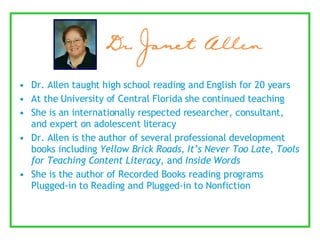
Dr. Allen taught high school reading and English for 20 years At the University of Central Florida she continued teaching  She is an internationally respected researcher, consultant, and expert on adolescent literacy Dr. Allen is the author of several professional development books including  Yellow Brick Roads ,  It’s Never Too Late ,  Tools for Teaching Content Literacy , and  Inside Words She is the author of Recorded Books reading programs Plugged-in to Reading and Plugged-in to Nonfiction
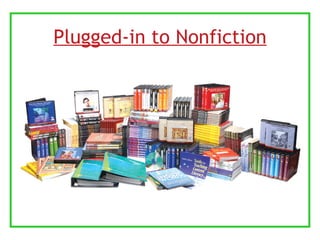
Plugged-in to Nonfiction
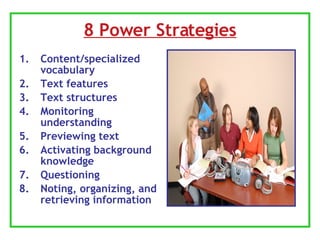
8 Power Strategies Content/specialized vocabulary Text features Text structures Monitoring understanding Previewing text Activating background knowledge Questioning Noting, organizing, and retrieving information
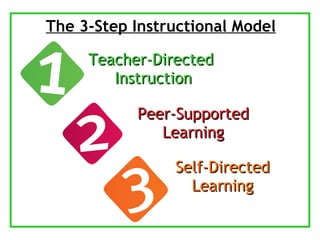
Teacher-Directed  Instruction Peer-Supported Learning Self-Directed Learning The 3-Step Instructional Model
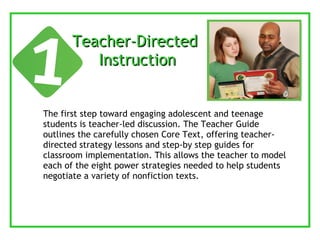
Teacher-Directed  Instruction The first step toward engaging adolescent and teenage students is teacher-led discussion. The Teacher Guide outlines the carefully chosen Core Text, offering teacher-directed strategy lessons and step-by step guides for classroom implementation. This allows the teacher to model each of the eight power strategies needed to help students negotiate a variety of nonfiction texts.
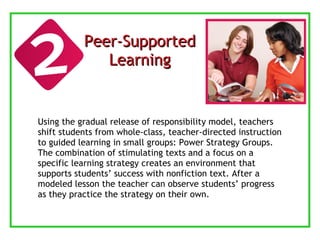
Peer-Supported Learning Using the gradual release of responsibility model, teachers shift students from whole-class, teacher-directed instruction to guided learning in small groups: Power Strategy Groups. The combination of stimulating texts and a focus on a specific learning strategy creates an environment that supports students’ success with nonfiction text. After a modeled lesson the teacher can observe students’ progress as they practice the strategy on their own.
Video clip time! http://www.vimeo.com/1183356
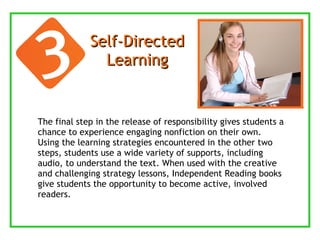
Self-Directed Learning The final step in the release of responsibility gives students a chance to experience engaging nonfiction on their own. Using the learning strategies encountered in the other two steps, students use a wide variety of supports, including audio, to understand the text. When used with the creative and challenging strategy lessons, Independent Reading books give students the opportunity to become active, involved readers.
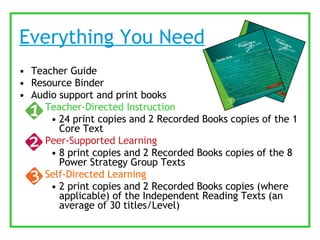
Everything You Need Teacher Guide Resource Binder Audio support and print books Teacher-Directed Instruction 24 print copies and 2 Recorded Books copies of the 1 Core Text  Peer-Supported Learning 8 print copies and 2 Recorded Books copies of the 8 Power Strategy Group Texts Self-Directed Learning 2 print copies and 2 Recorded Books copies (where applicable) of the Independent Reading Texts (an average of 30 titles/Level)
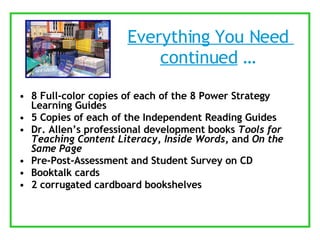
Everything You Need  continued  …  8 Full-color copies of each of the 8 Power Strategy Learning Guides 5 Copies of each of the Independent Reading Guides Dr. Allen’s professional development books  Tools for Teaching Content Literacy ,  Inside Words , and  On the Same Page Pre-Post-Assessment and Student Survey on CD Booktalk cards 2 corrugated cardboard bookshelves
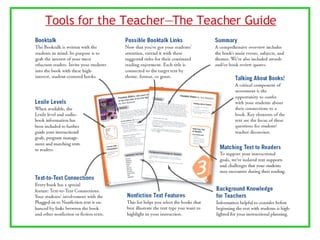
Tools for the Teacher—The Teacher Guide
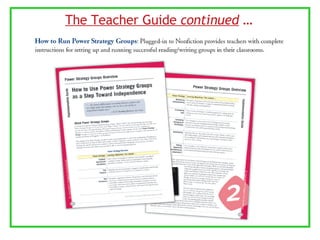
The Teacher Guide  continued  …
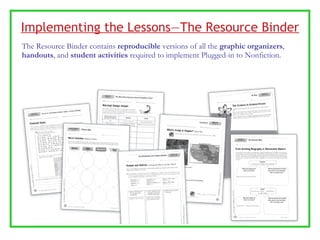
Implementing the Lessons—The Resource Binder The Resource Binder contains  reproducible  versions of all the  graphic organizers ,  handouts , and  student activities  required to implement Plugged-in to Nonfiction.
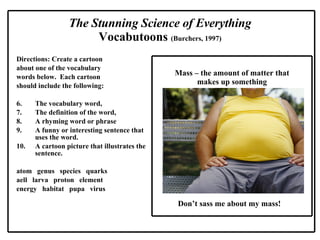
Directions: Create a cartoon  about one of the vocabulary words below.  Each cartoon  should include the following: The vocabulary word, The definition of the word, A rhyming word or phrase A funny or interesting sentence that uses the word. A cartoon picture that illustrates the sentence. atom  genus  species  quarks aell  larva  proton  element  energy  habitat  pupa  virus The Stunning Science of Everything Vocabutoons  (Burchers, 1997) Mass – the amount of matter that makes up something Don’t sass me about my mass!
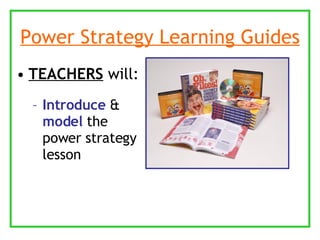
Power Strategy Learning Guides TEACHERS  will: Introduce   &  model  the power strategy lesson
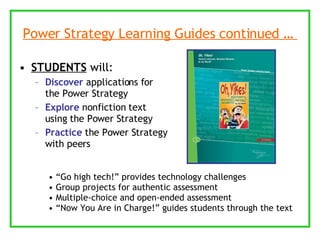
Power Strategy Learning Guides continued …  STUDENTS  will: Discover  applications for the Power Strategy Explore  nonfiction text using the Power Strategy Practice  the Power Strategy with peers “ Go high tech!” provides technology challenges Group projects for authentic assessment Multiple-choice and open-ended assessment “ Now You Are in Charge!” guides students through the text
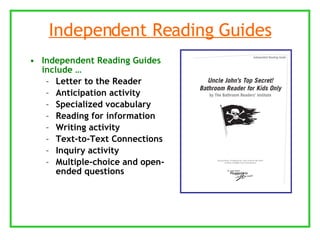
Independent Reading Guides Independent Reading Guides include … Letter to the Reader Anticipation activity Specialized vocabulary Reading for information Writing activity Text-to-Text Connections Inquiry activity Multiple-choice and open-ended questions
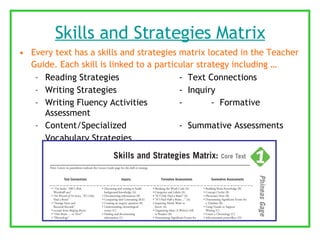
Skills and Strategies Matrix Every text has a skills and strategies matrix located in the Teacher Guide. Each skill is linked to a particular strategy including …   Reading Strategies -  Text Connections Writing Strategies -  Inquiry Writing Fluency Activities -  -  Formative Assessment Content/Specialized  -  Summative Assessments Vocabulary Strategies
“ If books could have more, give more, be more, show more, they would still need readers, who bring to them sound and smell and light and all the rest that can’t be in books.  The book needs you.” Gary Paulsen,  The Winter Room
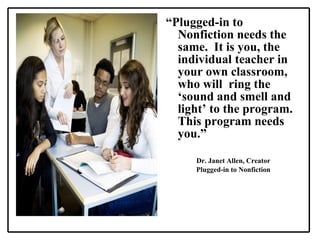
“ Plugged-in to Nonfiction needs the same.  It is you, the individual teacher in your own classroom, who will  ring the ‘sound and smell and light’ to the program.  This program needs you.” Dr. Janet Allen, Creator Plugged-in to Nonfiction

Anne PitN

  • 1.
  • 2.
    Anticipation Guide Studentsin our district shout with glee when asked to open their textbooks. Agree or disagree?
  • 3.
    Anticipation Guide Followingthese expressions of elation, students dive into reading armed with nonfiction strategies to comprehend complex texts. Agree or disagree?
  • 4.
    Anticipation Guide Uponcompletion of their reading, our students demonstrate effective use of expository text structures in their writing. Agree or disagree?
  • 5.
    Anticipation Guide Duringtesting scenarios, our students effectively transfer these nonfiction literacy strategies to achieve best results. Agree or disagree?
  • 6.
    Anticipation Guide Morethan successful test-takers, we strive to create lifelong learners. Agree or disagree?
  • 7.
    Dr. Allen taughthigh school reading and English for 20 years At the University of Central Florida she continued teaching She is an internationally respected researcher, consultant, and expert on adolescent literacy Dr. Allen is the author of several professional development books including Yellow Brick Roads , It’s Never Too Late , Tools for Teaching Content Literacy , and Inside Words She is the author of Recorded Books reading programs Plugged-in to Reading and Plugged-in to Nonfiction
  • 8.
  • 9.
    8 Power StrategiesContent/specialized vocabulary Text features Text structures Monitoring understanding Previewing text Activating background knowledge Questioning Noting, organizing, and retrieving information
  • 10.
    Teacher-Directed InstructionPeer-Supported Learning Self-Directed Learning The 3-Step Instructional Model
  • 11.
    Teacher-Directed InstructionThe first step toward engaging adolescent and teenage students is teacher-led discussion. The Teacher Guide outlines the carefully chosen Core Text, offering teacher-directed strategy lessons and step-by step guides for classroom implementation. This allows the teacher to model each of the eight power strategies needed to help students negotiate a variety of nonfiction texts.
  • 12.
    Peer-Supported Learning Usingthe gradual release of responsibility model, teachers shift students from whole-class, teacher-directed instruction to guided learning in small groups: Power Strategy Groups. The combination of stimulating texts and a focus on a specific learning strategy creates an environment that supports students’ success with nonfiction text. After a modeled lesson the teacher can observe students’ progress as they practice the strategy on their own.
  • 13.
    Video clip time!http://www.vimeo.com/1183356
  • 14.
    Self-Directed Learning Thefinal step in the release of responsibility gives students a chance to experience engaging nonfiction on their own. Using the learning strategies encountered in the other two steps, students use a wide variety of supports, including audio, to understand the text. When used with the creative and challenging strategy lessons, Independent Reading books give students the opportunity to become active, involved readers.
  • 15.
    Everything You NeedTeacher Guide Resource Binder Audio support and print books Teacher-Directed Instruction 24 print copies and 2 Recorded Books copies of the 1 Core Text Peer-Supported Learning 8 print copies and 2 Recorded Books copies of the 8 Power Strategy Group Texts Self-Directed Learning 2 print copies and 2 Recorded Books copies (where applicable) of the Independent Reading Texts (an average of 30 titles/Level)
  • 16.
    Everything You Need continued … 8 Full-color copies of each of the 8 Power Strategy Learning Guides 5 Copies of each of the Independent Reading Guides Dr. Allen’s professional development books Tools for Teaching Content Literacy , Inside Words , and On the Same Page Pre-Post-Assessment and Student Survey on CD Booktalk cards 2 corrugated cardboard bookshelves
  • 17.
    Tools for theTeacher—The Teacher Guide
  • 18.
    The Teacher Guide continued …
  • 19.
    Implementing the Lessons—TheResource Binder The Resource Binder contains reproducible versions of all the graphic organizers , handouts , and student activities required to implement Plugged-in to Nonfiction.
  • 20.
    Directions: Create acartoon about one of the vocabulary words below. Each cartoon should include the following: The vocabulary word, The definition of the word, A rhyming word or phrase A funny or interesting sentence that uses the word. A cartoon picture that illustrates the sentence. atom genus species quarks aell larva proton element energy habitat pupa virus The Stunning Science of Everything Vocabutoons (Burchers, 1997) Mass – the amount of matter that makes up something Don’t sass me about my mass!
  • 21.
    Power Strategy LearningGuides TEACHERS will: Introduce & model the power strategy lesson
  • 22.
    Power Strategy LearningGuides continued … STUDENTS will: Discover applications for the Power Strategy Explore nonfiction text using the Power Strategy Practice the Power Strategy with peers “ Go high tech!” provides technology challenges Group projects for authentic assessment Multiple-choice and open-ended assessment “ Now You Are in Charge!” guides students through the text
  • 23.
    Independent Reading GuidesIndependent Reading Guides include … Letter to the Reader Anticipation activity Specialized vocabulary Reading for information Writing activity Text-to-Text Connections Inquiry activity Multiple-choice and open-ended questions
  • 24.
    Skills and StrategiesMatrix Every text has a skills and strategies matrix located in the Teacher Guide. Each skill is linked to a particular strategy including … Reading Strategies - Text Connections Writing Strategies - Inquiry Writing Fluency Activities - - Formative Assessment Content/Specialized - Summative Assessments Vocabulary Strategies
  • 25.
    “ If bookscould have more, give more, be more, show more, they would still need readers, who bring to them sound and smell and light and all the rest that can’t be in books. The book needs you.” Gary Paulsen, The Winter Room
  • 26.
    “ Plugged-in toNonfiction needs the same. It is you, the individual teacher in your own classroom, who will ring the ‘sound and smell and light’ to the program. This program needs you.” Dr. Janet Allen, Creator Plugged-in to Nonfiction