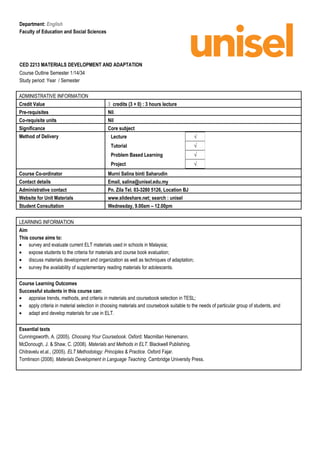
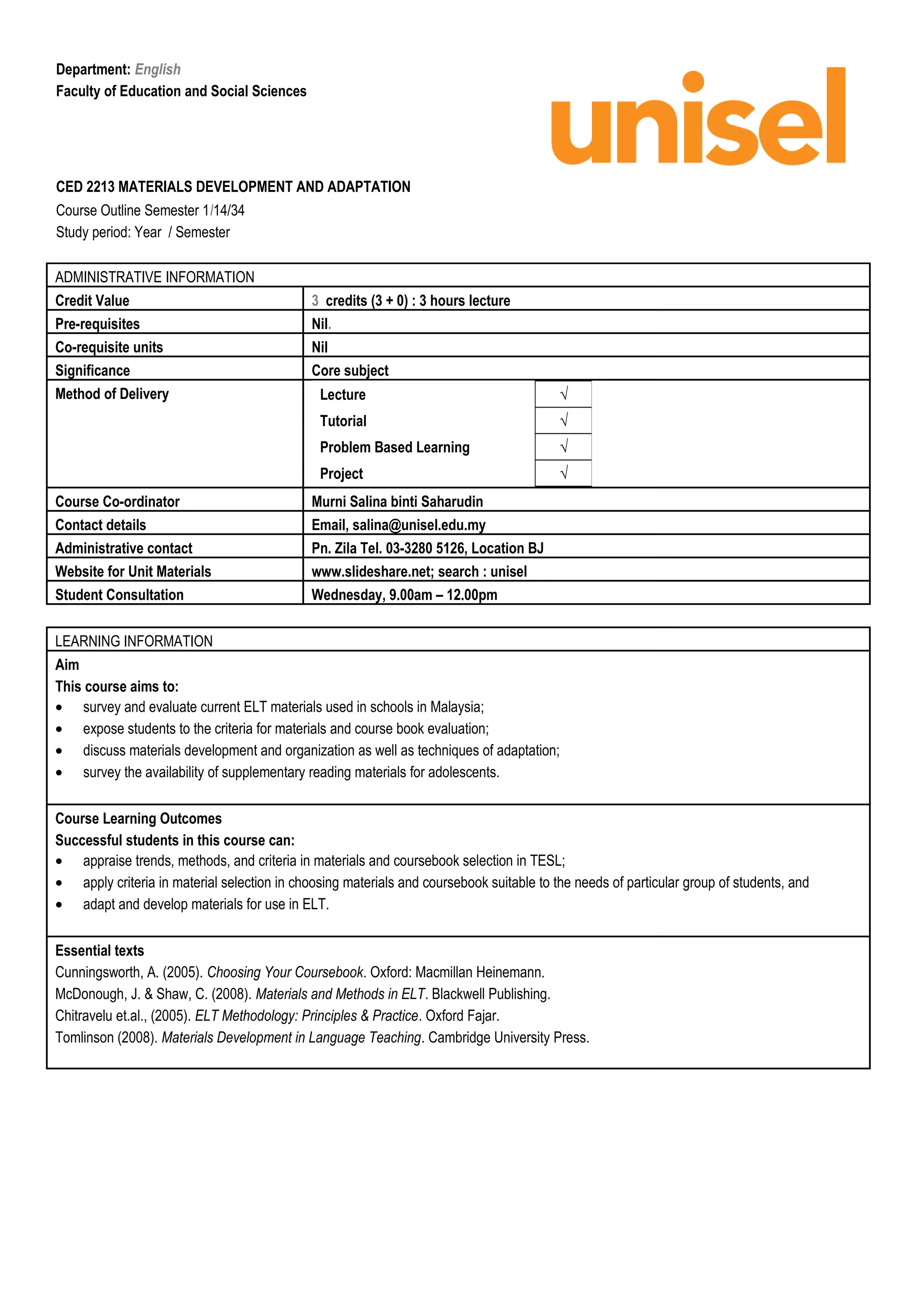
Department: English
Faculty of Education and Social Sciences

CED 2213 MATERIALS DEVELOPMENT AND ADAPTATION
Course Outline Semester 1I14/34
Study period: Year / Semester
ADMINISTRATIVE INFORMATION
Credit Value
Pre-requisites
Co-requisite units
Significance
Method of Delivery

3 credits (3 + 0) : 3 hours lecture
Nil.
Nil
Core subject
√

Tutorial

√

Problem Based Learning

√

Project
Course Co-ordinator
Contact details
Administrative contact
Website for Unit Materials
Student Consultation

Lecture

√

Murni Salina binti Saharudin
Email, salina@unisel.edu.my
Pn. Zila Tel. 03-3280 5126, Location BJ
www.slideshare.net; search : unisel
Wednesday, 9.00am – 12.00pm

LEARNING INFORMATION
Aim
This course aims to:
• survey and evaluate current ELT materials used in schools in Malaysia;
• expose students to the criteria for materials and course book evaluation;
• discuss materials development and organization as well as techniques of adaptation;
• survey the availability of supplementary reading materials for adolescents.
Course Learning Outcomes
Successful students in this course can:
• appraise trends, methods, and criteria in materials and coursebook selection in TESL;
• apply criteria in material selection in choosing materials and coursebook suitable to the needs of particular group of students, and
• adapt and develop materials for use in ELT.
Essential texts
Cunningsworth, A. (2005). Choosing Your Coursebook. Oxford: Macmillan Heinemann.
McDonough, J. & Shaw, C. (2008). Materials and Methods in ELT. Blackwell Publishing.
Chitravelu et.al., (2005). ELT Methodology: Principles & Practice. Oxford Fajar.
Tomlinson (2008). Materials Development in Language Teaching. Cambridge University Press.
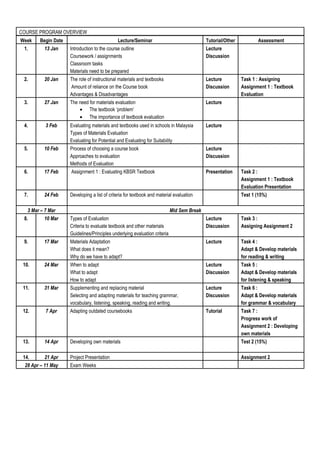
COURSE PROGRAM OVERVIEW
Week
1.

Begin Date
13 Jan

Lecture/Seminar
Introduction to the course outline
Coursework / assignments
Classroom tasks
Materials need to be prepared
The role of instructional materials and textbooks
Amount of reliance on the Course book
Advantages & Disadvantages
The need for materials evaluation
• The textbook ‘problem’
• The importance of textbook evaluation

Tutorial/Other
Lecture
Discussion

2.

20 Jan

3.

27 Jan

4.

3 Feb

Lecture

17 Feb

Evaluating materials and textbooks used in schools in Malaysia
Types of Materials Evaluation
Evaluating for Potential and Evaluating for Suitability
Process of choosing a course book
Approaches to evaluation
Methods of Evaluation
Assignment 1 : Evaluating KBSR Textbook

5.

10 Feb

6.

7.

24 Feb

Developing a list of criteria for textbook and material evaluation

3 Mar – 7 Mar
8.
10 Mar

Lecture
Discussion

Task 1 : Assigning
Assignment 1 : Textbook
Evaluation

Lecture

Lecture
Discussion
Presentation

Task 2 :
Assignment 1 : Textbook
Evaluation Presentation
Test 1 (15%)

Lecture
Discussion

Task 3 :
Assigning Assignment 2

Lecture

Task 4 :
Adapt & Develop materials
for reading & writing
Task 5 :
Adapt & Develop materials
for listening & speaking
Task 6 :
Adapt & Develop materials
for grammar & vocabulary
Task 7 :
Progress work of
Assignment 2 : Developing
own materials
Test 2 (15%)

Mid Sem Break

9.

17 Mar

10.

24 Mar

11.

31 Mar

12.

7 Apr

Types of Evaluation
Criteria to evaluate textbook and other materials
Guidelines/Principles underlying evaluation criteria
Materials Adaptation
What does it mean?
Why do we have to adapt?
When to adapt
What to adapt
How to adapt
Supplementing and replacing material
Selecting and adapting materials for teaching grammar,
vocabulary, listening, speaking, reading and writing.
Adapting outdated coursebooks

13.

14 Apr

Developing own materials

14.
21 Apr
28 Apr – 11 May

Assessment

Project Presentation
Exam Weeks

Lecture
Discussion
Lecture
Discussion
Tutorial

Assignment 2
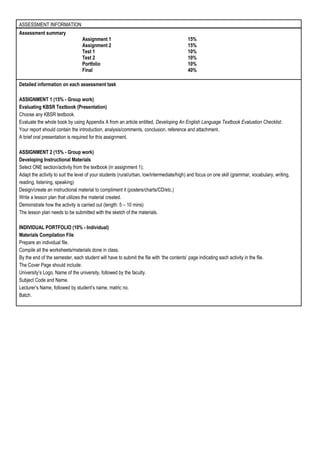
ASSESSMENT INFORMATION
Assessment summary
Assignment 1
Assignment 2
Test 1
Test 2
Portfolio
Final

15%
15%
10%
10%
10%
40%

Detailed information on each assessment task
ASSIGNMENT 1 (15% - Group work)
Evaluating KBSR Textbook (Presentation)
Choose any KBSR textbook.
Evaluate the whole book by using Appendix A from an article entitled, Developing An English Language Textbook Evaluation Checklist.
Your report should contain the introduction, analysis/comments, conclusion, reference and attachment.
A brief oral presentation is required for this assignment.
ASSIGNMENT 2 (15% - Group work)
Developing Instructional Materials
Select ONE section/activity from the textbook (in assignment 1);
Adapt the activity to suit the level of your students (rural/urban, low/intermediate/high) and focus on one skill (grammar, vocabulary, writing,
reading, listening, speaking)
Design/create an instructional material to compliment it (posters/charts/CD/etc.)
Write a lesson plan that utilizes the material created.
Demonstrate how the activity is carried out (length: 5 – 10 mins)
The lesson plan needs to be submitted with the sketch of the materials.
INDIVIDUAL PORTFOLIO (10% - Individual)
Materials Compilation File
Prepare an individual file.
Compile all the worksheets/materials done in class.
By the end of the semester, each student will have to submit the file with ‘the contents’ page indicating each activity in the file.
The Cover Page should include:
University’s Logo, Name of the university, followed by the faculty.
Subject Code and Name.
Lecturer’s Name, followed by student’s name, matric no.
Batch.

Course Outline - Materials Development & Adaptation

  • 1.
    Department: English Faculty ofEducation and Social Sciences CED 2213 MATERIALS DEVELOPMENT AND ADAPTATION Course Outline Semester 1I14/34 Study period: Year / Semester ADMINISTRATIVE INFORMATION Credit Value Pre-requisites Co-requisite units Significance Method of Delivery 3 credits (3 + 0) : 3 hours lecture Nil. Nil Core subject √ Tutorial √ Problem Based Learning √ Project Course Co-ordinator Contact details Administrative contact Website for Unit Materials Student Consultation Lecture √ Murni Salina binti Saharudin Email, salina@unisel.edu.my Pn. Zila Tel. 03-3280 5126, Location BJ www.slideshare.net; search : unisel Wednesday, 9.00am – 12.00pm LEARNING INFORMATION Aim This course aims to: • survey and evaluate current ELT materials used in schools in Malaysia; • expose students to the criteria for materials and course book evaluation; • discuss materials development and organization as well as techniques of adaptation; • survey the availability of supplementary reading materials for adolescents. Course Learning Outcomes Successful students in this course can: • appraise trends, methods, and criteria in materials and coursebook selection in TESL; • apply criteria in material selection in choosing materials and coursebook suitable to the needs of particular group of students, and • adapt and develop materials for use in ELT. Essential texts Cunningsworth, A. (2005). Choosing Your Coursebook. Oxford: Macmillan Heinemann. McDonough, J. & Shaw, C. (2008). Materials and Methods in ELT. Blackwell Publishing. Chitravelu et.al., (2005). ELT Methodology: Principles & Practice. Oxford Fajar. Tomlinson (2008). Materials Development in Language Teaching. Cambridge University Press.
  • 2.
    COURSE PROGRAM OVERVIEW Week 1. BeginDate 13 Jan Lecture/Seminar Introduction to the course outline Coursework / assignments Classroom tasks Materials need to be prepared The role of instructional materials and textbooks Amount of reliance on the Course book Advantages & Disadvantages The need for materials evaluation • The textbook ‘problem’ • The importance of textbook evaluation Tutorial/Other Lecture Discussion 2. 20 Jan 3. 27 Jan 4. 3 Feb Lecture 17 Feb Evaluating materials and textbooks used in schools in Malaysia Types of Materials Evaluation Evaluating for Potential and Evaluating for Suitability Process of choosing a course book Approaches to evaluation Methods of Evaluation Assignment 1 : Evaluating KBSR Textbook 5. 10 Feb 6. 7. 24 Feb Developing a list of criteria for textbook and material evaluation 3 Mar – 7 Mar 8. 10 Mar Lecture Discussion Task 1 : Assigning Assignment 1 : Textbook Evaluation Lecture Lecture Discussion Presentation Task 2 : Assignment 1 : Textbook Evaluation Presentation Test 1 (15%) Lecture Discussion Task 3 : Assigning Assignment 2 Lecture Task 4 : Adapt & Develop materials for reading & writing Task 5 : Adapt & Develop materials for listening & speaking Task 6 : Adapt & Develop materials for grammar & vocabulary Task 7 : Progress work of Assignment 2 : Developing own materials Test 2 (15%) Mid Sem Break 9. 17 Mar 10. 24 Mar 11. 31 Mar 12. 7 Apr Types of Evaluation Criteria to evaluate textbook and other materials Guidelines/Principles underlying evaluation criteria Materials Adaptation What does it mean? Why do we have to adapt? When to adapt What to adapt How to adapt Supplementing and replacing material Selecting and adapting materials for teaching grammar, vocabulary, listening, speaking, reading and writing. Adapting outdated coursebooks 13. 14 Apr Developing own materials 14. 21 Apr 28 Apr – 11 May Assessment Project Presentation Exam Weeks Lecture Discussion Lecture Discussion Tutorial Assignment 2
  • 3.
    ASSESSMENT INFORMATION Assessment summary Assignment1 Assignment 2 Test 1 Test 2 Portfolio Final 15% 15% 10% 10% 10% 40% Detailed information on each assessment task ASSIGNMENT 1 (15% - Group work) Evaluating KBSR Textbook (Presentation) Choose any KBSR textbook. Evaluate the whole book by using Appendix A from an article entitled, Developing An English Language Textbook Evaluation Checklist. Your report should contain the introduction, analysis/comments, conclusion, reference and attachment. A brief oral presentation is required for this assignment. ASSIGNMENT 2 (15% - Group work) Developing Instructional Materials Select ONE section/activity from the textbook (in assignment 1); Adapt the activity to suit the level of your students (rural/urban, low/intermediate/high) and focus on one skill (grammar, vocabulary, writing, reading, listening, speaking) Design/create an instructional material to compliment it (posters/charts/CD/etc.) Write a lesson plan that utilizes the material created. Demonstrate how the activity is carried out (length: 5 – 10 mins) The lesson plan needs to be submitted with the sketch of the materials. INDIVIDUAL PORTFOLIO (10% - Individual) Materials Compilation File Prepare an individual file. Compile all the worksheets/materials done in class. By the end of the semester, each student will have to submit the file with ‘the contents’ page indicating each activity in the file. The Cover Page should include: University’s Logo, Name of the university, followed by the faculty. Subject Code and Name. Lecturer’s Name, followed by student’s name, matric no. Batch.