Using Strategic
Teaching
in the Middle and High
School to Promote
High Levels Of Active
Engagement And
Student Learning
Shelby County Schools Strategic Teaching Overview 2.18.10
Strategic Teaching Defined…
Strategic teaching is the process of using a variety of
literacy strategies.
It maximizes the understanding and retention of content
material.
It incorporates before, during, and after reading strategies.
It incorporates a variety of vocabulary development and
writing strategies.
The strategies a teacher chooses will depend on the purpose
of the lesson and the nature of the material being studied.
Why is Strategic Teaching Necessary?
• The student performance drops off in the middle
school and high school years (International Reading Association
and National Middle School Association, 2002).
• Research has shown that many children who read
at grade level in grade 3 will not automatically become
proficient comprehenders in later grades. Therefore,
teachers must teach comprehension explicitly,
beginning in the primary grades and continuing
through high school (RAND Reading Study Group, 2002).
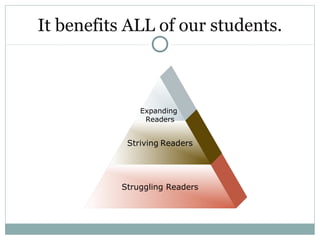
It benefits ALL of our students.
Struggling Readers
Striving Readers
Expanding
Readers
The Strategic Teacher
The strategic teacher plans lessons with the outcome
in mind. The outcomes of strategic lessons move the
students toward mastery of content standards.
The strategic teacher plans and facilitates engaging
lessons. Students in strategic classrooms have the
opportunity to talk, listen, read, write, and investigate
everyday while actively involved in the learning
process.
The strategic teacher builds assessment into every
lesson. The lesson contains elements that allow the
teacher to know which students have and have not
met the stated outcome(s).
Connection to Comprehension
The following six strategies appear to have a firm scientific basis for
improving text comprehension. These findings are from Put Reading First:
The Research Building Blocks for Teaching Children to Read, 2001.
 Monitoring comprehension
 Using graphic and semantic organizers
 Answering questions
 Generating questions
 Recognizing text structure
 Summarizing
The following strategies have received some support from the research.
 Making use of prior knowledge
 Using mental imagery
Before Reading Strategies
activate background knowledge
establish a purpose for reading
generate questions
make predictions about text
encounter new vocabulary
connect writing to reading
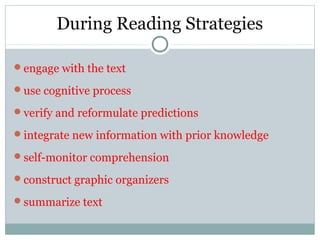
During Reading Strategies
engage with the text
use cognitive process
verify and reformulate predictions
integrate new information with prior knowledge
self-monitor comprehension
construct graphic organizers
summarize text
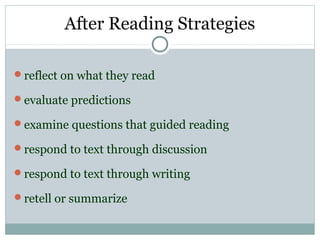
After Reading Strategies
reflect on what they read
evaluate predictions
examine questions that guided reading
respond to text through discussion
respond to text through writing
retell or summarize
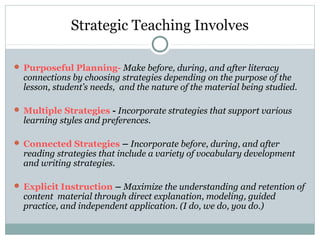
Strategic Teaching Involves
 Purposeful Planning- Make before, during, and after literacy
connections by choosing strategies depending on the purpose of the
lesson, student’s needs, and the nature of the material being studied.
 Multiple Strategies - Incorporate strategies that support various
learning styles and preferences.
 Connected Strategies – Incorporate before, during, and after
reading strategies that include a variety of vocabulary development
and writing strategies.
 Explicit Instruction – Maximize the understanding and retention of
content material through direct explanation, modeling, guided
practice, and independent application. (I do, we do, you do.)
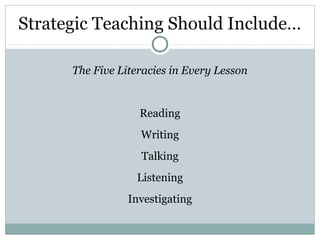
Strategic Teaching Should Include…
The Five Literacies in Every Lesson
Reading
Writing
Talking
Listening
Investigating
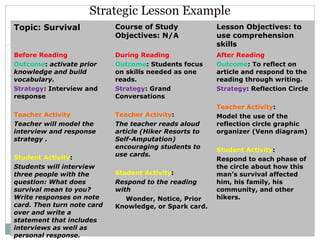
Strategic Lesson Example
Topic: Survival Course of Study
Objectives: N/A
Lesson Objectives: to
use comprehension
skills
Before Reading
Outcome: activate prior
knowledge and build
vocabulary.
Strategy: Interview and
response
Teacher Activity:
Teacher will model the
interview and response
strategy .
Student Activity:
Students will interview
three people with the
question: What does
survival mean to you?
Write responses on note
card. Then turn note card
over and write a
statement that includes
interviews as well as
personal response.
During Reading
Outcome: Students focus
on skills needed as one
reads.
Strategy: Grand
Conversations
Teacher Activity:
The teacher reads aloud
article (Hiker Resorts to
Self-Amputation)
encouraging students to
use cards.
Student Activity:
Respond to the reading
with
Wonder, Notice, Prior
Knowledge, or Spark card.
After Reading
Outcome: To reflect on
article and respond to the
reading through writing.
Strategy: Reflection Circle
Teacher Activity:
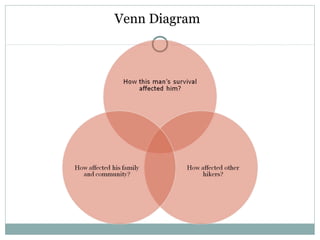
Model the use of the
reflection circle graphic
organizer (Venn diagram)
Student Activity:
Respond to each phase of
the circle about how this
man’s survival affected
him, his family, his
community, and other
hikers.
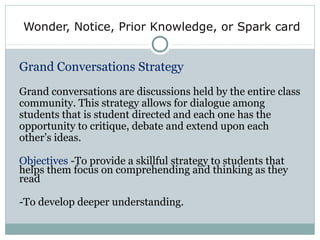
Wonder, Notice, Prior Knowledge, or Spark card
Grand Conversations Strategy
Grand conversations are discussions held by the entire class
community. This strategy allows for dialogue among
students that is student directed and each one has the
opportunity to critique, debate and extend upon each
other’s ideas.
Objectives -To provide a skillful strategy to students that
helps them focus on comprehending and thinking as they
read
-To develop deeper understanding.
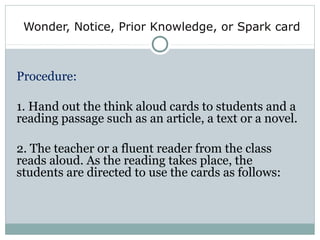
Wonder, Notice, Prior Knowledge, or Spark card
Procedure:
1. Hand out the think aloud cards to students and a
reading passage such as an article, a text or a novel.
2. The teacher or a fluent reader from the class
reads aloud. As the reading takes place, the
students are directed to use the cards as follows:
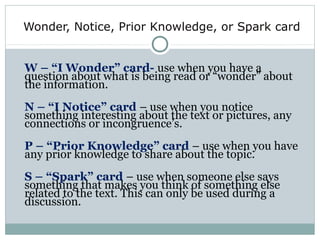
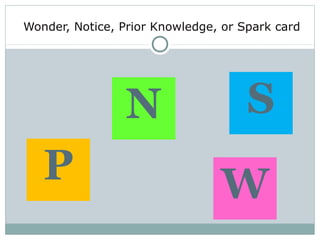
W – “I Wonder” card- use when you have a
question about what is being read or “wonder” about
the information.
N – “I Notice” card – use when you notice
something interesting about the text or pictures, any
connections or incongruence’s.
P – “Prior Knowledge” card – use when you have
any prior knowledge to share about the topic.
S – “Spark” card – use when someone else says
something that makes you think of something else
related to the text. This can only be used during a
discussion.
Wonder, Notice, Prior Knowledge, or Spark card
3. As each student uses a card, the card is turned
over. All students must use
their cards before starting over.
4. When all students have used their cards, turn
them back to front and start
the process over.
Wonder, Notice, Prior Knowledge, or Spark card
N S
WP
Wonder, Notice, Prior Knowledge, or Spark card
Venn Diagram
Literacy Strategies to Promote Students
Engagement
Quick Write
Purposes: (1) introduce a concept and connect this concept
with prior knowledge or experiences and (2) allow students to
discuss and learn from each other
Procedure:
1. Introduce a single word or phrase to the class
2. Students copy the concept on index cards.
3. Students are given two minutes to write whatever comes to
their minds relative to the concept. They may write freely using
single words, phrases, sentences, etc.
4. After time is called, students may volunteer to share their thoughts
on the subject.
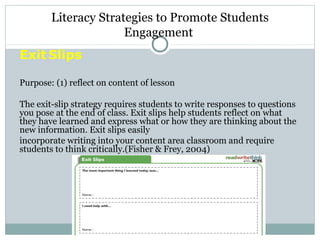
Exit Slips
Purpose: (1) reflect on content of lesson
The exit-slip strategy requires students to write responses to questions
you pose at the end of class. Exit slips help students reflect on what
they have learned and express what or how they are thinking about the
new information. Exit slips easily
incorporate writing into your content area classroom and require
students to think critically.(Fisher & Frey, 2004)
Literacy Strategies to Promote Students
Engagement
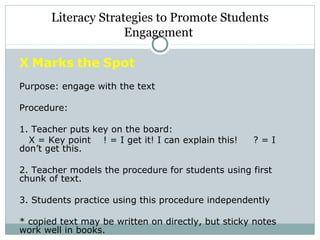
X Marks the Spot
Purpose: engage with the text
Procedure:
1. Teacher puts key on the board:
X = Key point ! = I get it! I can explain this! ? = I
don’t get this.
2. Teacher models the procedure for students using first
chunk of text.
3. Students practice using this procedure independently
* copied text may be written on directly, but sticky notes
work well in books.
Literacy Strategies to Promote Students
Engagement
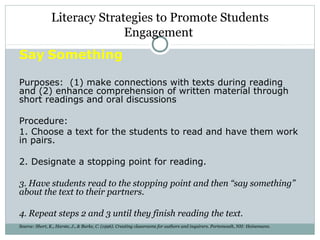
Say Something
Purposes: (1) make connections with texts during reading
and (2) enhance comprehension of written material through
short readings and oral discussions
Procedure:
1. Choose a text for the students to read and have them work
in pairs.
2. Designate a stopping point for reading.
3. Have students read to the stopping point and then “say something”
about the text to their partners.
4. Repeat steps 2 and 3 until they finish reading the text.
Source: Short, K., Harste, J., & Burke, C. (1996). Creating classrooms for authors and inquirers. Portsmouth, NH: Heinemann.
Literacy Strategies to Promote Students
Engagement
References
 http://lc3.littlechute.k12.wi.us/literacy/Grand%20Conversations.pdf
 http://www.vrml.k12.la.us/2nd/more/graphic_organizers.htm
 https://sites.google.com/site/mrsbegleycom/GOs-and-Paperwork
 http://www.readwritethink.org/files/resources/printouts/Exit
%20Slips.pdf
 http://www.thoughtfulclassroom.com/PDFs/TheStrategicTeacher-
BetterInstruction.pdf
 http://www.shelbyed.k12.al.us/instruction/doc/StrategicTeaching.pdf

Strategic teaching middle and high school (1)

  • 1.
    Using Strategic Teaching in theMiddle and High School to Promote High Levels Of Active Engagement And Student Learning Shelby County Schools Strategic Teaching Overview 2.18.10
  • 2.
    Strategic Teaching Defined… Strategicteaching is the process of using a variety of literacy strategies. It maximizes the understanding and retention of content material. It incorporates before, during, and after reading strategies. It incorporates a variety of vocabulary development and writing strategies. The strategies a teacher chooses will depend on the purpose of the lesson and the nature of the material being studied.
  • 3.
    Why is StrategicTeaching Necessary? • The student performance drops off in the middle school and high school years (International Reading Association and National Middle School Association, 2002). • Research has shown that many children who read at grade level in grade 3 will not automatically become proficient comprehenders in later grades. Therefore, teachers must teach comprehension explicitly, beginning in the primary grades and continuing through high school (RAND Reading Study Group, 2002).
  • 4.
    It benefits ALLof our students. Struggling Readers Striving Readers Expanding Readers
  • 5.
    The Strategic Teacher Thestrategic teacher plans lessons with the outcome in mind. The outcomes of strategic lessons move the students toward mastery of content standards. The strategic teacher plans and facilitates engaging lessons. Students in strategic classrooms have the opportunity to talk, listen, read, write, and investigate everyday while actively involved in the learning process. The strategic teacher builds assessment into every lesson. The lesson contains elements that allow the teacher to know which students have and have not met the stated outcome(s).
  • 6.
    Connection to Comprehension Thefollowing six strategies appear to have a firm scientific basis for improving text comprehension. These findings are from Put Reading First: The Research Building Blocks for Teaching Children to Read, 2001.  Monitoring comprehension  Using graphic and semantic organizers  Answering questions  Generating questions  Recognizing text structure  Summarizing The following strategies have received some support from the research.  Making use of prior knowledge  Using mental imagery
  • 7.
    Before Reading Strategies activatebackground knowledge establish a purpose for reading generate questions make predictions about text encounter new vocabulary connect writing to reading
  • 8.
    During Reading Strategies engagewith the text use cognitive process verify and reformulate predictions integrate new information with prior knowledge self-monitor comprehension construct graphic organizers summarize text
  • 9.
    After Reading Strategies reflecton what they read evaluate predictions examine questions that guided reading respond to text through discussion respond to text through writing retell or summarize
  • 10.
    Strategic Teaching Involves Purposeful Planning- Make before, during, and after literacy connections by choosing strategies depending on the purpose of the lesson, student’s needs, and the nature of the material being studied.  Multiple Strategies - Incorporate strategies that support various learning styles and preferences.  Connected Strategies – Incorporate before, during, and after reading strategies that include a variety of vocabulary development and writing strategies.  Explicit Instruction – Maximize the understanding and retention of content material through direct explanation, modeling, guided practice, and independent application. (I do, we do, you do.)
  • 11.
    Strategic Teaching ShouldInclude… The Five Literacies in Every Lesson Reading Writing Talking Listening Investigating
  • 12.
    Strategic Lesson Example Topic:Survival Course of Study Objectives: N/A Lesson Objectives: to use comprehension skills Before Reading Outcome: activate prior knowledge and build vocabulary. Strategy: Interview and response Teacher Activity: Teacher will model the interview and response strategy . Student Activity: Students will interview three people with the question: What does survival mean to you? Write responses on note card. Then turn note card over and write a statement that includes interviews as well as personal response. During Reading Outcome: Students focus on skills needed as one reads. Strategy: Grand Conversations Teacher Activity: The teacher reads aloud article (Hiker Resorts to Self-Amputation) encouraging students to use cards. Student Activity: Respond to the reading with Wonder, Notice, Prior Knowledge, or Spark card. After Reading Outcome: To reflect on article and respond to the reading through writing. Strategy: Reflection Circle Teacher Activity: Model the use of the reflection circle graphic organizer (Venn diagram) Student Activity: Respond to each phase of the circle about how this man’s survival affected him, his family, his community, and other hikers.
  • 13.
    Wonder, Notice, PriorKnowledge, or Spark card Grand Conversations Strategy Grand conversations are discussions held by the entire class community. This strategy allows for dialogue among students that is student directed and each one has the opportunity to critique, debate and extend upon each other’s ideas. Objectives -To provide a skillful strategy to students that helps them focus on comprehending and thinking as they read -To develop deeper understanding.
  • 14.
    Wonder, Notice, PriorKnowledge, or Spark card Procedure: 1. Hand out the think aloud cards to students and a reading passage such as an article, a text or a novel. 2. The teacher or a fluent reader from the class reads aloud. As the reading takes place, the students are directed to use the cards as follows:
  • 15.
    W – “IWonder” card- use when you have a question about what is being read or “wonder” about the information. N – “I Notice” card – use when you notice something interesting about the text or pictures, any connections or incongruence’s. P – “Prior Knowledge” card – use when you have any prior knowledge to share about the topic. S – “Spark” card – use when someone else says something that makes you think of something else related to the text. This can only be used during a discussion. Wonder, Notice, Prior Knowledge, or Spark card
  • 16.
    3. As eachstudent uses a card, the card is turned over. All students must use their cards before starting over. 4. When all students have used their cards, turn them back to front and start the process over. Wonder, Notice, Prior Knowledge, or Spark card
  • 17.
    N S WP Wonder, Notice,Prior Knowledge, or Spark card
  • 18.
  • 19.
    Literacy Strategies toPromote Students Engagement Quick Write Purposes: (1) introduce a concept and connect this concept with prior knowledge or experiences and (2) allow students to discuss and learn from each other Procedure: 1. Introduce a single word or phrase to the class 2. Students copy the concept on index cards. 3. Students are given two minutes to write whatever comes to their minds relative to the concept. They may write freely using single words, phrases, sentences, etc. 4. After time is called, students may volunteer to share their thoughts on the subject.
  • 20.
    Exit Slips Purpose: (1)reflect on content of lesson The exit-slip strategy requires students to write responses to questions you pose at the end of class. Exit slips help students reflect on what they have learned and express what or how they are thinking about the new information. Exit slips easily incorporate writing into your content area classroom and require students to think critically.(Fisher & Frey, 2004) Literacy Strategies to Promote Students Engagement
  • 21.
    X Marks theSpot Purpose: engage with the text Procedure: 1. Teacher puts key on the board: X = Key point ! = I get it! I can explain this! ? = I don’t get this. 2. Teacher models the procedure for students using first chunk of text. 3. Students practice using this procedure independently * copied text may be written on directly, but sticky notes work well in books. Literacy Strategies to Promote Students Engagement
  • 22.
    Say Something Purposes: (1)make connections with texts during reading and (2) enhance comprehension of written material through short readings and oral discussions Procedure: 1. Choose a text for the students to read and have them work in pairs. 2. Designate a stopping point for reading. 3. Have students read to the stopping point and then “say something” about the text to their partners. 4. Repeat steps 2 and 3 until they finish reading the text. Source: Short, K., Harste, J., & Burke, C. (1996). Creating classrooms for authors and inquirers. Portsmouth, NH: Heinemann. Literacy Strategies to Promote Students Engagement
  • 23.
    References  http://lc3.littlechute.k12.wi.us/literacy/Grand%20Conversations.pdf  http://www.vrml.k12.la.us/2nd/more/graphic_organizers.htm https://sites.google.com/site/mrsbegleycom/GOs-and-Paperwork  http://www.readwritethink.org/files/resources/printouts/Exit %20Slips.pdf  http://www.thoughtfulclassroom.com/PDFs/TheStrategicTeacher- BetterInstruction.pdf  http://www.shelbyed.k12.al.us/instruction/doc/StrategicTeaching.pdf

Editor's Notes

  • #2 Welcome! Denise and I are secondary regional reading coaches for the Alabama Reading Initiative. This year marks the beginning of a new focus for education in Alabama. 14 schools have been chosen to be part of an initiative in the middle and high schools called ARI Project for Adolescent Literacy. A key factor in promoting adolescent literacy is strategic teaching. Today you will learn about the part that strategic teaching plays in adolescent literacy, the defining features of this, how to recognize strategic teaching in a classroom, and participate in strategic lessons.
  • #3 Notice the term literacy strategies, meaning that strategic teaching is used in all content areas, every day, every class. It is a process, not a program, a way of thinking and organizing a lesson. We tell teachers, strategic teaching isn’t just about teaching reading, it is about maximizing one’s students ability to comprehend content material. It is not isolated strategies, but connections are made before, during, and after reading so that students learn that reading is purposeful and active at all stages. It doesn’t isolate skills such as vocabulary or writing but makes these an integral part of comprehension. The teacher’s purpose for each lesson guides the strategies used.
  • #4 Kids are doing well at the elementary level, but achievement declines as they go through middle and high school. Turn and talk to a neighbor about the reasons for this decline.
  • #5 Strategic teaching will benefit all students. Everyone encounters text that they can’t handle. We as teachers need to provide literacy tools for these students to take with them after they leave our classroom. Struggling readers – 5-10 percent that need extreme intervention (decoding). 10-60% that are poor comprehenders, need leveled text and good strategies via strategic teaching. These students needs can be addressed through strategic teaching. And lastly, expanding readers that still encounter difficult text and need ways to deal with that text successfully.
  • #7 Strategic teaching is able to address each of these at one point or another. The connection to comprehension is made through the connections of before, during, after reading strategies.
  • #8 What makes strategic teaching extremely effective is that connections are made before, during, and after reading. Everyday those kids are engaged in each of these phases. Not, Monday is a day to activate prior knowledge…Tuesday, we read, and Wednesday we access. Purposes….
  • #9 Frequently the part left out the most, replace with well meaning teachers that summarize information, write it up as a study guide, and lecture. During reading activities are purposeful and active.
  • #10 Before and after do not take much of the class period but are vital. Before – 10 minutes, During – 30, After 10, if that much.
  • #11 To make all of this happen smoothly, these ideas must become part of a philosopy, a way of thinking about student learning.
  • #12 Every day in every class should encompass …
  • #13 Sample lesson plan and activity for today.
  • #14 To make all of this happen smoothly, these ideas must become part of a philosopy, a way of thinking about student learning.
  • #15 To make all of this happen smoothly, these ideas must become part of a philosopy, a way of thinking about student learning.
  • #16 To make all of this happen smoothly, these ideas must become part of a philosopy, a way of thinking about student learning.
  • #17 To make all of this happen smoothly, these ideas must become part of a philosopy, a way of thinking about student learning.
  • #20 To make all of this happen smoothly, these ideas must become part of a philosopy, a way of thinking about student learning.
  • #21 To make all of this happen smoothly, these ideas must become part of a philosopy, a way of thinking about student learning.
  • #22 To make all of this happen smoothly, these ideas must become part of a philosopy, a way of thinking about student learning.
  • #23 To make all of this happen smoothly, these ideas must become part of a philosopy, a way of thinking about student learning.
  • #24 To make all of this happen smoothly, these ideas must become part of a philosopy, a way of thinking about student learning.