HUMAN RESOURCE MANAGEMENT
Human Resource Information System
Professor AAFREEN SHAH
MEANING: An integrated system used to
gather,store, and analyze information regarding an
organisation’s human resources
COMPRISING OF: Database,
Computer applications,
Hardware,
Software.
Necessary to collect, record, store, manage, deliver,
present and manipulate data for human resource
managment
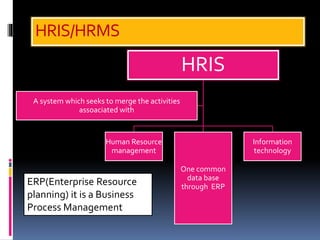
HRIS/HRMS
HRIS/HRMS
HRIS
Human Resource
management
One common
data base
through ERP
Information
technology
A system which seeks to merge the activities
assoaciated with
ERP(Enterprise Resource
planning) it is a Business
Process Management
Definition
Susan M Healthfield ( HR expert) states:
HRIS is a software or online solution for the
 Data entry
 Data tracking (searching)
 Data information
Needs of human resources :
• payroll,
• Management,
• accounting function with business
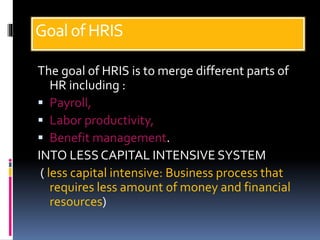
Goal ofHRIS
The goal of HRIS is to merge different parts of
HR including :
 Payroll,
 Labor productivity,
 Benefit management.
INTO LESS CAPITAL INTENSIVE SYSTEM
( less capital intensive: Business process that
requires less amount of money and financial
resources)
HRexecutiverelyon
Internal IT
professionals
External IT
professional
To develop
and
maintain
integrated
HRIS
PersonnelrequiredformanagingHRIS
 SYSTEM MANAGER: He is responsible for
planning,monitoring and controlling the
activities related to computerisation of HR
data
 SYSTEM ANALYST: He is responsible to
study and analyse the problems and design
solutions and programme specifications (
instructions)
PersonnelrequiredformanagingHRIS
 PROGRAMMERS:They are required to
develop computer programmes based on
specifications of the system analyst
 DATA ENTRY OPERATORS:They are
responsible to feed the HR data in the
computers for implementing the HRIS
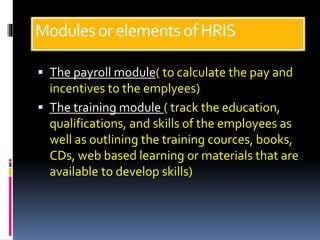
Modulesorelementsof HRIS
 The payroll module( to calculate the pay and
incentives to the emplyees)
 The training module ( track the education,
qualifications, and skills of the employees as
well as outlining the training cources, books,
CDs, web based learning or materials that are
available to develop skills)
Modulesorelementsof HRIS
 The HR management module ( covering many
HR aspects from recruitment to retirement)
 The benefits administration module ( employee
participation in benefit programmes it includes
insurance,compensation,profit sharing, and
retirement benefits.)
 The employee self-service module ( employee
may query their attendance record from the
system without asking the HR personnel) .
ImportanceofHRIS
 Provides employee information
 An effective HRIS provides information which a
Campany needs to track and analyze about
Employees, former employees, and applicants
 (HR Management Module )in HRIS is a
component that records basic demographic and
address data, selection, training and development,
capabilities and skills management, compensation
planning records and other related activities.
ImportanceofHRIS
 Facilitates updates and changes:
 An appropriate HRIS enables employees to
do their own updates and changes, thus
freeing HR staff for more strategic
functions.also data necessary for employee
management,career growth and
development is facilitated by HRIS
( EMPLOYEE SELF-SERVICE MODULE)
ImportanceofHRIS
 Recruitment
 Online job advertisements on corporate
websites and internet job boards, online CV
databases, different forms of electronic
applications, applicant management systems
and corporate skill databases are only few
examples of the various ways by which
information systems today support recruitment
processes
ImportanceofHRIS
 Human resource planning
 HRIS can provide relevant data to forecast human
resource requirements and also to forecast human
resource supply
 HRIS can also facilitate quick comparison between
HR requirements and HR supply
 For instance if there is shortage of manpower,
arrangements can be made to recruit or hire
additional employees and if there is surplus of
manpower, arrangements can be made to reduce
the workforce
ImportanceofHRIS
 Risk and security management
 The risk and security management can be
done by following private and highly sensitive
individual data and multiplatform security
aspects which are perhaps the most serious
factors that need to be taken into consideration
ImportanceofHRIS
 Meeting training needs:
 In the HRIS, an employee might go into the
data of available training courses and then
request for his/her training
 When that training becomes available the HRIS
notifies him/her so that he/she can register and
complete the training
Training module( learning Management system)
ImportanceofHRIS
 Employee payroll ( compensation)
 The payroll module in HRIS automates the pay
process by gathering data on employee time
and attendance, calculating various deductions
and taxes and generating periodic pay cheques
and employee tax reports
 This module can encampass all employee
related transactions as well as integrate with
existing financial management system
ImportanceofHRIS
 Administration of employee benefit
 The benefits administration module provides a System for
organisations to administer and track employee participation in
benefits programmes
 Compliance
 HRIS supports the organisation to comply with government
regulations for instance public sector need to give
employment to certain sections of the society such as
scheduled castes, schedule tribes,OBCs, physically challenged and
so on
 HRIS makes available the required data which can be presented
to the government as and when needed
ImportanceofHRIS
 Reporting
 HRIS system stores all information relating to human resources
including details regarding,selection,training,performance appraisal,
promotion,compensation etc
 HRIS provides accurate and uptodate information relating to human
Resources ,These data can be used by the HR manager to prepare the
reports relating:
 performance appraisal,
 compensating competent and loyal employees
 promotion and transfer of employees.
ImportanceofHRIS
 Safety and health:
 HRIS software maintains the records of
various categories of occupational diseases
and related issues such as
 The dangers of such diseases,
 How employees can contract the diseases ,
 Methods of prevention and cure
The software can provide information on safety
measures so as to minimize the risk of accidents
ImportanceofHRIS
 Human relation
 HRIS helps the management to design effective HR policies
and to implement healthy practices so as to develop good
human relation throughout the organisation
 For maintaining the good relation the management may sign
agreements with employees union specially relating to
employees compensation
 The computer can maintain the record of negotiation between
employees union and management and the agreement signed
between the management and the union leaders the
management at all level are fully aware about the negotiations
and agreements which in turn may reduce the conflicts
Real job interview

Human resource management

  • 1.
    HUMAN RESOURCE MANAGEMENT HumanResource Information System Professor AAFREEN SHAH
  • 2.
    MEANING: An integratedsystem used to gather,store, and analyze information regarding an organisation’s human resources COMPRISING OF: Database, Computer applications, Hardware, Software. Necessary to collect, record, store, manage, deliver, present and manipulate data for human resource managment HRIS/HRMS
  • 3.
    HRIS/HRMS HRIS Human Resource management One common database through ERP Information technology A system which seeks to merge the activities assoaciated with ERP(Enterprise Resource planning) it is a Business Process Management
  • 4.
    Definition Susan M Healthfield( HR expert) states: HRIS is a software or online solution for the  Data entry  Data tracking (searching)  Data information Needs of human resources : • payroll, • Management, • accounting function with business
  • 5.
    Goal ofHRIS The goalof HRIS is to merge different parts of HR including :  Payroll,  Labor productivity,  Benefit management. INTO LESS CAPITAL INTENSIVE SYSTEM ( less capital intensive: Business process that requires less amount of money and financial resources)
  • 6.
  • 7.
    PersonnelrequiredformanagingHRIS  SYSTEM MANAGER:He is responsible for planning,monitoring and controlling the activities related to computerisation of HR data  SYSTEM ANALYST: He is responsible to study and analyse the problems and design solutions and programme specifications ( instructions)
  • 8.
    PersonnelrequiredformanagingHRIS  PROGRAMMERS:They arerequired to develop computer programmes based on specifications of the system analyst  DATA ENTRY OPERATORS:They are responsible to feed the HR data in the computers for implementing the HRIS
  • 9.
    Modulesorelementsof HRIS  Thepayroll module( to calculate the pay and incentives to the emplyees)  The training module ( track the education, qualifications, and skills of the employees as well as outlining the training cources, books, CDs, web based learning or materials that are available to develop skills)
  • 10.
    Modulesorelementsof HRIS  TheHR management module ( covering many HR aspects from recruitment to retirement)  The benefits administration module ( employee participation in benefit programmes it includes insurance,compensation,profit sharing, and retirement benefits.)  The employee self-service module ( employee may query their attendance record from the system without asking the HR personnel) .
  • 11.
    ImportanceofHRIS  Provides employeeinformation  An effective HRIS provides information which a Campany needs to track and analyze about Employees, former employees, and applicants  (HR Management Module )in HRIS is a component that records basic demographic and address data, selection, training and development, capabilities and skills management, compensation planning records and other related activities.
  • 12.
    ImportanceofHRIS  Facilitates updatesand changes:  An appropriate HRIS enables employees to do their own updates and changes, thus freeing HR staff for more strategic functions.also data necessary for employee management,career growth and development is facilitated by HRIS ( EMPLOYEE SELF-SERVICE MODULE)
  • 13.
    ImportanceofHRIS  Recruitment  Onlinejob advertisements on corporate websites and internet job boards, online CV databases, different forms of electronic applications, applicant management systems and corporate skill databases are only few examples of the various ways by which information systems today support recruitment processes
  • 14.
    ImportanceofHRIS  Human resourceplanning  HRIS can provide relevant data to forecast human resource requirements and also to forecast human resource supply  HRIS can also facilitate quick comparison between HR requirements and HR supply  For instance if there is shortage of manpower, arrangements can be made to recruit or hire additional employees and if there is surplus of manpower, arrangements can be made to reduce the workforce
  • 15.
    ImportanceofHRIS  Risk andsecurity management  The risk and security management can be done by following private and highly sensitive individual data and multiplatform security aspects which are perhaps the most serious factors that need to be taken into consideration
  • 16.
    ImportanceofHRIS  Meeting trainingneeds:  In the HRIS, an employee might go into the data of available training courses and then request for his/her training  When that training becomes available the HRIS notifies him/her so that he/she can register and complete the training Training module( learning Management system)
  • 17.
    ImportanceofHRIS  Employee payroll( compensation)  The payroll module in HRIS automates the pay process by gathering data on employee time and attendance, calculating various deductions and taxes and generating periodic pay cheques and employee tax reports  This module can encampass all employee related transactions as well as integrate with existing financial management system
  • 18.
    ImportanceofHRIS  Administration ofemployee benefit  The benefits administration module provides a System for organisations to administer and track employee participation in benefits programmes  Compliance  HRIS supports the organisation to comply with government regulations for instance public sector need to give employment to certain sections of the society such as scheduled castes, schedule tribes,OBCs, physically challenged and so on  HRIS makes available the required data which can be presented to the government as and when needed
  • 19.
    ImportanceofHRIS  Reporting  HRISsystem stores all information relating to human resources including details regarding,selection,training,performance appraisal, promotion,compensation etc  HRIS provides accurate and uptodate information relating to human Resources ,These data can be used by the HR manager to prepare the reports relating:  performance appraisal,  compensating competent and loyal employees  promotion and transfer of employees.
  • 20.
    ImportanceofHRIS  Safety andhealth:  HRIS software maintains the records of various categories of occupational diseases and related issues such as  The dangers of such diseases,  How employees can contract the diseases ,  Methods of prevention and cure The software can provide information on safety measures so as to minimize the risk of accidents
  • 21.
    ImportanceofHRIS  Human relation HRIS helps the management to design effective HR policies and to implement healthy practices so as to develop good human relation throughout the organisation  For maintaining the good relation the management may sign agreements with employees union specially relating to employees compensation  The computer can maintain the record of negotiation between employees union and management and the agreement signed between the management and the union leaders the management at all level are fully aware about the negotiations and agreements which in turn may reduce the conflicts
  • 22.