What is HRIS
• It is a systematic way of storing data information for each individual
employee to aid planning, decision making & submitting of returns
and reports to the top management.
• A method by which an organization collects, analyses & reports the
information about people and job.
Objectives of HRIS
• To offer sufficient, comprehensive & ongoing information about
people & jobs.
• To supply up to date informational at a reasonable cost.
• To offer data security & personal privacy.
• Operational HIS. Operational HIS systems collect and report human
resource data such as employee records, position details, and performance
appraisal information.
• Tactical HRIS.
• Strategic HRIS.
• Comprehensive HRIS.
• Limited-Function HRIS.
The 5 different types of HIS systems
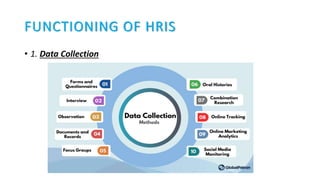
FUNCTIONING OF HRIS
• 1. Data Collection
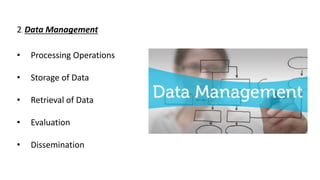
2. Data Management
• Processing Operations
• Storage of Data
• Retrieval of Data
• Evaluation
• Dissemination
Six steps of HRIS
Step 1 : Search
Step 2 : Plan and align
Step 3 : Define and design
Step 4 : Configure and test
Step 5 : Train and communicate
Step 6 : Deploy and sustain
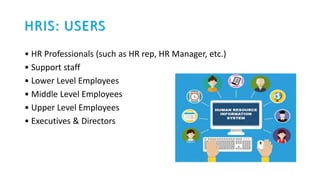
HRIS: USERS
• HR Professionals (such as HR rep, HR Manager, etc.)
• Support staff
• Lower Level Employees
• Middle Level Employees
• Upper Level Employees
• Executives & Directors
Applications of Computerised HRIS
 1. Job Descriptions : To produce printouts that describe the jobs according to the
user specifications and information's input to the system, as min job description
include the job titles purpose duties and responsibilities.
 2. HR Planning : forecast the demand for the key jobs as well as employees
turnover and patterns of inter organizational mobilities.
 3. Staffing : Address recruitment selection and placement functions can be include
further things – Application Tracking, Job Posting, Job requirement analysis, Job
person Matchings.
 4. Succession Planning : domain wise availability of candidates for specified
positions, it helps to identify the persons for key positions.
 5. Training & Development : It Includes the following – Career Planning,
Development needs analysis, Development Advisor.
 6. Performance Appraisal : Helps the manager to direct employee to achieve
the organizational goals and includes – Performance Assessment, Goals
Accomplishment, Rewards managements.
 7. Job Evaluations : Computer assisted job evaluations methods helps to Job
Evaluation Points, Classification levels & Job Hierarchies.
 8. Compensation : Track analyse and report compensation information on pay
grade structure, merit, guidelines support, salary budgeting etc.
Benefits of HRIS
• It keeps everything organized.
• Reduce the cost of data stored in the HR department.
• reduce duplication of effort, resulting in reduced costs
• faster data extraction and processing
• the availability of accurate and up-to-date human resources data
• It frees up HR professionals to handle more important tasks.
• It makes the company look good to employees.
Competitive Challenges and Human Resources
Management
CHALLENGE 1:Going Global
• Globalization.
• Impact on HRM.
• Impact of globalization issues
CHALLENGE 2:
Embracing New Technology
•Knowledge Workers
•The Spread of E-commerce
•The Rise of Virtual Workers
CHALLENGE 3:
Managing ChangeTechnology and globalization are only two of the forces
driving change inorganizations and HRM.
Types of Change
•Reactive change •Proactive change
CHALLENGE 4:
• Developing Human Capital
• Human Capital . Valuable because capital
CHALLENGE 5:
• Responding to the Market
• Total Quality Management (TQM)
• Six Sigma
CHALLENGE 6:
• Containing Costs
• Downsizing
• Outsourcing
• Employee LeasingSocial Issues and HRM
• Changing Demographics

Groupgajajkka 1.pptx

  • 2.
    What is HRIS •It is a systematic way of storing data information for each individual employee to aid planning, decision making & submitting of returns and reports to the top management. • A method by which an organization collects, analyses & reports the information about people and job.
  • 3.
    Objectives of HRIS •To offer sufficient, comprehensive & ongoing information about people & jobs. • To supply up to date informational at a reasonable cost. • To offer data security & personal privacy.
  • 4.
    • Operational HIS.Operational HIS systems collect and report human resource data such as employee records, position details, and performance appraisal information. • Tactical HRIS. • Strategic HRIS. • Comprehensive HRIS. • Limited-Function HRIS. The 5 different types of HIS systems
  • 5.
    FUNCTIONING OF HRIS •1. Data Collection
  • 6.
    2. Data Management •Processing Operations • Storage of Data • Retrieval of Data • Evaluation • Dissemination
  • 7.
    Six steps ofHRIS Step 1 : Search Step 2 : Plan and align Step 3 : Define and design Step 4 : Configure and test Step 5 : Train and communicate Step 6 : Deploy and sustain
  • 8.
    HRIS: USERS • HRProfessionals (such as HR rep, HR Manager, etc.) • Support staff • Lower Level Employees • Middle Level Employees • Upper Level Employees • Executives & Directors
  • 9.
    Applications of ComputerisedHRIS  1. Job Descriptions : To produce printouts that describe the jobs according to the user specifications and information's input to the system, as min job description include the job titles purpose duties and responsibilities.  2. HR Planning : forecast the demand for the key jobs as well as employees turnover and patterns of inter organizational mobilities.  3. Staffing : Address recruitment selection and placement functions can be include further things – Application Tracking, Job Posting, Job requirement analysis, Job person Matchings.  4. Succession Planning : domain wise availability of candidates for specified positions, it helps to identify the persons for key positions.
  • 10.
     5. Training& Development : It Includes the following – Career Planning, Development needs analysis, Development Advisor.  6. Performance Appraisal : Helps the manager to direct employee to achieve the organizational goals and includes – Performance Assessment, Goals Accomplishment, Rewards managements.  7. Job Evaluations : Computer assisted job evaluations methods helps to Job Evaluation Points, Classification levels & Job Hierarchies.  8. Compensation : Track analyse and report compensation information on pay grade structure, merit, guidelines support, salary budgeting etc.
  • 11.
    Benefits of HRIS •It keeps everything organized. • Reduce the cost of data stored in the HR department. • reduce duplication of effort, resulting in reduced costs • faster data extraction and processing • the availability of accurate and up-to-date human resources data • It frees up HR professionals to handle more important tasks. • It makes the company look good to employees.
  • 12.
    Competitive Challenges andHuman Resources Management CHALLENGE 1:Going Global • Globalization. • Impact on HRM. • Impact of globalization issues CHALLENGE 2: Embracing New Technology •Knowledge Workers •The Spread of E-commerce •The Rise of Virtual Workers
  • 13.
    CHALLENGE 3: Managing ChangeTechnologyand globalization are only two of the forces driving change inorganizations and HRM. Types of Change •Reactive change •Proactive change CHALLENGE 4: • Developing Human Capital • Human Capital . Valuable because capital CHALLENGE 5: • Responding to the Market • Total Quality Management (TQM) • Six Sigma
  • 14.
    CHALLENGE 6: • ContainingCosts • Downsizing • Outsourcing • Employee LeasingSocial Issues and HRM • Changing Demographics