Introduction to HRM
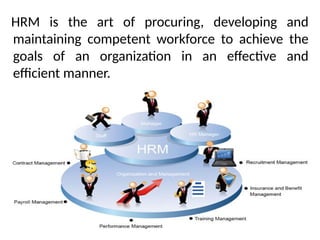
HRM is the art of procuring, developing and
maintaining competent workforce to achieve the
goals of an organization in an effective and
efficient manner.
Nature of HRM
• Pervasive force
• Action oriented
• Individual oriented
• People oriented
• Future oriented
• Development oriented
• Integrative mechanism
• Interdisciplinary function
• Continuous function
Scope of HRM
• Personnel aspect:
Manpower planning
Recruitment
Selection
Placement
Transfer
Promotion
Training and development
Lay off and retrenchment
Remuneration
Incentives
Productivity
• Welfare aspect:
Working conditions
Amenities(canteens, crèches, rest and lunch
rooms, housing, transport, medical assistance,
education, health and safety, recreation
facilities, etc.)
• Industrial relations aspect:
Union management relations
Joint consultation (aims to promote
cooperation between the employer and
employees and allow personnel to participate in
decision-making.)
Collective bargaining (It is a process of
negotiations between employers and a group of
employees aimed at reaching agreements that
regulate working conditions.)
Grievance and disciplinary procedures
Settlement of disputes.
Objectives of HRM
• Societal objectives – To be socially responsible to the
needs of the society.
• Organizational Objective – To recognize the role of HRM
in bringing about organizational effectiveness.
• Functional objective – To maintain department’s
contribution at a level appropriate to the organization's
needs.
• Personal Objective – To assist employees in achieving
their personal goals, at least in so far as these goals
enhance the individual’s contribution to the
organization.
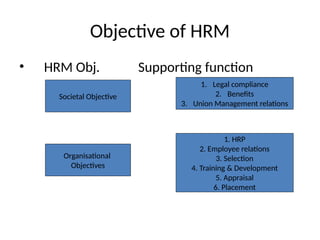
Objective of HRM
• HRM Obj. Supporting function
Societal Objective
1. Legal compliance
2. Benefits
3. Union Management relations
Organisational
Objectives
1. HRP
2. Employee relations
3. Selection
4. Training & Development
5. Appraisal
6. Placement
Objectives of HRM
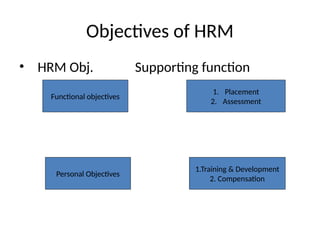
• HRM Obj. Supporting function
Functional objectives
1. Placement
2. Assessment
Personal Objectives
1.Training & Development
2. Compensation
Objectives of HRM
• To help the organization reach its goals.
• To employ the skills and abilities of the workforce
efficiently.
• To provide the organization with well-trained and well
motivated employees.
• To increase to the fullest the employee’s job
satisfaction and self-actualization.
• To develop and maintain a quality of work life.
• To communicate HR policies to all employees.
• To be ethically and socially responsive to the needs of
society.
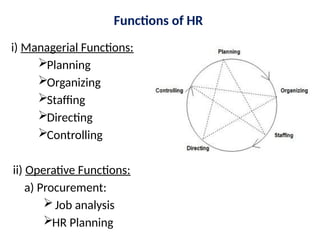
Functions of HR
i) Managerial Functions:
Planning
Organizing
Staffing
Directing
Controlling
ii) Operative Functions:
a) Procurement:
Job analysis
HR Planning
Recruitment
Selection
Induction and internal mobility.
 Placement
b) Development:
Training
Executive development
Career Planning
Succession planning
Human resources development strategies
c) Motivation and compensation:
Job design
Motivation
Job evaluation
Performance and potential appraisal
Compensation administration
Incentives and other benefits
d) Maintenance:
Health
Safety
Welfare
Social security.
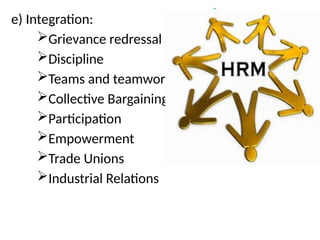
e) Integration:
Grievance redressal
Discipline
Teams and teamwork
Collective Bargaining
Participation
Empowerment
Trade Unions
Industrial Relations
Importance of HRM
Human Resource Management helps an
organization and its people to realize their
respective goals:
1. At the enterprise level:
 Good human resource practices can help in
attracting and retaining the best people in the
organization.
 It helps in training people for challenging roles,
promoting team spirit among the employees and
developing loyalty through appropriate reward
schemes.
2. At the individual level:
It promotes teamwork and team spirit among
employees.
It offers excellent growth opportunities to people
who have the potential to rise.
It allows people to work with diligence.
3. At the society level:
Employment opportunities multiply.
Scarce talents are put to best use. Companies that
pay and treat people well always and deliver
excellent results.
4. At the national level:
Helps in use of national, physical and financial
resources in a better way.
People with right skills, proper attitudes and
appropriate values help the nation to compete
with the best in the world leading to better
standard of living and better employment.
Evolution of HRM
• Early Phase:
Though it is said that HRM is of recent origin, it
had its origin dating back to 1800 B.C. Eg.
Minimum wage rate and incentive wage plans
were included in Babylonian Code of Hammurabi
around 1800 B.C.
Kautilya, in India(in his book Arthashastra) made
reference to various concepts like job analysis,
selection procedure, executive development,
incentive system and performance appraisal.
• Legal phase:
The early roots of HRM in India could be traced
back to the period after 1920. The royal
commission on labour in 1931 suggested the
appointment of labour officer to protect
workers’ interest.
Two professional bodies , the Indian Institute of
Personnel Management(IIPM) Kolkata and the
National Institute of Labour Management( NILM)
Mumbai have come into existence in 1950.
• Welfare Phase:
During 1960’s the scope expanded as it covered
labour welfare, participative management, industrial
harmony, etc.
• Development Phase:
In 1960’s and 1970’s, the HR professionals focused
more on developmental aspects of human
resources.
The emphasis was on striking a harmonious balance
between employee demands and organizational
requirements. HRD occupied an important place.
• The two professional bodies, IIPM and NILM
were merged to form the National Institute of
Personnel Management (NIPM) at Kolkata.
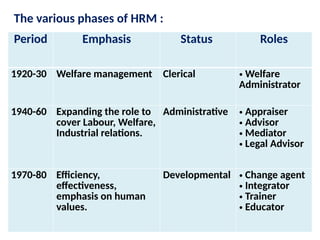
The various phases of HRM :
Period Emphasis Status Roles
1920-30 Welfare management Clerical • Welfare
Administrator
1940-60 Expanding the role to
cover Labour, Welfare,
Industrial relations.
Administrative • Appraiser
• Advisor
• Mediator
• Legal Advisor
1970-80 Efficiency,
effectiveness,
emphasis on human
values.
Developmental • Change agent
• Integrator
• Trainer
• Educator
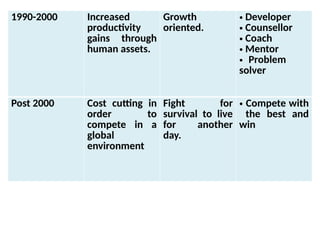
1990-2000 Increased
productivity
gains through
human assets.
Growth
oriented.
• Developer
• Counsellor
• Coach
• Mentor
• Problem
solver
Post 2000 Cost cutting in
order to
compete in a
global
environment
Fight for
survival to live
for another
day.
• Compete with
the best and
win
Personnel management:
• Personnel management is concerned with people
at work and their relationships with each others.
• It may be defined as a set of programmes,
functions and activities designed to maximize
both personal and organizational goals.
• It involves the establishment of various policies
to deal with employees and to retain them.
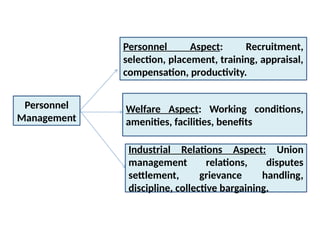
Personnel
Management
Personnel Aspect: Recruitment,
selection, placement, training, appraisal,
compensation, productivity.
Welfare Aspect: Working conditions,
amenities, facilities, benefits
Industrial Relations Aspect: Union
management relations, disputes
settlement, grievance handling,
discipline, collective bargaining.
.
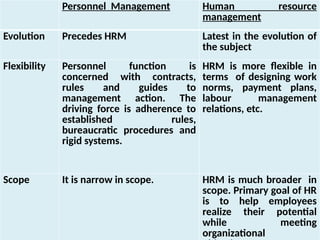
Personnel Management Human resource
management
Evolution Precedes HRM Latest in the evolution of
the subject
Flexibility Personnel function is
concerned with contracts,
rules and guides to
management action. The
driving force is adherence to
established rules,
bureaucratic procedures and
rigid systems.
HRM is more flexible in
terms of designing work
norms, payment plans,
labour management
relations, etc.
Scope It is narrow in scope. HRM is much broader in
scope. Primary goal of HR
is to help employees
realize their potential
while meeting
organizational
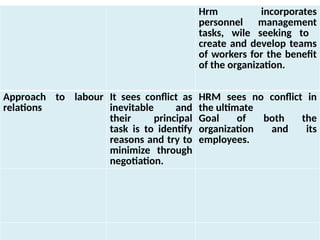
Hrm incorporates
personnel management
tasks, wile seeking to
create and develop teams
of workers for the benefit
of the organization.
Approach to labour
relations
It sees conflict as
inevitable and
their principal
task is to identify
reasons and try to
minimize through
negotiation.
HRM sees no conflict in
the ultimate
Goal of both the
organization and its
employees.
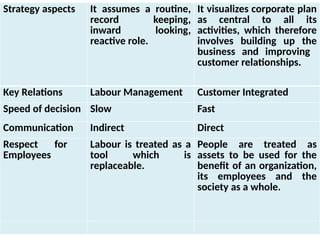
Strategy aspects It assumes a routine,
record keeping,
inward looking,
reactive role.
It visualizes corporate plan
as central to all its
activities, which therefore
involves building up the
business and improving
customer relationships.
Key Relations Labour Management Customer Integrated
Speed of decision Slow Fast
Communication Indirect Direct
Respect for
Employees
Labour is treated as a
tool which is
replaceable.
People are treated as
assets to be used for the
benefit of an organization,
its employees and the
society as a whole.
Challenges faced by HRM
• Vision penetration
• Internal environment
• Change in industrial relations
• Job design and organizational structure
• Increasing size of workforce
• Satisfaction of higher level needs
• Equalitarian social system
• Technological advances
• Computerized information system
• Changes in legal environment
• Management of human relations
Strategies for the New Millennium
• HR strategies set out what the organization intends to
do about its human resource management policies and
practices and how they should be integrated with the
business strategy and with each other. Key elements:
– Strategic objectives
– Plan of action
• HR strategy must be aligned with the organization’s
vision, mission and goals. In developing an HR strategy,
the company must analyze the characteristics of its
industry, determine its competitive advantage, and
identify key processes and key people.
• Strategy determines the direction where the
organization is going.
• A good HR strategy satisfies business needs and
takes account of the needs of line managers,
employees and other stakeholders.
• An HR strategy can be:
Overall / General strategy
Specific strategy: focuses on specific areas
– Talent management
– Development
– Reward management
Overall HR strategies
• Describes about how people should be
managed and developed and what steps should
be taken to ensure that the organization can
attract and retain the people it needs; and
ensure that employees are committed,
motivated, engaged.
Categories of overall strategies
• The overall strategies involves:
High-performance management
High-involvement management
High-commitment management
High-performance management
• Aims to influence organizational performance
through people.
• HRM areas involved
(HPWS – high performance work systems):
– Recruitment & selection
– Training and development
– Reward management
– Performance management
High-involvement management
• Treating employees as partners. Providing
opportunity for the employee to control and
understand their work.
• Communication for mutual understanding.
High-commitment management
• Organizational relations based on trust.
• Approaches to achieve commitment:
– Emphasis on trainability
– Functional flexibility
– Reduction of hierarchy, ending of status differentials
– Reliance on teams: problem solving
– Intrinsic satisfaction via job design
– Permanent employment with temporary workers
– Merit pay and profit sharing
– Involvement in quality management
Specific HR strategies
• Corporate social responsibility
• Organization development
• Employee Engagement
• Knowledge management
• TQM
• Talent management
• Quality Circles
• Kaizen
• Flexible working
• Employee relations
• Reward management
• Mentoring
• Emotional quotient

Introduction to Human Resource Management.pptx

  • 1.
  • 2.
    HRM is theart of procuring, developing and maintaining competent workforce to achieve the goals of an organization in an effective and efficient manner.
  • 3.
    Nature of HRM •Pervasive force • Action oriented • Individual oriented • People oriented • Future oriented • Development oriented • Integrative mechanism • Interdisciplinary function • Continuous function
  • 4.
    Scope of HRM •Personnel aspect: Manpower planning Recruitment Selection Placement Transfer Promotion Training and development Lay off and retrenchment
  • 5.
    Remuneration Incentives Productivity • Welfare aspect: Workingconditions Amenities(canteens, crèches, rest and lunch rooms, housing, transport, medical assistance, education, health and safety, recreation facilities, etc.)
  • 6.
    • Industrial relationsaspect: Union management relations Joint consultation (aims to promote cooperation between the employer and employees and allow personnel to participate in decision-making.) Collective bargaining (It is a process of negotiations between employers and a group of employees aimed at reaching agreements that regulate working conditions.) Grievance and disciplinary procedures Settlement of disputes.
  • 7.
    Objectives of HRM •Societal objectives – To be socially responsible to the needs of the society. • Organizational Objective – To recognize the role of HRM in bringing about organizational effectiveness. • Functional objective – To maintain department’s contribution at a level appropriate to the organization's needs. • Personal Objective – To assist employees in achieving their personal goals, at least in so far as these goals enhance the individual’s contribution to the organization.
  • 8.
    Objective of HRM •HRM Obj. Supporting function Societal Objective 1. Legal compliance 2. Benefits 3. Union Management relations Organisational Objectives 1. HRP 2. Employee relations 3. Selection 4. Training & Development 5. Appraisal 6. Placement
  • 9.
    Objectives of HRM •HRM Obj. Supporting function Functional objectives 1. Placement 2. Assessment Personal Objectives 1.Training & Development 2. Compensation
  • 10.
    Objectives of HRM •To help the organization reach its goals. • To employ the skills and abilities of the workforce efficiently. • To provide the organization with well-trained and well motivated employees. • To increase to the fullest the employee’s job satisfaction and self-actualization. • To develop and maintain a quality of work life. • To communicate HR policies to all employees. • To be ethically and socially responsive to the needs of society.
  • 11.
    Functions of HR i)Managerial Functions: Planning Organizing Staffing Directing Controlling ii) Operative Functions: a) Procurement: Job analysis HR Planning
  • 12.
    Recruitment Selection Induction and internalmobility.  Placement b) Development: Training Executive development Career Planning Succession planning Human resources development strategies
  • 13.
    c) Motivation andcompensation: Job design Motivation Job evaluation Performance and potential appraisal Compensation administration Incentives and other benefits d) Maintenance: Health Safety Welfare Social security.
  • 14.
    e) Integration: Grievance redressal Discipline Teamsand teamwork Collective Bargaining Participation Empowerment Trade Unions Industrial Relations
  • 15.
    Importance of HRM HumanResource Management helps an organization and its people to realize their respective goals: 1. At the enterprise level:  Good human resource practices can help in attracting and retaining the best people in the organization.  It helps in training people for challenging roles, promoting team spirit among the employees and developing loyalty through appropriate reward schemes.
  • 16.
    2. At theindividual level: It promotes teamwork and team spirit among employees. It offers excellent growth opportunities to people who have the potential to rise. It allows people to work with diligence. 3. At the society level: Employment opportunities multiply. Scarce talents are put to best use. Companies that pay and treat people well always and deliver excellent results.
  • 17.
    4. At thenational level: Helps in use of national, physical and financial resources in a better way. People with right skills, proper attitudes and appropriate values help the nation to compete with the best in the world leading to better standard of living and better employment.
  • 18.
    Evolution of HRM •Early Phase: Though it is said that HRM is of recent origin, it had its origin dating back to 1800 B.C. Eg. Minimum wage rate and incentive wage plans were included in Babylonian Code of Hammurabi around 1800 B.C. Kautilya, in India(in his book Arthashastra) made reference to various concepts like job analysis, selection procedure, executive development, incentive system and performance appraisal.
  • 19.
    • Legal phase: Theearly roots of HRM in India could be traced back to the period after 1920. The royal commission on labour in 1931 suggested the appointment of labour officer to protect workers’ interest. Two professional bodies , the Indian Institute of Personnel Management(IIPM) Kolkata and the National Institute of Labour Management( NILM) Mumbai have come into existence in 1950.
  • 20.
    • Welfare Phase: During1960’s the scope expanded as it covered labour welfare, participative management, industrial harmony, etc. • Development Phase: In 1960’s and 1970’s, the HR professionals focused more on developmental aspects of human resources. The emphasis was on striking a harmonious balance between employee demands and organizational requirements. HRD occupied an important place.
  • 21.
    • The twoprofessional bodies, IIPM and NILM were merged to form the National Institute of Personnel Management (NIPM) at Kolkata.
  • 22.
    The various phasesof HRM : Period Emphasis Status Roles 1920-30 Welfare management Clerical • Welfare Administrator 1940-60 Expanding the role to cover Labour, Welfare, Industrial relations. Administrative • Appraiser • Advisor • Mediator • Legal Advisor 1970-80 Efficiency, effectiveness, emphasis on human values. Developmental • Change agent • Integrator • Trainer • Educator
  • 23.
    1990-2000 Increased productivity gains through humanassets. Growth oriented. • Developer • Counsellor • Coach • Mentor • Problem solver Post 2000 Cost cutting in order to compete in a global environment Fight for survival to live for another day. • Compete with the best and win
  • 24.
    Personnel management: • Personnelmanagement is concerned with people at work and their relationships with each others. • It may be defined as a set of programmes, functions and activities designed to maximize both personal and organizational goals. • It involves the establishment of various policies to deal with employees and to retain them.
  • 25.
    Personnel Management Personnel Aspect: Recruitment, selection,placement, training, appraisal, compensation, productivity. Welfare Aspect: Working conditions, amenities, facilities, benefits Industrial Relations Aspect: Union management relations, disputes settlement, grievance handling, discipline, collective bargaining.
  • 26.
    . Personnel Management Humanresource management Evolution Precedes HRM Latest in the evolution of the subject Flexibility Personnel function is concerned with contracts, rules and guides to management action. The driving force is adherence to established rules, bureaucratic procedures and rigid systems. HRM is more flexible in terms of designing work norms, payment plans, labour management relations, etc. Scope It is narrow in scope. HRM is much broader in scope. Primary goal of HR is to help employees realize their potential while meeting organizational
  • 27.
    Hrm incorporates personnel management tasks,wile seeking to create and develop teams of workers for the benefit of the organization. Approach to labour relations It sees conflict as inevitable and their principal task is to identify reasons and try to minimize through negotiation. HRM sees no conflict in the ultimate Goal of both the organization and its employees.
  • 28.
    Strategy aspects Itassumes a routine, record keeping, inward looking, reactive role. It visualizes corporate plan as central to all its activities, which therefore involves building up the business and improving customer relationships. Key Relations Labour Management Customer Integrated Speed of decision Slow Fast Communication Indirect Direct Respect for Employees Labour is treated as a tool which is replaceable. People are treated as assets to be used for the benefit of an organization, its employees and the society as a whole.
  • 29.
    Challenges faced byHRM • Vision penetration • Internal environment • Change in industrial relations • Job design and organizational structure • Increasing size of workforce • Satisfaction of higher level needs • Equalitarian social system • Technological advances • Computerized information system • Changes in legal environment • Management of human relations
  • 30.
    Strategies for theNew Millennium • HR strategies set out what the organization intends to do about its human resource management policies and practices and how they should be integrated with the business strategy and with each other. Key elements: – Strategic objectives – Plan of action • HR strategy must be aligned with the organization’s vision, mission and goals. In developing an HR strategy, the company must analyze the characteristics of its industry, determine its competitive advantage, and identify key processes and key people.
  • 31.
    • Strategy determinesthe direction where the organization is going. • A good HR strategy satisfies business needs and takes account of the needs of line managers, employees and other stakeholders. • An HR strategy can be: Overall / General strategy Specific strategy: focuses on specific areas – Talent management – Development – Reward management
  • 32.
    Overall HR strategies •Describes about how people should be managed and developed and what steps should be taken to ensure that the organization can attract and retain the people it needs; and ensure that employees are committed, motivated, engaged.
  • 33.
    Categories of overallstrategies • The overall strategies involves: High-performance management High-involvement management High-commitment management
  • 34.
    High-performance management • Aimsto influence organizational performance through people. • HRM areas involved (HPWS – high performance work systems): – Recruitment & selection – Training and development – Reward management – Performance management
  • 35.
    High-involvement management • Treatingemployees as partners. Providing opportunity for the employee to control and understand their work. • Communication for mutual understanding.
  • 36.
    High-commitment management • Organizationalrelations based on trust. • Approaches to achieve commitment: – Emphasis on trainability – Functional flexibility – Reduction of hierarchy, ending of status differentials – Reliance on teams: problem solving – Intrinsic satisfaction via job design – Permanent employment with temporary workers – Merit pay and profit sharing – Involvement in quality management
  • 37.
    Specific HR strategies •Corporate social responsibility • Organization development • Employee Engagement • Knowledge management • TQM • Talent management • Quality Circles • Kaizen • Flexible working • Employee relations
  • 38.
    • Reward management •Mentoring • Emotional quotient