COMPENSATION What is compensation? All forms of pay or rewards given to employees and  arising from their employment. there are direct financial payments   in the form of   wages  salaries  allowances incentives  Commission Perquisites  bonuses etc. and Indirect payments in the form of financial benefits like  employer paid insurance or paid leave/holiday
What do you mean by  Wages Salaries pay Remuneration Rewards Incentives Perquisites  allowances
Basic classification of compensation methods Time rated - employees are paid on the basis of  the time they put in on the job.  Performance is not a basic criteria. Piece rated-  employees are paid based on the number of units produced/serviced/sold by them.  Time spent on the job is not a  basic criteria.
Duration of payment Daily Weekly Monthly Annually Once Advance payment On completion of the assignment
Factors influencing the determination of compensation Statutory requirements Employee unions Policy of the organization Ability to pay Equity-internal and external Demand supply gap in labour market
Statutory requirements in India Examples Article 39(d) of Constitution suggests equal pay for equal work for both men and women. Minimum wages Act 1948 empowers the government to  fix minimum wages irrespective of the ability of the employer to pay and to Fix the hours of work Fix overtime wages
Statutory requirements in India Payment of wages Act 1936 prescribes the method of payment of wages
Statutory requirements in India Payment of bonus Act 1965  requires employers to pay bonus to eligible employees every year. Beedi and Cigar Workers[conditions of employment )Act 1966  requires payment of overtime at double the normal rate[s.18] and  One day paid holiday for every six days of work [s.21]
Statutory requirements in India Factories Act 1948 Sec.52 of the provides weekly holiday for workmen. Sec.59 provides extra wages for overtime Industrial Employment standing orders Act1946   Requires the employers to  prescribe wage rates and mode of payment  Prescribes subsistence allowance during suspension
Statutory requirements in India Section 33 of  Mines Act 1952  requires  payment of overtime to workmen Working journalists Act 1955  provides for weekly holiday[s.6] over time [s.10] annual holidays [s.13]. Apprentices  Act 1961   requires payment of overtime and weekly holiday.
Statutory requirements in India Weekly holidays Act 1942 and  the Shops and commercial establishments Acts  of the states  provide for weekly holidays.
Statutory requirements in India Annual Leave with wages  Examples The Factories Act The Mines Act The Plantation Labour Act The working journalists Act The sales promotion employees Act Beedi Cigar workers Act Motor Transport workers Act
Employee Unions  The Trade Union Act 1926 allows formation of union by employees Unionized employees bargain collectively with the employer for higher wages. Unions can avail the statutory remedies like settlements or award provided under the industrial dispute Act.  Unions can boycott work demanding better wages Industrial employment standing orders Act provide for certified standing orders to prescribe service conditions
Compensation policies Employers’ compensation policy influences the determination of compensation. Each organization has its own policy whether they want to be seen as high paying employer or low paying. The other issues of compensation policy are the difference between managerial and non managerial salaries, apprentice’s salary etc. The method of deciding increments, incentives etc.
Equity issues in pay External equity - pay must be comparable favourably with other organizations for similar jobs Internal equity - Each employee should feel that his pay is equitable compared to others in the organization
How to determine equity Conduct a salary survey [formal, informal, government, consultants] to find out external equity Determine the worth of job within the organization by job evaluation by taking into account the compensable  factors like  efforts required,  responsibility,  skills,  working conditions, Accountability For external equity
Methods of job evaluation Ranking method-  ranking each job relative to all other jobs Obtain information Select the raters and job to be rated Select compensable factors Rank jobs
Methods of job evaluation Classification or grading method Categorizing jobs into groups based on the compensable factors Point method Identify several compensable factors and the degree to which each of these factors present in the said job.
Methods of job evaluation Factor comparison method Ranking jobs according to a variety of skill and difficulty factors Adding up these ranking to arrive at an overall numerical rating for each given job.
Group similar jobs into pay grades Jobs are classified according to the compensible factors, then Grouped them into relative pay grades depending upon the similarities of compensable factors.
Fine tune the pay scales Develop rate ranges for similar jobs Correcting out of line rates
Current trends in compensation Skill based pay-  employees are paid  for the range, depth and types of skills and knowledge  they are capable of using  rather than the job currently they hold.
Differences between skill based and job based pay In job based pay (JBP) testing competence is not required  but it is required under skill based pay In JBP, normally the  pay changes with the change of jobs   but This is not the case for SBP  In JBP seniority has the role to pay in determining the wages but  this is not the case CBP Upward mobility is faster and easier in SBP than JBP
Broad Banding Broad banding of salary means Reducing the many narrow pay grades into few wide levels. Which allows employees greater flexibility  to workout the pay range they wish to move into. In  broad  banding employees will have significant scope for salary increase based on  performance .
Managerial or executive compensation Plans How are the managerial compensation plans different from employee compensation plans? What are the main components of managerial compensation? What are the objectives of managerial compensation plans?
Managerial compensation Managerial compensation is different from employee compensation in many ways for example Employee compensation is governed by many labour legislations like minimum wages Act or bonus Act, but this is not the case with managerial compensation. employee compensation is mainly based on productivity of the employees within the organization but managerial compensation is determined  normally on the basis of market performance of the organization. the  number of people covered under employee compensation are larger compared to managerial compensation plans
Are any statutory requirements for managerial compensation Total managerial remuneration payable by a public company in a financial year shall not exceed 11% of the net profit If any professional services are rendered, they are to be paid separately If no profits in any  year no remuneration payable except with prior approval of central government  The 11% limit is inclusive of  Rent free accommodation Any other free amenities Any expenditure incurred on behalf of directors. Directors are not eligible for any tax free remuneration or allowances [section 198-200 Companies Act 1956] The remuneration of MD shall not exceed 5% of the net profit [s.309]
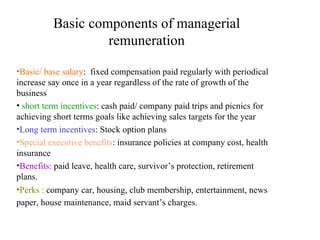
Basic components of managerial remuneration Basic/ base salary :  fixed compensation paid regularly with periodical increase say once in a year regardless of the rate of growth of the business  short term incentives : cash paid/ company paid trips and picnics for achieving short terms goals like achieving sales targets for the year Long term incentives : Stock option plans Special executive benefits : insurance policies at company cost, health insurance  Benefits:  paid leave, health care, survivor’s protection, retirement plans. Perks :  company car, housing, club membership, entertainment, news paper, house maintenance, maid servant’s charges.
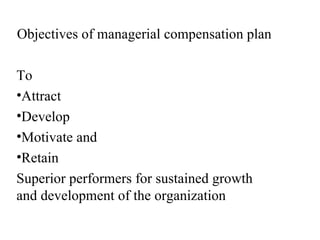
Objectives of managerial compensation plan   To  Attract Develop  Motivate and Retain  Superior performers for sustained growth and development of the organization
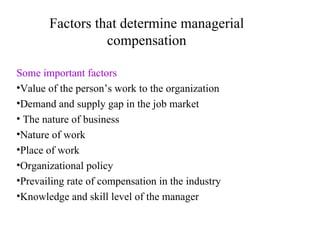
Factors that determine managerial compensation Some important factors Value of the person’s work to the organization Demand and supply gap in the job market The nature of business Nature of work  Place of work Organizational policy Prevailing rate of compensation in the industry Knowledge and skill level of the manager
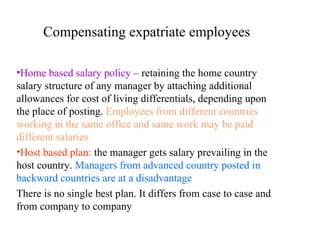
Compensating expatriate employees Home based salary policy  – retaining the home country salary structure of any manager by attaching additional allowances for cost of living differentials, depending upon the place of posting.  Employees from different countries working in the same office and same work may be paid different salaries Host based plan:   the manager gets salary prevailing in the host country.  Managers from advanced country posted in  backward countries are at a disadvantage There is no single best plan. It differs from case to case and from company to company
Incentive plans Individual  incentive plans : give money over and above base salary to individual employees who meet  specific performance standard. Example;  Spot bonus group incentive plans :  give money over and above bas salary to all members of the group for meeting specific performance standard. profit sharing plans:  provide employees with a share of the organization's profit in a specified period. Gain sharing plan :  reward employees for improvements in organizational productivity
Incentive plans Piecework plans Straight piece work plan : each worker receives a set  payment for each piece produced or processed in a factory/shop  Guaranteed piecework plan : the minimum hourly wage plus an incentive for each piece produced above a set number of pieces per hour. Standard hour plan : the worker is rewarded by a percent premium that equals the percent by which his or her performance exceeds the standard
Team based incentives METHOD 1 Set work standards for each member of the group and maintain a count of the out put of each member.  Then pay in one of the following ways All members receive the pay earned by the highest producer or All members receive the pay earned by the lowest producer or All members receive payment equal to the average pay earned by the group.
Team based incentives METHOD 2 set a performance standard based on the final output of the group as a whole  then all member will receive the same pay based on the rate fixed. METHOD 3 Tie team performance to the company’s strategic goals.  Teams which achieve the goals get the stated incentive.
Long term incentives  Stock option : the right to purchase a stated number of share of a company stock at today's price at some time in the future. Stock appreciation rights : either to buy the stocks in future as per the stock option or  or take any appreciation in the stock price. Performance achievement plans :  get shares for achieving predetermined performance targets Restricted stock plans : shares allotted for free or discount but not allowed to sell immediately Phantom stock plans : receive  units not shares and in future date they receive the appreciated value of money on those units
Incentive plans-important points to note Link the incentive with your business strategy Ensure that efforts and rewards are directly related Make the plan understandable and easily calculable  by the employees Set effective standards Guarantee your standards Guarantee base pay Have objective measurement systems Emphasize long term as well as short term success Take the market conditions into consideration


Compensation

  • 1.
    COMPENSATION What iscompensation? All forms of pay or rewards given to employees and arising from their employment. there are direct financial payments in the form of wages salaries allowances incentives Commission Perquisites bonuses etc. and Indirect payments in the form of financial benefits like employer paid insurance or paid leave/holiday
  • 2.
    What do youmean by Wages Salaries pay Remuneration Rewards Incentives Perquisites allowances
  • 3.
    Basic classification ofcompensation methods Time rated - employees are paid on the basis of the time they put in on the job. Performance is not a basic criteria. Piece rated- employees are paid based on the number of units produced/serviced/sold by them. Time spent on the job is not a basic criteria.
  • 4.
    Duration of paymentDaily Weekly Monthly Annually Once Advance payment On completion of the assignment
  • 5.
    Factors influencing thedetermination of compensation Statutory requirements Employee unions Policy of the organization Ability to pay Equity-internal and external Demand supply gap in labour market
  • 6.
    Statutory requirements inIndia Examples Article 39(d) of Constitution suggests equal pay for equal work for both men and women. Minimum wages Act 1948 empowers the government to fix minimum wages irrespective of the ability of the employer to pay and to Fix the hours of work Fix overtime wages
  • 7.
    Statutory requirements inIndia Payment of wages Act 1936 prescribes the method of payment of wages
  • 8.
    Statutory requirements inIndia Payment of bonus Act 1965 requires employers to pay bonus to eligible employees every year. Beedi and Cigar Workers[conditions of employment )Act 1966 requires payment of overtime at double the normal rate[s.18] and One day paid holiday for every six days of work [s.21]
  • 9.
    Statutory requirements inIndia Factories Act 1948 Sec.52 of the provides weekly holiday for workmen. Sec.59 provides extra wages for overtime Industrial Employment standing orders Act1946 Requires the employers to prescribe wage rates and mode of payment Prescribes subsistence allowance during suspension
  • 10.
    Statutory requirements inIndia Section 33 of Mines Act 1952 requires payment of overtime to workmen Working journalists Act 1955 provides for weekly holiday[s.6] over time [s.10] annual holidays [s.13]. Apprentices Act 1961 requires payment of overtime and weekly holiday.
  • 11.
    Statutory requirements inIndia Weekly holidays Act 1942 and the Shops and commercial establishments Acts of the states provide for weekly holidays.
  • 12.
    Statutory requirements inIndia Annual Leave with wages Examples The Factories Act The Mines Act The Plantation Labour Act The working journalists Act The sales promotion employees Act Beedi Cigar workers Act Motor Transport workers Act
  • 13.
    Employee Unions The Trade Union Act 1926 allows formation of union by employees Unionized employees bargain collectively with the employer for higher wages. Unions can avail the statutory remedies like settlements or award provided under the industrial dispute Act. Unions can boycott work demanding better wages Industrial employment standing orders Act provide for certified standing orders to prescribe service conditions
  • 14.
    Compensation policies Employers’compensation policy influences the determination of compensation. Each organization has its own policy whether they want to be seen as high paying employer or low paying. The other issues of compensation policy are the difference between managerial and non managerial salaries, apprentice’s salary etc. The method of deciding increments, incentives etc.
  • 15.
    Equity issues inpay External equity - pay must be comparable favourably with other organizations for similar jobs Internal equity - Each employee should feel that his pay is equitable compared to others in the organization
  • 16.
    How to determineequity Conduct a salary survey [formal, informal, government, consultants] to find out external equity Determine the worth of job within the organization by job evaluation by taking into account the compensable factors like efforts required, responsibility, skills, working conditions, Accountability For external equity
  • 17.
    Methods of jobevaluation Ranking method- ranking each job relative to all other jobs Obtain information Select the raters and job to be rated Select compensable factors Rank jobs
  • 18.
    Methods of jobevaluation Classification or grading method Categorizing jobs into groups based on the compensable factors Point method Identify several compensable factors and the degree to which each of these factors present in the said job.
  • 19.
    Methods of jobevaluation Factor comparison method Ranking jobs according to a variety of skill and difficulty factors Adding up these ranking to arrive at an overall numerical rating for each given job.
  • 20.
    Group similar jobsinto pay grades Jobs are classified according to the compensible factors, then Grouped them into relative pay grades depending upon the similarities of compensable factors.
  • 21.
    Fine tune thepay scales Develop rate ranges for similar jobs Correcting out of line rates
  • 22.
    Current trends incompensation Skill based pay- employees are paid for the range, depth and types of skills and knowledge they are capable of using rather than the job currently they hold.
  • 23.
    Differences between skillbased and job based pay In job based pay (JBP) testing competence is not required but it is required under skill based pay In JBP, normally the pay changes with the change of jobs but This is not the case for SBP In JBP seniority has the role to pay in determining the wages but this is not the case CBP Upward mobility is faster and easier in SBP than JBP
  • 24.
    Broad Banding Broadbanding of salary means Reducing the many narrow pay grades into few wide levels. Which allows employees greater flexibility to workout the pay range they wish to move into. In broad banding employees will have significant scope for salary increase based on performance .
  • 25.
    Managerial or executivecompensation Plans How are the managerial compensation plans different from employee compensation plans? What are the main components of managerial compensation? What are the objectives of managerial compensation plans?
  • 26.
    Managerial compensation Managerialcompensation is different from employee compensation in many ways for example Employee compensation is governed by many labour legislations like minimum wages Act or bonus Act, but this is not the case with managerial compensation. employee compensation is mainly based on productivity of the employees within the organization but managerial compensation is determined normally on the basis of market performance of the organization. the number of people covered under employee compensation are larger compared to managerial compensation plans
  • 27.
    Are any statutoryrequirements for managerial compensation Total managerial remuneration payable by a public company in a financial year shall not exceed 11% of the net profit If any professional services are rendered, they are to be paid separately If no profits in any year no remuneration payable except with prior approval of central government The 11% limit is inclusive of Rent free accommodation Any other free amenities Any expenditure incurred on behalf of directors. Directors are not eligible for any tax free remuneration or allowances [section 198-200 Companies Act 1956] The remuneration of MD shall not exceed 5% of the net profit [s.309]
  • 28.
    Basic components ofmanagerial remuneration Basic/ base salary : fixed compensation paid regularly with periodical increase say once in a year regardless of the rate of growth of the business short term incentives : cash paid/ company paid trips and picnics for achieving short terms goals like achieving sales targets for the year Long term incentives : Stock option plans Special executive benefits : insurance policies at company cost, health insurance Benefits: paid leave, health care, survivor’s protection, retirement plans. Perks : company car, housing, club membership, entertainment, news paper, house maintenance, maid servant’s charges.
  • 29.
    Objectives of managerialcompensation plan To Attract Develop Motivate and Retain Superior performers for sustained growth and development of the organization
  • 30.
    Factors that determinemanagerial compensation Some important factors Value of the person’s work to the organization Demand and supply gap in the job market The nature of business Nature of work Place of work Organizational policy Prevailing rate of compensation in the industry Knowledge and skill level of the manager
  • 31.
    Compensating expatriate employeesHome based salary policy – retaining the home country salary structure of any manager by attaching additional allowances for cost of living differentials, depending upon the place of posting. Employees from different countries working in the same office and same work may be paid different salaries Host based plan: the manager gets salary prevailing in the host country. Managers from advanced country posted in backward countries are at a disadvantage There is no single best plan. It differs from case to case and from company to company
  • 32.
    Incentive plans Individual incentive plans : give money over and above base salary to individual employees who meet specific performance standard. Example; Spot bonus group incentive plans : give money over and above bas salary to all members of the group for meeting specific performance standard. profit sharing plans: provide employees with a share of the organization's profit in a specified period. Gain sharing plan : reward employees for improvements in organizational productivity
  • 33.
    Incentive plans Pieceworkplans Straight piece work plan : each worker receives a set payment for each piece produced or processed in a factory/shop Guaranteed piecework plan : the minimum hourly wage plus an incentive for each piece produced above a set number of pieces per hour. Standard hour plan : the worker is rewarded by a percent premium that equals the percent by which his or her performance exceeds the standard
  • 34.
    Team based incentivesMETHOD 1 Set work standards for each member of the group and maintain a count of the out put of each member. Then pay in one of the following ways All members receive the pay earned by the highest producer or All members receive the pay earned by the lowest producer or All members receive payment equal to the average pay earned by the group.
  • 35.
    Team based incentivesMETHOD 2 set a performance standard based on the final output of the group as a whole then all member will receive the same pay based on the rate fixed. METHOD 3 Tie team performance to the company’s strategic goals. Teams which achieve the goals get the stated incentive.
  • 36.
    Long term incentives Stock option : the right to purchase a stated number of share of a company stock at today's price at some time in the future. Stock appreciation rights : either to buy the stocks in future as per the stock option or or take any appreciation in the stock price. Performance achievement plans : get shares for achieving predetermined performance targets Restricted stock plans : shares allotted for free or discount but not allowed to sell immediately Phantom stock plans : receive units not shares and in future date they receive the appreciated value of money on those units
  • 37.
    Incentive plans-important pointsto note Link the incentive with your business strategy Ensure that efforts and rewards are directly related Make the plan understandable and easily calculable by the employees Set effective standards Guarantee your standards Guarantee base pay Have objective measurement systems Emphasize long term as well as short term success Take the market conditions into consideration
  • 38.
  • 39.
  • 40.
  • 41.
  • 42.
  • 43.
  • 44.