© 2008 Hewlett-Packard Development Company, L.P.
The information contained herein is subject to change without notice
The Service
Lifecycle
2
Life Cycle
The various stages through which a living thing passes
• Creation – The first part of our journey
• Childhood – The formative stage
• Adulthood – Where we hone our skills and perform within
expected societal parameters
3
Continual Service
Improvement
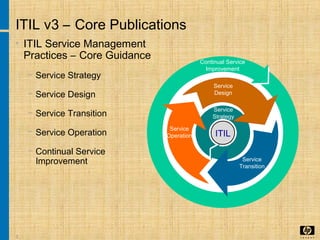
ITIL v3 – Core Publications
• ITIL Service Management
Practices – Core Guidance
− Service Strategy
− Service Design
− Service Transition
− Service Operation
− Continual Service
Improvement
Se rviceService
Strategy
Service
Operation
Se rvice
De sig n
Service
Design
Service
Transition
ITIL
4
Service Strategy
• Shows organization how to
transform Service Management
into strategic asset and to then
think and act in a strategic manner
• Helps clarify the relationships
between various services,
systems or processes and the
business models, strategies or
objectives they support
5
Service Strategy - Key Concepts
• Value Creation
− Utility and Warranty
• Service Assets
− Service Capabilities and Resources
• Service Provider Types
− Type I, Type II, Type III
• Developing Service Offerings
− Service Portfolio
6
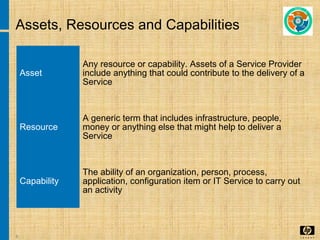
Assets, Resources and Capabilities
Asset
Any resource or capability. Assets of a Service Provider
include anything that could contribute to the delivery of a
Service
Resource
A generic term that includes infrastructure, people,
money or anything else that might help to deliver a
Service
Capability
The ability of an organization, person, process,
application, configuration item or IT Service to carry out
an activity
7
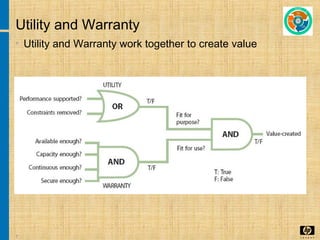
Utility and Warranty
• Utility and Warranty work together to create value
8
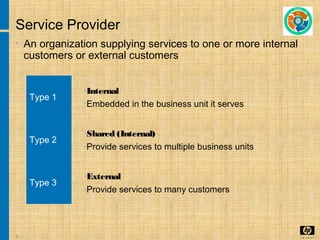
Service Provider
• An organization supplying services to one or more internal
customers or external customers
Type 1
•Internal
•Embedded in the business unit it serves
Type 2
•Shared (Internal)
•Provide services to multiple business units
Type 3
•External
•Provide services to many customers
9
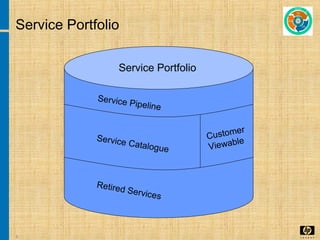
Service Portfolio
Service Pipeline
Customer
Viewable
Retired Services
Service Catalogue
Service Portfolio
10
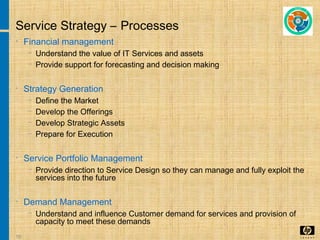
Service Strategy – Processes
• Financial management
− Understand the value of IT Services and assets
− Provide support for forecasting and decision making
• Strategy Generation
− Define the Market
− Develop the Offerings
− Develop Strategic Assets
− Prepare for Execution
• Service Portfolio Management
− Provide direction to Service Design so they can manage and fully exploit the
services into the future
• Demand Management
− Understand and influence Customer demand for services and provision of
capacity to meet these demands
11
Service Design (SD)
• Provides guidance for the design
and development of services and
Service Management processes
• The scope includes new services,
and the changes and
improvements necessary to
increase or maintain value to
customers over the lifecycle of
services
12
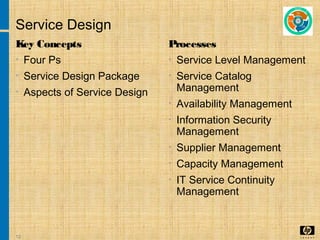
Service Design
Key Concepts
• Four Ps
• Service Design Package
• Aspects of Service Design
Processes
• Service Level Management
• Service Catalog
Management
• Availability Management
• Information Security
Management
• Supplier Management
• Capacity Management
• IT Service Continuity
Management
13
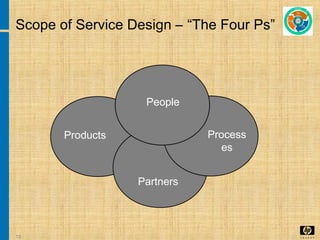
Scope of Service Design – “The Four Ps”
Products
Partners
People
Process
es
14
Service Design Package
• Service Design Package
− Defines the service through all stages of its lifecycle
− Passed to Service Transition for implementation
15
Service Design - Aspects
• Service solutions
• Service management systems and tools
• Technical and management architectures
• Service management processes
• Measurement systems and metrics
16
Service Transition (ST)
• Plan and implement the
deployment of all releases to
create a new services or improve
an existing service
• Assure that the proposed changes
in the Service Design Package
are realized
• Successfully steer releases
through testing and into live
environment
• Transition services to/from other
organizations
• Decommission or terminate
services
17
Service Transition
Key Concepts
• Service V Model
• Configuration Item
• Configuration Management
System (CMS)
• Service Knowledge Management
System
• Data Information Knowledge
Wisdom (DIKW)
• Definitive Media Library
Processes
• Transition Planning and
Support
• Change Management
• Service Asset Configuration
Management
• Release and Deployment
Management
• Service Validation and
Testing
• Evaluation
• Knowledge Management
18
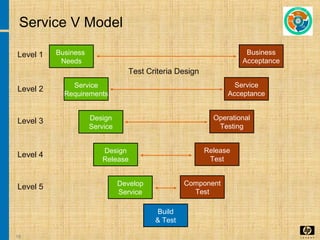
Service V Model
Level 1 Business
Needs
Level 2 Service
Requirements
Level 5 Develop
Service
Level 3 Design
Service
Level 4
Design
Release
Business
Acceptance
Service
Acceptance
Component
Test
Operational
Testing
Release
Test
Build
& Test
Test Criteria Design
19
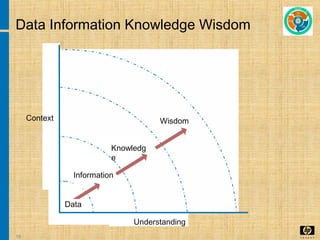
Data Information Knowledge Wisdom
Context
Understanding
Wisdom
Knowledg
e
Information
Data
20
Service Operation (SO)
• Coordinate and carry-out day-to-
day activities and processes to
deliver and manage services at
agreed levels
• Ongoing management of the
technology that is used to deliver
and support services
• Where the plans, designs and
optimizations are executed and
measured
21
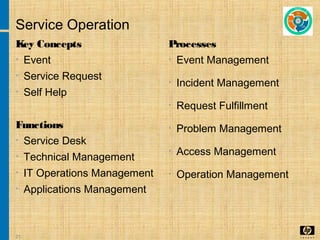
Service Operation
Key Concepts
• Event
• Service Request
• Self Help
Functions
• Service Desk
• Technical Management
• IT Operations Management
• Applications Management
Processes
• Event Management
• Incident Management
• Request Fulfillment
• Problem Management
• Access Management
• Operation Management
22
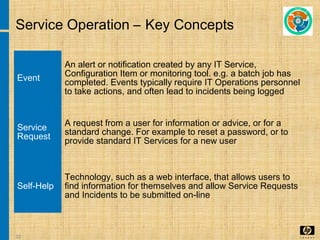
Service Operation – Key Concepts
Event
An alert or notification created by any IT Service,
Configuration Item or monitoring tool. e.g. a batch job has
completed. Events typically require IT Operations personnel
to take actions, and often lead to incidents being logged
Service
Request
A request from a user for information or advice, or for a
standard change. For example to reset a password, or to
provide standard IT Services for a new user
Self-Help
Technology, such as a web interface, that allows users to
find information for themselves and allow Service Requests
and Incidents to be submitted on-line
23
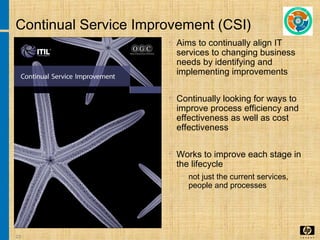
Continual Service Improvement (CSI)
• Aims to continually align IT
services to changing business
needs by identifying and
implementing improvements
• Continually looking for ways to
improve process efficiency and
effectiveness as well as cost
effectiveness
• Works to improve each stage in
the lifecycle
− not just the current services,
people and processes
24
Scope of CSI
• Service Measure
25
Value to business of CSI
• Improved service quality, higher availability
• Gradual cost reductions and better cost-justification
• Better information about existing services and areas for
improvement
• Better business/IT alignment
• Increased flexibility and adoptability
• Improved communication
26
Continual Service Improvement
Key Concepts
• Plan-Do-Check-Act
• CSI model
• Business value of service
measurement
• Types of metric
Processes
• Service Measurement
• Service Reporting
• Service Improvement
27
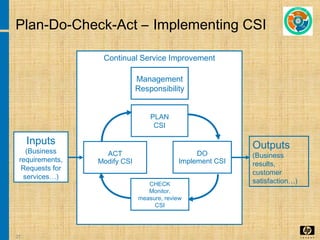
Continual Service Improvement
Plan-Do-Check-Act – Implementing CSI
Inputs
(Business
requirements,
Requests for
services…)
Outputs
(Business
results,
customer
satisfaction…)
ACT
Modify CSI
CHECK
Monitor,
measure, review
CSI
DO
Implement CSI
PLAN
CSI
Management
Responsibility
28
The CSI Model
29
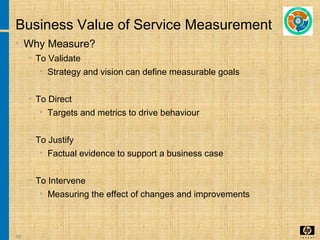
Business Value of Service Measurement
• Why Measure?
− To Validate
• Strategy and vision can define measurable goals
− To Direct
• Targets and metrics to drive behaviour
− To Justify
• Factual evidence to support a business case
− To Intervene
• Measuring the effect of changes and improvements
30
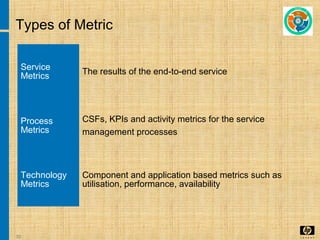
Types of Metric
Service
Metrics
The results of the end-to-end service
Process
Metrics
CSFs, KPIs and activity metrics for the service
management processes
Technology
Metrics
Component and application based metrics such as
utilisation, performance, availability
31
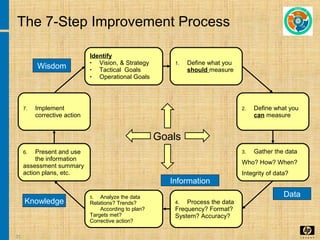
Identify
• Vision, & Strategy
• Tactical Goals
• Operational Goals
1. Define what you
should measure
2. Define what you
can measure
3. Gather the data
Who? How? When?
Integrity of data?
4. Process the data
Frequency? Format?
System? Accuracy?
5. Analyze the data
Relations? Trends?
According to plan?
Targets met?
Corrective action?
6. Present and use
the information
assessment summary
action plans, etc.
7. Implement
corrective action
Goals
The 7-Step Improvement Process
Data
Information
Knowledge
Wisdom
32
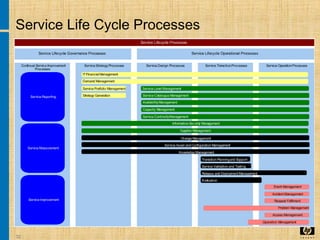
Service Life Cycle Processes

2 the service lifecycle

  • 1.
    © 2008 Hewlett-PackardDevelopment Company, L.P. The information contained herein is subject to change without notice The Service Lifecycle
  • 2.
    2 Life Cycle The variousstages through which a living thing passes • Creation – The first part of our journey • Childhood – The formative stage • Adulthood – Where we hone our skills and perform within expected societal parameters
  • 3.
    3 Continual Service Improvement ITIL v3– Core Publications • ITIL Service Management Practices – Core Guidance − Service Strategy − Service Design − Service Transition − Service Operation − Continual Service Improvement Se rviceService Strategy Service Operation Se rvice De sig n Service Design Service Transition ITIL
  • 4.
    4 Service Strategy • Showsorganization how to transform Service Management into strategic asset and to then think and act in a strategic manner • Helps clarify the relationships between various services, systems or processes and the business models, strategies or objectives they support
  • 5.
    5 Service Strategy -Key Concepts • Value Creation − Utility and Warranty • Service Assets − Service Capabilities and Resources • Service Provider Types − Type I, Type II, Type III • Developing Service Offerings − Service Portfolio
  • 6.
    6 Assets, Resources andCapabilities Asset Any resource or capability. Assets of a Service Provider include anything that could contribute to the delivery of a Service Resource A generic term that includes infrastructure, people, money or anything else that might help to deliver a Service Capability The ability of an organization, person, process, application, configuration item or IT Service to carry out an activity
  • 7.
    7 Utility and Warranty •Utility and Warranty work together to create value
  • 8.
    8 Service Provider • Anorganization supplying services to one or more internal customers or external customers Type 1 •Internal •Embedded in the business unit it serves Type 2 •Shared (Internal) •Provide services to multiple business units Type 3 •External •Provide services to many customers
  • 9.
    9 Service Portfolio Service Pipeline Customer Viewable RetiredServices Service Catalogue Service Portfolio
  • 10.
    10 Service Strategy –Processes • Financial management − Understand the value of IT Services and assets − Provide support for forecasting and decision making • Strategy Generation − Define the Market − Develop the Offerings − Develop Strategic Assets − Prepare for Execution • Service Portfolio Management − Provide direction to Service Design so they can manage and fully exploit the services into the future • Demand Management − Understand and influence Customer demand for services and provision of capacity to meet these demands
  • 11.
    11 Service Design (SD) •Provides guidance for the design and development of services and Service Management processes • The scope includes new services, and the changes and improvements necessary to increase or maintain value to customers over the lifecycle of services
  • 12.
    12 Service Design Key Concepts •Four Ps • Service Design Package • Aspects of Service Design Processes • Service Level Management • Service Catalog Management • Availability Management • Information Security Management • Supplier Management • Capacity Management • IT Service Continuity Management
  • 13.
    13 Scope of ServiceDesign – “The Four Ps” Products Partners People Process es
  • 14.
    14 Service Design Package •Service Design Package − Defines the service through all stages of its lifecycle − Passed to Service Transition for implementation
  • 15.
    15 Service Design -Aspects • Service solutions • Service management systems and tools • Technical and management architectures • Service management processes • Measurement systems and metrics
  • 16.
    16 Service Transition (ST) •Plan and implement the deployment of all releases to create a new services or improve an existing service • Assure that the proposed changes in the Service Design Package are realized • Successfully steer releases through testing and into live environment • Transition services to/from other organizations • Decommission or terminate services
  • 17.
    17 Service Transition Key Concepts •Service V Model • Configuration Item • Configuration Management System (CMS) • Service Knowledge Management System • Data Information Knowledge Wisdom (DIKW) • Definitive Media Library Processes • Transition Planning and Support • Change Management • Service Asset Configuration Management • Release and Deployment Management • Service Validation and Testing • Evaluation • Knowledge Management
  • 18.
    18 Service V Model Level1 Business Needs Level 2 Service Requirements Level 5 Develop Service Level 3 Design Service Level 4 Design Release Business Acceptance Service Acceptance Component Test Operational Testing Release Test Build & Test Test Criteria Design
  • 19.
    19 Data Information KnowledgeWisdom Context Understanding Wisdom Knowledg e Information Data
  • 20.
    20 Service Operation (SO) •Coordinate and carry-out day-to- day activities and processes to deliver and manage services at agreed levels • Ongoing management of the technology that is used to deliver and support services • Where the plans, designs and optimizations are executed and measured
  • 21.
    21 Service Operation Key Concepts •Event • Service Request • Self Help Functions • Service Desk • Technical Management • IT Operations Management • Applications Management Processes • Event Management • Incident Management • Request Fulfillment • Problem Management • Access Management • Operation Management
  • 22.
    22 Service Operation –Key Concepts Event An alert or notification created by any IT Service, Configuration Item or monitoring tool. e.g. a batch job has completed. Events typically require IT Operations personnel to take actions, and often lead to incidents being logged Service Request A request from a user for information or advice, or for a standard change. For example to reset a password, or to provide standard IT Services for a new user Self-Help Technology, such as a web interface, that allows users to find information for themselves and allow Service Requests and Incidents to be submitted on-line
  • 23.
    23 Continual Service Improvement(CSI) • Aims to continually align IT services to changing business needs by identifying and implementing improvements • Continually looking for ways to improve process efficiency and effectiveness as well as cost effectiveness • Works to improve each stage in the lifecycle − not just the current services, people and processes
  • 24.
    24 Scope of CSI •Service Measure
  • 25.
    25 Value to businessof CSI • Improved service quality, higher availability • Gradual cost reductions and better cost-justification • Better information about existing services and areas for improvement • Better business/IT alignment • Increased flexibility and adoptability • Improved communication
  • 26.
    26 Continual Service Improvement KeyConcepts • Plan-Do-Check-Act • CSI model • Business value of service measurement • Types of metric Processes • Service Measurement • Service Reporting • Service Improvement
  • 27.
    27 Continual Service Improvement Plan-Do-Check-Act– Implementing CSI Inputs (Business requirements, Requests for services…) Outputs (Business results, customer satisfaction…) ACT Modify CSI CHECK Monitor, measure, review CSI DO Implement CSI PLAN CSI Management Responsibility
  • 28.
  • 29.
    29 Business Value ofService Measurement • Why Measure? − To Validate • Strategy and vision can define measurable goals − To Direct • Targets and metrics to drive behaviour − To Justify • Factual evidence to support a business case − To Intervene • Measuring the effect of changes and improvements
  • 30.
    30 Types of Metric Service Metrics Theresults of the end-to-end service Process Metrics CSFs, KPIs and activity metrics for the service management processes Technology Metrics Component and application based metrics such as utilisation, performance, availability
  • 31.
    31 Identify • Vision, &Strategy • Tactical Goals • Operational Goals 1. Define what you should measure 2. Define what you can measure 3. Gather the data Who? How? When? Integrity of data? 4. Process the data Frequency? Format? System? Accuracy? 5. Analyze the data Relations? Trends? According to plan? Targets met? Corrective action? 6. Present and use the information assessment summary action plans, etc. 7. Implement corrective action Goals The 7-Step Improvement Process Data Information Knowledge Wisdom
  • 32.

Editor's Notes

  • #3 Purpose: Key Message: Creation – the first part of our journey. As an embryo develops, its life blueprint is being established through the architecture of its DNA. The embryo’s genetic structure will dictate its capability, propensity for immunity or vulnerability to disease, and certain personality characteristics it will carry throughout life. Childhood – the formative stage. We are influenced by our exposure to the world around us and can influence our life blueprint in how we manifest and integrate ourselves with the world around us. Our understanding of our needs, both for growth and creativity, are our ’requirements’ that allow us to create value for ourselves and those who come into contact with us. Adulthood – where we hone our skills and perform within expected societal parameters. We strive to improve our capabilities continually and define our value. By this time, we have built a complex network of relationships and dependencies to others. The world we live in has become far more complex than in childhood and managing our lives more challenging. Additional Information: N/A Transition to Next Slide:
  • #4 Diagram: Shows the Core ITIL V3 publications/books. Setting the scene (middle) is Service Strategies, laying out guidelines for the IT organization, how to deliver value, which service portfolios to offer, etc. Service Design – translates strategic plans and objectives into designs and specifications ready to be built. Service Transition – takes the IT service design and implements it into the production environment. Service Operation – management of the IT services on a day-to-day basis Continual Service Improvement – ensuring that the IT service meets it’s service level objectives over-time; ensuring that the overall IT Service Management implementation is able to support the needs of the IT services and their customers – and that improvement/corrections are made as required. Each of the life-cycle stages is subject to Continual Service Improvement. Up to this point, we have defined the Core ITIL V3 publications.
  • #5 Purpose: Key Message: Additional Information: Transition to Next Slide:
  • #12 Purpose: Key Message: Additional Information: Transition to Next Slide:
  • #13 Purpose: Key Message: Additional Information: N/A Transition to Next Slide:
  • #14 Purpose: Key Message: Additional Information: N/A Transition to Next Slide:
  • #17 Purpose: Key Message: Additional Information: Transition to Next Slide:
  • #19 Protect your services Cost to fix a defect at each level goes up by about 10x - so need to detect them as early as possible in the lifecycle
  • #21 Purpose: Key Message: Additional Information: Transition to Next Slide:
  • #24 Purpose: Key Message: Additional Information: Transition to Next Slide:
  • #25 Purpose: Key Message: Additional Information: Transition to Next Slide:
  • #26 Purpose: Key Message: Additional Information: Transition to Next Slide:
  • #32 Operational Goals