 Jimesh Joshi    32
 Suraj More      50
 Khan Aamir
 Sushant Bhaud   09
   Human Resource Planning could be expressed as a process by which the
    management ensures the right number of people and right kind of people, at the
    right place , at the right time doing the right things for which they are recruited and
    placed for the achievement of goals of the organization.
   Human Resource may be regarded as the quantitative and qualitative measurement
    of work required in an organization.

   Human Resource Planning aims at the continuous supply of right kind of
    personnel to fill various positions in the organization.
   HRP is a continuous process.
   In the words of Colman, ―Manpower planning is the process of determining
    manpower requirements and the means of meeting those requirements in order to

    carry out the integrated plan of the organization‖
   According to Geister, ―Manpower Planning is the process including forecasting,
    developing and controlling by which a firm ensures that it has the right number of
    people and the right kind of people at the right places, at the right time doing work
    for which they are economically most useful. Therefore, manpower planning consists
    of projecting future man power requirements and developing manpower plans for the
    implement action of projections‖.
   According to Dales.S.Beach, ―Human Resource Planning is a process of determining
    and assuring that the organization will have an adequate number of qualified persons,
    available at the proper times , performing jobs which meet the needs of the enterprise
    and which provides at is faction for the individuals involved.‖
 Ensure    optimum use of human resources currently employed
 Avoid    imbalances in the distribution and allocation of human
 resources
 Assess   or forecast future skill requirements of the organization's
 overall objectives
 Provide   control measure to ensure availability of necessary
 resources when required
 Control   the aspect of human resources
 Formulate    transfer and promotion policies
   HRP presents an inventory of existing man power of the organisation.
    Analysis of this resource helps in ascertaining the status of the available
    personnel and to discover untapped talent presently available with the
    organisation.
   HRP helps in determining the short fall or surplus of the resource by
    comparing the total resource needs with the present supply. It also
    helps in projecting future HR needs.
   HRP is concerned with the initiation of various organisation
    programmes depending upon the demand and supply of human
    resources
   Listing or current human resources
   Assessing the context to which the current man power is utilized to the
    advantage of the organizing.
   Planning out the surplus human resource, if any
   Analyzing the requirements of manpower in future in the light of
    expansion plans, retirement of personnel etc.
   Making human resource forecast
   Designing training programme for different categories of human
    resource.
 HRP   helps in proper recruitment and selections of the right
 type of people which are available for various positions in the
 organization.
 HRP   also facilitates designing of training programmes for the
 employees to develop the required skills in them.
 HRP   provides lead time for procuring personnel as the lead
 time given is a time- consuming process.
   HRP results in reduced labour costs as it helps the management to anticipate shortages
    and or surpluses or HR, and correct these imbalances before they become
    unmanageable and expensive.

   HRP is the scientific way for planning employee development that is designed to make
    optimum use of workers’ skills within the organization.

   HRP enables identification of the gaps of the existing HRs so that corrective training
    could be imparted.

   HRP leads of improvement in the overall ―Business Planning‖ process. HRP helps in
    formulating managerial succession plan as a part of there placement planning process.

   HRP leads to a greater awareness of the importance of soundman power management
    through out the organization HRP serves as a tool to evaluate the effect of alternative
    man power actions and policies.
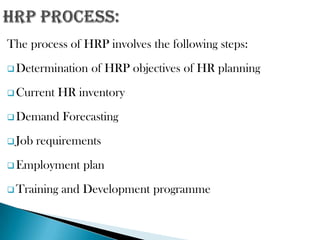
The process of HRP involves the following steps:
 Determination   of HRP objectives of HR planning
 Current   HR inventory
 Demand     Forecasting
 Job   requirements
 Employment     plan
 Training   and Development programme
   Human resource planning analyzes an organization’s HR needs and
    how to best fill them.
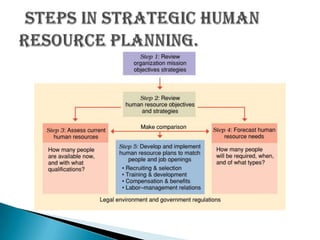
   Steps in the HR planning process:
    Step 1 — review organizational mission, objectives, and strategies.
    Step 2 — review HR objectives and strategies.
    Step 3 — assess current HR needs.
    Step 4 — forecast HR needs.
    Step 5 — develop and implement HR plans.
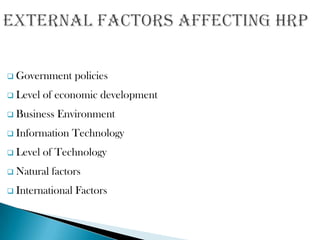
 Government      policies
 Level   of economic development
 Business   Environment
 Information   Technology
 Level   of Technology
 Natural   factors
 International   Factors
 Strategies   of the Company
 Human     Resource Policies of the Company
 Formal   and Informal Groups
 Job   Analysis
 Time    Horizons
 Types   of Quality Of Information
 Company’s     production Operations policy
 Trade   unions
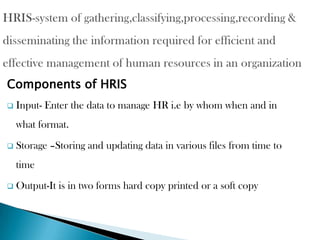
Components of HRIS
   Input- Enter the data to manage HR i.e by whom when and in
    what format.
   Storage –Storing and updating data in various files from time to
    time
   Output-It is in two forms hard copy printed or a soft copy
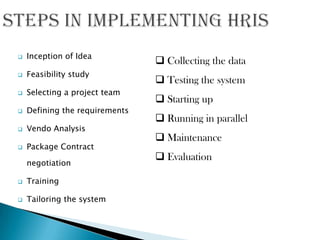
   Inception of Idea
                                 Collecting the data
   Feasibility study
                                 Testing the system
   Selecting a project team
                                 Starting up
   Defining the requirements
                                 Running in parallel
   Vendo Analysis
                                 Maintenance
   Package Contract
                                 Evaluation
    negotiation

   Training

   Tailoring the system
 Personal    Administration
 Salary   Administration
 Leave    / absence Increase
 Skill   Inventory
 Medical    History
 Performance     Appraisal
 Manpower      Planning
 Recruitment    and Carrier Planning
 Provide   accurate and timely information
 to   supply the required information by statutory
 provisions
 Provide   supply information in most cost effective way.
 No   legal Obstacle
 Attractive    financial compensation
 Flexibility

 Demerits      of VRS
 Fear   and Insecurities s among employees
 Spoil   reputation of the company
 Appose    from trade unions
Advantages of outsourcing-:
 It   Offers Cost Effective Selection
 It   allows management to focus more on core business
 It   gets more accurate and timely information
 No    need to invest in the latest technology
 It   avoids Duplication and makes easy and quick access
  to information.
Termination-It means to relieve the employee from

    their services.
    Lay off-inability of an employee to give employment to a workmen

    Suspension-Punishment usually imposed upon an employee for breaking
     rules

    Discharge or Dismissal-termination of the employee due to excessive
     abseentism

    Resignation-termination of the employment by the employee
Downsizing-It means elimination of certain jobs with
 a view to have a greater efficiency

Role of HR in downsizing
 Manager have to decide who is to be made
  redundant, where and when.
 Have programme’s to help the laid of employee
 They have to convince trade union
 They must ensure proper communication to
  minimize the negative effects of rumors
There are several forms of separation:-
 Resignation
 Dismissal
 Death
 Suspension
 Lay Off
 Retrenchment
 Retirement
Sub-Contracting
There are several alternatives to recruiting and hiring
employees directly. The first is to use temporary
workers obtained from a temporary help agency. The
second is employee leasing.
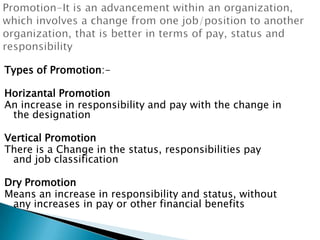
Types of Promotion:-

Horizantal Promotion
An increase in responsibility and pay with the change in
 the designation

Vertical Promotion
There is a Change in the status, responsibilities pay
 and job classification

Dry Promotion
Means an increase in responsibility and status, without
 any increases in pay or other financial benefits
 Put   the employee in a position where he will be of greater value of
 the company
 To    develop competitive spirit
 To    develop internal source of employee
 To    promote employee self-development
 To    build up a morale,loyalty and a sense of belongingness
 To    promote employee interest in training and development
 To    build royalty
Need of transfer
 To   meet organizational needs
 To   satisfy employee needs
 To   better use employee
 To   adjust the workforce
 To   provide relief
 To   punish employee
 To   accommodate family related issues
   Since Nike developed Human Resources Management (HRM) training to strengthen
    contract manufacturers' HRM systems and support lean manufacturing implementation,
    two waves of factories have taken part: eight factories in Vietnam in November 2008 and
    eight factories in Southern China in March 2009.
   Prior to participating in the workshop, each factory completed an employee satisfaction
    survey to better understand the top issues facing workers and to measure mutual trust
    and respect in the factory.
   Factories brought survey results along to the two-week training so they could apply their
    workers' insights to creation of action plans and HRM best practices. Each factory
    developed action plans to address core HRM areas, including supervisory skills, incentive
    structures, employee turnover and employee satisfaction.
   Following the training, factories have begun implementing their specific action plans with
    six-month deliverables.
   One factory set specific goals for reducing the number of workers reporting
    dissatisfaction with the behavior and attitude of their direct supervisor from 15 percent
    to 5 percent. The factory identified targeted training for supervisors including
    management, trust and respect, leadership, company policies and grievance systems,
    tying training completion directly to key performance indicators tracked within the
    factory.
   Another has set plans to increase the technical skill level among workers on the shop
    floor. Rather than focus only on building workers' technical skills, the plan requires
    supervisors to understand the importance of these skills among workers, which often
    had been overlooked. Plans also include reassessing skill levels, sharing with leadership
    and using findings to increase and improve training.
   For both factories - and all those participating in the training - each step in the process
    had clear goals, responsibilities, timelines and methods for tracking progress.
   Factories reported positive results. Statements from factories
    participating in the training include:
   "The HRM workshop was able to highlight the importance of having a
    strong HR system."
   "Human resources is one of the most important assets of the
    company as a foundation of lean."
   "We now share best practice at our weekly meetings and include CR
    and HR."
   "I am confident that our goals will be achieved within the year."
   "HRM has helped us to have a better understanding of how strong
    HR supports lean. If HR is strong, we'll use effective processes to
    recruit the right people and develop them with a foreseeable career
    path. Skilled employees will stay with us longer. This means our
    turnover rate will be reduced and our recruiting efforts and training
    investment are not wasted."
   "The HRM tools we received are helping us follow our projects
    closely, followed up by responsible persons within specified
    timelines, giving a greater chance to realize measurable
    improvements."
   "HRM created a community where each factory set off the boundary
    of its own experience and knowledge. In return, each factory
    received many good practices - a great return on investment."
   Factories are not alone in this process.
    Factories are supported by the HRM Learning
    Community established in the training. The
    Learning Community brings together
    factories that shared the training and
    continue to share lessons learned and best
    practices meeting bimonthly.
   The real measure of success will be the HRM
    training's ability to drive systemic and lasting
    improvement in working conditions. Nike is
    working closely with contract factories in
    their implementation of action plans and
    ongoing efforts to monitor workers'
    experience.
Human resource planing

Human resource planing

  • 2.
     Jimesh Joshi 32  Suraj More 50  Khan Aamir  Sushant Bhaud 09
  • 3.
    Human Resource Planning could be expressed as a process by which the management ensures the right number of people and right kind of people, at the right place , at the right time doing the right things for which they are recruited and placed for the achievement of goals of the organization.  Human Resource may be regarded as the quantitative and qualitative measurement of work required in an organization.  Human Resource Planning aims at the continuous supply of right kind of personnel to fill various positions in the organization.  HRP is a continuous process.  In the words of Colman, ―Manpower planning is the process of determining manpower requirements and the means of meeting those requirements in order to carry out the integrated plan of the organization‖
  • 4.
    According to Geister, ―Manpower Planning is the process including forecasting, developing and controlling by which a firm ensures that it has the right number of people and the right kind of people at the right places, at the right time doing work for which they are economically most useful. Therefore, manpower planning consists of projecting future man power requirements and developing manpower plans for the implement action of projections‖.  According to Dales.S.Beach, ―Human Resource Planning is a process of determining and assuring that the organization will have an adequate number of qualified persons, available at the proper times , performing jobs which meet the needs of the enterprise and which provides at is faction for the individuals involved.‖
  • 5.
     Ensure optimum use of human resources currently employed  Avoid imbalances in the distribution and allocation of human resources  Assess or forecast future skill requirements of the organization's overall objectives  Provide control measure to ensure availability of necessary resources when required  Control the aspect of human resources  Formulate transfer and promotion policies
  • 6.
    HRP presents an inventory of existing man power of the organisation. Analysis of this resource helps in ascertaining the status of the available personnel and to discover untapped talent presently available with the organisation.  HRP helps in determining the short fall or surplus of the resource by comparing the total resource needs with the present supply. It also helps in projecting future HR needs.  HRP is concerned with the initiation of various organisation programmes depending upon the demand and supply of human resources
  • 7.
    Listing or current human resources  Assessing the context to which the current man power is utilized to the advantage of the organizing.  Planning out the surplus human resource, if any  Analyzing the requirements of manpower in future in the light of expansion plans, retirement of personnel etc.  Making human resource forecast  Designing training programme for different categories of human resource.
  • 8.
     HRP helps in proper recruitment and selections of the right type of people which are available for various positions in the organization.  HRP also facilitates designing of training programmes for the employees to develop the required skills in them.  HRP provides lead time for procuring personnel as the lead time given is a time- consuming process.
  • 9.
    HRP results in reduced labour costs as it helps the management to anticipate shortages and or surpluses or HR, and correct these imbalances before they become unmanageable and expensive.  HRP is the scientific way for planning employee development that is designed to make optimum use of workers’ skills within the organization.  HRP enables identification of the gaps of the existing HRs so that corrective training could be imparted.  HRP leads of improvement in the overall ―Business Planning‖ process. HRP helps in formulating managerial succession plan as a part of there placement planning process.  HRP leads to a greater awareness of the importance of soundman power management through out the organization HRP serves as a tool to evaluate the effect of alternative man power actions and policies.
  • 10.
    The process ofHRP involves the following steps:  Determination of HRP objectives of HR planning  Current HR inventory  Demand Forecasting  Job requirements  Employment plan  Training and Development programme
  • 11.
    Human resource planning analyzes an organization’s HR needs and how to best fill them.  Steps in the HR planning process: Step 1 — review organizational mission, objectives, and strategies. Step 2 — review HR objectives and strategies. Step 3 — assess current HR needs. Step 4 — forecast HR needs. Step 5 — develop and implement HR plans.
  • 13.
     Government policies  Level of economic development  Business Environment  Information Technology  Level of Technology  Natural factors  International Factors
  • 14.
     Strategies of the Company  Human Resource Policies of the Company  Formal and Informal Groups  Job Analysis  Time Horizons  Types of Quality Of Information  Company’s production Operations policy  Trade unions
  • 15.
    Components of HRIS  Input- Enter the data to manage HR i.e by whom when and in what format.  Storage –Storing and updating data in various files from time to time  Output-It is in two forms hard copy printed or a soft copy
  • 16.
    Inception of Idea  Collecting the data  Feasibility study  Testing the system  Selecting a project team  Starting up  Defining the requirements  Running in parallel  Vendo Analysis  Maintenance  Package Contract  Evaluation negotiation  Training  Tailoring the system
  • 17.
     Personal Administration  Salary Administration  Leave / absence Increase  Skill Inventory  Medical History  Performance Appraisal  Manpower Planning  Recruitment and Carrier Planning
  • 18.
     Provide accurate and timely information  to supply the required information by statutory provisions  Provide supply information in most cost effective way.
  • 20.
     No legal Obstacle  Attractive financial compensation  Flexibility  Demerits of VRS  Fear and Insecurities s among employees  Spoil reputation of the company  Appose from trade unions
  • 21.
    Advantages of outsourcing-: It Offers Cost Effective Selection  It allows management to focus more on core business  It gets more accurate and timely information  No need to invest in the latest technology  It avoids Duplication and makes easy and quick access to information.
  • 22.
    Termination-It means torelieve the employee from their services.  Lay off-inability of an employee to give employment to a workmen  Suspension-Punishment usually imposed upon an employee for breaking rules  Discharge or Dismissal-termination of the employee due to excessive abseentism  Resignation-termination of the employment by the employee
  • 23.
    Downsizing-It means eliminationof certain jobs with a view to have a greater efficiency Role of HR in downsizing  Manager have to decide who is to be made redundant, where and when.  Have programme’s to help the laid of employee  They have to convince trade union  They must ensure proper communication to minimize the negative effects of rumors
  • 24.
    There are severalforms of separation:-  Resignation  Dismissal  Death  Suspension  Lay Off  Retrenchment  Retirement
  • 25.
    Sub-Contracting There are severalalternatives to recruiting and hiring employees directly. The first is to use temporary workers obtained from a temporary help agency. The second is employee leasing.
  • 26.
    Types of Promotion:- HorizantalPromotion An increase in responsibility and pay with the change in the designation Vertical Promotion There is a Change in the status, responsibilities pay and job classification Dry Promotion Means an increase in responsibility and status, without any increases in pay or other financial benefits
  • 27.
     Put the employee in a position where he will be of greater value of the company  To develop competitive spirit  To develop internal source of employee  To promote employee self-development  To build up a morale,loyalty and a sense of belongingness  To promote employee interest in training and development  To build royalty
  • 28.
    Need of transfer To meet organizational needs  To satisfy employee needs  To better use employee  To adjust the workforce  To provide relief  To punish employee  To accommodate family related issues
  • 29.
    Since Nike developed Human Resources Management (HRM) training to strengthen contract manufacturers' HRM systems and support lean manufacturing implementation, two waves of factories have taken part: eight factories in Vietnam in November 2008 and eight factories in Southern China in March 2009.  Prior to participating in the workshop, each factory completed an employee satisfaction survey to better understand the top issues facing workers and to measure mutual trust and respect in the factory.  Factories brought survey results along to the two-week training so they could apply their workers' insights to creation of action plans and HRM best practices. Each factory developed action plans to address core HRM areas, including supervisory skills, incentive structures, employee turnover and employee satisfaction.  Following the training, factories have begun implementing their specific action plans with six-month deliverables.  One factory set specific goals for reducing the number of workers reporting dissatisfaction with the behavior and attitude of their direct supervisor from 15 percent to 5 percent. The factory identified targeted training for supervisors including management, trust and respect, leadership, company policies and grievance systems, tying training completion directly to key performance indicators tracked within the factory.  Another has set plans to increase the technical skill level among workers on the shop floor. Rather than focus only on building workers' technical skills, the plan requires supervisors to understand the importance of these skills among workers, which often had been overlooked. Plans also include reassessing skill levels, sharing with leadership and using findings to increase and improve training.  For both factories - and all those participating in the training - each step in the process had clear goals, responsibilities, timelines and methods for tracking progress.
  • 30.
    Factories reported positive results. Statements from factories participating in the training include:  "The HRM workshop was able to highlight the importance of having a strong HR system."  "Human resources is one of the most important assets of the company as a foundation of lean."  "We now share best practice at our weekly meetings and include CR and HR."  "I am confident that our goals will be achieved within the year."  "HRM has helped us to have a better understanding of how strong HR supports lean. If HR is strong, we'll use effective processes to recruit the right people and develop them with a foreseeable career path. Skilled employees will stay with us longer. This means our turnover rate will be reduced and our recruiting efforts and training investment are not wasted."  "The HRM tools we received are helping us follow our projects closely, followed up by responsible persons within specified timelines, giving a greater chance to realize measurable improvements."  "HRM created a community where each factory set off the boundary of its own experience and knowledge. In return, each factory received many good practices - a great return on investment."
  • 31.
    Factories are not alone in this process. Factories are supported by the HRM Learning Community established in the training. The Learning Community brings together factories that shared the training and continue to share lessons learned and best practices meeting bimonthly.  The real measure of success will be the HRM training's ability to drive systemic and lasting improvement in working conditions. Nike is working closely with contract factories in their implementation of action plans and ongoing efforts to monitor workers' experience.