HR Audit
By - Nagendra Dewangan
Introduction
• Personnel audit refers to an examination and
evaluation of policies, procedures and practices to
determine the effectiveness of personnel
management.
• It is a tool to judge organisations performance and
effectiveness of HR management.
• It is an analytical, investigative and comparative
process.
• It gives feedback about HR functions to operating
managers and HR specialists.
• It further provides feedback about how well
managers are meeting their HR duties.
• It refers to determine the effectiveness and
efficiency of HRM.
• It provides quality control check on HR activities.
Sections of review include:
1. Hiring
2. Benefits
3. Compensation
4. Performance evaluation process
5. Termination process and exit interviews
6. Job descriptions
Objectives of HR Audit:
1. To review every aspect of management of HR to
determine the effectiveness of each programmes
in an organisation.
2. To seek explanation and information in respect of
failure and success of HR.
3. To evaluate implementation of policies.
4. To evaluate the performance of personnel staff
and employees.
1. powerful influence on motivation of employees at
work due to participation of employees in
decision making.
2. Growth of organisation needs HR audit.
3. Large organisation requires continuous feedback
for improvement in performance of its employees.
4. An effective two way communication system has
also facilitated the need for HR audit.
Need for Human Resource Audit:
5. The HR audit becomes essential because of
delegation of authority and decentralization of
power.
6. Mounting pressures from trade unions of
employees and their participation in formulating
employment policy and questioning of managerial
competence have raised the need for HR audit.
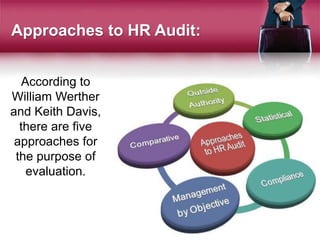
According to
William Werther
and Keith Davis,
there are five
approaches for
the purpose of
evaluation.
Approaches to HR Audit:
(1) Comparative Approach:
Under this approach auditors identify one model
company and the results obtained of the
organisation under audit are compared with it.
(2) Outside Authority Approach:
In outside authority approach a benchmark is set to
compare own results. A standard for audit set by
outside consultant is used as benchmark.
(3) Statistical Approach:
Under statistical approach the statistical information
maintained by the company in respect of
absenteeism, employee turnover etc. is used as the
measures for evaluating performance.
(4) Compliance Approach:
Under compliance approach the auditors make a
review of past actions to determine to see whether
those activities are in compliance with the legal
provisions and in accordance with the policies and
procedures of the company.
(5) MBO Approach:
Under MBO approach specific targets are fixed. The
performance is measured against these targets. The
auditors conduct the survey of actual performance
and compare with the goals set.
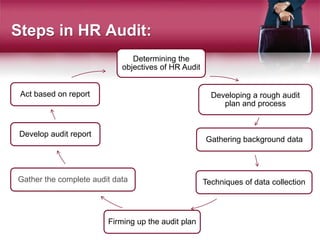
Steps in HR Audit:
Determining the
objectives of HR Audit
Developing a rough audit
plan and process
Gathering background data
Techniques of data collection
Firming up the audit plan
Gather the complete audit data
Develop audit report
Act based on report
Thanks

Hr audit

  • 1.
    HR Audit By -Nagendra Dewangan
  • 2.
    Introduction • Personnel auditrefers to an examination and evaluation of policies, procedures and practices to determine the effectiveness of personnel management. • It is a tool to judge organisations performance and effectiveness of HR management. • It is an analytical, investigative and comparative process. • It gives feedback about HR functions to operating managers and HR specialists.
  • 3.
    • It furtherprovides feedback about how well managers are meeting their HR duties. • It refers to determine the effectiveness and efficiency of HRM. • It provides quality control check on HR activities.
  • 4.
    Sections of reviewinclude: 1. Hiring 2. Benefits 3. Compensation 4. Performance evaluation process 5. Termination process and exit interviews 6. Job descriptions
  • 5.
    Objectives of HRAudit: 1. To review every aspect of management of HR to determine the effectiveness of each programmes in an organisation. 2. To seek explanation and information in respect of failure and success of HR. 3. To evaluate implementation of policies. 4. To evaluate the performance of personnel staff and employees.
  • 6.
    1. powerful influenceon motivation of employees at work due to participation of employees in decision making. 2. Growth of organisation needs HR audit. 3. Large organisation requires continuous feedback for improvement in performance of its employees. 4. An effective two way communication system has also facilitated the need for HR audit. Need for Human Resource Audit:
  • 7.
    5. The HRaudit becomes essential because of delegation of authority and decentralization of power. 6. Mounting pressures from trade unions of employees and their participation in formulating employment policy and questioning of managerial competence have raised the need for HR audit.
  • 8.
    According to William Werther andKeith Davis, there are five approaches for the purpose of evaluation. Approaches to HR Audit:
  • 9.
    (1) Comparative Approach: Underthis approach auditors identify one model company and the results obtained of the organisation under audit are compared with it. (2) Outside Authority Approach: In outside authority approach a benchmark is set to compare own results. A standard for audit set by outside consultant is used as benchmark.
  • 10.
    (3) Statistical Approach: Understatistical approach the statistical information maintained by the company in respect of absenteeism, employee turnover etc. is used as the measures for evaluating performance. (4) Compliance Approach: Under compliance approach the auditors make a review of past actions to determine to see whether those activities are in compliance with the legal provisions and in accordance with the policies and procedures of the company.
  • 11.
    (5) MBO Approach: UnderMBO approach specific targets are fixed. The performance is measured against these targets. The auditors conduct the survey of actual performance and compare with the goals set.
  • 12.
    Steps in HRAudit: Determining the objectives of HR Audit Developing a rough audit plan and process Gathering background data Techniques of data collection Firming up the audit plan Gather the complete audit data Develop audit report Act based on report
  • 13.