HUMAN RESOURCE AUDIT
By
Dr.K.HariHaraRaju
A.D.C.A, M.B.A., Ph.D., P.D.F (UGC)., D.Litt., FDP (IIM-V).,
Associate Professor,
Department of Management Studies,
Pydah College of Engineering and Technology, Visakhapatnam
1. Definition Of HR Audit
2. HR Audit Significance
3. Need Of HR Audit
4. Scope Of HR Audit
5. Use Of HR Audit
6. Objectives Of HR Audi
7. Benefits Of HR Audit
8. Special Areas of HR Audit
9. Threats Of HRM
10.FIVE Approaches to HR Audi
11.Period of Audit, Audit Report
HR Audit :
An HR audit is a process to review implementation of
your institutions policies and procedures, ensure compliance
with employment law, eliminate liabilities, implement best
practices and educate your managers.
(OR)
HR Audit refers to Examination & Evaluation of Polices,
Practices & Procedures to detect Effectiveness & Efficiency of
HRM and Verify if Mission, Objectives, Polices, Procedures,
Programs are chased and expected results achieved. HR Audit
also suggest future improvements based on past activities
measurement.
Definition:
HR Audit Significance:
Managements Feel, that Employee Participation in Activities is:
1. Essential for Organization success.
2. It Provides Required Feedback.
3. Managing Rising Labor Costs.
4. Increasing Opportunities for Competitive Advantage of HRM.
5. HR Audit can avoid Government intervention
6. HRP protect Employees interests
Need for HR Audit:
Though, to audit HR- Policies & Practices no legal obligation
exists, some Modern Organizations chase to:
1. Increase size of Organization & Personnel
2. Change Philosophy of Management towards HR
3. Increase Strength & Influence of Unions
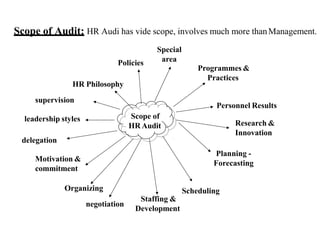
Scope of Audit: HR Audi has vide scope, involves much more thanManagement.
Scope of
HR Audit
Planning -
Forecasting
Scheduling
Motivation &
commitment
Policies
leadership styles
Personnel Results
Staffing &
Development
Programmes &
Practices
HR Philosophy
supervision
Organizing
negotiation
delegation
Special
area
Research &
Innovation
Use Of HR Audit:
Basic purpose of HR-Audit is to find:
1. How various units are functioning?
2. How they met policies & guidelines Pre-agreed upon?
3. To assist Rest of Organization locating gaps between Objectives
& Results.
4. Formulate Plan for corrections
Objectives:
1. Effectiveness: To review performance of Human resource Department and its
activities to determine effectiveness.
2. Implementation: To locate gaps, lapses, failings in applying Polices, Procedures,
Practices & HR-directives. Also to see areas of wrong/ non- implementation that
hindered the planned programs & activities.
3. Rectification: To take corrective steps to rectify mistakes, shortcomings contesting
effective work performance of HR Department.
4. Evaluation: To evaluate HR Staff & employees.
5. To evaluate the extent to which Line Managers Applied Policies Programmes &
Directives initiated by Top Management & HR Department.
6. Modify: To review HR System and Modify to meet challenges in comparison with
other organizations.
7. Questioning: To seek answers to ‘What, Why ‘When Happened while implementing
Policies, Practices & Directives in managing HRs
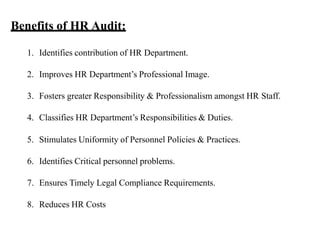
Benefits of HR Audit:
1. Identifies contribution of HR Department.
2. Improves HR Department’s Professional Image.
3. Fosters greater Responsibility & Professionalism amongst HR Staff.
4. Classifies HR Department’s Responsibilities & Duties.
5. Stimulates Uniformity of Personnel Policies & Practices.
6. Identifies Critical personnel problems.
7. Ensures Timely Legal Compliance Requirements.
8. Reduces HR Costs
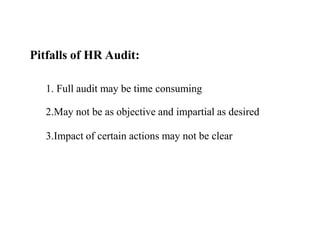
Pitfalls of HR Audit:
1. Full audit may be time consuming
2.May not be as objective and impartial as desired
3.Impact of certain actions may not be clear
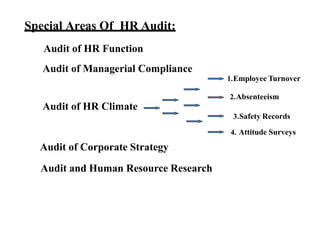
Special Areas Of HR Audit:
Audit of HR Function
Audit of Managerial Compliance
1.Employee Turnover
2.Absenteeism
Audit of HR Climate
3.Safety Records
4. Attitude Surveys
Audit of Corporate Strategy
Audit and Human Resource Research
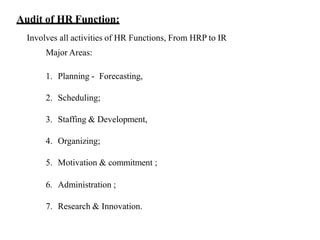
Audit of HR Function:
Involves all activities of HR Functions, From HRP to IR
Major Areas:
1. Planning - Forecasting,
2. Scheduling;
3. Staffing & Development,
4. Organizing;
5. Motivation & commitment ;
6. Administration ;
7. Research & Innovation.
For each activity in the HR Audit functions Auditors must:
1. determine objective of activity.
2. Identify who is responsible for it performance.
3. Review the performance.
4. Develop action plan to correct deviation, between Results & Goal.
5. Follow up action plan. HR Evaluation must justify existence of
department & its expenses. Department has no reason to function
if fails to contribute to Company’s bottom-line, Prune expenses to
make department viable.
Auditor’s Role:
FIVE Approaches to HR Audit:
Auditors may choose any of the five approaches for the purpose of
Evaluation.
1. Comparative Approach.
2. Outside Authority Approach.
3. Statistical Approach.
4. Compliance Approach.
5. MBO Approach
Comparative Approach –
Auditors Identify another Company as a MODEL. Result of their
Organization compared with those of Model Company.
Outside Authority Approach –
Often, Auditors use standard set by Outside Consultant as
BENCHMARK for comparison of own Results.
Compliance Approach –
Auditors review Past Actions to determine if those activities comply with legal
requirements and Company Policies, & Procedures. A Final approach is for
Specialists & Operating Managers to set objectives in their areas of responsibility.
Management By Objectives Approach –
creates Specific Goals against which performance can be measured. Then the
Audit Team Researches ACTUAL PEERFORMANCE and COMPARES
WITH THE OBJECTIVES.
Naturally any audit will be done annually. Though it is
preferred to conduct Human Resource Audit annually, but it is
advisable to conduct audit once in three years or five years,
keeping in view the fact that the realization of the
Organizational goals may not be identified within a year.
Audit Report
The Prog comes to end with preparation of Report. Report may be
Clean or Qualified. It is Qualified if HR Performance contains
Gaps for which remedies suggested. Report is Clean where
Performance is fairly Satisfactory
PERIOD OF AUDIT
References
http://www.whatishumanresource.com/Human-Resource-audit
http://smallbusiness.chron.com/objectives-scope-advantages-hr-audit-
14259.html

HR audit ppt.pptx

  • 1.
    HUMAN RESOURCE AUDIT By Dr.K.HariHaraRaju A.D.C.A,M.B.A., Ph.D., P.D.F (UGC)., D.Litt., FDP (IIM-V)., Associate Professor, Department of Management Studies, Pydah College of Engineering and Technology, Visakhapatnam
  • 2.
    1. Definition OfHR Audit 2. HR Audit Significance 3. Need Of HR Audit 4. Scope Of HR Audit 5. Use Of HR Audit 6. Objectives Of HR Audi 7. Benefits Of HR Audit 8. Special Areas of HR Audit 9. Threats Of HRM 10.FIVE Approaches to HR Audi 11.Period of Audit, Audit Report HR Audit :
  • 3.
    An HR auditis a process to review implementation of your institutions policies and procedures, ensure compliance with employment law, eliminate liabilities, implement best practices and educate your managers. (OR) HR Audit refers to Examination & Evaluation of Polices, Practices & Procedures to detect Effectiveness & Efficiency of HRM and Verify if Mission, Objectives, Polices, Procedures, Programs are chased and expected results achieved. HR Audit also suggest future improvements based on past activities measurement. Definition:
  • 4.
    HR Audit Significance: ManagementsFeel, that Employee Participation in Activities is: 1. Essential for Organization success. 2. It Provides Required Feedback. 3. Managing Rising Labor Costs. 4. Increasing Opportunities for Competitive Advantage of HRM. 5. HR Audit can avoid Government intervention 6. HRP protect Employees interests
  • 5.
    Need for HRAudit: Though, to audit HR- Policies & Practices no legal obligation exists, some Modern Organizations chase to: 1. Increase size of Organization & Personnel 2. Change Philosophy of Management towards HR 3. Increase Strength & Influence of Unions
  • 6.
    Scope of Audit:HR Audi has vide scope, involves much more thanManagement. Scope of HR Audit Planning - Forecasting Scheduling Motivation & commitment Policies leadership styles Personnel Results Staffing & Development Programmes & Practices HR Philosophy supervision Organizing negotiation delegation Special area Research & Innovation
  • 7.
    Use Of HRAudit: Basic purpose of HR-Audit is to find: 1. How various units are functioning? 2. How they met policies & guidelines Pre-agreed upon? 3. To assist Rest of Organization locating gaps between Objectives & Results. 4. Formulate Plan for corrections
  • 8.
    Objectives: 1. Effectiveness: Toreview performance of Human resource Department and its activities to determine effectiveness. 2. Implementation: To locate gaps, lapses, failings in applying Polices, Procedures, Practices & HR-directives. Also to see areas of wrong/ non- implementation that hindered the planned programs & activities. 3. Rectification: To take corrective steps to rectify mistakes, shortcomings contesting effective work performance of HR Department. 4. Evaluation: To evaluate HR Staff & employees. 5. To evaluate the extent to which Line Managers Applied Policies Programmes & Directives initiated by Top Management & HR Department. 6. Modify: To review HR System and Modify to meet challenges in comparison with other organizations. 7. Questioning: To seek answers to ‘What, Why ‘When Happened while implementing Policies, Practices & Directives in managing HRs
  • 9.
    Benefits of HRAudit: 1. Identifies contribution of HR Department. 2. Improves HR Department’s Professional Image. 3. Fosters greater Responsibility & Professionalism amongst HR Staff. 4. Classifies HR Department’s Responsibilities & Duties. 5. Stimulates Uniformity of Personnel Policies & Practices. 6. Identifies Critical personnel problems. 7. Ensures Timely Legal Compliance Requirements. 8. Reduces HR Costs
  • 10.
    Pitfalls of HRAudit: 1. Full audit may be time consuming 2.May not be as objective and impartial as desired 3.Impact of certain actions may not be clear
  • 11.
    Special Areas OfHR Audit: Audit of HR Function Audit of Managerial Compliance 1.Employee Turnover 2.Absenteeism Audit of HR Climate 3.Safety Records 4. Attitude Surveys Audit of Corporate Strategy Audit and Human Resource Research
  • 12.
    Audit of HRFunction: Involves all activities of HR Functions, From HRP to IR Major Areas: 1. Planning - Forecasting, 2. Scheduling; 3. Staffing & Development, 4. Organizing; 5. Motivation & commitment ; 6. Administration ; 7. Research & Innovation.
  • 13.
    For each activityin the HR Audit functions Auditors must: 1. determine objective of activity. 2. Identify who is responsible for it performance. 3. Review the performance. 4. Develop action plan to correct deviation, between Results & Goal. 5. Follow up action plan. HR Evaluation must justify existence of department & its expenses. Department has no reason to function if fails to contribute to Company’s bottom-line, Prune expenses to make department viable. Auditor’s Role:
  • 14.
    FIVE Approaches toHR Audit: Auditors may choose any of the five approaches for the purpose of Evaluation. 1. Comparative Approach. 2. Outside Authority Approach. 3. Statistical Approach. 4. Compliance Approach. 5. MBO Approach
  • 15.
    Comparative Approach – AuditorsIdentify another Company as a MODEL. Result of their Organization compared with those of Model Company. Outside Authority Approach – Often, Auditors use standard set by Outside Consultant as BENCHMARK for comparison of own Results.
  • 16.
    Compliance Approach – Auditorsreview Past Actions to determine if those activities comply with legal requirements and Company Policies, & Procedures. A Final approach is for Specialists & Operating Managers to set objectives in their areas of responsibility. Management By Objectives Approach – creates Specific Goals against which performance can be measured. Then the Audit Team Researches ACTUAL PEERFORMANCE and COMPARES WITH THE OBJECTIVES.
  • 17.
    Naturally any auditwill be done annually. Though it is preferred to conduct Human Resource Audit annually, but it is advisable to conduct audit once in three years or five years, keeping in view the fact that the realization of the Organizational goals may not be identified within a year. Audit Report The Prog comes to end with preparation of Report. Report may be Clean or Qualified. It is Qualified if HR Performance contains Gaps for which remedies suggested. Report is Clean where Performance is fairly Satisfactory PERIOD OF AUDIT
  • 18.