HR AUDIT AND EVALUATION
Presented By :- Nilesh Mahananda
CONTENTS
 Definition
 Nature Of HR Audit
 Scope Of HR Audit
 Objectives
 HR Audit Methods
 HR Audit Approaches
 HR Audit Process
 Benefits
 Conclusion
DEFINITION
 The Human Resources (HR) Audit is a process of examining
policies, procedures, documentation, systems, and practices
with respect to an organization’s HR functions.
NATURE
 An HR audit is a tool for evaluating the personnel activities of an organization.
 It gives feedback about the HR functions to operating managers and HR
specialists.
 It also provides feedback about how well managers are meeting their HR duties.
SCOPE
 Audit of all the HR function.
 Audit of managerial compliance of personnel
 Policies, Procedures and Legal provisions.
 Audit of corporate strategy regarding HR
 Planning, Staffing, IRs, Remuneration and other HR activities.
 Audit of the HR climate on employee motivation, morale and job satisfaction.
OBJECTIVES
 To analyze and improve the HR functions in the organization.
 To expose the strengths and weaknesses in the HR function, and any issues need
resolution.
 To evaluate the efficiency and effectiveness of HR functions.
 To ensure whether the HR function is on the right path to achieve and helping
company to achieve its goal or not.
HR AUDIT METHODS
 Interview Method
 Questionnaire Method
 Observation Method
 Task Force Method
HR AUDIT - Approaches
Auditors may adopt any of the five approaches for the purpose of evaluation:
 Comparative approach
 Outside authority approach
 Statistical approach
 Compliance approach
 In the comparative approach, the auditors identify another company as the model.
The results of their organization are compared with those of the model company.
 In the outside authority approach, the auditors use standards set by an outside
consultant as benchmark for comparison of own results.
 In the statistical approach, statistical measures of performance are developed
based on the company’s existing information.
 In the compliance approach, auditors review past actions to determine if those
activities comply with legal requirements and company policies and procedures.
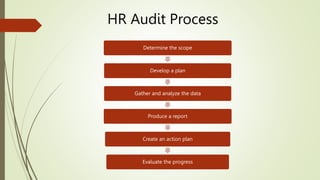
Determine the scope
Develop a plan
Gather and analyze the data
Produce a report
Create an action plan
Evaluate the progress
HR Audit Process
BENEFITS
 Identifies the contribution of Human Resource department to the organization
 Improves the professional image of the Human Resource department.
 Encourages greater responsibility and professionalism among member of the Human
Resource department.
 Clarifies the HR department’s duties and responsibilities.
 Stimulates uniformity of HR policies and practices.
 Finds critical HR problems.
 Ensures timely compliance with legal requirements.
CONCLUSION
 HR audit is a comprehension evaluation of the current hr strategies, structure, style
and skills in the context of the short and long term business plan of a company.
 Its main objective is to align the hr functions with business goals or to create a
business driven hr function.
THANK YOU

HR AUDIT AND EVALUATION.pptx

  • 1.
    HR AUDIT ANDEVALUATION Presented By :- Nilesh Mahananda
  • 2.
    CONTENTS  Definition  NatureOf HR Audit  Scope Of HR Audit  Objectives  HR Audit Methods  HR Audit Approaches  HR Audit Process  Benefits  Conclusion
  • 3.
    DEFINITION  The HumanResources (HR) Audit is a process of examining policies, procedures, documentation, systems, and practices with respect to an organization’s HR functions.
  • 4.
    NATURE  An HRaudit is a tool for evaluating the personnel activities of an organization.  It gives feedback about the HR functions to operating managers and HR specialists.  It also provides feedback about how well managers are meeting their HR duties.
  • 5.
    SCOPE  Audit ofall the HR function.  Audit of managerial compliance of personnel  Policies, Procedures and Legal provisions.  Audit of corporate strategy regarding HR  Planning, Staffing, IRs, Remuneration and other HR activities.  Audit of the HR climate on employee motivation, morale and job satisfaction.
  • 6.
    OBJECTIVES  To analyzeand improve the HR functions in the organization.  To expose the strengths and weaknesses in the HR function, and any issues need resolution.  To evaluate the efficiency and effectiveness of HR functions.  To ensure whether the HR function is on the right path to achieve and helping company to achieve its goal or not.
  • 7.
    HR AUDIT METHODS Interview Method  Questionnaire Method  Observation Method  Task Force Method
  • 8.
    HR AUDIT -Approaches Auditors may adopt any of the five approaches for the purpose of evaluation:  Comparative approach  Outside authority approach  Statistical approach  Compliance approach
  • 9.
     In thecomparative approach, the auditors identify another company as the model. The results of their organization are compared with those of the model company.  In the outside authority approach, the auditors use standards set by an outside consultant as benchmark for comparison of own results.
  • 10.
     In thestatistical approach, statistical measures of performance are developed based on the company’s existing information.  In the compliance approach, auditors review past actions to determine if those activities comply with legal requirements and company policies and procedures.
  • 11.
    Determine the scope Developa plan Gather and analyze the data Produce a report Create an action plan Evaluate the progress HR Audit Process
  • 12.
    BENEFITS  Identifies thecontribution of Human Resource department to the organization  Improves the professional image of the Human Resource department.  Encourages greater responsibility and professionalism among member of the Human Resource department.  Clarifies the HR department’s duties and responsibilities.  Stimulates uniformity of HR policies and practices.  Finds critical HR problems.  Ensures timely compliance with legal requirements.
  • 13.
    CONCLUSION  HR auditis a comprehension evaluation of the current hr strategies, structure, style and skills in the context of the short and long term business plan of a company.  Its main objective is to align the hr functions with business goals or to create a business driven hr function.
  • 14.