Talsaniya Roman
Date 12-8-2019
Chemisty department of PG center sir p.p institute of science
Maharaj Krishnkumar sinhji bhavnagar university
12/8/2019 1Talsaniya Roman
HPLC(liquidChromatography)
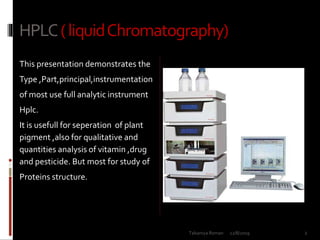
This presentation demonstrates the
Type ,Part,principal,instrumentation
of most use full analytic instrument
Hplc.
It is usefull for seperation of plant
pigment ,also for qualitative and
quantities analysis of vitamin ,drug
and pesticide. But most for study of
Proteins structure.
12/8/2019 2Talsaniya Roman
DEFINATION OF CHROMATOGRAPHY
Chromatography is based on the principle where
molecules in mixture applied onto the surface or into the
solid, and fluid stationary phase (stable phase) is
separating from each other while moving with the aid of a
mobile phase.
The factors effective on this separation process include
molecular characteristics related to adsorption (liquid-
solid), partition (liquid-solid), and affinity or differences
among their molecular weights.
Because of these differences, some components of the
mixture stay longer in the stationary phase, and they
move slowly in the chromatography system, while others
pass rapidly into the mobile phase, and leave the system
faster.
12/8/2019 3Talsaniya Roman
Three components thus form the basis of the chromatography
technique.
Stationary phase:This phase is always composed of a “solid” phase
or “a layer of a liquid adsorbed on the surface solid support”.
Mobile phase:This phase is always composed of “liquid” or a
“gaseous component.”
Separated molecules
The type of interaction between the stationary phase, mobile
phase, and substances contained in the mixture is the basic
component effective on the separation of molecules from each
other.
12/8/2019 4Talsaniya Roman
12/8/2019 5Talsaniya Roman
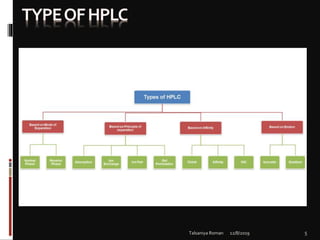
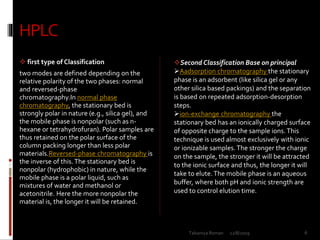
HPLC
 first type of Classification
two modes are defined depending on the
relative polarity of the two phases: normal
and reversed-phase
chromatography.In normal phase
chromatography, the stationary bed is
strongly polar in nature (e.g., silica gel), and
the mobile phase is nonpolar (such as n-
hexane or tetrahydrofuran). Polar samples are
thus retained on the polar surface of the
column packing longer than less polar
materials.Reversed-phase chromatography is
the inverse of this.The stationary bed is
nonpolar (hydrophobic) in nature, while the
mobile phase is a polar liquid, such as
mixtures of water and methanol or
acetonitrile. Here the more nonpolar the
material is, the longer it will be retained.
Second Classification Base on principal
Aadsorption chromatography the stationary
phase is an adsorbent (like silica gel or any
other silica based packings) and the separation
is based on repeated adsorption-desorption
steps.
ion-exchange chromatography the
stationary bed has an ionically charged surface
of opposite charge to the sample ions.This
technique is used almost exclusively with ionic
or ionizable samples. The stronger the charge
on the sample, the stronger it will be attracted
to the ionic surface and thus, the longer it will
take to elute.The mobile phase is an aqueous
buffer, where both pH and ionic strength are
used to control elution time.
12/8/2019 6Talsaniya Roman
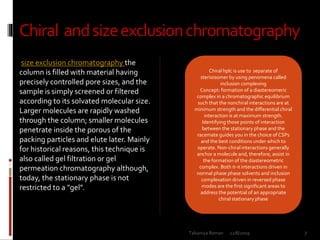
Chiral andsizeexclusionchromatography
size exclusion chromatography the
column is filled with material having
precisely controlled pore sizes, and the
sample is simply screened or filtered
according to its solvated molecular size.
Larger molecules are rapidly washed
through the column; smaller molecules
penetrate inside the porous of the
packing particles and elute later. Mainly
for historical reasons, this technique is
also called gel filtration or gel
permeation chromatography although,
today, the stationary phase is not
restricted to a "gel".
Chiral hplc is use to separate of
sterioisomer by using penomena called
inclusion complexing
Concept: formation of a diastereomeric
complex in a chromatographic equilibrium
such that the nonchiral interactions are at
minimum strength and the differential chiral
interaction is at maximum strength.
Identifying those points of interaction
between the stationary phase and the
racemate guides you in the choice of CSPs
and the best conditions under which to
operate. Non-chiral interactions generally
anchor a molecule and, therefore, assist in
the formation of the diastereometric
complex. Both π-π interactions driven in
normal phase phase solvents and inclusion
complexation driven in reversed phase
modes are the first significant areas to
address the potential of an appropriate
chiral stationary phase
12/8/2019 7Talsaniya Roman
HPLC
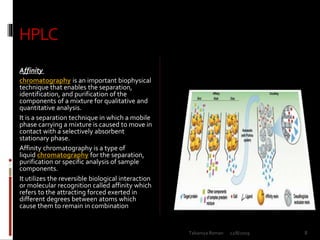
Affinity
chromatography is an important biophysical
technique that enables the separation,
identification, and purification of the
components of a mixture for qualitative and
quantitative analysis.
It is a separation technique in which a mobile
phase carrying a mixture is caused to move in
contact with a selectively absorbent
stationary phase.
Affinity chromatography is a type of
liquid chromatography for the separation,
purification or specific analysis of sample
components.
It utilizes the reversible biological interaction
or molecular recognition called affinity which
refers to the attracting forced exerted in
different degrees between atoms which
cause them to remain in combination
12/8/2019 8Talsaniya Roman
TypebaseonElution
ISOCRATIC SEPARATION
The separation of the mixture
compounds is done by using one mobile
phase and constant throughout the
elution, it is called as isocratic elution.
It consists of single, two or more
solvents of similar polarity to elute the
sample through the column.
If the separation of the sample mixture is
observed in the bands on the column,
the development process may be
stopped at that moment and separated
constituents are extracted by using
suitable solvents.
 GRADIENT SEPARATION
 The separation of the mixture of
components is done by using two or more
mobile phases and the flow of solvent is
stepwise manner depending on ratios are
sent into the column.
 This separation technique is started with a
low concentration of the organic
components of the mobile phase.
 Upon increasing the concentration of the
organic components of the mobile phase,
the competition for adsorption was
increased.
 The commonly used organic solvents
include methanol, acetonitrile, THF, etc.
 The accelerated compounds from the
column decrease the retention time of slow
eluting components.
12/8/2019 9Talsaniya Roman
12/8/2019 10Talsaniya Roman
HPLC
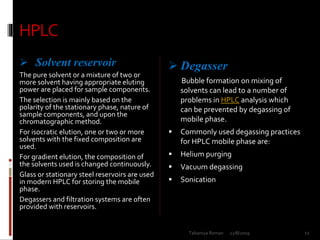
 Solvent reservoir
The pure solvent or a mixture of two or
more solvent having appropriate eluting
power are placed for sample components.
The selection is mainly based on the
polarity of the stationary phase, nature of
sample components, and upon the
chromatographic method.
For isocratic elution, one or two or more
solvents with the fixed composition are
used.
For gradient elution, the composition of
the solvents used is changed continuously.
Glass or stationary steel reservoirs are used
in modern HPLC for storing the mobile
phase.
Degassers and filtration systems are often
provided with reservoirs.
 Degasser
Bubble formation on mixing of
solvents can lead to a number of
problems in HPLC analysis which
can be prevented by degassing of
mobile phase.
 Commonly used degassing practices
for HPLC mobile phase are:
 Helium purging
 Vacuum degassing
 Sonication
12/8/2019 11Talsaniya Roman
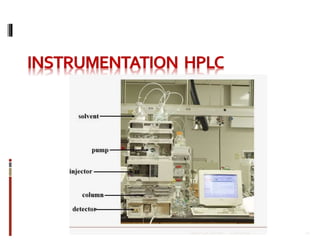
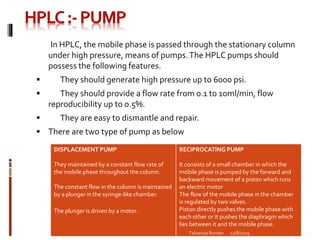
In HPLC, the mobile phase is passed through the stationary column
under high pressure, means of pumps.The HPLC pumps should
possess the following features.
 They should generate high pressure up to 6000 psi.
 They should provide a flow rate from 0.1 to 10ml/min, flow
reproducibility up to 0.5%.
 They are easy to dismantle and repair.
 There are two type of pump as below
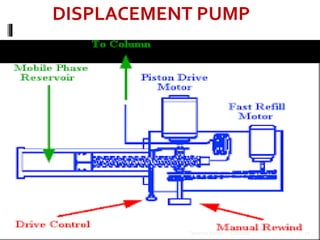
DISPLACEMENT PUMP
They maintained by a constant flow rate of
the mobile phase throughout the column.
The constant flow in the column is maintained
by a plunger in the syringe-like chamber.
The plunger is driven by a motor.
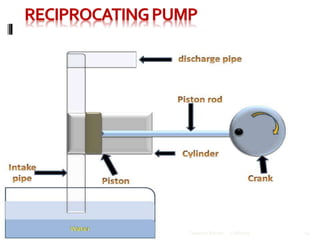
RECIPROCATING PUMP
It consists of a small chamber in which the
mobile phase is pumped by the forward and
backward movement of a piston which runs
an electric motor
The flow of the mobile phase in the chamber
is regulated by two valves.
Piston directly pushes the mobile phase with
each other or it pushes the diaphragm which
lies between it and the mobile phase.
12/8/2019 12Talsaniya Roman
DISPLACEMENT PUMP
12/8/2019 13Talsaniya Roman
12/8/2019 14Talsaniya Roman
Column
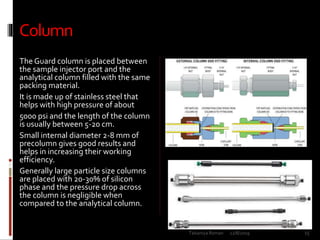
The Guard column is placed between
the sample injector port and the
analytical column filled with the same
packing material.
It is made up of stainless steel that
helps with high pressure of about
5000 psi and the length of the column
is usually between 5-20 cm.
Small internal diameter 2-8 mm of
precolumn gives good results and
helps in increasing their working
efficiency.
Generally large particle size columns
are placed with 20-30% of silicon
phase and the pressure drop across
the column is negligible when
compared to the analytical column.
12/8/2019 15Talsaniya Roman
Analyticcolumn
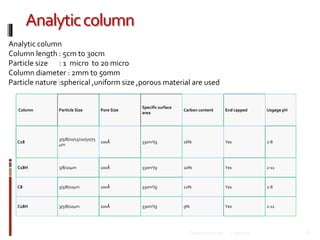
Analytic column
Column length : 5cm to 30cm
Particle size : 1 micro to 20 micro
Column diameter : 2mm to 50mm
Particle nature :spherical ,uniform size ,porous material are used
Column Particle Size Pore Size
Specific surface
area
Carbon content End capped Usgage pH
C18
3/5/8/10/15/20/50/75
μm
100Ǻ 330m²/g 16% Yes 2-8
C18H 5/8/10μm 100Ǻ 330m²/g 20% Yes 2-11
C8 3/5/8/10μm 100Ǻ 330m²/g 12% Yes 2-8
C18H 3/5/8/10μm 100Ǻ 330m²/g 9% Yes 2-11
12/8/2019 16Talsaniya Roman
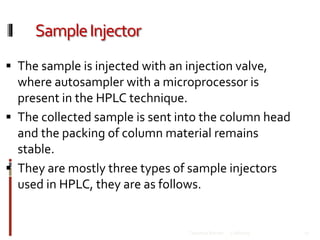
SampleInjector
 The sample is injected with an injection valve,
where autosampler with a microprocessor is
present in the HPLC technique.
 The collected sample is sent into the column head
and the packing of column material remains
stable.
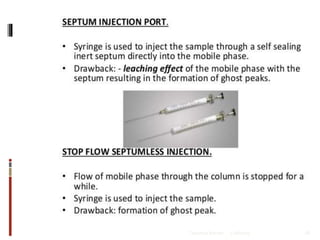
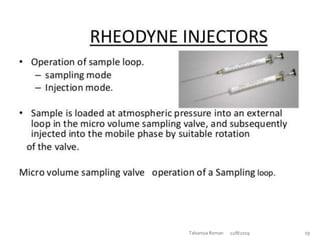
 They are mostly three types of sample injectors
used in HPLC, they are as follows.
12/8/2019 17Talsaniya Roman
12/8/2019 18Talsaniya Roman
QuickStyles
There is a spectrum of designer
styles for every chart, diagram, table
or picture you add to your
presentation. In a single click you
can go from understated to wow or
anywhere in between.
1
2
3
4
5
1
2
3
4
5
1
2
3
4
5
1 2 3
1 2 3
1 2 3
1 2 3
1 2 3
1 2 3
1 2 3
1 2 3
1 2 3
12/8/2019 19Talsaniya Roman
DetectorUsedInHPLC
12/8/2019Talsaniya Roman 20
 There is versatile detector use but most use detector
For HPLC is listed below .
1. UV visible detector
2. Reflective index detector
3. Fluorescence detector
4. Conductivity detector
5. Mass Spectometero
Fluorescence detectors
I. CriteriaForGoodDetector
12/8/2019Talsaniya Roman 21
It should have either specific or general response to compounds in
a mixture.Sensitivity towards solute over mobile phase.
It should have a response to solute and not the mobile phase.
It should have a low cell volume for memory effects minimization.
It should respond linearly to solute concentration
it sould not contribute to zone spereading
it sould be not be affected by temperature variation and flow rate.
UV Detector
Thistypeofdetectorisonlyusedfor compoundcontaining
chromophore.Thedetectormeasurestheconcentrationsormassflows
oftheseparatedanalytes,andconvertsthemintoelectronicsignals.
Theavailabilityofreliableandsensitivedetectorsismostlyresponsible
forthesuccessofHPLCasapervasiveanalyticaltechniqueinscientific
discoveryandqualitycontrolapplications.Constructionshowbelow.
12/8/2019Talsaniya Roman 22
RefractiveIndexdetector
12/8/2019Talsaniya Roman 23
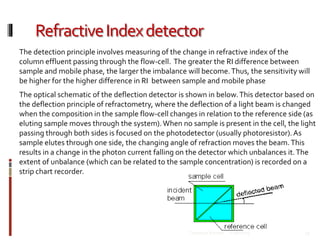
The detection principle involves measuring of the change in refractive index of the
column effluent passing through the flow-cell. The greater the RI difference between
sample and mobile phase, the larger the imbalance will become.Thus, the sensitivity will
be higher for the higher difference in RI between sample and mobile phase
The optical schematic of the deflection detector is shown in below.This detector based on
the deflection principle of refractometry, where the deflection of a light beam is changed
when the composition in the sample flow-cell changes in relation to the reference side (as
eluting sample moves through the system).When no sample is present in the cell, the light
passing through both sides is focused on the photodetector (usually photoresistor).As
sample elutes through one side, the changing angle of refraction moves the beam.This
results in a change in the photon current falling on the detector which unbalances it.The
extent of unbalance (which can be related to the sample concentration) is recorded on a
strip chart recorder.
Fluorescencedetectors
12/8/2019Talsaniya Roman 24
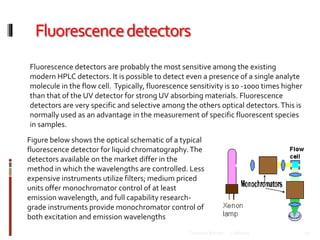
Figure below shows the optical schematic of a typical
fluorescence detector for liquid chromatography.The
detectors available on the market differ in the
method in which the wavelengths are controlled. Less
expensive instruments utilize filters; medium priced
units offer monochromator control of at least
emission wavelength, and full capability research-
grade instruments provide monochromator control of
both excitation and emission wavelengths
Fluorescence detectors are probably the most sensitive among the existing
modern HPLC detectors. It is possible to detect even a presence of a single analyte
molecule in the flow cell. Typically, fluorescence sensitivity is 10 -1000 times higher
than that of the UV detector for strong UV absorbing materials. Fluorescence
detectors are very specific and selective among the others optical detectors.This is
normally used as an advantage in the measurement of specific fluorescent species
in samples.
Conductivitydetector
12/8/2019Talsaniya Roman 25
Solutions containing ionic components will conduct
electricity. Conductivity detector measures electronic
resistance and measured value is directly proportional to
the concentration of ions present in the solution.Thus it is
generally used for ion chromatography.
12/8/2019Talsaniya Roman 26

Hplc (high perfomance liquid chromatography

  • 1.
    Talsaniya Roman Date 12-8-2019 Chemistydepartment of PG center sir p.p institute of science Maharaj Krishnkumar sinhji bhavnagar university 12/8/2019 1Talsaniya Roman
  • 2.
    HPLC(liquidChromatography) This presentation demonstratesthe Type ,Part,principal,instrumentation of most use full analytic instrument Hplc. It is usefull for seperation of plant pigment ,also for qualitative and quantities analysis of vitamin ,drug and pesticide. But most for study of Proteins structure. 12/8/2019 2Talsaniya Roman
  • 3.
    DEFINATION OF CHROMATOGRAPHY Chromatographyis based on the principle where molecules in mixture applied onto the surface or into the solid, and fluid stationary phase (stable phase) is separating from each other while moving with the aid of a mobile phase. The factors effective on this separation process include molecular characteristics related to adsorption (liquid- solid), partition (liquid-solid), and affinity or differences among their molecular weights. Because of these differences, some components of the mixture stay longer in the stationary phase, and they move slowly in the chromatography system, while others pass rapidly into the mobile phase, and leave the system faster. 12/8/2019 3Talsaniya Roman
  • 4.
    Three components thusform the basis of the chromatography technique. Stationary phase:This phase is always composed of a “solid” phase or “a layer of a liquid adsorbed on the surface solid support”. Mobile phase:This phase is always composed of “liquid” or a “gaseous component.” Separated molecules The type of interaction between the stationary phase, mobile phase, and substances contained in the mixture is the basic component effective on the separation of molecules from each other. 12/8/2019 4Talsaniya Roman
  • 5.
  • 6.
    HPLC  first typeof Classification two modes are defined depending on the relative polarity of the two phases: normal and reversed-phase chromatography.In normal phase chromatography, the stationary bed is strongly polar in nature (e.g., silica gel), and the mobile phase is nonpolar (such as n- hexane or tetrahydrofuran). Polar samples are thus retained on the polar surface of the column packing longer than less polar materials.Reversed-phase chromatography is the inverse of this.The stationary bed is nonpolar (hydrophobic) in nature, while the mobile phase is a polar liquid, such as mixtures of water and methanol or acetonitrile. Here the more nonpolar the material is, the longer it will be retained. Second Classification Base on principal Aadsorption chromatography the stationary phase is an adsorbent (like silica gel or any other silica based packings) and the separation is based on repeated adsorption-desorption steps. ion-exchange chromatography the stationary bed has an ionically charged surface of opposite charge to the sample ions.This technique is used almost exclusively with ionic or ionizable samples. The stronger the charge on the sample, the stronger it will be attracted to the ionic surface and thus, the longer it will take to elute.The mobile phase is an aqueous buffer, where both pH and ionic strength are used to control elution time. 12/8/2019 6Talsaniya Roman
  • 7.
    Chiral andsizeexclusionchromatography size exclusionchromatography the column is filled with material having precisely controlled pore sizes, and the sample is simply screened or filtered according to its solvated molecular size. Larger molecules are rapidly washed through the column; smaller molecules penetrate inside the porous of the packing particles and elute later. Mainly for historical reasons, this technique is also called gel filtration or gel permeation chromatography although, today, the stationary phase is not restricted to a "gel". Chiral hplc is use to separate of sterioisomer by using penomena called inclusion complexing Concept: formation of a diastereomeric complex in a chromatographic equilibrium such that the nonchiral interactions are at minimum strength and the differential chiral interaction is at maximum strength. Identifying those points of interaction between the stationary phase and the racemate guides you in the choice of CSPs and the best conditions under which to operate. Non-chiral interactions generally anchor a molecule and, therefore, assist in the formation of the diastereometric complex. Both π-π interactions driven in normal phase phase solvents and inclusion complexation driven in reversed phase modes are the first significant areas to address the potential of an appropriate chiral stationary phase 12/8/2019 7Talsaniya Roman
  • 8.
    HPLC Affinity chromatography is animportant biophysical technique that enables the separation, identification, and purification of the components of a mixture for qualitative and quantitative analysis. It is a separation technique in which a mobile phase carrying a mixture is caused to move in contact with a selectively absorbent stationary phase. Affinity chromatography is a type of liquid chromatography for the separation, purification or specific analysis of sample components. It utilizes the reversible biological interaction or molecular recognition called affinity which refers to the attracting forced exerted in different degrees between atoms which cause them to remain in combination 12/8/2019 8Talsaniya Roman
  • 9.
    TypebaseonElution ISOCRATIC SEPARATION The separationof the mixture compounds is done by using one mobile phase and constant throughout the elution, it is called as isocratic elution. It consists of single, two or more solvents of similar polarity to elute the sample through the column. If the separation of the sample mixture is observed in the bands on the column, the development process may be stopped at that moment and separated constituents are extracted by using suitable solvents.  GRADIENT SEPARATION  The separation of the mixture of components is done by using two or more mobile phases and the flow of solvent is stepwise manner depending on ratios are sent into the column.  This separation technique is started with a low concentration of the organic components of the mobile phase.  Upon increasing the concentration of the organic components of the mobile phase, the competition for adsorption was increased.  The commonly used organic solvents include methanol, acetonitrile, THF, etc.  The accelerated compounds from the column decrease the retention time of slow eluting components. 12/8/2019 9Talsaniya Roman
  • 10.
  • 11.
    HPLC  Solvent reservoir Thepure solvent or a mixture of two or more solvent having appropriate eluting power are placed for sample components. The selection is mainly based on the polarity of the stationary phase, nature of sample components, and upon the chromatographic method. For isocratic elution, one or two or more solvents with the fixed composition are used. For gradient elution, the composition of the solvents used is changed continuously. Glass or stationary steel reservoirs are used in modern HPLC for storing the mobile phase. Degassers and filtration systems are often provided with reservoirs.  Degasser Bubble formation on mixing of solvents can lead to a number of problems in HPLC analysis which can be prevented by degassing of mobile phase.  Commonly used degassing practices for HPLC mobile phase are:  Helium purging  Vacuum degassing  Sonication 12/8/2019 11Talsaniya Roman
  • 12.
    In HPLC, themobile phase is passed through the stationary column under high pressure, means of pumps.The HPLC pumps should possess the following features.  They should generate high pressure up to 6000 psi.  They should provide a flow rate from 0.1 to 10ml/min, flow reproducibility up to 0.5%.  They are easy to dismantle and repair.  There are two type of pump as below DISPLACEMENT PUMP They maintained by a constant flow rate of the mobile phase throughout the column. The constant flow in the column is maintained by a plunger in the syringe-like chamber. The plunger is driven by a motor. RECIPROCATING PUMP It consists of a small chamber in which the mobile phase is pumped by the forward and backward movement of a piston which runs an electric motor The flow of the mobile phase in the chamber is regulated by two valves. Piston directly pushes the mobile phase with each other or it pushes the diaphragm which lies between it and the mobile phase. 12/8/2019 12Talsaniya Roman
  • 13.
  • 14.
  • 15.
    Column The Guard columnis placed between the sample injector port and the analytical column filled with the same packing material. It is made up of stainless steel that helps with high pressure of about 5000 psi and the length of the column is usually between 5-20 cm. Small internal diameter 2-8 mm of precolumn gives good results and helps in increasing their working efficiency. Generally large particle size columns are placed with 20-30% of silicon phase and the pressure drop across the column is negligible when compared to the analytical column. 12/8/2019 15Talsaniya Roman
  • 16.
    Analyticcolumn Analytic column Column length: 5cm to 30cm Particle size : 1 micro to 20 micro Column diameter : 2mm to 50mm Particle nature :spherical ,uniform size ,porous material are used Column Particle Size Pore Size Specific surface area Carbon content End capped Usgage pH C18 3/5/8/10/15/20/50/75 μm 100Ǻ 330m²/g 16% Yes 2-8 C18H 5/8/10μm 100Ǻ 330m²/g 20% Yes 2-11 C8 3/5/8/10μm 100Ǻ 330m²/g 12% Yes 2-8 C18H 3/5/8/10μm 100Ǻ 330m²/g 9% Yes 2-11 12/8/2019 16Talsaniya Roman
  • 17.
    SampleInjector  The sampleis injected with an injection valve, where autosampler with a microprocessor is present in the HPLC technique.  The collected sample is sent into the column head and the packing of column material remains stable.  They are mostly three types of sample injectors used in HPLC, they are as follows. 12/8/2019 17Talsaniya Roman
  • 18.
  • 19.
    QuickStyles There is aspectrum of designer styles for every chart, diagram, table or picture you add to your presentation. In a single click you can go from understated to wow or anywhere in between. 1 2 3 4 5 1 2 3 4 5 1 2 3 4 5 1 2 3 1 2 3 1 2 3 1 2 3 1 2 3 1 2 3 1 2 3 1 2 3 1 2 3 12/8/2019 19Talsaniya Roman
  • 20.
    DetectorUsedInHPLC 12/8/2019Talsaniya Roman 20 There is versatile detector use but most use detector For HPLC is listed below . 1. UV visible detector 2. Reflective index detector 3. Fluorescence detector 4. Conductivity detector 5. Mass Spectometero Fluorescence detectors
  • 21.
    I. CriteriaForGoodDetector 12/8/2019Talsaniya Roman21 It should have either specific or general response to compounds in a mixture.Sensitivity towards solute over mobile phase. It should have a response to solute and not the mobile phase. It should have a low cell volume for memory effects minimization. It should respond linearly to solute concentration it sould not contribute to zone spereading it sould be not be affected by temperature variation and flow rate.
  • 22.
  • 23.
    RefractiveIndexdetector 12/8/2019Talsaniya Roman 23 Thedetection principle involves measuring of the change in refractive index of the column effluent passing through the flow-cell. The greater the RI difference between sample and mobile phase, the larger the imbalance will become.Thus, the sensitivity will be higher for the higher difference in RI between sample and mobile phase The optical schematic of the deflection detector is shown in below.This detector based on the deflection principle of refractometry, where the deflection of a light beam is changed when the composition in the sample flow-cell changes in relation to the reference side (as eluting sample moves through the system).When no sample is present in the cell, the light passing through both sides is focused on the photodetector (usually photoresistor).As sample elutes through one side, the changing angle of refraction moves the beam.This results in a change in the photon current falling on the detector which unbalances it.The extent of unbalance (which can be related to the sample concentration) is recorded on a strip chart recorder.
  • 24.
    Fluorescencedetectors 12/8/2019Talsaniya Roman 24 Figurebelow shows the optical schematic of a typical fluorescence detector for liquid chromatography.The detectors available on the market differ in the method in which the wavelengths are controlled. Less expensive instruments utilize filters; medium priced units offer monochromator control of at least emission wavelength, and full capability research- grade instruments provide monochromator control of both excitation and emission wavelengths Fluorescence detectors are probably the most sensitive among the existing modern HPLC detectors. It is possible to detect even a presence of a single analyte molecule in the flow cell. Typically, fluorescence sensitivity is 10 -1000 times higher than that of the UV detector for strong UV absorbing materials. Fluorescence detectors are very specific and selective among the others optical detectors.This is normally used as an advantage in the measurement of specific fluorescent species in samples.
  • 25.
    Conductivitydetector 12/8/2019Talsaniya Roman 25 Solutionscontaining ionic components will conduct electricity. Conductivity detector measures electronic resistance and measured value is directly proportional to the concentration of ions present in the solution.Thus it is generally used for ion chromatography.
  • 26.