neethu asokan
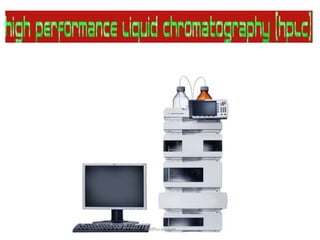
•HPLC stands for “High-performance liquid
chromatography”(sometimes referred to as High-
pressure liquid chromatography).
•The origins of Liquid Chromatography began in the
early 1900’s with the work of the Russian botanist,
Mikhail S. Tswett
•By the 1980's HPLC was commonly used for the
separation of chemical compounds. New techniques
improved separation, identification, purification and
quantification far above the previous techniques.
Computers and automation added to the convenience
of HPLC.
INTRODUCTION
neethu asokan
•High performance liquid chromatography is a
powerful tool in analysis, it yields high performance
and high speed compared to traditional columns
chromatography because of the forcibly pumped
mobile phase.
•HPLC is a chromatographic technique that can
separate a mixture of compounds
•It is used in analytical
chemistry,Biotechnilogy,Micobiology and
Biochemistry to identify, quantify and purify the
individual components of a mixture.
neethu asokan
The principle of separation in normal phase
mode and reverse phase mode is adsorption.
When a mixture of components are introduced into a
HPLC column, they travel according to their relative
affinities towards the stationary phase.
The component which has more affinity towards the
adsorbent, travels slower.
The component which has less affinity towards the
stationary phase travels faster.
Since no 2 components have the same affinity towards
the stationary phase, the components are separated
PRINCIPLE:
neethu asokan
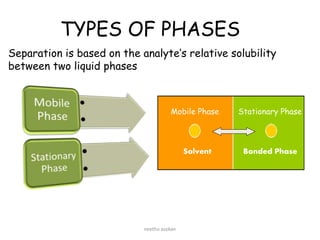
TYPES OF PHASES
Mobile Phase Stationary Phase
Solvent Bonded Phase
Separation is based on the analyte’s relative solubility
between two liquid phases
neethu asokan
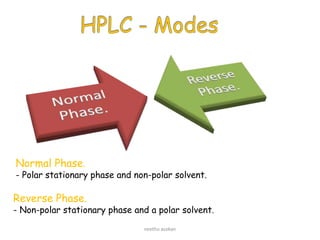
Normal Phase.
- Polar stationary phase and non-polar solvent.
Reverse Phase.
- Non-polar stationary phase and a polar solvent.
neethu asokan
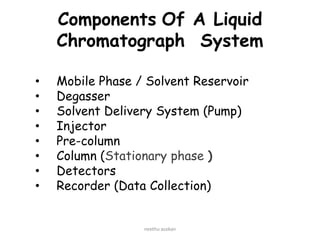
Components Of A Liquid
Chromatograph System
• Mobile Phase / Solvent Reservoir
• Degasser
• Solvent Delivery System (Pump)
• Injector
• Pre-column
• Column (Stationary phase )
• Detectors
• Recorder (Data Collection)
neethu asokan
Instrumentaion 0f HPLC
1. Mobile phase reservoir:
• Commonly glass bottles with caps are used.
• Teflon tubings and filters are connected to purge
gas (helium) for degassing.
• Vaccum for 5-10 min is also used for degassing.
2. Pump:
• It forces the mobile phase to pass through column.
• Flow rate is 1-2 ml/ min.
• Trypical pressure is 6000 – 9000psi.
neethu asokan
Instrumentaion 0f HPLC
3. Injector:
Can be manually (syringe) or automated.
Sample volume 5-20µl.
Ideal to stand pressure of mobile phase.
Autosampler is used for analysis of many samples
automatically.
4. Stationary phase (Column):
Heart of HPLC.
Separate sample components on basis of physical and
chemical parameters.
Lenght 10-30cm.
Diameter 4-10nm.
Packing material 5-10nm thick.neethu asokan
5. Detector:
Detection of elutes from column.
Detectors used depends upon the property of he compounds
to be separated. Different detectors available are:
1. Refractive index detectors
2. U.V detectors
3. Fluorescence detectors
4. Electro chemical detectors
Computer:
Data system that controls modules of HPLC.
Signals from detector are interpreted to determine elution
time, quantitative and qualitative analysis of sample.
neethu asokan
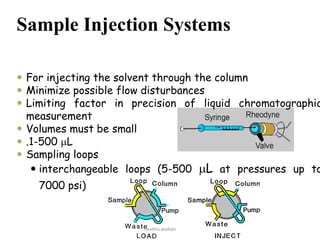
Sample Injection Systems
 For injecting the solvent through the column
 Minimize possible flow disturbances
 Limiting factor in precision of liquid chromatographic
measurement
 Volumes must be small
 .1-500 L
 Sampling loops
 interchangeable loops (5-500 L at pressures up to
7000 psi)
neethu asokan
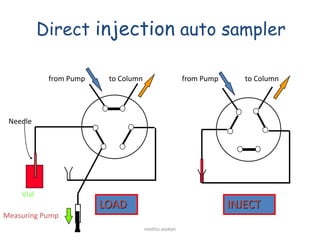
Direct injection auto sampler
from Pump from Pump to Column
Vial
Needle
Measuring Pump
to Column
LOAD INJECT
neethu asokan
Smooth-bore stainless
steel or heavy-walled
glass tubing
Hundreds of packed
columns differing in size
and packing are available
from manufacturers
($200-$500) India
13,000- 33,000
Add columns together to
increase length
hpLc Column
neethu asokan
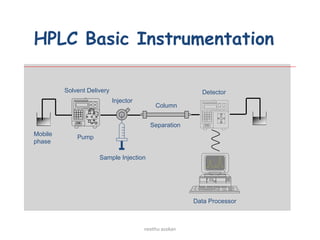
HPLC Basic Instrumentation
Mobile
phase
Pump
Solvent Delivery
Injector
Sample Injection
Column
Separation
Detector
Data Processor
neethu asokan
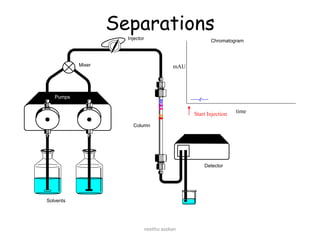
Separations
Separation in based upon differential
migration between the stationary and
mobile phases.
Stationary Phase - the phase which
remains fixed in the column, e.g. C18,
Silica
Mobile Phase - carries the sample
through the stationary phase as it
moves through the column.
Injector
Detector
Column
Solvents
Mixer
Pumps
High Performance Liquid Chromatograph
Waste
neethu asokan
SeparationsInjector
Detector
Column
Solvents
Mixer
Pumps
Chromatogram
Start Injection
mAU
time
High Performance Liquid Chromatograph
neethu asokan
Separations
Injector
Detector
Column
Solvents
Mixer
Pumps
Chromatogram
Start Injection
mAU
time
neethu asokan
Separations
Injector
Detector
Column
Solvents
Pumps
Mixer
Chromatogram
Start Injection
mAU
time
neethu asokan
SeparationsInjector
Detector
Column
Solvents
Pumps
Mixer
Chromatogram
Start Injection
mAU
time
neethu asokan
Separations
Injector
Detector
Column
Solvents
Pumps
Mixer
Chromatogram
Start Injection
mAU
time
neethu asokan
Separations
Injector
Detector
Column
Solvents
Pumps
Mixer
Chromatogram
Start Injection
mAU
time
neethu asokan
Separations
Injector
Detector
Column
Solvents
Pumps
Mixer
Chromatogram
Start Injection
mAU
time
neethu asokan
Separations
Injector
Detector
Column
Solvents
Pumps
Mixer
Chromatogram
Start Injection
mAU
time
neethu asokan
Separations
Injector
Detector
Column
Solvents
Pumps
Mixer
Chromatogram
Start Injection
mAU
time
neethu asokan
Separations
Injector
Detector
Column
Solvents
Pumps
Mixer
Chromatogram
Start Injection
mAU
time
neethu asokan
SeparationsInjector
Detector
Column
Solvents
Pumps
Mixer
Chromatogram
Start Injection
mAU
time
neethu asokan
Separations
Injector
Detector
Column
Solvents
Pumps
Mixer
Chromatogram
Start Injection
mAU
time
neethu asokan
Separations
Injector
Detector
Column
Solvents
Pumps
Mixer
Chromatogram
Start Injection
mAU
time
neethu asokan
SeparationsInjector
Detector
Column
Solvents
Pumps
Mixer
Chromatogram
Start Injection
mAU
time
neethu asokan
Separations
Injector
Detector
Column
Solvents
Pumps
Mixer
Chromatogram
Start Injection
mAU
time
neethu asokan
Separations
Injector
Detector
Column
Solvents
Pumps
Mixer
Chromatogram
Start Injection
mAU
time
neethu asokan
The Chromatogram
Injection
to
tR
mAU
time
tR
to - elution time of unretained peak
tR- retention time - determines sample identity
Area or height is proportional
to the quantity of analyte.
tK =
neethu asokan
neethu asokan
HPLC system
Mobile Phases
Flow Rate
Composition
Injection Volume
Column
Oven Temperature
Detectors
neethu asokan
ADVANTAGES OF HPLC
Needs a small sample with a high accuracy
and precis
Non-destructed sample during operation
compared to GC.
Separation is fast and efficient
Separation &analysis of very complex
mixture
Separation components can be easily
collected
Determination of multiple components in a
single analysis
neethu asokan
DISADVANTAGES OF HPLC
Need a skill to run the instruments
High cost
neethu asokan
Chemical
Environmental
Pharmaceuticals
Consumer Products
Clinical
polystyren
es
dyes
phthalates
tetracyclines
corticosteroids
antidepressants
barbiturates
amino acids
vitamins
homocysteine
Bioscience
proteins
peptides
nucleotides
lipids
antioxidants
sugars
polyaromatic hydrocarbons
Inorganic ions
herbicides
APPLICATIONS
neethu asokan
APPLICATIONS:
HPLC is one of the most widely applied analytical
separation techniques.
Pharmaceutical:
 Tablet dissolution of pharmaceutical dosages.
 Shelf life determinations of pharmaceutical
products.
 Identification of counterfeit drug products.
 Pharmaceutical quality control.
neethu asokan
APPLICATIONS
Environmental
 Phenols in Drinking Water.
 Identification of diphenhydramine in
sediment samples.
 mountain lakes through the analysis of fish
bile.
 Estrogens in coastal waters - The sewage
source.
 Toxicity of tetracyclines and tetracycline
degradation products to environmentally
relevant bacteria.
 Assessment of TNT toxicity in sediment.neethu asokan
Forensics
 A mobile HPLC apparatus at dance parties - on-site
identification and quantification of the drug
Ecstasy.
Identification of anabolic steroids in serum, urine,
sweat and hair.
 Forensic analysis of textile dyes.
 Determination of cocaine and metabolites in
meconium.
 Simultaneous quantification of psychotherapeutic
drugs in human plasma.
neethu asokan
Clinical
 Quantification of DEET in Human Urine.
 Analysis of antibiotics.
 Increased urinary excretion of aquaporin 2 in
patients with liver cirrhosis.
 Detection of endogenous neuropeptides in brain
extracellular fluids.
neethu asokan
APPLICATION
Food and Flavor
 Ensuring soft drink consistency and quality.
 Analysis of vicinal diketones in beer.
 Sugar analysis in fruit juices.
 Polycyclic aromatic hydrocarbons in Brazilian
vegetables and fruits.
 Trace analysis of military high explosives in
agricultural crops. Stability of aspartame in the
presence of glucose and vanillin.
neethu asokan
THANK YOU
neethu asokan

Hplc