How Wireless Networks/Bluetooth works and its role todayTechnical Communications Michael Henderson
What is a Wireless NetworkA wireless network allows for anytime and anywhere access to any information pertinent to that particular individual.Wireless network refers to any type of computer network that is wireless, and is commonly associated with a telecommunications network whose interconnections between nodes is implemented without the use of wires.
BluetoothBluetooth is a standard for a small, cheap radio chip to be plugged into computers, printers, mobile phones, etc. A Bluetooth chip is designed to replace cables by taking the information normally carried by the cable, and transmitting it at a special frequency to a receiver Bluetooth chip, which will then give the information received to the computer, phone whatever
BluetoothWireless Personal Area Networks (WPANs) interconnect devices within a relatively small area, generally within reach of a person.Bluetooth provides a WPAN for interconnecting a headset to a laptop
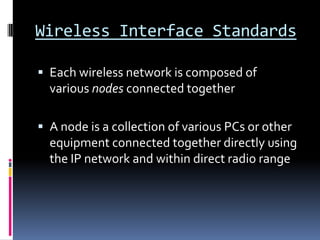
Wireless Interface Standards802.11 family802.11802.11a802.11b  802.11g
Wireless Interface StandardsEach wireless network is composed of various nodes connected togetherA node is a collection of various PCs or other equipment connected together directly using the IP network and within direct radio range
Wi-Fi TechnologyA hotspot is any location where Wi-Fi network access is made publicly available.You can often find hotspots in airports, hotels, coffee shops, and other places where business people tend to congregate.
Benefits of Wireless NetworksIn our home offices, networks allow us to share printers and peripherals very easilyOther computer peripherals can be shared similarly such as network scanners, Web cams, and CD burnersthe ability of multiple family members to access the Internet simultaneously without having to pay an ISP(Internet Service Provider) for multiple accounts
ConclusionWireless technology is clearly the future of networking. In building a wireless home network, you'll learn about the technology and be able to teach your friends and relatives. You'll also be better prepared for future advances in network technology coming in the future

How Wireless Networks/Bluetooth Works And Its Role Today

  • 1.
    How Wireless Networks/Bluetoothworks and its role todayTechnical Communications Michael Henderson
  • 2.
    What is aWireless NetworkA wireless network allows for anytime and anywhere access to any information pertinent to that particular individual.Wireless network refers to any type of computer network that is wireless, and is commonly associated with a telecommunications network whose interconnections between nodes is implemented without the use of wires.
  • 3.
    BluetoothBluetooth is astandard for a small, cheap radio chip to be plugged into computers, printers, mobile phones, etc. A Bluetooth chip is designed to replace cables by taking the information normally carried by the cable, and transmitting it at a special frequency to a receiver Bluetooth chip, which will then give the information received to the computer, phone whatever
  • 4.
    BluetoothWireless Personal AreaNetworks (WPANs) interconnect devices within a relatively small area, generally within reach of a person.Bluetooth provides a WPAN for interconnecting a headset to a laptop
  • 5.
    Wireless Interface Standards802.11family802.11802.11a802.11b 802.11g
  • 6.
    Wireless Interface StandardsEachwireless network is composed of various nodes connected togetherA node is a collection of various PCs or other equipment connected together directly using the IP network and within direct radio range
  • 7.
    Wi-Fi TechnologyA hotspot is anylocation where Wi-Fi network access is made publicly available.You can often find hotspots in airports, hotels, coffee shops, and other places where business people tend to congregate.
  • 8.
    Benefits of WirelessNetworksIn our home offices, networks allow us to share printers and peripherals very easilyOther computer peripherals can be shared similarly such as network scanners, Web cams, and CD burnersthe ability of multiple family members to access the Internet simultaneously without having to pay an ISP(Internet Service Provider) for multiple accounts
  • 9.
    ConclusionWireless technology isclearly the future of networking. In building a wireless home network, you'll learn about the technology and be able to teach your friends and relatives. You'll also be better prepared for future advances in network technology coming in the future

Editor's Notes

  • #4 Bluetooth device emits a signal using an extremely low power radio transmission and through an ultra-high (UHF) frequency. This allows it to communicate with other devices only within a vicinity of 10 meters or so. Bluetooth communicates by sending and processing signals at two levels: the physical level (one that transmits on a radio-frequency), and protocol level (mostly concerned with the "conversations" about standards and instruction between two devices). The signal emitted by a Bluetooth device is at a very high radio frequency. This ensures that the signal does not interfere with other lower-frequency radio transmissions, such as television and FM radio signals. While a signal from a Bluetooth device can go through thin materials like clothing, your body and the like, these radio signals cannot usually go through walls because of low power. Since Bluetooth technology allows for connectivity within a vicinity, earphones can actually connect simultaneously up to eight devices. And even with several devices interacting within a small area, it's still possible for the equipment to co-exist, because of a technique called spread-spectrum frequency hopping . This means that each device is transmitting at a different signal, even if they share the same frequency, and is still within the range allotted for Bluetooth devices.
  • #5 In recent years, wireless technology has become a way of life for many of us and can be found in just about every aspect of our daily lives. Understanding how these technologies work is the key to fully understanding the total impact they have on things such as, banking, travel, business and even domestic life in general.
  • #6 Several wireless interface standards currently exist, the most common readily available standard at the moment is the 802.11 family (802.11, 802.11a, 802.11b and 802.11g), which is consumer equipment that operates on radio frequency
  • #7 A node consists of at least one router and one of more clients. The clients normally require little configuration and talk only to the router, while the router will route its own data and that of its clients to the rest of the network.
  • #8 Hotspots are the same as the Wi-Fi connections you would have in your homes, the only difference is, it’s a public access Wi-Fi connection, sometimes free of charge and sometimes not.
  • #10 Bluetooth technology is a worldwide, universal wireless standard. With it being as popular as it is, you can count on it being around for years to come. As more and more devices start to use Bluetooth technology, more manufacturers will be eager to make their products compatible and with the range of devices becoming compatible with the technology it will undoubtedly be around for years to come, the more we understand it the easier the transition will be.