CONTENTS
1-What is Bluetooth?
2-History.
3-Technology Review.
4-Basic Ideas About Bluetooth.
5-Bluetooth Architecture.
6-Competting Technologies.
7-Advantages And Disadvantages Of
Bluetooth.
8-Future of Bluetooth.
9-Conclusions.
10-References.
What is Bluetooth?
 Bluetooth is a short range(10-100m) and low-
cost wireless network system to replace
cables and give RF connection between
consumer devices.
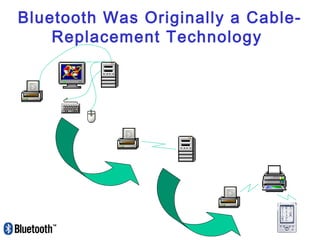
Bluetooth Was Originally a Cable-
Replacement Technology
HISTORY
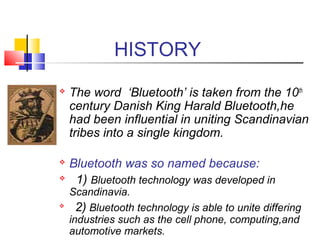
 The word ‘Bluetooth’ is taken from the 10th
century Danish King Harald Bluetooth,he
had been influential in uniting Scandinavian
tribes into a single kingdom.
 Bluetooth was so named because:
 1) Bluetooth technology was developed in
Scandinavia.

2) Bluetooth technology is able to unite differing
industries such as the cell phone, computing,and
automotive markets.
TECHNOLOGY REVIEW
 Bluetooth uses a radio technology called
frequency -hopping spread spectrum.
 Supports data rate of 1 Mb/s(originally).
 The Bluetooth specification are developed
and licensed by the Bluetooth Special Interest
Group(SIG).
BASIC IDEAS ABOUT
BLUETOOTH:
1)-Bluetooth Characteristics
2)-Classes of Bluetooth
3)-Bluetooth enabled devices
4)-Bluetooth Details
Bluetooth Characteristics:
 Allows up to 8 devices to communicate in a
localnetwork called a Piconet, also known as
a PersonalArea Network or PAN
 Because of its low power consumption, its
range islimited to 10 m.
 However, range can be increased to 100 m
by employing a scatternet topology or a
higher powered antenna.
Classes Of Bluetooth:
Three classes of bluetooth devices:
1) Class 3 radios: Have a range of upto
1 meter or 3 feet.
2) Class 2 radios: Most commonly found
in mobile devices-have a range of 10 meters
or 30 feet.
3) Class1 radios: Used primarily in industrial use
cases-have a range of 100 meters or 300 feet .
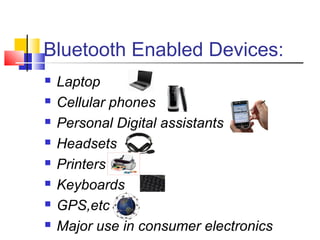
Bluetooth Enabled Devices:
 Laptop
 Cellular phones
 Personal Digital assistants
 Headsets
 Printers
 Keyboards
 GPS,etc
 Major use in consumer electronics
Bluetooth Details:
 Uses the radio range of 2.45 GHz.
 Theoretical maximum bandwidth is 1 Mb/s.
 Several Bluetooth devices can form an ad
hoc network called a “piconet”.
-In a piconet one device acts as a master (sets
frequency hopping behavior) and the others as
slaves.
- Example: A conference room with many laptops
wishing to communicate with each other.
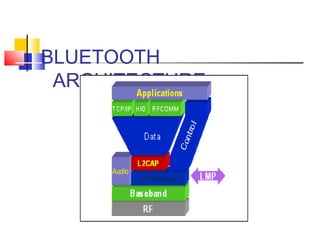
BLUETOOTH
ARCHITECTURE
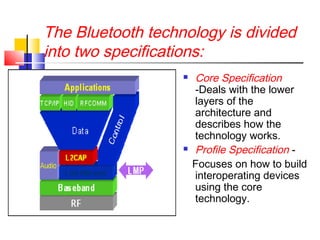
The Bluetooth technology is divided
into two specifications:
 Core Specification
-Deals with the lower
layers of the
architecture and
describes how the
technology works.
 Profile Specification -
Focuses on how to build
interoperating devices
using the core
technology.
Competting Technologies:
 Infrared Data
Association(IrDA):synchronization, link
between a phone and a laptop…
– Less flexible than Bluetooth, need of a line of
site.
– Comparable data rate.
 Wi-Fi (WLAN) : Wireless LAN access
– Far higher bandwidth and data rate
than Bluetooth.
– Higher power consumption than
Bluetooth.
– Requires infrastructure investment.
ADVANTAGES
AND
DISADVANTAGES
OF
BLUETOOTH
TECHNOLOGY
ADVANTAGES:
 Eliminates wires.
 Facilitates Data and Voice
Communication.
 Standardized protocol.
 Free of charge.
 Easy to use.
DISADVANTAGES:
 Relatively short range.
 Less secure.
 Interference with other devices.
FUTURE OF BLUETOOTH:
 Bluetooth has a good future ahead
because it meets a basic need of
connectivity.
 Latest version of Bluetooth are
improving both its security and
capabilities.
 New versions of Bluetooth technology
will meet the high-speed and large
range.
 Many companies are designing
impressive bluetooth applications in
demand.
CONCLUSIONS:
 A new global standard for data and voice
 Eliminates Cables.
 Low Power, Low range, Low Cost
network devices.
 Bluetooth seems to have a bright future
after reviewing its benefits and wide use.
 Further improvements are planned to be
made in :
1-Data rates 2-Power Reduction 3-Range
REFERENCES:
 Bluetooth Architecture Overview
James Kardach
 www.bluetooth.com
 www.palowireless.com
 www.google.com
 www.wikipidia.com
Bluetooth

Bluetooth

  • 2.
    CONTENTS 1-What is Bluetooth? 2-History. 3-TechnologyReview. 4-Basic Ideas About Bluetooth. 5-Bluetooth Architecture. 6-Competting Technologies. 7-Advantages And Disadvantages Of Bluetooth. 8-Future of Bluetooth. 9-Conclusions. 10-References.
  • 3.
    What is Bluetooth? Bluetooth is a short range(10-100m) and low- cost wireless network system to replace cables and give RF connection between consumer devices.
  • 4.
    Bluetooth Was Originallya Cable- Replacement Technology
  • 5.
    HISTORY  The word‘Bluetooth’ is taken from the 10th century Danish King Harald Bluetooth,he had been influential in uniting Scandinavian tribes into a single kingdom.  Bluetooth was so named because:  1) Bluetooth technology was developed in Scandinavia.  2) Bluetooth technology is able to unite differing industries such as the cell phone, computing,and automotive markets.
  • 6.
    TECHNOLOGY REVIEW  Bluetoothuses a radio technology called frequency -hopping spread spectrum.  Supports data rate of 1 Mb/s(originally).  The Bluetooth specification are developed and licensed by the Bluetooth Special Interest Group(SIG).
  • 7.
    BASIC IDEAS ABOUT BLUETOOTH: 1)-BluetoothCharacteristics 2)-Classes of Bluetooth 3)-Bluetooth enabled devices 4)-Bluetooth Details
  • 8.
    Bluetooth Characteristics:  Allowsup to 8 devices to communicate in a localnetwork called a Piconet, also known as a PersonalArea Network or PAN  Because of its low power consumption, its range islimited to 10 m.  However, range can be increased to 100 m by employing a scatternet topology or a higher powered antenna.
  • 9.
    Classes Of Bluetooth: Threeclasses of bluetooth devices: 1) Class 3 radios: Have a range of upto 1 meter or 3 feet. 2) Class 2 radios: Most commonly found in mobile devices-have a range of 10 meters or 30 feet. 3) Class1 radios: Used primarily in industrial use cases-have a range of 100 meters or 300 feet .
  • 10.
    Bluetooth Enabled Devices: Laptop  Cellular phones  Personal Digital assistants  Headsets  Printers  Keyboards  GPS,etc  Major use in consumer electronics
  • 11.
    Bluetooth Details:  Usesthe radio range of 2.45 GHz.  Theoretical maximum bandwidth is 1 Mb/s.  Several Bluetooth devices can form an ad hoc network called a “piconet”. -In a piconet one device acts as a master (sets frequency hopping behavior) and the others as slaves. - Example: A conference room with many laptops wishing to communicate with each other.
  • 13.
  • 14.
    The Bluetooth technologyis divided into two specifications:  Core Specification -Deals with the lower layers of the architecture and describes how the technology works.  Profile Specification - Focuses on how to build interoperating devices using the core technology.
  • 15.
    Competting Technologies:  InfraredData Association(IrDA):synchronization, link between a phone and a laptop… – Less flexible than Bluetooth, need of a line of site. – Comparable data rate.
  • 16.
     Wi-Fi (WLAN): Wireless LAN access – Far higher bandwidth and data rate than Bluetooth. – Higher power consumption than Bluetooth. – Requires infrastructure investment.
  • 17.
  • 18.
    ADVANTAGES:  Eliminates wires. Facilitates Data and Voice Communication.  Standardized protocol.  Free of charge.  Easy to use.
  • 19.
    DISADVANTAGES:  Relatively shortrange.  Less secure.  Interference with other devices.
  • 20.
    FUTURE OF BLUETOOTH: Bluetooth has a good future ahead because it meets a basic need of connectivity.  Latest version of Bluetooth are improving both its security and capabilities.
  • 21.
     New versionsof Bluetooth technology will meet the high-speed and large range.  Many companies are designing impressive bluetooth applications in demand.
  • 22.
    CONCLUSIONS:  A newglobal standard for data and voice  Eliminates Cables.  Low Power, Low range, Low Cost network devices.  Bluetooth seems to have a bright future after reviewing its benefits and wide use.  Further improvements are planned to be made in : 1-Data rates 2-Power Reduction 3-Range
  • 23.
    REFERENCES:  Bluetooth ArchitectureOverview James Kardach  www.bluetooth.com  www.palowireless.com  www.google.com  www.wikipidia.com