
CONNECTIVITY THROUGH LIGHT BULB
SUBMITTED BY:
PALAK (B.Sc BIOINFO.-I)
SUKHPREET KAUR (BCA-II)
 Do we have any technology which
can fetch data at speed of light?
 Can we imagine unlicensed
Internet?
 Do we need to spend even a single
penny on Internet Access?
 Can u imagine Internet through
light Bulb?
Li-Fi : Light Fidelity
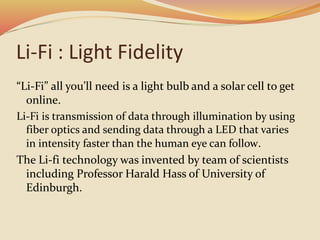
“Li-Fi” all you’ll need is a light bulb and a solar cell to get
online.
Li-Fi is transmission of data through illumination by using
fiber optics and sending data through a LED that varies
in intensity faster than the human eye can follow.
The Li-fi technology was invented by team of scientists
including Professor Harald Hass of University of
Edinburgh.
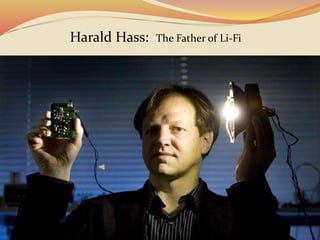
Harald Hass: The Father of Li-Fi
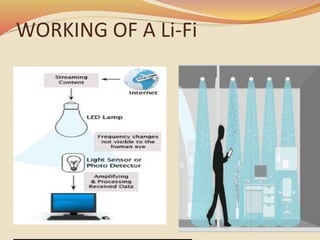
WORKING OF A Li-Fi
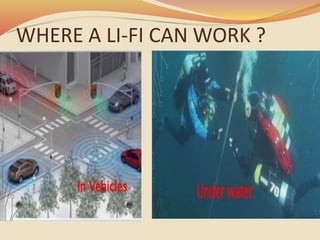
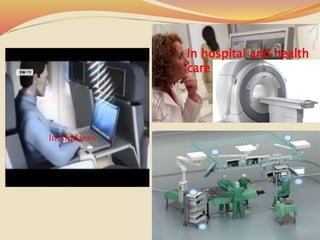
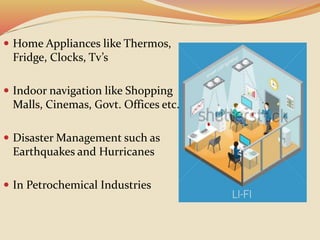
WHERE A LI-FI CAN WORK ?
In Airplanes
 Home Appliances like Thermos,
Fridge, Clocks, Tv’s
 Indoor navigation like Shopping
Malls, Cinemas, Govt. Offices etc.
 Disaster Management such as
Earthquakes and Hurricanes
 In Petrochemical Industries
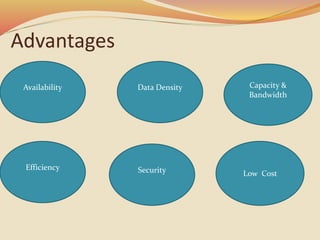
Advantages
Capacity &
Bandwidth
Security Low Cost
Availability
Efficiency
Data Density
Limitations:
1. As Li Fi technology uses light as transmission
medium, so if the receiver is somehow blocked in
a way then the signal will immediately will be cut
out.
2. While data transfer interference from external light
sources such as sunlight, normal bulbs, and
opaque materials can cause loss of reliability and
network.
3. As Li Fi works in direct line of slight. Slight
disturbance can cause to interruption
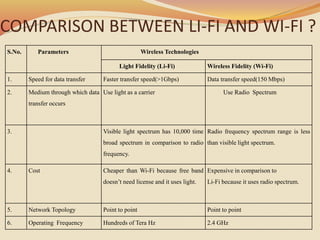
COMPARISON BETWEEN LI-FI AND WI-FI ?
S.No. Parameters Wireless Technologies
Light Fidelity (Li-Fi) Wireless Fidelity (Wi-Fi)
1. Speed for data transfer Faster transfer speed(>1Gbps) Data transfer speed(150 Mbps)
2. Medium through which data
transfer occurs
Use light as a carrier Use Radio Spectrum
3. Visible light spectrum has 10,000 time
broad spectrum in comparison to radio
frequency.
Radio frequency spectrum range is less
than visible light spectrum.
4. Cost Cheaper than Wi-Fi because free band
doesn’t need license and it uses light.
Expensive in comparison to
Li-Fi because it uses radio spectrum.
5. Network Topology Point to point Point to point
6. Operating Frequency Hundreds of Tera Hz 2.4 GHz
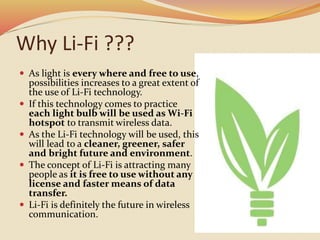
Why Li-Fi ???
 As light is every where and free to use,
possibilities increases to a great extent of
the use of Li-Fi technology.
 If this technology comes to practice
each light bulb will be used as Wi-Fi
hotspot to transmit wireless data.
 As the Li-Fi technology will be used, this
will lead to a cleaner, greener, safer
and bright future and environment.
 The concept of Li-Fi is attracting many
people as it is free to use without any
license and faster means of data
transfer.
 Li-Fi is definitely the future in wireless
communication.
Challenges
 Li-Fi requires Line of Sight.
 If the apparatus is set up outdoors, it would need to deal
with changing weather conditions.
 If the apparatus is set up indoors, one would not be able to
shift the receiver.
 The problem of how the receiver will transmit back to the
transmitter still persists.
 Light waves can easily be blocked and cannot penetrate
thick walls like radio waves can.
 Li-Fi is dependent on the light source for internet access. If
the light source malfunctions, there will be no access to the
internet.
CONCLUSION
Li-Fi is no doubt a revolutionary technology
that will provide the users with free, high
speed and full internet connectivity.
Although there are some challenges in its
complete implementation. As the research is
being going on, its limitations will be
overcome in near future and will be able to
take full advantage of this technology.
ANY QUERIES……

Lifi ppt final

  • 1.
    CONNECTIVITY THROUGH LIGHTBULB SUBMITTED BY: PALAK (B.Sc BIOINFO.-I) SUKHPREET KAUR (BCA-II)
  • 2.
     Do wehave any technology which can fetch data at speed of light?  Can we imagine unlicensed Internet?  Do we need to spend even a single penny on Internet Access?  Can u imagine Internet through light Bulb?
  • 4.
    Li-Fi : LightFidelity “Li-Fi” all you’ll need is a light bulb and a solar cell to get online. Li-Fi is transmission of data through illumination by using fiber optics and sending data through a LED that varies in intensity faster than the human eye can follow. The Li-fi technology was invented by team of scientists including Professor Harald Hass of University of Edinburgh.
  • 5.
    Harald Hass: TheFather of Li-Fi
  • 6.
  • 7.
    WHERE A LI-FICAN WORK ?
  • 8.
  • 9.
     Home Applianceslike Thermos, Fridge, Clocks, Tv’s  Indoor navigation like Shopping Malls, Cinemas, Govt. Offices etc.  Disaster Management such as Earthquakes and Hurricanes  In Petrochemical Industries
  • 10.
    Advantages Capacity & Bandwidth Security LowCost Availability Efficiency Data Density
  • 11.
    Limitations: 1. As LiFi technology uses light as transmission medium, so if the receiver is somehow blocked in a way then the signal will immediately will be cut out. 2. While data transfer interference from external light sources such as sunlight, normal bulbs, and opaque materials can cause loss of reliability and network. 3. As Li Fi works in direct line of slight. Slight disturbance can cause to interruption
  • 12.
    COMPARISON BETWEEN LI-FIAND WI-FI ? S.No. Parameters Wireless Technologies Light Fidelity (Li-Fi) Wireless Fidelity (Wi-Fi) 1. Speed for data transfer Faster transfer speed(>1Gbps) Data transfer speed(150 Mbps) 2. Medium through which data transfer occurs Use light as a carrier Use Radio Spectrum 3. Visible light spectrum has 10,000 time broad spectrum in comparison to radio frequency. Radio frequency spectrum range is less than visible light spectrum. 4. Cost Cheaper than Wi-Fi because free band doesn’t need license and it uses light. Expensive in comparison to Li-Fi because it uses radio spectrum. 5. Network Topology Point to point Point to point 6. Operating Frequency Hundreds of Tera Hz 2.4 GHz
  • 13.
    Why Li-Fi ??? As light is every where and free to use, possibilities increases to a great extent of the use of Li-Fi technology.  If this technology comes to practice each light bulb will be used as Wi-Fi hotspot to transmit wireless data.  As the Li-Fi technology will be used, this will lead to a cleaner, greener, safer and bright future and environment.  The concept of Li-Fi is attracting many people as it is free to use without any license and faster means of data transfer.  Li-Fi is definitely the future in wireless communication.
  • 14.
    Challenges  Li-Fi requiresLine of Sight.  If the apparatus is set up outdoors, it would need to deal with changing weather conditions.  If the apparatus is set up indoors, one would not be able to shift the receiver.  The problem of how the receiver will transmit back to the transmitter still persists.  Light waves can easily be blocked and cannot penetrate thick walls like radio waves can.  Li-Fi is dependent on the light source for internet access. If the light source malfunctions, there will be no access to the internet.
  • 15.
    CONCLUSION Li-Fi is nodoubt a revolutionary technology that will provide the users with free, high speed and full internet connectivity. Although there are some challenges in its complete implementation. As the research is being going on, its limitations will be overcome in near future and will be able to take full advantage of this technology.
  • 16.