How to Write an Abstract?
By Dr. Shahri S.A.
An abstract is a descriptive, self-contained,
short summary of a larger work. It give a brief
overview of the longer work that the person is
a bout to read and informs them of all they
key information that they should know going
into it.
Types of Abstract
Descriptive
Usually written for psychology,
social science, and humanities
papers. It is about 50–100 words
long. No conclusions can be
drawn from this abstract as it
describes the major points in the
paper.
Informative
The majority of abstracts for
science-related manuscripts are
informative and are surrogates
for the research done. They are
single paragraphs that provide
the reader an overview of the
research paper and are about
100–150 words in length.
Conclusions can be drawn from
the abstracts and in the
recommendations written in the
last line.
Critical
This type of abstract is lengthy
and about 400–500 words. In this,
the authors’ own research is
discussed for reliability,
judgement, and validation. A
comparison is also made with
similar studies done earlier.
Highlighting
This is rarely used in scientific
writing. The style of the abstract is
to attract more readers. It is not a
balanced or complete overview of
the article with which it is
published.
Structured
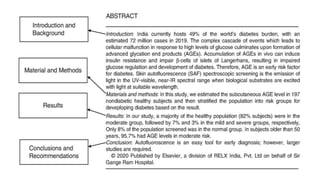
A structured abstract contains
information under subheadings
like background, aims, material
and methods, results, conclusion,
and recommendations (Fig. 15.1).
Most leading journals now carry
these.
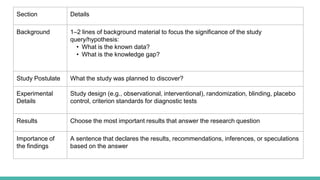
Section Details
Background 1–2 lines of background material to focus the significance of the study
query/hypothesis:
• What is the known data?
• What is the knowledge gap?
Study Postulate What the study was planned to discover?
Experimental
Details
Study design (e.g., observational, interventional), randomization, blinding, placebo
control, criterion standards for diagnostic tests
Results Choose the most important results that answer the research question
Importance of
the findings
A sentence that declares the results, recommendations, inferences, or speculations
based on the answer
Conclusion
An Abstract should be written last after all the other sections of the
manuscript have been completed and with due care and attention to the
details.
It should be structured and written in the IMRAD format.“IMRaD” format refers to a paper
that is structured by four main sections: Introduction, Methods, Results, and Discussion. This format is often used
for lab reports as well as for reporting any planned, systematic research in the social sciences, natural sciences, or
engineering and computer sciences.
For many readers, the abstract attracts them to go through the complete
content of the article.
The abstract is usually followed by keywords that help to index the paper.

How to Write An Abstract 2022.pptx

  • 1.
    How to Writean Abstract? By Dr. Shahri S.A.
  • 2.
    An abstract isa descriptive, self-contained, short summary of a larger work. It give a brief overview of the longer work that the person is a bout to read and informs them of all they key information that they should know going into it.
  • 3.
  • 4.
    Descriptive Usually written forpsychology, social science, and humanities papers. It is about 50–100 words long. No conclusions can be drawn from this abstract as it describes the major points in the paper.
  • 5.
    Informative The majority ofabstracts for science-related manuscripts are informative and are surrogates for the research done. They are single paragraphs that provide the reader an overview of the research paper and are about 100–150 words in length. Conclusions can be drawn from the abstracts and in the recommendations written in the last line.
  • 6.
    Critical This type ofabstract is lengthy and about 400–500 words. In this, the authors’ own research is discussed for reliability, judgement, and validation. A comparison is also made with similar studies done earlier.
  • 7.
    Highlighting This is rarelyused in scientific writing. The style of the abstract is to attract more readers. It is not a balanced or complete overview of the article with which it is published.
  • 8.
    Structured A structured abstractcontains information under subheadings like background, aims, material and methods, results, conclusion, and recommendations (Fig. 15.1). Most leading journals now carry these.
  • 10.
    Section Details Background 1–2lines of background material to focus the significance of the study query/hypothesis: • What is the known data? • What is the knowledge gap? Study Postulate What the study was planned to discover? Experimental Details Study design (e.g., observational, interventional), randomization, blinding, placebo control, criterion standards for diagnostic tests Results Choose the most important results that answer the research question Importance of the findings A sentence that declares the results, recommendations, inferences, or speculations based on the answer
  • 11.
    Conclusion An Abstract shouldbe written last after all the other sections of the manuscript have been completed and with due care and attention to the details. It should be structured and written in the IMRAD format.“IMRaD” format refers to a paper that is structured by four main sections: Introduction, Methods, Results, and Discussion. This format is often used for lab reports as well as for reporting any planned, systematic research in the social sciences, natural sciences, or engineering and computer sciences. For many readers, the abstract attracts them to go through the complete content of the article. The abstract is usually followed by keywords that help to index the paper.