OVERVIEW
• About the TOEFLibt
• Scores
• Writing Section
• Timed Writing in Writing 3A
• Test-taking Tactics
• Practice on Webcourses
WHAT IS THE TOEFLIBT?
• Most common English language assessment in the world
• I B T = Internet Based Test
• P B T = Paper Based Test (much less common)
• The Total score of the TOEFL ibt is 120
 Reading Section (Score of: 0–30)
 Listening Section (Score of: 0–30)
 Speaking Section (Score of: 0–30)
 Writing Section (Score of: 0–30)
 Total Score (0–120)
SCORE ADMISSIONS TO UCF
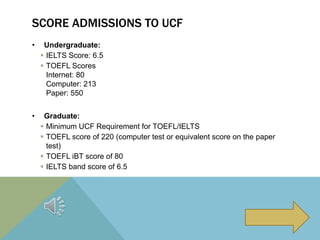
• Undergraduate:
 IELTS Score: 6.5
 TOEFL Scores
Internet: 80
Computer: 213
Paper: 550
• Graduate:
 Minimum UCF Requirement for TOEFL/IELTS
 TOEFL score of 220 (computer test or equivalent score on the paper
test)
 TOEFL iBT score of 80
 IELTS band score of 6.5
TOEFL IBT TEST SECTIONS
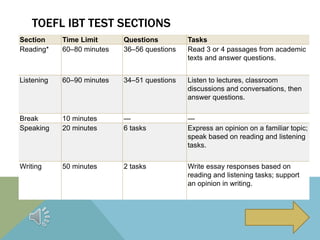
Section Time Limit Questions Tasks
Reading* 60–80 minutes 36–56 questions Read 3 or 4 passages from academic
texts and answer questions.
Listening 60–90 minutes 34–51 questions Listen to lectures, classroom
discussions and conversations, then
answer questions.
Break 10 minutes — —
Speaking 20 minutes 6 tasks Express an opinion on a familiar topic;
speak based on reading and listening
tasks.
Writing 50 minutes 2 tasks Write essay responses based on
reading and listening tasks; support
an opinion in writing.
WRITING SECTION
• There are two writing tasks in the TOEFLibt
• Task 1: The Reading-Listening-Writing Integrated Task
• Students are given a reading, a lecture, and then are asked to
summarize the main points
• Task 2: Independent Writing Task
• 30 minutes to write about an assigned topic
• Example:
http://www.ets.org/Media/Tests/TOEFL/pdf/ibt_writing_sample_r
esponses.pdf
FOR WRITING 3A…
• All students are required to take 3 timed writings
• All essays are scored on a 5 point rubric (covering 6 areas of criteria)
• According to the rubric, they must score at least a “3.25”
• Timed writings will be conducted on Webcourses and scored by the
professor according to the rubric
TIMED WRITING RUBRIC
5 4 3 2 1 0
Answer to
Question
s
 The student answers
the questions
thoroughly.
 The student answers
the questions
adequately but not
thoroughly.
 The student gives a
basically accurate
response to the
question.
 The student
discusses
information from
the task but does
not answer the
question directly.
 The student’s
response is
only slightly
related to the
topic.
 The student
either writes
nothing or fails
to answer the
question.
Comprehe
nsibility
 The student can be
understood
completely.
 The student can
generally be
understood.
 The student’s basic
ideas can be
understood.
 The student’s
ideas are not
always intelligible.
 The student’s
ideas are only
occasionally
intelligible.
.
Organizati
on
 The student’s
response is maturely
organized and
developed.
 The student’s
response is
adequately organized
and developed.
 The student’s response
is organized basically
and is not thoroughly
developed.
 The student’s
response is not
clearly organized
and is incomplete
or contains some
inaccurate points.
 The student’s
response is not
clearly
organized and
is only
minimally on
the topic.
Flow of
Ideas
 The student’s ideas
flow cohesively.
 The student’s ideas
generally flow
cohesively.
 The student’s ideas flow
cohesively sometimes
and at other times do
not.
 The student’s
ideas often do not
flow cohesively.
 The student’s
ideas do not
flow smoothly.
Grammar
 The student uses
advanced
grammatical
structures with a
high degree of
accuracy.
 The student uses
either accurate easier
grammatical
structures or more
advanced
grammatical
structures with a few
errors.
 The student has a
number of errors and
uses only very basic
grammar fairly
correctly.
 The student has
numerous errors
in grammar that
interfere in
meaning.
 The student
produces very
little
grammatically
correct
language.
Vocabular
y
 The student uses
advanced vocabulary
with a high degree of
 The student uses
either accurate easier
vocabulary or more
 The student has a
number of errors in
vocabulary or uses only
 The student has
numerous errors
in vocabulary that
 The student
uses very little
vocabulary
NOW, IMAGINE THIS..
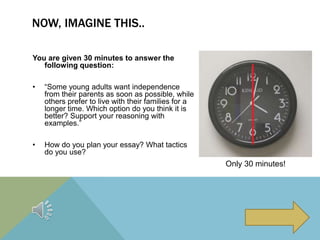
You are given 30 minutes to answer the
following question:
• “Some young adults want independence
from their parents as soon as possible, while
others prefer to live with their families for a
longer time. Which option do you think it is
better? Support your reasoning with
examples.”
• How do you plan your essay? What tactics
do you use?
Only 30 minutes!
HOW TO PLAN YOUR ESSAY
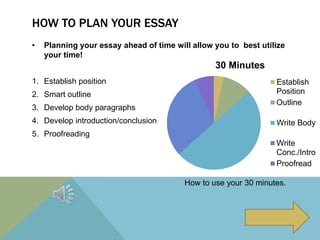
• Planning your essay ahead of time will allow you to best utilize
your time!
1. Establish position
2. Smart outline
3. Develop body paragraphs
4. Develop introduction/conclusion
5. Proofreading
30 Minutes
Establish
Position
Outline
Write Body
Write
Conc./Intro
Proofread
How to use your 30 minutes.
PRACTICE ON WEBCOURSES
• Enter Webcourses
• In Writing 3B, take the “Practice Timed Writing”
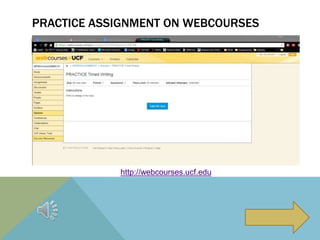
PRACTICE ASSIGNMENT ON WEBCOURSES
http://webcourses.ucf.edu
Introduction to the TOEFLiBT Writing

Introduction to the TOEFLiBT Writing

  • 2.
    OVERVIEW • About theTOEFLibt • Scores • Writing Section • Timed Writing in Writing 3A • Test-taking Tactics • Practice on Webcourses
  • 3.
    WHAT IS THETOEFLIBT? • Most common English language assessment in the world • I B T = Internet Based Test • P B T = Paper Based Test (much less common) • The Total score of the TOEFL ibt is 120  Reading Section (Score of: 0–30)  Listening Section (Score of: 0–30)  Speaking Section (Score of: 0–30)  Writing Section (Score of: 0–30)  Total Score (0–120)
  • 4.
    SCORE ADMISSIONS TOUCF • Undergraduate:  IELTS Score: 6.5  TOEFL Scores Internet: 80 Computer: 213 Paper: 550 • Graduate:  Minimum UCF Requirement for TOEFL/IELTS  TOEFL score of 220 (computer test or equivalent score on the paper test)  TOEFL iBT score of 80  IELTS band score of 6.5
  • 5.
    TOEFL IBT TESTSECTIONS Section Time Limit Questions Tasks Reading* 60–80 minutes 36–56 questions Read 3 or 4 passages from academic texts and answer questions. Listening 60–90 minutes 34–51 questions Listen to lectures, classroom discussions and conversations, then answer questions. Break 10 minutes — — Speaking 20 minutes 6 tasks Express an opinion on a familiar topic; speak based on reading and listening tasks. Writing 50 minutes 2 tasks Write essay responses based on reading and listening tasks; support an opinion in writing.
  • 6.
    WRITING SECTION • Thereare two writing tasks in the TOEFLibt • Task 1: The Reading-Listening-Writing Integrated Task • Students are given a reading, a lecture, and then are asked to summarize the main points • Task 2: Independent Writing Task • 30 minutes to write about an assigned topic • Example: http://www.ets.org/Media/Tests/TOEFL/pdf/ibt_writing_sample_r esponses.pdf
  • 7.
    FOR WRITING 3A… •All students are required to take 3 timed writings • All essays are scored on a 5 point rubric (covering 6 areas of criteria) • According to the rubric, they must score at least a “3.25” • Timed writings will be conducted on Webcourses and scored by the professor according to the rubric
  • 8.
    TIMED WRITING RUBRIC 54 3 2 1 0 Answer to Question s  The student answers the questions thoroughly.  The student answers the questions adequately but not thoroughly.  The student gives a basically accurate response to the question.  The student discusses information from the task but does not answer the question directly.  The student’s response is only slightly related to the topic.  The student either writes nothing or fails to answer the question. Comprehe nsibility  The student can be understood completely.  The student can generally be understood.  The student’s basic ideas can be understood.  The student’s ideas are not always intelligible.  The student’s ideas are only occasionally intelligible. . Organizati on  The student’s response is maturely organized and developed.  The student’s response is adequately organized and developed.  The student’s response is organized basically and is not thoroughly developed.  The student’s response is not clearly organized and is incomplete or contains some inaccurate points.  The student’s response is not clearly organized and is only minimally on the topic. Flow of Ideas  The student’s ideas flow cohesively.  The student’s ideas generally flow cohesively.  The student’s ideas flow cohesively sometimes and at other times do not.  The student’s ideas often do not flow cohesively.  The student’s ideas do not flow smoothly. Grammar  The student uses advanced grammatical structures with a high degree of accuracy.  The student uses either accurate easier grammatical structures or more advanced grammatical structures with a few errors.  The student has a number of errors and uses only very basic grammar fairly correctly.  The student has numerous errors in grammar that interfere in meaning.  The student produces very little grammatically correct language. Vocabular y  The student uses advanced vocabulary with a high degree of  The student uses either accurate easier vocabulary or more  The student has a number of errors in vocabulary or uses only  The student has numerous errors in vocabulary that  The student uses very little vocabulary
  • 9.
    NOW, IMAGINE THIS.. Youare given 30 minutes to answer the following question: • “Some young adults want independence from their parents as soon as possible, while others prefer to live with their families for a longer time. Which option do you think it is better? Support your reasoning with examples.” • How do you plan your essay? What tactics do you use? Only 30 minutes!
  • 10.
    HOW TO PLANYOUR ESSAY • Planning your essay ahead of time will allow you to best utilize your time! 1. Establish position 2. Smart outline 3. Develop body paragraphs 4. Develop introduction/conclusion 5. Proofreading 30 Minutes Establish Position Outline Write Body Write Conc./Intro Proofread How to use your 30 minutes.
  • 11.
    PRACTICE ON WEBCOURSES •Enter Webcourses • In Writing 3B, take the “Practice Timed Writing”
  • 12.
    PRACTICE ASSIGNMENT ONWEBCOURSES http://webcourses.ucf.edu

Editor's Notes

  • #2 Photo was taken by me and then edited in my cell phone application “Photo Grid”
  • #3 About the TOEFLibt Scores Writing Section Timed Writing in Writing 3A Test-taking Tactics Practice on Webcourses
  • #4 The TOEFL iBT test measures your ability to use and understand English at the university level. And it evaluates how well you combine your listening, reading, speaking and writing skills to perform academic tasks.
  • #10 Image was taken by myself and edited in MS Paint
  • #13 Screenshots were taken using Snipping Tool and then edited in MS Paint