Essential
Elements
of Writing
Thesis statements
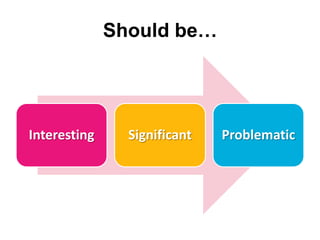
Should be…


Interesting     Significant   Problematic
Open-form
                  Writing
A series of
well-supported
descriptions,
including
scenes,
dialogue,
character
development,
etc.
Closed-form Writing


Single declarative sentence that summarizes
the entire essay.
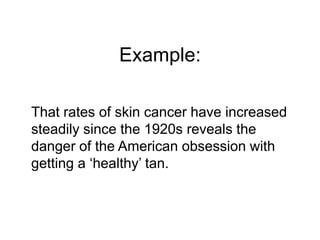
Example:

That rates of skin cancer have increased
steadily since the 1920s reveals the
danger of the American obsession with
getting a „healthy‟ tan.
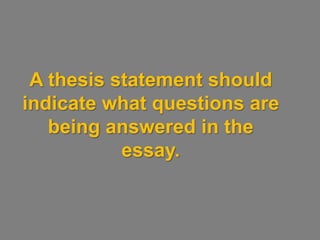
A thesis statement should
indicate what questions are
   being answered in the
           essay.
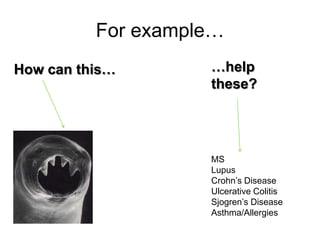
For example…
How can this…       …help
                    these?


                    MS
                    Lupus
                    Crohn‟s Disease
                    Ulcerative Colitis
                    Sjogren‟s Disease
                    Asthma/Allergies
Thesis: Hookworms are proven to
   have a beneficial effect on a
number of autoimmune diseases
 and may be considered a viable
 treatment protocol in the near
             future.
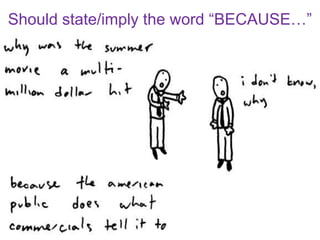
Should state/imply the word “BECAUSE…”
In-Class Activity
Purpose
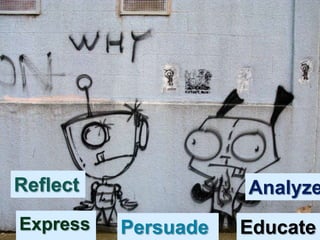
Reflect              Analyze
Express   Persuade   Educate
All essays have two purposes.
For the Writer
For the Reader
…But who is your reader?
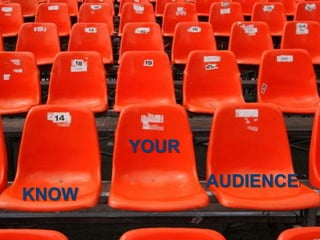
YOUR
              AUDIENCE!
KNOW
The writer CHOOSES her audience.
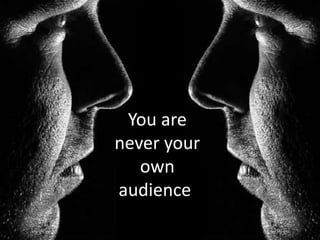
You are
never your
   own
audience.
Narrow down your audience
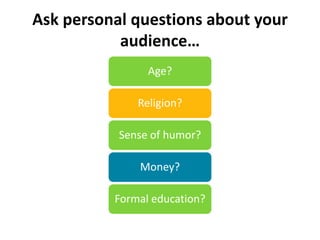
Ask personal questions about your
           audience…
                Age?

              Religion?

           Sense of humor?

              Money?

          Formal education?
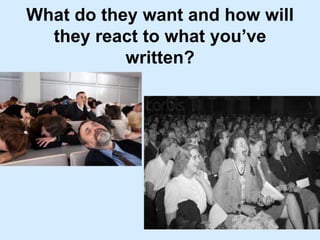
What do they want and how will
  they react to what you’ve
           written?
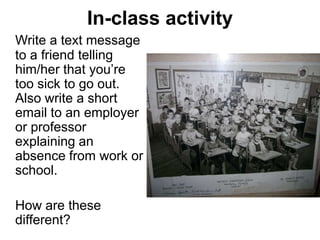
In-class activity
Write a text message
to a friend telling
him/her that you‟re
too sick to go out.
Also write a short
email to an employer
or professor
explaining an
absence from work or
school.

How are these
different?
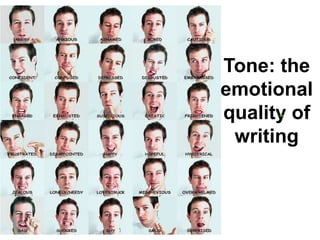
Tone: the
emotional
quality of
 writing
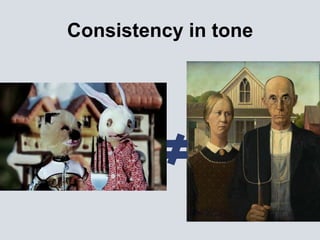
Consistency in tone
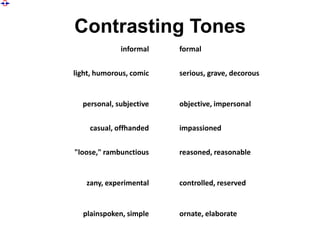
Contrasting Tones
             informal    formal


light, humorous, comic   serious, grave, decorous


  personal, subjective   objective, impersonal


    casual, offhanded    impassioned


"loose," rambunctious    reasoned, reasonable


   zany, experimental    controlled, reserved


  plainspoken, simple    ornate, elaborate
Apathy is not an option!


         Meh.
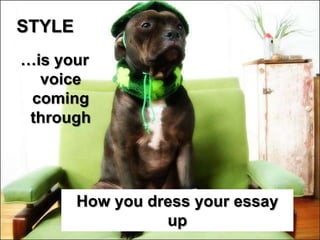
STYLE
…is your
  voice
 coming
 through


        How you dress your essay
                  up
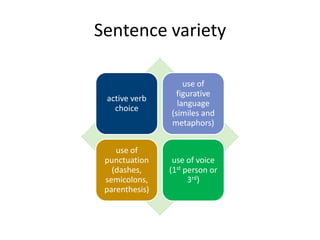
Sentence variety

                    use of
                 figurative
 active verb
                  language
   choice
                (similes and
                metaphors)


    use of
 punctuation     use of voice
   (dashes,     (1st person or
 semicolons,          3rd)
 parenthesis)
Support


          How?
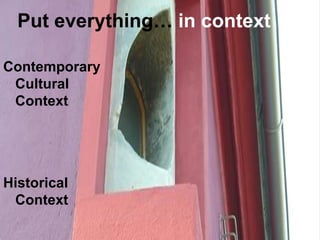
Put everything… in context

Contemporary
 Cultural
 Context


Historical
 Context
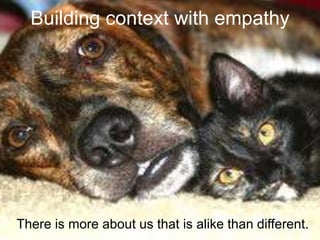
Building context with empathy


There is more about us that is alike than different.
In-Class activity
Write about the most exciting night of your life
 from your own perspective
In-Class Activity
Take that same experience and write about it
  from another person’s perspective.

How does it change?

Elements of Writing