WRITING AND SPEAKING
SKILLS
PRODUCTIVE SKILLS
Writing Skills
Writing
• It means putting letters or symbols on any surface
• Good writing skills allow you to communicate your message with
clarity and ease
• One of the best methods to communicate
• Writing is one of the oldest known forms of communication
• Creates a permanent record and necessary for legal and binding
documentation
• Allows you to store information for future reference
• Easily distributed, all recipients receive the same information
Writing as a skill
• Writing is an important skill in communication.
• Writing skills are highly essential because organizations need
professional writers.
• Some people develop writing skills as career like poets, writers,
novelist, and historian etc.
• Good writing skills allow you to communicate your message with
clarity and ease to a far larger audience to understand.
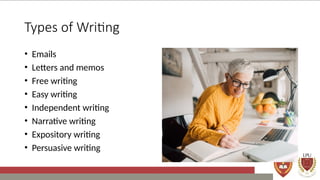
Types of Writing
• Emails
• Letters and memos
• Free writing
• Easy writing
• Independent writing
• Narrative writing
• Expository writing
• Persuasive writing
Email
• Email is fast, convenient, and easy
• Email is now dominant method in
business communication.
• Convenient for communicating with
people in different places and
different time zones.
• Easier to communicate with people
who understand written English but
don’t speak it well.
• Excellent mechanism for follow-up or
action items after a meeting.
Letters and Memos
• Letters and memos are the basic
vehicles in business
communication.
• They should be brief and make a
single point (no more than 2
pages)
• Letters are for external
communications.
• Memos are for internal
communication.
Free Writing
• It is prewriting technique in
which a person writes
continuously for a set period of
time without regard to spelling,
grammar, or topic. It produces
raw, often unstable material, but
helps writers overcome blocks of
apathy and self-criticism.
Easy Writing
• Sentences containing verbs
• Sentences using present and past
participles (in phrases)
• Appositive construction
• Sentences using semicolons for
more intricate formats
• Sentences containing relative
clauses
• Sentences using subordinate
clauses
Principles of Good Writing
Purpose
• First of all you must know why
you are writing.
• The writing is like building. On
the skeleton of purpose, the
building is constructed.
• There are many purposes of
writing good news, bad news,
message of inquiry, etc.
Use clear language
• Use the sort of words you would
use in conversation.
• Use a level of language that is
accessible to your readers.
• Avoid overuse of cliches, simile
and worn-out phrases.
• Write short sentences to get the
theme or point of your phrase.
Be objective
• Present the information
objectively.
• Your conclusions should arise
from the information presented,
and be based on the facts and
evidence you have collected,
rather than your own opinion or
what you would like to happen.
Structure
• A clear beginning, middle and an
end.
• It is more challenging to
understand the chain of thought
in written communication than
when it is expressed verbally.
• The blueprint of your thoughts in
your mind will decide the
structure of your writing.
Choice of words
• The words that you use
determine your style.
• Your writing could be easy and
based on simple words so that
your readers get the main point.
• Words can convey positive,
negative, strong or weak
messages depending on what
you choose to express yourself.
Punctuation
• Punctuation has a large effect.
• In speaking, we don’t need to
have any punctuations but if you
don’t use punctuations in your
writing, the reader can get
difficulty to read and
understand.
• A writer should have a best
knowledge to use these things.
Grammatically correct
• There should be no grammatical
mistakes.
• If you write in correct grammar,
the reader understands the
context easily.
Proofread
• Proofread as many times as it is
required to get it perfect.
• This helps send out errors all the
time.
• After you finish writing, read and re-
read and check for typos and
grammar errors.
• Check for concision and cut out every
single word.
• Have someone read your work.
Style
• Every writer has their own style.
• An easy style has a quick impact.
• The message should be
understood on the first reading.
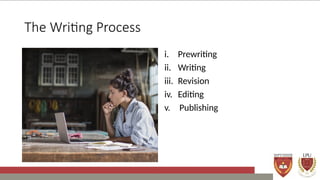
The Writing Process
i. Prewriting
ii. Writing
iii. Revision
iv. Editing
v. Publishing
i. Prewriting
Prewriting identifies everything you need to do before you sit down to
start your rough draft.
• FIND YOUR IDEA. Ideas are all around you. You might draw inspiration
from a routine, an everyday situation or a childhood memory.
• BUILD ON YOUR IDEA. Two of the most popular methods of fleshing
out your idea are free writing and brainstorming. Free writing means
writing every idea that comes into your head.
• PLAN AND STRUCTURE. Piecing the puzzle together comes next. It’s
time to sort through your ideas and choose which one you will use to
form your story.
ii. Writing
• Now that you have your plan, you’re now ready to start writing.
• Forget about word count and grammar. Don’t worry if you stray off
topic in places; even the greatest writers produce multiple drafts
before they produce their finished manuscript.
• Identify the best time and location to write and eliminate potential
distractions.
• Make writing a regular part of your day.
iii. Revision
Your story can change a great deal during this stage. When revising their
work, many writers naturally adopt the ARRR approach.
ADD
• Have you given your readers all the information they need to make sense
of your story?
• If not, go back to your notebook that you kept for additional scene and
any additional details.
REARRANGE
• Consider the flow, pacing and sequencing of your story. Would the plot be
better served if some of the event occur in a different order?
REMOVE
• After making additions to your story, how is your word count now?
Are your readers experiencing information overload? You may need to
eliminate passages that don’t quite fit.
REPLACE
• The most effective way to revise your work is to ask for a second
opinion. Do you need more vivid details to help clarify your work?
iv. Editing
• You have overhauled your story. It’s time to fine tune your manuscript
line by line.
• Check for repetition, clarity, grammar, spelling, and punctuation.
Editing is an extremely detailed process and it’s best when performed
by a professional.
• Nobody wants to read a book that is full of mistakes, and they
certainly won’t buy a book that is riddled with them.
v. Publishing
• Publication may extend to a multimedia presentation or lead to a
public performance.
• The presentation trait is emphasized during this phase of the writing
process as the writer works to make the piece appealing and inviting
to the audience.
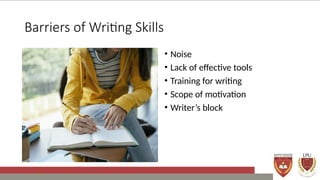
Barriers of Writing Skills
• Noise
• Lack of effective tools
• Training for writing
• Scope of motivation
• Writer’s block
Noise
• It’s a very common problem that we feel in our workstation.
• A writer requires a complete silent place.
• When anyone involved in writing, his thoughts travel in a coded
message to his mind. If anyone interrupts, the flow of thoughts is
disturbed when he became disturbed.
• But a writer should be used to the noise factor because he cannot
come across a place that is filled with utmost silence except
occasionally.
• He should concentrate in his work deeply.
Lack of effective tools
• Writer requires many tools for writing.
• Today, writers require internet to gather information.
• Everyone is not lucky enough to own a PC and avail internet connection
at home.
• If he lacks digital facilities, then he can gather information from the
books. He should store books that he buys or uses for academic
purposes.
• A writer should also learn to make affective use of his tools. Even if he
has an internet connection at home, he must know the techniques to
search the desired results.
Training for writing
• Everybody is not lucky enough to imbibe training for effective writing.
• If a writer belongs to a wealthy background, his parents can assist and
finance for him to learn various courses for writing.
• But even if he is not able to acquire any training he should train
himself.
• He can gather information from various sources such as internet,
books, libraries, friends, etc.
Scope of motivation
• Sometimes a person can feel the urge to write something but people
around him may not encourage him. They may tell him that he is not
a good writer.
• In such situation, he should not follow the words of others, but he
should follow his own path. If he is urged, he should take a step
ahead.
• If he has not developed the necessary skills, he can learn a lot by
watching the other writers in the forum.
Writer’s block
• A writer consistently needs to think and ponders to write something.
• At a point of time when he or she is continuously delivering thought
to pin down, he may come to a point where his mind becomes
saturated. At this time, he cannot think further as his mind becomes
blocked.
• To refresh his mind and start writing again, he can use different
techniques. He should quietly sit down in a room and read something
that absorbs his mind.
How can we improve writing skills?
• Use straightforward language and
simplify writing by using simpler
words
• Trim long sentences
• Avoid redundances
• Cut excessive qualification
• Avoid needless self-reference
• Factor active voice
• Favor verbs, not nouns
• Use parallel forms
Speaking Skills
Speaking
• Speaking is an act of making vocal sounds. We can say that speaking
means to converse or expressing one’s thoughts and feelings in spoken
language. To speak often implies conveying information. It may be from
an informal remark to a scholarly presentation to a formal address.
• Speaking is the skill that gives us the ability to communicate effectively.
This skill allows the speaker to convey his message in a passionate,
thoughtful, and convincing manner. Speaking skills also help to assure
that one won’t be misunderstood by those who are listening.
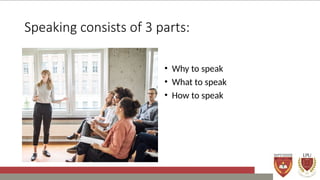
Speaking consists of 3 parts:
• Why to speak
• What to speak
• How to speak
Why to speak
• Not just presentation but also
persuasion
• Get people’s mindshare
What to speak
• Brainstorming. Individual
brainstorming is the process of
you getting your ideas out on
paper.
• Speaking with format.
I-B-C: Introduction, Body,
Conclusion
• Aiming for persuasion.
• Perfect clarity of thoughts
How to speak
Speak like a STAR
S – Situation
T – Task
A – Attitude
R – Result
Kinds of speaking situations in which we find
ourselves
• Interactive speaking situations include face-to-face conversations and
telephone calls, in which we are alternately listening and speaking, and in
which we have a chance to ask for clarification, repetition, or slower
speech from our conversation partner.
• Some speaking situations are partially interactive, such as when giving a
speech to a live audience, where the convention is that the audience does
not interrupt the speech. The speaker nevertheless can see the audience
and judge from the expressions on their faces and body language
whether or not he or she is being understood.
• Some few speaking situations may be totally non-interactive, such as
when recording a speech for a radio broadcast.
Public Speaking (This you shouldn’t do)
• Reading directly from notes
• Turning back on audience
• Hands in pockets
• No um, ah, you know
• No nervous gestures
• Talking too fast or talking too
quietly
Public Speaking (This you should do)
• Maintain eye Contact
• Can glance at notes minimally
• Appropriate gestures
• Rhetorical questions to involve
audience
Common barriers to effective communication
• The use of jargon. Over-complicated, unfamiliar and/or technical
terms.
• Emotional barriers and taboos. Some people may find it difficult to
express their emotions and some topics may be completely 'off-limits'
or taboo.
• Lack of attention, interest, distractions, or irrelevance to the receiver.
• Differences in perception and viewpoint.
• Physical disabilities such as hearing problems or speech difficulties.
• Physical barriers to non-verbal communication. Not being able to see
the non-verbal cues, gestures, posture and general body language can
make communication less effective.
• Language differences and the difficulty in understanding unfamiliar
accents.
• Expectations and prejudices which may lead to false assumptions or
stereotyping. People often hear what they expect to hear rather than
what is actually said and jump to incorrect conclusions.
• Cultural differences. The norms of social interaction vary greatly in
different cultures, as do the way in which emotions are expressed. For
example, the concept of personal space varies between cultures and
between different social settings.
THANK YOU FOR LISTENING!

2.-MACRO-SKILLS-PRODUCTIVE for econ.pptx

  • 1.
  • 2.
  • 3.
    Writing • It meansputting letters or symbols on any surface • Good writing skills allow you to communicate your message with clarity and ease • One of the best methods to communicate • Writing is one of the oldest known forms of communication • Creates a permanent record and necessary for legal and binding documentation • Allows you to store information for future reference • Easily distributed, all recipients receive the same information
  • 4.
    Writing as askill • Writing is an important skill in communication. • Writing skills are highly essential because organizations need professional writers. • Some people develop writing skills as career like poets, writers, novelist, and historian etc. • Good writing skills allow you to communicate your message with clarity and ease to a far larger audience to understand.
  • 5.
    Types of Writing •Emails • Letters and memos • Free writing • Easy writing • Independent writing • Narrative writing • Expository writing • Persuasive writing
  • 6.
    Email • Email isfast, convenient, and easy • Email is now dominant method in business communication. • Convenient for communicating with people in different places and different time zones. • Easier to communicate with people who understand written English but don’t speak it well. • Excellent mechanism for follow-up or action items after a meeting.
  • 7.
    Letters and Memos •Letters and memos are the basic vehicles in business communication. • They should be brief and make a single point (no more than 2 pages) • Letters are for external communications. • Memos are for internal communication.
  • 8.
    Free Writing • Itis prewriting technique in which a person writes continuously for a set period of time without regard to spelling, grammar, or topic. It produces raw, often unstable material, but helps writers overcome blocks of apathy and self-criticism.
  • 9.
    Easy Writing • Sentencescontaining verbs • Sentences using present and past participles (in phrases) • Appositive construction • Sentences using semicolons for more intricate formats • Sentences containing relative clauses • Sentences using subordinate clauses
  • 10.
  • 11.
    Purpose • First ofall you must know why you are writing. • The writing is like building. On the skeleton of purpose, the building is constructed. • There are many purposes of writing good news, bad news, message of inquiry, etc. Use clear language • Use the sort of words you would use in conversation. • Use a level of language that is accessible to your readers. • Avoid overuse of cliches, simile and worn-out phrases. • Write short sentences to get the theme or point of your phrase.
  • 12.
    Be objective • Presentthe information objectively. • Your conclusions should arise from the information presented, and be based on the facts and evidence you have collected, rather than your own opinion or what you would like to happen. Structure • A clear beginning, middle and an end. • It is more challenging to understand the chain of thought in written communication than when it is expressed verbally. • The blueprint of your thoughts in your mind will decide the structure of your writing.
  • 13.
    Choice of words •The words that you use determine your style. • Your writing could be easy and based on simple words so that your readers get the main point. • Words can convey positive, negative, strong or weak messages depending on what you choose to express yourself. Punctuation • Punctuation has a large effect. • In speaking, we don’t need to have any punctuations but if you don’t use punctuations in your writing, the reader can get difficulty to read and understand. • A writer should have a best knowledge to use these things.
  • 14.
    Grammatically correct • Thereshould be no grammatical mistakes. • If you write in correct grammar, the reader understands the context easily. Proofread • Proofread as many times as it is required to get it perfect. • This helps send out errors all the time. • After you finish writing, read and re- read and check for typos and grammar errors. • Check for concision and cut out every single word. • Have someone read your work.
  • 15.
    Style • Every writerhas their own style. • An easy style has a quick impact. • The message should be understood on the first reading.
  • 16.
    The Writing Process i.Prewriting ii. Writing iii. Revision iv. Editing v. Publishing
  • 17.
    i. Prewriting Prewriting identifieseverything you need to do before you sit down to start your rough draft. • FIND YOUR IDEA. Ideas are all around you. You might draw inspiration from a routine, an everyday situation or a childhood memory. • BUILD ON YOUR IDEA. Two of the most popular methods of fleshing out your idea are free writing and brainstorming. Free writing means writing every idea that comes into your head. • PLAN AND STRUCTURE. Piecing the puzzle together comes next. It’s time to sort through your ideas and choose which one you will use to form your story.
  • 18.
    ii. Writing • Nowthat you have your plan, you’re now ready to start writing. • Forget about word count and grammar. Don’t worry if you stray off topic in places; even the greatest writers produce multiple drafts before they produce their finished manuscript. • Identify the best time and location to write and eliminate potential distractions. • Make writing a regular part of your day.
  • 19.
    iii. Revision Your storycan change a great deal during this stage. When revising their work, many writers naturally adopt the ARRR approach. ADD • Have you given your readers all the information they need to make sense of your story? • If not, go back to your notebook that you kept for additional scene and any additional details. REARRANGE • Consider the flow, pacing and sequencing of your story. Would the plot be better served if some of the event occur in a different order?
  • 20.
    REMOVE • After makingadditions to your story, how is your word count now? Are your readers experiencing information overload? You may need to eliminate passages that don’t quite fit. REPLACE • The most effective way to revise your work is to ask for a second opinion. Do you need more vivid details to help clarify your work?
  • 21.
    iv. Editing • Youhave overhauled your story. It’s time to fine tune your manuscript line by line. • Check for repetition, clarity, grammar, spelling, and punctuation. Editing is an extremely detailed process and it’s best when performed by a professional. • Nobody wants to read a book that is full of mistakes, and they certainly won’t buy a book that is riddled with them.
  • 22.
    v. Publishing • Publicationmay extend to a multimedia presentation or lead to a public performance. • The presentation trait is emphasized during this phase of the writing process as the writer works to make the piece appealing and inviting to the audience.
  • 23.
    Barriers of WritingSkills • Noise • Lack of effective tools • Training for writing • Scope of motivation • Writer’s block
  • 24.
    Noise • It’s avery common problem that we feel in our workstation. • A writer requires a complete silent place. • When anyone involved in writing, his thoughts travel in a coded message to his mind. If anyone interrupts, the flow of thoughts is disturbed when he became disturbed. • But a writer should be used to the noise factor because he cannot come across a place that is filled with utmost silence except occasionally. • He should concentrate in his work deeply.
  • 25.
    Lack of effectivetools • Writer requires many tools for writing. • Today, writers require internet to gather information. • Everyone is not lucky enough to own a PC and avail internet connection at home. • If he lacks digital facilities, then he can gather information from the books. He should store books that he buys or uses for academic purposes. • A writer should also learn to make affective use of his tools. Even if he has an internet connection at home, he must know the techniques to search the desired results.
  • 26.
    Training for writing •Everybody is not lucky enough to imbibe training for effective writing. • If a writer belongs to a wealthy background, his parents can assist and finance for him to learn various courses for writing. • But even if he is not able to acquire any training he should train himself. • He can gather information from various sources such as internet, books, libraries, friends, etc.
  • 27.
    Scope of motivation •Sometimes a person can feel the urge to write something but people around him may not encourage him. They may tell him that he is not a good writer. • In such situation, he should not follow the words of others, but he should follow his own path. If he is urged, he should take a step ahead. • If he has not developed the necessary skills, he can learn a lot by watching the other writers in the forum.
  • 28.
    Writer’s block • Awriter consistently needs to think and ponders to write something. • At a point of time when he or she is continuously delivering thought to pin down, he may come to a point where his mind becomes saturated. At this time, he cannot think further as his mind becomes blocked. • To refresh his mind and start writing again, he can use different techniques. He should quietly sit down in a room and read something that absorbs his mind.
  • 29.
    How can weimprove writing skills? • Use straightforward language and simplify writing by using simpler words • Trim long sentences • Avoid redundances • Cut excessive qualification • Avoid needless self-reference • Factor active voice • Favor verbs, not nouns • Use parallel forms
  • 30.
  • 31.
    Speaking • Speaking isan act of making vocal sounds. We can say that speaking means to converse or expressing one’s thoughts and feelings in spoken language. To speak often implies conveying information. It may be from an informal remark to a scholarly presentation to a formal address. • Speaking is the skill that gives us the ability to communicate effectively. This skill allows the speaker to convey his message in a passionate, thoughtful, and convincing manner. Speaking skills also help to assure that one won’t be misunderstood by those who are listening.
  • 32.
    Speaking consists of3 parts: • Why to speak • What to speak • How to speak
  • 33.
    Why to speak •Not just presentation but also persuasion • Get people’s mindshare
  • 34.
    What to speak •Brainstorming. Individual brainstorming is the process of you getting your ideas out on paper. • Speaking with format. I-B-C: Introduction, Body, Conclusion • Aiming for persuasion. • Perfect clarity of thoughts
  • 35.
    How to speak Speaklike a STAR S – Situation T – Task A – Attitude R – Result
  • 36.
    Kinds of speakingsituations in which we find ourselves • Interactive speaking situations include face-to-face conversations and telephone calls, in which we are alternately listening and speaking, and in which we have a chance to ask for clarification, repetition, or slower speech from our conversation partner. • Some speaking situations are partially interactive, such as when giving a speech to a live audience, where the convention is that the audience does not interrupt the speech. The speaker nevertheless can see the audience and judge from the expressions on their faces and body language whether or not he or she is being understood. • Some few speaking situations may be totally non-interactive, such as when recording a speech for a radio broadcast.
  • 37.
    Public Speaking (Thisyou shouldn’t do) • Reading directly from notes • Turning back on audience • Hands in pockets • No um, ah, you know • No nervous gestures • Talking too fast or talking too quietly
  • 38.
    Public Speaking (Thisyou should do) • Maintain eye Contact • Can glance at notes minimally • Appropriate gestures • Rhetorical questions to involve audience
  • 39.
    Common barriers toeffective communication • The use of jargon. Over-complicated, unfamiliar and/or technical terms. • Emotional barriers and taboos. Some people may find it difficult to express their emotions and some topics may be completely 'off-limits' or taboo. • Lack of attention, interest, distractions, or irrelevance to the receiver. • Differences in perception and viewpoint. • Physical disabilities such as hearing problems or speech difficulties.
  • 40.
    • Physical barriersto non-verbal communication. Not being able to see the non-verbal cues, gestures, posture and general body language can make communication less effective. • Language differences and the difficulty in understanding unfamiliar accents. • Expectations and prejudices which may lead to false assumptions or stereotyping. People often hear what they expect to hear rather than what is actually said and jump to incorrect conclusions. • Cultural differences. The norms of social interaction vary greatly in different cultures, as do the way in which emotions are expressed. For example, the concept of personal space varies between cultures and between different social settings.
  • 41.
    THANK YOU FORLISTENING!